← Business Daily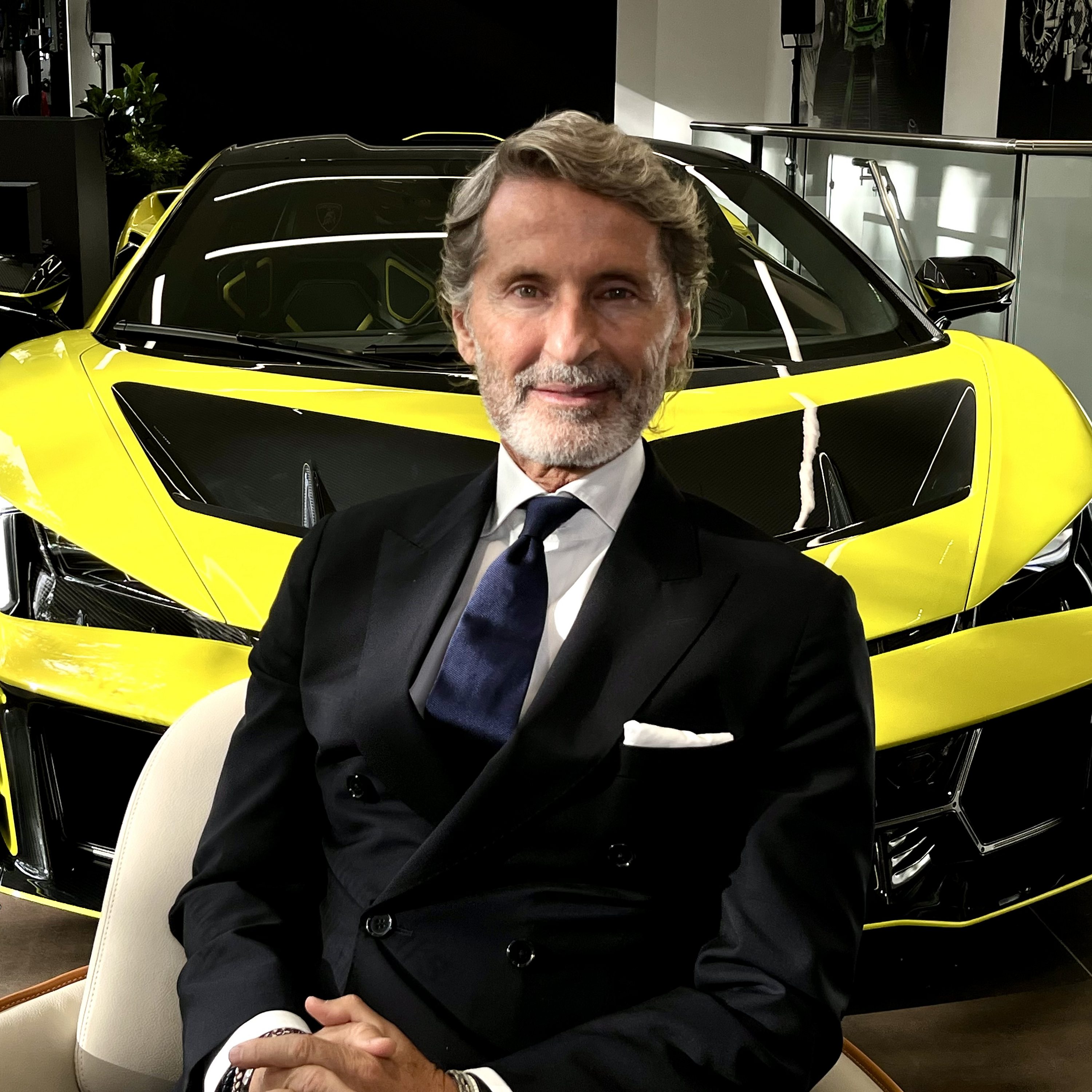
Business Daily
Business Daily meets: Lamborghini's Stephan Winklemann
00:17:29
The boss of the luxury supercar brand tells about his journey from paratrooper to CEO
Loading summary
Transcript69 lines
- [00:00]
Theo Leggett
This BBC podcast is supported by ads outside the uk. Vanity Fair calls Britbox a delicious streamer. Collider says everyone should be watching. Catch Britain's next best series with Britbox. Streamer claim new originals like Code of Silence. You read lips right? And Lynley, based on the best selling mystery series CI Linley. Take it from here and don't miss the new season of Karen Pirie coming this October. You don't look like. Please see.
- [00:29]
Stefan Winkelmann
I'll take that as a compliment.
- [00:30]
Theo Leggett
See it differently when you stream the best of British TV with BritBox. Watch with a free trial today. Mmm.
- [00:37]
Stefan Winkelmann
I love ravioli. O tanta farm me. Since when do you speak Italian?
- [00:40]
Theo Leggett
Since we partnered with SAP Concur. Their integrated travel and expense platform and breakthrough solutions with AI gave me time back to dive into our financial future. We expand into Europe in 2027, so I'm getting ready.
- [00:52]
Stefan Winkelmann
Well, you can predict the future.
- [00:53]
Theo Leggett
I can predict you'll like that message. What message?
- [00:55]
Stefan Winkelmann
Oh, hey, we all got bonuses.
- [00:57]
Theo Leggett
You can save for college now. I don't have kids. You don' SAP concur.
- [01:02]
Stefan Winkelmann
Helps your business move forward faster.
- [01:04]
Theo Leggett
Learn more@concur.com hello and welcome to Business Daily. I'm Theo Leggett. In today's Full Throttle program, I'll be speaking to a man who wanted to be a paratrooper, but ended up working in finance before becoming a car salesman. Yet the cars he sells today are not your ordinary runabouts. We're talking 1,000 horsepower, super streamlined carbon fibre bodywork and enough computing power to steer a spaceship. Stefan Winkelmann is the president and chief executive of Lamborghini, one of the most exotic brands in the business. His job sounds like a schoolboy's dream, but for him, it wasn't.
- [01:47]
Stefan Winkelmann
When I was a kid, I was more into motorcycles. When I grew up in Rome, there was not the helmet law. So we were always drying without any boundaries. There was freedom, and therefore I was more into motorbikes.
- [02:01]
Theo Leggett
We'll be hearing how he ended up at Lamborghini, how he steered the company through a series of crises and asking what the future holds for the supercar business.
- [02:11]
Stefan Winkelmann
The biggest challenge is for sure how the transition is going to be in the future for a company like ours. Into electrification or not, all that's coming.
- [02:21]
Theo Leggett
Up in Business Daily meets. He drives a Lambo. He drives a Lambo. He drives a Lambo. He drives a Lambo. Lamborghini is a car company, but what it really sells is a lifestyle. It may be owned by Germany's Volkswagen but its heritage is all Italian, with a bit of Hollywood glamour thrown in. And forget all the power and all the speed. For many buyers, the whole point of a supercar is quite simply to show off.
- [02:54]
Stefan Winkelmann
Lamborghini presents new Huracan Technica.
- [02:57]
Theo Leggett
It's a way for those who have wealth to flaunt it loudly. You can get a good idea of what it's all about by wandering down to Lamborghini's London dealership. It's situated off Barclay Square, an enclave of wealth and privilege. Next door is the Bentley showroom, while Ferrari and Bugatti are just down the road. The showroom itself isn't large. In fact, when I turn up the there's only one car on display. But that car, garish in wasp like yellow and Black, is a 4 million euro Lamborghini Phenomeno. And it's here I meet with the chief executive. Grey bearded, carefully coiffed and wearing a sombre jacket and dark blue tie. Stefan Winkelmann's own style is understated and almost self effacing. I ask him, first of all if he himself drives a Lamborghini.
- [03:47]
Stefan Winkelmann
I drive an Urus sa, but we change the cars very often to see what the competitors are doing. So usually I drive more cars than only one and I change them very frequently.
- [04:01]
Theo Leggett
The Urus, in case you're wondering, is Lamborghini's upmarket SUV less ostentatious than the brand's other models? It still makes up around half of its sales. Now Stefan Winkelmann fronts an Italian company. He speaks fluent Italian, but as he explained to me, he was actually born in Berlin.
- [04:19]
Stefan Winkelmann
My father was a diplomat and we moved to Rome when I was a baby. My father worked for the fao, which is the Food and Agriculture Organization, which has the headquarters in Rome. And this is the reason why my family moved to Italy.
- [04:32]
Theo Leggett
You stayed in Italy for a long time. You began studying in Italy, but then you moved back to Germany. Why did you do that?
- [04:38]
Stefan Winkelmann
After my high school degree, I went to German school in Rome. I started to study political sciences, but then I moved to Munich. And while I was in Munich, also there studying political sciences, I wondered if I should not do what I dreamt of. To be a professional soldier.
- [04:59]
Theo Leggett
And you did spend two years in the military. You were a paratrooper?
- [05:02]
Stefan Winkelmann
Yes, I was in the parachute division in Germany. It was a very nice experience. I enjoyed it a lot. It was a tough time, but at the end of the day I thought that my destiny was somewhere else. So I got back to university and I finished my studies of political sciences.
- [05:22]
Theo Leggett
Okay, let's look at that brief period in the military. What did you learn from that that you've used in later life?
- [05:28]
Stefan Winkelmann
I learned for sure that you have to never give up. This is something which in the military you learn the hard way on your own skin, which in my opinion is very important also for the future of your character. So it's more about character building, to understand how far you can go and what you're made of. But it also teaches you a lot about camaraderie, friendship, and to be able to obey without feeling bad about it.
- [05:58]
Theo Leggett
So you learned a lot, but you decided not to go for a career in the military, and initially you went into finance.
- [06:04]
Stefan Winkelmann
Yes, after political sciences, I had to reinvent myself because I had no clear idea of what to do after that. There was an opportunity to go and to a finance company, which I didn't like that much. So I changed after one year.
- [06:19]
Theo Leggett
So yet again you were reinventing yourself. And this time you went into a trade that I think time has told that you're more suited to. You went into the motor industry. What attracted you to the motor industry?
- [06:30]
Stefan Winkelmann
It's easy to like cars, in my opinion. Everybody has a car, everybody knows what a car is, and so you don't have to create a need. I always like cars, motorbikes even more than cars. And in that time in Mercedes, they were looking for trainees in the commercial department.
- [06:50]
Theo Leggett
Now you have an Italian background, even though technically you're German. Italy is known as the land of the car. Do you think your Italian heritage gave you some of that passion?
- [07:00]
Stefan Winkelmann
I don't know. I don't know. But as I said, when I was a kid, I was more into motorcycles. When I grew up in Rome, there was not the helmet law, so we were always driving without any boundaries. There was freedom as something which was part of the daily routine. The cars came by chance. But then I thought that this is a good place to be. And after one year I was in Mercedes Benz for this trainee. They were looking in Fiat Auto. Fiat Auto at the time was Fiat, Alfa Romeo and Lancia. They were looking for people who were perfect bilingual, German and Italian. And this was an opportunity. So I took it.
- [07:39]
Theo Leggett
Mr. Winckelmann worked at Mercedes Benz for a year before moving to Fiat, where he rose rapidly through the ranks. By 2004 he was head of operations in Germany. And then the Volkswagen Group came calling, offering him the top job at Lamborghini.
- [07:54]
Stefan Winkelmann
My last period was in Fietauto, the CEO of Fiet Auto in Germany. So it was a very visible market, the toughest market for Fiat, for sure, in this period of time. And when they contacted me if I would be interested in being in charge of Lamborghini, at the beginning I was reluctant almost because I was in a good position in Fiat. But then thinking about it, I thought, this is something which is unique and this is an opportunity which is once in a lifetime and I would have been stupid not to take it. And I never had any regrets.
- [08:31]
Theo Leggett
And this was in 2005, wasn't it? You were in your early 40s, so it's quite a youthful age to be taking over such a resonant brand.
- [08:41]
Stefan Winkelmann
See, I turned 40 in October 2004, so I was 40 when I started. And it was a different company. It was a big opportunity for me. I was more in marketing and sales. So I had for sure to learn a lot. But it was also a moment in time where I was enthusiastic about what could happen with this type of company. And imagine it's a company which is a headquarter in Italy. I was growing up in Italy, which is dealing worldwide, so doing business worldwide. So it was something which was something which I could not even have dreamt of. And yes, it worked out quite well.
- [09:22]
Theo Leggett
But then this happened. The collapse of one of America's biggest investment banks has sent shock waves around the world. Share prices have plummeted. Lehman Brothers suffering a spectacular downfall. Its stock at one point this year sold for $67 a share. Right now, it's trading Lehman Brothers. In 2008, the collapse of the American investment bank Lehman Brothers, the largest bankruptcy in U.S. history sent a wave of panic through the financial system. It was one of the key triggers of a worldwide crisis that sent stock markets plummeting and shook entire industries to their foundations. And after that came a global economic slowdown. The Great Recession that lasted for years. All in all, it was not a great time to be running a luxury supercar business.
- [10:09]
Stefan Winkelmann
We had a good run between 2005 and the middle of 2008 and shortly the motor show in Paris where we presented a concept car, a four door limousine, which we called the stock. There was the crash and this for sure was a big hit for Lamborghini. We had to half production in 2009 and also in 2010. It was very difficult to bridge. The downturn of the markets globally was not only locally, but globally. The first, let's say, coming back for us was with the introduction of the new V12 with the Aventadoro in 2011. And then from there on, it was a good period of time.
- [10:52]
Theo Leggett
So that must have taken a great deal out of you, trying to bring a company back pretty much from the brink in such a horrible economic climate.
- [10:59]
Stefan Winkelmann
There were two things which were more than two things, but for sure the team was helping a lot. They were all committed. This is something we have to do. So we cut production and we worked a lot on the brand positioning, so we were never stopping to speak about the brand. And the brand was already strong enough not to perish under the pressure of this difficult period of time. And therefore when the market was recovering, we were lucky that we had new products coming in. And this was something which helped us a lot. So we never stopped developing the cars. And this was together with the team and the strengths of the brand, something which helped for sure for Lamborghini to be back on track pretty soon.
- [11:45]
Theo Leggett
You're listening to Business Daily on the BBC World Service. That's the sound of James adding long lasting gain scent boosters to his laundry this morning. Several hours later, James sniffs the irresistible scent of gain on his shirt. Ah, Gain. Several hours later, James has even caught the attention of his mother in law and she never gives him attention. Oh, you smell amazing, James. Oh, thanks mom. I love you too. I never said that. Add gain scent boosters to your laundry.
- [12:19]
Stefan Winkelmann
Add joy to your day.
- [12:21]
Theo Leggett
Hey, let's talk about your expense report. I didn't submit an expense report. You will. Custom saddles and dog training services are not within policy.
- [12:28]
Stefan Winkelmann
What are you talking about?
- [12:29]
Theo Leggett
SAP Concur uses advanced AI to audit and automatically detect out of policy expenses. It's the breakthrough I needed to focus more on our future.
- [12:37]
Stefan Winkelmann
These are my future expenses?
- [12:39]
Theo Leggett
Yes. And self defence classes are out of policy. I'll need self defense classes. You will? For what?
- [12:45]
Stefan Winkelmann
It's a big dog. SAP Concur helps your business move forward faster.
- [12:49]
Theo Leggett
Learn more@concur.com I'm Theo Leggett and today we're hearing from the chief executive of Lamborghini, Stefan Winkelmann. In 2015, Mr. Winckelmann faced a new challenge. He was asked to take charge of Audi's sports car division at precisely the time when the parent company was grappling with the aftermath of the major emissions testing scandal that later became infamous as dieselgate.
- [13:14]
Stefan Winkelmann
At that moment in time, it was important for Audi Sport to have somebody who had an experience like I had in Lamborghini to create the new product lineup. It was at the worst possible moment because it was at the beginning of the diesel gate. So the attention was very much on different stuff, but I think that in the two years I was there, we reorganized the brand and we set the boundaries and the basis for the new RS models which are still on the market today.
- [13:44]
Theo Leggett
And for a while, you were also head of Bugatti, the French brand which was at the time part of the Volkswagen Group.
- [13:51]
Stefan Winkelmann
Yes. They asked me, seeing what we achieved with Lamborghini, if I would be ready to repeat this with Bugatti, because Bugatti was a brand which came back after decades with the Veyron at the beginning of the millennium, and it was immediately back in the mindset of the people. So it was a good brand to be in. It was a very exclusive brand. And therefore I said, okay, I accept. So at the beginning it was looking very promising. We had a lot of things coming up, and it was also very successful, and the customers were enthusiastic, even more than I could imagine. But then the Volkswagen Group decided to sell the company. This was really at the beginning of the year 2020, when Covid started. So it was not the best moment in time.
- [14:45]
Theo Leggett
And yet this was the moment as the world grappled with the after effects of a devastating pandemic which had also paralyzed the car industry. When Stefan Winkelmann was summoned back to Lamborghini for his second stint as chief.
- [14:59]
Stefan Winkelmann
Executive, it was better than expected because everybody was fearing the post pandemic season. We had a product line up which was seasoned as well, so we had to renew the Aventador, we had to work on the Euros and to have the new Huracan in place. We were surrounded by a market which was coming back stronger than expected. So this effect of after Covid, which is called YOLO now, you only live once, which was helping a lot for sure. But also the. The brand was strong. We were benefiting from the fact that we were selling the last internal combustion engine only cars, and we were preparing for the new strategy of having all hybrid cars coming in the next years.
- [15:47]
Theo Leggett
Okay, so you actually, looking at it that way, came back at a very good time. You were able to take advantage.
- [15:53]
Stefan Winkelmann
Let's say the time was looking very bad, but at the end it turned out to be a good moment, which.
- [15:58]
Theo Leggett
Brings us to where we are now. What do you see as the biggest challenges for a company like lamborghini today in 2025?
- [16:05]
Stefan Winkelmann
The biggest challenge is for sure how the transition is going to be in the future for a company like ours, into electrification or not. Today, the enthusiasm of electric cars is going down. So we see for us a huge Opportunity to stay with internal combustion engine and the battery system. So with the plug in hybrids much longer than expected. This is positive not only for us, but also for our customers.
- [16:35]
Theo Leggett
So you've delayed the production of your first all electric car. Is that just buying a little bit more time? Would you see a future in which there will be different markets, Some in which we have pure electric cars and in others where internal combustion engines remain for many years to come?
- [16:51]
Stefan Winkelmann
For us you have to have one car which is able to being sold all over the world. We are an exclusive brand, we have strong roots in Italy and this is what the customers want. So we want to have a car which is developed and built in Italy. This has to has to stay. What we decided was that the follow of the euros, this is the first decision we took, is not going to be a full electric car as the next generation, but it's again going to be a plug in hybrid car. And this car is coming out in 29 for the model number four. So the fourth model we are planning, we still need to decide whether we are going full electric. This was the, the decision we took some years ago, or seeing the new environment and how the things are going not to have also here a plug in hybrid car. This is something we have to decide in the next months.
- [17:46]
Theo Leggett
But ultimately you will have to go all electric. Would you?
- [17:49]
Stefan Winkelmann
Today we see a big opportunity on staying plug in hybrid with all the lineup also for the years to come.
- [17:56]
Theo Leggett
Now, looking at the wider business environments at the moment, there's been a lot of uncertainty over tariffs, particularly with exports to the United States. That's a major market. Where do you stand on that at the moment?
- [18:08]
Stefan Winkelmann
But there are two things which are a difference to the, to the year before. One, as you said, is the tariff. We are paying 15% as a European manufacturer. And then there is that. The other matter is the exchange rate between the euro and the US dollar. So this is affecting for sure the business because yes, we are only partially recovering the tariffs which are put on us. But in terms of sate, it should be pretty stable. Also the year 26, so you're not.
- [18:40]
Theo Leggett
Currently passing the full costs on to your customers. Why is that? Because anybody on the street would look at a car like that and say people are paying hundreds of thousands of euros, millions of euros on cars. Why do they care if the price goes up a little bit?
- [18:55]
Stefan Winkelmann
To rise the prices so dramatically would have been a very negative impact on the business also because other manufacturers have not done it. So we partially raised the prices. But we are keeping part of the additional tariffs on our shoulder.
- [19:14]
Theo Leggett
So even multi millionaire supercar buyers care about increasing prices.
- [19:18]
Stefan Winkelmann
Yes.
- [19:19]
Theo Leggett
And I was speaking there to Stefan Winkelmann, President and chief executive of Lamborghini. And that brings us to the end of this edition of Business Daily. The programme will be back next week. I'm Theo Leggett. Bye for now. You know that big bargain detergent jug is 80% water, right? It doesn't clean as well. 80% water. I thought I was getting a better deal because it's so big. If you want a better clean, Tide pods are only 12% water. The rest is pure concentrated cleaning ingredients. Oh, let me make an announcement. Attention, shoppers, if you want a real deal, try tide pods. Stop paying for watered down detergents. Pay for clean. If it's got to be clean, it's got to be Tide pods. Water content based on the leading bargain liquid detergent.