← Business Daily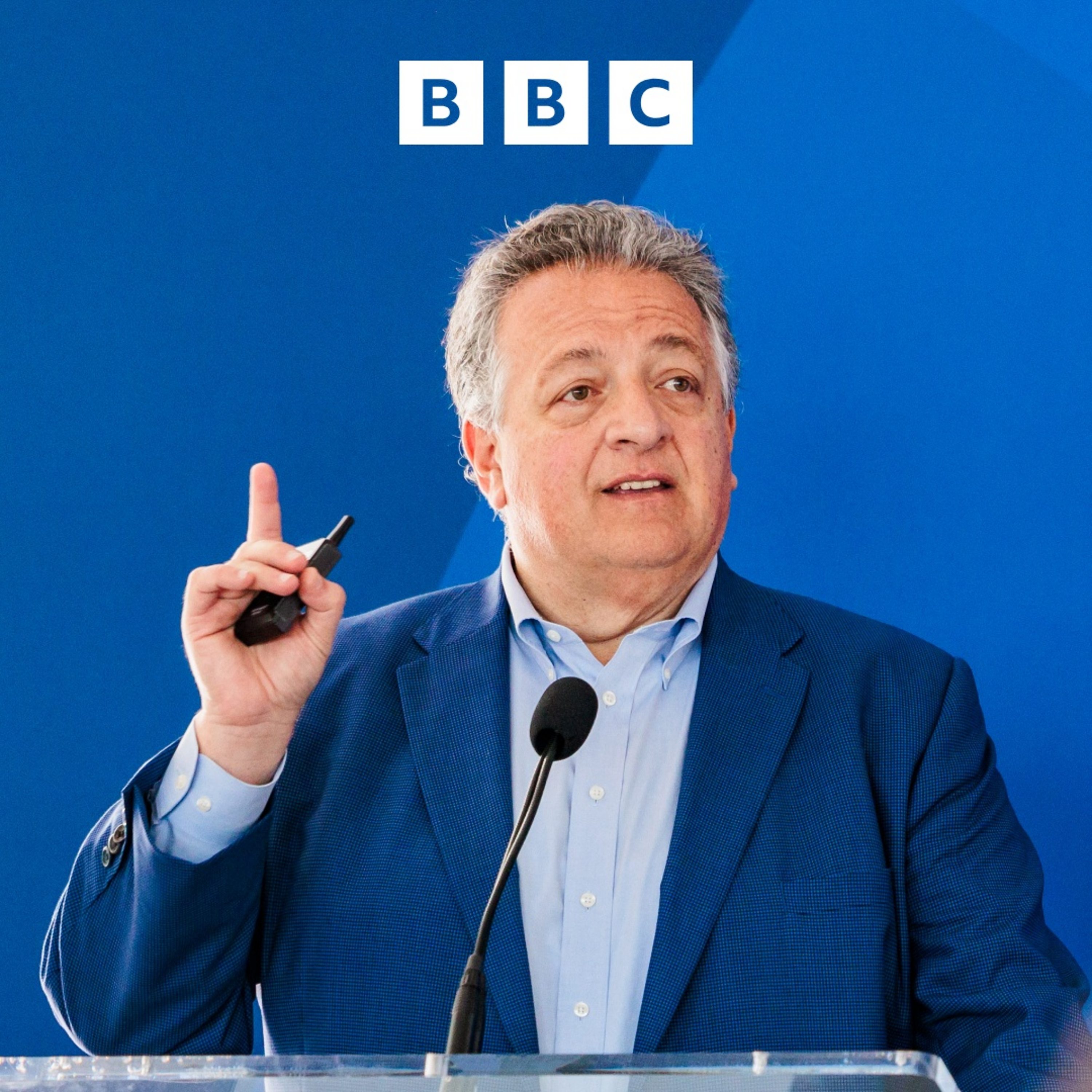
Business Daily
Founders: Moderna's Noubar Afeyan
00:17:28
We hear from Noubar Afeyan the man behind Moderna, the vaccine maker.
Loading summary
Transcript47 lines
- [00:00]
Will Bain
This BBC podcast is supported by ads outside the UK.
- [00:06]
Noubar Afayan
I cashed out my entire 401k thinking
- [00:09]
Will Bain
someone stole my identity.
- [00:10]
Scam Victim 1
A fake email cost me my dream home. After I sent my personal information to a scammer, my AI agent wired thousands
- [00:16]
Noubar Afayan
to an account I'd never seen.
- [00:18]
Gen Digital Advertiser
When billions of people feel unsafe, that's no longer a security problem, it's an economic one. At Gen, we're building the trust layer for a more fearless planet with products and technologies from our global brands, Norton, Lifelock, Avast and Money Lion. See it in action@genndigital.com Grainger knows when
- [00:38]
Grainger Advertiser
you're a procurement manager for an office park, you're not managing one building, you're managing all of them. And to stay ahead, you need to see through walls and around corners. Lights about to fail, filters ready to clog. H Vac on its last leg. If you wait until something breaks, you're already behind. Count on Grainger for quality products, easy reordering and 24. 7 support. Call 1-800-GRAINGER click grainger.com or just stop by Granger for the ones who get it done.
- [01:09]
Will Bain
Today on founders, we speak to the man behind Moderna, the vaccine that changed the shape of the COVID 19 pandemic. Nouba Afayan Noubar. Let us indulge you a tiny bit, if we can. So it begins back in Lebanon and the civil war there, and takes you and your family via Canada, the United States, to build, well, one of the most influential careers in modern biotechnology. Founding, flagship, pioneering in 2000, the venture capital firm from which more than 100 other firms turning science into medicine emerge, including perhaps best known to our audience, Moderna, and its COVID 19 vaccine. Why don't we start right back there again? Can you kind of imagine it? You were just kind of becoming a teenager right at the moment the civil war kind of breaks out in Lebanon. And now we sit chatting to you, a billionaire businessman with 100 plus companies and a million things to think about. That journey. Is it still kind of hard to fathom at this moment?
- [02:08]
Noubar Afayan
It is. I keep putting off thinking about it, and I suspect I'll do so before I can't anymore. But I was in my early teenage years in Lebanon, you know, kind of having a bit of an idyllic life. It was a beautiful place, except once in a while it was to break out into wars, usually proxy wars between other neighboring countries. But this time in 1975, civil war broke out and so we basically were forced to stay home for months on end. Saw Lots of rocket fire, lots of explosions, and importantly, the building about a block away from where we were is completely leveled when I was 12 years old. So we got up to a lot of dead bodies and the like. And while I could say that now, and most people relate to that as something they've seen on tv, when you see it live, if it doesn't completely depress you, it certainly causes you to think differently about the precarious position that peace represents and the opportunity to do things. I didn't think of that back then, but certainly since then, having to completely get uprooted, go to Montreal, see snow for the first time, see languages I didn't know. I mean, these are all things that I only wish upon other people to be honest. Because at the end of the day, the resilience, if you can kind of get through that carries through to starting companies. Lots of failures, lots of ups and down and just continuing the kind of constant struggles.
- [03:31]
Will Bain
And in that time, using money for the first time and all that kind of stuff. I'm guessing as an early teenager then, who was kind of teaching you about that?
- [03:38]
Noubar Afayan
My father growing up was in the import export business of all things, ironically, in plastics. He was one of the first to bring products that were based nylon, vinyl, these kinds of things into the Middle East. And I used to go to his workplace since a pretty early age, probably 6, 7 years old. And it was a big deal for me to go with him. I was the youngest of three. You know, I'd say probably less about the money part, but about the kind of seriousness of work.
- [04:02]
Will Bain
The work ethic.
- [04:03]
Noubar Afayan
Yeah, exactly.
- [04:04]
Will Bain
So fast forward a little bit, you go to two, back to back, fantastic academic institutions, McGill and MIT. Was education was learning really important in your house growing up?
- [04:14]
Noubar Afayan
Yeah, education was super important. And I studied engineering as an undergraduate student. And engineering is really all about making things, designing things, building things and scaling up things to using engineering in the opposite direction, which was reverse engineering, which is carefully taking things apart, putting them together and seeing what they do in fractional parts, is the way we study complex biological systems. And I was drawn to that in the early stages. And there were no tools to do this with. There was no information, knowledge. And all of that became available over the 40 years, 43 years since I entered this field.
- [04:51]
Will Bain
So at what point does that become a business? Does it go from being something you're interested in and you're working in, and as you say, you're right at the kind of forefront of people trying to do this stuff? When does that Go. You know what?
- [05:01]
Noubar Afayan
I've got an idea where there's a great story. I was a graduate student at MIT in the mid-80s. At the time, graduate students even now largely aim to become professors in the field. And sometimes they go to large companies. That's all that existed. And in 1985, by complete chance, I ended up being sent by the folks at MIT to a conference in D.C. held by the National Science foundation of the U.S. which was all about competitiveness, where the U.S. was being challenged by Japan. And I found myself being one of the few biotech people happened to sit at lunch completely randomly next to a gentleman. He told me what he had done. It turned out he and his friend had started a company 30 years earlier in making new instruments for a new breed of engineers called electrical engineers. They had invented the oscilloscope. They had made it in their garage and built a company. And I was listening to a story thinking, well, I'm a new breed of engineer, biological, biochemical engineer. I could do this kind of thing. So I was drawn by his story. And it turned out it was David Packard, Hewlett Packard. I had no idea while he was telling me the story which company he was talking about or who he was. He was about my father's age. So essentially he was just describing to me how he thought about the business model of making tools for their colleagues, engineers who are building things. He thought he could make the instruments. And that's what I did. I came back to mit, took a couple of courses of management, which were quite primitive at the time. Startups were not a field per se. This is mid-80s, and in 1987, when I got my PhD, I started a company that made instruments for the biological engineers.
- [06:39]
Will Bain
What were those?
- [06:40]
Noubar Afayan
So it turns out to study biological systems, you need to purify the molecules so that you can identify what they are. We didn't know what was in blood or in growing bacteria or whatever. So we made the first purification systems that were designed for the new age of biology, which meant we could do separations of each individual component from the rest in minutes as opposed to hours. So these are all techniques that today are in tens of thousands of labs and instruments that are used routinely. But back then there was none of that. And so that company, initially Perceptive Biosystems, grew, ended up being about 100 million in revenues, about 800 people. And that's how I learned the, I would say, art to this day of leadership management as best I could.
- [07:28]
Will Bain
You're listening to Founders from Business Daily right here on the BBC World Service. And our guest today is the founder of Flagship Pioneering and one of those companies that came out of Flagship Pioneering that you may well know best. Moderna Nubo Fin.
- [07:44]
Grainger Advertiser
The ultimate cookout starts with the ultimate ingredients at Whole Foods Market. No antibiotics ever. Burgers and kebabs are prepped and ready to throw on the grill. Fire up a juicy ribeye, grab creamy potato salad and savory flatbreads from the prepared foods department and round it all out with 365 brand condiments, chips and dips at everyday low prices. Whole Foods Market make your summer sizzle.
- [08:11]
AT&T Advertiser
The AT&T guarantee is all about having your back with AT&T Internet air. Your home Internet is backed by the AT&T guarantee. In the rare event of a network outage, you'll automatically get a credit for a full day of service. It's like waking up from a nap with a warm blanket resting on your shoulders. Visit att.comguarantee to learn more. When the connection matters, it has to be at&t credit for Internet air downtime lasting 20 minutes or more. Restrictions and exclusions apply guaranty. For full details,
- [08:43]
Will Bain
why don't you take us then to the pandemic as we kick off the second half here? New balm Moderna itself and Flagship Pioneering.
- [08:50]
Noubar Afayan
My firm basically, that was the founder of Moderna as an institution, essentially specializes in anticipating or let's say leaping to totally new uncharted territories. So we practice an institutional, I would even say industrial form of taking leaps of faith, but then figuring out how to prove them. And this is relevant for Moderna because we do this by asking what if questions. We imagine kind of things that should be possible and should be desirable and then see if we can reduce them to practice one of those in 2010, which was, what if you could inject the molecule in a human and use the body to produce any medicine you wanted to, any biological medicine you wanted. Well, we set out to do that in summer of 2010, and by 2011 we had shown that, yes, we could deliver as a message. That's why it's called messenger rna, a new instruction into the body, in this case into the liver or into other cell types and make a protein that had no precedent before. And then Covid hit in 2020 and we had a platform already 10 years in the making. We had spent two and a half billion dollars building a company, building a fairly substantial pipeline of potential products. None of them were approved yet. That's very normal in the biotech industry. It takes a good decade or so after you start chasing these things, to have products after product, which is where we are today. And so that's how we started. And so we knew the virus type. And as soon as we were approached, even before the sequence was available, we decided that this was something we had to do. But importantly, it really fit our platform. And so we were eager to see if we could actually work.
- [10:34]
Will Bain
That's such an interesting area as well, isn't it? Because clearly it changed a lot of lives. It evidently saved a lot of lives. We know that from the stats, don't we, down the track. But I know you're a huge humanitarian as well. You run a lot of not for profit organizations too, don't you, on the side do a lot of charity work as well? Was there ever any tension, just pure personal tension, I suppose, about making a lot of money as well, at the same time, with this, the company's booming, and yet there's something kind of slightly disastrous happening to humanity at the same time. Must be kind of a weird feeling to. To have in that moment.
- [11:06]
Noubar Afayan
Well, I would say it's. It's weird. I mean, the life is weird. Anyway, so this was just kind of shades of weird, but there was weird different reason, because, you know, I had, in my life separated the philanthropy part from my work. And I never viewed my work as a humanitarian activity. But in fact, when we started going through kind of an immense amount of risk and intense activity to try to scale up and make literally a billion doses of something we had only ever made thousands of in the past in such a short time, I can assure you that the profit motive or the economic return would not have risen to the level of probability adjusted, meaning the probability this would have worked times the reward would have been a bad activity. But for its humanitarian impact, right in the beginning, we announced that we would not enforce our patents. We were the only game in town in MRNA at the time. You know that there's two entities, Pfizer, BioNTech together, who ended up making a vaccine. That vaccine, to the best of our knowledge, is exactly the same technology. We made our technology available for that to happen during the period of the pandemic, we didn't have to, and we did because it was the right thing to do, because we realized literally people were dying. And so that plus the kind of partnership with the governments in EU as well as in the US These were fairly unprecedented things. So I'd say the weirdness was not as stark as what you're saying, which is we're making money on the Pandemic, we were providing a solution. You may know that vaccines are an order of magnitude or 2 more cost effective as a health approach than any medicine, any other thing that health care offers.
- [12:51]
Will Bain
If that was a period where it was sort of partnership, if you like, between politics and science, it feels like when we're talking today in 2026, that there's a tension there and not just, I mean very obviously right in the United States and questions about institutions and funding for science in the United States. But that is not unique to the US is it? I'm sure it's in a lot of countries where you're working now this. We've heard it said here in the uk, right that we've had enough of experts in inverted commas being one of the most famous quotes during the Brexit campaigns here as well. How damaging has that been to progress in science that it suddenly seems to have become a political football?
- [13:28]
Noubar Afayan
Look, I think in the short term it's been very damaging. In the long term it may naturally from an evolutionary standpoint, improve or cause the scientific establishment to adapt to the societal expectations that primarily they don't overstate what they know. The problem with experts are that they became experts by knowing a lot about what is and probably what will be in the short term. But those experts know almost nothing about what will be further out. And yet nothing stops them from projecting their expertise. And did they ever including, you know, I had to give lots of interviews during the COVID times with CEOs of large pharma companies and large other types of academic institutions saying you can't develop a vaccine less than four years. If you do, it's going to kill lots of people. And they had no idea because nobody had ever tried before. And so they were just expertizing, if there is such an English word, they were just projecting expertise. It is that that had a unfortunate boomerang effect where people then who either didn't like science or didn't believe in science raised their voice and said see, we're being subjected to this. It's a natural process. I'm sure everybody was wanted somehow to contribute their expertise. And in their case their expertise was expertise. So they kind of were projecting it. I think that's been a useful kind of self realization. But it's gone now from the politics of science, which we had before, to the politics of anti science. It is concerning for the long term.
- [15:02]
Will Bain
Does it make you think about decisions about where you work? I suppose as well. I mean, would it make you move operations from the United States, for example.
- [15:10]
Noubar Afayan
We haven't reached that level yet. Although I will say that, you know, at flagship, we have a burgeoning presence in the uk, which we've found very productive and we're growing. We have a burgeoning presence in Singapore and in Korea, Japan, for the APAC region. We're looking carefully at the Gulf. These were not necessarily in our plans pre Covid. I think it's a good thing that the whole world has woken up to realizing that life science, innovation is an integral part of our life.
- [15:36]
Will Bain
You've been working a lot with AI, haven't you? And you've talked. I was reading an interesting piece done with the Financial Times about how you think that's going to really kind of supercharge research. Why so and in what kind of timescale?
- [15:48]
Noubar Afayan
It's doing so now. It's doing so in both predictable and unpredictable ways now. And the reason is that it is in short, to me, the first major prosthesis for the human intellect. I think lots of people can debate whether it's a replacement or not. To me it's not that interesting as opposed to if it can act as a true thought prosthesis, an extender of our ability to interact with knowledge, deploy knowledge. We're going to develop new skills to make sure that we're not misapplying knowledge or, or being fooled in an industrial scale. And so all of that in my view, affects science because science needs tools. And while 40 years ago I was developing tools for measurements in labs, now we're developing tools for how to make millions of measurements, develop models, and then from there impact the whole activity of discovering and deploying new medicine. So truly it is not about being excited for scientific discovery, for the development of medicines. This is a, a true disruption. It's great because in the time I have left, I'm 63 years old, the time I have left, I think I'll be able to do what we did in the last 40 years, probably in three or four, really. And I'm not exaggerating.
- [17:02]
Will Bain
Wow. Take us over that 40 years then as we round out here. Nubar. Anything that you wish you could have back, maybe good or bad, Bad, you know, a deal where you wish I should have done that and I learned that I would do that the next time. Or perhaps the flip, you know, something you did and you go, oh, I still put my head in my hands thinking about that now.
- [17:20]
Noubar Afayan
You know, look, I, I would say that I've probably over focused on innovation and its potential impact and the ways to do it and the ways to create companies. And within that, you know, I probably, if I had to do it over again, I would develop skills earlier in my life, social skills of how to create connections with people and how to create the kind of.
- [17:45]
Will Bain
That's so interesting because you're such a technical guy, but people being the real key thing, as well as that learning and that knowledge and that expertise.
- [17:53]
Noubar Afayan
Yes. And the facility and the power of creating communities. You know, I've learned that on the fly. I've learned that on the job. Probably I would not score myself high in that. In part probably by nature, but also in part because I was so busy trying to help focusing on the outcome. So I would say to people, focus on all three, the input, the process and the output. And all three could benefit from lots of learning and lots of experience.
- [18:20]
Will Bain
And take us full circle. If you could talk to that young man, well, young boy really still in Beirut, then what would you say to him again now as he sets out?
- [18:31]
Noubar Afayan
You know, interestingly, it's stuff I've said to my four children growing up, which, which I don't know why I did, but I tell them one thing is that disappointment is overrated. If I could do one thing, it's to convince kids or people growing up not to avoid disappointment, which a simple way to do it is not even to try. I think the way, the way we bring up kids, the way we, you know, kind of overemphasize the outcome in sports or in school and people are devastated by, by these situations. I think if you think of failure as the, as the ancestor of success and it's a descendancy game, then you better accumulate a bunch of those and learn from them.
- [19:10]
Will Bain
Nouba Afayan, thank you so much for speaking to us on Founders here from Business Daily.
- [19:15]
Noubar Afayan
Thank you.
- [19:16]
Will Bain
That was Noubar Afayan, the founder and chief executive of Flagship Pioneering and co founder of Moderna. He was speaking with me, Will Bain, for this edition of Founders from Business Daily. The program was produced by Barbara George and Elisa Siddiq. And if you'd like to get in touch with the team, our email address is business dailybc.co.uk.
- [19:41]
Noubar Afayan
I cashed out my entire 401k thinking
- [19:43]
Will Bain
someone stole my identity.
- [19:45]
Scam Victim 1
A fake email cost me my dream home. After I sent my personal information to
- [19:48]
AT&T Advertiser
a scammer, my AI agent wired thousands
- [19:51]
Noubar Afayan
to an account I'd never seen.
- [19:53]
Gen Digital Advertiser
When billions of people feel unsafe, that's no longer a security problem, it's an economic one. At Gen, we're building the trust layer for a more fearless planet with products and technologies from our global brands, Norton, Lifelock, Avast and Moneylion. See it in action@genndigital.com.