← Business Daily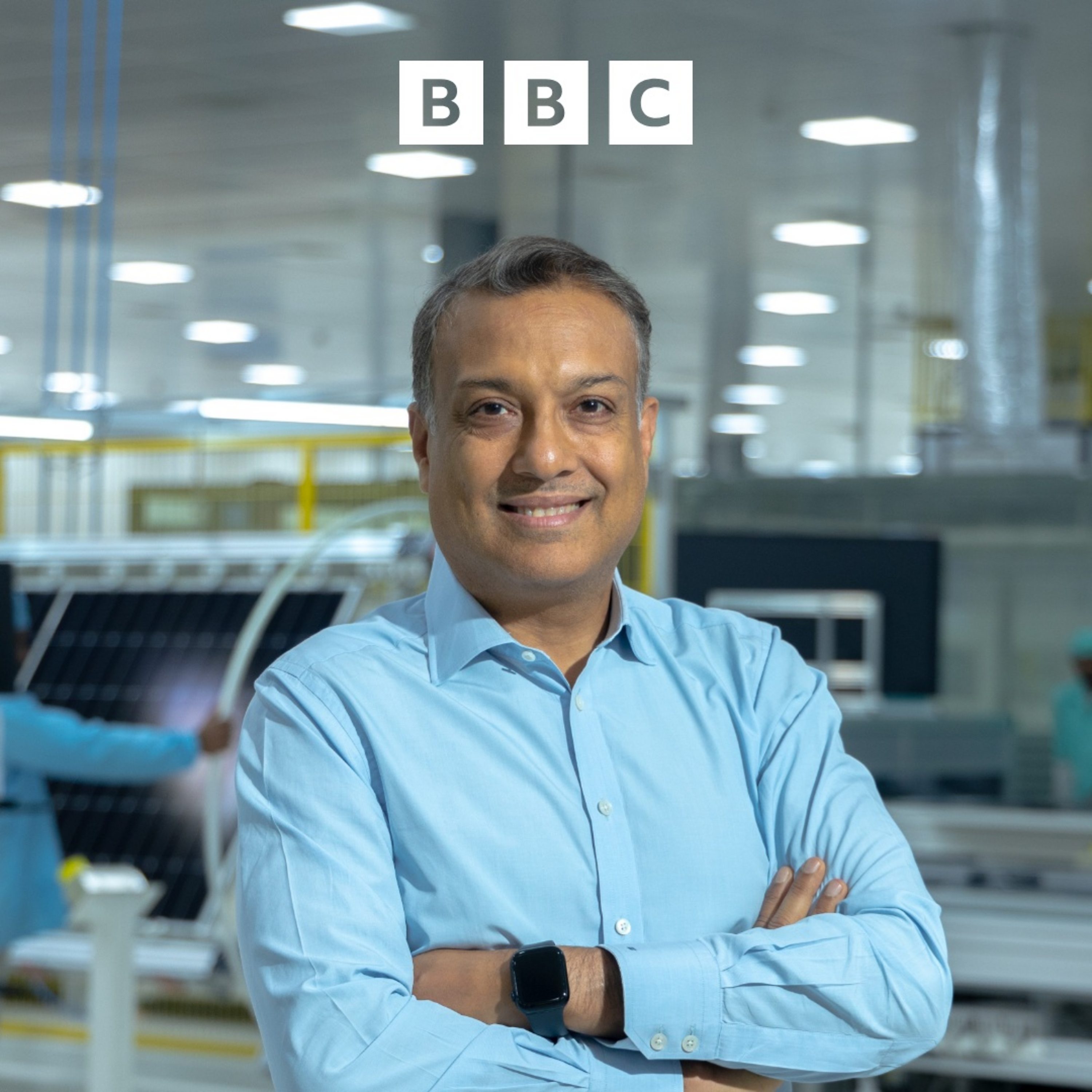
Business Daily
Founders: Sumant Sinha's bet on a greener India
00:17:29
Sumant Sinha on building ReNew into one of India's largest renewable energy companies
Loading summary
Transcript59 lines
- [00:00]
Sumant Sinha
This BBC podcast is supported by ads outside the uk.
- [00:06]
Whole Foods Market Advertiser
This is summer at its peak. Whole Foods Market Summer Fruit Fest is your invitation to eat the season fresh, organic and bursting with flavor. Start your day with peaches and organic blueberries and yogurt. Build a grazing board with fresh fruit, prosciutto and artisanal cheese. Then fire up the grill with no antibiotics ever. Proteins and fresh produce. Savor the season. Shop Summer Fruit Fest at Whole Foods Market.
- [00:33]
Sumant Sinha
All new drinks are now at McDonald's with refreshers like the Strawberry Watermelon Refresher and the Mango Pineapple Refresher with popping boba. To crafted sodas like the Sprite Berry Blast with berry flavors and cold foam. Who knew ice cold drinks could be so fire six. All new drinks are here now at McDonald's. Refreshers contain caffeine.
- [01:05]
Liana Byrne
Welcome to Founders from Business Daily on the BBC World Service. I'm Liana Byrne and today I'm talking to Samanth Sinh, the founder of Renu, one of India's largest renewable energy companies. And he's been reshaping the nation's energy future one gigawatt at a time. Welcome to Founders. How are you doing today?
- [01:23]
Sumant Sinha
Thank you so much, Liana, for having me on the show. I'm doing terrific. Thank you.
- [01:28]
Liana Byrne
It's a pleasure having you. You are one of those founders who' work touches millions of people's lives, even if they don't necessarily know your name. You began your career in finance working in New York and London before walking away from the corporate world in your 40s to make a bet on renewable energy. In 2011, you founded Renu with the ambition of helping transform India's energy system. Today, it's one of the country's largest renewable energy companies, generating 1.8% of India's electricity and playing a major role in. In one of the world's biggest clean energy transitions. How do you feel listening to all of that?
- [02:05]
Sumant Sinha
You know, it's actually a pretty surreal thing to listen to it because, you know, when we started off, our ambitions were a lot more modest. But it's. It's really good to know that over the last decade and a half, we've been able to have some impact in a positive sense.
- [02:20]
Liana Byrne
Is it right to say you didn't come from an entrepreneurial family? Your father was a civil servant and later a politician, and then your mother built a career as a writer. Was business ever discussed around the dinner table?
- [02:31]
Sumant Sinha
No, it wasn't, Liana. That was really interesting. And, you know, in my family, I was the first person to do an MBA or even consider, therefore, a job not in the government. And so when I started off thinking about doing something on my own, entrepreneurial, then it was something which was quite new, quite novel. In my family, nobody would have been surprised if I had chosen a career in the civil service or if I had decided to become a politician in my father's footsteps. That would have been entirely natural. But I wanted to really follow my own path. And becoming an entrepreneur, I felt, was something that could take me in that direction.
- [03:06]
Liana Byrne
Was there anybody who taught you about money as a child and making money and that kind of entrepreneurial spirit?
- [03:14]
Sumant Sinha
Yeah, not really, now that you asked me that question. Not really. I think I learned it along the way as I went. And of course, in my corporate career and in my investment banking career, I came across a lot of people running corporations, doing it successfully. And that really taught me what it took to create value, why people invested in companies, why investors invested in companies, what it took to create value in them, and how to do that. So getting that exposure during my corporate life was actually very useful because it taught me how companies actually get into business areas, how they run businesses, and how value is truly created.
- [03:53]
Liana Byrne
Now, your dad, he became a finance minister. Did that teach you a lot about leadership?
- [04:00]
Sumant Sinha
You know, in some ways it did, but in some ways also not. Because in my family, everybody pursues their own path. And most of the time that my father was the finance minister, I was actually not in India. I was actually outside of India at the time.
- [04:15]
Liana Byrne
It's interesting, sometimes people rebel against what their parents are doing, because you see what perhaps politics or being a writer is doing. And you say, actually, I don't really want to go down that path. Maybe that made you more or less interested in government.
- [04:29]
Sumant Sinha
In some ways, yes. But in some ways it was also very attractive because obviously I'd seen my father's very successful political career, and secondly, obviously he had a lot of connects and so on. So it might have been easy for me to. Or easier for me to get into politics. But, you know, eventually I thought, it's somebody else's path, and I wanted to follow my own path and create my own journey. And that, to me, really was the most exciting thing I could do with my life.
- [04:55]
Liana Byrne
Tell me about when you enrolled in university. It's quite an interesting story there that you were about to go somewhere and then ended up going somewhere else. And actually, that was one of the luckiest accidents of your life.
- [05:06]
Sumant Sinha
All of these things sometimes play out. I was supposed to go and study economics in one of the top universities in India. But I'd also got admission to one of the IITs or the Indian Institutes of Technology, which are very hard to get into. There's a very competitive entrance examination. And I was frankly confused about which direction to go. And as luck would have it, that year, the IIT session started earlier. So I ended up going there and then I liked it and I just ended up staying on. And that's what made me an engineer.
- [05:37]
Liana Byrne
So why finance? What was the jump off point for you there?
- [05:41]
Sumant Sinha
Frankly speaking, when I was in the U.S. i, you know, I'd finished my master's at Columbia. I didn't really know very anybody in the us I had no networks, no contacts. I needed a job. And so I applied everywhere. And as luck would have it, I got a job in Citibank.
- [05:57]
Liana Byrne
And what was that like as a first job? I'm sure that's quite tough. Banks like those are known to be hard working.
- [06:04]
Sumant Sinha
It was very difficult, actually, Liana. And the reason is that I had never really been exposed to the world of finance. I didn't know a lot about how tough and competitive and cutthroat investment banking could be and would be. I just knew that I was willing to work very hard and put in the hours that were required.
- [06:23]
Liana Byrne
Did you ever think that you would stay at Citibank or on Wall Street? Because I know it's a tough job, but it's also a good job, isn't Is?
- [06:31]
Sumant Sinha
But, you know, I'd been doing it for about 10, 11 years, and I realized that that wasn't something that I wanted to do for the rest of my life. Investment banking at some level rewards specialization, and I wanted my career to be much broader than that and really to get exposure into a wider variety of areas. So I felt that I needed to do something different. And that's really when the opportunity of going back to India in a much more broader and different kind of role popped up. And I said, you know, this is something that I have to, I have to pursue.
- [07:04]
Liana Byrne
Well, tell me about that. What was the, the role that popped up for you?
- [07:08]
Sumant Sinha
You know, during one of my trips to India, I had met the chairman of one of India's largest business conglomerates. He wanted to hire somebody from outside India for the finance role. And he offered me the job of coming in as his finance head for the Organization for the Conglomera Comrade. And it was a very interesting opportunity to come into corporate India at a very, very senior level and really go from Investment banking to a corporate career and a corporate life.
- [07:35]
Whole Foods Market Advertiser
This is summer at its peak. Whole Foods Market Summer Fruit Fest is your invitation to eat the season fresh, organic and bursting with flavor. Start your day with peaches and organic blueberries and yogurt. Build a grazing board with fresh fruit, prosciutto and artisanal cheese. Then fire up the grill with no antibiot, everproteins and fresh produce. Savor the season. Shop Summer Fruit Fest at Whole Foods Market.
- [08:00]
Sumant Sinha
I cashed out my entire 401k thinking someone stole my identity.
- [08:05]
Liana Byrne
A fake email cost me my dream home. After I sent my personal information to
- [08:08]
Sumant Sinha
a scammer, my AI agent wired thousands to an account I'd never seen.
- [08:13]
Gen Digital Advertiser
When billions of people feel unsafe, that's no longer a security problem. It's an economic one. At Gen, we're building the trust layer for a more fearless planet with products and technologies from our global brands, Norton, Lifelock, Avast and Money Lion. See it in action@gendigital.com
- [08:32]
Liana Byrne
you're listening to founders from the BBC World Service. I'm Liana Byrne and today I'm speaking to Sumant Sinha, founder, chairman and CEO of Renew. What was different between that job and the one that you'd left in in New York?
- [08:48]
Sumant Sinha
Well, they were vastly different. One was investment banking, which, as I said, was really about giving advice to people. The other one was actually about making decisions actively about where to invest capital of your own and then living with the consequences of those investments. Working in India in that particular role, I got an exposure to a whole bunch of different sectors because our group had invested across many different areas. And so I really began to understand the dynamics of how they were thinking about investing their capital, how they looked at creating value, but also, I would say, a terrific exposure and a phenomenal experience.
- [09:28]
Liana Byrne
Well, it sounds like you really enjoyed the job. So tell me when you decided to set up your own business, because again, you could have stayed in that job and maybe been perfectly happy.
- [09:37]
Sumant Sinha
That is true. And one must ask why. I decided to take all the decisions I did. But I guess at some level, as I said, there was a level of discontent in that eventually my goal was to start something on my own. And the more I worked with other people, the more I realized that the things that I did not have that would allow me to become an entrepreneur was capital of my own. I didn't have the understanding of his specific sector where I could actually find a business opportunity. And so I then really pushed myself into doing that. I said, look, here's an opportunity and I just now have to jump off of the plane and find my way through. And so that's what I did. I essentially left my job and I started this company, Renew.
- [10:22]
Liana Byrne
Yeah, you jumped off that cliff and you landed on your feet in fairness. But back then, such a huge risk. What did Renew actually look like at the start? Where do you even start with a renewable energy company? Because as you said, there is so much capital involved. It's quite a complex business, isn't is?
- [10:42]
Sumant Sinha
And you know, to tell you an interesting story, when I started looking to raise capital, I had hired about six or seven people. I built a small pipeline of 100 odd megawatts of projects and I needed to raise to fund those projects about $60 million. Now when I went to the venture capitalists to look for capital because you know, we were a pre revenue company at that time, they said look, this is too much capital for us. We're not used to deploying such large amounts of capital. So you really have to go to the private equity guys. When I went to the private equity guys, they told me that the company was too early stage and therefore they couldn't, you know, it wasn't interesting from their standpoint. So it took a lot of pounding, the payment before we found an investor who was willing to come in. Then we really got started and you know, the whole shape of the company then began to change quite substantially.
- [11:31]
Liana Byrne
This is a family business, isn't it? Your wife Vishali also co founded Renew with youh and remains part of the company today. So how does that work? How do you handle disagreements together if you're, you're both at the head of the company?
- [11:44]
Sumant Sinha
Yeah, you know, actually I wouldn't say we are a family run business. I would say that we are a professionally run business. It just so happens that both I and my wife work in it. I of course founded the company and I am the CEO of the company. Vishali runs some aspects of our business. But I think it's very clear to our investors and to everybody within the company as to what the management and governance of the company is. And we try to keep it as professionally run and managed as we can. And Vishali has certain areas of responsibility within the company and she runs those relatively independently. And because she's my wife, she reports directly to the board. We have an independent board.
- [12:26]
Liana Byrne
What are the advantages and perhaps disadvantages of building a company with your spouse?
- [12:32]
Sumant Sinha
Look, there are many advantages in that. As an entrepreneur who started the company, it's very important for me to find people who are equally committed to the company as I am and who have the same sense of ownership and drive towards the company and finding. And who better to have that than your wife who is equally committed and as committed as you are to making sure that the business is successful.
- [12:57]
Liana Byrne
Just looking back at the 15 years of you building the company, was there a tough decision that you had to make as a founder that really stands out to you? Was there a deal that you wish you had said yes or no to?
- [13:09]
Sumant Sinha
I think one of the things that we perhaps should not have done was to list outside India. But at the time we took the decision that was the right decision. But things are subsequently turned out in the manner that, you know, that decision seems in hindsight to have not been the correct one. But, you know, it is what it is. Now, having said that, the hardest decisions really are people decisions because, you know, some people join you very early in the process. They show faith and commitment in you. And then over a period of time, not everybody is able to evolve into the roles that you would want them to. And because you have deep long term relationships with them, it becomes hard to take those decisions.
- [13:46]
Liana Byrne
Then you spent years in finance before betting your own money on renewable energy. It's interesting. What did you see in 2011 that convinced you that the future was going to look fundamentally different from the present?
- [13:59]
Sumant Sinha
You know, at the time that you start, it's very hard to really forecast where you're going to get to. So in the beginning, it was really all about trying to get the first few projects done, trying to demonstrate that we could execute on the ground, that we could hire people, that we could manage them, that we could create a company, et cetera. And so in the beginning, it was really not about creating a very large organization and trying to change India's electricity landscape. It was much more about survival and doing the first few projects properly. So that is really how we started off. And in the beginning, our ambitions are quite modest. You know, it's only over the years that those ambitions began to change.
- [14:36]
Liana Byrne
Now, where do you think India is at in terms of renewable energy today? Because to give a wider context, we have a lot of conversations about India taking oil from Russia. Narendra Modi has argued that, well, it is still a developing country, so we need cheap oil wherever it can come from. So do you think that India can become a renewable powerhouse? Is it on the right track today or does work still need to be done?
- [15:02]
Sumant Sinha
Look, I think India has done a terrific job on the clean energy Transition. And it's for a variety of reasons. Of course, climate change is how it all started. That is what drove the initial rollout in clean energy. But now, especially with what's happening globally, with all the wars going on and the geopolitical situation being what it is, India recognizes that we import all of our fossil fuels, or at least 85% of it, and that's a dependency that is very unhealthy for us. And so therefore, energy security is something that we have to work on with a high degree of urgency. And the solution for that is to move as quickly as possible into clean energy. Whether it is using renewable energy to generate electricity, whether it is to use renewable energy to power things like data centers or create green fuels like green hydrogen and green ammonia. All of those are areas that now the government is very strongly now pushing forward.
- [15:58]
Liana Byrne
It does seem as though the conversation has shifted because we were talking a lot about green energy over the last couple of years, but then obviously the US President, Donald Trump, the US is the biggest global economy in the world. He's saying things like, drill, baby, drill. They've pulled back on their climate commitments, so have other countries around the world. So does that worry you?
- [16:20]
Sumant Sinha
No, of course it does. It worries me because ultimately I do believe that climate change is one of the most central issues facing humanity. And if we don't act with the absolute highest sense of urgency on it, then we are going to, you know, it's going to lead to 2 degrees plus temperature change, which is going to be really, really damaging to the world as a whole. It'll lead to all sorts of consequences on food security, migration, you know, droughts, etc. So the consequences are going to be quite dire. But, you know, eventually I feel that technology, which is driving climate change efforts, will triumph over drilling things out of the ground. So I think longer term, it's going to eventually be a situation where the energy transition wins out.
- [17:04]
Liana Byrne
And what do you think about clean energy and how it could help equality, essentially, the divide between rich and poor is quite stark in India. Do you think that that's going to help with that?
- [17:16]
Sumant Sinha
You know, I think that clean energy ultimately is, it's a little bit more democratic than large single location power generating stations, because clean energy can be put up on one's roof through government subsidies. It can become very cheap. The farmer can use, you know, pumps getting powered by solar power. So all of that is going to bring renewable energy much closer to the common man.
- [17:43]
Liana Byrne
I mean, we were talking about what clean energy is going to look like in 20 years time. But what would you hope people would say what your contribution to India's development and energy future was? You might be retired in 20 years, who knows? But when they talk about renewable energy, how would you like to be spoken about in the mix?
- [18:02]
Sumant Sinha
That's an interesting question. 20 years. Of course, I'll no longer be active. At the very least, I hope that people think of me as one of the architects of the clean energy transition in India and not just as one of the people who created policies or who talked about it, but somebody who actually went out and got it done. Because I think that to me is the hardest thing to achieve, which is to actually execute things at a ground level. Talking is easy, writing papers is easy. But actually getting out there, raising capital, hiring people, getting them to work, creating a large organization over a period of time, acquiring land, building transmission lines, digging holes, building roads, all of that takes a lot of effort and it is not to be undermined. And if people recognize that I made a contribution in that area and helped set the industry up as being one of the early movers, I think that would be fine from my standpoint.
- [19:03]
Liana Byrne
Samanth Sinha, founder of Renew it's been an absolute pleasure. Thank you for being on Meet the Founders with Made Today.
- [19:09]
Sumant Sinha
Thank you so much, Liana.
- [19:12]
Liana Byrne
That was Saman Sinha, founder, chairman and CEO of Renu. He was speaking to me. Liana Byrne, for this edition of Business Daily. The program was produced by Barbara George. If you'd like to get in touch with the team, our email address is business dailybc.co.uk thanks for listening.
- [19:35]
Sumant Sinha
I cashed out my entire 401k thinking someone stole my identity.
- [19:39]
Liana Byrne
A fake email cost me my dream home. After I sent my personal information to
- [19:43]
Sumant Sinha
a scammer, my AI agent wired thousands to an account I'd never seen.
- [19:47]
Gen Digital Advertiser
When billions of people feel unsafe, that's no longer a security problem, it's an economic one. At Gen, we're building the trust layer for a more fearless planet with products and technologies from our global brands, Norton, Lifelock, Avast and Money Lion. See it in action at gendigital. Com.