← Business Daily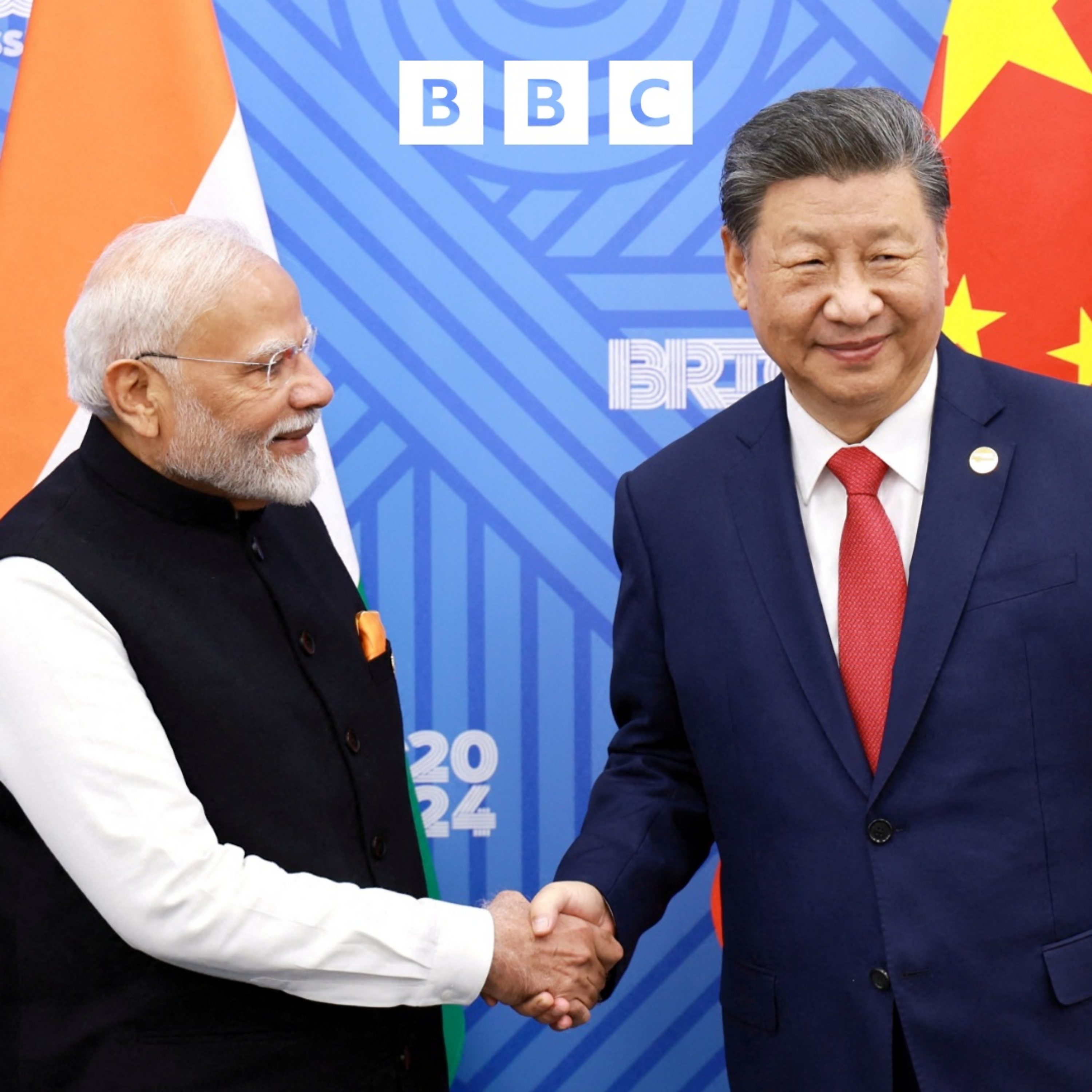
Business Daily
The BRIC architect's warning for the West
00:20:00
How does Jim O'Neill think Western countries should view Brazil, Russia, India and China?
Loading summary
Transcript55 lines
- [00:00]
Ed Butler
This BBC podcast is supported by ads outside the uk.
- [00:06]
Whole Foods Market Advertiser
This is summer at its peak. Whole Foods Market Summer Fruit Fest is your invitation to eat the season fresh, organic and bursting with flavor. Start your day with peaches and organic blueberries and yogurt. Build a grazing board with fresh fruit, prosciutto and artisanal cheese. Then fire up the grill with no antibiotics ever. Proteins and fresh produce. Savor the season. Shop Summer Fruit Fest at Whole Foods Market.
- [00:32]
Lele Pons
This is Lele pons from Suite 305 with Lele Pons Game day at my house. It's chaos but like in a fun way. The TV's ready, the remotes are ready, the kids doors are going off and somehow everybody needs batteries at the exact same time. That's why I keep Duracell stocked and Duracel just released limited edition Duracell and messy battery packs. The design is inspired by Messi's iconic left leg tattoo so so every battery feels like it comes with an extra kick. From the TV remote to automatic corkscrew, Duracell keeps us game day ready. Duracell double and AAA batteries are the only ones built different with power boost ingredients for long lasting performance you can trust. Find the limited edition Duracell and Messi batteries in stores at Lowe's and Walmart or on Amazon.
- [01:21]
Ed Butler
Hi there, I'm Ed Butler. Welcome to Business Daily from the BBC World Service. Today I'm talking to a man to redefine the West's relations with China, India and other emerging economies.
- [01:35]
Lord Jim O'Neill
Why don't I use this platform? I've got to try and get real solutions for things like infectious diseases, climate change and global AI governance. How can we really feel safe with this unless we've got similar sorts of rules all over the world?
- [01:50]
Narrator/Reporter
Yes, 25 years ago, Lord Jim O' Neill coined the term brick to describe the world's biggest emerging economies.
- [01:56]
Ed Butler
He says there's still a need to
- [01:58]
Narrator/Reporter
promote better understanding between the west and these new powerhouses. He's also advising the man set to become Britain's next Prime Minister on how to devolve power in the UK and boost growth. Shifting the centers. That's Jim o' Neill on Business Daily from the BBC.
- [02:18]
Keir Starmer
The question my party is asking now is whether I am best placed to lead us into the next general election. And I accept that answer with good grace.
- [02:33]
Ed Butler
A dramatic moment in British politics just a few weeks ago. The British Prime Minister Keir Starmer stepping aside after months of poll ratings, election results and mounting political pressure.
- [02:47]
Keir Starmer
I have spoken to His Majesty the King this morning to inform him of my decision to set out a timetable with nominations opening on 9 July and completed by the summer recess.
- [03:00]
Narrator/Reporter
Standing in the wings to replace Keir Starmer is the former Labour Minister and Mayor of Manchester, Andy Burnham, who's now been all but formally crowned as Starmer's successor. He's spoken of the need for a fresh start in British politics, a new approach to fixing its economic economic woes by devolving power to the regions. But what would that involve and what sort of economic advice is Andy Burnham getting?
- [03:26]
Lord Jim O'Neill
What is so powerful about Andy Burnham and why I'm chatting with him is here is a guy that is taking this thing to a whole advanced level and I have to say I am extremely excited about it.
- [03:40]
Ed Butler
Jim o', Neill, a former chief economist at the bank of Goldman Sachs, is now a crossbench peer in Britain's House of Lords. He's already served as a junior treasury minister in a former Conservative government in Britain, looking in part at how to enhance the economy of northern England. Could he now potentially have a role doing something very similar in a centre left Labour government? We'll have more on that shortly. But first let's recall the term that he's most famous for his coining back in 2001 of the brick acronym referring to the then emerging economies of Brazil, Russia, India and China.
- [04:21]
Lord Jim O'Neill
It coincided with the end of the Asian crisis, China becoming clearly a more important economy and the Europeans adopting the Euro. And I thought these big emerging giants should have a better say in the global rules of engagement because it wasn't fair and at the end of the day, global governance should represent relative importance in the world.
- [04:42]
News Reporter
Russia, India and China, collectively known as BRIC countries, called for a greater voice and representation of emerging economies in international financial institutions. The BRICS summit concluded in Russia.
- [04:55]
Ed Butler
Well, as the news headlines spread, it was clear that the term was catching on. By 2009, Russia had led the other nations in the group to formalise it as a rival to the better known Western structures like the G7 and G20. South Africa was added as a leading African nation as well, providing the S to the acronym brics. At Goldman Sachs, Jim o' Neill was attempting to chart the speed with which these economies might be threatening the preeminence of those in the West. He says that the forecasts he made then have proved largely accurate.
- [05:31]
Lord Jim O'Neill
What is extraordinary is the scale of the overshoot, the positive contribution of both China and India. What is equally true is that Russia and Brazil, and since they became part of the political club South Africa have actually underperformed what we projected. But because of the importance of China and India in the aggregates, collectively, the BRICs have vastly outperformed what we suggested. So, not surprisingly, the total weight of the BRICs combined in the world economy has accelerated significantly.
- [06:03]
Interviewer/Host
Nonetheless, some things haven't happened as much as at least some people were forecasting, have they? The decline and death of the dollar as a global reserve currency. Some have been talking about that. It has yet to happen. We've seen a property crash, of course, in China, the demographic crash there too. China's century hasn't yet happened. How do you see things evolving right now, globally?
- [06:25]
Lord Jim O'Neill
I would say, in fact, China's still reasonably well poised to become the biggest economy in the world, surpassing the US before the end of the2030s, which is what we said all along, as far as the dollar's concerned, I never suggested that the dollar would lose its mantle as the world's most important currency, because part of the issue is who else wants to take the responsibility. We saw it with Japan in the 90s, we've seen it with the Europeans, the Germans before the euro, the euro since. And of course, the Chinese don't really want to have the rest of the world playing around in its currency. So most of them, why?
- [07:02]
Interviewer/Host
Just to explain, because they need to be having a totally free trading currency that they cannot manipulate themselves.
- [07:09]
Lord Jim O'Neill
So to completely replace the dollar, you'd want to have a currency that people can buy and sell whenever they want anywhere in the world, which is what happens with the dollar. And the Chinese are never going to allow that because of what the Chinese system is. However, what is interesting and a lot of evidence of it this year alone, that the Chinese are increasingly exploring through digital payments and other forms to be able to expand the growth of the RMB purely for trade and not as most of us Western analysts assume for so long that it wouldn't really get anywhere unless they allow people to invest and buy and sell it at will. And so I'm now starting to think that it's not impossible that we'll have a very different kind of more complex monetary system than the one that we've all been used to over the past, what is it, 50 odd years now?
- [08:01]
Ed Butler
Jim O' Neill here on Business Daily from the BBC.
- [08:08]
Whole Foods Market Advertiser
This is Summer at its peak. Whole Foods Market Summer Fruit Fest is your invitation to eat the season fresh, organic and bursting with flavor. Start your day with peaches and organic blueberries and yogurt. Build a grazing board with fresh fruit. Prosciutto and artisanal cheese. Then fire up the grill with no antibiotics ever. Proteins and fresh produce. Savor the season. Shop Summer Fruit Fest at Whole Foods Market.
- [08:33]
TextNow Advertiser
Every wireless service comes with a cost, right?
- [08:36]
Money20/20 Advertiser
Wrong.
- [08:37]
TextNow Advertiser
The TextNow app lets you do your thing for free. Get real talk real text and 5G data from MUST have apps with no monthly bill. Need more data? Add it right from the app. Done. Go back to free. No long term contracts, no pressure, no surprises. Just wireless that works around you. TextNow, we've got your back. Download TextNow in your app store today. Wireless plans require the purchase of a sim card. Visit textnow.com for terms and conditions.
- [09:05]
Ed Butler
I'm Ed Butler and in today's programme I'm looking at what Lord Jim o' Neill is now suggesting should be a new understanding between east and west in the global economy and advising Western governments on how perhaps they should change their attitudes.
- [09:25]
Donald Trump
My fellow Americans, this is Liberation Day waiting for a long time. April 2, 2025 will forever be remembered as the day American industry was reborn, the day America's destiny was reclaimed, and the day that we began to make America wealthy again. Going to make it wealthy, good and wealthy.
- [09:52]
Ed Butler
Last year, President Trump shook up the entire global trading system by introducing wide ranging tariffs on countries around the world. His stated aim was to level what he saw as the global imbalances between the US and its trading partners. Some economists have suggested this new era of increased trade barriers could stall the advance of the emerging economies, the brics nations with their dependence on exports. Jim o', Neill, though, says that's not the reality of what's happening in the global economy.
- [10:26]
Lord Jim O'Neill
It is certainly the political narrative which many Western leaders, particularly Donald Trump, love to portray, that they're reversing this evil globalization. But if you actually look at the data, what is really going on is that more and more trade is going on between the BRICs and what you might call the Global south and it's actually accelerating significantly between some of them. And some of the Western countries are not just participating as much as Second thing to say as much as Trump goes on about these kind of things, that the reality is unless the US starts to save more and consume less and therefore is less dependent on global capital, the US is still going to run these huge current account deficits. And yes, by using tariffs it can stop some of the imports coming from country X, let's say China. But as you can see in the data, what actually happens is that the US is just importing a lot of stuff it used to do from China from elsewhere. And yes, so the nature of some aspects of globalization are changing. But you know, when you look at the likes of WhatsApp and Facebook and Twitter, or X as we call, I mean, these things are as global as they come.
- [11:36]
Interviewer/Host
How do you stop Western consumers spending and how do you make them safe?
- [11:42]
Lord Jim O'Neill
The reality is you have to do it through pretty aggressive policy change, possibly introducing rewards for saving and discouragement for consumption. But try doing that as a leader in the United States. I don't think it'd get you very far. Trump is taking grave, grave risks with the US Economy. He's such a clever articulator of populist ideas, but he's creating this narrative that the US can re. Industrialize and rebalance without doing anything about the savings rate. And if he carries on down that path, or is the person that follows him, what will happen is the US Will end up with higher inflation, weaker economic growth, much less relationship economically with other countries that have been traditionally allies ever since the First World War. And the US will actually weaken its position in the rest of the world, not just politically, but also economically. And I, I often think the US Seems to have a, an obsession with being the biggest, but you're never going to remain the biggest when there's other countries that have at least four times as many people as you and have their own ambitions.
- [12:49]
Interviewer/Host
Is one key to brics success the unashamed support of government investment spending? I mean, I make this point because there will be those looking at China, for instance, and China's success and say what the world really needs now is a rebalancing of the global economy. And for China, for example, to stop subsidizing ever larger export growth and completely failing on its own domestic consumption.
- [13:15]
Lord Jim O'Neill
So I agree with the latter part of your question. I don't agree with the former. I think actually much of the west could do with copying some of the success that China's had on government investment here in the United Kingdom. It's a hot topic of what is probably going to be yet another change of political leadership. Andy Burnham's guys are clearly focusing on trying to boost public sector investment spending and to help grow productivity and prosperity. I think that's right. Where I agree with you is the second part of your question. In China's case, partly because of their own very high savings rates, this turns out into helping even stronger export growth than they had before, despite the US tariffs. And that is not sustainable, in my opinion. So at some point, I think that model is going to have to change for China.
- [14:04]
Interviewer/Host
What is the purpose then? Where do you come in this institute? BRICS plus thinking. What's its role going to be in all of this?
- [14:12]
Lord Jim O'Neill
So in the latter part of COVID I was asked to join a commission, think of ways we could prevent such a catastrophic fallout of when the next disease hits. And one of the. And it was led by the ex Italian Prime Minister Mario Monti. And one of the ideas that Mario and I dreamt up was for something that we we called the Global Finance and Health Board and it was adopted as an idea by the G7. And here's the point of the story. The Brics actually stopped it. And when I quizzed them the answer was yet again, this is the west sort of treating us as colonial supplicants when we're the ones that are providing all the momentum to global growth and yet they're still behaving as though they need to tell us what to do. And that really resonated to me. And so when my co founder Gemma Dung suggested to me, why don't I use this platform I've got, because of the famousness of the BRICS mantra, to try and put in place some kind of system where we can foster the very best academic research from both Western and non Western universities to try and get real solutions for things like infectious diseases, for things like climate change and a hugely topical subject, global AI governance. How can we really feel safe with this unless we've got similar sorts of rules all over the world?
- [15:36]
Ed Butler
The essence of what Lord o' Neill is arguing is that a shift from the traditional centres of power to what were once seen as outlying regions is simply the new reality. Fifteen years ago he applied this idea to the uk, launching a project known as the Northern Powerhouse, looking at ways to revive Britain's de industrialised Northern region. And with the new political leadership that's now coming in in Britain, that looks like being a focus in Westminster as well. The launch of the policy platform BRICS plus Thinking has coincided with Lord o' Neill receiving urgent calls for advice from Andy Burnham. He's the former Manchester Mayor and Sir Keir Starmer's likely successor in Downing Street.
- [16:21]
Lord Jim O'Neill
What is so powerful about Andy Burnham and why I'm chatting with him, is here is a guy that is taking this thing, by the looks of it, to a whole advanced level beyond the aspirations that we had. And I have to say I am extremely excited about it. The reason why Andy sort of goes around talking about Manchesterism is because of the remarkable success that Greater Manchester has had. Greater Manchester has grown at three times the rate of London for the past 15 years. And if we can create another three or four areas of the same kind of population as Greater Manchester, it will mean that the country's growth trend is going to be stronger.
- [17:05]
Interviewer/Host
So what is the secret then? I mean that simply devolution for those regions or is it just heavy investment in re industrialization infrastructure? What I mean, how do you see it?
- [17:16]
Lord Jim O'Neill
You know, my honest answer is I'm not really sure. I think there's a lot of different ingredients. But the important one, I think at the center of it for Greater Manchester is that whether they are private business people, the leaders of the university or people from the council or civic society, they're all on the same hymn sheet and they're all into the same combined vision and passionately believe in it. I think part of that enthusiasm and joint behavior is why it's all working. And it's very sort of inducive to lots of people from elsewhere thinking, you know, I want to be part of this. And if you look at the inward direct investment from private business people to the northwest, there's one of many signs of it and it's not that easy to replicate, just that you need the right people.
- [18:06]
Ed Butler
Yeah.
- [18:06]
Interviewer/Host
Are you going to be one of those people?
- [18:09]
Lord Jim O'Neill
Listen, I am a cross bench peer and I am independent of politics and I quite like being a crossbench peer and I have a lot of things going on in my life, including the establishment of BRICS thinking and therefore having been in the position of being a minister in the past, I know just how much one has to give up. So I'm perfectly happy to talk to Andy as a normal human being.
- [18:33]
Interviewer/Host
Could it be divisive, this emphasis on the North? As soon as there is a sense that there is a kind of favoritism, a devolution, the breaking down of the central government's power perhaps to devolve more of it to Manchester or another northern city that, that, that could in fact some way be subtracting from what the rest of the country is receiving.
- [18:54]
Lord Jim O'Neill
I mean, this is a sort of generalized negative comment that's sort of beginning to fly around. But I think it's extremely naive. And if you look at what Andy said, it's not just about the north. You know, London has got to do well as well. The West Midlands would definitely be part of, well, you know, there's a place that's got enough people that they've really got to do better. So I, I kind of get the amusement and the game of oh, well, this is all about Manchester running the world. You know, it's just not factually correct whatsoever. If it's done with the right people, with the right accountability and the right ambition, many parts of the country could do way better than they've been doing.
- [19:32]
Interviewer/Host
You've also said the UK has to quit all of the stealth taxes and address some of the difficult economic choices that it. And of course, previous governments have kept avoiding. By that, I guess I take it you mean that the rising costs of pensions and other social benefits. I mean, tough for this government. It's tried that and it's tough for the current Prime Minister.
- [19:52]
Lord Jim O'Neill
I mean, it's become the sort of genre that you can't touch any of these things because there's always some interested party that's going to cause uproar and stop you from doing it. But it's becoming more and more obvious to independent observers, particularly ones in economics training, that at some point some leader is going to lead and not just be stuck in this game that goes around Westminster and pretends that they can boost growth without dealing with all these sacred cows, as I call them. And the idea that a Labour leader can't do this stuff, I think, is just not right. And if you can say, I'm going to deal with welfare, I think there would be a very large reward from financial markets and with it a very quick transformation in the way that business thinks about the way leadership is struggling so much in the United Kingdom.
- [20:43]
Interviewer/Host
Looking globally once again to round this off, would you say that the shift away from the traditional economic center of power. I guess what we're talking about is devolution in different forms, isn't it? The traditional economic center of power from Europe and the US and perhaps the traditional centers of power of places like Paris, Madrid, London to the regions of those countries. Does it remain as inevitable as you saw it being 25 years ago?
- [21:10]
Lord Jim O'Neill
I think it does. You know, you look at this extremely volatile leadership relationship with China, you know, and. And to some degree also with India, which of course is the world's largest democracy, at least in principle. And, you know, when I travel to these places, they're like, well, we don't really get the UK because if they want to have more of our trade, they're not going to get it if they just keep telling us how they think we should be. You know, there's plenty of other countries that want to deal with us. If you want to have a bigger share of the pie that's being created by these places, you've got to treat them with some respect and understand even if you don't want to have their values, you've got to understand the values that they believe are important. And if you go back far enough in history, of course, each of China and India were at some point already the largest economies in the world. So you know, it's pretty inevitable unless either of those places do something utterly disastrous for a long time that that's the way things are heading.
- [22:08]
Ed Butler
Lord Jim o'.
- [22:09]
Narrator/Reporter
Neill. And that's it for this edition of
- [22:11]
Ed Butler
Business Daily from me, Ed Butler and
- [22:13]
Narrator/Reporter
the rest of the team. Take care.
- [22:22]
Money20/20 Advertiser
Hey, how am I sounding in these expensive earbuds? Pretty good, huh? But as good as live in person on stage? No way. The only place you can see, hear and feel money doing business is at Money20 20 live and in person this October in Las Vegas. Search Money 2020 USA to find out more.