← Business Daily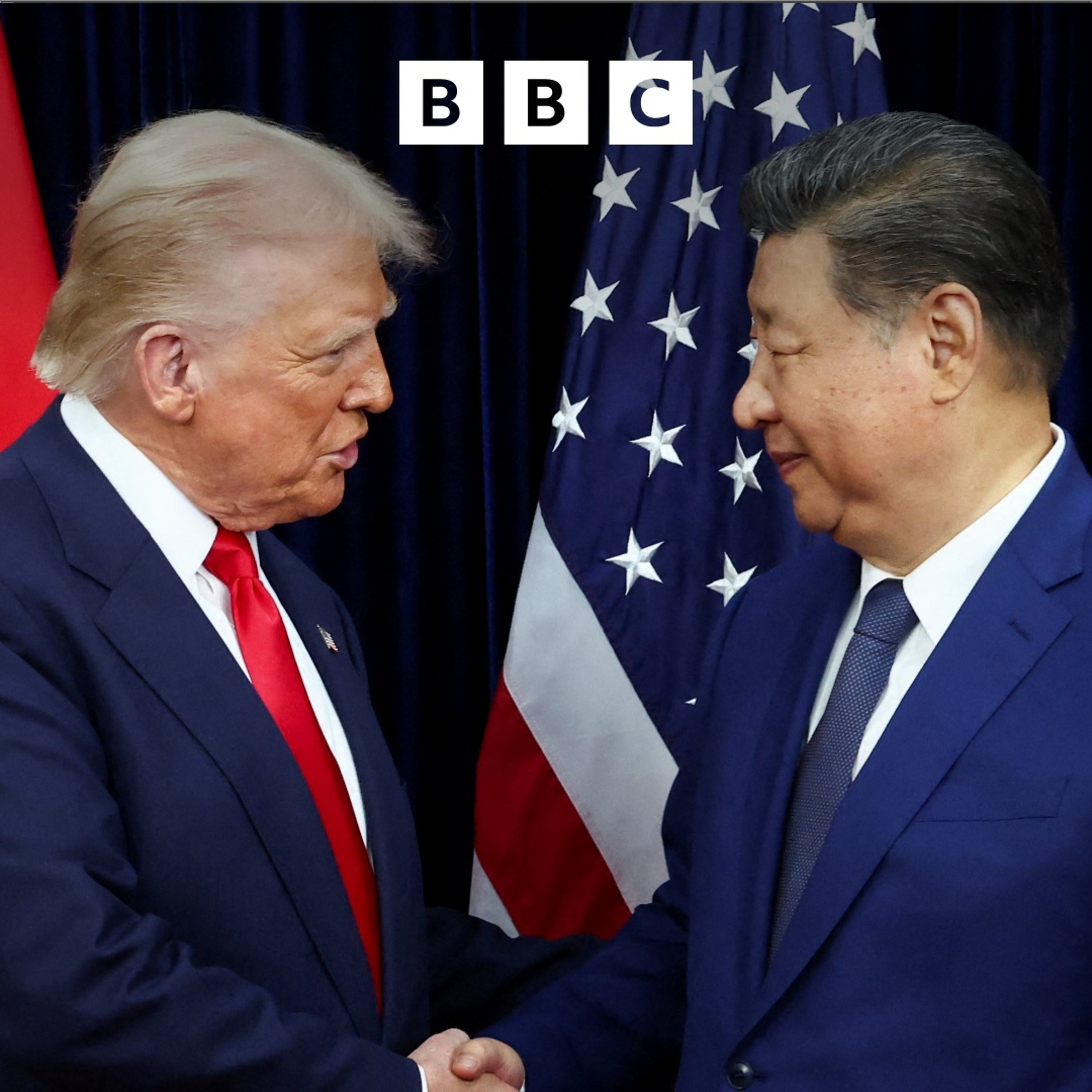
Business Daily
The US-China economic relationship
00:17:28
As Trump meets Xi how is the relationship between the world's two biggest economies?
Loading summary
Transcript54 lines
- [00:00]
Will Bain
This BBC podcast is supported by ads outside the uk.
- [00:06]
Podcast Sponsor/Advertiser
Today's episode is sponsored by Smart Travel, a podcast from NerdWallet. You know that one friend who always finds the best travel deals, picks the right credit cards and somehow ends up in first class for the price of coach? Smart Travel is like that friend, but in podcast form. NerdWallet's travel journalists sort out what's worth paying for. From lounge access to travel advisors to hotel loyalty programs, make your travel dollars work harder. Follow Smart Travel on your favorite podcast app. Ever invest in something that seemed incredible at first but didn't live up to the hype? Like those five dollar roses at a gas station? Or a secondhand piece of technology that breaks in the first 10 minutes? Marketers know that feeling. We optimize for the numbers that look great and impressions reach and reacts. But when they don't show revenue, well, that's a not so great conversation with the CFO. LinkedIn has a word for that. Bullspend. Now you can invest in what looks good to your CFO. LinkedIn Ads generates the highest roas of all major ad networks. You'll reach the right buyers because you can target by company, industry, job title and more. So cut the bull. Spend. Advertise on LinkedIn, the network that works for you. Spend $250 on your first campaign on LinkedIn ads and get a 250 credit for the next one. Just go to LinkedIn.com Broadcast. That's LinkedIn.com Broadcast. Terms and conditions apply.
- [01:41]
Will Bain
Guys, have you ever had a relationship, friendship perhaps that's got a bit awkward? Awkward and then suddenly you've got to see that person again.
- [01:49]
Michelle Fleury
I've got to say I don't like it when you put me on the spot like this because I feel like it's every time you and Raw look at me before we start recording.
- [01:55]
Will Bain
No, no.
- [01:57]
Raoul Sutherland
I come from a large Indian family. Every day I'm starting on a new footing with one member of it or the other. But fortunately with you guys haven't got there quite yet.
- [02:07]
Will Bain
So bygones being let. Bygones. Let's see if that maybe is one of the many themes this week as Donald Trump and Xi Jinping meet the presidents of the world's two biggest economies aiming to reset that relationship. That's today's episode of Business Daily from the BBC World Service. I'm Will Bain here in the studio in the uk.
- [02:28]
Michelle Fleury
I'm Michelle Fleury in New York and
- [02:31]
Raoul Sutherland
I'm holding sat just next to Will in the studio.
- [02:34]
Will Bain
Yes, in the last couple of hours before we started recording, guys, President Trump descending the stairs of Air Force One in Beijing. The first US president in almost 10 years to visit China. And in between, quite a lot's gone on. Michelle.
- [02:48]
Michelle Fleury
Yeah, I mean, if you think back 2017, that's when Donald Trump was doing that sort of hyper grand state visit in between Joe Biden, he never went. Barack Obama went about three times trying to figure out the relationship between these two superpowers. And you're sort of wondering what's going to happen? Are we going to see sort of some groundbreaking diplomatic shift like we saw when Richard Nixon visited Chairman Mao or during the Carter years? Or, you know, is this going to be a bit more of a damp squib?
- [03:23]
Raoul Sutherland
The thing is, all over the world, economies are being affected by the fact that these two don't have a good relationship. President Trump, President Xi, they met in South Korea last year. They didn't get very far. But the fact that they're still talking, that's gotta be important.
- [03:38]
Will Bain
Michelle, you talked about all the things that have changed in that decade. One word, I guess, has been with us throughout that period, though, hasn't it? T for tariffs.
- [03:49]
Michelle Fleury
Yeah, I had a feeling you'd be going for tea for tariffs. We've come a long way, both from the first term when Donald Trump was focused on tariffs on China. Then his second term, he sort of globalized it and put on tariffs on pretty much every country around the world. Where we are right now is what tariffs are at, around 23%, which may sound bad. But then just remember last year, we were pretty much at a economic freeze between these two. And so what's happened is that the Supreme Court slapped Trump's wrist back in February. Then the White House dug up another rule. They kind of threw on a 10% surcharge. Last week, the lower court threw that out as well. But in a twist, which I think you'll appreciate, Raoul. Cause I know you like cinema, cinematic timing. The appeals court saved it just as Trump's plane was essentially fueling up for Beijing. And so the tax is active and we carry on until July 24, when legally they expire. But of course, they are expected to be replaced.
- [04:47]
Will Bain
Well, let's hear from the man himself, shall we, about how he's setting all of that out. Because he's had some pretty strong words in the past, hasn't he, to say about China? This was him talking about those tariffs just last year.
- [04:56]
Raoul Sutherland
For years, we've been ripped off and taken advantage of by China and others. In all fairness, but by China, that's the big one. And it's just one of those things. You know, we're making $2 billion a
- [05:10]
Michelle Fleury
day right now, this country, $2 billion a day with tariffs.
- [05:15]
Will Bain
So President Trump really at the kind of crux of the argument between economically certainly between the two countries. Let's go back to their first meeting. This was 2017 at his mar a Lago resort in Florida. President Xi through an INTERPRETER as two
- [05:28]
Michelle Fleury
distinctive countries, our two sides may have different views or differences on some issues. This is only natural. The key is to properly handle and manage them. There is far more common interest between our two countries than differences.
- [05:45]
Raoul Sutherland
Even in that 10 years, both of you, from when they first met, China's economy has grown, but there are problems that President Xi is having to deal with at the moment. Before we started recording, I spoke to Han Lin. I know Will knows him very well. He's from the Asia Group, very good analysis of what's taking place in China. And he said the problem is because of the property prices going down, people are just not spending. China is still growing, but not growing as quickly as it used to. So President Xi, he needs that US Market.
- [06:16]
Michelle Fleury
And when you've got the US imposing tariffs and sort of essentially trying to close its doors to Chinese goods flooding the US Market, what has happened is you've seen Chinese products flow elsewhere and that is creating headaches for countries in other parts of the world. The U.S. i think, is just looking for an exit ramp. Trump, from what we understand, wants something like a board of trade. All of their people have been having meetings for weeks building up to this to try and work out what are non controversial products. Maybe we could agree we're not going to tariff Those products worth $30 billion of everyday consumer goods and leave the sort of trickier problem children for another day.
- [06:55]
Will Bain
I've heard in the American media people talking about the three Bs, Boeing, beans,
- [07:00]
Raoul Sutherland
beef, the relationship between China and the U.S. of course we're going to talk a lot about the business aspects of it, but there are many other sides of it. Iran at the moment is probably going to be top of the conversation. Taiwan as well. So there's the economics, there's the politics. It's hard to separate them sometimes
- [07:18]
Michelle Fleury
from
- [07:18]
Will Bain
taco night in Tulum to sushi in Tokyo. Make every bite rewarding with gold from Amex wherever you dine. 4 times Membership Rewards points at restaurants worldwide are piling up. Learn more@americanexpress.com Explore Gold terms and points cap apply.
- [07:33]
Raoul Sutherland
Want to Be a star.
- [07:35]
Michelle Fleury
No problem. Anyone can shine on TikTok. Post your first video today. Real life, real story, real you. Download TikTok and get started.
- [07:51]
Will Bain
You're listening to Business Daily from the BBC World Service, where today we're pulling out what the business and economic implications could be from President Trump's trip to China with our business presenter Ryle Tanton here in the studio with me and our North America business correspondent, Michelle Fleury in New York City. Now, how good are you two at packing a bag at short notice? Michelle, you're always on the road. I bet you're better than the rest
- [08:12]
Michelle Fleury
of us at this look. I'm pretty fantastic at it. But the caveat being you don't mind missing a toothbrush, maybe a phone charger, some mismatched socks might be thrown in the mix.
- [08:23]
Will Bain
I was going to say I'm definitely a flapper packer. Everything just goes in. As soon as I can get the zip closed, I'm done.
- [08:28]
Raoul Sutherland
It's not me packing the bag, it's generally me trying to find where it is from where I left it last
- [08:33]
Will Bain
time with the luckily, I think Jensen Huang, the boss of Nvidia, the chip maker, $5 trillion valuation. I'm sure he's got lots of people who do lots of those nice things for him or maybe he's got maybe, just maybe who makes sure all that stuff is done for him. He was a last minute Michelle flown up to Alaska to jump on Air Force One and join President Trump on this trip. We've all covered lots of these trips. They bring lot to their senior sort of business leaders with them and we've got a whole bunch of them coming this time, the likes of the boss of Boeing, Kelly Ortberg. You've got Elon Musk on this trip as well. You've got Tim Cook, the outgoing chief executive Apple. But is Jensen Huang's late arrival, Michelle, a bit of a, kind of a telltale of where some of the pressure points might be this week?
- [09:14]
Michelle Fleury
I think it was a surprise because a lot of the companies that are going, they had order book issues, some sort of troubles they were hoping to get ironed up during this trip. Jensen Huang, because he has a slightly different view on what the US Chinese relationship should be, was kind of notable for not originally being on the list. Jensen Huang runs Nvidia. He sells people high end computer chips and there's been a vigorous debate about whether or not the US should be selling these chips to China because there is this massive race on right now about who will dominate artificial intelligence going forward. And of course, as we know, chips are the key to that. And that's why his inclusion in this trip is so notable.
- [09:55]
Will Bain
And we've seen it back and forth, haven't we, Rahul? The Biden administration, for example, banning these type of chips, that affected not just Nvidia, but European companies too. But seen that that's been a real center of this ding dong recently.
- [10:06]
Raoul Sutherland
It's a really interesting debate because when you talk to people in China, they need these Nvidia chips. Remember, they're not getting the main one, the fast one, the Blackwell one. They're getting the generation before that, the HV2. But the government is saying, we don't want Chinese companies to use Nvidia's chips. We want you to develop your own and use those chips as well. The problem is Chinese businessmen are saying to the government, those chips are just not good enough at the moment. And Nvidia's point is, if China is reliant on chips coming from the US doesn't that give Nvidia and the US Leverage? To be honest here, Nvidia is now. It's part of America's foreign policy, isn't it?
- [10:43]
Will Bain
Well, let's hear a bit from Jensen Huang. And here he is talking about China to podcaster and AI researcher Dwarkesh Patel last month on Patel's own podcast.
- [10:51]
Guest Speaker (e.g., Jensen Huang or Ethan Frisch)
They manufacture 60% of the world's mainstream chips, maybe more. They have some of the world's greatest computer scientists, Most of the AI researchers in all of these AI labs, most of them are Chinese. They have 50% of the world's AI researchers. And so the question is, if you're worried about them, what is the best way to create a safe world? Well, victimizing them, turning them into an enemy likely isn't the best answer. They are an adversary. We want United States to win. But I think having a dialogue and having research dialogue is probably the safest thing to do.
- [11:22]
Michelle Fleury
So you've got Jensen Huang there arguing engagement is key. As Raoul was saying, they want leverage for the Americans. But there is pushback, I got to say, from Congress. Lawmakers here say we've tried that with manufacturing. That notion of kind of leverage doesn't work. The Chinese are happy to welcome American companies in until they develop their own, and then they kick us out. And there is this huge debate about whether or not export bans are the way forward. And in fact, just as the Americans were packing their bags to go to China, the Commerce Department officials apparently dropped a bomb on China's Second largest chip maker, Hua Hong, and it ordered a couple of US Companies to stop shipping tech tools to them. It believes China is making these sophisticated chips to kind of replace American ones. So you've got America essentially trying to disrupt China's AI plans.
- [12:16]
Raoul Sutherland
You certainly do. I want to go back to something that I looked at. I made a program on which was China's new five year plan. And President Xi in that used the word AI 52 times. And I think that gives you an indication, you know, the last five year plan. It was in five times. I think it gives you an idea of where we're going with this. And this is the next new battle between both countries.
- [12:40]
Will Bain
Michelle, in your newsletter this week, you called it the new Cold War.
- [12:43]
Michelle Fleury
Yeah, I mean, this is where on the economic front, obviously there's massive productivity gains. On the military side, there is obviously huge questions, but both countries are throwing everything at it. I mean, here where I am sitting, you've got the American firms really focused on kind of what you call Frontier A.I. in other words, super intelligent computers. I think the Chinese, I think you know more about this. They're taking a different approach.
- [13:14]
Raoul Sutherland
They are, but I think on that point of how they're disrupting each other, you know, Meta recently was trying to buy managed that company there. The Chinese said, no, you can't do that. So they're all trying to restrict each other. Can I just pick up on a point on the Cold War? Because I think this is really important. I grew up, you know, William's a little bit younger than me, just a little bit, Michelle, not that much. And, you know, grew up at that time with the Soviet Union and the United States in the Cold War. But this one, I think is completely different because that was a military. That was military tensions between them, control of the world in different areas. But they were never close economically in terms of the Soviet Union and the US And I think this is what is different here. You know, China's a $20 trillion economy. The US is a $30 trillion economy. That gap is getting closer. So is it not inevitable that these two countries are not, well, going to get on with each other because they are in competition militarily, influence economy in all those areas? I mean, I'm not quite sure that they're ever going to be able to get on.
- [14:12]
Michelle Fleury
Well, I mean, I think that's at the heart of this debate, right, is they do need to find some ways to cooperate because the economy is global, everyone gets sucked in. And that's why I think the three of US are here talking about this today. You know, if this is about the US And China and how they can work together, if that's even, as you point out, possible, given the rivalry they face. That's where AI becomes so important in this debate because people see it on the military side, nuclear weapons, biochemical attacks, cyber attacks. On the economic side, there's those huge productivity gains. Whoever controls this technology will have a huge leg up. And in fact, one of the things the Wall Street Journal, there was an article saying one of the things they might discuss is an AI safety hotline, a way to try and de escalate things if suddenly you start getting into the red hot zone.
- [15:08]
Will Bain
And so as we round this out, then is kind of the tip of the spear, if you like, of some of where the tension is, those broader issues. I mean, I was looking this week, Michelle, in the United States, bipartisan, which is a very rare thing in your part of the world, bipartisan bill coming forward.
- [15:24]
Michelle Fleury
So what is that?
- [15:25]
Will Bain
Yes, exactly. Coming forward between Republican and Democratic senators to try and block those Chinese car manufacturers, the likes of byd, from being able to sell and build plants in the US has it now got to a point, perhaps, Raoul, where that tension from the people you've spoken to, particularly close to the Chinese government and looking at the Chinese economy closely, has it come to that point where actually the US Is such an unreliable partner from their perspective that they have already looked elsewhere? And as a result, compared to 2017, where we started this program, it's not kind of the same stakes as perhaps were at play a decade ago?
- [15:59]
Raoul Sutherland
No, I just came off the phone, somebody in Shanghai, the commercial capital, who said, look, he'd been speaking to a lot of Chinese CEOs, they're not even paying that much interest to this. They don't think a lot's going to come out of it, but they do think good communication is taking place, those tariffs. So Michelle's not going to be as busy as she was for a while and not going back up. And they have some, some idea in the business. But I spoke a while ago to one of the leading economists in China. He's still advising the government and he said the mindset of China has changed here. The US Is seen as unreliable. They want to be the stable player in the global economy. Now, Michelle, that is quite a change, isn't it?
- [16:37]
Michelle Fleury
Yeah. I mean, the other big change, of course, is leverage going into this. If you think about over a year ago, it was America that was deemed to have held all the cards. But once this tariff war started. The US Blinked, and China realized they could in some ways call America's bluff when it came to tariffs. Now we're talking about AI Again. I think there is this sort of same approach. How many cars does each side hold? That is a big shift from where we've been in the past. Both men want to save face, want to cut deals. So we might hear lots of announcements about Boeing planes, as you alluded to, or American soybeans being bought. But managing the tension isn't really the same as solving the problems here. And all of this is reliant, really, on the personal chemistry of Xi and Trump to manage this massive rivalry that has huge consequences for all of us.
- [17:31]
Will Bain
And we've talked about these gigantic companies a lot, the Metas, the Boeings that work all around the world. Within reason, they can sort of ride these shocks, can't they, because of the size of them. But in both countries and actually around the world in the supply chains to these smaller firms, that can still be impacted. And we thought we'd give you a little snapshot of one of those. Ethan Frisch is the co founder and CEO of a company called Burlap and Barrel imports spices into the United States. This is what he told us on the World Service last week.
- [17:58]
Guest Speaker (e.g., Jensen Huang or Ethan Frisch)
We wound up paying close to $200,000 in tariffs under the first tariff regime that was imposed by the administration. You know, we're a small company. That's a lot of money in our. In our budget. That's money that we are now not able to spend on buying devices from around the world. It has been a real damper on our plans for growth over the past year.
- [18:17]
Will Bain
And Michelle, all three of us have spoken to so many companies of that kind of size, haven't we? People who are exporting grilling tools and barbecue tools to the United States, people importing plastic toys, even if they're here in the UK or Europe. What that's doing to the sort of wider supply chain and the wider cost there as well, is that somewhere that you think realistically that we could find some peace this week if they can't get somewhere on the really big stuff, as you guys have mentioned, the bar
- [18:43]
Michelle Fleury
is so low that as long as this summit ends with nothing else being broken, that is what people are talking about. Stability, status quo.
- [18:52]
Raoul Sutherland
And I think every time there's a problem between China and the U.S. my friends in India, I get phone calls. Great news, more iPhones coming to India. On the other hand, I was being somebody in Vietnam, and they said, look, great for our economy. You know, lots of exports have gone up. But we need a relationship with China. They are our biggest market. And that is the problem. Everybody trying to juggle these two countries. Someone said to me, can they just not get on for a while?
- [19:21]
Will Bain
Well, let's find out. In a way, I hope they sort of don't because it'll be good content for us going forward on the podcast here as well. I'm absolutely certain that we will continue to talk about that topic in the future. But until then, thanks so much. Michel Fleury as always in New York, Royal Tandem here in the studio with me, I've been Will Bain. Thanks so much for listening to Business Daily from the BBC World Series. From taco night in Tulum to sushi in Tokyo, make every bite rewarding with gold from Amex wherever you dine. 4 times. Membership rewards points at restaurants worldwide are piling up. Learn more@americanexpress.com Explore Gold terms and points cap apply.