← Business Movers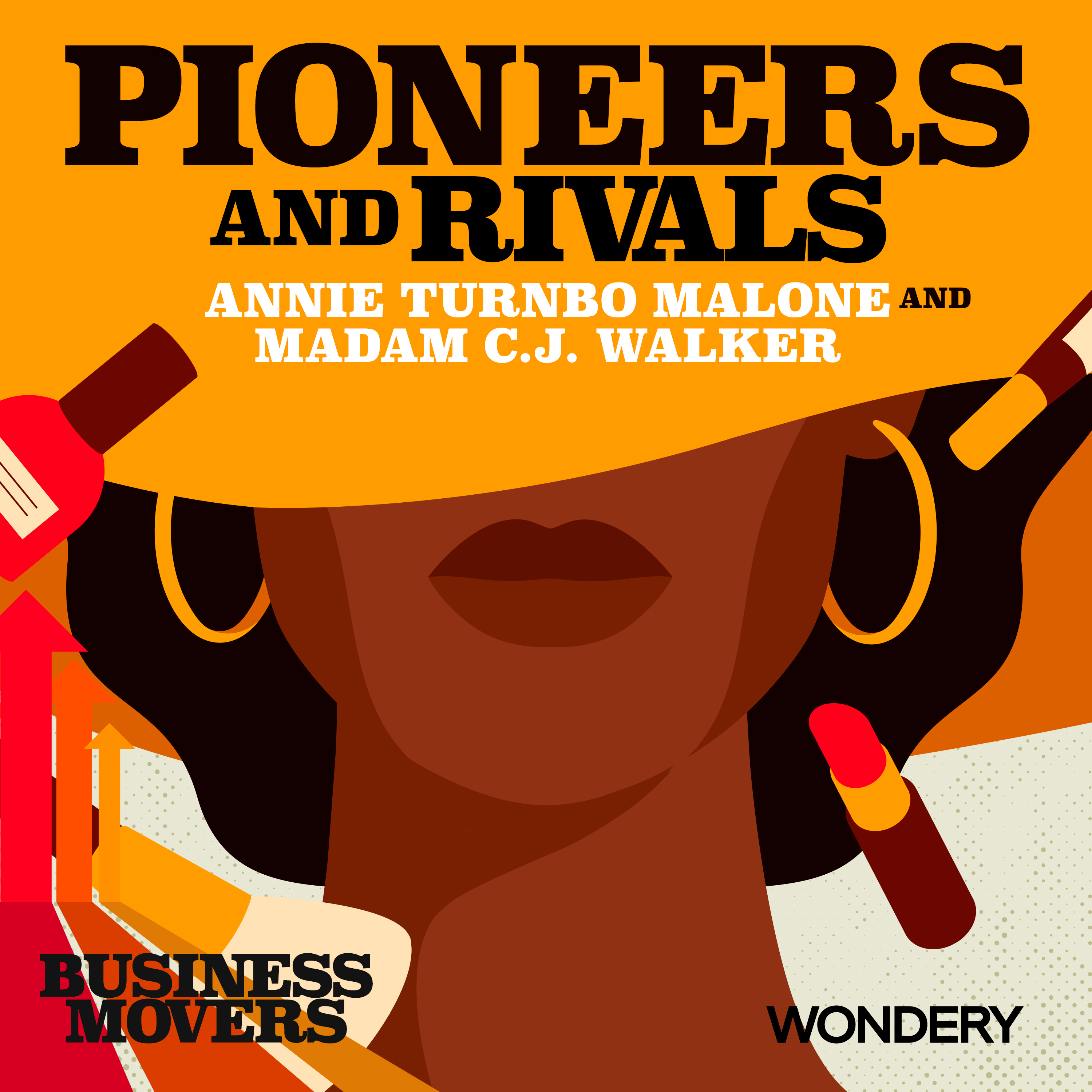
Business Movers
Pioneers and Rivals - Annie Turnbo Malone and Madam C.J. Walker | A’Lelia Bundles Discusses Her Ancestor’s Role in Pioneering the Black Haircare Industry | 5
00:47:43
Loading summary
Transcript70 lines
- [00:00]
Lindsey Graham
Want to get more from business movers? Subscribe to Wondery for early access to new episodes, ad free listening and exclusive content you can't find anywhere else. Join Wondery in the Wondery app or on Apple Podcasts. It's the evening of May 31, 1917, at Bethel African Methodist Episcopal Church in Indianapolis, Indiana. 49 year old Sarah Walker joins a group of women chatting at the back of the church as they wait for a Missionary Society meeting to begin. Sarah attended services here before she moved to New York City, but now she's back in Indianapolis for a few days and she's made sure she had time to visit her old church. Because Sarah knows the guest speaker the Missionary Society has invited tonight is her old boss and business rival, Annie Malone. Sarah has hardly spoken to Annie since their split 12 years ago, but she hopes this might be an opportunity to clear the air. She approaches one of the organizers. Mary, I'm so looking forward to tonight's talk, but I know you like to start meetings with a hymn or two and I wondered if you'd like my bookkeeper, Miss Flint, to play. You'll remember she's a wonderful piano player. But before the organizer can answer, a familiar voice cuts in. Oh, that won't be necessary. Sarah turns to find Annie Malone glaring coldly at her. Sarah tries a smile. Oh, Annie, hello. I hadn't seen you come in. I thought that since Ms. Flint is here, you might like to hear her play. She really is wonderful. Oh, I understand that this used to be your church, Mrs. Walker, but tonight this is my talk. Of course. I meant no harm. Although I know you don't always pay attention to little things like ownership. Sarah bristles because she's not used to being spoken to like this, but she takes a deep breath and forces a smile. Annie Mrs. Malone, please. Mrs. Malone. Of course. Why don't we talk later? No, we can talk now. It was just a friendly offer. Like when you offered to go to Denver and be my representative there. Like when you then offered my hair grower to clients with your name printed on it. That kind of offers. I see. Maybe it's best I leave. Perhaps I shouldn't have come. Well, we all have regrets, don't we? And I regret ever knocking on your door. That was years ago. Look how far we've both come since then. Doesn't that matter more? I've read all about how far you've come in the newspapers. A mansion on the banks of the Hudson, right? Living right up there with the rest of the folk who got rich off other people's work. Well, you gave me my start, Mrs. Malone. I admit that. And I thank the Lord you did knock on my door that day. But it was just a start. I worked hard. Since then, I've worked my hands to the bone to get where I am. And I won't apologize for that. Annie just stares. Sarah sighs. Well, I better go. This is not what I wanted. Sarah shoots the organizer an apologetic look before turning to walk away. Annie steps forward. I know who you really are, Madam C.J. walker. You'd still be a washerwoman if it weren't for me. More than a decade after becoming Annie Malone's competitor, Sarah Walker had hoped to mend fences with her former boss. But Annie was not ready to forgive and forget, and soon time would run out for any reconciliation. Two years after this encounter in Indianapolis, Sarah Walker would be dead. In the obituaries, in the national press, Sarah was praised as a pioneering black businesswoman who but she wasn't the only one who had blazed that trail. Together, Annie and Sarah had helped create an entirely new industry. But they'd done far more than just that. They'd also shattered preconceptions and redefined what was thought possible for African American women in the 20th century. Business movers is sponsored by Attentive. Imagine for a moment if you got a message from your favorite brand and it's so specific and personalized it feels like it was created just for you. Well, chances are if you got such a message, they're using Attentive, the SMS and email marketing platform designed to help brands build and connect with their ideal audience. Attentive helps marketers create unique messages for every subscriber, transforming the consumer shopping experience and maximizing marketing performance. It works like this. Attentive's AI learns what subscribers actually want based on their real time interactions with your brand and and that means it customizes the content, tone and even timing of every message so they always resonate. If you're ready to take your customers on a journey created just for them, visit attentive.com businessmovers to learn more. Business Movers is sponsored by ShipStation. Right now it's 4:41pm and I have 19 minutes to write and record this ad and get to my daughter's school for important parent stuff. Oh goodness. Now it's 4:43 and all of this because of a bit of chaos earlier in the day. In business, a little chaos can spell big trouble. But for those of you in charge of order fulfillment for an e commerce business, there's ShipStation to keep your day to day remaining calm. Save time and money every month by shipping from all your stores with one login, automating repetitive tasks and finding the best rates among all the global carriers. Calm the chaos of order fulfillment with the shipping software that delivers. Switch to ShipStation today. Go to ShipStation.com and use code movers to sign up for your free trial. That's shipstation.com code movers. Look, it's 4:46 shipstation.com code movers from Wondery, I'm Lindsey Graham, and this is Business Movers. Today, the global hair care market is worth more than $100 billion a year. It's an industry dominated by a handful of multinational corporations, each with thousands of employees and enormous budgets for research and advertising, all dedicated to finding the next competitive edge. But at the beginning of the 20th century, the the industry looked far different. Hair care pioneers built businesses out of their own homes, where they brewed up shampoo and conditioner in kitchen laboratories and sold them directly to salons and consumers. There were dozens of such operations across America. But among the most successful and remarkable of these early innovators were Annie Malone and Sarah Walker. Annie Malone built on knowledge passed down by her enslaved ancestors to create a new hair conditioner she called her Wonderful Hair Grower. And it was this same formula under a different name that became the foundation of Sarah Walker's business as well. Annie never forgave Sarah for what she saw as stealing her product and turning from employee to competitor. But the two women shared more than just a formula for hair conditioner. Their paths may have diverged when they split, but their lives would continue in parallel. Over the years that followed, both Annie and Sarah's companies expanded rapidly. Both women used similar distribution networks of trained hairdressers, and both faced prejudice from those who doubted that black businesswomen had what it took to succeed. But above all, both shared a commitment to giving back. Sarah Walker donated thousands of dollars to the NAACP and other organizations, and Annie Malone gave so generously to a local orphanage in St. Louis that it was eventually renamed after her. Today, Annie's company, Poro, has been consigned to the history books, while Madam C.J. walker is just another brand in the vast portfolio of consumer goods giant Unilever. But whether their name still appears on store shelves or whether their products can now only be found in museums, the legacies of Sarah Walker and Annie Malone live on. Here to talk more about the women behind the Poirot and Madam C.J. walker Companies is a'lelia Bundles, author of on her own. The life and Times of Madam C.J. walker. A'Lelia Bundles, thank you for speaking with me today on Business Movers.
- [08:19]
A'Lelia Bundles
Delighted to be with you.
- [08:21]
Lindsey Graham
Now, normally I would start an interview like this with an author and subject matter. How did you become interested in the topic? But Sarah Walker is your great great grandmother. Now, growing up, I didn't learn much about my great great grandparents. But what were you told?
- [08:36]
A'Lelia Bundles
Well, my mother was vice president of the Madam C.J. walker Manufacturing Company when I was growing up. So that's where she went to work. And I would sometimes go with her to her office. So I knew that I had a famous great great grandmother, but we did not sit around the dinner table talking about her.
- [08:55]
Lindsey Graham
How did your infatuation with her develop then?
- [08:58]
A'Lelia Bundles
Well, actually, the last thing in the world I thought I would be doing at this stage in my life is telling Madam Walker's story. Both of my parents worked in the hair care industry, but my real passion was writing and I became a journalist. And that's how I wanted to make my mark. And my parents were very wise in letting me follow my own passion. But when I was in graduate school at Columbia University in journalism, my advisor, Phyllis Garland, the only black woman on the faculty, recognized my name, A'Lelia and its unusual spelling. And she said, as I was trying to figure out my master's paper topic and I pitched some cliched and boring topics, she said, Your name is A'Lelia. Do you have any connection to Madam C.J. walker and A'Lelia Walker? That was the fall of 1975. And I said, yeah, that's my family. And she said, that's what you're going to write about.
- [09:55]
Lindsey Graham
So it was forced upon you. How did you do?
- [09:59]
A'Lelia Bundles
Well, it was forced upon me, but I will just for some perspective, in 1975, there were very few books that were being published by black authors or about black topics. So there. It wasn't as if somebody was trying knocking down my door. But in some ways, Phil Garland validated for me the importance of this family story. So I would say my arm was twisted mainly because I was not leading with that as who I was. But Phil was very smart to tell me this is an important topic and you are the person to tell the story.
- [10:35]
Lindsey Graham
But this was much earlier than when your book on Madam C.J. walker came out in 2001, correct?
- [10:42]
A'Lelia Bundles
That is correct. That's correct. So 1975, 76. I wrote this master's paper about Madam Walker before the Internet. You know, you still had to go to libraries and travel, to do research. And there again, the publishing industry was not clamoring for a book on Madam Walker. So I did little things along the way. I worked on a Madam Walker postage stamp that came out in 1998. I wrote a young adult book on Madam Walker that came out in 1991. That was the first biography of her, even though it was a young adult book. I did speeches, I wrote articles. And so I was, in some ways, seeding the ground to tell Madam Walker's story. And then eventually the book On Her Own Ground came out in 2001. But there have been a lot of little things, a lot of little seeds planted between 1975 and 2001.
- [11:39]
Lindsey Graham
So I suppose as you're tending this garden, you're probably gathering quite a few resources, and you're well positioned to tell the story, being in the family. But was this a difficult process to write your book? How well documented was her life?
- [11:52]
A'Lelia Bundles
You know, we are really fortunate that we have literally tens of thousands of documents. One of the brilliant moves of Madam Walker's life is that she hired a really smart C suite. Her attorney, F.B. ransom, would have been. He was called the general manager, but now he would have been the cfo, the cio, the cto, and all of those things. But he really organized the business, which allowed her to be the visionary and to travel and to organize people. So because of him, and because of one particular secretary, Violet Reynolds, who started working for the company in 1916 when she was a teenager and was still working for the company in 1970, she saved these documents. And to the degree that more than 40,000 pages of photographs, bills, legal documents, letters, have been digitized and are at the Indiana Historical society. But in 1975, when I was really beginning my research, those things were, I guess we would say, analog. They the pieces of paper that I photocopied. So I had a corpus of material that most people, you know, very few women owned businesses or businesses that are owned by African Americans, have the kind of body of material that I'm fortunate to have.
- [13:16]
Lindsey Graham
Now, presumably, there was also a lot of family lore. But I'm wondering, were there any discoveries in your research that surprised you?
- [13:23]
A'Lelia Bundles
Tons of discoveries. I mean, as I say, we did not sit around the dining room table talking about Madam Walker. So a lot of what I discovered came from those documents. And then I did a lot of additional research in especially black newspapers. You know, now you can find things online on Newspapers.com and ProQuest and other places. But then it really required visiting more than a dozen cities with libraries, historical societies, courthouses, and really piecing that together. I'll tell you a couple of early discoveries in St. Louis at the Missouri Historical Society that I visited in the early 80s when I was working on the young adult book, they had city directories. Now, we would just now go online and find an address or a phone number for somebody. But at that point, each city had a directory that was used by salespeople, used by fire departments. And in those directories, I discovered brothers, Madam Walker's brothers, who were listed in 1888, 18, 1878, 1879, 1880. That helped me realize that the reason she came to St. Louis from Louisiana is because she had family there. Well, that began to help me create her community in St. Louis. So that was very. And then another key discovery for me was just how much of a political activist she was, how much of a philanthropist she was. I knew a little bit about the philanthropy. The political activism was really a revelation.
- [15:02]
Lindsey Graham
Now, many of our listeners will be most familiar with Madam CJ Walker and Annie Malone because of the 2020 Netflix series, Self Made. Did you have any involvement in that?
- [15:13]
A'Lelia Bundles
So my book On Her Own, the Life and Times of Madam C.J. walker, was optioned, as they say in Hollywood, for that. So it was the nonfiction inspiration for the Netflix series. And while I had what was called script review, which meant that the showrunners and producers had to show me the scripts before they were filmed, I did not have script approval. And so there are some things in the series that are really not true and that I really would have done differently. But I did have some involvement in that and that my book was the inspiration.
- [15:53]
Lindsey Graham
I was wondering if I should dare ask how you thought it turned out.
- [15:56]
A'Lelia Bundles
Oh, you should ask. I talk about it all the time. I'm happy to talk about it. You know, Octavia Spencer was great. I mean, I am really happy that she was the one who played the role, because in my interaction with her in my one day on the set, I know that she really understood and had a great deal of respect for Madam Walker. But I think the showrunners really were kind of leaning into the least common denominator, and they wanted to do what I was hoping for, something like Hidden Figures. That was really inspirational. I feel like they veered a little bit towards Real Housewives of Atlanta. They sort of invented and intensified a conflict between Madam Walker and Annie Malone. They made it in part over skin color. They turned Annie Malone into a drug addict. I mean, those things were. I Don't know, offensive to me because I think both Madam Walker and Annie Malone are really important historical figures who did a lot to empower other women.
- [17:00]
Lindsey Graham
So if this Netflix series altered the facts a bit and perhaps sensationalized the relationship between Annie and Sarah, how would you characterize what was actually happening between these?
- [17:12]
A'Lelia Bundles
So Madam C.J. walker and Annie Malone, at that point, Annie Turnbow, were both women who were trying to make a better life for themselves. And Madam Walker, who at the time, when she moved to St. Louis, was a washerwoman named Sarah Breedlove. Sarah Breedlove McWilliams. Her first husband was McWilliams. Her brothers had migrated to St. Louis a decade earlier. They were part of that post reconstruction, post 1876 election that was quite violent in places like Delta, Louisiana, where the black population was in the majority and had begun to get some political power, but were pushed out by the Ku Klux Klan. And her brothers had, especially. Her older brother had been a salesperson in a shop. You know, didn't own the shop by any means, but had deposited money in the Freedmen's bank. So he was a forward thinking person. He really, with their family minister who had been a state senator, was chased out of Louisiana and settled in St. Louis. In St. Louis, he opened a barber shop at a time when black men dominated the barbering trade in most American cities. So he had a bit more agency power than the average black laborer. He also belonged to St. Paul African Methodist Episcopal Church. The AME church was very instrumental in helping new settlers to the city adapt. And he introduced Sarah to the women of the church. And she had a good enough voice to be in the choir. She was in the missionary society, and she was modeling herself and being mentored by these women in the church, including a schoolteacher named Jessie Batts Robinson, who later would run her St. Louis school and beauty salon. But though that was the community that she was a part of. Annie Malone moved from Metropolis, Illinois and Peoria to St. Louis around the time of just before the World's Fair. And they met at some point. We don't have details on exactly when they met, but Sarah Breedlove was already a part of a community there and had brothers who knew something about hair care. But those brothers died sort of in quick succession. And she met Annie Malone and for a while sold Malone's Products in St. Louis. And then to escape a really violent second marriage, moved to Denver, where she worked for a pharmacist who saw that she was selling the products. And he said, well, there are other products already like this on the market, including Cuticura. You know, you really can make your own products and if you tell me you want to switch up the formula to do a little bit more of this and that, and that was how she came up with her own formula. And then her third husband, Charles Joseph Walker, moved from St. Louis to Denver and she began to call herself not Sally McWilliams but Madam C.J. walker, using the name of her third husband, Charles Joseph Walker.
- [20:33]
Lindsey Graham
American Scandal is sponsored by Tech Unheard, a new podcast from ARM and NPM that takes you behind the boardroom door with technology's most inspiring leaders. Technology, especially these days, is evolving fast. But I think it's more than just the pace of new innovations. It's how technology is increasingly changing the way we interact with the world and each other. ARM is a leader in chip manufacturing on the forefront of this change, so it's fantastic insight to hear their CEO Renee Haas talk with other tech leaders about trends, forecasts and their own thoughts on leadership in a fast paced, high stakes world like this. Clip from a conversation with Mike Gallagher from Palantir Technologies My sort of personal.
- [21:12]
Unknown
Mantra in life is just to make original mistakes. My only goal is to not be making the same mistakes over and over again. And I try to encourage my subordinates to make original mistakes and give them enough of a leash where they don't feel like they're going to get punished for taking intelligent risks.
- [21:26]
Lindsey Graham
Get in the room with some of tech's biggest leaders. Tune in to Tech Unheard from ARM and npm. Wherever you get your podcasts, here's a.
- [21:34]
Unknown
Tip for growing your business. Get the VentureX business card from Capital One and start earning unlimited double miles on every purchase. That's right, with unlimited double miles, the more your business spends, the more miles you earn. Plus, the venturex Business Card has no preset spending limit, so your purchasing power can adapt to meet your business needs. The VentureX business card also includes access to over 1,000 airport lounges. Just imagine where the VentureX business card from Capital One can take your business. Capital One what's in your wallet? Terms and conditions apply. Find out more@capital1.com venturexbusiness.
- [22:26]
Lindsey Graham
What do you think made this moment the start of the 20th century, an ideal time for the black hair care industry to develop, to be able to sustain these two giants of the industry?
- [22:36]
A'Lelia Bundles
Well, at that point in the early 20th century, we're still really just two generations out of slavery. So 1913 was the 50th anniversary of the Emancipation Proclamation. And while 90% of African Americans really were still living in the south and many in the rural south as sharecroppers, people were becoming more urban. And especially with the ramp up to World War I, the first great migration was happening. And there people were coming to the cities and they were. They wanted to be more sophisticated. They really on these. In these rural areas with no indoor plumbing and no electricity, hygiene was very different. And so women were losing their hair. And Sarah Breedloves, Madam Walker's formula really was the secret, just as with Annie Malone's wonderful hair grower, was to wash your hair more often, to sort of heal the scalp from the really bad scalp infections, because people didn't wash their hair often and then to apply an ointment. In Madam Walker's case, it was petrolatum, like Vaseline, petroleum jelly and sulfur, which is a centuries old remedy for scalp and skin infections.
- [23:55]
Lindsey Graham
But both Annie and Madam C.J. walker, both Poro products, and Madam C.J. walker also had a very specific type of business model, an early form of franchising. How important do you think it was this was for their success?
- [24:08]
A'Lelia Bundles
Well, I think they both realized that they weren't being spoken to in some of the ladies magazines. That was not how they were gonna get their advertising done. I know in Madam Walker's case, she really saw an important model with how black women were organized, both in the AME Church and in the Baptist church. The women's auxiliary, they had meetings, the missionary society, the choir, but they also had national conventions. And then during the World's Fair in 1904, an organization called the national association of Colored women met in St. Louis and had some of their meetings at Madam Walker's church. She was still at that point, Sarah Breedlove McWilliams. But those women had organized in the 1890s. They were really, they wanted to be a part of the suffrage movement. And many of these women, and extremely well educated, some who had studied in Europe, were denied membership in the white suffrage organizations. And so they created their own organization, the national association of Colored Women. And they at this point had chapters in many states around the country. They were organizing orphanages and kindergartens and community centers, retirement homes, because there was no safety net. So she saw what these women were doing and that they had been able to create a national organization. So that years later, as she was recruiting her agents all over the United States, the Caribbean and Central America, she kept their template in mind. When she had her first national convention in 1917, she said that she was Organizing the infrastructure modeled by and inspired by the national association of Colored Women.
- [26:08]
Lindsey Graham
But isn't it interesting that even though they took their inspiration from these social progress organizations, that even within the black community, some of the highest profile individuals like Booker T. Washington were skeptical about Annie and Sarah's prospects. Why do you think these people were not more supportive?
- [26:27]
A'Lelia Bundles
Well, you know, I think that with Booker T. Washington, it's interesting especially, and one of the, one of the things that the Netflix series really got wrong was just how powerful these women were. Booker T. Washington's wife, Margaret Murray Washington was president for a couple of terms of the national association of Colored Women. So he knew the power of women being organized. And he's sort of portrayed as a total misogynist in the film. He was not, he wasn't always the most progressive, but he was not as portrayed in that, in the series. And he was really concerned about the white owned companies that were essentially selling snake oil to black women, really exploiting the, you know, some of the racism. That was clear when people would say the sort of the pseudoscience that would say, well, black people have kinkier hair, their hair is not straight. Well, that means that they're really more, they're closer to animals than to human beings. And so he was operating with that knowledge of people trying to exploit that sense of racial superiority and racial inferiority. And so he was not a fan of what he thought were hair straighteners because those ads appeared in black newspapers. Kink Killa was one of the names. And it would show a before and after picture of a woman who really looked untidy and who clearly was a brown person. And then the after picture would show a European looking Gibson, the more the ideal of, you know, white beauty. So he was, he was concerned and sensitive to that. But Madam Walker's answer to that was, I'm not selling hair straighteners, I'm selling hair growers. Essentially, wash your hair more often, apply this ointment, heal your scalp disease, your dandruff, and then your hair will grow.
- [28:33]
Lindsey Graham
So throughout her business and life, Sarah Walker moved both herself and her business between several different cities. How varied would her experience of business climate, of racial discrimination have been in different parts of the United States at the time?
- [28:47]
A'Lelia Bundles
You know, it is really pretty amazing. I will say this to you, Lindsay. I've lived with this story so long that some of the things I just say, oh, yeah, that's what happened. But when I really reflect on it, how much she moved was really quite extraordinary for a woman and for a Black woman, given how difficult it was just to, you know, for. Move to one side of town to the other. But most Americans at that point were born and died in the same town. But she had this desire to keep moving to better her life. And that first move from Delta, Louisiana to St. Louis was a huge move. And then St. Louis to Denver. And then she and Charles Joseph Walker moved from Denver to Pittsburgh, where they briefly stayed and set up their. Her first beauty school, Lelia College, named after her daughter. Then she moved to Indianapolis. And Indianapolis was at the time. Now, that's where I grew up. So I know this about Indianapolis. It was the center of population for America in 1910. When she got there, it was called the crossroads of America because of all of the trains that went through. And she had a mail order business, so it was a good place for her to be, to operate her business. But that idea, which is what you'd ask me, how unusual was it? It was really quite unusual for a woman to move a business, for a woman to travel as extensively as she did, and certainly for a black woman, because in the north it was a little bit better. But if she went below the Mason Dixon Line, she would have to sit in the train car. And the colored car, as they called it, was usually right behind the engine. And so it was dirty and sooty. But that was the nature of the Jim Crow laws and customs during the period of time.
- [30:42]
Lindsey Graham
Now, Sarah, in addition to moving often, she got married often. She seemed to have been a bit unlucky in love before our series even began. She had two husbands. Was this unusual at a time?
- [30:55]
A'Lelia Bundles
Well, her first husband, Moses McWilliams, died when she was 20, and her daughter was 2. So that was a loss. She was now a young widow. Then the second husband, John Davis, whom she married in 1894, about six years after she arrived in St. Louis. That marriage came during a really horrible economic crisis, the panic of 1893, right after that, and really after the death of her oldest brother, the most dependable brother. So my interpretation, without having, you know, letters to document this, is that her life was really unstable. And she married thinking that she'd now have a partner. But it turned out to be a really bad decision. And that marriage really kind of ended pretty quickly. But even though she stayed married to him for another. Another few years. And then I think Charles Joseph Walker, who was more polished, he had been a salesman for newspapers in St. Louis. He had ideas about putting on events. When they. He moved to Denver, they got married and they in the Denver Black newspaper. There are advertisements where together they are doing picnics and festivals. And he's has raffles and she's selling hair care products. So I think that seemed to her like a good match. But then over time, she had more ambition than he did.
- [32:24]
Lindsey Graham
That brings a question to mind. How much of a team do you think Sarah and C.J. were?
- [32:30]
A'Lelia Bundles
So Madam C.J. walker. And you know, I will say this to you, that she would not like for people to call her Sarah. And I just put that in perspective for the audience. You know, there was, during that period of time, there was a great deal of disrespect for black women. And people who didn't know you might call you by your first name as a way to sort of keep you in your place. And so she intentionally named herself Madam CJ Walker so nobody would know her first name. But I think initially they really were a team. And I just think that, as she said to a reporter, when we began to make $10 a week, my husband thought that was enough. $10 was a lot of money then. And she said, but I knew that we had something that was bigger than that. So I think it started out okay. And, you know, sometimes that happens with teams where somebody has a different vision. And I think she was developing a different vision.
- [33:28]
Lindsey Graham
Well, in enduring respect, I will from henceforth call her madam C.J. walker.
- [33:35]
A'Lelia Bundles
Well, I just, I just thought, you know, and it's not something that we think about now because people, and some young people say, well, why would she take her husband's name? You know, but then you really had to take your husband's name in some ways as protection. Women couldn't own property in their own names.
- [33:57]
Unknown
Ladies, is everyone trying to fix their health concerns with unproven gummies and tricks? Well, thank goodness low libido has a real clinically proven treatment. Low libido can be so frustrating. But there is a treatment called Addi. Addyi. Addi is the first and only FDA approved pill proven to boost sexual desire in certain premenopausal women. Isn't that great a clinically proven option for your low libido that comes from a doctor, not a gas station. Learn more@addi.com and take charge of your sexual health with a treatment that's backed by science. Remember, that's Addy A D D Y.
- [34:35]
Dash com Addi or Flovanserin is for premenopausal women with acquired generalized hypoactive sexual desire disorder who have not had problems with low sexual desire in the past. Who have low sexual desire. No matter the type of sexual activity, the situation, or the sexual partner, the low sexual desire is troubling to them and is not due to a medical or mental health problem, problems in the relationship or medicine or other drug use. Addi is not for use in men or to enhance sexual performance. Your risk of severe low blood pressure and fainting is increased if you drink one to two standard alcoholic drinks. Close in time to your Addi dose. Wait at least two hours after drinking before taking ADDI at bedtime. Your risk of severe low blood pressure and fainting is also increased if you take certain prescriptions over the counter or herbal medications or have liver problems. Low blood pressure and fainting can happen when you take Addi. Even if you don't drink alcohol or take other medicines, do not take if you are allergic to any of the ingredients in addi. Allergic reactions may include hives, itching or trouble breathing. Sleepiness, sometimes serious can occur. Common side effects include dizziness, nausea, tiredness, difficulty falling asleep or staying asleep, and dry mouth. See full PI and medication guide including boxed warning@addi.com PI or call 844pinkpill addy.
- [35:38]
That'S addie a d d y I.com.
- [35:41]
This new year, why not let Audible expand your life by listening? Explore over 1 million audiobooks, podcasts and exclusive Audible originals that'll inspire and motivate you. Tap into your well being with advice and insight from leading professionals and experts on better health, relationships, career, finance, investing and more. Maybe you want to kick a bad habit or start a good one. If you're interested in learning how to master your emotions and hearing scientifically backed advice for using your emotions as a tool, may I suggest Shift by psychologist and bestseller author Dr. Ethan Cross? Trust me, listening on Audible can help you reach the goals you set for yourself. Start listening today when you sign up for a free 30 day trial at audible.com wondery that's audible.com wondery.
- [36:43]
Lindsey Graham
Once they made their money, you hinted at this. Both Annie and Madam C.J. walker turned to philanthropy. I'm asking you a series of questions in which boils down to was that unusual? And here's another one. Was this sort of philanthropy unusual for their time, or were they an exception in giving away their huge fortunes?
- [37:02]
A'Lelia Bundles
Well, they were both unusual in having, you know, fortunes that they could give away. But there is, you know, a strong tradition, certainly at that time, within the Black Church of Charity. This mite m I T e Widow's mite mite Missionary Society was something perhaps with A different name, but something that was very common in black organizations where you would collect a penny or a nickel and there was. That kind of charity was happening. There also were organizations like the Black Knights of Pythias and the women's auxiliary called the Court of Calanthe, the Black Elks, different organizations. And especially with people who were from the West Indies, where people would create collectives and would give to charity, would organize bake sales. So on a very small scale, this was very infused in the traditional of the black church and the black community. A good friend of mine, Tyrone McKinley Freeman, has written a wonderful book called Madam Walker's Gospel of Giving where he talks about and in some ways reframes the concept of philanthropy. That people think of philanthropy as the Carnegie's and the Rockefellers. But he really looks at the long tradition of philanthropy within the black community.
- [38:27]
Lindsey Graham
Was their philanthropy, do you think, largely informed by this tradition or was there something else, something more personal for them?
- [38:35]
A'Lelia Bundles
Well, I mean, I think both, certainly by that tradition. Because Madam Walker would say that she had really learned philanthropy in the church she saw, even when she was a poor washerwoman, a widow, it was the women of the church. It was the church that helped her. It was the women of the local chapter of the national association of Colored Women who made sure her daughter was taken care of in the orphan's home when she had to go away to work during the week, who made sure her daughter was enrolled in kindergarten. So she had gotten those kinds of charity philanthropy lessons. But I think once she began to have much more money than she could personally use, there were two things happening. Both people were coming to her and asking for things. But she also knew how fortunate she was and she would have said how blessed she was so that she gave money to. She gave turkeys away at Thanksgiving because she knew that people were hungry. She gave scholarships to schools because she personally had not had a lot of formal education. And then she kind of expanded it to being a patron of the arts, commissioning art by black artists, but then to becoming involved in political causes, giving money to the NAACP's Anti Lynching Fund, for instance.
- [39:57]
Lindsey Graham
Now it's tempting because they were in the same industry selling very similar products, living kind of parallel lives to an extent that Annie Malone and Madam C.J. walker might be compared more than they're contrasted. I wonder what you think the key differences were between these two women.
- [40:14]
A'Lelia Bundles
Well, I have to say both were really extraordinary women, really visionary women. And maybe like Tesla and Edison or Jobs and Gates, they. They had similar Kinds of things and went in different directions or had different visions and, you know, could not be, you know, could not work together. They had a different idea of seeing things. So both women were really extraordinary. I think when I look at how they structured their businesses, I think there are a couple of key differences. Madam Walker's hiring of FB Ransom, her attorney, I think made a huge difference for her business. He was able to monitor her intellectual property. He was able to organize her business. And he was really a straight arrow who crossed the T's and dotted the I's, who made sure the shipments got out on time. That's a huge difference. For me, it was the C suite. She surrounded herself not just with FB Ransom, but a woman named Alice Kelly, who had been a dean of girls at a black boarding school in Kentucky. She became the manager of the factory. She hired a young black woman who, you know, would have been a CPA today, but who was a bookkeeper, who was very meticulous. Another young woman who replaced her as the bookkeeper, who had the highest civil service exam score in Indiana and had wanted to go to work for the War Department. But once she sent her picture in and it was clear that she was black, she was denied the job. But Madam Walker was very happy to hire her. So that ability to identify talent, to realize where you need to shore up your own inefficiencies, insufficiencies, that was, I think, key for Madam Walker. And I will say this about Annie Malone, where Madam Walker's third marriage to Charles Joseph Walker turned out not to be a good marriage. FB Ransom made sure that she was protected financially and legally from any kind of blowback from that. And Annie Malone, unfortunately, with her marriage to Aaron Malone, that was a very difficult marriage. Where he tried to sue her, tried to, you know, take control of her finances and undermined her. And I think that was a real difficult moment for her.
- [42:46]
Lindsey Graham
Now, after Madam walker died in 1919, her company continued and was inherited by her daughter, A'Lelia, your namesake. She's an interesting character in her own right. Enough so that you wrote a book about her as well. How did she try to step into her mother's shoes? Because that couldn't have been easy.
- [43:04]
A'Lelia Bundles
No, you're absolutely right. I mean, she was definitely overshadowed by her mother. And I think by the time Madam Walker died in 1919, A'Lelia Walker was in Harlem. She had persuaded her mother that they needed to have a presence in Harlem as it was becoming the mecca for black politics and culture. But she was not as interested in that, you know, sort of pouring over the books and inventory and all of those kinds of things. And fortunately, Madam Walker had FB Ransom and Alice Kelly and the people in Indianapolis to really run the day to day operation. And a'lelia walk work was in Harlem and in New York. But she really. It was hard to measure up to somebody who was larger than life. And so through the years, it was really the people in Indianapolis who managed the day to day operation, who managed the manufacturing facility, and A'Lelia Walker, who in some ways was following her real passion, which was culture. She and her mother had bonded over their love of theater, their love of music. They hosted events that featured some of the top black musicians of the era. And so she became more a patron of the arts than the business person, even though she had good business instincts, but she was not as interested in those that nitty gritty.
- [44:30]
Lindsey Graham
Now, Poro and Madam Walker Co. Were fairly successful right through the 1920s, but both businesses fell away fairly quickly after that. That. Why do you think that was?
- [44:41]
A'Lelia Bundles
Well, you know, I think actually both were pretty strong. There's a third company, so it was Poro Walker and then Apex, all founded by women. And they were pretty strong. Through the 1950s, all had beauty schools in major American cities with large black populations. People even now I will hear from people whose mother or grandmother was trained at one of those three schools. So those were really the big three. And those were the companies, sort of the prestige black companies through the 1950s. And then there was a disruption of the market. In the same way that we know newspapers have been disrupted by the Internet. We see that what happened during the late 1950s where these companies had used what was called the press and curl method of care, care with the shampoo and then you use a hot comb, heated comb, to straighten hair, to style hair with the curlers that were heated. That was the way people did hair. But in the late 1950s, there were a number of new companies that use chemical hair straighteners. That disrupted the business model of those three companies. And so they all began to decline at that point.
- [46:00]
Lindsey Graham
Today, Poro is no more. And Madam C.J. walker's manufacturing facility, they closed in 1981, although the brand is still alive as a division of Unilever. What legacy do you think these two women and their businesses left, though?
- [46:16]
A'Lelia Bundles
Well, I think that they showed especially that women could be economically independent. I think both women were very interested in empowering women, in helping women to become educated in. In an effort to create generational wealth because they had their own businesses. They did not have to work for somebody else as a maid or as a sharecropper. This was about women's independence. And I think both women's stories still inspire others, whether somebody is a CEO of a company or whether they are in junior high school working on their National History Day project, or whether the students that I talked to at Harvard Business School a couple of weeks ago, they all can see the drive, the desire to be successful, but especially the desire to help their communities, to use their influence, their money, their power to help their community.
- [47:18]
Lindsey Graham
Both of these women were successful in spite of incredible adversity, racism and misogyny being only two of them. What kind of barriers do you think black women especially still face in the business world today?
- [47:30]
A'Lelia Bundles
Oh, well, this is February 2025. It is a real. It's very interesting to me. So, Lindsay, I'm 72 years old, so that means that I graduated from college in 1974 as doors were opening up for women and for African Americans. And while many people malign the words affirmative action, I certainly benefited from that. Not because I would not have been a good student and gone to Harvard anyway, perhaps, but those doors opened up. Women couldn't have credit cards in their own name when I graduated from college, but those opportunities where I could become a producer at NBC and a deputy bureau chief at ABC, that had not been available prior to the 1970s. And I have seen those doors open up. And I have to say that right now I am seeing efforts to close those doors. And that is very difficult for me to watch when people have worked so hard and made so much progress, made so many contributions in terms of what is it like for a woman to be in business? People have been successful, they've created million dollar, billion dollar businesses, but women still get less than 1% of the venture capital. And recently we have seen a lawsuit that against the Fearless Fund where a group of black women were giving itty bitty $10,000 grants targeted to black women. And they were sued because that was considered racist and discriminatory, even though those companies, those venture capitalists, wouldn't have given those women $10,000. So even that is being attacked in.
- [49:25]
Lindsey Graham
Today'S climate of perhaps some sort of reversal of access in the business world and society at large. What more do you think can be done to remove those barriers? Where does the arc of progress go?
- [49:37]
A'Lelia Bundles
I think that many of us had come to believe that this sort of attitude of black people being viewed as inferior, that they're these stereotypes, These, you know, really just outright lies about the capabilities and the intelligence. I mean, I can't even believe I'm having to say this in 2025, but I think that I really had begun to believe that those attitudes were waning. And unfortunately, right now I am seeing that many people believe that they have permission to discriminate, to segregate, and that is where we are now. I don't believe that most Americans believe that, but I believe we are in a climate where there are some people who have a lot of power who are fine with that.
- [50:34]
Lindsey Graham
Finally, this is a business show, of course, and not everyone can start a hair care revolution, especially not at the turn of the century like Madam C.J. walker did. But what business lessons do you think our listeners can learn from her career and apply to their own businesses?
- [50:50]
A'Lelia Bundles
You know, what I love about Madam Walker's story is that she really is someone who transformed herself by her efforts, but also because she was smart enough to be receptive to the mentoring from others. And then having taken those lessons, she used in the ways that she had been benefited with the help of others to help other women. She was smart enough to pursue self education. She became a sponge for learning. Lifelong learning was important to her. She surrounded herself with an excellent set of executives in her C suite. She saw that because she had been so fortunate that there was a need and really an obligation and responsibility to give back to her community. And she didn't just stop with turkeys at Thanksgiving for people in the neighborhood. She took it to another level that was both cultural and civic and political so that she became involved in the right rights for black soldiers during World War I in the anti lynching movement in speaking out in a very forceful way about the rights for African Americans.
- [52:12]
Lindsey Graham
Well, A'Lelia Bundles, thank you so much for talking with me today on Business Movers.
- [52:16]
A'Lelia Bundles
It has been my pleasure. Thank you.
- [52:19]
Lindsey Graham
That was my conversation with A'Lelia Bundles. Her book on her own, the Life and times of Madam C.J. walker is available now. Her her next book, Joy A'Lelia Walker and the Harlem Renaissance is out later this year from Wondery. This is the final episode of our series on Annie Malone and Madam C.J. walker on the next season of Business Movers. Media mogul Ted Turner shakes up the television industry and redefines the world's relationship to the news with the creation of cnn. If you like business Movers, you can unlock exclusive episodes found nowhere else on Wondery and access new episodes early. Join Wondery plus in the Wondery app or on Apple Podcasts. Prime members can listen ad free on Amazon Music. And before you go, tell us about yourself by filling out a survey@wondery.com survey if you'd like to learn more about Annie Turnbo Malone and Sarah Walker, we recommend on her own the Life and times of Madam C.J. walker by today's guest, A'Lelia Bundles, a friend to all mankind, Mrs. Annie Turnbow Malone and Poro College by John H. Whitfield and Notable Black American Women Edited by Jessie Carney Smith this episode contains reenactments and dramatized details. And while in most cases we can't know exactly what was said, all our dramatizations are based on historical research. Business Movers is hosted, edited and executive produced by me, Lindsey Graham for Airship. Audio editing by Mohamed Shahzib Sound design by Molly Bachelor Our supervising sound designer is Matthew Filler. Music by Thrum. This episode is written and researched by Scott Reeves Coordinating producer Jake Sampson. Executive producers are William Simpson for airship and Aaron O'Flaherty, Jenny Lauer Beckman and Marshall Louie for Wondery.
- [54:12]
Unknown
Being an actual royal is never about finding your happy ending. But the worst part is if they step out of line or fall in love with the wrong person, it changes.
- [54:21]
The course of history.
- [54:24]
I'm Arisha Skidmore Williams.
- [54:26]
A'Lelia Bundles
And I'm Brooke Zifrin.
- [54:27]
Unknown
We've been telling the stories of the rich and famous on the hit Wondery show. Even the Rich and talking about the latest celebrity news on Rich and Daily. We're going all over the world on our new show, Even the Royals.
- [54:39]
A'Lelia Bundles
We'll be diving headfirst into the lives of the world's kings, queens and all the wannabes in their orbit throughout history. Think succession meets the crown meets real life.
- [54:48]
Unknown
We're going to pull back the gilded curtain and show how royal status might be bright and shiny, but it comes at the expense of, well, everything else, like your freedom, your privacy, and sometimes even your head. Follow even the royals on the Wondery app or wherever you get your podcasts. You can listen to even the royals early and ad free right now by joining Wondery.