← But Why: A Podcast for Curious Kids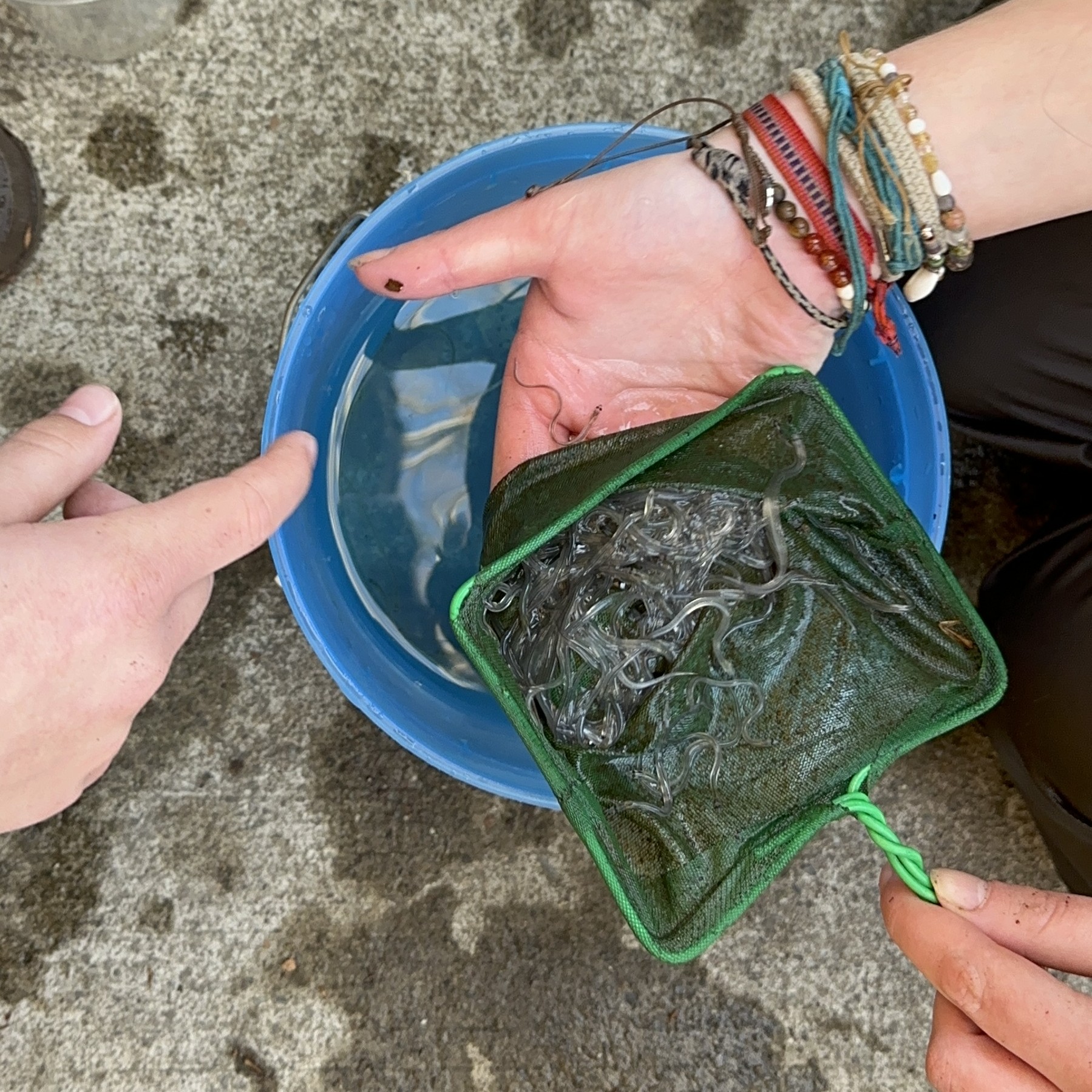
But Why: A Podcast for Curious Kids
What are eels?
00:23:04
What are eels? And why are some eels electric? We head to Poughkeepsie, New York to learn about eels with Chris Bowser, Hudson River estuary educator with the New York Department of Environmental…
Loading summary
Transcript81 lines
- [00:02]
A
Hi, it's Jane. Every summer my family makes a list of the things we want to do while the weather is warm. It includes things like how many different lakes we want to jump into, what animals we hope to see, and new crafts we want to try out this summer. But why has made a Summer Bucket List and an invitation to you to join the but why Fan Club so you can get it. New members of the fan club will get a special but why Summer Adventure Kit with a notebook, a magnifying glass, a drawstring bag and a list of fun summer activities and adventures to have together. With a $10 a month donation, you're supporting all we do at Boatwide to explore and encourage curiosity and learning. And you're getting the Summer Adventure Kit. Check it out and make your gift@butwhykids.org donate before we get started, here's a message for the adults who are listening. Support for but why comes from Progressive Insurance do you ever think about switching insurance companies to see if you could save some cash? Progressive makes it easy to see if you could save when you bundle your home and auto policies. Try it@progressive.com Progressive Casualty Insurance Company and affiliates. Potential savings will vary. Not available in all states. One thing experts and parents tend to agree on is that learning to swim isn't just about strokes. It's about confidence, stability, safety and consistency. Goldfish Swim School takes a thoughtful approach to swim lessons, combining research based teaching with a warm, kid friendly environment. Making swim lessons feel encouraging, not intimidating. They offer year round swim lessons for children as young as 4 months up through 12 years old. Safety is never optional at Goldfish. Every lesson includes dedicated, professionally trained lifeguards on deck or all certified through Ellis and Associates, a global leader in lifeguard training. If you're ready to take the next step, Goldfish Swim School has a special offer just for listenerswaved membership and your first lesson free at participating locations. Head to goldfishswimschool.com free find your local school and use promo code. Free to enroll. It's an easy way to get started with lessons that focus on safety, confidence and real progress in the water. This is but why? A podcast for curious kids from Vermont Public, I'm Jane Lindholm. On this show you ask the questions and we find cool people to help us get some answers. Do you like going on field trips? Maybe that's something you've had a chance to do at school or with your family or community group. Well, adults like field trips too, and any chance Melody and I have to go somewhere new and actually see some of what we're talking about in our episodes, we jump at the opportunity. Earlier this spring, we drove over to New York State and parked up right, right next to the banks of a very big river to learn about some animals that are mysterious, slippery and wiggly.
- [03:30]
B
You know what? Let's get some more in here. Let's get a big one. Let's get a big one.
- [03:39]
A
Those were eels. Well, technically, those were humans who were doing the screaming. Eels are silent, but they can be pretty strange when a handful of a couple of hundred of them are placed in your hands and start streaming through your fingertips. Some people even scream when that happens. American eels can be found all over the east coast of north and South America, as far south as Venezuela and as far north as Greenland and northern Quebec in Canada. European eels are very similar and can be found all over the eastern coast of that continent. You could see these animals in the ocean or in fresh water, depending on what part of their life cycle they're in. But chances are you've never seen one at all. So come along with us today as we learn more from this guy.
- [04:30]
B
My name is Chris Bowser. I am a Hudson river estuary educator with the New York State Department of Environmental Conservation in cooperation with Cornell University's Water Resource Institute. We are here on the Fog Hill Creek where it leads into the Hudson river in Poughkeepsie, New York State in the United States of America. We're about 75 miles north upstream of big New York City. Here the water is very, very. Let's take a little taste. Tastes fresh. No salt at all. But if we started heading south towards New York City in a few miles, Ooh, just a little bit of salt. And as we got closer and closer to the city, it gets saltier and saltier. And if we went past the city, what's the big ocean we would run into? What ocean does the Hudson river run into?
- [05:29]
C
The Atlantic High five.
- [05:34]
B
Good job. The Atlantic Ocean, excellent.
- [05:37]
A
As you can hear, Chris wasn't alone. In fact, there were a bunch of people with us.
- [05:42]
D
Valentina Sirda and I go to Marist.
- [05:45]
C
Hi, I'm Kira Lawless. I also go to Marist College.
- [05:48]
A
Kira and Val are students who work with Chris as part of their college studies.
- [05:53]
C
I'm Jesse Blaback.
- [05:54]
A
I'm Blaise Blaback. Jesse and his dad Blaze live near Pequil, and we were all there for one reason.
- [06:02]
B
We're here trying to catch baby eels.
- [06:06]
A
Chris runs a project every year where people who live along the Hudson river can get involved in monitoring and counting juvenile eel populations. Juvenile means not adult. So basically, these are kid eels.
- [06:18]
B
We think American eels. All of them hatch somewhere out in the Atlantic ocean. Many people think it's the sargasso sea, roughly between Bermuda and Puerto Rico. But we're not roughly between Bermuda and Puerto Rico. We're here in Poughkeepsie, New York. So if we catch any baby eels today, they will have traveled over 1500 miles to get here. So if we have any eels here, they've been on this migration, this journey, a really long time.
- [06:53]
A
We got suited up in big waterproof overalls with boots called waders, and we walked right into the water of the fall kill creek. Chris and his team had set up a trap to catch eels as they traveled from the Hudson into the fall kill to start swimming upstream.
- [07:11]
B
You can see this net, and this net is kind of shaped like a cone on its side, and it's got the big, white, wide opening, faces the Hudson river, and the skinny little end is upstream. The whole net's maybe, I don't know, 12ft long. Any eels that we caught since yesterday are gonna be right here in this trap. So let's open this up and check it out. Pull this nice and tight. Okay. I'm gonna pull this out of the water. Tell us if you see anything wiggling around in there.
- [07:46]
C
Yeah, there's a million.
- [07:48]
A
Can you describe it? Like rice noodles?
- [07:52]
C
Yeah, like.
- [07:52]
D
Like rice noodles.
- [07:53]
C
If you had a bowl of rice, but they started moving.
- [07:57]
A
Yeah.
- [07:57]
C
They have clear skin, Black dots for eyes. And then you can see, like, this long gray line going down, like, their whole entire body.
- [08:08]
B
What's this. What's this thing that goes down your body?
- [08:10]
A
This thing?
- [08:11]
C
Yeah.
- [08:12]
B
And if you look really close, you might see their little pink heart and their little pink gills.
- [08:18]
C
Oh, yeah, I can see it. They're really wiggly.
- [08:23]
A
What does it feel like?
- [08:26]
C
Pasta noodles in your hand, except they're moving. Yeah, that's a whole bunch of eels. I saw a lot more in there.
- [08:37]
B
Oh, so you're saying there's more in here?
- [08:39]
C
Yeah, a lot more.
- [08:40]
B
Do you think we should get them out?
- [08:41]
C
Definitely.
- [08:42]
B
Let's do it. Okay. Dump those right in the bin there. So now what we're gonna do is we're gonna do what I like to call the dump and flush. So, Kieran, Val, if you want to dump some water on here, this is gonna get a little messy because we're gonna shake this. I want. I want anybody with expensive recording equipment to be aware. And we're shaking all of our eels on down. Let's keep shaking them down. We're just gonna shake those eels on down. Okay. That's probably a lot. Look at them all in there.
- [09:14]
C
Oh, yeah.
- [09:15]
B
Jess, your job is to get that bucket up on the hill without spilling it.
- [09:20]
A
Jesse carried a big plastic bucket full of water and tiny eels up onto shore, and we all followed him up where we got down to business.
- [09:28]
B
Now the hard part happens. It's called the counting. Dun, dun, dun. Now, sometimes we'll just weigh them all, but today we're actually going to count them.
- [09:41]
A
Counting sounds pretty easy, right? But these eels are very small and very wiggly, so counting them can actually be quite tricky. The group split into teams where one person separated the eels and dropped them into a different bucket while their teammate counted. Once they had 10 eels, they'd shout out 10, and another person with a clipboard would mark down a tally.
- [10:02]
C
9, 10, 11, 10, 10.
- [10:04]
A
Meanwhile, I wanted to get a little more information out of Chris Bowser. So what are eels?
- [10:10]
B
A lot of people have the misconception that eels are snakes or eels are worms or eels are something. Eels are fish. Just like a guppy, a trout, a tuna. An eel is a fish. Why? Well, we actually saw a few things on those eels I mentioned. You can see the gills. Fish have gills. Eels do have fins. They have a slightly stranger arrangement of fins than most fish typically do, but they have fins and they even have scales. They're very small scales. You can't see them just by looking at it with your eye, but they're in there. So even though fish have. I mean, eels have kind of a long, snaky body, they are fish, and they have to live in the water.
- [10:58]
A
Okay, so the eels that we're mostly seeing are pretty small. They're a couple of inches long.
- [11:02]
B
Correct. They're clear.
- [11:04]
A
You call them glass eels.
- [11:05]
B
Yep. Right.
- [11:06]
A
How old are they?
- [11:07]
B
So they're probably about a year old. And remember, they've lived most of that year in the ocean. So being clear, being transparent is an adaptation, is a strategy for survival in the ocean, because there's not a lot of places to hide in the ocean. So looking like water is about the best you can do. But now that they're here and now that they're in a stream and there's mud and gravel and rocks, they'll quickly develop pigment, develop coloration. They'll develop, like, browns and dark greens. You'll even see a few of the bigger eels in here we call elvers, and they might be 3 or 4 inches long. They were glass eels a year ago, so now they've kind of developed a little bit more pigment and they're. They're living here. And these eels, if they don't get eaten, which many of them will, that's the food web. In 10 or 20 years, they may be a foot or so long, if they're a male, they may be 2 or 3ft long if they're a female and live a long time. And then they'll go back to the ocean where they were hatched, and they'll spawn, they'll reproduce, and they'll start a whole new generation. They'll only do that once in their life. This is an evolutionary miracle to me.
- [12:26]
A
Not only are American eels an evolutionary miracle, they're a bit of a mystery, too.
- [12:32]
B
The mystery is we don't actually know where they spawn. We don't actually know for sure what this whole life cycle is about. Here in the Hudson river, we're still trying to figure out why do some eels go to one creek or another? Is that just random? Are there environmental factors? And can we figure out, let's say, what eels like in order to help conserve them? Because one thing we haven't talked about is the fact that the last hundred years have been a rough century for eels around the world. The American eel, the European eel, the Japanese eel, you name it. Eels have had a rough century. A lot. They're tasty to eat, people have eaten them. They're as sensitive to pollution as any other animal. Is the fact that we've put so many dams up on rivers big and small around the world, that has a big effect on eels. So there's all. One of the things that we're trying to do is understand eels so that we as people can make choices with how we treat our streams. That is beneficial to the eel, and if it's beneficial to the eel, it's probably beneficial to every other creature that lives in and along the river, including people.
- [13:53]
A
We've talked before about certain fish that spend part of their lives in the ocean and part of their lives in fresh water. And it's one of my favorite vocabulary words, anadromous fish. So are eels also anadromous fish?
- [14:09]
B
That's a great question. They are not, because they are the opposite of anadromous, which is they are catadromous. So anadromous fish, that's your sturgeon and your salmon and your striped bass and your alewives. And your alewives, right? And your bluebacks and your shad. These are fish that hatch, lay their eggs, spawn, or born in fresh water, go out to salt water, and then come back. Eels are the opposite. They hatch in the ocean, in saltwater, and then they come to freshwater to live most of their years before they go back. So eels are catadromous. And if you want one more vocab word that captures both of those words together, the word is diadromous, which just means, I live part of my life at salt water, part of my life in fresh water. I'm diadromous.
- [15:03]
A
As the counting continued, Chris told us a little more about the eel counting project and its goals.
- [15:09]
C
4, 5, 6.
- [15:10]
B
Two goals with this project. Goal number one is we're trying to do like a census of eels, get a count of how many eels we have. Goal number two is to involve local communities in real science, what's sometimes called citizen science, or I like the term community science. And as you can see, that's where we got both going on here today. We're getting the data, but we're doing it with people who are really learning to be scientists. And that's the best part of this whole project. Since 2008, this eel project, not just here at Poughkeepsie, but at a dozen sites up and down the Hudson River. When you put it all together, since 2008, we have caught, counted, and released almost 2 million glass eels in 16.
- [16:00]
A
What percentage of the total population do you think that is?
- [16:03]
B
I think that is a drop in the bucket, to use a very apt analogy today. I think that there are so many eels that are coming into our coastal estuaries. And remember, most of those will not grow up to be adults and swim back to the ocean. Most of those will be food for hundreds, thousands of different animals, different species of fish, different birds, different mammals. So it's seeing all these eels come in. It is okay to know that they're not just eels that are going to grow up to adult eels. They're eels that are part of the food web fabric of the Hudson river watershed.
- [16:46]
A
It was getting late in the afternoon, and almost all the eels had been counted. So the counters wrapped up, and Chris's colleague Maude read out the final tally.
- [16:56]
B
1,600 glass eels and 4 elvers. When you say 1,600, do you mean we ended on that number? Oh, sorry.
- [17:06]
A
1,607.
- [17:08]
B
Okay. I mean, I wasn't questioning you. I just wanted to double check. It's possible.
- [17:13]
A
That's a lot of tiny eels, all 1,607 glacials, the ones that are about a year old and the four Elvers, the ones that are slightly older were packed up so Chris and his team could take them further upstream.
- [17:29]
B
We actually take them all the way up to the middle of Poughkeepsie and we let them go above a couple of dams because they're trying to go upstream. So we release them upstream for two reasons. One, that's where they want to go and so we want to get them above those man made dams. Second reason is we don't want to catch them again. So by putting them up there, that's where they're supposed to be. And that helps assure us that we're not recounting eels over and over again.
- [18:00]
A
Before we left for the evening, Jesse told us what he had enjoyed about this experience.
- [18:04]
C
It was pretty awesome. Made my hands really slimy. But the counting eels part was it was a struggle trying to get all the eels like into your hand and count them. They tended to come out in like in clumps. So it made it really hard. But it was, it was fun.
- [18:23]
A
Why did you want to do this?
- [18:26]
C
I want to be a marine biologist when I grow up and I've always loved just like the ocean, the water and the fish that live in. So this was a great thing to do. What a cool experience.
- [18:40]
A
Yeah, it was a really cool experience. I've never noticed the tiny eels that might be in the streams and lakes near me. Even here in Vermont, so many miles from the ocean. And maybe you have eels near you that you've never noticed either. Now, there might not be an eel counting project near where you live, but you could check out if there are any citizen science groups or projects run by your country or state stock, Department of Fish and Wildlife or environmental conservation or maybe even a nearby museum. It can be a great way to get up close and personal with the wild creatures living nearby you. Thanks to Chris Bowser and Maude Salinger at the New York Department of Environmental Conservation for letting us be a part of their project. Coming up, we're going to learn about electric eels. But first, a message for the adults who are listening. Support for our program comes from Oak Meadow providing secular student centered homeschooling curriculum and a teacher supported distance learning school for K through 12. Oak Meadow has encouraged kids to follow their curiosity and uncover the answers to but why? For 45 years. To learn more, visit oakmeadow.com this show
- [19:52]
D
is supported by Blueland. We hear a lot about microplastics in oceans and food, but they can also come from products we use every day at home and including cleaning products. Blueland is on a mission to make it easy for everyone to make sustainable choices. Blueland believes that hardworking, clean products can be the norm, not the exception, so that you can do better for your family and the planet at the same time. From cleaning sprays and toilet bowl cleaner to dishwasher and laundry detergent tablets, Blueland's products are independently tested to perform alongside major brands and the formulas are free from dyes, parabens and harsh chemicals. You'll love not having to choose between the safe option and what actually gets your house clean. Blueland is a Certified B Corp and Leaping Bunny Cruelty Free Certified. Their formulas are EPA Safer Choice certified and many products have also earned Cradle to Cradle's Gold Material Health Certificate. If you're looking to make a small change in your routine, you can get 15% off your first order at blueland.com prx get 15% off your first order by going to blueland.com prx blueland.com prx
- [21:02]
A
this is but why A Podcast for Curious Kids I'm Jane Lindholm. We wanted to learn about eels because so many of you are curious about them. But the eels you've been sending us questions about are electric eels, not American eels. Electric eels live in the Amazon and here's what you've been wanting us to explore.
- [21:24]
C
I am Eliana and I am 7 years old and I live in Toronto, Canada. How do eels get electricity? Hi, my name is Samuel and I'm from Wheaton, Illinois and I'm 5 years old. How do electric eels make electricity? My name is William, I live in Scottsdale, Arizona and I am from why are electric eels electric? My name is Anton, I am seven years old and I live in Sweden. Why are eels electrified?
- [22:04]
A
And here's someone who can give you an answer.
- [22:07]
E
Hi there, I'm David Santana, a scientist with Smithsonian National Museum of Natural History in Washington, dc. Eels are electric because they can produce their own electricity through three electric organs and they use these electricity to navigate in the rivers to communicate. Yes, electric eels can talk with their own fellow eels using this specific language to defend themselves, as for instance to avoid to be eaten by caimans or freshwater dolphins and also to stone fray. So here is an example of two Electric yields Talking. Electric yields produced at electricity through three electric organs. The select organs are made of electrocytes which are equivalent to mini batteries. So when eels go hunting, they fire the three elect organs at the same time, producing impressive strong discharges of up to 860v. By comparison, it can be seven times stronger than A wall socket. So here is the sound of red gills hunting on tetrafishes in the Amazon basin.
- [23:59]
A
Electric eels are called eels, it's in their name, right? But they actually aren't eels at all. They're a type of knifefish.
- [24:09]
E
They are a group of over 250 species that can produce weak electric discharge of up to 5v. Used to communicate and navigate. Because its eel like body and the capacity of generating high voltage discharges. Fish of the genus Electrophorus are known as elect eels. Why do some eels produce more electricity? We are not sure yet, but it can be a response to the environment that they live in. Eels that produce more electricity live in Amazon highlands in a kind of environment or water that isn't friendly to propagate electric discharges. So probably an eel living highlands must produce more electricity to reach a prey than would have a fellow eel living in Amazon lowlands where the water can conduct more electricity.
- [25:10]
A
David was part of a group of researchers who discovered that what we once thought was one species of electric eel is actually three species of electric eel. Some have stronger voltage, stronger electrical power than others. While we had David, we really wanted to know what was it like to study these fish in the Amazon.
- [25:31]
E
Studying eels in the Amazon is awesome because working with fish was a childhood dream. And every time that I go there, I learn something new about those fascinating fishes. To stay safe in rainforest with lead eels, I always keep calm. I operate carefully, knowing that I am in the wildness. I respect the eels, knowing that the eels can hurt me with the electricity. And I listening a lot to the local people because there they are, the specialists.
- [26:06]
A
Thanks to David DeSantana, fish detective at the Smithsonian. So now you know about electric eels, which I think we should just start calling electric fish. And you know about true eels, American eels and their cousins, the European eels, which are very similar. That's it for today. Now if you have something you'd like us to explore, have an adult record you asking your question and then send the file to questionsutwhykids.org Our show is produced by Melody Beaudet, Kiana Haskin, Kaylee Mumford and me, Jane Lindholm at Vermont Public and distributed by prx. Our theme music was composed by Luke Reynolds. We'll be back in two weeks with an all new episode. Until then, stay curious.
- [27:05]
C
From prx.