← BYU Speeches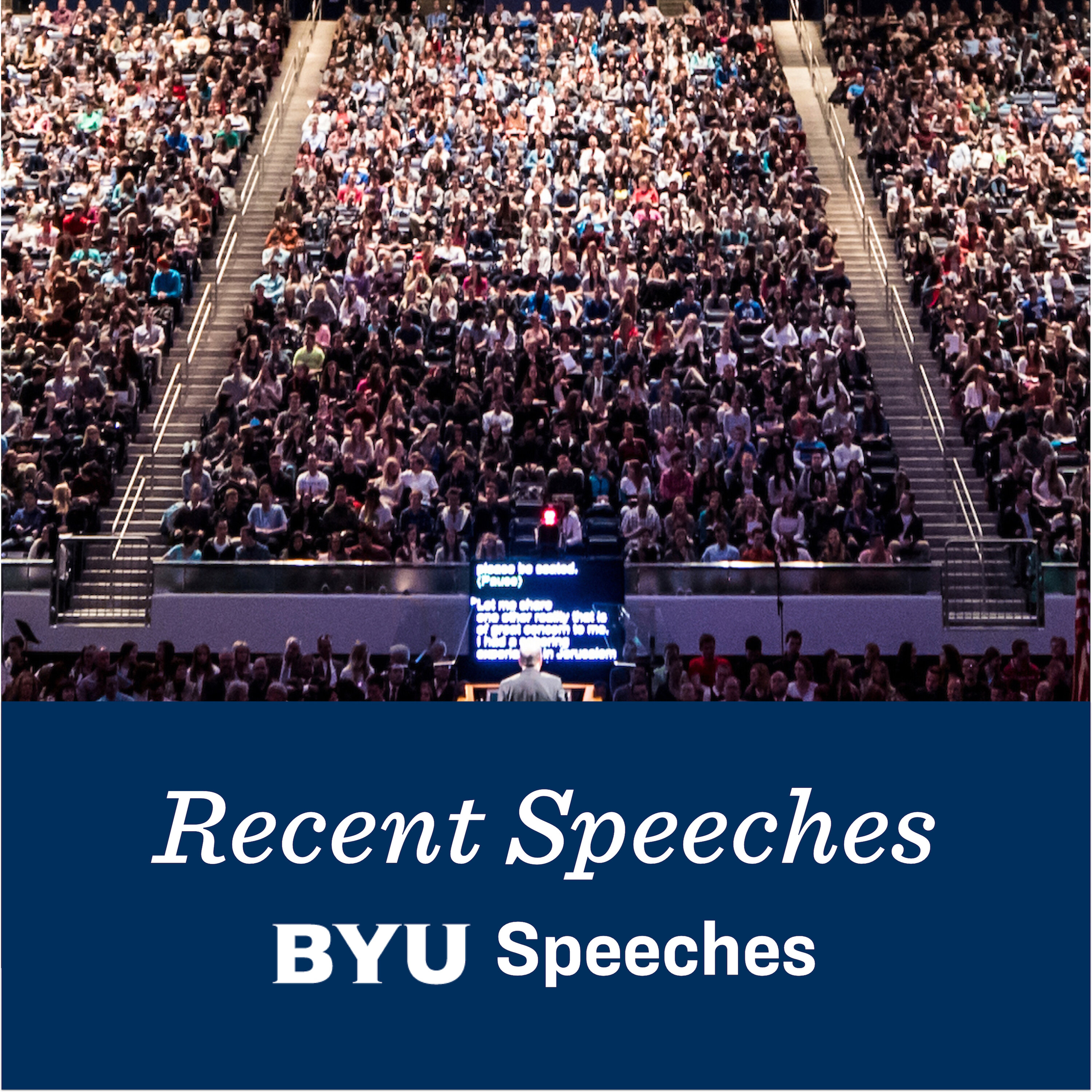
BYU Speeches
The Power of Faith and Inspired Learning | C. Shane Reese and D. Michael Lindsay | May 2026
00:28:04
Loading summary
Transcript38 lines
- [00:01]
A
Welcome to the Recent Speeches podcast presented by BYU Speeches, featuring inspiring new devotionals and forums given each week on BYU campus. Be sure to check out our other podcasts by searching BYU Speeches wherever you get your podcasts or by visiting speeches BYU Edu Podcasts.
- [00:23]
B
This forum address, entitled the Power of Faith and Inspired Learning was given on May 19th of 2026 by C. Shane Reese, President of Brigham Young University, and D. Michael Lindsey, President of Taylor University. Thank you both for joining us today. So excited to have this discussion. President Reese, first question for you. Faith based universities and their students often feel embattled. Do you have any advice for students about integrating faith and learning in a joyful and a hopeful way?
- [00:57]
C
Well, how's everybody doing? So great to see everyone. Welcome to the Marriott Center. Absolutely. This has a different flavor than oftentimes when we're together and it's so great to see so many of you. The weather is stunning out there, so I could imagine you had other places you could have been today. So we're grateful you're here with us. And I'm so grateful to have President Lindsay with us. President Lindsay is a great friend and I love the question because President Lindsey could not be a more perfect person to have here on campus. As it relates to this question, he talks about standing in the breach in that video segment that we watched and President Lindsey has. I think you'll hear a little bit more about that later. But he is a dear friend and I would just say someone from whom our campus community can learn a great deal. So we're grateful to have you with us. Thank you. Thank you, President. Yeah, exactly. By the way, when we talk to each other as friends, it's usually Michael and Shane, so we might fall back into that habit. First of all, the question is an interesting one because you talk about sometimes feeling embattled and I think this idea that you have to feel some tension when it comes to things of academic excellence and spiritual pursuit, I worry sometimes that those things need to be in tension. So while there may be issues upon which we find battles or we find some tension, I think more often than not it's what Dean Bridgewater said in that short video segment, that truth is truth, and oftentimes we may not have a full understanding of the truth in either of those two different spheres. But I think we're seekers of truth and I think it has every reason for hope and every reason for joy. I just think, President Lindsay, we had some something on this campus which it shouldn't have been the first time that we had it on this campus, but we had a Christmas tree on campus for the first time in our history. It's long overdue, I think. And if you were to look at the gathering of nearly 15,000 of our students, our faculty, and even community members, the joy of being in that moment and celebrating Jesus Christ, his birthday, his teachings was a remarkable occasion. And when I walk into the Marriott center and I see our students with the joy in participating in an athletic contest, when I see them, it's not always that I see them walking in the testing center, that there's always that sense of joy.
- [03:38]
D
Understand? Yeah.
- [03:40]
C
But there is this idea. And, boy, I just am so grateful for our students because I see how you. You reflect the joy in the pursuits that you're engaged in. And so I think that there is, like Ari Berman said in that video, there isn't as much a crisis of faith. And that doesn't mean that we don't have faith questions, that we don't wrestle with important questions in our lives. But it is a joyful pursuit. And I think that our students. I see it in your eyes. I see the excitement that you have, the enthusiasm you have for the endeavor in which you're engaged. And so I'm inspired by our students. I don't know if I have as much advice, but if I did, one thing it would be, is lean into it. Lean into that pursuit of truth, both as to things of your academic disciplines and of the pursuit of the truths of the gospel. I think those two things can happen simultaneously, even though people might tell you otherwise.
- [04:47]
B
Yeah. Yeah. President Lindsay, how about you?
- [04:50]
D
So let me just say it's a great honor to be here. I think the world of President Reese and grateful for the work and witness of BYU on our campus. We have a bell tower in the very center of campus that has two pillars. One represents faith, the other represents learning. And at night, we light up the bell tower, and there's a beam of light that comes up each pillar and in the night sky they meet in the heavens. And we said that's really the vision of. What we're trying to do at Taylor is to encourage students to integrate faith and learning. And we do believe that that's a joyful pursuit. And we believe the admonition in Nehemiah that the joy of the Lord is our strength. And so we have lots of opportunities where students can be able to experience that joyful spirit of encountering. How does your faith make a difference in your academic work? I get the chance to teach an undergraduate class in Sociology, my field. We don't do Bayesian statistics, but I'm looking forward to that Pulitzer Prize.
- [05:43]
C
But you won't win a Pulitzer Prize
- [05:44]
D
either, so let's see about that. But I love the fact that my students ask deep questions and they such an energy and a joyful spirit being here in the Marriott Center. I think probably one of our favorite traditions on our campus is called Silent Night. It's the last home game of our basketball season before Christmas break. Students come dressed up in lots of different costumes and the crowd is silent until we score the 10th point. And then they just go crazy. They rush the court. We get two technicals and have a lot of fun. And at the very end of the game we link arms and we sing Silent Night. I brought a video clip here that I thought may be fun just so you get a sense of what it is that makes the joy on the Taylor campus.
- [06:56]
B
That was amazing. What an incredible tradition. I love it.
- [06:59]
D
It's a lot of fun.
- [07:00]
C
Yeah, we only rush the court after the game. We have very specific requirements of our students.
- [07:05]
D
I know you're good rule abiding students.
- [07:08]
B
Absolutely. Yeah. You saw a picture of that earlier. So. One of BYU's strategic priorities revolves around constitutional government and religious liberty. And as this landscape continues to evolve, what gives you confidence in the future of higher education and faith in higher education? And how can our universities be proactive and wise about how we meet some of these challenges? President Lindsey.
- [07:36]
D
You know, I have to say I have a deep respect for the LDS Church, which has really sort of led the way on issues of religious liberty. But also care for your friends and neighbors. I was involved in a lawsuit that went all the way up to the U.S. supreme Court. And it was a BYU alum, Eric Baxter, Baxter at Beckett, who's I think probably the best First Amendment attorney working in the higher education space alive today. And he represented the LDS Church in remarkable ways. And I found that one of the key things we have to do as Christians is we have to demonstrate to our friends and neighbors that we really love and care for them, even if they don't always agree with our theological convictions. They need to understand we want to be good neighbors. And there's lots of scripture admonitions where we're encouraged to be the kind of neighbor that is going to be a blessing and an encourage. Jeremiah 29 tells the faithful people to seek the peace and the prosperity of the place where God carried you, because if it prospers, you too will prosper. We've decided that that's a really important admonition for our campus community. We're located in the middle of the corn fields of Indiana, halfway between Indianapolis and Fort Wayne, a very rural location. In many ways, our community has been forgotten by economic development. So we decided that we would try and take on the initiative to say, how could we really invest in our community? How could we spur economic development? We're in the midst of doing a large fundraising campaign, and as part of that, we decided first that we would tithe 10% of the funding that we would secure for the campaign to be a blessing to our friends and neighbors off campus. So how could we help spur economic community development in the little town of Upland, Indiana? And then we were challenged by some of our board members. Actually, you know, Scripture talks about a double portion, and so could we actually double that commitment. So we've set a goal of 20% of our campaign to actually be a blessing to our friends and neighbors. It's called the Main Street Mile initiative because there's one mile of Main street between our campus and downtown Upland. And so we set an initiative to try and raise $100 million in the course of about five, six, or seven years. And we're about 95% of the way on that. And it's, I think, a really good opportunity. Well, it's a good opportunity for us as a community to say, hey, we really care for our friends and neighbors who may or may not agree with our theological convictions, but we know that we want to be a blessing. And boy, BYU has done that time and time again. I mean, the legendary stories about how your student athletes when you're playing away games, how you leave the locker room better than it was when you found it, how you give ice cream, which, by the way, I had great ice cream last night at the BYU Creamery. Hats off. I love it. It was awesome. But those are visible ways in which you actually bless and serve our friends and neighbors. And I think that the way that we gain the respect of people who don't agree with our theological positions is we say we're going to be a good neighbor, even if you don't agree with us. And the process of that, you embody the grace and truth of Jesus, which I think is at the heart of what we're trying to do at Taylor and the heart of what you're trying to do at byu.
- [10:39]
C
Boy, talk about somebody who can really talk specifically about paving the way. I mean, you're literally paving the roads. It's an amazing thing. President Lindsey. And you talked about Eric Baxter. In fact, it reminded me of the first time we met. President Lindsey and I were at a gathering of leaders of Christian colleges and universities in the United States. And I was there as a guest, not a part of this group. But President Lindsay treated me as if I was part of the group. I love that. And as I left, the person who leads this organization is called the Council on Christian Colleges and Universities, cccu. He said, you know, I don't know if everybody feels they don't all feel the same way about you being the president of byu. I'm like, well, it's not the first time people haven't all felt the same way about me. But he said, they're all very certain, though, how they feel about your lawyers.
- [11:35]
D
Yeah, exactly.
- [11:37]
C
They like our lawyers. We love BYU lawyers.
- [11:40]
D
That's right.
- [11:41]
C
No, and it is really, I think we all find, I think, something on which we can build common ground. While there are obviously doctrinal differences between many of these universities, there's so much that we share in common, and I'm grateful for the way we've been warmly welcomed into that community. I will also say, when I think about your question, Audrey, it's a really good question. I remember I was at a gathering of presidents of universities, not the cccu, but these were presidents from all over the map. There were presidents from large public universities, large private universities, there were faith based universities, there were small liberal arts colleges, there were HBCUs, there were community colleges. In this gathering of presidents, there's like 100 presidents. I said, 100. There were 200 presidents at this gathering. And they had this panel that was convened to ask the question, how do we build trust in higher education? Which I think is an important question. We're kind of at a moment in higher education. And they asked these seven presidents, all who had been presidents for a long time, how do we build trust in higher education? And six of the presidents had almost identical answers to the question. They said, we just have to tell our story better. We haven't done a good enough job of telling our story. And they finally asked the last president on this panel, someone who'd been president for 27 years of his institution long time, and he said. He sat back in his chair and he said, with all due respect to my colleagues on the panel, by the way, if anyone ever starts a sentence like that, there is no respect coming. It's going to be good.
- [13:31]
D
Yeah.
- [13:32]
C
Said with all due respect to my colleagues on the panel, I think what they've just said is bull.
- [13:38]
D
Wow.
- [13:39]
C
I mean, I literally, you could have heard a pin drop in the room. And he said, I think what higher education needs at this moment is a bit of humility. And I thought, what a powerful idea. I think, though, faith based institutions are well situated in that very conversation.
- [13:58]
D
I think that's right.
- [13:59]
C
I hope that we as faith based institutions have a healthy sense of humility. I think it's a commandment and we need to observe that. This idea that some of the criticisms of higher education maybe we've earned a little bit, and I think that's a caution that I might add, is that all of us, as we're pursuing education, that we have a healthy dose of humility. I love what, what one of the members of the officers of our board of Trustees, President D. Ty Christofferson, taught on this campus. He said, look, education we don't pursue for our own personal gratification. We pursue education because we believe that it is a means by which we can bless God's children. In fact, our prophet, President Russell M. Nelson, who recently passed Bless His Soul, he gave an address on this campus. He said that for members of this church, and I would say for the vast majority of the Christian community, President Lindsay, is a religious responsibility. We feel a responsibility to God's children. And it is in fact the difference between merely wishing you can do something to help God's children and actually having the skills and abilities to do so. And I'm so grateful for the students at Brigham Young University who I think enter, and I've met two students from Taylor University who I think have a sincere desire within their hearts to really use their education as a means to bless God's children wherever they are.
- [15:41]
B
I think that's clearly a very important point as higher education gets criticized so much that we've really got a formula for making it better, making it more meaningful. So critics leaning into that. Critics sometimes claim that you can't have academic rigor as well as spiritual conviction. And that's not necessarily what we find at our universities. Can you tell me a time, President Reese, when you were as president, where you saw faith strengthen scholarship or vice versa?
- [16:14]
C
Yeah, it's a great question. And I really firmly believe that those two things are not mutually exclusive, but rather mutually reinforcing. We really believe that study amplifies faith and that belief enhances inquiry, and that revelation leads to deeper understanding. They're literally mutually reinforcing. It's not things that are competing with one another. I believe that with every fiber of my being that we have to do both and do Both well, and that actually we're going to be strengthened. President Spencer W. Kimball, in the landmark address for us as a university, President Lindsay is something called the 2nd century of Brigham Young University. And he talked about the importance of being bilingual. And what he meant by that is as conversant in, in the language of God as we are in the language of our disciplines. And I think that that's a high charge for us as a campus, but one that we take seriously. I think that faith based institutions are going to do remarkable things in all of the places where you see institutions on the planet contributing. Like we have people who have developed pioneering things on the imaging of the. The very most fine level cellular kind of imaging that you could have, like, like you would get at most institutions. Those, those are remarkable. But we are also simultaneously able to do things like ask different questions. Yeah, we have a School of Family Life, for example, and I think they're in. They ask some fundamental questions. We have, I think, more faculty in the School of Family Life than any other institution on the planet. And they ask questions that can't be asked in other places. Traditional view of the family, like what are the things that contribute to that, to family formation? How is that an important institution in society and how can it be strengthened? I mean, everything from finances to family formation to what children do to family dynamics. We can answer some of those questions in a faithful way, in ways that others aren't permitted to, in part because the academy has largely abandoned some of those core institutions. So I think we're able to ask different questions in part because of our faith based commitments, our moral commitments that we have as faith based institutions.
- [18:41]
B
Yeah, absolutely. Thank you. President Lindsey, how about you?
- [18:44]
D
Yeah, you know, it's interesting. I taught undergraduate classes at Princeton, at Rice and then at Gordon, where I worked previously, and now at Taylor, I've taught basically the same class is on the Sociology of Power and Leadership. And I gave virtually some of the same assignments, assigned the same text, engage the students. Sometimes I do oral exams and I just say the quality of my students at Gordon and at Taylor has been on par with the quality of the student engagement I had at Princeton and Rice. I find that there's not a difference in the quality, and I'm certain that's the case here at byu. But in a faith based context, you've got the freedom to ask the bigger questions of life. You're not constrained in that same kind of way, which I think is exactly right. You know, for over a thousand years, the church tradition going all the Way back to Anselm, the 11th century theologian who says, we, we want to pursue faith seeking understanding and to draw students from all over the world. Our very first international student at Taylor came to Taylor in the late 19. His name was Samuel Morris. He was a Liberian prince who actually had to flee his homeland because there was a coup. He took refuge in the home of some American missionaries who happened to be Taylor graduates and they discipled him in the Christian faith and then encouraged him to pursue higher education. They wrote to the Taylor president and said, hey, would you admit Sammy Morris to come and be a student? It was our first student of color, our first international student in the 19th century. He came and was a legendary figure because he embodied the kind of servant leadership that has that epistemic humility. You're talking about a student who says, hey, I'm going to approach this with a posture of faith seeking understanding. I think that's really what we want to try and encourage in each of our students. And I think it's the great value of higher ed in our kind of context is that we're willing to tackle the big questions, not shy away from them because we believe all truth is really God's truth.
- [20:36]
B
Yeah, absolutely. Thank you. So President Reese, you've described college students as facing a two headed mom to of loneliness and a crisis of meeting. And even as this rising generation becomes less connected to institutional religion, faith based universities are seeing an increased demand. What do you think that says? President Lindsay? You first. What are these students finding on your campuses and what does that say about what young people are really longing for?
- [21:03]
D
Well, certainly we see with the advent of expansion of say, artificial intelligence, it's asking big questions about what we do. I'm really impressed with the work of Megan Sullivan at Notre Dame philosopher who Sundays, look, there's five things that faith based higher education has to sort of underscore even as we recognize that technology is really changing things. One is the value of human dignity, that we believe all people are made in the image of God. We therefore need to embody empathy for one another, that an ethic of love has to be at the center of all that we're doing. And yet we recognize there is a sense of transition, transcendence. We're about something much bigger than just ourselves. And yet there's also a sense of human agency. Delta. The Delta framework is what she has said is really sort of on the leading edge of how faith based institutions can grapple with some of these big questions of what does it mean to be a Human in a day and age where technology is really driving a lot of the focus and the energy. And Taylor and at byu, we're really committed to helping to say, how do we keep people at the center of what we're doing? We aspire to be as Christ centered and student focused as we possibly can. And I think that that's sort of the key of building an educational model that recruits students and draws them in to help them to live into the very best vision of themselves, while also recognizing we're a work in progress. We're all here trying to embody the grace and truth of Jesus as best we can.
- [22:24]
B
Fantastic.
- [22:25]
C
Wow. You've said it perfectly. Some of those fundamental tenets I think we share at byu, we talk all the time about, and in fact, we approach to belonging for us on campus begins and ends with the notion that we are all children of God, and that fundamentally ought to change how we treat one another. I also think, you know, I spoke with my predecessor, President Kevin J. Worthen, who's an amazing mentor for me personally one time about the students that enter byu. And about seven years ago, I think you all are students. And I would contend that this has some very similar parallels at most institutions. You called the rising generation for a reason. I think you walked through the doors of this institution with a desire to make a difference in the world. Like, when I entered school, most everyone that was entering this university, including Brigham Young University, were asking questions about what kind of job am I going to get? But I think they walk through the doors of these institutions and they're asking questions that are much bigger than that. I think they're asking questions about how can I take the education that I'm getting and how can I go out and make a difference in the world? Not always knowing exactly how to do that, but I think their hearts are molded in a different way to ask the question, how can I make a difference in the world? Like, I am so inspired by that. It's a beautiful thing to see people walking into the world with a desire to make a difference in the world that desperately needs it. You combine that with a faculty who are striving to provide the kind of education that can help you go out and bless God's children. And it's a powerful combination. I'm truly inspired by you, our students, by your hearts, where your hearts are, that you, in fact, want to make a difference in the world, that you want to bring glory to God. It is a remarkable thing to me, and I love that that's happening on this campus at this moment. I think it brings a momentum with it that is inspiring. And I'm sure that you see the similar things from your students. They're going to go out and do absolutely remarkable things. They're going to go out and change the world in sometimes what might seem like small ways that will have huge impact on individual lives. And so for that, I'm immensely grateful.
- [25:11]
B
Absolutely. Well, unfortunately, we're running short on time, but President Lindsay, do you have anything you'd like to share in conclusion with us?
- [25:20]
D
I'm so excited to be here because my family are BYU groupies. I have a daughter. My oldest daughter, Elizabeth, has a profound intellectual disability. She's 22, and she's become a real fan of music videos on YouTube. And I told President Rent a couple of years ago that she's a huge fan of both Vocal Point and particularly Noteworthy, and she absolutely loves watching a number of different music videos. But Amazing Grace has been a source of great consolation and encouragement to Elizabeth. And so our family has been blessed by the ministry of this place. And I bet I've listened to Noteworthy songs maybe a hundred hours. I mean, a lot in our house. And it's amazing to see the way in which your ministry reaches out and touches the life of my daughter. Elizabeth will never go to college. So we live on a college campus, but she'll never be a college student. But she feels this connection, and the music really speaks to her in a profound and powerful way. And so you never know how the small contributions. Being involved in an a cappella group could have a ripple effect, you know, half a world away and make a very positive difference. BYU has always had a legacy of making a positive difference, of being positive contributors to a wider world. And I'm inspired and encouraged by it. And our family is personally really grateful. Jesus tells us to pursue life to the full in John chapter 10, and John's a very careful writer and describes Jesus in chapter one of being full of both grace and truth. That's my encouragement and admonition for all of us to embody the grace and truth to a world in need. And it's a great privilege and partner to be here. We love and appreciate you very much.
- [27:00]
B
Thank you so much and thank you for being here. Thank you both so much for joining us today. This was an incredible discussion and I appreciate how thoughtful you are. And the shout out to Noteworthy was fantastic. Those are incredible music videos. Can you join me in thanking these great presidents one more time?
- [27:29]
A
You've been listening to the recent Speeches podcast presented by BYU Speeches. Please check out our other podcasts, including classic speeches taken from our vast audio library, as well as other BYU Speeches compilations on love and Marriage, Overcoming Adversity by Study and by Faith. Come Follow Me, the Prophet, Joseph Smith and Jesus Christ Our Savior and Redeemer. Go to speeches BYU.edu and click on Podcasts for more information. You can also find all BYU Speeches podcasts at your preferred podcast provider.