Loading summary
Transcript13 lines
- [00:01]
A
Close your eyes. Exhale. Feel your body relax. And let go of whatever you're carrying today.
- [00:08]
B
Well, I'm letting go of the worry that I wouldn't get my new contacts in time for this class. I got them delivered free from 1-800-contacts. Oh my gosh, they're so fast.
- [00:16]
A
And breathe.
- [00:17]
B
Oh, sorry. I almost couldn't breathe when I saw the discount they gave me on my first order. Oh, sorry. Namaste. Visit 1-800-contacts.com today to save on your first order.
- [00:28]
A
1-800-contacts lifelock. How can I help?
- [00:32]
B
The IRS said I filed my return, but I haven't.
- [00:35]
C
One in four tax paying Americans has paid the price of identity fraud.
- [00:38]
A
What do I do? My refund, though. I'm freaking out. Don't worry, I can fix this.
- [00:42]
C
Lifelock fixes identity theft guaranteed and gets your money back with up to $3 million in coverage.
- [00:48]
B
I'm so relieved.
- [00:49]
A
No problem. I'll be with you every step of the way.
- [00:51]
C
One in four was a fraud paying American. Not anymore. Save up to 40% your first year. Visit lifelock.com podcast terms apply what if
- [01:01]
A
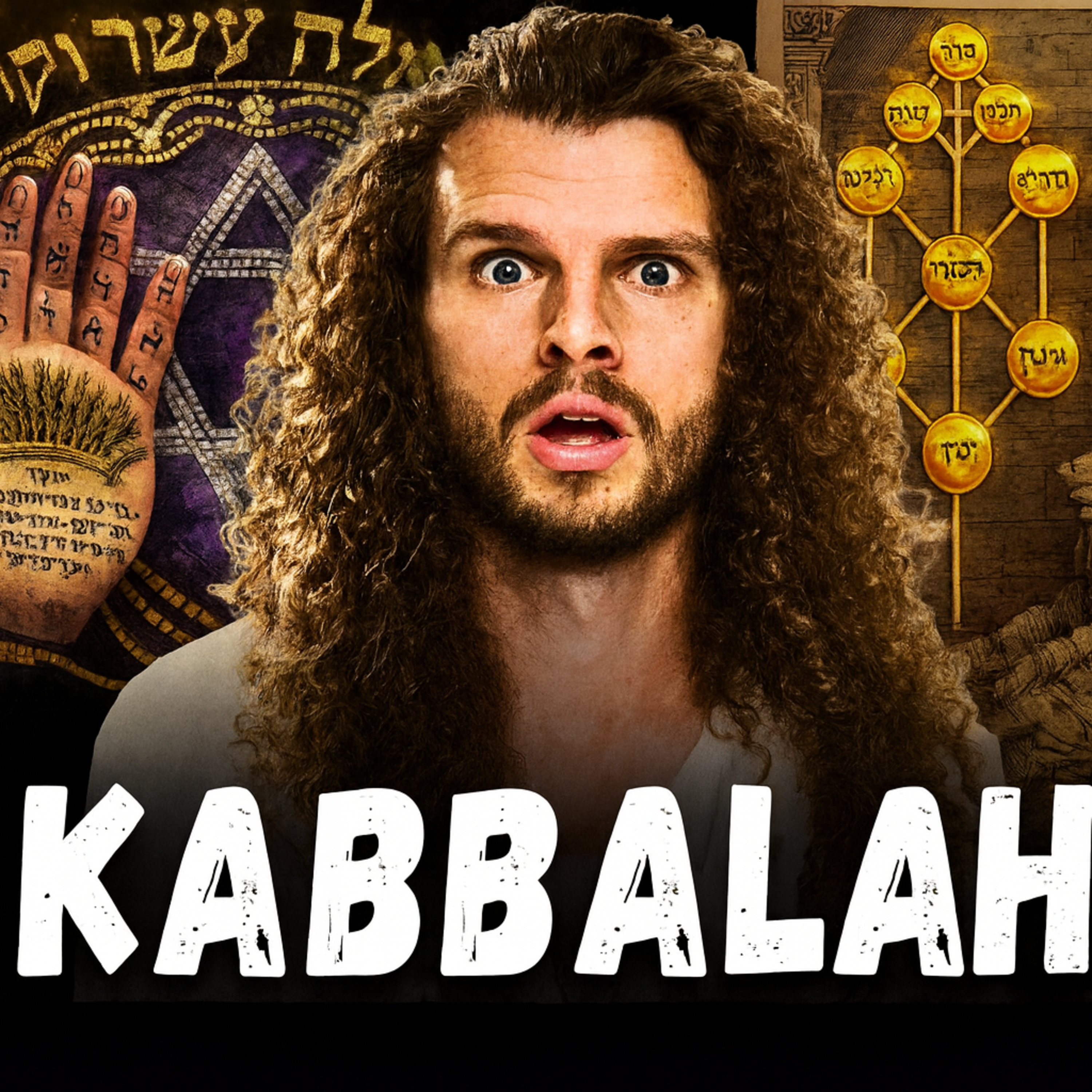
I told you that hidden within Judaism, one of the world's oldest religions is a secret mystical system that claims to decode the very fabric of reality itself. This is a system so powerful and dangerous that for centuries, rabbis discouraged anyone under 40 from studying it. A system that influenced everything from Renaissance magic to modern psychology to Madonna's red bracelet. This is Kabbalah. And it's far more interesting than whatever you probably think that it is. Because Kabbalah isn't just some new age celebrity trend. It's a complex metaphysical framework that attempts to answer the biggest questions that humans have ever asked. Why does something exist instead of nothing? What is the nature of God? And how can finite human beings connect with the infinite? So if you are interested in questions of the divine, specifically the mystical elements of one of the oldest religions that we know of, well, this is the episode for you. So sit back, relax, and welcome to Religion Camp. What's up, people? And welcome back to Religion Camp. My name is Mark Gagnon, and thank you for joining me in my tent, where every single week we explore the most interesting, fascinating and controversial stories from every religion from the world from all time. Yes, that's what we do here in this tent. I try to understand what every human on this beautiful planet believes. And I truly believe that there's no better way to understand a person than to understand the God that they worship. All of us live in families, societies. We all grew up in some way, shape or form influenced by religion. And so I think if you want to truly understand the world that you live in, you got to understand all the different ways that people worship. And that's what my goal here is to today. Now, I want to say thank you. I assume that you probably feel, you know, similarly as. As how I do, which is why you're here at the campsite and you have the same interest in trying to understand people in the world better. Now, I try to take all the good stuff from every religion and I leave the rest. And today is no exception because we're going into the mystical nature of Judaism. This is one of the most fascinating facets and elements of Judaism to me. Now, really quick, before I begin, I just want to say thanks to everyone for tuning in and, you know, making the show possible. Every time you comment or, you know, click the episodes or you like or anytime you interact with this content, you make my life possible. You help take care of my family. You keep the lights on here at the campsite, and more importantly, you keep the fire burning. And of course, you're also making a very, very wealthy man out of my good pal Christos. Papadopados, how are you? I'm sorry, Christos, I'm sorry. We don't have time for you to go over your lavish spending habits because today we're talking about Kabbalah. Now, the first time I ever heard about Kabbalah was probably like 8 years old, and I was. My mom was telling me that Madonna had become a kabbalist. Now, what does that mean? I had no idea at the time. So I've decided to try to deep dive down into it. And what I found is fascinating. Let me just say a few things up top. First off, I'm not Jewish. I was not raised Jewish. I did not grow up in this tradition, and I've never formally learned Kabbalah. So if there's anything I miss, anything that I, you know, gloss over too quickly, anything that I get wrong, please don't hesitate to let me know. If you are Jewish and you grew up learning this tradition, please inform me. I would love to know what I missed. My interest here is in truth, and truth never hurt anybody. So let me know. Please drop a comment and be civil in the comments. And to my non Jewish friends, I hope that you learned something. Please let me know what you learned from this dissection of Kabbalah. Now, where do we start? How about we start with the word Kabbalah. It means literally receiving or tradition, specifically a Tradition received from teacher to student, mouth to ear, an oral tradition in an unbroken chain, according to tradition, going all the way back to Moses himself. That's what is the origin point of Cabala. Basically, according to Kabbalistic tradition, when Moses received the Torah on Mount Sinai, you remember he goes up to the mountain and God basically gives him the Torah. The first five books of the Christian Bible, he actually received two teachings. The first was the written Torah, the five books everyone knows, Genesis, Exodus, Leviticus, Numbers, and Deuteronomy. But the second is the oral teaching, a secret sort of transmission about the hidden meaning within those texts. The mystical blueprint beyond the books, beyond the actual blueprint, the secret knowledge that was considered so powerful and so easy to misunderstand, that it was quite restricted. I mean, the Talmud explicitly warns against studying certain mystical topics. One famous passage describes four rabbis who enter parties the orchard of mystical knowledge. And of the four, one of them dies, one goes insane, and one became a heretic, and only one, Rabbi Akiva, emerged safely. Not exactly a ringing endorsement for casual study of the mystical. So for centuries, Kabbalah was only taught to married j men who were over 40 and who had already mastered the Torah and the Talmud. Now, the logic in this is that you needed spiritual maturity and intellectual grounding before diving into this knowledge that could shatter your understanding of reality. People always talk about psychedelic drugs, and they'll say, be wary of unearned wisdom. And you could say that this sort of rigid structure around the Kabbalah and understanding Kabbalah is kind of the opposite. It's saying, hey, you have to really earn this wisdom. And people are in states where they've mastered so much, you know, formal religious training up until they're 40 years old before they can even dive in. But here's the thing. While the formal tradition was restricted, the ideas just kept on getting out. And eventually they would reshape not just Judaism, but you could say, the Western world itself. Now, at the heart of Kabbalah is a problem, and it's a big problem. How can an infinite, unlimited, unknowable God create this finite, limited, and knowable universe? And it's an interesting philosophical problem that we probably don't have time to fully dissect today. But it goes as follows. Like, if God is truly infinite, filling all existence beyond all categories, and is perfectly transcendent in every way, then how can anything else exist? Like, where would you put it? Like, there's no room for a universe when God and its infinite existence takes up all the space. But yet here we are existing in a universe that is in some ways distinct from God. What's up, people? We're going to take a break really quick because I got to tell you a little story. All right? This is a story about a man who turned 29 years old, and slowly everything started to fall apart. Not in, like, a dramatic way. Life just got more difficult, all right? You know, the same workouts, all of a sudden, not getting the same gains, you know, in the musculature area, same diet all of a sudden, just, you know, still being a little bit soft around the middle. And around 2pm every day, just feeling terrible brain fog, you know, and not to mention, you know, hair falling out, thinning. And that man is my friend David Sanchez. And so naturally, what did he do? He started to panic. Google, okay? He was like, low testosterone. What do I do? What do I do? And it was terrifying because doctors act like, oh, the solution's casual. Like, yeah, just inject yourself with testosterone forever. Use needles. Dir needles from the streets of Kensington, Pennsylvania, Philadelphia, whatever. All right? But then you actually look at, like, trt, you know, it's thousands of dollars a year, could have fertility issues. It could shut down your body's natural production. I mean, yeah, you look better, but it might actually leave you worse in the long run. And that's why there's something natural. Something I found called Mars Men. Yes. And I've been taking it consistently, and some men have actually reported, I mean, better energy all day, better focus, stronger lifts, not just a spike, but a steady, consistent drive. And yeah, it's not trt. There's no needles, no synthetics, no dependency. It's designed to support healthy testosterone using real ingredients like zinc boron, you know, tonga ali. Things your body actually recognizes and needs to fuel testosterone use. Yeah, I genuinely like it. I just wake up in the morning, toss a couple pills back, and I start feeling better, and so can you. With Mars Men, I feel great. And you should, should start feeling great, too. And the way you do that is you go to mengotomars.com and for a limited time, the listeners of this program are going to get 50% off for life, plus free shipping and three free gifts@ Mengotomars.com that's right, use the promo code camp and you're going to be getting all that and more. And better yet, 90 day money back guarantee. If you don't like it, just be like, hey, this isn't for me. Send it back if you feel no difference. Which odds are you won't. Because 91% of men say that they feel more energetic when they're taking it, but maybe you're in the 9%, you send it back, money back. I'm telling you, there's no reason not to try it. And after you purchase, they will ask you how you heard about them. Please say you heard about it from the good old folks here at camp. It really helps the show and it keeps the fire burning. Let's get back to it. Kabbalah's answer to this cosmic paradox is one of the most radical ideas in religious history, and it's called the Tsim Tsum, and it's the divine contraction. According to the great 16th century Kabbalist Isaac Lauria, before creation, God's infinite light, called Ein sof, basically meaning without end, filled everything. There was nothing but God. So in order to make room for creation, God had to do the unthinkable. God himself contracted. Some later mystics insist that this contraction wasn't literal, that God didn't actually leave, but concealed his presence from our direct perspective. But if we were to believe that God withdrew into himself and created a void, a primordial empty space where the universe could exist, it's like God basically, like, held his breath, like, to, like, make room for us to exist. But here's where it gets wild. Even after this contraction, the void wasn't truly empty. A residue of divine light remained, like the moisture left in a cup after, like you pour all the water out, like, it's still, like a little bit wet. And into this void, God projected a single ray of light which would eventually form all things that exist in our reality. This is creation not as an act of expansion, but as an act of divine self contraction. God made himself smaller so that we could exist. I mean, just think about that. It's kind of a interesting way to view creation, that it was actually through God's limiting of himself than rather the expansion or the creation that we typically think about. Now, that single ray of divine light didn't just create the universe directly. That would be way too easy. Instead, it passed through a series of 10 stages, 10 channels, if you will. Each one stepping down the infinite light into increasingly finite forms. And these 10 stages are called the Sephirot. And together they form the most iconic image in Kabbalah, the Tree of Life. Now, if you see it here on the screen, you've probably seen a version of this before, even if you didn't know what it was. 10 circles connected by 22 paths, looking something like a cosmic, you know, circuit or something like that, and that's basically what it is. It's a map of how divine energy flows from the infinite into the finite, from God, the ultimate unmoved mover into creation, the potential into the actual. Now we can walk through it. At the top is Keter, the crown. This is the first emanation closest to Einsof, representing pure divine will before it takes any form. It's so transcendent that we can barely even talk about. We can't comprehend it. And below Kater, the tree splits into two pillars, right and left, masculine and feminine, mercy and severity. And this duality, it is said, runs through all of creation. On the right pillar you have Chakma. This is wisdom. And this is the first flash of creative insight. And below it is cassette, loving and basically kindness. This is the expansive force of giving. Now on the left pillar you have Bina. This is understanding. This is the womb that receives wisdom and gives it form. And below it is Gevora. This is strength or judgment. This is the restrictive force that sets boundaries. And these pairs ultimately need each other. Wisdom without understanding is just intuition with no real structure. Loving in kindness without any type of judgment is just chaos. I mean, you just get taken advantage of and it's basically just giving without any type of discernment. The universe requires balance between expansion and restriction. Now, in the middle pillar, balancing these forces, you find Teferet, beauty or harmony. And this is the heart of the tree where mercy and judgment ultimately meet. And below it is Yesod. This is the foundation which channels all of these higher energies into Malkut. Now this is the kingdom, the 10th and the final Sephirah. And this ultimately represents our physical reality, the destination of all that divine light basically stepped down through these nine stages until it is dim enough for us to handle, for human beings to actually interface with that creation. And here's the thing. These aren't just abstract cosmic principles. Kabbalists believe these Sephirot exist within each human. You have all 10 within you right now, Self knowledge becomes a path to knowing the entire universe, and knowing the universe becomes a path to ultimately knowing God. So we have this system. God contracts, light flows down through the Sephirot, steps down through all these phases, and creation emerges in this orderly fashion. Except that's not exactly what happened. Now, according to Isaac Luria, something went wrong, something catastrophic. When the divine light that first flowed into the Sephirot, the vessels couldn't contain it. They were too fragile to truly endure the just the power of God. The light was just too powerful and different. Cabalists will explain it differently, but the result is ultimately the same. And this cosmic catastrophe is called shevarat hakalim, the breaking of the vessels. And it ultimately changes everything. So when the vessels broke, the divine light scattered sparks of holiness fell into the lowest realms, becoming trapped into basically shells of materiality called the klipot. Now, these shells aren't quite evil. They're more like husks or like the peel of a fruit that kind of hide the goodness inside. And this is the Kabbalistic explanation for why the world is ultimately broken, why there's suffering today, why there's evil and confusion and separation from God. It's not that God made a mistake. It's that creation required this shattering in order to fulfill the ultimate purpose. Because here's kind of a twist. The shattering created a job for humanity. It instilled us with a purpose. If the Sephirot shattered and divine sparks fell into the material world, then someone needs to gather them back up, and they need to repair this damage. And that someone is us. It is humans. It's you and I. And this is the concept of tikkun olam. This is the repair of the world. And in Kabbalah, it's not just a nice idea about social justice. It's the actual purpose of human existence. Every time you perform a mitzvah, basically like a commandment or like a good deed, you're releasing a trapped spark. Every act of kindness, every prayer said with intention, every moment of doing the right thing over the wrong thing, choosing good over evil, you're literally repairing the. The cosmic damage, gathering holy light and reuniting it with its source, the Creator God. The cabalists took this very seriously. They believe that human actions had cosmic consequences. The way you treat your neighbor doesn't just affect your neighbor. It affects the structure of divine reality itself. And here is the ultimate hope of a Kabbalist. When enough sparks are gathered, when enough repair is done, then the world will be healed. And when the world is healed, the. The Messiah will come. Creation will be complete. You're not just living a life. You're participating in the total redemption of the universe. So no pressure now. For centuries, all of this remained mostly hidden, taught in small circles, passed down mostly by oral tradition. But in the 13th century, something changed. A book appeared in Spain called the Zohar, the Book of Radiance. And it claimed to be an ancient text from the second century, according to the the mystical teachings of Rabbi Shimon Bar Yocai. As he hid in a cave from the Romans. Now, modern scholars are pretty sure it was actually written by a Spanish cabalist named Moses de Leon around 1280. But whether it was genuinely ancient or a brilliant rendition, the Zohar changed everything. It was written in Aramaic in a poetic, almost dreamlike style, full of parables and dialogues and very vivid, crazy imagery. And it really systematized Kabbalistic ideas in a way that could be studied and transmitted. And suddenly, the secrets that were passed down orally for generations now had a textbook. The Zohar spread through the Jewish world. And when the Jews were expelled From Spain in 1492, one of the great catastrophes of Jewish history, they took the Zohar with them. Kabbalistic communities sprouted in Italy, in North Africa, and especially in the town of Safed in Galilee, where Isaac Luria developed his revolutionary teachings about zimzum and the breaking of the vessels. And then Kabbalah jumped the fence. Christian scholars in Renaissance Italy got their hands on kabbalistic texts, and they were fascinated. They saw connections to Christian mysticism, to Neoplatonism, to their own ideas about the nature of reality and the problem of evil and why anything exists. And a tradition called Christian Kabbalah emerged, basically blending Jewish mysticism with hermeticism and alchemy. And from there, Kabbalistic ideas filtered into Western occultism, influencing everything from Tarot to Freemasonry to the golden dawn magical society of Victorian England. The Tree of Life became a universal symbol of spiritual development, often far removed from its Jewish roots. But the legacy persists. Now, this brings us to the modern era and the complicated questions of what Kabbalah really is today and who it belongs to now. In traditional Judaism, obviously, Kabbalah remains a serious discipline, studied by scholars who have first mastered the foundational texts of the Torah and the Talmud. To these scholars, it's not separate from Judaism. It's considered the inner dimension of the Torah. It is the soul beneath the body of Jewish law. But Starting in the 1960s and accelerating through the 90s and the 2000s, Kabbalah went mainstream in ways that made many traditional Kabbalists really uncomfortable. The Kabbalah center, founded by Philip Berg, started teaching Kabbalistic ideas to really anyone that wanted to learn, regardless of Jewish background or without the traditional prerequisites. And as a result, they attracted celebrities like Madonna and Ashton Kutcher, Demi Moore. Oftentimes, they were found wearing a red string bracelet, and it almost became a fashion accessory. Traditional authorities were horrified. This wasn't just popularization to them. In their view, this was A religious distortion. They took these profound mystical teachings that have been passed down for generations, going all the way back to Moses in their tradition, and all of a sudden, they're taken out of context and they're stripped of the Jewish foundations and this understanding of the text that precedes them. And it's ultimately sold as spiritual self help. And yet the surge of interest also brought people to Judaism or deeper into it. Some started seeing this pop Kabbalah, you know, sprouting up and ended up studying the real thing. So the debate continues. Is Kabbalah this universal wisdom that belongs to humanity, or is it inseparable from this Jewish practice and this community? And can you really have this specific mysticism without the mitzvahs? Different teachers will have different answers. And I don't think the tension's going away anytime soon. Now, here's what I think makes Kabbalah so powerful. Whether you are a devout Jewish mystic or just someone trying to make sense of existence, it takes the problem of being human extremely seriously, and it ultimately tries to answer the biggest question that humans have asked for the longest time. We are finite creatures who somehow sense the infinite. All people on Earth, throughout basically all of human history, have been oriented towards worship. They feel like there's something out there, we just don't know exactly what. And we live in this broken world and, you know, we look around, there's suffering everywhere, there's so much evil. But we dream of wholeness, and we can see the beauty in these glimpses and these little glimmers. And we try to square all this together. We experience this separation, but we long for this connection with some type of divine force. And Kabbalah doesn't pretend that these tensions don't exist. They make them the point. The breaking of the vessels isn't a mistake to be regretted. It just gives us purpose. It literally injects meaning into humanity. If everything were already perfect, then what would there be to do? The brokenness creates the opportunity for repair. And it's not God's fault. It's just a consequence of God's power. The darkness created the opportunity for the sparks to exist. And that light is hidden everywhere. And every person you meet, every situation you encounter, in the most mundane moments of daily life. The task of the Kabbalist is to find it and to free it and to lift it back up, to be back in unison with God, the Creator. And maybe it's superstition, maybe it's, you know, poetic, and it's an interesting metaphor. Or perhaps maybe it's the deepest truth about reality, I don't know. I'm not God. But I will tell you is that next time you look at the world and think, oh, something's broken in here, you'll know that Jewish mystics have been thinking the same thing for centuries. And they came up with a very interesting response and perhaps one of the most researched responses in all of human history. Because it's broken. Because perhaps that's how it's supposed to be. And you are the person that can help fix it. What's up, guys? We're going to take a break really quick because I just want to state the obvious. You're not going to hire a chiropractor to do brain surgery. And if you're going to go fight in the octagon, you wouldn't hire a guy that watches a lot of ufc. And if you have a personal injury case, you're not going to just, like, hire your buddy that's good with contracts because you know that when you're hurt, it's because someone else wants was negligent. You don't want just, you know, lawyery vibes. You want real lawyers. And that's where Morgan and Morgan comes in. They are America's largest injury law firm with over a hundred offices nationwide and more than 1,000 lawyers. Crazy thing, they've recovered over $30 billion for over 500,000 clients. They've got a real track record of fighting to get people full and fair compensation. So if you are ever injured, you can check out Morgan and Morgan and their fee is free. Unless they win. Yes, free. You literally don't pay anything unless they win your case. That's how confident Morgan Morgan is that they can get compensation for you and your injuries. So for more information, go to for the people.comgagnon that is f o r the people.comgagnon or dial pound law, that is pound 529, and let them know that you got sent by the people here at the campsite. Also, this is a paid advertisement. Now let's get back to the show. And that, ladies and gentlemen, is a short synopsis of Kabbalah, the study of Jewish mysticism. I mean, I found it very interesting. I've been hearing this word my whole life. Like, you hear about Kabbalah and Kabbalah and no one really knows. Like, most of my friends that weren't Jewish would be like, oh, it's this mystical thing. It's like, it's their connection with, you know, their God. And it's like, all right, once I know A little bit more. And again, I'm not an expert by any means. I don't pretend to be some type of religious scholar. I just, as I always say, a guy with a WI fi connection and a will to learn. But it just seems like, yeah, this is their version of mysticism. Christians have their own mysticism. I mean, Muslims have Sufism. That's their own version of mysticism. And it's this desire to experience and understand reality at the most profound levels while we're on earth. And to me, I don't know, like, I can. I can understand that there's some ideological concerns with this idea that like, reality is supposed to be broken, that God is the one that broke reality and that it's our job to fix it. I can see how there are doctrinal or dogmatic sort of disagreements between Christianity and Judaism because Christians would say, no, God didn't break anything. It's humans that broke it. And it's our bad will that ultimately created the evil that exists in the world. And it's Jesus that fixes it. So it's kind of an inversion where Jews would say, these things broke, it's not anyone's fault. It's just the vessels broke and it's humans job to fix it. And then once we fix it, then the Messiah returns or doesn't return. The Messiah comes for the first time and you can see how these things kind of exist in tension. So I'm not going to sit here and say like, yeah, both are correct. But I can appreciate how this idea of Kabbalah makes sense in its own framework. And it does maybe change your perspective of the divine. But I think the outcome is still probably good. Like, hey, every time you do a good thing, you're releasing the spark back up to God, right? Like, this is a good ethic to do. Like, you are helping your neighbor and within you, you have these sparks that you can release through these individual mitzvahs. I'm like, yeah, makes for a good society. People should always be better to each other. Anytime there's a religion that's like, hey, be nice, be humble, submit yourself to God and be a good person. I'm like, it's hard to argue with that. I mean, I don't know. That's my takeaway. It's an interesting philosophical inversion from, I think, how Christianity sees itself as a dogma. But still the outcome is pretty similar. It's like, yeah, be good people. We can all humble ourselves and, you know, try to treat our neighbors like we want to be Treated Croesus. Did you learn anything? I actually learned a lot, I think past this 90s, early 2000s Kabula water marketing stuff. It's really just saying that the universe is broken and the humans can fix it. Right. Which is great. Yeah. I've heard, actually people make this criticism of Christianity to say that, like, oh, Jesus is the one that will fix, like, creation. Jesus is the one that will fix, like, our reality, and so we don't have to do anything. I've heard people criticize Christianity. Now, I don't believe that, but it's an interesting criticism that basically says if you believe that we don't have to do anything, we just have to accept Jesus and that eventually he will save us, then it's kind of like, all right, well, while we're here, like, let's just, like, we. We should obviously do good things and try to help our neighbors. Da, da, da. But, like, do we really need to, like, save the planet? Do we really need to, like, fix everything? Because, like, bad stuff exists and that's the way that it is, and it's not our job to fix it. Now, I've heard people criticize Christianity that way. Again, I think there's probably ideological disagreements with that that I have that we don't need to go into today. But I can understand why someone would say, oh, no, Tikkon olam is actually better because it puts the onus on humankind to save itself. Now, again, if you're a Christian, this is obviously very antithetical to what Christians believe and, you know, maybe Muslim. I'm curious what, like, a Muslim would say to this. I can't say specifically, but it is an interesting framework. Like, okay, if it's all on humans to fix everything, then what do we do? Do we create more problems trying to fix it? Do we make the world better by trying to fix it? I don't know. It's probably a perspective question, but I think it's an interesting one that I would love to talk about more. I would love to have a Kabbalist or a Kabbalah teacher come on to answer all of my most burning questions about the nature of reality. So if you know anyone, drop a comment. Anyway, what did you guys think? If you're Jewish, if you studied Kabbalah, if you understand Jewish mysticism, please drop a comment. I would love to know what you think. If there's anything I missed, please don't hesitate to correct me. Anything I got incorrect, of course, please drop it in the comments. I read of them. YouTube, Spotify, and if you're going to have a discussion with someone in the comments, please keep it civil. We're all human beings trying to get to. Trying to get to heaven. So, you know, no need to be rude. If, if you're not Jewish and you didn't study Kabbalah growing up, maybe you heard about it from Madonna. What did you think of this? Please drop a comment. I'd love to know if there's anything you took from this or anything that changed your perspective on, you know, how Kabbalah works. Of course. If you like history content and you like deep dives on all the most interesting historical figures from all time, great news, we have History Camp. That's where I do a deep dive on everything that's ever happened. And if you like deep dives on more occult, interesting, mystical stuff, well, Camp Gagnon is probably the place for you. That's the main channel. That's where I do interviews with people way smarter than me and then deep dive on all sorts of interesting stuff that, you know, whatever I find that week, the occult, mysticism, geopolitics, who knows? So you can check that out there. Now, of course, if you like religious content, you're in the right spot. This is religion Camp. We do this every single Sunday. This is my attempt to understand what everyone believes. Why are we here? Where are we going? History Camp is everything that's already happened. This is where we're going in the future. Camp Gagnon is what's going on right now. Now, thank you guys so much for tuning in. I appreciate it. Please comment, like, subscribe, all that. It makes this show possible. And I will see you guys next Sunday. Peace be with you.