← Camp Gagnon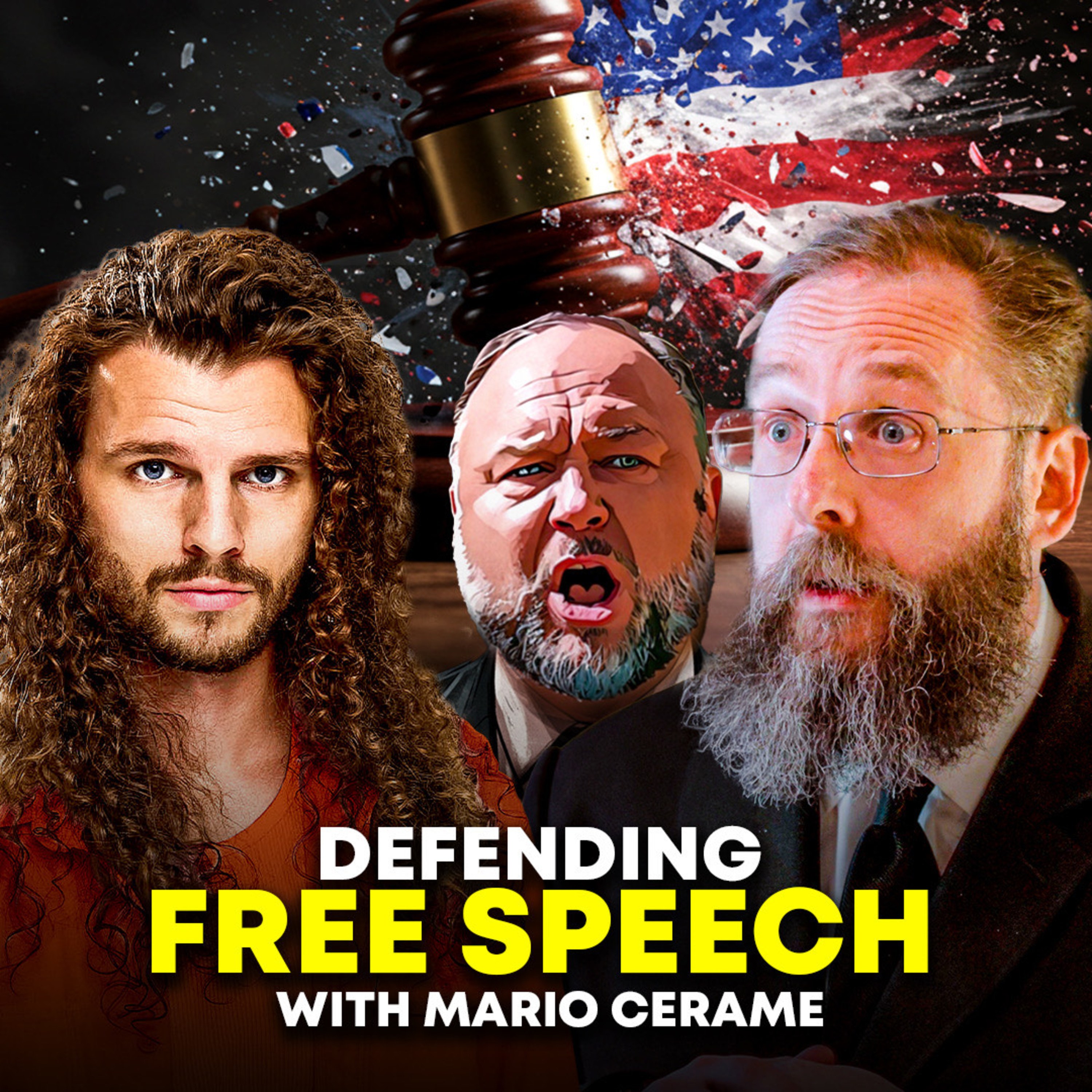
Loading summary
Transcript449 lines
- [00:00]
Mark Gagnon
This is Mario Sarame. He's a free speech attorney that has dealt with some of the most high profile cases in the United States. He's gone up against the faa, the Superior Courts of Connecticut, and even was involved in the Alex Jones Free Speech.
- [00:16]
Mario Cerami
Hey there travelers. Kaley Cuoco here. Sorry to interrupt your music great artist BT Dubs, but wouldn't you rather be there to hear it live? With Priceline, you can get out of your dreams and into your dream concert. They've got millions of travel deals to get you to that festival gig, rave, sound, bath or Sonic you've been dreaming of. Download the Priceline app today and you can save up to 60% off hotels and up to 50% off flights. So don't just dream about that trip. Book it with Priceline. Go to your happy price. Priceline. This episode is brought to you by Greenlight. Get this, adults with financial literacy skills have 82% more wealth than those who don't. From swimming lessons to piano classes, Us parents invest in so many things to enrich our kids lives. But are we investing in their future financial success? With Greenlight, you can teach your kids financial literacy skills like earning, saving and investing. And this investment costs less than that. After school treat start prioritizing their financial education and future today with a risk free trial@greenlight.com Spotify greenlight.com Spotify and today.
- [01:15]
Mark Gagnon
He'S going to talk to us about the Alex Jones case. He's also going to talk about free speech in standup comedy. Right now there are stand up comedians getting arrested for jokes that they said in India. So should different countries have different freedom of speech laws? Is it a human right to be able to say whatever you want? He's also going to talk to us about artificial intelligence and whether AI has a right to free speech. And of course he's going to talk to us about Kanye West's recent controversial tweets. Should he be allowed to say whatever he wants on a closed platform like X? Should the government come and step in on hate speech? All of this and more will be discussed in the theory of freedom of speech. Mario is a brilliant guy and breaks down the free speech argument really, really well. I hope you enjoy this conversation. And if you're interested in free speech, the limits of free speech, and the theory behind why free speech is so important, this is the episode for you. So please sit back, say whatever you want in the comments and welcome to Camp Mario Cerami.
- [02:16]
Mario Cerami
That's perfect. Bingo.
- [02:17]
Mark Gagnon
How are you sir?
- [02:18]
Mario Cerami
I am doing well. I'm so excited to be here. You have no idea.
- [02:21]
Mark Gagnon
I am so excited to speak with you. We've even spoken a little bit off air about a ton of things and we're gonna get into a bunch of stuff today. You are a fascinating person. We met actually at a comedy show we did. Which is a perfect setting for us to meet. And I'm so glad it happened there. You are a free speech attorney.
- [02:38]
Mario Cerami
I am.
- [02:39]
Mark Gagnon
You've represented a bunch of high profile cases and defendants, most notably the one that we had spoken about. You defended a co defendant in the Alex Jones trial.
- [02:50]
Mario Cerami
We didn't get to trial. They let us out on the eve just before trial. We can talk about why they probably did that.
- [02:55]
Mark Gagnon
I see.
- [02:55]
Mario Cerami
But. Right. We litigated all the way to two weeks before jury selection.
- [02:59]
Mark Gagnon
Fascinating. And you defended the only co defendant in the entire saga that didn't have to pay any type of penalty or restitution.
- [03:06]
Mario Cerami
That's right. They let us go because we were going to ruin the case.
- [03:10]
Mark Gagnon
Because you did a good job.
- [03:11]
Mario Cerami
Maybe. I like to think so, yes.
- [03:13]
Mark Gagnon
And today we're going to touch on a bunch of different things relating to comedy. Are comedians allowed to make jokes? Are there certain jokes that go too far? Should a Nazi be allowed to speak at college campus? Is that legally protected? Should they be allowed to. What does the Constitution say about our ability to express ourselves? Our call of duty group chats and call logs? Are those bastions of free speech where people are allowed to say whatever they want? Or should those be logged and put into some type of ledger? Should that be protected in some capacity? And there's a ton of things happening culturally right now that are pertaining to this issue of free speech, free will, freedom of religion. They're all sort of tied in and we're going to unpack all of them. And so I think a good place to start would maybe just be defining what is freedom of speech.
- [03:58]
Mario Cerami
This is a big definition, right? This is a kind of riddle. And I don't know that we're going to settle upon it. There's. In some ways it's easier to think of it as freedoms of speech. We might think about how the law is applied in different contexts. And what are the rules when you are dealing with, say, advertisements? What are the rules when you're dealing with campaign finance? What are the rules when you say something that might be perceived as a threat? Threat. These are unique. These are each kind of separate rights. You might think of them. Where can I speak? What are the rules about burning a flag? Why Is it okay for me to burn a flag in one place, but definitely. Probably can't burn it next to a gas station. Right. I can hold up a sign at a political protest, but I can't hold up that same sign in your bedroom late at night and make a whole bunch of noise. The police will come and lawfully take me away from one place when I'm saying one thing. And they will not be allowed to do so, or would be illegal for them to do so in another context. So freedoms of speech, it can get really. It depends on the context. And I think different people, in the same way that they have different definitions or different concepts of whatever a supreme being may be, I think they have fairly different concepts of what free speech may be. I have a very broad definition of free speech that I don't think everybody shares. I know that most people don't share it, but that's. But that's okay. I think that's part of the charm of free speech, is that people have. It's a value that Americans tend to all share. It's a shared. If we have our national religion, that's as close as we get. I haven't met many Americans who think free speech is a bad idea. I struggle to think of one. They may think that certain things shouldn't be protected, or they may debate about. In the same way people might debate about the Supreme Being. They might say, well, this is what we do on Sunday, or we do it on Saturday and so on. But the fundamental idea that free speech is an important thing in America, it's a fundamental American value that seems to be shared.
- [06:05]
Mark Gagnon
Do you think we could go through a couple examples of positive versions of freedom of speech that most people, maybe 99% of the population will jump on board with?
- [06:12]
Mario Cerami
Sure. Criticizing the government. Right. The newspapers, when they're in the pursuit of truth, and when you just for its enjoyment, you might enjoy something on television or a movie or a film. There's three foundational pillars around free speech. We might say, right, so it's a search for truth, is what we have. This marketplace of ideas, these different ideas, they compete with one another. There might be. When I say ideas, I might even be talking about different forms of evidence, as in support of different principles or what happened. Right. In court trials, for example, we might put on different evidence in the court of public opinion, people put on evidence, too, and they debate. They try to find out what the truth is. Scientists, they engage in debates. So the search for truth is one of the foundational values behind free speech. Another one would be like a fourth branch of government, you might say that was Potter Stewart put that out there. Justice Stewart saying the press, the institutional press, institutional media is there to check the government. Now that's interesting. In the beginning of the Republic there wasn't an institutional media, but you still had the principle where individuals with pamphleteers. And today we have it all over with YouTube. There's so many different ways that people can criticize those in power. It's not just the government, but it's criticizing those in power, which is related to the search for truth. But it's somewhat different too. And then it's just fun. There's a self fulfillment element to free speech, to being able to. There's this line from this guy, Tacitus, Tacitus, sometimes we call him. He writes what wonderful times to live in where you can say you can think what you feel and say what you think is how he puts it. And that's like a nice time. He describes that I'm living in a good time because here I can think what I feel and say what I think. And that's self fulfilling. That's just a wonderful thing. Right? And so it's linked to the freedom of thought. It might be linked to something much bigger. The freedom of speech is linked to the freedom of thought, but it might be linked that itself might be linked to something bigger. We do connect it to religious speech and religious thoughts. So it might be. There might be some spiritual quests there, but it's just, it's enjoyable.
- [08:36]
Mark Gagnon
Alrighty. Don't skip forward guys, because I am on the road. World's fastest ad read coming at you. I'm going to be in Bangor, Maine. Portland, Maine, Charleston, South Carolina, Atlanta, Stroudsburg, Hoboken, Indianapolis, Buffalo, Raleigh, Poughkeepsie, Portland, Oregon. Fort Worth, Texas, Austin, Texas. Stanford, Philly, Levittown, Chandler, Arizona, San Diego. I'm also going to be adding Toronto, Montreal, as well as Washington D.C. and a bunch of other dates. You can get all that@themarkagnon.com dates are in the description. Also in probably the comments of this episode. Go see me on the road. Come hang out. I'll be hanging out with everyone after the show. Come shake my hand, call me an idiot, whatever you want to do, I will be there. Additionally, I will be doing my one hour of standup comedy. I'm very proud of this hour. I'm really excited to share with you guys and it would mean the world if everyone could come on out. And what do you wear to a show? On the road. That's a great question. You can go to campgoods Co. That's right. We got merch, we got Camp merch. We got hats, hoodies, T shirts. A lot of stuff is out of stock. Things have been selling like hot cakes. But we're going to be restocking everything in all the sizes. So you can go there right now, get all the merch, get all the coolest clothing in the podcast game. We're going to be updating that site regularly. And if you come out to a show, I'd love to see you sporting some of the threads that we got up online. I'll see you guys there. Let's get back to the show.
- [09:51]
Mario Cerami
So those are the three principles, the search for truth, holding a check on those in power. And it's just fun. And I think there's one more. If Mario was going to add one, he'd say there's an inherent disruptiveness to it. You may be persuaded against your. What you thought was the best idea. You might be persuaded to think something else, or you might find something funny that you don't want to find funny. There's a. This. This chaotic element to speech that can be very useful. In some ways, that's like the search for truth. In some ways, that's like the holding those in power accountable. But there's something not necessarily voluntary about it that I think can be very healthy. So I see you frowning your eyebrows.
- [10:44]
Mark Gagnon
No, I think that's fun.
- [10:46]
Mario Cerami
Yeah. So there. I think that's valuable to. It's. It's an instrument by which we can take things down and we don't really think of it as. Some people might think of that as a negative thing. Right. That you can use it in this way to disrupt it certainly can be right. But I think that that's a way to effect a change. You know, the only thing constant is change and so on. So I think that those are. That if I would add to the three pillars, I would add. It's a not necessarily consensual, disruptive element.
- [11:20]
Mark Gagnon
I think that's great. Now, I agree that most people look at this and they sort of say, like, yeah, there are those good cases that we talked about. Everyone, I think, likes the idea, broadly speaking, freedom of speech. Like, should a group of Muslims be able to congregate at a mosque and share a message? Could a Christian pastor preach in a town square and spread the Gospels? Can people express themselves in the way that they truly feel and for the betterment of society? Most people like that now, could we go into some of the darker examples where they get contested, maybe unpack what that is?
- [11:53]
Mario Cerami
Sure.
- [11:54]
Mark Gagnon
And I can just rifle off a few. I'm sure you probably have some in mind as well. But one that always kind of stands out in my mind, the 1960s in America, black children are going to school and there are protests of white racist people that are standing outside of these schools. And as the children are getting escorted in by police, they're yelling racial slurs, calling them the N word and yelling at these children as they're going into schools. Now, on a free speech basis, you're like, I don't know what to make of this because I want free speech. I want people to say what they want. But now they're saying something that I don't like, that I sort of violently disagree with. I think that those people are reprehensible. Should I protect the right for them to say bad things to a vulnerable population?
- [12:34]
Mario Cerami
Let me unpack that. I think absolutely. But let me unpack why you can't legislate an outcome. You can't legislate thou shalt think this. It doesn't work. Our brains won't adapt that well to being told, you must think this if you want to persuade. How often are you persuaded by someone who completely ignores your point? Even if you have a stupid point, even if you have a bad point, you have a bad argument. Don't you get, at least I know for me, I am persuaded. When someone can acknowledge the strengths of my position, or at least I feel heard, then I'm going to be more open to being, I'm going to feel like my ideas can be weighed against the other idea. If you just silence someone, you're not going to persuade them. I don't think that's not a very effective way to persuade, is to say, you can't say these things, you can't think these things. I don't like you thinking those things. I don't like you saying those things. So if you want to, if you want to write people off, okay, I don't think that's the right thing to do. Even if you disagree with people, I think that they're, you know, maybe I'm wrong about, about things. Right. So there's this intellectual humility that's really important to free speech that maybe, you know, I probably don't know enough about anything. I, I, I presume I don't know enough about any subject, but I also presume other people don't necessarily. But I'm open to the Idea that they may be able to persuade me off of. Off of where I'm at. If you're not willing to try to persuade other people who disagree with you, you've kind them off entirely. I don't think that's a particularly great idea. So the reason we would keep that forum open for those hostile, offensive, awful, disgusting, stupid ideas is so that they may be persuaded off of them. You know Daryl Davis?
- [14:18]
Mark Gagnon
Absolutely.
- [14:19]
Mario Cerami
Yeah. He's like the greatest American hero for free speech. Cause he engages in exactly that kind of discipline.
- [14:28]
Mark Gagnon
Could you just explain who is Daryl Davis and what has he done for the civil rights movement?
- [14:32]
Mario Cerami
I don't pretend to be an expert on Daryl Davis. I just love him. I love his work. I'm a huge fan of his. So he's a boogie woogie musician. He plays piano, he sings, He's a person of color. And he grew up in a time when things. It was okay, permissive to be openly racist. And he had this principle when he was growing up. He understood, how can you hate me if you don't even know me? And as a child, this really rang for him as a thing. Now he will. One of the things he's most known for is he will engage in dialogue with people who are in the clan or other white supremacist groups. And by listening to them and by dialoguing with them, he will persuade them over time that their position is not actually what they want, isn't going to make them happy. And he has been very successful in that. And his stories are. This is wonderful. This is everything that's wonderful about free speech. It's the marketplace of ideas. You have self fulfillment there. You have the search for truth, holding people in power or trying to hold power accountable. It's great. It's a wonderful. Like, he's the saint of free speech right now. He's one of our patron saints. If we had to have them, I would put him out there as one of the most. If I had a boy, I would want to name him Daryl Davis. I'm not joking. So he's. So anyways, but by listening, right? By making people feel heard. This episode is brought to you by Meundies underwear. Drawers are like the Wild west. You never know what you're gonna pull out or what shape it's in.
- [16:08]
Mark Gagnon
So upgrade your collection with the buttery.
- [16:10]
Mario Cerami
Soft comfort of meundies. Meundies signature fab fabric is as soft as a warm hug from your favorite sweater. Plus, it's breathable and, oh, so comfy, making it ideal for all day wear get 20% off your first order plus free shipping on orders of $75 or more@meundies.com Spotify enter promo code Spotify Ryan Reynolds here from Int Mobile.
- [16:31]
Mark Gagnon
I don't know if you knew this.
- [16:32]
Mario Cerami
But anyone can get the same Premium Wireless for $15 a month plan that I've been enjoying. It's not just for celebrities.
- [16:39]
Mark Gagnon
So do like I did and have one of your assistant's assistants switch you to Mint Mobile today.
- [16:45]
Mario Cerami
I'm told it's super easy to do@mintmobile.com Switch upfront payment of $45 for 3 month plan equivalent to $15 per month required intro rate first 3 months only then full price plan options available, taxes and fees, extra fee, full terms@mintmobile.com he can then persuade them. So that's the when you instead of silencing them, we could go to the thing. If you silence the folks in the clan, they're going to feel there's something very attractive about a banned. Right? If you say you can't don't read this, you can't read this, we take the book, you're not allowed to look at this one over here. Kids in this part of the school, that makes it inherently interesting. Why? What is so dangerous about this language here? Maybe the ideas are dangerous. Maybe someone's trying to keep you down by making something taboo, you can make it inherently attractive.
- [17:34]
Mark Gagnon
Yeah. No, just this idea that ideas need to be disinfected with sunlight. You can't just have them tucked away to fester in the underbelly of people that all sort of agree with this echo chamber, maybe have sort of a perverted interest. And by letting them exist in this marketplace of ideas, they can be sort of dissected, discussed and kind of neuter them of the power of the ideology and ideally persuade people away from it.
- [18:03]
Mario Cerami
The only thing I would alter there, you said let them. And I would, Mario would say force them into the marketplace of ideas where they have to be confronted with oppositional viewpoints. If you take them out of the marketplace by saying, well these are the black marketplace of ideas, we don't let them compete in the marketplace of ideas. You're in some ways protecting them because people can't discuss them.
- [18:24]
Mark Gagnon
Right.
- [18:24]
Mario Cerami
So they can end up in this. It's a nice little echo chamber there where they don't have to have their ideas confronted in the open.
- [18:32]
Mark Gagnon
Yeah, I see this all the time. Like specifically on Twitter or X people will tout ideas that are inflammatory, conspiratorial, offensive you know, like ethnocentric ideals where, you know, they'll say, like, oh, these people control the world. Jewish people do this, or, you know, look at the facts about this thing, and people kind of push it away and they say, oh, we don't want to confront that. And I think, in a way, I think the most responsible thing to do would be let's engage these ideas, let's scrutinize them. And under pressure, I'm fairly certain that there will be some type of explanation or some type of like, causal theory that'll explain. This is not as nefarious as you think for any given, you dangerous line of thought, right? Like this, you know, if someone, some racist holds an idea that, you know, white people are the supreme race or something, instead of saying, okay, you go away, you're not allowed here, and you have to go into some underbelly where you're just with other acolytes that kind of promote this idea to say, no, no, no, come in. Tell me, why are white people the. What about the lack of melanin? Our skin makes us somehow supreme. What is the argument? And I would presume in that case the argument would fall apart.
- [19:36]
Mario Cerami
So you're. I came here wearing this outfit because I'm here to ask you questions too. Dang, you're 20 years my junior. And so you grew up with the Internet in a different way than I have. And some people from my generation, I suppose some people who are older than you might think, well, this technology, you know, one thing that makes this different, the era we're living in now is this prolifera. It's so easy to communicate, so it's easy for these students, stupid ideas to get out there and get in people's heads. So maybe this is different. This is not like the other times when we had the television or when we the printing press. This is a different kind. This is such an order of magnitude different that the marketplace of ideas isn't working. And I wonder what you think of that. As someone who grew up in a very different way with a different relationship with the Internet. Do you think. Do you find merit in that? How do you. Do you think that the marketplace of ideas is going to work on the Internet? What do you think?
- [20:45]
Mark Gagnon
Well, I think with most technology, it sort of creates polarization, that as many steps as you go forward, there are other ways that you go steps backwards. And I think that broadly applies to most technological advancements. Like, I don't know if our threshold of happiness currently is so much greater than it was 2000 years ago or 2000 years before that. So I think that the capacity for human flourishment sort of caps in a way that you can introduce these ideas like medicine or phones, technology, cars. And I think that we sort of reach a threshold of happiness that's probably not that much greater to certain extents. So when it comes to technology, when it comes to freedom of speech, I think that my biggest concern is algorithmic compartmentalization. That you can have the algorithm that puts people into positions where they're now only seeing the ideas that they want, where it's not really a free marketplace of ideas as we're sort of discussing it theoretically, that in a perfect algorithm you would see many different ideas and you would see good ideas competing with bad ideas and that I think the greatest, I think the greatest. I don't know, like inoculation for hate speech is likely like love speech, right? Like if you're getting in a dude.
- [21:56]
Mario Cerami
The Darryl Davis cure.
- [21:57]
Mark Gagnon
Right, Exactly. And Daryl Davis was bravely able to enter spaces of Klan members and racists and being able to, you know, inoculate them with who he was. And they were able to see like, oh, wow, this is actually a good guy. And maybe I completely misunderstood what black people really were all about and we have so much in common. And I'm going to put down my robe and you know, go play jazz with this guy. Right. Like it's a, it's a sort of a Hollywood esque idea, but I think it's true. And my fear is that with the way that the algorithms work in the digital marketplace, that the Daryl Davis message won't cut through to someone that holds, you know, Nazi esque ideals.
- [22:30]
Mario Cerami
That's really interesting. And it's not entirely a new problem. And so I'm interested in this problem. I've thought about it a lot too, but in slightly different contexts. I love Michael Malice, you know who, Michael Malice?
- [22:44]
Mark Gagnon
Yeah, absolutely. He's been on flagrant. He's a. He's a good guy.
- [22:46]
Mario Cerami
He's wonderful guy.
- [22:48]
Mark Gagnon
He's also very funny. I don't know if people. I don't know if. I don't know if he gets. He's credited as being a, you know, an anarchist academic. And that is where he sort of his bread and butter. But he's very funny.
- [22:58]
Mario Cerami
He. At levels. At levels. And he also has really interesting thoughts about consciousness. He's just a. He's a wonderful guy. In, in a world where you have all this, you consent to what you're able to be exposed to, in a world in the, in the kind of utopia of libertarian utopia. Not that he's anarcho libertarian utopia where property rights, this is what's allowed in my, in my sphere. You may write out that disruptive element of speech that you don't want to hear. There's no First Amendment if you're in this anarcho capitalist utopia because it's all property rights. So to what degree is there a limit on property rights vis a vis free speech? That's a real, like a hot button issue for some of my libertarian friends, and I fancy myself as one. But is there a limit there? In a perfect libertarian world, there's no first Amendment.
- [24:02]
Mark Gagnon
So could you expand on, could you make that like more accessible?
- [24:05]
Mario Cerami
Sure. So if I, I'm gonna, I'm gonna use a, a really unfair example in order to try to explain the point. Let's say we said we set things up. We have a, we don't have. We have only a government that we agree to. We have a partialized government. We all sign into different parts of the government. We're gonna sign up, okay, I want, we're gonna decide that I'm gon these people with. In order to have cops. And you sign up to it too. And we kind of get together or through consent, however we consent, not necessarily to, we consent to getting different kinds of services through. And we have, you know, our property, we have it set out. It is all privatized. Like I own and I don't necessarily subscribe to this, so I'm not necessarily being fair to it. But if, if you set things up so this is my land and I am in control of what goes on my land, and only through my consent am I exposed to or do I engage in something like a government, something like services that are where we pool our resources. Then you can write out you only have free speech on your land. You don't have free speech on other people's land. So. And no one else has free speech on your land except you. So how. Because you're, you know, you've kind of done away with the government. You've minimized it so much that it doesn't have anything to be restrained from. Like it's not infringing on your rights. It can't, it's almost non existent. So you don't have a First Amendment in that context to restrain the government. You only have private actors who might be restrained. And if it's all consent based, you have the echo chambers. Functionally, the same kind of isolated communities right Instead of digitally, you might have them in the real world, but it's the same kind of parallel where you have these isolated pockets that are essentially echo chambers that are losing that disruptive element, that are losing that search for the truth because the ideas are not necessarily being challenged. If you only consent to the speech you want to hear, there might be a problem there. I think that's uncomfortable for free speech folks because we tend to be really oriented on property rights. And I understand. I don't know the riddle, I don't know how to solve this riddle, but I see a problem there, that in a libertarian utopia, even as I am mostly libertarian, there is no First Amendment. And there might be a problem there. There might be. We might mess something up. So that's something to ruminate on. I don't know the solution. I don't know that we can. We don't have the social technology yet for it again. Then we get into things about free will and so on. But I just thought your idea, the problem, you were identifying relative algorithmic isolated communities or algorithmic echo chambers and not having the pursuit of truth because of the way the algorithm works, in trying to please you, please the viewer, please the listener, that. That was a similar kind of problem. And I. I thought. And it's not something that free speech folks talk about a lot. We don't talk about this element of things if we're really in theory land. But. So I just thought that was a really interesting insight and I really appreciated what you were saying.
- [27:20]
Mark Gagnon
I'm curious. So going back to sort of the hate speech example that I was talking about, where does hate speech fit within free speech?
- [27:27]
Mario Cerami
Okay, so we got a definitional problem. First off, I'm not. I just. So many people have put forward to me definitions of hate speech. I could try to make one, but it's not going to be quite fair because I don't really believe in hate speech. I don't believe. I think people find certain really offensive words are so horrible that they hurt people, they cause people psychic wounds. That's a principle. In some other jurisdictions, it's very alive. In England, for example, I think that offensive ideas. Offensive. That's not. When you walk out your door, you consent to having other people's ideas put upon you. They may be really offensive. I think that. Suck it up, buttercup. I can imagine. I can try to imagine the case of a person of color with being confronted with this word, with.
- [28:28]
Mark Gagnon
With.
- [28:28]
Mario Cerami
With this horrible word, this very ugly word, this very ugly concept. I don't have that Experience. Right. So it's some ways, perhaps it's blithe for me to say, well, suck it up, buttercup. Nonetheless, I think that if you. The alternative is what? Again, we can't out. We can't legislate outcomes. We can only legislate processes. Do you make it illegal for those words, for those. Those hateful words? What if I'm being hateful about Donald Trump or former President Biden, I'm writing something really hateful about them. Do we. Is that even suggesting some. Bringing up the very old principles of disenfranchisement and struggle? Where do you draw the line? I don't.
- [29:16]
Mark Gagnon
Now, people bring up this concept of punching up or punching down. This is brought up in comedy all the time. It's like if you're chastising or criticizing someone in a power position above you, that it's seen as a protest. But if you're sort of picking on or beating up or saying something derogatory to a disenfranchised group, historically United States black people being historically disenfranchised by the US Government, being oppressed, et cetera, that people would see that as sort of, I guess, offensive, rude, many other adjectives to describe that behavior. So people might look at that example and say, like, oh, well, criticizing a black guy going to school versus criticizing the president. These are unequivocal. But what would your argument be in that case?
- [30:01]
Mario Cerami
So there's two. I have two pieces to it, but the first one, just because you can say something doesn't mean you should. Right? Like, that's a common kind of principle in free speech. Right. So just because you have the right or the government doesn't have the power to restrain you, doesn't mean you ought to. But then the next piece, though, is we're at that definitional place again. Is free speech what we tell the government it can't stop, or is it also crossover into private lands, right into social mores? Is it an infringement of free speech for people to have extraordinary judgment about you if you say something? I'm not sure. I think different people will get off that train in different points. Can your employer discipline you if they disagree with your political views? In Connecticut, there's a law on point where if you. If you're punished and it has nothing to do with your job and doesn't affect your efficiency, if you're punished for your viewpoint, your political viewpoint, that's not allowed, you can sue your employer for that. But that's not the case. Normally. Normally we say, well, private individuals they aren't restrained based on what other people thought. They can disagree with them all they want. So as to the point, I got a little off. I didn't quite answer your question. It wasn't necessarily answering your question. But I think we have a definitional problem there about what is free speech. So punching up, punching down, I would go to. Just because you can say something doesn't mean you should. I do think, though, that if there's an undue amount of social pressure around certain topics, that can act essentially like a gag. Right. It isn't. Isn't a government enforced gag, but it can be. And it can have similarly detrimental effects. That doesn't mean that the solution is to make a process by which those are not there. But I think that that's something to be conscious of when you're thinking about free speech or when you're. It's like a principle underlying free speech that we allow people to express their ideas even if they're dumb.
- [32:08]
Mark Gagnon
Yeah, I think that's an interesting distinction because I do think people get mixed up sometimes looking at the legal protection of free speech and then the social protection of free speech. You see it all the time. Someone will say, you know, something offensive on the Internet and people will get mad at them and they'll say, why are you mad at me? It's freedom of speech.
- [32:24]
Mario Cerami
Yes.
- [32:25]
Mark Gagnon
And that's not really what freedom of speech is in the sort of governmental context. Right. If we're talking legally speaking, you didn't go to jail for what you said. You weren't persecuted by the government. No police knocked on your door. So freedom of speech is alive and well. And furthermore, these people getting mad at you, that definition. Right. And then people getting mad at you. You could argue that they're exercising their freedom of speech to be angered by what you said.
- [32:50]
Mario Cerami
Yep.
- [32:50]
Mark Gagnon
And in that example, I kind of see, like, all right, freedom of speech is operating functionally, that someone presented an idea, other people shot down the idea, and they're having a discourse that is quasi civil right. There's no violence being sort of inducted from this. So, yeah, that's fine by me. Colin Kaepernick kneels during the national anthem. He's in protest of the US Government and the treatment of black people in America. And I think he's within his rights as a citizen to do that. And the people that are in the stands that are angry about this, I think they have the right to express their dissatisfaction if they so choose.
- [33:27]
Mario Cerami
Do we have judgment around the NFL for punishing him for that or to go the other way around, Gina Carano being. She said something that was rather offensive and this got her fired from Disney. And the other side of the coin, there was there an infringement on their freedom of speech if their employers, who are these very powerful organizations who normally would be the kind of thing that we subject to the freedom of speech in order to criticize them. Right. When they are de facto censoring, not legally censoring, we don't have the kind of prior restraint of a censorship board or what have you, but de facto they are punishing someone for their speech that is not necessarily related to their job. They're using it to make a political point about someone who works under them that is not connected to their efficacy as someone who works for them as an employee. Is that an infringement on freedom of speech? Not in the. It isn't under the First Amendment. It isn't under most state constitutions, but it might be in terms of the principles of free speech.
- [34:35]
Mark Gagnon
If you were defending Colin Kaepernick in a, you know, court of law against the NFL, hypothetically speaking.
- [34:40]
Mario Cerami
Yeah.
- [34:41]
Mark Gagnon
Would you think that you could build a case to levy against the NFL to say that the punishment against Colin Kaepernick was an infringement on his freedom of speech?
- [34:49]
Mario Cerami
If I had him in Connecticut, I could.
- [34:50]
Mark Gagnon
Okay, how would you frame that?
- [34:52]
Mario Cerami
Well, there's a statute on point that says if we're lucky to have a statute, and I think some other states have similar statutes, but not many where if an employee engages in speech that would have been protected by the First Amendment or the state constitution, and, and we would treat the. And the employer infringes on that speech in the same. To an impermissible degree in the same way that the government is restrained as an employer in certain contexts from punishing speech. So we apply the same test to the private employer that we would apply to the government if it was an employer. And if it's the same kind of violation, then the employer is punished, the employee can sue, the has a right to recover from the employer. So in that case, I would look at the. If he was in Connecticut, I would say, well, let's look at the NFL as if it was the government in this case. To what degree was. There's a balancing test that's used called the Pickering balancing test. And to what degree is the importance of the employee's speech and people's right to hear that speech, public's right to hear that speech vis a vis the efficiency of the organization, how much that's impacted right so in that case, there's pretty high interest and the efficiency. He's still playing football pretty well. And sure, people are upset, but they're still paying tickets. So I have to. This is the kind of argument I would make if you were in Connecticut, if I could use that Connecticut statute, if I was trying to defend him. Otherwise, I'm really making appeals to authority. I might be looking for something in the NFL contract where it says something sometimes college. Most college campuses have something where they affirm the right to free speech or expression. I might be looking for something about racial equality in the NFL's code or contracts, that it values these things. And I might be trying to make an argument out of that. But I'm on a very different kind of ground. Right. I don't have a really good. I'm making more appeals to principles than actually invoking the strength of law in a courtroom.
- [36:52]
Mark Gagnon
I see.
- [36:53]
Mario Cerami
Yeah.
- [36:53]
Mark Gagnon
What's up, guys? We're gonna take a break really quick because I want to talk to you about the most discreet, coolest way to curb your nicotine craving. Thank you.
- [37:03]
Mario Cerami
I couldn't have completed this project without a little extra coffee. And since I brushed with Colgate's pro series toothpaste with an expert level whitening for a vibrant glow, I could show up to set each day, camera ready and smiling wide.
- [37:16]
Mark Gagnon
Well, Kelly, looks like a little Colgate gave you a lot of confidence.
- [37:21]
Mario Cerami
Colgate Optic White. Find it at all major retailers.
- [37:28]
Mark Gagnon
This episode is brought to you by Lifelock. It's tax season and we're all a bit tired of numbers, but here's one you need to hear. $16.5 billion. That's how much the IRS flagged for possible identity fraud last year. Now here's a good number. 100 million. That's how many data points LifeLock monitors every second. If your identity is stolen, they'll fix it, guaranteed. Save up to 40 your first year@lifelocked.com podcast terms apply things. And that's right here with Zipix. You've probably seen me chomping on a couple of these toothpicks during the episodes of this podcast. I like to use a little bit of nicotine when I'm locking in on a long term conversation with someone trying to figure out the, you know, deep meanings of life and aliens or even consciousness. I also like it when I'm trying to write. Sometimes right before I go on stage, I find that it just gives me me a little bit more of a locked in feeling. I can focus for a little bit longer. There's even been some studies to show that nicotine has improved aspects of fine motor skills, attention and auditory processing and memory. So if you're trying to lock in for a little project you have, you just need a little boost. A little bit of nicotine is great. And these are great if you're trying to quit smoking, too. If you don't want to fill your lungs up with smoke, but you still like the little nicotine feel, they have a bunch of great flavors. They also have 2 milligram and 3 milligram options. Zipix toothpicks are great for flights, little sporting event, or even just hanging out with the boys, having a couple drinks. Zipix has helped hundreds of thousands of customers get their nicotine fix without needing to inhale smoke or vapes or any of that stuff. So if you're interested, go to Zipix. That's z I P Pix toothpicks.com and the listeners of this program will get 10 off their first order by using the promo code Gagnon. That's right. G, A, G, N, o, n. Get 10 off. I also should let you know that you have to be 21 years old or older to order. Also, nicotine is an addictive chemical, so please use it wisely. Only as much as you need. Now, let's get back to the show. Now, I'm curious with some more, like, gray area things, Right? Like, I feel like we've kind of talked about, you know, hate speech and, you know, very clearly negative, vitriolic things that you, you know, sort of make the case to defend, because on principle, we have to defend bad things in order to defend good things and that they fall under the same umbrella occasionally in an unfortunate way.
- [39:45]
Mario Cerami
And as part of the search for truth, the only way to get closer to the truth is to allow these stupid ideas out there so they can be confronted.
- [39:53]
Mark Gagnon
Yep. Right. Because, I mean, if you even look in the time of Martin Luther King Jr. He's standing up and saying black people deserve the same rights. And in a marketplace at that time that says, this is a dumb idea, if that idea was shut up, how much longer does that delay the search for equality in American society? So that is a situation where there was an unpopular idea that was protected.
- [40:16]
Mario Cerami
Yeah. Marriage between black folks and white folks. The fact the idea that to be gay is not a disease. These were ideas that were dominated. Contrary ideas were prohibited. They were not allowed. They were taboo. To say that to be gay was anything other than a disease. You could be really punished as a psychologist, if you said that. But because we have this free speech, this marketplace of ideas, those stupid ideas could be confronted. So I interrupted you though, so I'm.
- [40:49]
Mark Gagnon
Curious about some gray area things. So you mentioned a case that you had dealt with where there was a desire to put LGBTQ sort of discussion, or you can fill in the blanks once I kind of lay it out. Just basically like they had some type of lgbtq, lgbtq, I guess, messaging in a high school graduation and multiple parents, one in particular said, don't do this. Take out the gay stuff. We don't want this at our school. And if you don't do it, quote, there will be hell to pay.
- [41:23]
Mario Cerami
Yeah, yeah, yeah, yeah. That's a case going on right now. And I took appeal on it. And I, I think because there's been so much publicity around it, I think I can speak fairly around it. My client, he, you almost have it exactly right. At graduation, one of the teachers had a, had a rainbow hair display and a number of parents found this offensive. My client's very Christian fellow, and he didn't think that injecting politics like that de facto into graduation was fair. It wasn't his political beliefs, it didn't reflect his beliefs or the beliefs that he wanted his children to grow up with. He doesn't hate folks who are lbtqtqia. He doesn't bear them ill will, but he just didn't think it was appropriate to have it marched across the stage as a very Christian fellow with his values being as how they were. And he did. He protested to the school, he wrote them a letter, and he wrote, among other things, that there would be hell to pay, meaning that there would be outrage in the court of public opinion that there would be press, bad press around this. And this was seized upon by the school. And they accused him of making a threat for actual physical violence to occur. In fact, they accused him of making a threat for actual physical violence to the entire senior graduating class. And he was convicted. And there were no, to be clear, there were no guns. There was no imagery of guns. My client doesn't even own a firearm. There was no presentation or alluding to any kind of, of actual physical violence. It was just that phrase that, to be fair, could in some contexts, or even in that context, could, could be understood as a threat for physical violence. But that's not the test. So we, we have this test in order to protect political speech in, in the US we call it the true threat. What is something a true threat, and it has to be unambiguously so. Unambiguous call for actual physical violence to occur. A genuine intent for physical violence to occur, an unambiguous one. So if it could is not enough, it has to be such that a reasonable person would understand it to be a call for actual physical violence to occur. So you may call that a gray area. I would call it rather black and white. I have an easy test I can lay out for it. And so I can say, nope, it's actually on this side of the line. You made a mistake, Judge. So sorry. Sorry. I can understand how you made that mistake. Judges don't often have First Amendment cases go in front of them, so it's something unusual that comes up. So we may have. Sometimes we have a lack of expertise, not just in terms of prosecutors and attorneys, but sometimes among the judiciary or the bench, sometimes this too, because they don't have a lot of these cases come up for them. So I can understand where the mistake may come from. But nonetheless, it is a mistake. And I think it's. I don't think that's a close one. I think that's pretty good. Because it's just that phrase alone. It doesn't say that someone's going to go in with a knife or a gun or going to be. It could mean that. That I'm gonna yell at you. It could mean, I wish ill upon you. It doesn't mean that there's gonna be something physically violent's going to occur.
- [44:27]
Mark Gagnon
I see. I see your point, and I see the case you're laying out for your client. On this specific case, I'm like, hey, if someone wants to have gay hair, suck it up. You know what I mean? Like, I'm like, it's. Who gives a shit? I don't particularly care if someone wants to have gay hair at a graduation. So I think this guy should have just sucked it up in that case, just on my personal opinion.
- [44:47]
Mario Cerami
Sure. But should he have? If he felt that it was a.
- [44:51]
Mark Gagnon
Bad idea, he should be allowed to petition. He should be allowed to ask the school.
- [44:55]
Mario Cerami
Yeah.
- [44:55]
Mark Gagnon
And I think the school would be well within the race to be like, hey, suck it up, buttercup. We don't care. I think him saying, there's hell to pay without knowing the full context of, you know, his character as well as the email I would be, if I got that message, if someone had DM'd me. And I've gotten DMs at times where people say, like, you know, it's on site.
- [45:14]
Mario Cerami
Yep.
- [45:14]
Mark Gagnon
People will say that or, I better not catch you. Yeah, I interpret those as violent. It's obviously different than what he said. But if someone had DM me and they said, hey, man, I saw that joke that you posted. Better take that down or there will be hell to pay. If that's the whole message that I got, I would feel uncomfortable with that.
- [45:33]
Mario Cerami
Sure.
- [45:33]
Mark Gagnon
That would make me unhappy.
- [45:34]
Mario Cerami
You could understand it as a call for physical violence.
- [45:37]
Mark Gagnon
Right, Right.
- [45:38]
Mario Cerami
Why do we do this? Why do we protect words that could be at the edge there? Right. Because we want to have a rich ability to criticize the government here. That's what we have. We have a guy criticizing the. And if sometimes we don't just protect words just for those exact words, we protect them because other words might come close to them. So here he used a colorful idea in order to criticize the government, Government employees, government officers at the school. If you censure that, you can censure based on. Would they have done the same thing if he was coming out in favor of lbgtq? Right, right. Is it just being levied on one side of the viewpoint? Right. The government shouldn't be able to put its thumb on the scale of one side. Right. If you're gonna have a marketplace of ideas, the government can say whatever it wants. It can say, dude, take a hike. We don't agree with you. We believe this is part of our values in our community. They do that through the proper channels. But to punish him, them. To hit him with a stick, the carrot is one thing, but to hit him with the stick and say you'd said that bad of you and one side of a political debate, that's not okay. That's viewpoint discrimination, we would say.
- [46:54]
Mark Gagnon
It's an interesting case because I do think that there's almost like a social Rorschach that comes into play when you look at language and culture. And this is kind of getting into like, you know, like linguistics a little bit.
- [47:04]
Mario Cerami
Absolutely.
- [47:05]
Mark Gagnon
But, like, you know, there's a phrase, and I'm actually curious if you would pick up on this. If a kid was at school and he was leaving school and he said to some of the other kids at school, hey, don't come to school tomorrow. And then he left. That is, on its face, sort of innocuous, but it has taken up a sort of meaning culturally to suggest that there will be violence at the school the next day. It's almost reminiscent of Columbine and different mass shootings that have happened in America where, you know, a student might warn other students that he likes, hey, don't come to school tomorrow. And so if you understand the context and the character, then all of a sudden the words have a different meaning.
- [47:46]
Mario Cerami
Yeah, absolutely. If in that context. If in that context those words are unambiguously a call for physical violence to actually occur because no one says it otherwise. No one ever says that otherwise, then that's. Or if they're meaning to intend that it's going to happen even if it doesn't happen, they're meaning to show a genuine intent for it to occur, then that can be. Absolutely. Can be a true threat. Right. And I'm just talking about how the law works. I'm not talking about morality. I'm talking about how the First Amendment works in this context. You may have a different opinion about where people should get off on the scope of the freedom of speech. Right. That's separate. That's a separate thing, and I'm open to debate on that. Right. Where should it be? Okay, as to the legal question in that context. Yeah, it depends. And I don't know enough because I don't work in schools yet anymore. Right. I haven't been in the particular school. May really matter. It may really be different in Columbine. Right. If somebody did say that in the school next door or another school two weeks ago and someone says it again and it's clearly recalling that, that might be very different.
- [48:54]
Mark Gagnon
Yeah. That's interesting how the circumstances can change speech and also the character of the person saying it. Right. Like, if I, you know, if I get a message from someone that's like someone involved in crime or someone that, you know, has access to a lot of weapons and they post their weapons all the time and they message me, there will be hell to pay. I would interpret that very differently than, you know, if, like, sort of like a smarmy, you know, like, woman were to say it to me that, like, has a vegan health restaurant and she says there will be hell to pay, I would interpret her hell to pay and his hell to pay very differently.
- [49:30]
Mario Cerami
Yeah. It's a different question. And there would be a. A lot more specifics I'd want to know before I would be able to opine on how the law might come down on that.
- [49:37]
Mark Gagnon
Sure.
- [49:37]
Mario Cerami
But no question, you're talking about something very. You're talking about two very different contexts for the true threat exception to the freedom of speech is going to play out legally. So, no, you're onto something there, man.
- [49:48]
Mark Gagnon
How often does that come up in your cases that the character of the person changes the words that they say?
- [49:54]
Mario Cerami
It's Usually a consideration of the context of the circumstances. What other facts are adduced around this person? What imagery? What other things have they said in the past? What's the context of the conflict between these two people? The identity of the individuals involved is supposed to not be a thing. We're not supposed to, for example, punish folks for saying something if they're one ethnicity than another. That's not supposed to be a thing.
- [50:25]
Mark Gagnon
That's another fascinating example because there are cultural things that exist within different ethnic groups in the United States that, that someone might say something that means something to a culture. Like some guy that grows up in a black hood in America might say, oh, I'll put you on a T shirt. That is a very clear threat. But to people that grew up in a white suburb, you might hear that and be like, I don't even know what that means.
- [50:46]
Mario Cerami
So we use that. Under the circumstances, how would a reasonable person understand it? But there's a doctrine, another speech exception, that's more problematic in this way called the fighting words doctrine. And it's, it's not been one that's been. That the U.S. supreme Court has dealt with. And it's kind of done a bit of mischief in the meanwhile. For the last 60 some odd years, 70 years, it's been around this exception. And that does look at the context in particulars about individuals and how people did understand the language that was used. If it was the kind of language that would be understood to be, that might wound a person dropping the N bomb and calling someone with extra words around it as if to goad them into fighting you.
- [51:34]
Mark Gagnon
Right.
- [51:35]
Mario Cerami
Yeah.
- [51:35]
Mark Gagnon
It's fascinating. If you say that to a black person out at a bar, they have to fight you. You're gonna be in a fight.
- [51:42]
Mario Cerami
But if black folks say it in a different context, it may very well not be. So to what degree is that doctrine working? If we're pun. You know, the N bomb is a funny word for a lot of reasons.
- [51:57]
Mark Gagnon
Yeah. Culturally, so much power.
- [51:58]
Mario Cerami
Yeah. It's the worst word in the English lexicon right now. It's the most offensive word. It's supplanted the F word way many times over. So it's an interesting example to look at. It's difficult for me to talk about it sometimes in an honest way because I have to be mindful of my own ethnicity in the context. But I think there's a, there's a, there's some mischief there. If we are, if we're going to put. What happens when you have someone who's identifies with a particular ethnicity, but they're particularly pale. Are they not allowed to engage to use the word?
- [52:35]
Mark Gagnon
Right.
- [52:36]
Mario Cerami
When does that happen? You know, at what point is their line, are we getting to the one black. One drop of black blood before you can use the word or can't use it?
- [52:42]
Mark Gagnon
It's almost like American Jim Crow racial identity flipped in a way.
- [52:46]
Mario Cerami
Yeah. And that. It's a. I don't know the answer. I don't. I can identify this problem. I don't know the solution right now. There's a. We have a kind of working or not working model around it where the words allowed to be appropriated by folks who identify with a particular ethnicity. And it's definitely not by people who don't who have a different ethnicity. Okay. So it's like a weird truce.
- [53:13]
Mark Gagnon
If I can even add to that. Oftentimes it can be used by people that exist even within the culture of that ethnicity.
- [53:19]
Mario Cerami
Yeah.
- [53:20]
Mark Gagnon
So if there's a. Like a Mexican dude that grows up in a black hood.
- [53:23]
Mario Cerami
Oh, maybe. Yeah. Yeah.
- [53:24]
Mark Gagnon
Typically speaking, in my experience, it's kind of given a pass like many of my black friends. I mean, there's a lot of, like Puerto Rican rappers that grow up in black communities that use the word and it's sort of acceptable. I have Indian friends that grew up in black communities that have used the word. And people go like, yeah, this is like, you are non white and you exist within our cultural context. So we kind of let it go.
- [53:45]
Mario Cerami
Can we talk about the Randall. We talked about this off.
- [53:47]
Mark Gagnon
Yeah, the Randall Kennedy book. Yeah.
- [53:49]
Mario Cerami
Yeah. And I brought you a book. The Word I'm not. The title of which I'm not going to say for the reasons we've discussed, but he talks about how the word was used by his parents as a compliment in context, as a powerful kind of compliment. That's one. Smart. And it was. He is smart. And it's. Hearing him retell it. I've heard him talk about this. It's like, wow, that's a really powerful use of the word. And it's not. I don't. I couldn't use it in that way. I would. It wouldn't ring the same way. But that's. That word deserves a place in the lexicon when used in that context. It's kind of awesome. Right. It takes all of the. It builds on the pain and suffering of the history of the word and transmogrifies it into something rather beautiful and amazing.
- [54:41]
Mark Gagnon
Yeah.
- [54:41]
Mario Cerami
As an expression of awe at a person. So anyway, it's A riddle. That word. It's a troublesome word.
- [54:51]
Mark Gagnon
There's an interesting example. Gabe, would you mind searching? Mexican dude says the N word in front of black guy. There's a video. And obviously this exists as a microcosm of one example. Black people are not a monolith. And so this one guy kind of hears this thing happen and he has this experience. If you click on that Facebook link, I think think so you whites and brown beers.
- [55:17]
Mario Cerami
See, I'm Mexican. I can say.
- [55:27]
Mark Gagnon
So that's. I. That's one. Just a fire video. I love that video. I think it's so funny. But it does illustrate something to me that's interesting culturally, right. That, that this guy sort of indicates to these other guys, hey, I understand what the word means. I understand I'm saying it in the context that you all have allowed. And I also understand what it means to be not white in a white America. And these guys sort of seem to understand it in that exact moment. Maybe they didn't want a confrontation or maybe they kind of accepted his explanation. They go, yeah.
- [55:57]
Mario Cerami
Acura's all new adx. A compact SUV that isn't just built for one thing. It's precision crafted for everything. To escape the grind. With available all wheel drive to go with your flow. With available Google built in.
- [56:08]
Mark Gagnon
Hey, Google, turn it up. Okay.
- [56:10]
Mario Cerami
Turning up the volume. And crafted to be heard with an available bang. And Olufsen premium sound system. The all new Acura adx, crafted to match your energy. Acura precision crafted performance. Google is a trademark of Google llc.
- [56:27]
Mark Gagnon
You're my boy. That's cool.
- [56:28]
Mario Cerami
They were confronted with a choice, the black folks in that video. And they, I thought, made a very charitable, magnanimous choice so that they, but they heard the word. And as we pointed out, if you use that word in a bar, like, dude's gotta fight you. Like if you, you know, and they, they're. That's what they're cued onto. And. But then he, they make the decision very quickly to be charitable and accepting of the thing and, and create camaraderie around the word where it could have absolutely gone the opposite way.
- [56:55]
Mark Gagnon
Right?
- [56:56]
Mario Cerami
Like, these are all big dudes. So like, you know, but they decide, no, this is, we're going to be cool with this. And they had the power in that moment to do that, to create that acceptance or rejection.
- [57:07]
Mark Gagnon
Right?
- [57:08]
Mario Cerami
And it's a wonderful video because they chose to be magnanimous in that situation. It would have been really awful. It could have been absolutely right. I'm not doing that yeah, yeah.
- [57:21]
Mark Gagnon
No, not odd. That's interesting with this word specifically as it pertains to comedy. And that's obviously one of the big things I wanted to speak about with you. As a comedian, I am very much in defense of jokes. I exist as an ally to all comedians expressing themselves on stage genuinely, whether you're a white guy talking about black people, black guy talking about white people. I think the sort of art form of comedy has space for all of them. And some of my favorite comedians in the world do N word bits, you know what I mean?
- [57:55]
Mario Cerami
Absolutely.
- [57:56]
Mark Gagnon
Chris Rock, Dave Chappelle, but also some white guys. Some of my favorite comedians in the world, Louis C.K. neal Brennan, two of my all time favorites have these brilliant, fascinating, amazing bits where they say the full N word and it's brilliant and funny and poignant, but it exists as this sort of time capsule because I'm skeptical that a white comedian will ever have, quote, an N word bit where they say the word for a long time. And I don't know if they should or shouldn't. I don't have like a real moral answer for myself. Like, you know, on the one hand, I think people should express their art and if they have a really funny bit where they say the word, then it's permissible. But I also don't know if I'm going to be the guy that's like, every white guy should have an N word. You know what I mean? Like, I'm not going to take a hard line there. Yeah.
- [58:43]
Mario Cerami
Is the rule, is it funny? Is that the rule? Is that the kind of the legal principle? If it was the controlling principles. Is it funny? Dude?
- [58:52]
Mark Gagnon
And here's the tricky part though, is that obviously, like all heart comedy's subjective.
- [58:56]
Mario Cerami
Yep.
- [58:57]
Mark Gagnon
And so 95% of people think it's funny. Or maybe let's say in the United States, what, 87% of people think it's funny, but then 13% that happen to be black that live in this country don't think it's funny.
- [59:08]
Mario Cerami
Yeah.
- [59:09]
Mark Gagnon
Then what?
- [59:09]
Mario Cerami
Well, we protect bad jokes too, don't we? It doesn't have to be a good joke to fall within the freedom of speech. But. But maybe it does fall with, you know, in terms of the social stigma. Well, dude, you're just bad at your job. You're not doing a very good, you're not doing a very good act there.
- [59:23]
Mark Gagnon
Right.
- [59:23]
Mario Cerami
So maybe you should take a, you know, that one bombed. You learn. But, you know, being a comedy is really wonderful as it intersects with the freedom of speech. You Know, you're. You got all of them there, right? You have taken on people in power. You got a bit of the search for truth. It is obviously enjoyment. And it's got that disruptive piece in some ways, not even voluntarily. Like, it upsets people. You don't. We talked about this again before. When I go to a comedy club and someone makes me laugh, they make me laugh. I didn't consent to laugh unless it's not really that funny and then I'm ha, ha, ha. But, you know, there's something. Something kind of wonderful around that disruptiveness to it, that involuntary disruptiveness to it. So. But you as a comedian, like, this is your world. Like, you live in the freedom of speech. So I'm really curious to you about your opinions around boundaries and what ought to be allowed. What ought not to be allowed. Is it right? Is that the only rule that. Is it funny or not? Or are there jokes? Is there a thing is too soon? Only something that applies. As Gilbert Gottfried said, the only time it's too soon is if the timing is off. Right. So is there. How do the social rules work here? How should they work? Should the government ever be involved in jokes? I don't know.
- [60:47]
Mark Gagnon
Yeah, I mean, the way I look at it, one of the things I'm really drawn to with comedy is that there are very few rules and the things that I really like and the only rules that I really sort of grab onto is be original. And I think that's first, actually. I think originality is first and be funny, and it's those two. And funny is an extremely close second. But it's really only those two rules. Like, if I were to see a white guy. Do you know Chris Rock's N word bit? Like the infamous N words versus N words. I don't know if you've heard the bits, of course, but if I saw a white guy do that bit, I think I would be more offended that he stole a joke from one of the greats than the fact that he said the N word. You know what I mean? As a comedian, I'd be like, dude, you're a hack. Why are you doing that?
- [61:31]
Mario Cerami
There's very few cover songs in comedy. You can kind of of imitate the great artists. Comedy.
- [61:36]
Mark Gagnon
No, of course, Absolutely. And I think that all artists sort of have a version of imitation or inspiration, but you can't just steal a bit. Right? So that's where I'd be like, okay, you can't do that. So those are only really two rules. I think the Government has no place in the expression of art. Generally speaking, I would maybe make some caveats for like painters or something that are painting some type of graphic pornography. I think that's maybe where I would take a line on a personal basis.
- [62:04]
Mario Cerami
All right, I'm gonna push you on this.
- [62:06]
Mark Gagnon
Yeah, please do.
- [62:06]
Mario Cerami
Okay, well, I'm gonna use an example on one far side, right. That you'll say, okay. Whoa. Okay. But it's gonna open up the. Luigi. Right. He wrote on the bullets. He wrote messages, right. And he used those bullets to kill someone. Right. Literally his message was used to kill someone. The instrument upon which he wrote his words.
- [62:30]
Mark Gagnon
Right. If it was a Shakespeare play, that'd be beautiful. The fact that it's real life makes you a little bit more morally ambiguous. You go, ah, you shouldn't kill people.
- [62:36]
Mario Cerami
A little bit more. So. But where along that. There's a spectrum there. Right. So can it be used as a sham? Or what if it is genuinely art, but it infringes on someone's. Well, life is. That's a pretty good one. That's a pretty easy one. Property trespassing on the outside of someone's home. How does it work? Can comedy be used as a sham defense? Really? Maybe bad jokes aren't protected. I don't know. If a bad joke suggests danger, I don't know. So where's the limit, though? Where's the limit? Because you say has no place in comedy. But let's say Luigi wrote a joke on there. And some people might find it to be a very dark and awful joke what he did. So where's the line? Is the line. Limit of causing physical harm is the line. Psychic harm is the line. Cause some different places are gonna call the line at a different place.
- [63:39]
Mark Gagnon
Right? Precisely. So when I'm speaking about comedy in this context, it's strictly stand up comedy on stage with a microphone.
- [63:45]
Mario Cerami
Okay.
- [63:46]
Mark Gagnon
And I think maybe the line could be drawn if there was some type of like. Like inciting a violence or some type of like physical threat. Like, how funny would it be if we all just beat the shit out of this guy right now?
- [63:57]
Mario Cerami
Yeah.
- [63:58]
Mark Gagnon
And then that guy gets a shit beat out of him.
- [64:00]
Mario Cerami
Yeah.
- [64:00]
Mark Gagnon
Then I would suggest that perhaps that was not a joke with the desire to be funny, but rather that was a joke with a desire to physically harm someone. And then I would almost pull that out of the context of comedy. Because now you're no longer doing comedy, you are inciting violence. Which comedy, I think definitionally is designed to incite humor and laughter and not violence.
- [64:20]
Mario Cerami
Does the government have a duty to intervene in things that aren't so obviously calling for physical violence if the social mores are so strong? For example, certain kinds of jokes in an Arab country or certain kinds of jokes in India or Pakistan or in England.
- [64:36]
Mark Gagnon
Right. Which, I mean, I don't understand how their freedom of speech laws work. I would wish that they had the same freedom of speech laws that we have in America. They don't. So I'm only really speaking about America specifically. But, for example, like, we went to the United Arab Emirates and we did comedy there.
- [64:49]
Mario Cerami
Yeah.
- [64:50]
Mark Gagnon
And they told us, don't talk about the royal family. Don't talk about Islam or. Yeah, that's basically what they said. They didn't even say, like, hey, if you joke about it, make it funny. They just said, don't talk about it. And we didn't. And that's just what it was, you know? And I think, yeah, one of the guys got off stage and he was like, dude, I just told a 911 joke. Joke. It's like, is that bad? And I was like, hey, dude, they didn't do 9 11. I was like, it's fine. All right. It was George Bush that day. Don't worry. But yeah, so it's one of those things, like different countries obviously have different, you know, legal parameters. It's funny you mentioned India because we were just talking about America or India's Got Latent.
- [65:30]
Mario Cerami
Yeah.
- [65:30]
Mark Gagnon
Would you mind pulling that up? India's got Latent. This is a show reminiscent of Kill Tony. If anyone's familiar with Kill Tony, it's obviously extremely popular. Very funny show that happens at the Mothership in Austin, Texas. Tony Hinchcliffe and a panel of comedians will interview comedians after they do one minute of comedy. And it'll be a one minute standup set followed by eight to nine minutes of banter where they learn who the person is. And that's the show. This guy, I forget his name. If you're able to find the name of the guy that hosts. Oh, Samay. Samay Reina. And so he's the comedian that runs the show. And the show is a smash hit in India. Millions and millions of views every episode. Like, they're cooking at like 10 to 15 million views an episode. Massive. And this guy, same Reina, is a mainstay celebrity now in India. And he had another comedian on the show. Or actually, he's not a comedian. I should rephrase it. He's a podcaster. This guy, Ranveer Alabadia, and he's A very famous podcaster. His name's Beer Biceps on Twitter and on his podcast. And that show is also master. So this was a big episode. Same is doing the show. Alabadia is there as a guest, and he makes a comment while they're doing the discourse in the banter where he says, would you rather watch your parents have sex every day for the rest of your life or join in one time and it stops forever?
- [66:54]
Mario Cerami
Holy cow.
- [66:55]
Mark Gagnon
And it is a classic, you know, middle school, high school. Would you rather question that kids in America have been saying forever? It is a purely absurd and grotesque sort of hypothetical. And the disturbing nature of it is what makes it so funny.
- [67:08]
Mario Cerami
Right.
- [67:08]
Mark Gagnon
That you're stuck between this, you know, this terrible conundrum, and you have to choose one of these terrible things. And to my understanding, the morality board saw this and I think are issuing political sanctions against both the comedian that hosts the show as well as Alabadia for making the comment. And there is now political action being taken against them. How that will pan out, I don't know exactly, but it's one of these fascinating cases where this guy just said something. It wasn't even about the religion. It wasn't about the government. It was just a hypothetical. But the government saw it as an offense to the moral fabric of the nation, and as a result, they're now putting sanctions against them.
- [67:46]
Mario Cerami
Yeah, we're getting to the definitional thing again. People have different views. Just. They have different views of God. They have different views of what the scope of the freedom of speech ought to be or is. And so now Mario to step out of himself. I think that that's a really dumb idea. I don't agree with that. But I also know maybe I'm wrong. I believe really strongly these views, but I may very well be wrong. If the Greeks could be wrong about slavery, these bastions of Western society, they couldn't conceive of a world without slavery. They were wrong. Similarly, I may be wrong about what the freedom of speech ought to be, about what free will is. So I'm open to the idea that maybe I'm wrong on that principle, but I don't think I am. I welcome people to try to explain and in their culture, maybe that is the right thing. Maybe in that context, it is. It certainly isn't over here.
- [68:44]
Mark Gagnon
Is it cultural or is it human? Oh, right. Like in this case, like, sure, there's a cultural component that making fun or mocking Islam in a Muslim country that is more frowned upon than doing it in America. Like, I can Understand the cultural context of religion. But a hypothetical like this, that is. Sure, it's grotesque. I'll admit I don't. I think you should be allowed to say that anywhere in the world without being punished by the government.
- [69:12]
Mario Cerami
I would hope for that principle. We're getting a little bit. There's a little something here though, too. Remember that involuntary thing I was talking about, how you don't consent? Right, Right. You put that idea in someone's head. I can't get it out. You said the thing. I don't want to think that anymore. I really don't like to think about my parents having sex, to be honest with you. It's not. This is. I need to think about something else. I'm thinking of Happy Fields. But like when you say that to the person, you put an idea in their head and they don't want it there. It's there and it's really ugly and it's really awful. It makes them feel icky. That's part of why it's funny. But in the same way tickling makes you laugh involuntarily. But maybe that's where the government's coming in. Like you're doing something in the same way that hate speech, ostensible hate speech, wounds people. You're wounding the morality of the people by inflicting this imagery upon them. I don't think that that's a good idea. I don't think that that's how you get closer to the truth. I don't think that that's how I think. This goes against a number of principles. And I think you censuring it, you make it more attractive. More people are going to. You're going to put that in a black marketplace of ideas and people are going to seek it out and find it in other places. Not your form, they'll find it elsewhere. But as to whether it's right for the policing of that, I don't know to what degree I. Am I being a colonizer? If I go over and say that's wrong now, I may think it is. But if I say it's wrong for India, to what degree is that me imposing my view of the freedom of speech upon another people in a superioritous way? Now, I think my way is the right way, but I don't know if it's. I can be open to the idea that it may not be right for Indians. Maybe I'm wrong. I don't know. It merits a closer look. It's a really complicated piece. I don't know if I'm getting there.
- [71:07]
Mark Gagnon
No, of course. That makes sense. I guess as a comedian and someone that exists in that space.
- [71:10]
Mario Cerami
Yeah, yeah.
- [71:11]
Mark Gagnon
I've said jokes that are bad. I've said jokes that are probably offensive, and I will probably say jokes that are offensive in the future, and that might not even be funny. But I'm trying to be funny.
- [71:21]
Mario Cerami
Stopping your shows, Mark. I'm not gonna.
- [71:25]
Mark Gagnon
I've said jokes that are. That are potentially offensive. Right. That night, I don't know if I said any.
- [71:29]
Mario Cerami
Yeah, you did. It was great, though. I mean, that's why I signed up. But.
- [71:32]
Mark Gagnon
But I. I'll. I'll say jokes that might be, you know, that might be wrong or offensive, and that might not be funny. But my goal was always to be fun funny.
- [71:40]
Mario Cerami
Yeah.
- [71:40]
Mark Gagnon
And in this case, I think. And again, I don't speak Hindi, so I can't necessarily pick up on maybe some intonation thing that occurred, but Al Abadia's joke was with the intent to be absurd and ridiculous and shocking and funny. And in that regard, as a comedian, I kind of say he should be allowed to do that.
- [71:57]
Mario Cerami
Subjective intent for you enough. Is it. Your intent is not to harm, therefore that's enough. Or are there some things. Even if you didn't intend for it to be harmful, even if you didn't intend for it to come off as a threat, it was so recklessly stupid of a thing to say that it did cause harm to the moral fabric or the feeling of physical safety of people around you is intent enough. I think that's a good question. Mario has definite opinions about it. Mario has very open views on what the scope of the freedom of speech ought to be. But I can respect that. People have different views and the government has different views about it. Our government too. So, yeah, if your predominant intent is to. To is not to cause someone to be alarmed in the U.S. that's a really big, important factor that's going to save you from a lot of crimes.
- [72:42]
Mark Gagnon
Right.
- [72:42]
Mario Cerami
But I don't know if ultimately that's the arbiter. It's interesting to hear your view on it, though.
- [72:47]
Mark Gagnon
Yeah. The consent component that you were even talking about before, I find very fascinating. I've. I've heard this argument. I think Alex O'Connor, the YouTuber podcaster, said this. He brought it up as a hypothetical.
- [72:57]
Mario Cerami
Yeah.
- [72:57]
Mark Gagnon
That it's illegal for me to commit bodily harm to you.
- [73:02]
Mario Cerami
Yeah.
- [73:02]
Mark Gagnon
Like if I slap you in the face, that should be protected. I shouldn't be allowed to do that. That's illegal.
- [73:06]
Mario Cerami
Y.
- [73:08]
Mark Gagnon
Your Brain is a part of your body. Yes.
- [73:11]
Mario Cerami
Yeah, I'm with you.
- [73:13]
Mark Gagnon
I'm with you.
- [73:13]
Mario Cerami
Yeah, yeah.
- [73:14]
Mark Gagnon
Hypothetically, you're Italian by descent.
- [73:18]
Mario Cerami
More about half. Yeah, yeah, yeah.
- [73:19]
Mark Gagnon
Half Italian.
- [73:20]
Mario Cerami
All good. All good.
- [73:21]
Mark Gagnon
And let's say the Italian side of you, you were picked on relentlessly throughout your life in America and that you were just ridiculed constantly for being Italian.
- [73:29]
Mario Cerami
I. I got a fight with a kid. I did get in a fight with a kid for calling me a greasy, scummy, scuzzy Italian boy in high school.
- [73:35]
Mark Gagnon
I'm sorry for saying that. No, no, I shouldn't have called you that after the comedy show. But if I were to say that to you right now and I were to call you a greasy, scummy, whatever the hell, am I not inflicting some type of pain into your brain that's causing you to feel anxiety and panic and just overall, just a heightened state of. Of sort of this angry. Like angry arousal.
- [74:00]
Mario Cerami
Yeah.
- [74:01]
Mark Gagnon
That then is affecting your entire body.
- [74:04]
Mario Cerami
Sure. In the same way that you're involuntarily making me laugh with a joke.
- [74:08]
Mark Gagnon
Precisely.
- [74:09]
Mario Cerami
Right.
- [74:09]
Mark Gagnon
So my question here is, am I not causing you bodily harm by saying a slur or by insulting you or just by using my words against you?
- [74:18]
Mario Cerami
Where do you choose to get off on the. Where do you choose to get off the train of the freedom of speech? Right. It's a definitional problem again. Right. So. And I can respect views that are other than my own. I have that. I really believe very strongly in disciplined intellectual humility, that I may be wrong about everything. I don't think I am on this one. Certainly it's not true for here under the law. And I'll use that game of the law to try to enforce my view here in the US But I recognize that my comrades, my friends, my colleagues over in England may have a different view of what scope, what means to cause harm to someone. That's sort of. The other Western countries have a kind of definition around speech being able to cause harm similar to that. And I think part of what I'm trying to get at with my acknowledgement of involuntary. As an involuntary element to making someone laugh or saying speech can have an involuntary effect on people is to acknowledge that they have. There's a point that they have that's not entirely invalid. I don't think it's the one that should win in the end because I think that the benefits are. The dangers of censuring that speech are very great because people will start picking on one side or the Other in political issue, for example, we see that all the time. So are you going to only get to all the words that hurt people? Are you just gonna pick out certain ones that are politically advantageous at a given time? I tend to think you're not gonna pick out all the words that actually cause this psychic harm to people. You're gonna pick out certain ones that are politically expedient. Cause that's part of the. That's the way to advance an agenda. That's how politicians work. We do this kind of thing. That's just how it's probably gonna work out. That doesn't mean that their ideas are completely without merit. I just think that on balance, the American style is the better one. But I recognize that maybe I'm wrong and I'm open to being persuaded otherwise.
- [76:17]
Mark Gagnon
Yeah, that's interesting. So I think maybe we can make a concession that, sure, this is inflicting psychological harm and potentially bodily harm.
- [76:25]
Mario Cerami
I don't like that definition, but I'll accept it that you may perceive it and there's a validity to that perception.
- [76:31]
Mark Gagnon
But as an American society that protects freedom of speech and all the pillars you had laid out before, we have to tolerate an amount of psychological harm.
- [76:40]
Mario Cerami
Yeah, suck it up, buttercup. And the benefits have historically far outweighed. It's a wonderful social technology and it is inherently unstable. And part of me thinks that there's a benefit to that instability. And if you do something to take away the instability, you may be undermining the benefits of the freedom of speech. So if things are at equipoise, if things are at a balancing point like here in this thing, where we can't tell psychological harm. Okay. There may be an fair argument that certain kinds of speech are causing harm, but which is more disruptive and which has the potential to be, especially in a way that has a potential to be good. Right. If you take that away, you're undermining some of the pillars that Mario puts out there as really important and valuable in speech. So I'm, I'm, I'm. I'm holding it suspect. So if things are at a balancing point, if things are otherwise equal, I'm going to side on more free speech rather than less side on the freedom of the individual if things are otherwise equal. But I'm open to being persuaded otherwise.
- [77:48]
Mark Gagnon
I see.
- [77:49]
Mario Cerami
Yeah.
- [77:49]
Mark Gagnon
What's up, guys? We're going to take a break really quick because I got to tell you about a dirty little secret. Okay. The insurance industry doesn't want you to know this. Well, basically what the insurance companies do is that they profit by holding onto your money money as long as possible. You pay them every month and then eventually when an accident happens, they try to deny or delay your claim so that they can keep their profits going. I mean it goes even worse when in court. The insurance companies want jurors to think that the at fault driver, you know, a mom that rear ends someone, you know, she's a single mom and they think that she is going to be paying the verdict amount. Meanwhile, it's really the insurance companies who are going to be covering the costs.
- [78:29]
Mario Cerami
This episode is brought to you by.
- [78:30]
Mark Gagnon
The Disney Hulu Max Bundle.
- [78:32]
Mario Cerami
With plans starting at just $16.99 a month.
- [78:35]
Mark Gagnon
Stream the latest seasons of the Last.
- [78:37]
Mario Cerami
Of Us on Max and or on.
- [78:39]
Mark Gagnon
Disney and the final season of the.
- [78:41]
Mario Cerami
Handmaid's Tale on Hulu. All of these and more streaming soon. Terms apply.
- [78:46]
Mark Gagnon
Visit DisneyPlus hulumaxbundle.com for more details.
- [78:52]
Mario Cerami
At Sephora, we've got what you want because you're obsessed with your skin and we're obsessed with what it needs. Sephora has the best products to help you get beautiful glowing radiant skin with an extensive inclusive range of results driven formulas and in store beauty advisors to help you find exactly which are right for you. The best skincare is only at Sephora. Sephora for all your skincare.
- [79:21]
Mark Gagnon
And that's what I want to tell you about the good folks over at Morgan and Morgan because they will take on the case and they are almost always going after are the big insurance companies and not the individuals at fault. Morgan and Morgan fights hard for their clients and these corporations know that and it pisses them off. A recent client in Pennsylvania just received $29 million. The insurer's best offer, 500,000. Yeah, there's another client in Florida that received $20 million and the last offer from the insurance company was $0. There's a reason why Morgan and Morgan is America's largest injury law firm. So if you are ever injured or dealing with an insur want to pay up their fair share, you could go check out Morgan and Morgan. That's right. Hiring the wrong law firm can be disastrous. And hiring the right law firm could, you know, be a big substantial increase to your settlement. And Morgan and Morgan makes it so easy to get started. Their fee is free. Unless they win, there's literally no risk. Unless they win your case, you're not paying a dime. With Morgan and Morgan, it's never been easier. I'm telling you, you just go to for the people. People.com. that's right. F o r the people.com and use the code Gagnon G a g n o n or dial pound law. That's pound 529. That's for the people.com Gagnon. Or dial pound law. That's pound 529. And this is a paid advertisement. Now, ladies and gentlemen, let's get back to the show. I asked the same question to James Sexton. I don't know if you're familiar with him. He's a divorce attorney in New York City.
- [80:52]
Mario Cerami
Yes, I saw that episode.
- [80:53]
Mark Gagnon
Yeah, he's brilliant. He's hilarious. Dude.
- [80:56]
Mario Cerami
Great episode.
- [80:56]
Mark Gagnon
Yeah, he's a great guy.
- [80:57]
Mario Cerami
You should put that up there. Yeah, people should watch that.
- [80:59]
Mark Gagnon
People should check that out after this one, though. Finish this. But he's. He's a great dude. But I asked him the question. Is it difficult to defend people that you find morally reprehensible? Right. Like, he's had to take the case of, you know, domestic abusers that are getting divorced, and he had to defend this guy that is abusing his wife and his kids and yada, yada, yada. And his answer was interesting. But I'm curious, is it difficult for you to defend people that have been accused or even convicted of these crimes that we've discussed before, like possessing material that is reprehensible? Is it difficult for you to be in a courtroom with them being like, your Honor, this guy's a good guy?
- [81:35]
Mario Cerami
I mean, normally in a criminal defense case, you're not. It's rare that you get the not guilty. That's very rare. You're usually helping someone navigate a process and make sure that they're treated fairly throughout the process. You're. That's what normally happens. That's what happened 99% of the time. And I can say in every CP case I did that was. It was helping them navigate the process and make sure that they were treated fairly and got a fair judgment.
- [81:57]
Mark Gagnon
Another strange. Like, another strange theory thing where it's like, what this person did is terrible, and if some guy shot him in the middle of the street, I wouldn't really care. But I also think that he's entitled to due process.
- [82:07]
Mario Cerami
That's essential because what's going to happen if. If. If I'm accused of a crime and I really didn't do it? Like, you make sure that the process is fair for everybody so that those exceptions that do exist, that people are treated fairly throughout those parts of the process, too, and that it's not abused Again, the government will if it can put its thumb on the scales of one side of a debate. But it's not. I represented, I did a death penalty habeas too. I represented someone who did some really awful things. There are two times I had where it was. Where going through the evidence was difficult. I never had trouble representing the person because I live on the principle in order to keep the system alive. It's a John Adams thing. Everybody gets a lawyer. John Adams. John Adams, as everybody might not remember. He defended the people who killed Americans at the Boston massacre. He defended the British soldiers because they deserved an attorney. And that was a really important thing. Thing. He's. That's a great. He's like a saint up there for lawyers, right? He's one of the, that's a, that's a. What a magnificent moment that he, he wanted to protect. The process was so important to him that even these people who did this horrible thing did it in front of all these people. They deserved to be treated fairly too and had and deserved the right to an attorney to make sure they were treated fairly throughout the process. So, so I, I can go to that place, right? The. I'm doing some pale shadow of it but I have no problem vis a vis the process going through the evidence. I mentioned the one where I had to actually go through imagery and still disturbs me. And you have to. Because the, the one of the elements is how many unique images. So you have to go through and see if there are 10, 50 unique images or less duplicated images are not counted. So that was, that's part of the elements. It's first degree, second degree, third degree. How many unique images because they're counting how many children are being ostensibly hurt by this material. So that was really awful. Another time though, I represented a guy who was on death row and he had conspired to murder a 10 year old and his mom. And doing the habeas. Okay, like again I'm at the John Adams place but going through the material and when I came across the 10 year old written signature where he wrote his name incriminating a witness, that's why he was shot was because he had seen someone shoot someone else. So he was shot because he was a witness and that was really hard to see his signature. I was deeply moved in that moment. The person's still incarcerated. He will be for the rest of his life. But that was hard. Those were the only two times though really. And again, again I still, I could rely on, you know, someone has to do it right? Someone has to. If some. If nobody does it, then the process kind of falls apart. So if I do something, well, I try to stand up when no one else does.
- [85:14]
Mark Gagnon
Right, Right.
- [85:15]
Mario Cerami
When someone should and no one does, then, okay, I'm going to do it. And that comes up a lot in free speech cases. Like, because nobody wants to touch it, it's toxic. People will accuse you of agreeing with your client. People will think you're endorsing the. That you're trying to have it. You're supporting the speech. You're maybe supporting the process and the principles. But.
- [85:38]
Mark Gagnon
Yeah, that's interesting. Yeah, supporting the process is. Yeah, it's one of those things. As an American, you're like, what the person did is terrible. Throw them out of the prison. But also, yeah, there's some legal protection that's afforded to them by the United States, and that should be upheld regardless of who it is. Yeah, I think that's honorable. I'm curious how the free speech courts sort of see, like, social media platforms and how they interact with people, you know, spewing negative or hateful things on social media. Like, I don't know if you've seen Kanye west tweets recently.
- [86:08]
Mario Cerami
I haven't seen him recently.
- [86:09]
Mark Gagnon
He's. He's been on. On Twitter X. And what do you even call tweets on X? X's messages? I don't know. I don't know. I don't know if. Yeah, I don't know if we figured out the term for that yet. No. But he's been saying what many would consider to be anti Semitic material.
- [86:25]
Mario Cerami
Okay.
- [86:25]
Mark Gagnon
I don't know if we have any specific tweets that we could call on specifically. I wouldn't want to malign this person unfairly, but I think most people have accepted that his. I don't even know if his Twitter is up anymore at the moment. Oh, there it is. So1 tweet eight minutes ago. Okay. Would you mind Googling, like, just antisemitic tweet and see if we find anything? But. Yeah, so he's had these tweets that many people perceive to be anti Semitic, and in the past, he would have been removed from the platform.
- [86:55]
Mario Cerami
Yeah.
- [86:55]
Mark Gagnon
And I think at the current impasse, I think that he had basically some type of guardrail put on his account and then he deactivated it. So there was kind of like this win for freedom of speech that he was allowed to say all of this crazy stuff, and the platform didn't take him down. I'm curious, do you think Think in the core to freedom of speech, is that acceptable? Should the platforms take down things that are hateful, quote, unquote, if such a thing exists, and what is the obligation of the platforms when it comes to platforming people that are saying stuff like this?
- [87:27]
Mario Cerami
Yeah, you're coming close to something that's almost maybe a religious schism. I have colleagues who I very respect, very much respect, and I don't necessarily agree with them on this issue. People who I think very, very highly of. I think that relative to the First Amendment piece. Let me just set aside the law piece. The law piece is separate here, right. If the government gets involved and starts secretly trying to coerce people into effectively doing censorship. That's not what I'm going to talk about for a minute. We're going to put that. We'll come back to that piece. But relative, whether as a principle X should allow the speech or not, whether it should censor it, I tend to think if you start taking one side of a political debate, you're starting to say, look, this is not allowed, then you've got to do it for all of them. You're going to have to send. You're going to. And do you really want to go down that way that road? The underlying principle in American law, if you want to analogize from it, not use it necessarily, but analogize from it, is you don't discriminate on viewpoint. If you're the government, you're not allowed to. You may. You can't. You can discriminate sometimes on content. Certain. Certain circumstances, depending. Not always, but in certain circumstances you can say, okay, we're going to allow this on this form outside the school, we're going to allow. But we're not. We're only talking about that topic there. Sometimes you can discriminate on content, but you can't discriminate on viewpoint. And to the degree, I think that that is a good value. That is a good value because it allows the. We're going to those pillars again, right? It allows the marketplace to work, to try to work itself out. And if you put your thumbs on one side of a debate, there's a risk there. Right? You may not be allowing the. You're sheltering bad ideas and you're giving. You're increasing that echo chamber problem again. Right? So that we were talking about. So the material is disgusting, but allow the stupidity of the idea to collapse upon itself is how I would go.
- [89:35]
Mark Gagnon
But now this is a private company and I believe this is a tweet that he put out on February 7th, I'm assuming it's legitimate. It says, I love Hitler. Now what, bitch? I would perceive that to be anti Semitic in relation to the rest of his other tweets where he talks about Jewish people and their desire to steal, et cetera. But X is a private company. It's owned by a sole proprietor and perhaps a board of people that control the function and operations. They're not the government. So do they have a right as a private company to say, hey, that's not welcome on our platform. We're going to remove that under American.
- [90:08]
Mario Cerami
Law, they have the right. They also have the right to say, we're not going to take sides, like, ever, except on material that is actually illegal. So, like Child, for example. And I think that that is a good moral position. I respect that moral position. I respect people who disagree with it, too. But I think that there's definitely a place and a DEs for that in the world, for there to be that kind of form that isn't viewpoint discriminatory. It may discriminate on content. It may say, you can't have this kind of. You can't have nudity, you can't have pornography, or you can't have certain kinds of material on. But it won't discriminate on viewpoint. I think that. That there's a. There's a good case to be made morally there. Then you get into, well, what should the government rules be? Can you have? So let's open up that Pandora's box a little bit. To what degree can the government encourage companies to censure material? To what degree can the government coerce companies to censure certain material? We can see that sometimes that can create real problems. We saw that with the Twitter files. Right? So I think at. I think you avoid that problem. If you're a company that says, we're not going to discriminate on viewpoint, you avoid that problem. You can say to the government, no, this is our. We do not discriminate on viewpoint. I think there's an attempt, and I think to reappropriate that position by. I think that's what X was doing, and I think that's what Facebook seems to be doing now. Seems to be trying to go towards that. We're not going to discriminate on viewpoint.
- [91:49]
Mark Gagnon
I'm also curious at what point these social media companies and platforms become public goods. Right? Like if, you know, there's four companies that basically dominate 95% of the discourse that occurs in this country, and let's say they all cooperate to stop the message of a political candidate.
- [92:07]
Mario Cerami
Yeah.
- [92:07]
Mark Gagnon
And they all just agree, they say, hey, this doesn't align with our viewpoints. And they're within their right to say that. Right?
- [92:13]
Mario Cerami
Yes. And here we have the Michael Malice problem. So I was talking about who I love once again. But if you have that world, world where he might say, well, that creates an opportunity, the traditional libertarian view would be, well, that kind of essential self censorship creates an opportunity for those who don't do that. Okay. But it may de facto be so pervasive as to exclude other possibilities. Right of thought. We don't know yet. It's still, this is part of why I look to you, someone who's only grown up with the Internet. I know things, times before it's come become a new thing to me. But you've only lived with it. So. So what do you think?
- [93:00]
Mark Gagnon
Yeah, I do see the issue with the libertarian idea that let's say, okay, all of the mainstream social media companies say we're going to censor this political candidate and then the sort of supporters of that candidate will say, well, we're going to create our own social media and we are going to support our candidate. We're not going to allow the other candidate on our social media because it's, you know, tit for tat. We're going to strike back at what you guys have done to us. Does that lead to further division and polarization? And if that is the desire of these privately held companies, then so be it. But it is done at the detriment, I think, of American political discourse. But then the solution comes. Should there be a government funded social media platform that all ideas are then accepted and it falls under constitutional law where we say, okay, we allow all viewpoints, but then it is basically state, state funded media which many libertarians and people of the like will ardently disagree with.
- [93:52]
Mario Cerami
Let me posit a different one. And this is what I'm about to say is heresy to many people. I have some friends who agree with me and I have some friends who very much disagree with what I'm going to suggest. And I'm not sure whether this idea should be adopted, but I'm going to put it out there as one that merits debate. Section 230. Sacred cow. Right. Everybody knows what is 15 words that made the Internet that if the online service provider is not the originator of the material of the content, the online service provider cannot, is absolutely immune to liability in almost everything. Okay, so that's why we can have Google can actually republish Defamation, for example. Because it's not. It's an online service provider that did not create the material. I'm simplifying it just for the example.
- [94:32]
Mark Gagnon
Amazon Web Services, you know, hosts websites and things like that that they might not align with in their sort of.
- [94:38]
Mario Cerami
They didn't, but they didn't make the material. Right. So they. So even if there's something on there that's criminal, it's not. It's not. They can't. They are absolutely immune from liability as to it. Okay, what if Section 230 is awesome? Maybe it's. What if we made it so that you could only enjoy it if you were viewpoint neutral?
- [94:58]
Mark Gagnon
I'm sorry, what again is section 230? Did you explain?
- [95:01]
Mario Cerami
Ah, that's the, that's the thing that allows online service providers to be absolutely immune from liability if they aren't the originator of the content that they are republishing. So what if you can only now, right now, everybody gets it, no matter what. You just. Everybody has access to it. What if you could only access it if you engaged in a public good kind of way in viewpoint neutrality on your platform? Some might say that's essentially compelled speech, Mario, you're forcing people to espouse viewpoints that they may disagree with in order to enjoy this really important thing. That's section 230, this immunity from liability. And essentially they can't exist on the platform. They can't exist on the Internet. Internet without that immunity from liability. A contrary view might be. Well, it was really good to get things started. Section 230. We've had it for 30 years. Maybe we can take a different look at it now. We have some really entrenched powers now. When the Internet was young, we didn't. We didn't have these enormous tech companies that are now. These exercise such power. And that power comes from this freebie. 230 is a giant freebie. It has created something awesome. It's been really valuable. It's allowed ideas to flourish in ways we could never have conceived 30 years ago. But maybe we've created. Maybe there's something to. Maybe it should be tempered and turned into something that allows for public goods to flourish. Maybe it's something I think that's worth at least discussing and thinking about. I don't know whether that's the right idea. I don't know if I'm conveying what I'm saying. I don't know if I'm being clear on what I'm talking about.
- [96:44]
Mark Gagnon
So slightly, if you can make it a little bit more accessible.
- [96:47]
Mario Cerami
Right, right. Let me try. So what if you weren't automatically immune from liability for material you republished? What if you were only immune from liability if you allowed material on in a viewpoint discriminatory way in a non viewpoint discriminatory way? What if in order to have 230 immunity, section 230 immunity, you had to allow both candidates on. You had to allow on viewpoints you didn't agree with, you had to do so in a way that was viewpoint neutral.
- [97:18]
Mark Gagnon
I see.
- [97:19]
Mario Cerami
Yeah. What if that was the only way you could be immune from liability instead of you're immune from liability and you get to pick and choose.
- [97:27]
Mark Gagnon
Ah, which is the current status.
- [97:29]
Mario Cerami
Yes, I see. You get to pick and choose and you're immune from liability. What if it was you had to choose from those two chocolates from the candy box. You only got to get one of those two things.
- [97:40]
Mark Gagnon
Oh, that's interesting.
- [97:41]
Mario Cerami
You could either be viewpoint neutral as X is trying to be. I think, and ostensibly right. They may be failing, but I think that's the underlying principle. Facebook may be moving towards that direction. Maybe they're successful, maybe they're not. I'm not going to judge on that. But if you can only enjoy that immunity because you engage, you do not censure viewpoints. Maybe you censure content. You're not gonna allow anyone to put. Maybe you don't want pornography on your platform. Okay. Maybe you don't want political speech on your platform. Okay. But no political speech is allowed on your platform. If you don't discriminate on viewpoint, then you can enjoy 230 liability. I think that would make. That would change things a lot.
- [98:25]
Mark Gagnon
That's interesting. Interesting.
- [98:26]
Mario Cerami
And that would allow private companies to kind of. You might obtain that public good interest through private action if you limit the government's goodie of immunity. I see the carrot. Right now we're giving the carrots all away for anybody has them. But instead we say, okay, it's a trade. You're going to be a bit of a public good here by being viewpoint neutral control. And then you can be immune.
- [98:55]
Mark Gagnon
That's interesting because right now as it stands, Facebook, Google, YouTube, any online service provider, all of these services are immune from what's published on there. But they can also say we're only going to publish half of what's on here because it doesn't align with our views. And then it's possible that in that you can create even more negative discourse because the echo chamber grows. So Large that now you could get some neo Nazi group that props up and it's. And now. And you've partially created it because you've selected what discourse is allowed and that those ideas weren't in a free marketplace.
- [99:27]
Mario Cerami
That's right. So whenever you do that immunity, you run into this moral hazard. We don't really have really talked about what the moral hazard is of 230. I love 230. I don't want to be seen as a critic of it. I, I think it, we should look at it a little more carefully though, as, as how the tool should operate. So if maybe it has created a bit of a moral hazard where people can get away with too many kinds of. It's created these echo chambers and unbalances, as you suggest. Maybe there's a problem there. Maybe that's interesting. Something to think about. I hope somebody writes articles about this and interrogates it. Maybe people have and I just don't know them.
- [100:09]
Mark Gagnon
That's interesting. I mean, this relates a little bit to the Alex Jones case that you. You worked on.
- [100:14]
Mario Cerami
Oh, absolutely. Yeah, yeah, yeah, yeah. Sure, sure, sure.
- [100:16]
Mark Gagnon
Could you explain what exactly you did in that case?
- [100:18]
Mario Cerami
Sure. I represented the talk radio show distributor. So Genesis Communication Network, they would take the sound that was generated on Alex Jones's program. They would create spaces for commercials. They would insert commercials. They would upload the sound to satellites and they would distribute them to the satellites, would then distribute them to different radio networks.
- [100:41]
Mark Gagnon
And for anyone that's not aware Alex Jones was being pro for what he had said regarding a national tragedy. I don't even know.
- [100:48]
Mario Cerami
Sue, not prosecuted.
- [100:49]
Mark Gagnon
But he sued for what he said about a national tragedy, basically denying the events had occurred.
- [100:53]
Mario Cerami
It's a little more complicated than that. But he had material on his show that did amount to denials about the Newtown disaster. So. And I was 10 miles from Newtown, so I, you know, I, I had judges tell me shouldn't do this case. I had. There's a lot of pressure to, to not do this. And I mean, Connecticut, it's fair point. But they were just Genesis Communication Network. They were basically sound producers. Right. They bleeped out F bombs. They made spaces for commercials to happen. And they did this for a lot of networks, for a lot of shows. Right. It wasn't just Alex's show. They did it for several hundred shows, and they didn't scrutinize any of them. They didn't look at any of them as to what the material was on. That's just not what they did. They Were sound producers.
- [101:44]
Mark Gagnon
Their job was to do mild editing and release it and distribute it.
- [101:47]
Mario Cerami
They're not new. They weren't a news network.
- [101:49]
Mark Gagnon
They're not editors.
- [101:50]
Mario Cerami
They were a communications network. Right. So to what degree should they have been in the suit now? There were some relationships, and things got complicated, and there was insurance that got denied. But basically, I litigated with them. There was very powerful interests at stake. The other people, we were like this little piece going on, and they kept us in until the eve of trial. I don't think we're in. There's a documentary. I don't think I'm in it. I don't think they take anybody from Alex's team or anybody on that side of the V. I think they only look at plaintiff's side of the V. But, yeah, I think I had the great result. I didn't have a lot of cards to play with. We didn't have a lot of resources. If my client was held for even a fraction of 1% of what the jury verdict was, they would have been absolutely bankrupt. They couldn't even absorb $100,000 of a judgment, let alone a million, 10 million. And here you had 1.4 billion. Right. So tiniest fraction would have absolutely wiped out my client. Talk radio was already on the decline. The business was already losing money. It was just a way for other interests to be able to use it for advertising for themselves. So that's what I did. I litigated through and I used little clever tricks to make it uncomfortable for them to take my client into trial. My client still had its trial rights. So Alex lost his trial rights. We can talk about that. But he lost his trial rights for not producing certain information. And he was held. He was punished for that by losing his trial rights. So my client still had his. And these were gonna go on at the same time. So I was gonna put on a trial, and I was gonna make you know, you're gonna have to show that my client acted recklessly with reckless disregard for the truth. And there was gonna be lots of questions about who knew what and what people's roles were. And I don't know exactly why they dropped my client from the suit two weeks before trial, But I suspect it was gonna much easier case without me in there.
- [103:59]
Mark Gagnon
So, you know, prior to going to the trial, they didn't want you to go in, and they thought maybe having the distributor also involved in the lawsuit would potentially hurt their case, specifically with the information you were going to bring up. So they dropped your defendant in the case.
- [104:13]
Mario Cerami
That's my guess that I sort of positionally. Right. I made it uncomfortable for them to keep me and my client in the case and there wasn't a lot there to get. PayPal lets you pay all your pals like your graduation gifters. Who's paying for the mattress topper? You mean the bean bag chair? Aren't we getting a mini fridge?
- [104:31]
Mark Gagnon
Can we create a pool on PayPal?
- [104:33]
Mario Cerami
It lets us collect the money before we buy. Oh yes, that's smart. Glad we can agree on something easily. Pool split and Send Money with PayPal. Get started in the PayPal app. A PayPal account is required to send in receive money. A balance account is required to create a pool. Discovering Porio Armani Stronger with you Parfum. A captivating fragrance embodying the liberating energy found in togetherness.
- [104:59]
Mark Gagnon
Featuring a warm vanilla and leather scent.
- [105:01]
Mario Cerami
With a powerful head turning trail that lasts 24 hours. Compelling and aromatic with top notes of spicy pink pepper and sparkling fruity mandarin.
- [105:10]
Mark Gagnon
Layered with the freshness of lavender and sage and a warmer ambery background.
- [105:16]
Mario Cerami
Emporio Armani Stronger with you Parfum from my client. So I presented the threat of. Look, these are the things I'm going to put on. I'm going to ask questions about how much your clients were hurt by the death of their children vis a vis these lies. I'm going to suggest the great weight of their emotional harm harm came from the horrible death of their children. This was a really tough case because with some of the depositions, you know, I'm asking people about this really horrible thing that happened to their loved ones parents and children.
- [105:55]
Mark Gagnon
You spoke with the parents?
- [105:56]
Mario Cerami
No, no. You would have one of the. There were teachers who were killed too. And those teachers had children who are adults and they were also plaintiff and that's sometimes forgotten.
- [106:08]
Mark Gagnon
Oh, wow.
- [106:08]
Mario Cerami
Actually, Ms. Lafferty, who's the lead plaintiff, she was her parent. Her mom was killed and I remember her deposition quite clearly. And there are things I'm not allowed to say about people's evidence, but I was sometimes moved quite close to tears in these things. They were very emotional. So I will say there's two. I have two questions about the Alex Jones case. Um, to what degree was man's we all conspiracy theories. There's not. They're not completely. Sometimes a conspiracy turns out to be true. Right. And so we allow people to explore them because sometimes there is that Hunter Biden laptop that was a conspiracy until it wasn't.
- [106:53]
Mark Gagnon
Right?
- [106:53]
Mario Cerami
Right. So there's some value in them. Even when they aren't true, perhaps there's some value in them. The 1.4 billion, is that for the harm of what he said, or is that for trying to compensate these parents for the loss of their dear loved one in some way? We look to someone who has a deep pocket who we don't like, and we force him to pay for that. That's one piece. It's a question. I'm not going to try to answer it, but it's a question out there. There I'm not. I have mixed feelings about it. The other. So we have a principle. In free speech law, you're not allowed to be strictly liable. You have to be. In order to be held accountable for your speech, it has to be at least an unreasonable accident. You have to be unreasonable, negligent in saying something. You can't be. If you say it, you're automatically on the hook. Except for that's strict liability. But we in defamation, if you say something that isn't true, you have to be had said so uncarefully. You can't be automatically. You're on the hook for it. I don't know if I'm making sense.
- [108:07]
Mark Gagnon
So if you ask a question, right, like if some news story breaks and you say, is this girl lying? You know, let's say there's like a me too case and you say, is this girl lying? Would that be. Would you be on the hook for denial or something like that?
- [108:22]
Mario Cerami
Let me posit a slightly different example to build on that. There's a newspaper story with a woman in it, and I quote the newspaper story and I talk to other people about it, and it turns out that that story's not true. Now I'm repeating a lie, but I'm not necessarily doing so negligently. It was a trusted media source. I actually read two newspapers about it. Let's say I had multiple sources and I ended up saying something that isn't true. We can't, under American law, hold. The First Amendment won't let a government hold someone strictly liable automatically liable. They have to have been at least negligent as the First Amendment standard here. Alex Jones didn't produce certain documents from Google Analytics. It's Google's documents first off. So that's a question. Why was he held liable for. Why was he punished for documents that Google has. Secondarily, he lost his trial rights as a result. De facto, that seems to me, I didn't represent Alex at this time, but de facto, that seems to me to be strict liability for ostensible defamation here. He doesn't. It's liability without fault. They don't have to prove that he was negligent or not. The judge imposed a punishment on him for not producing the Google Analytics data. That amounts to strict liability. That might hit a constitutional limit. Maybe the judge could have fined him a million dollars, but not said, you lose your trial rights. In this context, they don't have to prove that you were at least negligent in what you said. Does that make sense?
- [110:00]
Mark Gagnon
Yeah, I get, I'm tracking, so it's.
- [110:03]
Mario Cerami
A technical piece here, but it actually may have effects whenever. I haven't heard anyone who hasn't talked about some conspiracy theory somewhere. Yeah, right.
- [110:11]
Mark Gagnon
I mean, at this point everyone believes some.
- [110:13]
Mario Cerami
Right. And we toy with it, we explore it. People do. People come up with things on both sides of political divide and that's not entirely bad. Like that's part of the searching for the truth.
- [110:25]
Mark Gagnon
Right.
- [110:25]
Mario Cerami
You get things wrong and you change your mind. Well, that was kind of stupid. I thought there about aliens. I don't think that now anymore.
- [110:30]
Mark Gagnon
I mean, in the last two elections, both sides have said that there's widespread elections fraud.
- [110:34]
Mario Cerami
Yeah, yeah, yeah, yeah, yeah, yeah. And maybe it merits exploring. It's a, it's a conspiracy until it isn't. So how many times we still have some of them with the JFK assassination and so on. Right. There's almost like an American tradition around these things.
- [110:47]
Mark Gagnon
What's up, guys? We're gonna take a break really quick because I'm sitting here in my beautiful tent, as you can see, every week, day in, day out, and people always ask, they say, mark, how do I have a tent like that? I want to, I want to sit in a beautiful tent and invite a lover, a friend, you know, someone that I appreciate and adore. I want to give them a good time inside my tent. Well, it's easy. Thanks to the good folks over@bluechew.com. that's right. Bluechew is the original OG brand offering chewable tablets. And what do these tablets do? Oh, I'm glad you asked. They are going to give you the just in a stronger, harder and longer lasting sexual performance. That's right. They're going to help you pitch a tent any place, anywhere. And the best part, it's all done online. That means you don't have to go to a doctor's office and, you know, talk to them, be like, oh, you know, I'm feeling some type of way. Look, this is not for people that are, you know, lacking necessarily. This is for people that want to have the best experience of their life, whether it's Valentine's Day, birthday, a funeral, who knows, whenever you need it. You never know when you. You could use bluechew. And we have a special deal for the listeners of this program. That's right. Try your first month of BlueChew for free. That's right. Completely free. Mark, is it gonna work for me? Is this, hey, it's free. Why not just try it? Visit bluechew.com for more details and important safety information. And we thank BlueChew for sponsoring this podcast. All right, now let's get after it and let's get back to the show. I guess that conspiracy theories do possess some truth.
- [112:17]
Mario Cerami
Truth or some value, even when they're not.
- [112:20]
Mark Gagnon
Value is a better way to put it.
- [112:22]
Mario Cerami
As part of the search for truth.
- [112:23]
Mark Gagnon
They could have truth in them, which is why they're worth pursuing.
- [112:27]
Mario Cerami
So allowing them to exist may have some value there, right? Yeah. So holding someone strictly liable as a punishment for not producing data that was in the possession of Google, maybe that has a problem. Maybe there's a problem with that structurally. For other times when people come up with conspiracy theories and are in trouble for saying things that turn out that may be completely conspiracy theories.
- [112:49]
Mark Gagnon
Right. I mean, you're familiar with the Gulf of Tonkin incident.
- [112:51]
Mario Cerami
Yes.
- [112:52]
Mark Gagnon
Would you mind just googling that? Gulf of Tonkin. I'm pretty sure this was an attack that happened on a U.S. ship.
- [112:59]
Mario Cerami
Yes.
- [112:59]
Mark Gagnon
And this effectively was a building block for the United States engaging in a full on war with Vietnam. And it has come to light afterwards that this was, was perhaps skewed, misrepresented, or perhaps never happened at all.
- [113:16]
Mario Cerami
Yep. And then, you know, it might be a matter of national security to prevent information around that duplicity from coming out. It might be really important national interest. People might die. If you allow the war to be prolonged because we started it on a false premise, people will certainly die if the war gets prolonged. So. So maybe there's even life and death is at stake.
- [113:40]
Mark Gagnon
Right. So in this case, it's like, you know, I'm sure there were people that are exploring this in the, you know, 70s and 80s saying, you know, this whole thing is crazy, da da da da. And people were like, oh, that guy's a conspiracy theorist. But as a matter of fact, hundreds of thousands of Americans and you know, perhaps hundreds of thousands to the millions of Vietnamese people have died because of this thing that turned out to be true.
- [113:59]
Mario Cerami
Yeah.
- [114:00]
Mark Gagnon
So I do see your point. I think that there are There are. There's value in allowing these theories to persist in an open marketplace.
- [114:06]
Mario Cerami
And I think it's great that you have. Have really diverse views on your program. Like, I definitely. I agree with probably less than half, but I like listening to it.
- [114:16]
Mark Gagnon
I feel the same way.
- [114:17]
Mario Cerami
Yeah.
- [114:18]
Mark Gagnon
Yeah. And really? Yeah, I. I'm there. Half the people I sit across from, I go, I think this person is crazy. I. I don't know if I believe a word that they're saying.
- [114:27]
Mario Cerami
Wow.
- [114:27]
Mark Gagnon
And I didn't realize that. Yeah. And I. But I have an.
- [114:31]
Mario Cerami
I'm really curious.
- [114:32]
Mark Gagnon
You put that on there. Yeah. No, I have an open interest in hearing what they have to say because I'm one. I'm curious, you know, and again, this is not only. I think there might be an assumption that I'm talking about people that have, like, UFO or alien.
- [114:43]
Mario Cerami
No, no, no, no, no, no. I think. You really think that there are UFOs. I'm pretty sure you do. And that's cool. That's cool.
- [114:49]
Mark Gagnon
It's across the spectrum where it's like, you know, with the UFO stuff, but even politically and then even to, you know, history and alternative history, there are many people that I don't agree with some or all of what they say, and I. But I'm genuinely curious. And so like, to the UFO topic, for example, I sit across from people that claim to have been abducted or spoken to aliens. And I have a really hard time believing that you express that skepticism, but.
- [115:12]
Mario Cerami
You'Ve also been so permissive.
- [115:13]
Mark Gagnon
Yeah, absolutely.
- [115:15]
Mario Cerami
I admire that value set. That's a really good free speech. I didn't realize this is what you were doing. So this is really good for me to hear. I'm sorry, keep talking.
- [115:23]
Mark Gagnon
Because I think it's both and. Right. Because they're saying things where they're looking at the Wilson memo and this crash in Virginia and. And this abduction that happened here. And they're all very strange. And many of them are documented within government files and they're all on the record. And you look at it and you go, that is really weird that that exists. The Go Fast video, David Fravor and Ryan Graves testimony. These are all very compelling and very strange what has occurred to these people. So that's weird. But then someone's expressing that they spoke with an entity or that they saw an alien. And I go, that's also really weird. And with extraordinary claims requires extraordinary evidence. And to this day, there's been very little evidence in that regard to give me some type of suffic belief. That there's intergalactic communication with some type of entity. But then going back to Fermi, the Fermi paradox, there's a likelihood that aliens do exist. I have a really hard time accepting that they're here on Earth communicating with people on a regular basis, but perhaps it's true. And I'm really curious to talk to people. And some of the people I've talked to, I'm like, I don't think this person's lying. I don't think they're lying to me. And so that leads me to. Either they're talking to an alien, which is fascinating and unbelievable, or they're having some type of delusion that they fully believe in, which is equally fascinating to me.
- [116:40]
Mario Cerami
Yeah.
- [116:41]
Mark Gagnon
And both hold space in my mind. And I really enjoy speaking with people from all sides of the aisle on that issue and many other issues.
- [116:47]
Mario Cerami
So that's. Let me explain why I like this. So that's that disciplined intellectual humility, Right. I was talking about before. Like, you're open, you believe pretty strongly that's not happening. But you're open to being persuaded otherwise. You just, you know, you may not know enough about the subject, but you are, you presume they may not necessarily know more either, but you're open to being persuaded otherwise. You still have your. It's not like you're just open minded to the point that you're. You flip easily. You have this kind of these discipline principles in terms of evidence, in terms of. In order to be persuaded on a piece. I think if I'm gonna hazard something slightly spiritual in this discussion, I think that the ability to be persuaded that your idea is not the best, but you still hold to it to a certain degree with some intellectual firmness. I think that's a sign of consciousness like that you are able to be persuaded that your idea is not the best, but you nonetheless are rigorous about checking your ideas and trying to go forward and defending them to a degree. I think that that's. If you're just either so open minded that you're easily persuaded one way, or you're so close minded that you are not able to be persuaded. I think those are. We traditionally think of those as kind of non conscious or less conscious in a way. Right. So. So I see that as when I encounter people, it's also part of its curiosity. Right. Curiosity feeds into this. I feel like we're describing some part of the elephant. There's a big elephant out there. We can feel the leg, we can feel the butt. And these are the pieces we Feel right now that this open minded, this disciplined intellectual humility, free speech is so important to it. I admire that quality a lot.
- [118:50]
Mark Gagnon
I appreciate that, I really do. I really try to look at it as data points in a mosaic of my worldview. Right, like that. By talking to someone that had this bizarre experience or talking to someone that has a different view on history or whatever, that the pyramids maybe, or not what we thought they were, something to that effect is one really fun. It's just personally enjoyable. I get a real. I have so much glee diving into the conspiracy. Someone's gonna tell me something that I didn't know. I have so much joy. Tell me everything. And simultaneously I try my best to discern what is valuable and what is invaluable or not invaluable, but rather less valuable. And by taking the little data points, I can apply it to my worldview. And then it gives me a better scope and empathy to interact with people on a daily basis. So maybe me five years ago and someone were to say, oh yeah, this guy talked to an alien. I would go, oh, he's crazy. But now I'll say he's actually not crazy. What happened to him might have been a real experience in his subconscious or like maybe in his sort of subjective experience with reality. But he's not crazy. Because I've talked to these people and they're not crazy.
- [119:58]
Mario Cerami
He might be wrong.
- [119:59]
Mark Gagnon
He might be wrong, but he's not crazy. So now it's given me a much more nuanced and sort of refined view of humanity. And I feel like I can have more empathy and interact with people on a, you know, a more honest basis because of that.
- [120:13]
Mario Cerami
That's really good. That's really. That's great. That's great.
- [120:15]
Mark Gagnon
That's what I hope the listeners of the show were able to get right. Like, I just like to put all the information out and they can sort of perceive it from that lens. And then ideally it broadens their scope of what reality is.
- [120:24]
Mario Cerami
I have a new respect for your show.
- [120:26]
Mark Gagnon
Well, I appreciate that. Thank you.
- [120:27]
Mario Cerami
No, really, like, oh, now I get it. It's like there's this, there's been this. This is sort of like the thesis of the show sort of behind underlying it to explore these things. And you may not agree with most of them, but you're. We're going to explore them nonetheless. We're going to put them to some kind of evidence in our mind and allow them to exist in the marketplace of ideas and then be tested.
- [120:48]
Mark Gagnon
Yeah, absolutely. And I think A lot of that comes from, like, my mom was, like, very into conspiracies growing up. Yeah, yeah. She was, like, fascinated with conspiracy. We would, like, be debating about, like, Freemasons when we were. When I was 10 years old or something. And I think it's a personal discovery for me to kind of figure out, like, okay, what is. I think my growing up, my sort of my solid ground for what was really happening was always a little bit. You know, it was moving a little bit.
- [121:14]
Mario Cerami
How did that square with the Catholic.
- [121:15]
Mark Gagnon
It squared perfectly. Because the worldview kind of comes down to God created all things. Right. He created all the angels. One of the angels, Lucifer, Satan, falls from grace, becomes the devil, and is now in control of Earth. Earth in the time that we're here. Oh. And so Satan is, you know, has a domain over Earth.
- [121:38]
Mario Cerami
I see.
- [121:39]
Mark Gagnon
And so good things happen on Earth, and that's due to the glory of God and his creation. But bad things also happen on Earth, and that's because of Satan. So if bad things happen, Satan in some way, directly or indirectly was involved in it. So then when you look at government leaders that are doing nefarious, evil things, whether it's, you know, like potentially colluding with Epstein or whether they're committing mass atrocities and genocide around the world world, they're now working directly or indirectly with Satan. So it fits with a Catholic worldview in the sense that these people are evil and are either Satanists by proxy or actual Satanists.
- [122:15]
Mario Cerami
I see, I see.
- [122:17]
Mark Gagnon
And, you know, depending on who you ask, you know, in regards to my mom, she would say, like, oh, this person's an actual Satanist.
- [122:24]
Mario Cerami
Interesting.
- [122:25]
Mark Gagnon
And what does Satan take joy in? He takes joy in the, you know, destruction and death of God's creation, humanity. And so.
- [122:31]
Mario Cerami
So, yeah, it closes that causality loop of why does God allow evil things?
- [122:36]
Mark Gagnon
Precisely. And so in that regard, like, the conspiracy stuff was all melted into that.
- [122:42]
Mario Cerami
Right. Fits in real well. Aliens as explaining things like the cosmology kind of comes together in this way.
- [122:48]
Mark Gagnon
Right. So aliens, those are demons. Yes, those are demons trying to pull people away from Christ. Right. I'm trying to think what else she would say. I don't want to misrepresent her, but. But, yeah, I mean, all the evil things that you would see in society, you know, it's at the behest of the devil. And perhaps they don't even know it. They might just be useful idiots carrying out the devil's will. This is an idea that I don't necessarily subscribe to. But was sort of raised kind of hearing these ideas.
- [123:15]
Mario Cerami
Part of your ancient cosmology as a child.
- [123:17]
Mark Gagnon
Yeah, I guess you do that.
- [123:18]
Mario Cerami
You may deviate from now, but it's.
- [123:21]
Mark Gagnon
Given me a long leash when it comes to interacting with people, with viewpoints I don't agree with.
- [123:25]
Mario Cerami
Oh, yeah.
- [123:26]
Mark Gagnon
So I would hear someone say, know I was abducted by an alien. And I go, well, maybe. I mean, you know, talk about it. Yeah, tell me about it. My mom thinks JFK was killed by, you know, the CIA or something. So, you know, like, I grew up believing something that's pretty, you know, atypical, at least in the time. Now it's not as unusual, but. Yeah, tell me about your atypical experience. So whereas other people might hear someone saying something like that.
- [123:51]
Mario Cerami
Just spread them off. Yeah, they got the mousetrap shots immediately.
- [123:55]
Mark Gagnon
Yeah, exactly. This doesn't fit within my worldview. Whereas for me, growing. Growing up, the worldview was always open. Everything was. Everything was kind of on the table.
- [124:01]
Mario Cerami
It's like you are. It's an analogy. Might be you're so confident enough in your sexuality, you're not threatened. Right. But you're so confident enough in your worldview that you're able to experience these conspiracy theories and measure whether they're worth something or not.
- [124:13]
Mark Gagnon
Yeah, yeah, precisely. Yeah, maybe that. Yeah, that's a. That's a gratuitous way to put it, and I appreciate that. But, yeah, I mean, that's. That's. That's definitely part of it. Which is why I'm so. Why I'm so drawn to comedy and philosophy and law, obviously, as a subset of philosophy, because it is the only place where you can entertain truly wild ideas without public scrutiny. Right. Like, you could go on stage and say, like, oh, in comedy, you mean. Right, precisely. Comedy influence. It's lovely this way that, like, you know, Bill Burr will have a bit like, yeah, you should never hit a woman, but. And then there's a great bit, and he's being silly, and obviously he doesn't mean it, but he's exploring the philosophical lens of, well, when is it okay to do that, Daniel? Tosh is a great bit. Like, you should never hit a woman, right, until you come home and she's drowning three of your kids in the bathtub. She's about to drown the fourth. Are you allowed to hit her then? Or what if she doesn't record the last half of the football game? There's a gray area. Okay.
- [125:10]
Mario Cerami
And we get to interrogate these subjects that we normally would not discuss in Polite society. They're totally taboo in polite society. But nonetheless, merit discourse, merit exploration. And so you do it through the guys, the conceit of comedy.
- [125:24]
Mark Gagnon
Yeah, and it's a fun exper. And philosophy was the only other place that I ever found that to be. I would go to philosophy classes in school and I would have, you know, my professor, my ethics professor that says, you know, euthanasia, killing yourself, why is that bad?
- [125:38]
Mario Cerami
What about the kids in Asia?
- [125:40]
Mark Gagnon
That's a terrible thing.
- [125:41]
Mario Cerami
I always hear that.
- [125:42]
Mark Gagnon
Precisely. But yeah, like, should, should people be allowed to kill themselves? And I just remember hearing this going like, oh, we're, we're going to talk about this. That's, that's okay to. All right, yeah, let's talk about it. And so that became the only other place outside of comedy that I was able to. Yeah, I had, I was like, it was free to, to sort of meander intellectually.
- [126:03]
Mario Cerami
Yeah, we could explore that. You may have another place you want to go. I don't like, like, there's so many ways. This has been a great conversation too.
- [126:12]
Mark Gagnon
Thank you, I appreciate that.
- [126:12]
Mario Cerami
Really, really, really.
- [126:13]
Mark Gagnon
Okay, tell me, how does AI fit into the equation of free speech?
- [126:18]
Mario Cerami
What is the new, what is going to be like the emerging huge issue is to what these AI and the technology that comes after it that we can't really comprehend. Right. There's a technology here, we're going to be entering a new thing. There's going to be things that we cannot comprehend. Just in the same way people couldn't comprehend the Internet in 18, 1984. Right. So when the, when these, they go out and they get all this information, they scrape it, they say to what degree is that fair use? So fair use is a principle. It's actually a First Amendment oriented principle. It dominates our view, American view of fair use, dominates the world because of the way the DMCA works, the Digital Millennium Copyright act and ways people get things taken down. But there's four factors. Is the use transformative is one of the most, is one of the biggest ones. If it is fair use, then what they're doing is kosher. If it isn't, they owe a lot of people money. And maybe some of the things are and some of the things aren't. Maybe there's just so much of it that our legal system can't handle it.
- [127:29]
Mark Gagnon
This is what I find interesting with AI art, for example, is that you'll have, you go on midjourney and you'll type in guy at a grocery store and it'll pull Up a guy at a grocery store. And it might look like the amalgamation of all other images it's ever seen and been trained on of guy at a grocery store. And it's drawing from all these other influences to then spit out this new image. The artist that originated that first image would argue that they have claim to the new image that it's produced, that it's infringing on the right of the person that made it, that you used.
- [128:00]
Mario Cerami
My image to make that other one. You used it. You took my copyrighted material.
- [128:05]
Mark Gagnon
Now, how I find that interesting and sort of unsubstantial in a way, because I find that that is the way that all art is created.
- [128:13]
Mario Cerami
It's derivative.
- [128:14]
Mark Gagnon
Right. Are all things not a remix? Is the first artist not just looking at nature and then taking the form of a buffalo and putting it on a wall? And furthermore, the modern artists of our day, are they not inspired and influenced by all the art that preceded them?
- [128:27]
Mario Cerami
Yeah. So we have rules around this. Right? So there's a reason why I can't put a Mario on my legal card. When I give out cards, I can't give out Super Mario Brothers. Right. Nintendo will freak out and say, that's our ip. You can't do that. Even though it's kind of funny. And I'm using it in a different way. I'm not using it to try to make a video game. I'm using it to try to sell me. But there's good reasons for that. And we apply the four factors vis a vis fair use. Whether the use is transformative to the degree to which it displaces other the design, the other media, nature of the work, whether it's factual or not, the materiality and the amount of the infringement. A host of other kind of lesser considerations. Other considerations. If we do that analysis here, you're using my picture and you come up with something that looks really close to it. Is that really true? And you made another picture that looks a lot like mine. Is that really transformative? You're using it to make another picture? AI might say no, we're using it to make an algorithm by which a person can type things into a computer and then generate an image. It's not the use of the picture, it's the prompt. For example, we have a totally different process here. This, this, this super complicated, super interesting. This is gonna be the new frontier for free speech. This is a huge one. Once this is going to settle, if and when this settles, it's gonna determine things for generations.
- [130:04]
Mark Gagnon
Is there currently Something in front of the Supreme Court on this topic?
- [130:06]
Mario Cerami
No, no, it's still percolating as something to be litigated. People are still trying to get a hold of it. People don't. There's contests over whether they have standing vis a vis the material. They don't even know that their material is being used. Sometimes I have a case right now where an individual's likeness is being used by an AI and there was a contract, and it seems there was a violation of that contract because there was no provision for AI use. But there was a specific contract there, and they agreed that things wouldn't be used in this way. But what if there was no contract to start with and they just pulled this material off the Internet? How would she know she was being used in this way? Her likeness was being used, or her intellectual property otherwise was being used?
- [131:00]
Mark Gagnon
Now, someone's likeness being used does seem different than art being used.
- [131:05]
Mario Cerami
It is different. It is. So misappropriation of likeness is a state tort. It's like defamation. It's a thing that you have a right to in each state gives you the right to sue someone for violating that right. And copyright is when you take something and whoever reduces it to a tangible medium, first that's their thing, and then they have the license or the ability to give it to other people or sell it or what have you. So when you take a thing, you make a thing. You're the first person to make the thing thing. You reduce it to a tangible medium. That's copyright. Your likeness is kind of like what you look like. You don't. You didn't make it. Your parents did. Right. It's just something you carry around. It's your right to publicity. So it is different both in a legal sense and in a moral sense, too. So, but here. Here's like a curious one. One bad case of. Of using someone's likeness legally. Someone had a car company used an imitator of Liza Minnelli's voice. And after Liza Minnelli said, I don't want to do a commercial for you, they used a likeness of her voice to sell cars. And that was not fair use. There was. She has a particularly distinctive voice. It wasn't even her voice, though, on the recording, it was an imitator. But her voice being so distinctive, it was inappropriate use of her voice. How is that going to play out in the AI contest context, things like that? Along that vein, in terms of misappropriation of likeness, it's not. It may just sound a lot like the person it may just look a lot like the person. Is that going to be misappropriation of likeness? How's this going to be enforced? You're selling this service where people are making things that look like other people.
- [132:45]
Mark Gagnon
Now, what if that car company in the voiceover said, hi, I'm not Liza Minnelli, you should buy cars from this car company.
- [132:52]
Mario Cerami
And then they still use the voice imitator of Liza Minnelli, but they clearly.
- [132:55]
Mark Gagnon
Still stated, I'm not Liza Minnelli.
- [132:57]
Mario Cerami
Yeah, but you'd go through the factors again. To what degree does it displace the demand for Liza Minnelli's work? For example, is it transformative use? Nope. She's singing a song now. You're not. Even though you're saying this is not Liza Minnelli, you're still benefiting from her likeness.
- [133:15]
Mark Gagnon
Right.
- [133:16]
Mario Cerami
You're still using it and she has a right to her likeness. And you're displacing the demand for her likeness, her ability to use it in the marketplace. So I don't know that that would change it entirely. If you did something that was a parody and it was, you know, you made it clear it was obviously not Liza Minnelli and it was a joke and it wasn't actually displacing the desire for her work. Cause it was a parody. So that would be probably be different, but you'd have a transformative use of that.
- [133:42]
Mark Gagnon
Like an Elvis impersonator.
- [133:43]
Mario Cerami
Yeah, we know it's not Elvis. We know that the risk of sounding terrible, this fellow of a different ethnicity than Elvis is definitely not Elvis. Right, right. So. But nonetheless, like, yeah, it's a use of likeness, but it's probably fair use because it doesn't displace the other. It's transformative use in this new medium. It's not using someone pretending to be Elvis and selling records. They're doing a whole different kind of experience of Elvis impersonating.
- [134:16]
Mark Gagnon
Now, what if this car company says, you know, oh, they had someone sing a song and you saw their face, and let's say it was a woman that looked nothing like Liza Minnelli, and then she began singing and then it did a cutaway where they said, hey, check out our cars, and they had continued to have the song the same exact way that they had it before. Would that be enough to be transformative to where the audience knows that this person is not Eliza Manelli? They just happen to sound so much like her?
- [134:42]
Mario Cerami
I don't know. But why did they use an imitator then? Why didn't they get a different vocalist. If they're going to go to the trouble of getting an imitator of this famous voice and then say, look, this is not that person. Is that really the per. Like, is that just a sham defense? Are they just saying that to try to get away with the goodies? It seems it's also kind of. We would never see a commercial like that. No one would actually do a commercial like that. But it's an interesting hypothetical. I don't know. It would depend on facts. We'd have to take a look at particulars in the circumstance. That's. It sounds like a cop out when lawyers say that, but it really does. Like, there's nuanced little facts that sometimes can really change a case. So I'm not sure how it would be. I'm not sure how it would go down, but that case actually happened. The case I was talking about with Liza Minnelli, there was another case where they used the physical likeness and vocal likeness of a band in a video game. I think it was the R versus Activision. The R, I can't remember the name of the band, but they sued Activision for their likeness in a video game. And the Activision had the right to the song, the sound of the music and the song itself, but they didn't have the right to use the likeness of the band. But they weren't distinctive, particularly distinctive, said the court. That's kind of not necessarily a nice way to put it. You look kind of plain guy. But their likeness was. Their vocal and physical likeness weren't particularly distinctive enough, unlike Liza Minnelli's voice, for example, that it was for it to. To not for. To overcome fair use. So different ends of the spectrum there. So I'm not. I'm not sure how it's going to come. This is like a new media. This is a new thing. Copyright law was never written with AI in mind. But we're going to play it out. This is the law we have now. So we're going to play it out the way it is.
- [136:31]
Mark Gagnon
One that I've seen that comes up very frequently is someone will take a video video of a podcaster and it'll typically be a very famous podcaster. You can take your pick and they'll be speaking, but the voice will be an AI imitation of their voice and the mouth will move in alignment with what the new script is saying. And typically it's used to sell a product. So you'll see a video of me sitting on this podcast and I'll Say, hey, buy this brand of gum. This is the best gum ever. Obviously my hand won't go up, but it'll just be me talking to you and I'll say, oh, I try this gum. I love this gum. It's the best gum ever. I never said that. I've never heard of this brand. I've never interacted with this brand in any capacity. But now they're running ads on Instagram, on Facebook, retargeting to fans that listen to this show. And then now the audience is under the impression that I'm promoting this gum.
- [137:20]
Mario Cerami
That's probably a really bad. That you can probably sue them for a lot of money, right? So that's, that's a pretty bad you have now when you have with the dmca, we can find out where people are if they're doing this in the U.S. right. So we have like these checks. We have a really strong legal legal system. And if people are doing this and there's US based companies, a lot of people are using YouTube, right. So we can kind of get them through YouTube if we need to, or through other streaming services.
- [137:44]
Mark Gagnon
Sure, you can get the person that created the material, but could you get the creator, the originator of the material insofar as the AI platform that regurgitated or gave out this voice.
- [137:56]
Mario Cerami
Oh my. That's going to be a question. Are they somehow knowingly contributing to this malfeasance reasons or at least not, you know, stopping it, negligently contributing to it.
- [138:06]
Mark Gagnon
Right.
- [138:06]
Mario Cerami
What about too if you have. What about when companies are outside the jurisdiction of the U.S. we have problems emerging relative India in this way. We have garbage DMCA takedowns being coming from sometimes not saying this is all of them coming from India, but there are companies outside of the U.S. some of them are in India that are using the DMCA as a weapon in to get material taken down. And then people are inundated with this cheaper legal labor, let's say. And they have to keep trying to put down contest these. Normally if this was done in the US you could sue someone through a provision of The DMCA called 512F and you could hold them accountable for unlawfully infringing on your own copyright by misusing the dmc. But because they're in another jurisdiction, practically speaking, that can't happen. You can't get them here. And there would be judgment proof if you could. So there are these as we have these systems that have worked in a lot of ways. As the economy changes, as technology moves Some of the old rules, we'll still be putting them on there because that's how we work in the law until it really breaks. And then maybe we'll get a new law of some kind. Maybe it'll be great, maybe it'll be terrible. But this is like, I'm in apprehension about this, so.
- [139:28]
Mark Gagnon
Yeah. Because now the Internet is functioning as a country. Right.
- [139:32]
Mario Cerami
Whoa, you just blew my mind.
- [139:34]
Mark Gagnon
I attacked that. If the countries have laws where people within the countries are operating with those laws, but now that the Internet is so interconnected with all people from around the world, someone could be running an AI company in China that then you can get material to pretend to impersonate someone else.
- [139:54]
Mario Cerami
Yeah.
- [139:55]
Mark Gagnon
And I don't know what recourse the United States would have other than sanctioning some type of, like, political power against the other country to take that down.
- [140:03]
Mario Cerami
Is this going to be the tariffs?
- [140:05]
Mark Gagnon
Yeah. Like, it could, like.
- [140:07]
Mario Cerami
Right.
- [140:07]
Mark Gagnon
Something. Something like that.
- [140:08]
Mario Cerami
Sort of the principle behind. I'm not saying I agree or disagree at this point with that, but like, yeah, what tools do you have for that? If that's, like, affecting. If it's a small thing, what does the individual have? If it's a broad thing. Thing. It's not entirely new. We've had, you know, piracy and people making, I don't know what you call them, infringing on copyright, illegal copies of things.
- [140:35]
Mark Gagnon
But just free speech in general with these social media platforms. Like, there's a nation, let's say in the Middle east, that has strict free speech laws against, you know, criticizing the religion.
- [140:45]
Mario Cerami
Yeah.
- [140:45]
Mark Gagnon
And someone in America that operates with different free speech laws could go into the subcultures on the Internet of people from this country and then continue to malign the religion.
- [140:57]
Mario Cerami
And we're cheering it because we're Americans. We're like, this is free speech, dude. We're here. Free speech. Yes.
- [141:03]
Mark Gagnon
But then people in that country are saying, well, you're coming into our social spaces on the Internet, infringing on our.
- [141:09]
Mario Cerami
Free speech on our boundaries of what's.
- [141:13]
Mark Gagnon
Permissible, our legal parameter of free speech.
- [141:15]
Mario Cerami
Yes, yes, yes.
- [141:16]
Mark Gagnon
And that's. That's annoying, frustrating, offensive and disruptive. Yeah, it's disruptive. And so now these two.
- [141:23]
Mario Cerami
Involuntarily disruptive.
- [141:24]
Mark Gagnon
These two free speech laws are now against each other in this sort of, like, global nation that is the Internet.
- [141:31]
Mario Cerami
Maybe we'll get closer to the truth through these principles of free speech to be a little meta with it. Right. You'll have this marketplace of ideas about what is Permissible vis a vis free speech. And perhaps we will get to closer to the truth as these different sets of views of what free speech ought to be battle it out. I suspect something like that's going to happen. I mean, I definitely have, you know, I'm Jashweet Charlie. Like, I'm like way on one side of, you know, that is a good thing. The disruptiveness is, in my view, good. And I can respect people who disagree with that. Absolutely. But I'm like, yeah, American eagles flying all out 4th of July. Like that's the thing, dude. Yeah, yeah, yeah. Let the people figure it out. Let them, let them become conscious about it. Let them choose to choose what they want to believe and follow. Let them find that thing with their own curiosity electrified. Let them figure it out. Don't make them more close minded than they have to be. So anyway, but, but other views are, you know, it can really. That's not a particularly orderly way to run a society. It's inherently unstable.
- [142:40]
Mark Gagnon
Right. Well, Mario, I'm impressed by your conviction to freedom of speech and I'm grateful that there are people like you in this country that are protecting people to have freedom of speech and have due process. Even people that I find bad, reprehensible. Because a case will come along where you are, and probably many already have, where you're defending someone that is being maligned by the powers that be. And you've held helped them get a good message out there that helps the United States and the people that live within it.
- [143:08]
Mario Cerami
And bad ideas too.
- [143:09]
Mark Gagnon
Yeah, exactly.
- [143:09]
Mario Cerami
And bad ideas too. That then can be defeated in the marketplace of ideas, if that's what's appropriate.
- [143:14]
Mark Gagnon
In the pursuit of truth.
- [143:15]
Mario Cerami
In the pursuit of truth and self fulfillment and holding those in power accountable.
- [143:21]
Mark Gagnon
I think that's awesome. I really appreciate it. This was a really, really fun conversation. It's sort of bent my perception on what freedom of speech is. And I hope, I hope people that came into it as like free speech absolutists kind of were like, oh, maybe I'm not as hardline as I thought I was. And maybe people that came in that were resistant to the idea of free speech are now a little bit more like, oh, no, I think this is a great doctrine that we have in the United States that people are allowed to express ideas freely.
- [143:46]
Mario Cerami
Yeah. Awareness of what your boundaries are on it, thinking about that, being aware of it.
- [143:51]
Mark Gagnon
Well, this is awesome, Mario. Let's do this again soon. All right.
- [143:54]
Mario Cerami
You sure?
- [143:55]
Mark Gagnon
Are you kidding me? I'm going to run into trouble. I'm going to need some help. Okay, I'm going to say a joke that's going to get people pissed off.
- [143:59]
Mario Cerami
I'm there.
- [144:00]
Mark Gagnon
And I'm going to call you up.
- [144:01]
Mario Cerami
I'm there.
- [144:02]
Mark Gagnon
Thanks, Mario. If you've made it to the end of this episode, that's because you rock with us. And for that, we rock with you. You are sophisticated. You enjoy honest, true communication. A highbrow type of person that understands this. History is not just dates and names. It is a tapestry of human triumph and tragedy. From the day Nostradamus made his first president prophecy to the morning Paul Revere took his midnight ride from ancient oracles to modern revolutionaries. That is why I need you. If you have not already, please sign up for Today in History. Our free newsletter. Today in History brings you the stories that matter, the moments that changed everything, and the secrets hidden in time. Join thousands of history enthusiasts who get their daily journey through time. Don't let another day of history pass you by. Take the conversation to your inbox. Sign up now through the QR code or link in the description Today in History because history's stories shape tomorrow's world. Thank you for watching the episode and we'll see you next time.