← Camp Gagnon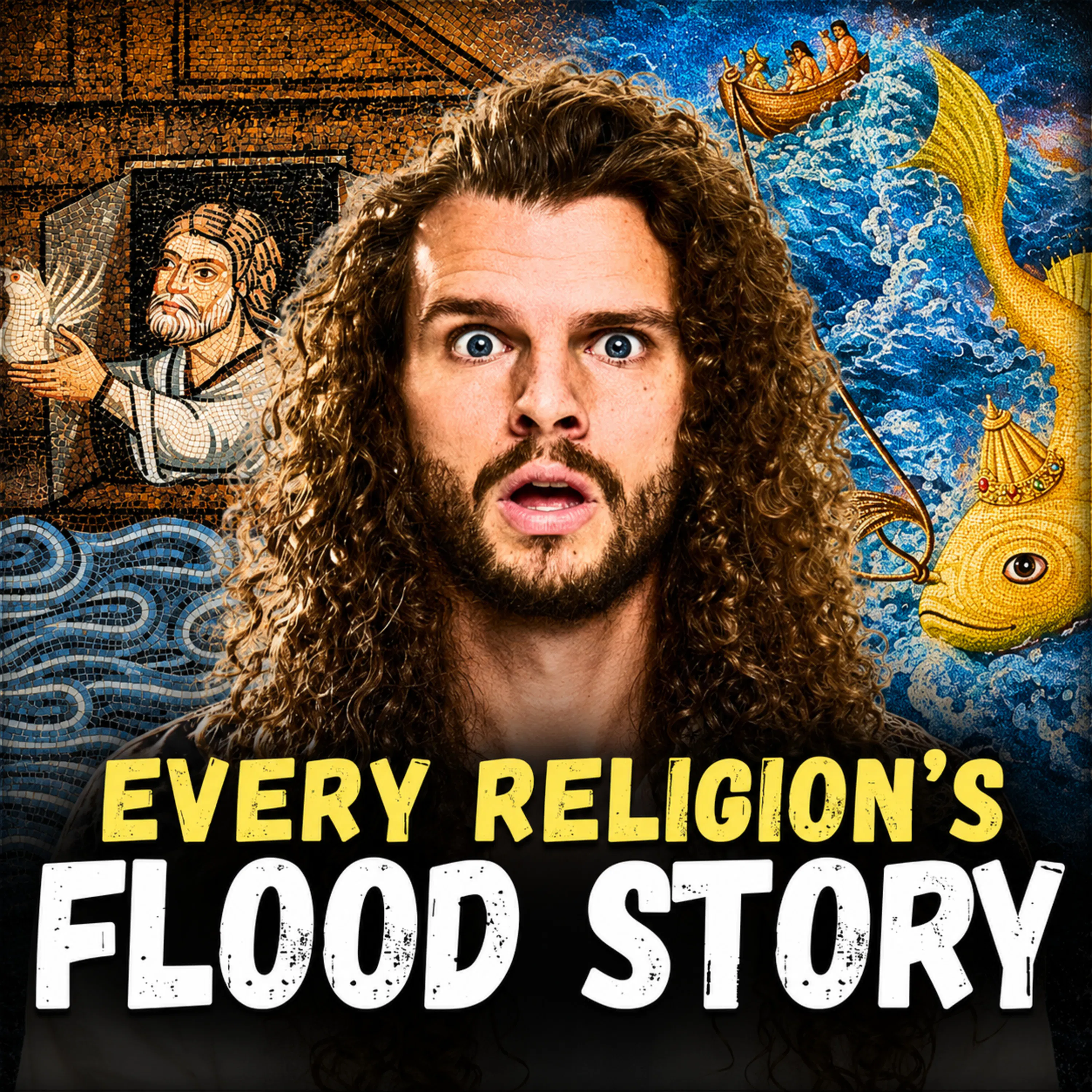
Camp Gagnon
The Flood Story Found in EVERY Religion
00:56:53
<p>Today we’re looking into every religion's flood story. We'll explore Noah’s Flood, the Great Flood of Gun-Yu, the Ojibwa Flood, the Deucalion Flood, and other interesting stories... WELCOME TO RELIGION CAMP! 🏕️</p><p><br></p><p>Shoutout to our sponsors: Brunt and Morgan & Morgan- Get $10 off at BRUNT with code "CAMP" at http://bruntworkwear.com/CAMP</p><p><br></p><p>Want the even WILDER theories?SIGN UP TO THE PATREON: https://www.patreon.com/cw/CampGagnon</p><p><br></p><p>✝️☪️✡️🕉️☦️ Religion Camp Merch: https://camp-rd.com</p><p><br></p><p>🎟️ 🎫 Comedy Tour Tickets Here: https://markgagnonlive.com</p><p><br></p><p>🏕️ Get Today In History Email Here (Free): https://www.dailytodayinhistory.com</p><p><br></p><p>Timestamps:</p><p><br></p><p>0:00 Camp Bulletin + Christos YAPPIN</p><p><br></p><p>1:57 The Epic of Gilgamesh (Sumerian Flood Story)</p><p><br></p><p>6:35 Eridu Genesis (Sumerian Flood Story)</p><p><br></p><p>9:01 Noah’s Flood (Christian Flood Stor...
Loading summary
Transcript18 lines
- [00:01]
A
So good, so good, so good.
- [00:03]
B
New markdowns up to 70% off are at Nordstrom Rack stores now. Stock up and save big on shoes, tops, dresses, accessories and more must haves for summer. Join the NordicLub to unlock exclusive discounts. Shop new arrivals first and more. Plus buy online and pick up at your favorite Rack store for free. Great brands, great prices. That's why you Rack,
- [00:28]
A
study and play come together on a Windows 11 PC. And for a limited time, college students get the best of both worlds.
- [00:38]
C
Get the unreal college deal everything you
- [00:40]
A
need to study and play with select Windows 11 PCs.
- [00:42]
C
Eligible students get a year of Microsoft 365 Premium and a year of Xbox game Pass ultimate with a custom color Xbox wireless controller. Learn more@windows.com studentoffer while supplies last ends
- [00:54]
A
June 30 terms@ aka mscollegepc 4000 years ago, someone carved a story onto a clay tablet. And it's about a man warned by God who builds a giant boat and then survives a world ending flood and sends out birds to find dry land. And you probably heard the story and you know it as the story of Noah. But this tablet was older than the Bible. It was older than Noah. And that raises a question. What if the most famous flood story ever told wasn't the first? That same story, the warning, the boat, the flood that drowns the whole world, it doesn't just appear in Mesopotamia and the Bible. It shows up in ancient India, in Greece, amongst the native peoples of the Americas, and in aboriginal Australia, where they've told it for 10,000 years, describing coastlines that are now underwater exactly where the science says they should be. More than 200 cultures separated by oceans, by millennia, by every barrier imaginable, all telling the same story. So today we're chasing one haunting question. Did the whole world just happen to dream up the same flood? Or is it possible that something really happened out there? Something so catastrop that humanity has never stopped talking about? Well, today we're going to dig into that and more. So sit back, relax, and welcome to Religion Camp. What's up people? And welcome back to Religion Camp. My name is Mark Gagnon and thank you for joining me in my tent, where every single week we explore the most interesting, fascinating, controversial stories from every religion from around the world, from all time, forever. Yes, that is what I do in this tent every single time Sunday. I'm trying to understand what everyone on this planet believes for a few reasons. One, I think the best way to connect with someone else is to understand the God that they Worship. If you want to understand humanity, you have to understand how they. How their culture, how their religion interfaces with the divine. And furthermore, I like to take all the good stuff from every religion I ever read about and apply it to my own lives. Like, that's kind of my whole thing. I apply the good stuff to me and just leave all the rest, you know, but, like, all the great habits of, like, family, fasting, humility, understanding what God is. I try to apply all these things to my own life, and it makes me a better person. So I hope if you're tuned into this channel, if you clicked on this episode, maybe you have the same interest. And today we're diving into a rabbit hole that maybe you heard it before, you know, maybe you've heard this idea, like, oh, every culture has a flood myth. Every story has, you know, this. This massive deluge, a cataclysm that consumes the whole world, and it shows up time and time again in different cultures. And I've had the same thought. I've heard the same thing. And today I've actually done the research with my good pal Sophia to get to the bottom of what it really is all about. Before we jump in, I just want to give a big shout out to my pal Christos Papadopoulos, the Greek freak himself to Greek Orthodox legend that is sitting on the ones and twos that makes this whole show possible. How are you, Christos doing? Great. Christos. Before you jump in and interrupt me, I want to know, does the Greek Orthodox tradition. They must have a flood myth, huh? I wouldn't know. Oh, come on, dude. I'm a terrible Orthodox. I'm going to get you reconnected to Orthodox faith, okay? That is my goal. All right? You have the same flood myth as me. It's the guy Noah. You've heard of him? Never heard of any. Come on, dude. Oh, my gosh. Well, you're going to learn today, all right? As well as every other flood myth that's under the sun, at least the ones that we have the records of, you know? Now, the question here that we're going to ultimately answer by the end, is it the case that these cultures all experience floods in some way, and then they're all describing their localized flood stories? Is it possible that they all are kind of dreaming up the same kind of story all in parallel? Or is it possible that one slash, all of these stories are true and that the whole world truly was flooded at one point way in ancient history, and that all these stories are just calling on the same shared Human memory. Well, we're gonna figure that out. But in order to do that, we gotta do some real detective work. We're gonna go through each of these stories one at a time so we can figure out where they overlap, where they differ. And we're gonna start with the oldest one we have ever dug up and in some smart guy at a college somewhere. And this one comes from ancient Mesopotamia, the land between the Tigris and the Euphrates. The bread basket of civilization. Very important place on the, on the map now in modern day Iraq. And it's written in a text that you probably heard of, the Epic of Gilgamesh. We did a whole episode on it. You should check it out. But what you need to know for this episode is that this is one of the oldest pieces of writing ever discovered by human beings, ever. It's pressed into clay tablets in this wedge shaped script that they call cuneiform. And some of those tablets are nearly 4,000 years old. And here's the crazy part, they are copies of older versions. So it's possible that this story is even older than 4,000 years old, maybe 6,000, who knows? But the story basically is an epic that follows a king named Gilgamesh, part God, part man, who goes searching for immortality after his best buddy dies. And he doesn't find it. But late in this whole story, he meets a guy named Utnapishtim. And Utnapishtim tells him something crazy. He says, I was there, I survived the flood, and let me tell you what happens. And this is a story that he tells. Utnapishtim basically says that he lived in a city called Shurupak on the banks of the Euphrates, and he was a respected man. And one night the God Ea came to him. And this is where things get interesting, because in the time there's a big pantheon of gods, and all the gods made a pact amongst themselves to not warn the humans about what is coming. But Ea found a loophole. He didn't speak to Utnapishtim directly. Instead, he stood outside the house and spoke to the wall of a reed hut, knowing full well that Utnapishnam was on the other side and knowing that he would hear every single word. And so he tells the wall, and by the wall, I mean Utnapishnam. And basically this is what he hears, that the gods have decided to drown humanity, that Utnapishtim needs to tear down his house, he needs to build a boat and make it equal in every direction, as wide as it is Long as tall as it is wide. Seal it with pitch. Bring your family, bring your craftsmen, bring the animals. And Utnapishtim built it. He loaded it up, brought everyone on board, and he sealed the door. And what came next, the text describes in language that feels too big for words. The storm was so violent that even the gods, the one who ordered the flood to take out the whole world, they were terrified by what they unleashed. They fled to the heavens and crouched against the walls like frightened dogs, shaking. And then the goddess Ishtar, she cried. And she had agreed to the destruction. And now, watching it happen, she cried out that she had given birth to humanity. And now they were filling the sea like dead fish. It rained for six days and seven nights. And when it stopped, Utnapishtim opened a latch and looked out. And it was silence. Just water in every direction. Flat, empty, Every trace of land completely gone. And he sat down and wept. And then a shape on the horizon, a mountain. The boat struck it and ran aground at a peak called Mount Nasir. And he waited seven days. And then he sent out a dove. And it came back nowhere to land. The swallow did the same exact thing. And then a raven. And then the raven found receding water, and it found things to eat. And it never came back. The land was finally returning. So Utnapishtim stepped off the boat and made an offering to the gods on the mountaintop. Food, incense. And the gods who hadn't received a single offering or a prayer during the entire flood because everyone was drowning, they swarmed around, the smell of it like flies. And then Enlil arrived, the God who pushed hardest for this destruction. And when he saw that someone had survived, he was furious. But Ea spoke up and made an argument worth remembering. Don't wipe out everything at once. If you want to punish humanity, be precise. And so Enlil relented. And as something between, like, you know, a gift and an apology, he granted Utnapishtim and his wife immortality, carrying them off to the edge of the world where the rivers meet the sea. And there, the story says, they live to this very day. Now, it's a nice story, but before we leave Mesopotamia, we need to know something, because it's the first clue in this whole mystery. The flood story in Gilgamesh isn't even the original, so there is an older Sumerian text called the Eridu Genesis, possibly dating to like 2100 BC or even earlier, where the flood survivor named Ziusudra. In later Babylonian retellings, he becomes Atrahasis and finally in Gilgamesh, he becomes Utnapishtim. The same man, different centuries, and a different name in each telling. So just think about that, right? A single character traveling across hundreds of years and three civilizations, kind of changing this, you know, his name, but still recognizable. And that chain is, you know, all by itself a story about how myths move, really. And then there's even another text, the Atrahasis epic, dated around 1700 BC, at least five centuries before the standard version of the Epic of Gilgamesh was assembled. And it tells almost the identical flood story with almost the same structure. God warns a man, a boat is then built, and then a flood comes and the survivor makes an offering when it's over. And most scholars believe that Atrahasis is the common ancestor, the source that becomes Utnapishtim's story, and maybe something else too. Just hold on to that thought. One last thing about this story, specifically, because it's one of my favorite moments in the whole history of archeology. This flood narrative was lost for over like 2000 years. And then in 1872, a young self taught scholar, this guy, George Smith, he's working at the British Museum sorting through fragments of all these clay tablets that were hauled back from Nineveh. And he picked up a piece and he recognized it as something and he translated it, you know, stood it up and reportedly began removing his clothing in the middle of the reading room. What he had found in that room was this flood tablet that we're talking about, a story almost identical to the story of Noah, but predating Genesis. And as a result, it created a cultural earthquake because it raised an immediate and deep, uncomfortable central question. What if the biblical flood story is based off this? And where did the biblical flood story actually come from? A story sealed in clay for millennia had just re entered into the world. And frankly, the world at that time didn't really know what to do with it. Hey, real quick, most people who watch this channel aren't subscribed. And when you subscribe, you help the channel grow and you stay in the loop with every new drop Religion, camp, history camp, and Camp Gagnon. Now let's get back to it. Because centuries later, different culture, different language, different corner of the near east, that same flood story surfaces again in the Hebrew Bible. In Genesis, scholars generally place the writing of the Genesis flood narrative between like the 10th and the 6th centuries BC. But the story it tells, maybe drawing on something older. And you already know this one, of course, God looked at the earth and he was Pissed. Humanity had been corrupted. The world was drowning in violence. And, you know, it was a whole mess before any flood happened. So God was like, you know what? I'm going to start over. But there was one man who was different. Noah. And the text calls him righteous in his generation, the one man and his family worth saving. And so God comes to him and says, hey, I'm going to send a flood. Build an ark. Bring your family to every kind of animal on Earth, male and female, so that life can. Can continue to propagate. And so Noah did it. And the door was shut. And then, of course, the rain began. The rain started, and it didn't stop. 40 days and 40 nights, and the waters climbed until even the tallest mountain vanished beneath them. Everything that breathed air on the face of the Earth died. Only what was sealed inside the ark survived. And the water stayed high for 150 days before it began to fall. And then the ark came to rest on the mountains of Arat, a region that the ancient world called Uratu, or is now called Eastern Turkey. And then Noah sent out a raven, which flew back and forth, finding nowhere to land. And then a dove, which came back with nothing. Seven days later, he sent a dove again. And this time it returned with a freshly plucked olive leaf. Seven more days. He sent it a final time, and it didn't come back. The ground was dry. Noah came out, he built an altar, he made burnt offerings, and God promised, never again will I destroy every living creature. And he set a rainbow in the sky as a sign of that promise. But here's the thing about that rainbow. It's pretty easy to miss reading it one way. It isn't a celebration at all. It is a reckoning. God commits to never doing this again. And that promise only carries weight if what just happened in some way was irreversible, not a reset back to how things were, something new built on top of the ruin of everything that came before. Now, let's take a step back and look at what we've got so far. Okay, we have Atrahasis and that epic, and then the Gilgamesh flood, and then Genesis. Three texts from overlapping corners of the ancient near east telling versions of kind of the same story, right? Some of the timelines are, you know, the days of the rain and things like that are different. But the warning, the boat, the mountains, the birds, all sent out in sequence, and then the offerings made when it's over. And maybe it's a coincidence, maybe it's not right, but it is the single most Remarkable coincidence in the history of human storytelling. And we can come back to what that means in a second. But now we have to leave this neighborhood entirely. We're going to go thousands of miles east in ancient India, and a flood story surfaces again in the Shataputa Brahmana. And it's one of the oldest Vedic texts, dating roughly to, like, 900 to 700 B.C. and then again centuries later in the Mahabharata. And it's one of the, you know, two great Sanskrit epics. And at the center of the story is Manu, specifically Vaivasata Manu. And this is the ancestor from whom all of humanity descends in the Hindu tradition. And here's a detail that tells you the kind of story that you're about to hear. His name comes from the same ancient root as the English word man, this proto Indo European word meaning simply to think. So before the story even begins, it's already pointing at something. And this is a story about the origins of what we are and who we are as human beings. So here's how the story goes. One morning, Manu was performing his daily water ritual, just pouring water over his hands, when a tiny fish swam into his cupped palms. And he was about to toss it back, but then the fish spoke, and the fish said this. I'm small, and the big fish will eat me. Protect me, and I will protect you from what is coming. Obviously, Manu is like, what? And the fish says, hey, there's a great flood coming, and it's going to destroy all of creation. So build a boat, keep protecting me, and I'm going to save you. And so Manu kept the fish, and as it grew, it kept growing. And he moved it from a pot to a tank to a lake, and then finally out into the open ocean. And at every stage, it grew larger, and at every stage, it renewed its promise. And then eventually, when the flood came, exactly when the fish had said it would, Manu tied his boat to the fish with a rope and. And the fish pulled him. And through the rising water and the storm and the dark, all the way to the mountains of the Himalayas, to a place called Nalbandana. And the word that literally means the tying of the boat. So when the waters finally receded and they pulled back, Manu was alone. And he made offerings. He prayed. And through his prayers, a woman appears. And her name was Ida, meaning nourishment, sustenance, or the gift of life itself. And from the two of them, humanity was then reborn. And only then did the fish reveal what it Truly was. It had been Vishnu all along. The preserver God, appearing as his very first avatar in the form of a fish. Specifically to carry the seed of humanity through the end of everything. So once again you have a mountain, a boat, a mountaintop, offerings. One man chosen. And then humanity is reborn. Now you have heard the story a couple times so far. I mean, at least three, maybe four in three languages from three very different civilizations. And here's what matters. The Near Eastern stories at least share a cultural neighborhood. Contact is possible. Borrowing is very common. But India and Mesopotamia, I mean that connection is a little bit harder to draw. But just hold on to that. You know, the list of things to kind of hold on to is getting kind of tricky. But that's kind of the point. And now we're moving over to a beautiful part of the world called Greece.
- [17:00]
B
Ready to soundtrack your summer with Red Bull Summer All Day Play. You choose a playlist that fits your summer vibe the best. Are you a festival fanatic, a deep end dj, a road dog or a trail mixer? Just add a song to your chosen playlist and put your summer on track. Red Bull Summer All Day Play. Red Bull gives you wings. Visit red bull.com fright summer ahead to learn more. See you. This summer,
- [17:26]
A
Zootopia 2 has come home to Disney. Let's go get ready for a new case.
- [17:32]
B
We're gonna crack this case and prove we're victorious partners of all time.
- [17:35]
A
New friends. You are Gary Destiny.
- [17:38]
B
And your last name.
- [17:39]
A
The Snake Dream team. Hidden new habitats. Zootopia has a secret reptile population. You can watch the record breaking phenomenon on At Home. You're clearly working at Zootopia 2. Now available on Disney Plus. Rated PG. We're talking about a Greek flood hero named Deion. Or Deion as Christos likes to say it. And his story comes with a detail that you need very quickly. Deon's father is Prometheus. Yeah, that, that Prometheus. The one who stole fire from the gods and then handed it to humanity. Who was chained to a rock and then had his liver devour powered by an eagle every single day as punishment. You know the story, right? Everyone knows Prometheus. Anyway, so now Deucalion already comes from a family with a very complicated relationship with authority and the gods. So Zeus looked down at the world and he hated what he saw. The race of men had grown brutal and lawless. So he called a council and he announced his verdict. Zeus says we're doing a flood to clean up this whole thing. Now Prometheus hears this and he's like, well, I should probably tell my son. So Deucalion built a chest, sometimes described as a boat, sometimes as, like, a great wooden box. And he and his wife, Pyrrha, they sealed themselves inside. And then the rains came for nine days and nine nights until basically everything on Earth was gone. And the chest came to rest on this place called Mount Parnassus. And De Kilion and Pyrrha stepped out as the only two human beings left alive. And the first thing they did now, for the fourth time in four different stories from four different parts of the world, was make an offering. They step off the boat, they look at the empty world, and they make an offering. And then the oracle of Themis gave them a riddle. Throw your bones of your mother behind you. And they were horrified. I mean, their mothers were dead. And throwing the bones of the dead was sacrilegious. But then they understood the Earth is the mother of all things. Her bones are the stones beneath their feet. And so they pick up the rocks and they throw them over their shoulders. And then the rocks Deucalion threw became men, and the rocks that Pyrrha threw then became women. So now the fullest version of this comes from Ovid's Metamorphosis. This is written around 8 AD which makes it much later than all the others. But the story itself shows up in Greek texts from at least the 5th century BC, and the structure is pretty identical. The warning. A divine figure who defied the other gods to give it the survival, the offerings, the world, starting over. I mean, you caught that, right? Prometheus broke ranks with the gods to save his sons. And that exact move, a God going around the decision of the other gods, that already happened, right? In the early Mesopotamian story, you have Ea whispering to the wall. A different story, different continent. Almost the same exact move. Now, just. I know there's a lot of threads to hold on to, but just keep all this in your mind. Here's the thing. Every story that we've gone through so far has kind of marched to the same drum beat, right? Divine warning. Boat. Mountain birds. Offering. Chosen man. Woman. Rebirthing humanity. So now let me show you the ones that break it. Because the exception turns out to matter just as much as the pattern. And in order to see these stories that don't really fit, we're going to China. And this story is set around 2200 BC, although the written versions come many centuries later. And from the very first beat, it is different. There's no divine punishment. The flood isn't sent by anyone. It's just there, vast, and it's swallowing the land year after year, and no one knows why. The water is just flooding. And then the Emperor Yao sends a man named Gun to deal with it. And so Gun builds walls and, like, dams to hold the water back. And he's working at it for nine years, and the walls keep on breaking, the water keeps on rising, and he fails. And then eventually he's executed for it. And so then his son Yu, well, he has to inherit the problem. Now, Yu doesn't try to stop the water. He actually studies it. He spent years mapping where the rivers want to go, learning how they drain. And then he starts cutting channels and making riverbeds and carving passages through the moun to redirect the flow. He doesn't fight the flood. He works with the flood. He gives the water a place to exit. Thirteen years he spends doing this. And in those 13 years, he passed by his own house three times, and he heard his own children inside. But he never went back. He never stopped. Eventually, the water's drained, the land returns, and Yu becomes the founder of the Sha Dynasty. Traditionally, this is known as China's very first dynasty. And it's interesting you can notice the difference, right? There's no divine warning. There's no boat, no birds, no mountain, no offerings, no, like, chosen survivor, really. I mean, kind of, but not really. The hero doesn't escape the flood with a boat. He just kind of solves it by working with the water. The religious texture is kind of gone from the story. And here's the craziest part of that, is that it might be maybe the most historically grounded story in this whole episode. Because in 2016, a team of geologists published evidence in the journal Science of a catastrophic outburst of the Yellow river, dated around 1800 BC, one of the largest floods of the past 10,000 years. And it lands squarely inside the window when the Yu story is actually set. Now, it's not proof, but it is a interesting archaeological coincidence that I think demands a little bit of explaining. Now, we're not done, because we're going to still go even farther out past every culture that you could have ever possibly traded stories with in the ancient Near East. And we're going to the Ojibwe people of North America. Now, the way their story goes is a little different. You have a great spirit that warns a figure named Nana Bozo, a trickster, a cultural hero, part human, part spirit. And he's told that a flood is coming, so he ends up basically floating on A raft surrounded by animals and water stretching in every direction. And one by one, he sends them diving to find solid ground beneath the surface. So an otter goes down and fails. A beaver goes and fails. Then finally, a muskrat goes down and stays under so long it nearly dies. But then it surfaces, barely breathing, but clutched in its tiny paws is a tiny single speck of earth. Now, Nana Boza takes it and places it in the back of a turtle and breathes on it and tends to it. And then that little piece of earth slowly expands until there's enough ground for life to begin. And some nations still call this continent Turtle Island. So in this door, you have a warning, a gathering of animals, but no boat. In, like, the ordinary sense, it's kind of just like a makeshift raft. There's no mountains, no offerings, no birds in the sky. But the story is recognizable in outline, but is different in all the major details. But that's not the only one from the Americas. I mean, the Aztec society had their own story, and it ends very, very darkly. So in this story, the water goddess Chalchi Udlique warns a man and his wife, Tata and Nene, that a flood is coming soon. And so they hollow out a great log and they seal themselves inside. And then, of course, the water rises and they survive. But when they climb out, they cook a fish, breaking the one instruction that the gods had given them. So then the smoke curls upwards and the gods smell it, and they come down and they cut off their heads and set them back on their bodies the wrong way around, turning Tata and Ninna into dogs. And in that story, survival comes with a transformation. Staying human was conditional on obedience, and they failed it. Now, the most remarkable evidence of all this isn't what the story contains, it's actually how long it's been carried. So the Aboriginal Australians also hold oral traditions that are among the oldest continuously maintained records of human experience anywhere on Earth. I mean, the Aboriginal people of Australia are some of the most ancient people groups that have, I guess, intermixed with the rest of the world the least. They have some of the oldest genetic DNA of anyone on the planet. And here's what's strange. These stories don't describe one sudden, overwhelming catastrophe. What they describe is something slower. The sea rising year after year, islands disappearing, familiar coastlines being swallowed up inch by inch. Whole communities basically packing up and moving inland, watching landmarks that they've known their entire lives just eventually get consumed by the sea and never coming back. And some of these stories name specific bays, specifically headlands and places that are now underwater. And the grief of all of it is right there in the details. And this is where things are crazy and almost difficult to believe. So starting in 2016, there's a research team of linguists and geologists and Aboriginal community leaders, and they all work together, and they publish findings that are genuinely striking. More than 20 original Australian Aboriginal stories, drawn from 18 different language groups across the continent, describe specific geographical features. We're talking like bays and inlets and coastal landmarks, which isn't that weird, right? I mean, native groups always will refer to different geography in order to, you know, guide themselves or just as markers for where they are. But some of these features don't match the coastline of Australia as it exists today. Instead, they match the coastline as it existed thousands of years ago, even before the Ice Age ended and the sea levels rose to swallow them. So think about that. The researchers cross referenced these stories against the geological record and found accounts that appear to accurately describe the Australian coastline as it was at least 7,000 years ago. So in some cases, even 10,000. I mean, the places these stories say that the sea swallowed, the geology confirms that those were actual landmarks that were actually covered up by the rising sea 10,000 years later. No writing, no maps, no cartography of any kind. Just stories passed from one person to another, mouth to ear, mouth to ear, across more than 300 generations. And that brings us back to that number. From the very beginning, by one account, there are more than 200 distinct flood traditions across the human species. I mean, 200 different separate cultures with their own language, separated by oceans and time. And all of them are telling some version of the same story. And we've heard most of the biggest ones, I guess, at this point. And I guess the question that everyone's wondering is, like, why? And there have been a few different explanations that have been positive, and none of them really are complete on their own. And all of them are, like, partially true. So let's go through the three most obvious explanations. Okay, the first explanation is that floods happen, and they're universal. And this is probably the simplest version, is that floods happen everywhere. And when you survive a catastrophic flood, the logic of surviving is roughly the same no matter where on earth you are. Whether, you know, there's a flood in North America, in Central Mexico, in India, in the Middle east, you need something that floats. So you're going to have a boat. And the water is lower around high ground, so you run for a mountain. And then before you commit to coming off, you have to check whether the land can actually support you, or if it's just like a marsh, so you send out a bird or some other type of living thing. And then after living through something like that, you know, so apocalyptic and something so catastrophic, you somehow make an offering to the gods, you show gratitude to whatever the divine force is that's there to say thank you that you didn't die. And these aren't story conventions that had to travel. They're just a practical response that human beings have inside of them to the same physical nightmare across different people groups and different floods. But ultimately, the conclusion here is the same name. And that probably covers a lot of the broad overlap that we see in these stories, but it doesn't cover everything, because in both Gilgamesh and Genesis, written in different languages, centuries apart, a dove is released and comes back and then is sent again. Seven days pass between attempts and an offering is made on the mountain the instant that they land. And it's not survival logic inherently. It's like pretty weirdly specific. And those hyper specific matches show up up in cultures that were historically connected, not in the isolated traditions across the ocean. Which points us to explanation two. And the second explanation is that these stories just traveled. And so the technical word here that anthropologists will use is diffusion flood stories spreading through the ancient world in the same way that language and technology and religion spreads through the normal means, right? Trade or migration or contact of some kind. And obviously this happened to an extent. I mean, fragments of the Gilgamesh epic have turned up up across, you know, a huge sweep of the ancient Near East. I mean, Hittite translations in Turkey, copies in Syria, a fragment as far away as Canaan, and the story is physically moved on clay across borders. And this explanation will explain the Gilgamesh Genesis overlap pretty clearly. Mesopotamia and Canaan were in contact for centuries. And remember that ancestor text that we were talking about, Atrahasis, that epic? Well, that's around 1700 BC, and it puts it earlier than both of the other epics of Gilgamesh in Genesis. And it also shares nearly every structural beat. So most scholars think that that is where the written tradition begins. It probably even explains some of the Greek overlap, since Greek mythology was absorbed around the region and took in a lot of Near Eastern material for ages. But this explanation does have a wall. It doesn't reach the Americas, and it definitely does not reach Australia, where the traditions are. So contact with the ancient near east isn't even conceivable. And so the stories travel, but not everywhere. But here's the thing, there's a deeper version of that argument that doesn't need trade routes at all. What if the stories didn't travel between civilizations, but with human beings themselves way before that? I mean, we began migrating out of Africa, like, 60,000 years ago into Asia, and then eventually Australia and then eventually the Americas, carrying that culture with us. And so if the flood story is old enough, it might be part of what people took with them from the very start. Not a story that crossed trade routes, but a story that literally walked across land bridges around the entire Earth. Now, the problem here is that oral traditions don't usually survive intact across 60,000 years. So either these stories are much younger than the migrations, or something continued to refresh them, like new floods or new disasters and really kind of pressing the same ancient story back into living memory over and over. And now you probably bumped into a much bolder version of this. Of course, Graham Hancock, one of my favorites. He writes a book called Fingerprints of the Gods, and, of course, Magicians of the Gods. He argues that the flood myths are real memories of a real technologically advanced civilization that existed before the Ice Age and was wiped out by exactly these catastrophes. And its survivors became these mysterious teachers of the ancient world. And it's a really compelling framework, and he makes the case with, like, a lot of energy and explains it really well. But the problem isn't that the floods weren't real. They absolutely were, and we're about to get into that. The problem is the leap. And it's difficult to really make that jump from catastrophic floods happening and people remember them all the way to an advanced lost civilization encoded into the knowledge of mythology. I mean, the second claim is the one that's most interesting to me, and I like it, but it really needs physical evidence. You need cities and tools and remains. And for mainstream archaeology, it hasn't really been found to a standard that satisfies them. The floods are in the geology, but the civilization isn't. And the stories, as far as we can tell, they don't really require it. Which brings us to the third explanation, the one that has arguably the most physical evidence of all. Hey, guys. Crazy story. So the good people at Brunt Workwear sent me boots. They actually sent me two pairs. And I'm not making this up. They said, hey, wear them to an actual job site, beat them up, and if you don't like them, just send them back for a full refund. I was like, there's no way that's true, one for a few reasons. First off, I don't work on a work site. I do stand up comedy. So these have been in pristine condition, I will say. But I gave some to a friend of mine who's a carpenter. He just works with his hands all day and just destroys his shoes. And he literally hits me up two weeks later and goes, these are the most comfortable boots I've ever gotten. Thank you so much. So I'm probably gonna charge them for them, but regardless, what I'm saying here is that Brunt Workwear has maybe the most comfortable, durable boots ever right out of the box. They last super, super long, they're super comfortable, and they. So here's the deal. This guy Eric, he's the founder, he grew up blue collar. And his buddies in all the trades kept telling him how, like the big boot brands, you know the ones I'm talking about, they became like these fashion companies and they stopped doing the product that they all needed. So he was like, fine, I'm going to build one that actually works. And he named everything after actual tradesmen he really grew up with. So they're waterproof, they got a safety toe, they got a soft toe, they got pull up, lace up. You got all the options that you need. Now, right now, if you go to bruntworkwear.com you're going to get $10 off if you use the code camp. So you can save money. You can buy boots, wear them to work, and if you hate them, here's the crazy thing, you just send them back. There's literally nothing to lose. If you don't like them, you send them back for a full refund. That is the Brunt guarantee. So go to bruntworkware.com camp, that is C A M P camp, and use the code camp, save money, buy the boots, wear them to work, and if you hate them, you're going to get a full refund. Just send them back and they'll give you your money back. There's literally nothing to lose. I don't see why you wouldn't just give it a try. I mean, my friends love them, I love them, but I mean, I'm not doing manual labor, but they still look great. Anyway, that is bruntworkware.com camp. Use the promo code link is in the description and tell them that the good people here at the campsite sent you. Let's get back to it. What's up, guys? We're gonna take a break really quick because I just want to state the obvious. You're not going to hire a chiropractor to do brain surgery. And if you're gonna go fight in the Octagon, you wouldn't hire a guy that watches a lot of ufc. And if you have a personal injury case, you're not going to just like hire your buddy that's good with contracts because you know that when you're hurt, it's because someone else was negligent. You don't want just, you know, lawyer y vibes. You want real lawyers. And that's where Morgan and Morgan comes in. They are America's largest injury law firm with over 100 offices nationwide and more than 1,000 lawyers. Crazy thing, they've recovered over $30 billion for over 500,000 clients. They've got a real track record of fighting to get people full and fair compensation. So if you are ever injured, you can check out Morgan and Morgan and their fee is free. Unless they win. Yes, free. You literally don't pay anything unless they win your case. That's how confident Morgan Morgan is that they can get compensation for you and your injuries. So for more information, go to for the people.comgagnon that is f o r the people.com g a g n o n or dial pound law that is pound 529 and let them know that you got sent by the people here at the campsite. Also, this is a paid advertisement. Now let's get back to the show. And the third explanation is that it really happened. And it doesn't start with the stories, but literally with the earth itself. Around 12, 000 years ago, the last Ice age ended, or rather began to end. And the process took thousands of years. And it was not quiet during the Ice Age. You have of sheets of ice, I mean, miles thick in certain places. And it was burying huge portions of the Northern hemisphere and really locked up staggering volumes of the ocean water. I mean, sea levels worldwide sat about 120 meters lower than where they are today. So just think about that. That's not a small number. That means vast stretches of land that are now underwater. The continental shelves around the globe, they were once dry rivers and forests and coastlines, land where people actually lived. And then eventually when the ice melted, all that water went back into the ocean. And sometimes it didn't go gradually. Around 12,900 years ago, something stopped. The thaw of all this ice and temperatures across the Northern hemisphere plunged. And the ice sheets that had started melting refroze. And then for roughly 1200 years, the warming reversed. And then around 11,700 years ago, that ended just as abruptly as it began. And the Thaw came roaring back. And this period has a name, the Younger Dryas. What caused it is still debated. Maybe a disruption of ice circulation, maybe a dramatic shift in meltwater flow. There's also a contested but not disproven hypothesis that a comet or an asteroid airburst triggered it, setting off wildfires and mass extinctions and catastrophic flooding across the hemisphere. New evidence for this idea keeps on appearing, and this debate is obviously still wide open. But what isn't debated is the event itself. A sudden, dramatic climate reversal, followed by an equally sudden return of the thaw, happening at the exact same time human populations were spreading, spreading across the world. And if you had lived through the second ending of the Younger Dryas, I mean, all of this ice giving away at once, the river surging and the coast just swallowing land that had been dry for thousands of years, you would have definitely told your children about it, and they would have definitely told their children about it. And geologists actually have a term for the worst of these moments. They call them meltwater pulses. And this is when ice sheets collapse or, like an ice dam will burst, which is dumping colossal volumes of water into the ocean all at once. And if you're a coastal community, like many of them would have been, there wouldn't have been a single bad day. It would have been many bad days. It would have just been relentless. The sea just coming year after year, taking more of everything that you've ever known. And then there's also one specific event that's worth singling out. In 1997, two geologists, this guy William Ryan and Walter Pittman, they published evidence for something remarkable around 7,600 years ago. They argue the Black Sea, which at the time was partly a freshwater lake and was below the sea level of the Mediterranean, was suddenly flooded when the Mediterranean broke through the land and basically destroyed the land bridge at what's now known as the Bosphorus. Now, how fast that happened is still debated. Ryan and Pittman said that it was catastrophic. They describe a wall of salt water pouring in. And later research complicated that picture. But here's what the archaeology confirms. Farming communities were along these two shores. And whether they had days to flee or years, either way, they would have remembered it, that they had a way of life that was suddenly, within a few generations, completely disrupted. And Ryan and Pittman suggested something tantalizing, that this very event could be the memory at the root of the Mesopotamian and biblical floods, that the people driven from those drowning shores carried the stories inland with them, and that that eventually became Atrahasis, and then Gilgamesh, and then potentially even the story in Genesis. And the details, of course, are still argued over, but the broad idea, this real catastrophic flood happened and the survivors told stories about them, that part is pretty difficult to argue with. And then, of course, there's Australia. I mean, 10,000 years, 7,000 at the absolute minimum, 300 generations carrying the precise shape of a coastline that's not there anymore. And they carry the story intact in the form of oral tradition. Not a map, not writing, just a story. And that one piece of evidence raises a question worth really sitting with, right? If one tradition has been carrying an accurate memory of a drowned coastline for 10,000 years, what else might be in these stories? What are the other stories holding that we still can't confirm yet? Now, here's the thing that has to be said very plainly. A literal global flood. Water rising high enough to bury every mountain on the continent at the same time, it's just sort of physically impossible. There just simply isn't enough water on Earth to do it. So the Genesis image of water covering the mountains is. It's difficult to really read that as a claim about, like, Everest. And here's the thing, the ancient author wasn't thinking about Everest. I mean, the math just doesn't really go that way. And I think, even for the record, in the story of Genesis, it says the known world was flooded. Could you fact check me on that, Christos? So what does the geology have to say in this case? Right. Well, there's something kind of different. Not one global flood, but many separate catastrophes at different times, at different places, two different people, a sea level rise that ate one community's coastline, a glacial dam bursting upstream, a river system that is flooding in a way that annihilated everything around it. And this kind of ties it all together. Each one of those would have felt the people living through it like literally the end of the world, because their world did end. And the flood that ends your world becomes, in the telling, passed down, retold, growing in the, you know, the minds of your descendants. That is the flood that ended the world. And the scale expands to match the experience, because the experience was total. And maybe, let me just say, just maybe, the stories that look the most alike are really signatures of a particular kind of catastrophe. This fast, sudden in sort of indignation, you know, this kind where the only hope is to build something and climb inside of it, like the Black Sea. Breakthrough would have been exactly that. So would a meltwater pulse that slams a coastal village without any warning. I mean, this type of fast water floods, they will produce the boat stories. Slow water produces the stories of coastlines retreating, of landmarks going under the sea, of the sea, sort of quietly taking these pieces of land that were normally left alone, which is exactly what the aboriginal Australian traditions will describe. So you have three explanations, practical logic, diffusion, real events. None of them are totally complete on their own. And all of them are certainly partly true, which is kind of what you would expect, right? I think the true answer to understanding this is that all of these different theories and explanations are all kind of converging in order to explain all of these stories. But there is something underneath all of this that geology can't really explain. Most of these traditions don't treat the flood merely as just a natural disaster. They treat it as a judgment of from God. Were you able to find that verse in Genesis? There's a new way to sweetgreen Meat wraps handheld, hearty and made for life on the move. With bold chef crafted flavors, fresh Ingredients and over 40 grams of protein, they're built to satisfy without slowing you down. Try wraps today in the app or@order.sweetgreen.com available at all participating locations.
- [44:24]
B
Expedia and visit Scotland invite you to come step into centuries of history that await in Scotland. Castles steeped in legend walk along cobblestone streets. Come share the warmth of stories passed down through generations. This is a place with a past that is fully present today and all yours to explore. Plan your Scottish escape today@expedia.com visitscotland
- [44:54]
A
yeah, in the book of Genesis, chapter six through nine, the known world was destroyed by a massive year long catastrophe sent by God to cleanse the earth of human corruption. Which I think even that reading of the scripture kind of aligns with what we're saying, right? The known world. Like it doesn't necessarily say the entire world, it's just saying, hey, the world that we're familiar with, it gets flooded and it's done because of God's judgment. And the judgment part shows up over and over. I mean, Gilgamesh, Genesis, the Greek tradition, and that world that drowned had it coming is kind of the feeling humanity had grown corrupt and violent and forgetful of what it owed to God and to each other as human beings. And so the flood reads as sort of a death sentence from the divine. And the survivor isn't just lucky, they are chosen by God, the one person or the one family that is worth saving. And there's one more figure that's worth bringing up in this story, which, I mean, we can't talk about flood stories without talking about Plato. Writing around 360 BC in the Timaeus and the Critias, he described a powerful civilization, a civilization known as Atlantis. And Atlantis is destroyed by catastrophic flooding, sinking beneath the sea in a single day and night. And it's difficult to really understand how it's read. I mean, many people have, you know, dissected the story and how it's supposed to be told. It's presented, if, you know, depending on how you read it, as a historical account supposedly passed on to the Athenian statesman Solon during a visit to Egypt. Most scholars read it as a philosophical allegory. But here's the thing. Plato was writing within living memory of real floods that had reshaped the Mediterranean in a culture still carrying older flood traditions in the cultural DNA. So whether he invented an Atlantis or inherited a distorted memory of something that actually did happen, he was reaching for the very same question as everyone else in this entire episode, which is, what was lost and was anything saved? And why? And here's the part that I find the most interesting. In several of these traditions, even the gods aren't comfortable with what they did did. That's an interesting theological thread that I think it's overlooked. In Gilgamesh, the gods crouched against the walls of heaven like dogs horrified by their own flood. Ishtar was crying. And then the immortality that's handed to Utnapishtim at the end is kind of like a reward or like almost like a settlement for what they did. It was an apology, in a way. It's like, hey, we went too far. And then in Genesis, the covenant isn't a party celebrating survival. It is a commitment made in the wreckage of irreversible destruction. It's like, hey, I had to do this once, but never again. And then the rainbow marks not as a return to the old world, but a promise of something new, built on the cost of what the flood did. And then, of course, in the Hindu tradition, Vishnu doesn't just deliver the warning and then go away. He gets into the water, he pulls the boat himself. And the divine investment in humanity is physically there. And then in the Greek story, that final image, stones thrown over the shoulder, hardening into people. Humanity couldn't just be preserved. It had to be reborn. And from the most basic materials that there were, I mean, stone becoming flesh, as if the flood had sort of, you know, destroyed things so completely that life had to climb up out of the ground again, which, I mean, we see versions of this, even in the Genesis story, right? I mean, God creating Adam from the mud. Now, every one of these traditions is sitting with the same question and its own kind of cultural voice. Why did I survive? Why did we survive when everything else didn't? And what does that mean for us? And the answers in these stories, I mean, they differ. In Genesis, Noah was chosen because he was righteous. And Gilgamesh, he was chosen because God found a loophole in this promise. And then in the Hindu tradition, the preserver God, literally Vishnu as an avatar, became a fish and pulled the boat with his own body. And then in the Greek story, because a father defied heaven itself in order to warn his son. The question is sort of identical across all of them, but the answers. The answer is sort of different. And it says something about what each tradition believed humanity was there for. And that's the thing that's the most interesting in this whole thing as we kind of wrap up that, you know, we went looking for one flood, one original catastrophe big enough to echo through every culture on earth. But instead, I think we come away with many floods, right? Hundreds. Different seas, different centuries, different people, each one drowning in its own private apocalypse that destroys the world and every single one, to the people living through it, it was the end of their world because their world was over. And the flood that ends your world, in the retelling that you tell your kids, that flood ends the world, which I think is maybe the most important part of all this, why these stories persist as these worldwide cataclysms. The water rises to fill the size of the grief. And maybe that's why these stories are, you know, so impossibly alike. Not because one thing happened, but because the same thing kept on happening to everyone, everywhere, over time, across civilizations. We were all, at some point, the last ones standing on the high ground. At some point in your genetic history, your great, great, great ancestors were the ones that survived a flood and everything else went under. But again, the flood is never the whole story. Every survivor does the same thing. When they step off the boat, they don't just rebuild. They ask, why me? Thank you, God. Like, literally immediately, they start building an offering. I mean, older than Noah, older than the tablets and museums. And we're still asking, why us? And I think that feeling of looking at God being like, why me? Why did I survive this? You know, like, all of these different people surviving these floods, they all just look around like. Like, holy, that is crazy. And that feeling is in many ways older than Noah, older than the tablet in the museum. And it's the one that we're still asking because, you know, when you survive something terrible and you stand on dry ground, the first thing you're going to ask is why the Sumerians are now gone. The world that wrote Genesis, that's. That world is gone in many ways, but the story is still there, still persistent, and still asking, why did we survive? And that, ladies and gentlemen, is a brief snapshot at all of the global flood myths that have ever happened. I mean, fascinating, right? I hope you learned something as a Greek Orthodox and finally someone's cracking a Bible open for you. It's. It's. I think that's the most reasonable thing. When we look at all these different explanations, I think you have a little bit of story drift where stories get passed to different cultures where, like, they kind of pull different pieces. And I think you can tell that with, you know, the Gilgamesh story, there's so many overlaps, and I don't know which one was necessarily first, but you do get some crossover with those. And then I think you have floods that happen independently in all these different cultures. And as a result of all these independent floods happening in all these different places, the stories are functionally the same. Floods happen all over the world. And when they do, they are catastrophic. They change your entire way of life. Your government can't save you, your riches can't save you. You are just, just immediately all on the same playing field and many, many people die. Especially if you look at how these civilizations were built. So many civilizations, even to this day, are built on the banks of rivers on, you know, coastal plains. They're sometimes in river valleys that they don't know are river valleys because they've been dried for so long. Then eventually when a flood comes through, everything's destroyed. And so for them, they're like, yeah, this is the end of my world. And you have to build a boat, and that's how you survive a flood generally. Or you get on a raft or some type of floating device, and then you have to look to the animals to discover safe to actually, you know, like, link up and actually get back and rebuild. And then that existential feeling, like, I even get it. If I, like, you know, I'm on my bike and a car drives real past fast me or like, I'll stop and a car runs a red light and flies across the street, I'll just be like, thank you, God. Like, I'm like, grateful. I'm like, man, I survived. Like, I could have died right there. That was wild. And I think it's the same feeling, like on 10, like, you survive a flood. It's you and your wife and, you know, maybe your family, and you're on a boat and you survive. And then all of a sudden the rain stops and you look out and you're like. Like, oh, God, thank you so much. And so immediately you offer some type of offering. And the fact that you look at, like, the Younger Dryas and this massive deluge of water that comes in and just floods the ocean and raises these coastlines, that really makes, you know, to me, like, accounts for a lot of these stories to a certain extent. And that. That is sort of like the shared history that people will talk about maybe at the same time, like, with the aboriginal stories and things like that. And then, of course, I mean. I mean, the Mediterranean dumping into the Black Sea and just, like, completely decimating that whole land bridge. I mean, if you were living in that region, which would have been a very hospitable place to live for 99% of the year, when that happens, it's over. I mean, that immediately is like the most catastrophic event in your entire lifetime. 90% of all the people you ever knew are immediately gone. That's going to get etched into your collective memory. And, of course, these types of catastrophes, these things get encoded into our epigenetics. Right? Right. Like, the reason why, like, you'll be afraid of, like, a snake or a spider is probably because someone in your family line at some point got bit by a snake, and they were like, this is the most terrifying thing ever. And so these things get encoded into our DNA as human beings, and we remember these stories, and then when we hear them, it really reinforces it. And then when another localized flood happens, it once again brings up that old, ancient story that's sort of preserved through the oral tradition or in the written tradition. And I. Yeah, I think, unfortunately, as with all things, if we're being nuanced, I think a collection of sort of the different stories, right? Cultural drift, diffusion, and, you know, just localized floods all happening. And I think the Book of Genesis supports that. The known world. That's all they were saying. The known world happened, why it happened, God's judgment. And I guess that's the only explanation you could really give. If all of a sudden you see everything get destroyed, you're just going to be like, God wanted this out of here. Because if God controls everything, he controls destruction as well. And there's a reason why all this was destroyed. God doesn't just do stuff Willy nilly. And so if he saved me and cursed all these other people, it must be for a reason. I must be doing something right. So that's the way I see it. If we're looking at it purely from an anthropological lens. Now, of course, the Catholic in me is like all these other stories are made up. The Catholic story in the Bible is the only one that actually is true and that's the one I rest on. So. So I exist in two places at the same time. What do you think, Christos? Anything you learned? Yep. If you do believe in the younger driest though, check out our second episode with Randall Carlson who breaks it down. That's a great point. That is a great episode. That's on the main camp, Gagged on channel where I do interviews and deep dives and all sorts of crazy mysteries. And we went through a little bit of history here today. But if you are a fan of history, we have History Camp and that is where I try to figure out everything that's ever happened ever. And if you just like to rock with the religious stuff, well, great news. We drop these episodes every single Sunday and you are more than welcome to join us in the tent anytime you want. Thank you guys so much for tuning into another episode of Religion Camp. God bless you. Peace be with you and have a wonderful Sunday.
- [55:50]
C
The right window treatments change everything. Your sleep, your privacy, the way every room looks and feels. @blinds.com We've spent 30 years making it surprisingly simple to get exactly what your home needs. We've covered over 25 million windows and have 50,000 five star reviews to prove we deliver. Whether you DIY it or want a pro to handle everything from measure to install, we have you covered. Real design professionals, free samples, zero pressure right now. Get up to 45% off site wide plus get a free professional measure@blinds.com rules and restrictions apply.
- [56:21]
B
Your next chapter in healthcare starts at Carrington College's School of Nursing in Portland. Join us for our open house on Tuesday, January 13th from 4 to 7pm you'll tour our campus, see live demos, meet instructors and and learn about our Associate Degree in Nursing program that prepares you to become a registered nurse. Take the first step toward your nursing career. Save your spot now at Carrington Edu Events. For information on program outcomes, visit carrington. Edu Sci.
- [56:51]
A
Peace.