Loading summary
Transcript5 lines
- [00:00]
Mark Gagnon
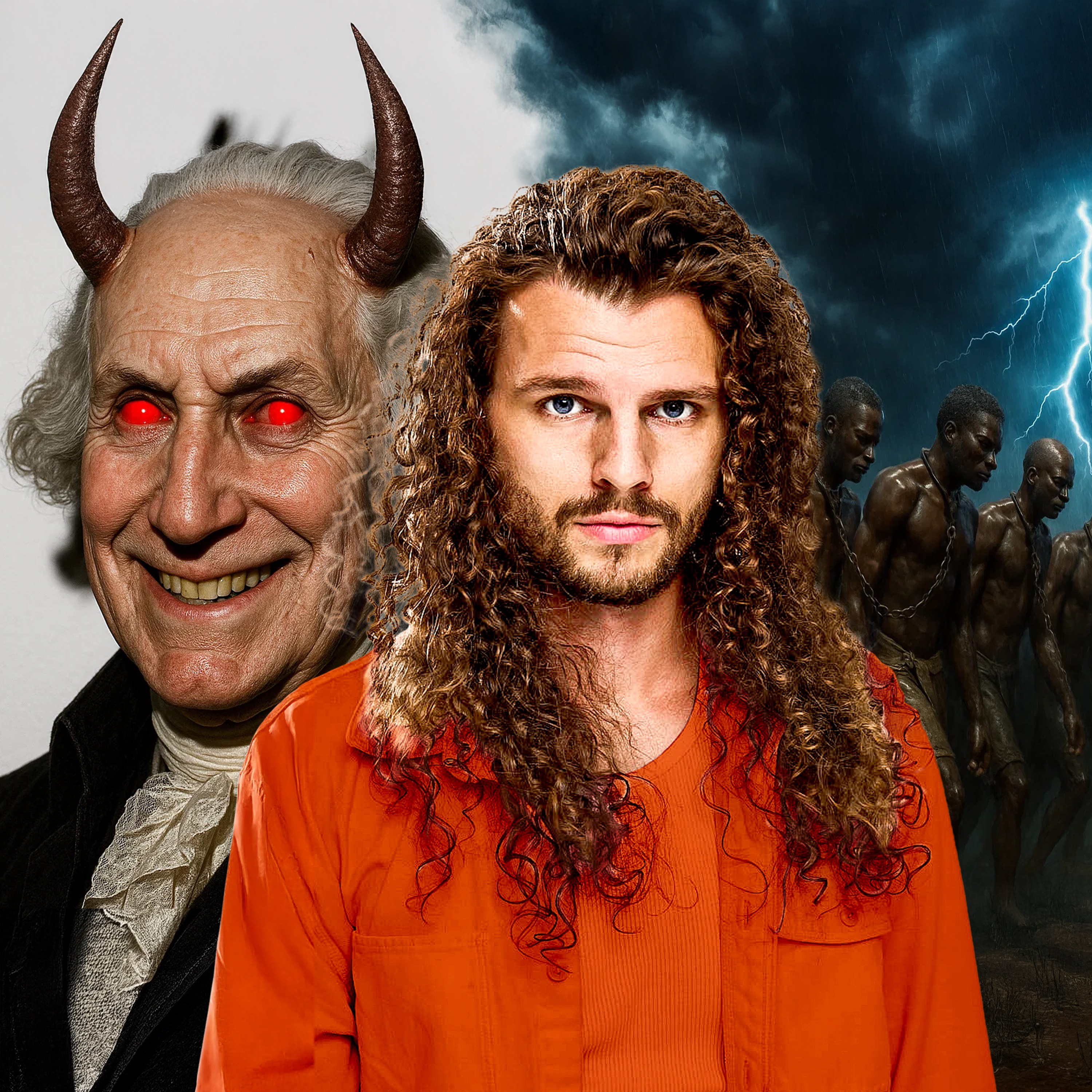
Today we're diving deep into the dark side of George Washington. This is the father of his country. Like most great men in history, they are not without terrible, awful things about them. He was a skilled military leader who helped create one of the greatest nations of all time. But he was also a man who profited from systems of violence and oppression that caused immense suffering. His actions as a slave owner who built his wealth on human bondage. His role as a land speculator who displaced poor people. One of the most disturbing examples of Washington's exploitation. He purchased nine teeth from unidentified enslaved persons for use by his dentist. Washington's military campaigns against native peoples earned him a name that indigenous communities still use today. Town Destroyer. So without further ado, let's jump in.
- [00:54]
Christos Glapadapouz
This episode is brought to you by Greenlight. Get this, adults with financial literacy skills have 82% more wealth than those who don't. From swimming lessons to piano classes, us parents invest in so many things to enrich our kids lives. But are we investing in their future financial success? With Greenlight, you can teach your kids financial literacy skills like earning, saving and investing. And this investment costs less than that. After school treat start prioritizing their financial education and future today with a risk free trial@greenlight.com Spotify greenlight.com Spotify what's up people?
- [01:24]
Mark Gagnon
And welcome back to history camp. My name is Mark Gagnon and thank you for joining me in my tent where every single week we explore the most interesting, fascinating and controversial people and events from our shared history. That's right, our shared history. Two human beings living on planet Earth. I'm joined, as always, by the Greek freak, the legend himself, Christos Glapadapouz. How are you? Okay, Christos, we don't have time, all right? Because today we are diving deep into the dark side of George Washington. Yes, like most great men in history, they are not without terrible, awful things about them. I've heard it said that great men are hardly ever good men. And maybe that's the case. I also think it's worth noting, you know, I think we can leave space for the idea that people living, you know, 200, 300, 400, 500 years ago, maybe even, you know, six years ago. For some of us have done bad things. You know, we've, you know, no one's perfect, right? And I think we can acknowledge that good people can do bad things, bad people can do good things, and we should sort of accept the duality of human existence. I am not one of these people that'll, you know, just Sit here and be like, oh, everyone in American history is evil. But I think we would be remiss to not look at some of the consequential bad and evil behaviors of these people. To not learn for the future, right? I'm not one to propagandize and paint a broad brush over anyone in American history or otherwise. So without further ado, let's jump in, shall we? George Washington, you know who he is, right? Marble statues, dollar bill, founding father, first president that we ever learned about in school. This is the father of his country, the man whose face is, you know, gracing the very currency in my pocket and yours. But underneath the marble exterior of his statues is perhaps a truth that's been sort of polished away by centuries of nation building and hero worship and myth making, which are essential and necessary in every country. And ours is no different. The man we're taught to revere, without question, kind of lived a life of moral contradiction. And that unfortunately makes me and very many other people a little uncomfortable about the truths of America's founding. So today we're going to go into some of the lesser known, troubling aspects, right? His actions as a slave owner who built his wealth on human bondage, his role as a land speculator who displaced poor people, status as an architect of a lot of the policies that affected Native American communities. And this isn't about tearing them down, right? This is, you know, confronting the complexity of all human beings. So let's start at the beginning. George Washington and his relationship with slavery began early and kind of defined his entire life. At the age of 11, when his father Augustine died in 1743, young George inherited 10 enslaved people. Through inheritance, purchase, and his 1759 marriage to the wealthy widow Martha Custis, Washington would eventually control over 577 enslaved men, women, and children. When George Washington was elected president, he brought seven enslaved people to work in the executive residence, first in New York and then in Philadelphia, forcing them to leave their families behind at Mount Vernon. The daily realities for those enslaved at Mount Vernon were harsh and dehumanizing. They endured forced labor from dawn to dusk. Right. Like you can imagine the brutality of American slavery. Regardless of who owns the slaves, many of them lived in overcrowded quarters where as many as eight people were crammed into a single room. There was constant threats of family separation through sale or transfer. And Washington's extensive records reveal a world where human beings were cataloged not unlike much of American chattel slavery as livestock and their children were automatically born into bondage and their Marriages were unrecognized, and the labor extracted from them was uncompensated. And built Washington's fortune. The psychological and physical violence that underpinned a lot of this system. Is exemplified in Washington's treatment of Charlotte, an enslaved seamstress who worked closely with. With Martha Washington. In January 1793, when Charlotte was accused of being impertinent. And refusing to do the work assigned by the gardener's wife, Farm manager Anthony whiting whipped her with a hickory switch. When Charlotte continued to resist and threatened to complain to Martha Washington about her treatment, Whiting declared he was, quote, determined to lower her spirit or skin her back. Charlotte's defiant response that she had not not been whipped for 14 years. Reveals both her dignity. And the routine nature of such violence. Washington's reaction to this was telling. He called whiting's punishment very proper and instructed that, quote, if she or any other of the servants Will not do their duty by fair means or are impertinent, correction must be administered. Not a great look, George. That was the wrong thing to do. And, you know, let me just point out, right? George Washington is not unlike many of the other slave owners in at the time, you know, and maybe some people will be like, oh, well, this one wasn't as bad as this one, dude. It's all. I mean, what are we talking about, right? We're talking about slaves. I wouldn't be like, oh, dude, it was a good one. Well, maybe as a joke, I wouldn't. That'd be kind of funny. But I'm not gonna seriously say that, right? It's absurd. Another troubling aspect of Washington's enslavement practices. Are the stories of ona judge and harry was washington. And they sort of reveal the lengths in which the future president would go to deny to, you know, basically stop freedom to those who sought it. Ona judge, Martha Washington's personal maid, fled enslavement on May 21, 1796, while the Washingtons ate dinner after learning that Martha planned to bequeath her to her granddaughter, Eliza custis law, known for having a terrible temper. After a judge escaped from Philadelphia, Washington attempted to recapture her, deploying agents and using his presidential power to try to return her to bondage. When one of Washington's agents actually was able to correspond with judge in new Hampshire, she offered to return to the Washingtons, but only if she would be guaranteed freedom upon their deaths. An indignant president responded that, quote, to enter into such a compromise with her, as she suggested to you, is Totally inadmissible. Ona judge was effectively able to evade the Washingtons and remain in hiding with her children, and she remained free until her death in 1848. But under the Fugitive Slave act of 1793, signed into law by Washington himself, she and her children remained fugitives until their death. Washington's systematic efforts to circumvent Pennsylvania's gradual abolition law revealed his calculated determination to deny freedom. You see, at the time, the president and kind of the first headquarters of the presidential state was held in Pennsylvania. So what Washington did is that he continued to rotate enslaved people in and out of the president's house throughout his presidency, sending them back to Mount Vernon before they could qualify for freedom under Pennsylvania law. Even though this violated the 1788amendment. George Washington's will, written in July 1799, appeared to offer a path to freedom for enslaved people at Mount Vernon. The document stated that the 123 enslaved people he owned outright would be freed upon Martha Washington's death. This emancipation provision was widely celebrated as a powerful public statement of Washington's anti slavery views seemed to distinguish him from other founding fathers. However, the reality was more complex and ultimately devastating. For the enslaved community, the promise of freedom came with a fatal flaw. It applied to fewer than half of the people in bondage at Mount Vernon. Of the 317 enslaved people living at Mount Vernon in 1799, 153 were dower slaves owned by the estate of Martha's first husband, Daniel Park Custis. By law, neither George nor Martha could free these people, and upon Martha's death, they would revert to the Custis estate and be divided among her four grandchildren, Eliza, Martha Eleanor and George Washington Park Custis. Many families at Mount Vernon included both Washington's slaves and Custis dower slaves, meaning that even Washington's promised emancipation would tear apart families who had built lives together. Yeesh. I mean, that is brutal, right? Martha Washington's decision to free her deceased husband's enslaved people early revealed the hollow nature of this supposed benevolence. In September 1800, just one year after George's death, Martha signed a deed of manumission, freeing the 123 people. On January 1, 1801, about 18 months before her own death. According to Abigail Adams, Martha did not feel as though her life was safe in their hands, many of whom would be told that it was their best interest to get rid of her. The formerly enslaved people understood that their freedom depended on her death, and she feared that they might kill her to hasten their liberation. This early Emancipation led to the immediate breakup of 20 families, as spouses and relatives owned by the Custis estate watched their loved ones leave for freedom while they remained in bondage. When Martha Washington died on May 22, 1802, the final betrayal was complete. The approximately 150 remaining Custis Dower slaves were divided among her four grandchildren. Like livestock, families were separated. Enslaved Dairy maid Kitty was inherited by Eliza, along with Kitty's two youngest daughters, While her six older daughters were dispersed amongst the other grandchildren. Kitty and her children had already been separated from her husband, Isaac, a carpenter who was emancipated by Washington's will. And this is just one example of how the division documents show each enslaved person assigned basically a monetary value, with strikethroughs and edits suggesting that the grandchildren treated human beings like property, be divided up like equal lots. What Washington had presented as, you know, like, a moral awakening was revealed as kind of a, you know, an unfortunate deception that destroyed the very communities that had sustained enslaved people through, you know, decades of bondage. And you got to wonder if Washington. I mean, he must have known that this was gonna happen. Like, I guess you just don't care, you know, you're like, hey, you're not gonna be with your kids anymore, but you're free. So, you know, like, it's just a complete dehumanization. It's, like, so bizarre. I mean, it's, like, crazy to even think that someone that's, like, revered, you know, like, to be honest, I don't even know the extent of, you know, how brutal some of the, like, the behavior was, right? Like, beyond even what I had been told. One of the most disturbing examples of Washington's exploitation appears in his dentures, A detail that exposes how the institution of slavery penetrated even his most personal needs. Contrary to the popular myth, Washington's dentures weren't made of wood. In May 1784, Mount Vernon records show that Washington purchased nine teeth from unidentified enslaved persons for use by his dentist, Jean Pierre lemuior. The transaction was recorded twice in Washington's financial records. While Washington paid these enslaved people for their teeth, being enslaved meant that any economic exchange was inherently not fair, right? They had little or no real choice in selling their teeth. Underscoring even more the power imbalance, Washington had multiple sets of dentures throughout his life, and they were made of ivory, metal alloys, and human teeth, possibly extracted from enslaved people at Mount Vernon. The fact that human teeth were considered valuable enough to purchase from enslaved people reveals the depths of a system that commodified Every aspect of human existence and the slavery chapter of George Washington is obviously disturbing and morbid, but it unfortunately does not end there. Washington's military campaigns against native peoples earned him a name that indigenous communities still use today, Town Destroyer. The most devastating example was the Sullivan Clinton expedition of 1779, which Washington ordered in response to Iroquois support for the British during the Revolutionary War. Washington's orders to General John Sullivan were. The expedition you are appointed to command is to be directed against the hostile tribes of the Six nations of Indians. The immediate objects are the total destruction and devastation of their settlements and the capture of as many prisoners of every age and sex as possible. The campaign was largely successful in the American eyes, with 40 Iroquois villages raised and their crops and food stores destroyed. Four Continental army brigades carried out a scorched earth campaign that displaced as many as 5,000 people who fled westward as refugees. To this day, many native tribes refer to George Washington as the Hanand. Go nurse, meaning he who destroys villages. The expedition's devastation was beyond military targets. Washington instructed that, quote, the country may not be merely overrun, but destroyed. What's up, guys? We're going to take a break really quick because you own a small business, or maybe you work for a small business and I am about to make your life so much easier. Let's say hypothetically, you own a little, you know, furniture business, right? And you're struggling to keep track of the raw materials, the production schedule, invoicing clients, all that stuff. Well, that's why I want to tell you about Odoo. Okay? Because with Odoo, it's an all in one business platform that streamlines everything. Now you have inventory management, you have manufacturing, you have accounting apps that will make everything so simple. So now if you have a small business, you can monitor the inventory in real time, schedule productions calls more effectively, and you can send invoices automatically, all from one platform. Plus, you get a customized CRM to track sales leads and follow up with potential clients, boosting your closing rates. Back in the day, you'd probably have to get, you know, some, you know, Ivy League operator, business person that's, you know, able to make everything happen for you. But now with Odoo, it cuts it all out. And I'm sure you're thinking, okay, if this is going to make my life easier, give me more free time to spend with my friends, family and playing softball and make me more money. It must be crazy expensive. This is the good news. Listeners of this program are going to get a 14 day free trial. That's right. You get two weeks with Odoo completely for free. When you go to odoo. That's right odoo.com use the promo code camp and you will get 14 days for free just to try it out, see if you like it. If it's not for you, you don't need it. All right. But Odoo is going to make your life so much easier. Everything you need all in one place. Save time, make more money. Let's get back to the show. Ryan Reynolds here from Mint Mobile. With the price of just about everything going up, we thought we'd bring our prices down. So to help us, we brought in a reverse auctioneer, which is apparently a thing thing. Mint Mobile Unlimited Premium Wireless. Everybody to get 30 30. Better get 30. Better to get 20 2020. But get 2020. Everybody get 15 15, 15 15. Just 15 bucks a month. So give it a try@mintmobile.com Switch upfront.
- [17:39]
Christos Glapadapouz
Payment of 45 for three month plan equivalent to $15 per month required new customer offer for first three months only. Speed slow after 35 gigabytes of network's busy taxes and fees extra. See mint mobile.com on WhatsApp. No one can see or hear your Whether it's a voice call message or sending a password to WhatsApp, it's all just this. So whether you're sharing the streaming password in the family chat or trading those late night voice messages that could basically become a podcast, your personal messages stay between you, your friends and your family. No one else, not even us. WhatsApp message privately with everyone.
- [18:16]
Mark Gagnon
As president, Washington continued policies that broke treaties and forced land cessations and basically threatened to annihilate any native nation that resisted American expansion. And his approach combined military might with economic pressure to systematically dispossess the indigenous people of their ancestral lands. And another element of Washington's history that I think many people overlook is the extraordinary wealth that he accumulated in his life. Much of Washington's wealth actually came from his career as a land speculator, an enterprise that began with his surveying work and continued throughout his life. In 1752, Washington made his first land purchase, 1,459 acres along Bullskin Creek in Frederick County, Virginia. Over the next half century, Washington would continue to seek out, purchase, patent, and eventually settle numerous properties. His will lists 52,000 acres to be sold or distributed in Virginia, Pennsylvania, Maryland, New York, Kentucky, and the Ohio Valley. At one point, he owned nearly 70,000 acres between the Potomac and Ohio Rivers. Washington's success as a land speculator grew out of his early career as a surveyor. And speculation of western lands Was a common source of wealth for the elites at the time. This massive accumulation of land Came at the expense of poor settler families who had occupied the territory as an absentee landlord. Washington sued these squatters to enforce his property rights, Forcing many families to basically abandon their homes and start over somewhere else with nothing. The human cost of his land empire was enormous, right? Families who had cleared forests and built cabins, Farmed the land for years Found themselves legally powerless against Washington's claims. His wealth was built not just on the labor of enslaved people, but but on the displacement of many poor white families who happen to live on the land. And of course, they lack the legal resources to actually challenge the ownership. The contradictions in Washington's character reveal the complex moral landscape of the era that he lived in, While highlighting, you know, the violence that underpinned not only his authority, but the authority of many people that had power at the time. Publicly, Washington cultivated an image of honor and virtue, right? And many of those things are true, right? He banned cursing and gambling and public nudity amongst his troops and presented himself as a model of sort of the virtue and self control of this new republic. Yet this same man, who demanded moral behavior from his soldiers, Routinely authorized violence against the enslaved people who built his wealth and approved the destruction of entire native american communities and uses legal power to displace poor families from their homes. Washington instituted a system of review to determine when he deemed physical punishment appropriate. As his secretary, Tobias lear, noted, quote, no whipping is allowed without a regular complaint and defendant found guilty of some bad deed. This bureaucratization of violence Reveals how thoroughly Washington had kind of systematized the oppression. During the whiskey rebellion, for example, Washington personally led federal troops Against American citizens who protested a tax they saw as unfair. The same principle of resistance to unjust taxation that basically sparked the revolution. His willingness to use force against fellow Americans who challenged federal authority Showed how quickly the champion of liberty can become the enforcer of state power. So there's George washington, right? His legacy is obviously complicated. Like, I don't think you can boil one person down into, like, they're good or they're bad. And his legacy embodies fundamental contradictions of American history. A nation founded on ideals of freedom and equality by men who enslaved other human beings and displaced indigenous people. I mean, Washington was genuinely a skilled military leader who helped create a brand new nation, One of the greatest nations of all time. But he was also a man who profited from systems of violence and oppression that Obviously caused immense suffering. Understanding this complexity doesn't diminish the importance of his life. Right. It makes that study, in my opinion, more essential. The kind of mythological version of Washington teaches us nothing about how power actually works or how individuals can perpetuate injustice while believing themselves to be moral. Right. I mean, we do it all the time. Myself, living in a first world country, an American, I stand against the improper treatment of human beings. But I also have an iPhone that has cobalt that was probably mined by a child in Africa. I understand that I am a walking contradiction. I try to be a good steward for the earth, but I also eat factory farmed meat that was basically this animal was tortured its whole life and then I consume it for protein. I recognize that people are complicated and of course what Washington did is sort of indefensible in regards to, you know, the destruction of native families or, you know, the enslavement of entire groups of people. But I think it's worth noting that like I've said before, people are complicated. And it's, I think, important to look at the whole scope of how a human conducted themselves in their life. Right. The real Washington, flawed, contradictory and shaped by the time that he lived. And, you know, the era's assumption about race and class I think offers more valuable lessons about the dangers of unchecked power and how power can corrupt people, even good people, beyond what we can imagine. So what I take from this, I mean, I think we have to examine all of our leaders, past and present, with the same kind of, you know, nuanced, clear honesty. Only by confronting the full truth of our history can we hope to avoid repeating its greatest injustices and build, you know, a better America. The America that has, you know, always been promised but never fully delivered. I mean, George Washington, like I said, he's a. It's a complicated person, but I don't know if that's any different than today. Right. We all have the benefits of, you know, many of us listening to this, I imagine, have the benefits of living in first world nations. And I'm sure we all do things that contradict our moral code in some, you know, some way, shape or form. And of course, I'm not saying that what he did was right, but again, I think nuance and complexity is at the underpinning of history. I've actually heard a quote that history is a different country and, you know, people that we revere can do bad things. I'm sure there's probably people in my own family line that probably did atrocious things that, you know, maybe I don't even know about, but I still have a relationship with them, you know, like great, great uncle or something that, you know, murdered a guy. Maybe it's not a true story, but it could be. Who knows all that to say? I'm curious what you guys think, you know, after hearing this stuff about George Washington. Maybe you were taught this in school. I know a lot of my black friends probably learned black history in a different way than I did, so I'm curious to know what you think. Were you taught this growing up? What did you think about hearing a lot of this stuff? Is there anything that I missed or got wrong? I would love to know your comments, please. If there's any history buffs out there or any people that have read extensively on Washington's life, please drop a comment. I'd love to know. And yeah, we do this every week where we explore the dark, controversial and fascinating figures and events all throughout history from all time forever. Thank you guys so much for joining me for another episode of History Camp and I will see you guys next time. Alrighty. Don't skip forward, guys, because I am on the road. World's fastest AD read coming at you. I'm going to be at Fort Worth, Texas, Austin, Texas, Stanford, Philly, Levittown, Chandler, Arizona, San Diego. I'm also going to be adding Toronto, Montreal, as well as Washington D.C. and a bunch of other dates. You can get all that@the markagnon.com dates are in the description. Also in probably the comments of this episode. Go see me on the road. Come hang out. I'll be hanging out with everyone after the show. Come shake my hand, call me an idiot, whatever you want to do, I will be there. Additionally, I will be doing my one hour of standup comedy. I'm very proud of this hour. I'm really excited to share with you guys and it would mean the world if everyone could come on out. And what do you wear to a show on the road? That's a great question. You can go to campgoods co. That's right. We got merch, we got camp merch, we got hats, hoodies, T shirts. A lot of stuff is out of stock. Things have been selling like hotcakes. But we're going to be restocking everything in all the sizes so you can go there right now, get all the merch, get all the coolest clothing in the podcast game. We're going to be updating that site regularly. And if you come out to a show, I'd love to see you sporting some of the threads that we got up online. I'll see you guys there. Let's get back to the show.