Loading summary
Transcript1 lines
- [00:00]
A
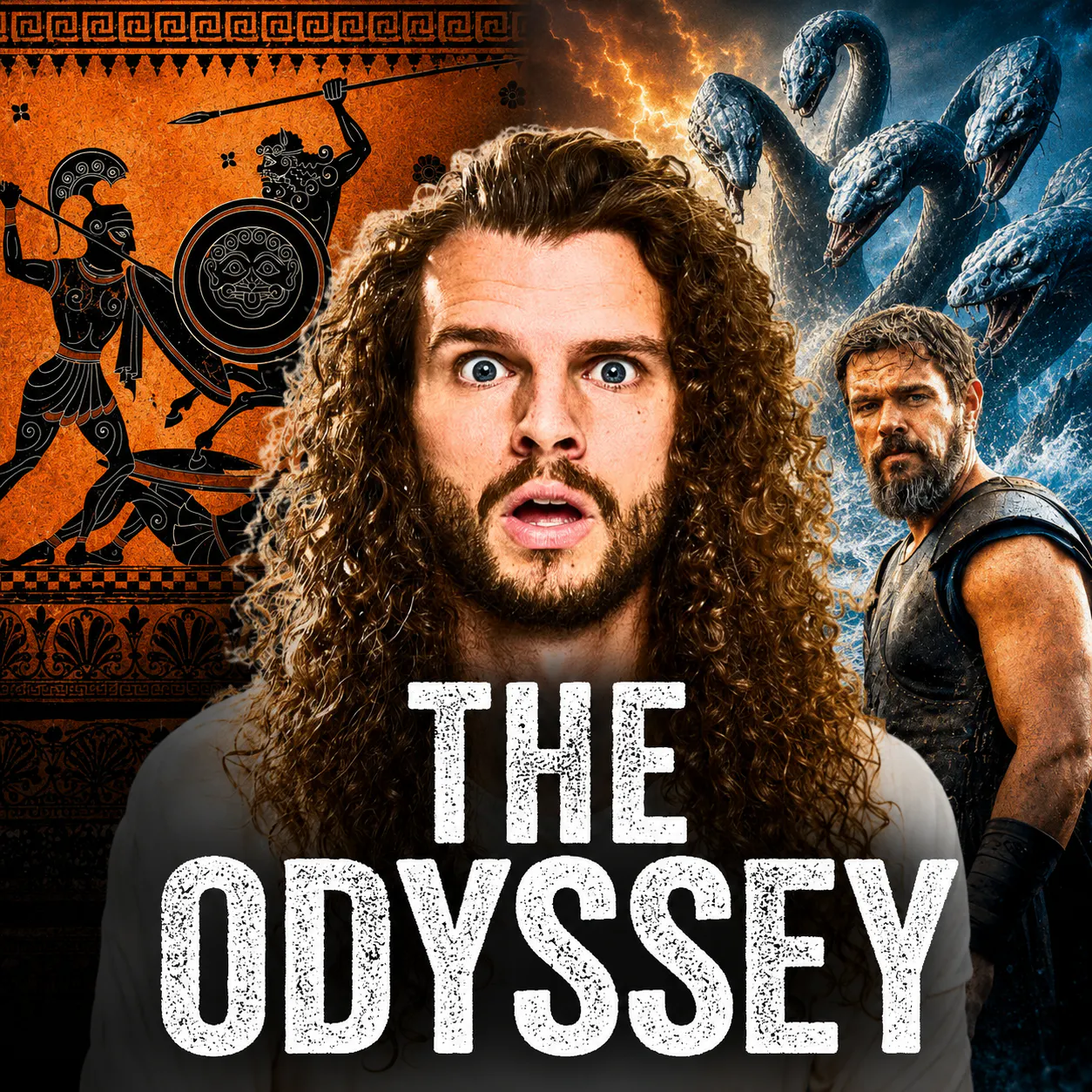
The Odyssey is one of the most famous stories in all of history. The story that everybody thinks that they know, right? The wooden horse, the sirens, the one eyed Cyclops, the hero lost at Sea for 10 years, fighting to get home. And it is so famous, it's just embedded in our culture. It kind of set the stage for Western literature as we know it. It's in movies, our language, video games. It is the reason a long, hard journey is called An Odyssey. And this summer, Hollywood is retelling it again, but this time on the biggest screen on Earth. But do we actually know what this story is and what tale it is really telling? Because the truth is you probably don't even know half of it. I mean, I didn't, that's for sure. The Odyssey is a massive story. 24 books, 12,000 lines. And the version that we all grew up on gets a lot of it wrong. And the parts that you think you know, those are just a fraction. So today, before you see the movie or even after, we're going to uncover this colossal mystery. We're debunking all the misconceptions, walking through every step of the journey and seeing what really happened after the fall of Troy. From six headed monsters to shipwrecks, to captivity to Poseidon, the bag of winds, the very edge of the world with ghosts and bloodshed and more terror than you ever even thought you knew. We are going to find out what's really hiding in Homer's epic tale. So sit back, relax, and welcome to History Camp. What's up, people? And welcome back to History Camp. My name is Mark Gagnon and thank you for joining me in my tent where every single Wednesday we try to explore the most interesting, fascinating, controversial stories from all history, from all time, forever. Yes. That is what I do here every single week as I try to figure out everything that's ever happened. And it's. It hasn't been easy, I'll be honest. I thought I'd get through this in like a couple weeks. But there is history happening every single day. And there's more history to uncover than I can even wrap my head around. And that's really why I do the show as I try to become a better student of the world. And I want to know what's really going on. Where do we come from? Why do we believe what we believe today? Well, the truth is, it's probably all predicated in history. And oh, boy, today we have a fascinating one because we get the convergence of pop culture and history, which is one of my most favorite Topics. Now, before we begin, I want to say thank you to you. Yeah, dude, you for tuning in, or girl, whoever you are, I want to say thanks for clicking on this episode, because every time you support the show and you. You know, you click, you comment, you like any. Anything like that, you help keep the lights on in the tent. You keep the fire burning here at the campsite. You also pay for the lavish Greek vacations of my dear pal Christos Pachadikados. How are you, my friend? Love you guys. All right, Christos, no time. All right, Because I know you're eager to jump in here. I know you're chomping at the bit to discuss one of the great Greek tales that is the Odyssey hits very close to home. It is maybe the. Like. I don't know if we give Homer enough credit, considering that this is perhaps the undergirding literary feat, the Iliad, as well as the Odyssey. Odyssey that is on the minds of all Greek citizens. Basically, it is under the pillow of Alexander the Great. It is the defining work of Western literature, I guess you could say. I mean, many people have said that. I'm not saying that. I don't think that. I think it's probably Harry Potter, but this one is close. And, look, it's been touted as perhaps one of the most important pieces of. Most important epics or poems ever created. And this summer, Christopher Nolan is rolling out his version of. Of the Odyssey, the Hollywood remake. And, oh, boy, people are pissed. There's been all sorts of discourse online, and I'm gonna be honest with you. This is not what this show's about. I know. Probably you clicked it and you're like, oh, man, Mark's gonna tear apart the historical inaccuracies and the. The. The Elliot page and the Lupita Nyong'. O. That's how you pronounce it, right? How Christopher Nolan got it all wrong. Exactly. Oh, man. Look, it's like, guys, it's just a trailer. Give it a rest. Like, just chill for a second. All right? So I. I actively try not to contribute to culture war fanaticism without at least adding a joke in there. You know, if it's funny. If I'm on stage joking about something, hey, that's a joke. But I mean, as far as, like, actually getting incensed by it, it's like, come on, how hard. How hard do you need to grift? That's how I feel. You know, I'm saying, so, look, let's wait for the movie to come out, but in the interest of history camp and trying to understand everything that's going on. I want to go through what the Odyssey actually is. What is it actually saying? And the version that I learned when I was, you know, coming up and, like, philosophy classes in college and stuff that left out some parts that are actually in the epic that I think are very interesting, and some of the things that people have pointed out from Nolan's film that are maybe inaccurate, but also going over some of the things that they got right. So before we answer any of these questions, what even is the Odyssey? Right? You maybe, you know, it is, like, a cartoon you watch as a kid. Maybe it's a movie or a video game or something that, like, you had to read, like, an abridged version of to, like, graduate from high school. But in reality, the Odyssey is an ancient story, and it was composed as an epic poem. An epic is a specific thing. It's a long narrative poem. Thousands and thousands and thousands of lines about heroes and gods and the fate of nations and all that stuff. But before the Odyssey was ever a text, it was just told from person to person, orally, just through stories that people would share. Someone would memorize the whole story, then tell it to their little group of people, and that's how the story got remembered and passed down. But what world are we even talking about? Like, where does the. Where does the. In history. Like, what is the beginning of the Odyssey? Well, we got to go back to sometime around, like, the 8th century BC on the eastern edge of the Aegean Sea, to a region called Ionia on the coastline of what is now Western Turkey. Sorry, Christos. And basically, all the islands kind of scattered around there because there Greek civilization was booming. Now. This area was like a. It was a maritime frontier, meaning that, like, you had traders and, you know, sailors and fishermen and all these people basically just, like, pushing out in all different directions. And it's important to understand this part, because they were sailors. Like, a lot of the people here were sailors, not people who would go sailing. We're not talking about, like, the Kennedys. We're talking about people whose entire existence was on the water. The sea was their highway. They were astronauts, and the ocean was space. All right? That was their marketplace, their farm. It was their entire existence. I mean, their olive oil, the wine, the pottery, it all moved by ship. So you were a sailor, you had a son, and your son grew up learning how to, like, read the wind and the stars and, like, in the way that you would teach your kid, like, cow says moo. It's like, hey, Orion's belt is right there. So almost every family had someone out on the water at any given moment, and the very same sea that was their life force, that was the essence of their existence, was also maybe the most dangerous thing that they would ever face. This is the world where your fortune and your death both waited somewhere beyond the horizon. And really quick, just keep that in mind as we go through this because it explains a lot about what the poem is really about and really like the meaning that's hidden in the text. So the Odyssey is a story fixated on the sea, on unfamiliar shores, and also on one really important question that mattered a lot to people in this culture. When a stranger shows up at your door, what do you owe him? Now, the Greeks had a sacred word for this obligation. They called it zinnia. To them, zinnia was like. It was a sacred cultural thing. Hospitality was so important to them and to the value of this people that zinnia defined the. Their entire code for how to treat guests. And ultimately you had to care for them. Now, look, I don't speak Greek. This is my understanding. Am I pronouncing that word basically, right? In more modern Greek, it's called philoxenia, which means hospitality. Oh, philoxenia. Like phileos. Exactly. Friend. Friend. Brother. Yep. Philadelphia. Sure. Right, yeah. City of brotherly love. They knew about that. And Xenia. Xenia. Ah, I like that. Thank goodness you're here, Christos. I know we need to flip the comments on you on this episode. I think people are gonna be very to have your copy. Something tells me that won't happen. Yeah, probably not. And that's basically what the entire poem is about. It is about places that honor this hospitality. This is inia. And places that don't honor it. And what happens if you wind up in either one of those spots? So who was telling the story? Well, it was mostly professional singers that the Greeks called aodoi. And they were poets who performed it usually from memory and would often accompany themselves on the lyre at feasts and festivals. Obviously, the liar, if you don't know, is a famous, like. Like a flute, basically. Right? And these men inherited generations of songs about the Trojan War, an event that, I mean, if it happened at all, was centuries, centuries before them. And they stitched and trimmed and polished that inherited story every single time they performed it. And as someone that does professional standup comedy, like, as you say things, you refine it and you get it into, like, the most perfect groove for your style. So the poem wasn't memorized like a script. It was rebuilt and lived every single night in every performance, slightly presented, you know, differently over centuries. Which brings us to the awkward question at the center of all this. Like, okay, well, who's the guy that wrote it? Who was Homer? And the honest question, and you're not going to like this. No one really knows. Ancient traditions describe, like, a blind poet, possibly from the island of Chios, but seven different cities in the area all claim him as a. As a local. And modern scholars have argued that he might have been one supreme genius who consolidated the tradition. Or maybe he was two different poets. Or maybe it was just a title that was passed down amongst, like, a guild of singers and writers. Or maybe he was no one at all. I mean, that's a whole episode in and of itself, like who Homer was. But for now, what matters is this. The Odyssey was never written the way books are written. It condensed and slightly morphed over time, and then it conquered the entire world. So traveling performers called Rhapsodes carried the poem across the entire Greek Mediterranean, from colonies in Spain to the shores of the Black Sea. Athens made it the centerpiece of its greatest civic festival, the Panathenia, where the Homeric poems were recited and in order and by relay because it was so long. And it was probably around this era, like the 6th century BC that the poem finally got pinned down to a version in writing. And from there, it became the literal textbook of the Greek world. And then Rome inherited the entire tradition and then folded it into its own founding mythology and then passed it down to every piece of European literature that came after it. And the Odyssey didn't survive so many generations because someone, like, locked it into a vault and it was discovered many thousands of years later. It survived because, in a way, it belonged to everyone and to every poet that would recite it and to every singer that sang it. It never stopped being performed across centuries. And that's the world that this poem was born into and existed inside of. Centuries of singers and just multiple empires of listeners. A story built in a culture of mystery and gods and adventure and war and sailing the sea and really wondering who your friends were and your family and, like, who your tribe was. And one more thing about the original. You'd like to think that a story like this would start at the very beginning of the. Of the journey, right with the fall of Troy and ship sailing away, where the adventure really begins. But the poem doesn't do that. The odyssey actually starts 10 years after the war is over. What's up Guys, we're gonna take a break real quick because I want to tell you about a brand that I actually love. You've probably seen ads for it on Instagram, and it's Ultra. It's the best. As you already know, I'm super locked in on, like, fitness and sleep and fasting and all that kind of stuff. And one thing that I care about now is getting energy and focus without feeling, like, jittery and cracked out and on edge, like my heart is beating out of my chest. And that's why I reached out to Ultra. Ultra pouches have zero nicotine, zero caffeine pouches that give you clean focus and smooth energy when you need to lock in. And a lot of people think pouches are helping them at the gym, but nicotine is actually a vasoconstrictor. It actually narrows your blood vessels and restricts oxygen delivery to your muscles and can actually work against the pump that you're trying to get. It also can raise your heart rate and your blood pressure, which is not exactly what you want when you're already training super hard. Ultra gives you that pouch experience. It's fun, it tastes good, but it's 100 nicotine free. And they use clinically proven nootropics and adaptogens to deliver immediate focus and smooth energy that lasts one to two hours. And if you're fasting, you're dieting, they actually can help you quiet the cravings and limit the food noise to help keep you locked in. And they have five flavors. Cool mint, wintergreen, watermelon, Tropical Blue rats. My favorite is Blue Blue raspberry and it tastes amazing. I have the watermelon ones right here because I already finished the blue razz, but these are great too. Now, Ultra is the ultimate guilt free pouch, delivering instant focus and mental clarity without nicotine or caffeine. And new customers can use the Code Camp C A M p to get 15% off when you go to take ultra.com that's take ultra.com for 15% off with the code Camp. And after you purchase, they're going to ask you where you heard about them. Please tell them that Mark and Christo is from the camp site, Sena. Now, let's get back to the show. Now, if you're not familiar, obviously the Iliad is covering this. This sort of epic around the Trojan War and the Odyssey is a sequel in a sense, picking up basically at that part. But 10 years after the fact, Odysseus is missing and is presumed to be dead. His palace on Ithaca had been overrun by more than 100 young aristocrats. These suitors who were basically camped in his hall, eating from his cattle and livestock, drinking his wine and pressuring his wife Penelope to give up and declare herself a widow and then marry one of them. And Odysseus son Telemachus, a baby when the ships actually left the harbor, is now 20 years old and extremely angry and powerless in his own home. And we don't even hear about Odysseus himself until book five. Which brings up something really strange about this whole story because there's a certain image from the tale, one of the most famous methods of secrecy in trickery in all of military history. And it is so well known, people throw it around as like, just like a colloquialism in politics and cybersecurity and just everyday conversation. And that is the image of the Trojan horse, but it's not even really in the story. So real quick, let's review the scene that everyone thinks that they know, right? It's nighttime. This enormous wooden horse gets brought into the walls of Troy and left behind apparently as like an offering by the Greeks who seem to have given up and sailed home after a 10 year siege. And the Trojans have dragged into the city and they start to celebrate their victory. We did it. We, we kicked out the Greeks. We won. And then in the middle of the night, a secret hatch opens in the horse's belly and Greek soldiers have smuggled their way into the city and they swing the gates wide open. Meanwhile, the fleet return in the dark. So now soldiers are pouring into the city of Troy and they burn the entire down. So that's the one that I thought that I knew. That's the sequence, right, generally attributed to the Odyssey, but it comes almost entirely from a different poem written in a different language, in a different country, 700 years after the fact. So most people assume that the Trojan horse is the Iliad's grand finale, but the Iliad actually ends before the fall of Troy. So, okay, surely the horse gets its big moment in the Odyssey, right? That's, it's, it's gotta be in the Iliad or the Odyssey. It's gotta be one of those. Well, not exactly. The horse exists in the Odyssey mostly as a song within the story. So beyond that it only surfaces in a couple of brief flashbacks. So Menelaus reminiscing about the men hiding inside it, a ghost in the underworld asking how his son behaved in its belly. So where does the full sequence actually come from? I mean, the debate over whether to bring the horse inside. The Greek double agent Sinon, telling the Trojans basically that they should drag it through the gates. The famous priest hurling his spear into the flank and then getting strangled by sea serpents for his trouble. All that stuff. Well, that's the Aeneid, and it was written by the Roman poet Virgil around 20 BC. Now, that seems like a long time ago, but that's roughly 700 years after Homer, and it is the national epic of the Roman Empire. So get this. It's told from the Trojan perspective because Rome claimed to be descended from Troy's refugees. So when you picture the fall of Troy, you're mostly picturing the Roman propagandized version, fused over 2000 years of paintings and movies into basically like a Greek poem that barely even mentions it. And honestly, the drift goes even further than just the horse. It goes all the way down to the hero's name. Half the world knows the main guy as Ulysses, but that's the Latin version from wherever Rome's influence ran in the original. In the Greek, his name is Odysseus, hence the Odyssey. Right. I mean, that's obvious. Which actually means the story, story of Odysseus. So, yeah, even his name got rewritten in different sort of interpolations throughout the years, which is kind of the theme here, right? I mean, everything about the story, like the horse and even the start of the story and the hero, the hero's name, it's all been edited by thirty centuries of people passing it along. But what about the real story, then? The one that the poem actually tells? Well, Troy burns exactly like the songs say. 12 ships turn for home, carrying somewhere around like 600 men. And 10 years later, one man washes ashore on Ithaca alone. Every other soul on those ships is dead. And the first blood spilled on that voyage home won't be spilled by a monster. It'll be spilled by the hero. So let's go through it. Just a few days out from Troy, sailing away, odysseus and his 12 ships pull up to a coastline and they raid a town called Ismarus, home to a people called the Cicones. And? And in Odysseus own words, I sacked the city and killed the men. Kind of blunt, but that's the story. The crews carry off the women and all the treasure. Then they make a mistake. They get drunk on the beach instead of leaving right away. So the survivors of the raid have time to come back with reinforcements. As a result, 72 of his men get killed. That is how the great journey begins. With a pirate raid that basically goes sideways. Anyway. Alright, let's go on. A storm blows the fleet to the land of the lotus eaters. And here's the twist. The locals aren't hostile at all. They're friendly actually. They just share a fruit that erases a person's desire to go home. That's the trap. And Odysseus has to drag his own weeping men back to the ships and tie them under the benches to get them to leave. After that comes the island of the cyclops and the cave of Polyphemus. Now this part of the story is super famous, but the whole driving force usually kind of gets forgotten. Odysseus tells the giant that his name is nobody. So later, when Odysseus gets the giant blackout drunk on strong wine and drives a sharpened fire hardened stake into his single eye, Polyphemus screams for help. And the other Cyclops shout back from their cave, if nobody is hurting you, you must be sick. Pray to the gods. And it's a joke that basically saves six lives. And it's like a really clever ruse from Odysseus to get out of a sticky situation. But then comes the fatal flaw. Sailing away safe, clear, mission accomplished. The boys are cruising home. Odysseus can't resist standing at the stern of his ship and shouting his real name. Back at the shore, his ego gets the best of him and he stands there and says, if anyone asks who blinded you, tell them it was Odysseus, sacker of cities, son of Laertes of Ithaca. Just ego, right? Like an artist, basically, like signing his work. It's like a serial killer. Like when he leaves, like a, like a zodiac, you know what I mean? It's like, dude, you're flying too close to the sun. And Polyphemus prays to his father, who happens to be the God of the sea, Poseidon, which Odysseus now has to cross the entire sea to get home. And that is why it takes Odysseus 10 years to get back. Because by yelling out like in, in just pure arrogance, he identifies himself and makes himself a target. So the hits keep coming and they keep getting worse. So Aeolus, keeper of the winds, does Odysseus an extraordinary kind gesture. He traps every contrary wind inside a leather bag, hands it over and sends the fleet home in one gentle breeze. So for nine days, Odysseus mans the sails himself, doesn't let his men do it. He does it on his lonely and refuses to sleep. But then on the 10th day with Ithaca, his home literally in sight, close enough to sea, men tending fires on the shore. He finally passes out. And his crew has been eyeing that leather bag the entire trip, convinced that it's full of gold that Odysseus is hoarding for himself. So while the captain is asleep, they open it. And as a result, every wind explodes all at once and blows them all the way back across the sea. And they wash up on the island of Eos, and they beg for help. But the wind king looks at them in horror and orders them off his island. A man that is this unlucky. As unlucky as Odysseus, he says, is hated by the gods. So then they have to start their journey all over again. And somehow things get even worse the next time they hit land. The fleet anchors inside a beautiful enclosed harbor with these high cliffs and calm water totally protected. All 12 ships sail in super easy, except one inside the harbor. Turns out the place belongs to Lestrygonians, these giants who come down to the coast and spear his men like fish, and they eat them. 11 of Odysseus, 12 ships are destroyed in a single sitting. Most of the men who survived the 10 years at Troy died in that one harbor. It is the biggest catastrophe of the entire journey, and it is the one that people don't really talk about. There's no clever trick, there's no cunning, there's no escape. Just one ship that happens to be on the outside, basically, like shipwrecked, while the rest of the fleet is butchered on the inside. Then the last ship is carried onto the island of Circe, where they meet a goddess, or maybe a witch, depending on the interpretation, who drugs half the crew and turns them into pigs. But Odysseus, who's armored with this, like, magical herb from the goddess Hermes, forces her at sword point to turn them back. And then the story does something very unexpected. They just stay there for an entire year, just like, hanging out, feasting, chilling. Finally, the crew has to pull their captain aside and remind him, hey, we gotta go home. A bunch of dudes are trying to hook up with your wife, Penelope. We gotta get this thing going. And then finally, they decide to leave. The goddess witch, Lady Cersei tells them something crazy. She says to them that their road home runs through the land of the dead. If you're Odysseus at this point, you got to be like, bro, why'd you guys open the Bag of Wind? I saw it. I saw all these guys trying to get with my lady, and now I'm Back on this island with a bunch of y' all as pigs and then unpigged. And now she says, we got to go to the land of the dead. So Odysseus is like, screw it, all right? He sails to the edge of the world, which is an actual place in the story, maybe in real life, I don't know. Never been there. And this is allegedly where the dead go. So he crosses the ocean to a shore where the poem says the sun don't shine. A land wrapped in permanent mist and clouds where it is always nighttime. And there's no monsters or giants or witches or cities, just fog and cold at the very border of the living world. And there on that gray beach, he does exactly what Circe told him to do. He digs a trench with his sword about like a. Like a forearm deep. And he pours in offerings. Milk, honey, sweet wine, water, barley. And then he cuts the throat of two black sheep and lets the blood run down into the pit. Because there is a rule in the world of the dead that is very creepy. It's that ghosts are mindless. They're empty. They're these, like, fluttering shadows with no memory and no voice until they drink blood. Once they taste blood, they suddenly remember who they were. And they can think and they can speak, and they. They become anthropomorphized, and they become almost like humans again. So the moment that blood hits the trench, the dead souls come swarming up out of the dark. Brides who died young, old men, soldiers still with their wounds, thousands of them, crowding in from every direction, sounding like, according to the poem, unearthly, shrieking. Odysseus stands over the trench with his sword drawn, holding back the entire dead population of all of history from one puddle that can make them feel human again. And there he meets the blind prophet Teiresias, who gets a drink and gives him a warning. And remember this about the cattle of the sun. That's the warning he gives Odysseus. He says, beware the cattle of the sun. Now, it's a weird warning. We're going to come back to it in a second, but just remember that, okay? Now, Odysseus meets Achilles. You know, Achilles, the greatest warrior who ever lived, the man that the entire Trojan War was built around. And Achilles is dead and delivers one of the most devastating lines in all of ancient literature. He says he would rather be a poor farmhand, alive, breathing, and toiling away in someone else's field than be a king over all the dead. So the glory that the Entire war ran on. Achilles says it's worthless. But then Odysseus sees a ghost that he was not expecting. It's his mother. His mother, Anticlia is there. She was alive when he first set sail for Troy. And she tells him how she died of grief waiting for him to return. Three times he tries to embrace her. Three times she just pours through his arms like a. Like a shadow, like a ghost. And then come the Sirens. Now, you probably heard of these ruthless creatures, but they're not exactly the way they're depicted in a lot of movies. Let's look at how the story actually goes. As the ship approaches their island, the wind just dies. Like the sea goes flat. It's like perfectly glassy and silent and the crew has to pull out oars and row towards the sound, which is its own kind of like horror. You can imagine being on like a perfectly still lake or like a perfectly still ocean, and you just. You don't even hear any waves or anything, just the sound of your own oars hitting the water and pulling, maybe like the creaking of the wood as you start to go, go forward. And nobody gets ambushed by the Sirens. You hear them coming from miles away across this dead calm sea, and still you just continue to row. Anyway, Odysseus preps the ships exactly the way that Cersei told him to. He takes this wheel of beeswax and he slices it up and he starts kneading it to become soft in the warmth of the sun. And then he plugs the ears of every single crewman and then the crew ties him to the mast, arms and legs. And in the Odyssey, there are two sirens. Not like a chorus of them, just two. And Homer gives them no physical description whatsoever. He doesn't describe, like, mermaids or fish scales or wings, no combs or mirrors on wet rocks. He doesn't say, like, they're baddies. The fish tailed mermaid temptress that we all imagine when we hear the word siren is just centuries of artistic drift. That came later. Ancient Greek painters actually drew them as birds with the heads of women. So the mermaid thing actually comes from much later depictions. In the original story. The bait isn't beauty. It isn't even love songs. It's not even really about the music. Listen to what they actually sing. In the actual text of the Odyssey. This is what he actually hears as he's going past them, as he's, you know, tied to the mast of the ship. He hears this. Come here, celebrated Odysseus. And we will tell you everything. We know all that happened at Troy, we know everything that happens when on the whole fertile earth that is so different than the version that we hear in, like, the Hollywood tale, right? Like, we hear, like, oh, like, they're beautiful. The song is so gorgeous. Like, they're drawn to the beauty. The sirens are actually offering knowledge. They're offering total information. The war explained. Death explained that. That experience he had with his mother on the island where he couldn't hug her, that unresolved, like, torment that he feels in his soul, all of it is explained. And that is the most all consuming, enticing thing that Odysseus truly wants in this whole poem. And it works on him, like, instantly. Odysseus starts thrashing against the ropes and jerking his head, signaling for the crew to cut him loose. He's like, hey, guys, this was. This was all the beeswax thing. Who cares? Just cut me loose. Let me out of here. He's just pleading with them with his life to get him unhooked from the mast. And all of his men respond by rowing even harder while two of them get up, walk over and tie their captain down with even more rope. And the whole time, the sirens are singing from a meadow heaped with rotting corpses. A flowering field, the poem says, piled with the bones of men, the skin still shriveling on them, thanks to his remaining faithful men who can't hear anything because they have, you know, beeswax in their ear. They kept on rowing and they make it past the Sirens. And next they go through a straight with a monster on each side. The Scylla. Six heads on long serpent necks striking down from a cliff. And then, of course, the Charybdis, a whirlpool that swallows the entire sea three times a day. Now, the advice that he has from Cersei to get past these guys was brutal. They have to hug the cliff beneath the Scylla. But as a result, they're going to lose six men. But they won't lose the entire ship. And Odysseus follows the advice, but with an adjustment that a lot of the adaptations always leave out. He doesn't tell his crew. Yeah, in the actual story, he doesn't tell the crew. He straps on his armor, watches the six heads of the Scylla monster come down, and later says that the sight of his men screaming his name as they were lifted away was the most painful thing that his eyes ever saw. But he had already decided that someone needed to pay the toll in order to get the rest of the men through then comes the thrinacia, the island where the sun God pastures his sacred cattle. Remember this part, that one ghost, Teiresias, back at the edge of the world. He warns Odysseus about this exact moment. And he said that if he didn't heed the warning, it meant death. Odysseus wants to sail right past it, but the crew is exhausted and starving and just saw six of their homies get eaten. And so they're starting to, you know, chat about mutiny. Led by his second in command, this guy Eurylochus, demanded one night of rest on the shore. So Odysseus gives in and then a storm traps them there for a month. Now, of course, the food runs out and while Odysseus is inland asleep again, at the fatal moment, the starving crew slaughters one of the sun God's cattle. This was again the big warning from Teiresias. Don't do that. The bad omens start immediately. They're pretty creepy, actually. The hides begin to crawl along the ground and then, like, the meat starts to, like, moo, like a cow on the spits, like while it's cooking over the fire. And finally, when the weather clears up and they set sail, the men meet their final destruction. Zeus splits the ship with a thunderbolt and every last man except Odysseus drowns in the wreckage. Odysseus clings to a piece of the ship and gets swept back through the Charybdis. And he survives by hanging from a fig tree over the whirlpool that's eating the sea three times a day. And then he just drifts in the ocean for nine days until he washes ashore on an island called Ogygia, alone. Think about it. He starts this whole journey with 12 ships, 600 men. Well, now 599 of them have died. All the ships are gone, and Odysseus is now alone. And the poem's opening lines have already told us about how to read this. The men died, it insists, by their own recklessness. The captain it doesn't blame. But remember who's talking here, because now we get to the part that changes everything we've just heard. I mean, the Cyclops, the Sirens, the witch Circe, the ghosts, the whirlpool. The poem doesn't show you any of it directly. You see, books 9 through 12, the entire famous section that everyone knows, like the whole reason you know the story even exists, probably, if you're like me, is a tale Odysseus tells about himself out loud after dinner to a Court full of wealthy strangers that he desperately needs a ride from. There's no other witnesses. Every man who could confirm a single word of it is dead. And the one thing the poem establishes about this man, beyond any doubt whatsoever, is that he lies, like, all the time. He loves lying. You may have just heard literature's very first unreliable narrator. And it's one of the. The most important works of literature ever. So next, let's look at what the poem actually says happened when he wasn't the one telling the story. Hey, guys, we're gonna take a break really quick because I want to talk to you about gld. This is an awesome new company that we're working with that I'm actually wearing right now. I actually got this crucifix right here. And honestly, even just getting it, you know, sometimes, like when you work with some companies, you're like, all right, I really hope the product is good. This one is. I. I wear it all the time. This is actually like the new crucifix. I lost my last one at a bathhouse, literally, at a sauna. I lost my crucifix, which is maybe God's way of telling me something. But I got a new one from gld and I've been rocking it non stop. My wife likes it, and it's got, like, a nice weight to it. The details actually look better in person. The clasp is, like, super solid. It doesn't feel like something you bought, like, in Times Square from a random dude. It doesn't feel like something you order from, you know, some. A sketchy website on teemu. And they got everything. Chains, pendants, bracelets, watches. Whether you want something subtle or something that's like, yo, I just. I just signed a deal. You know, I mean, if you want like the record deal chain, they got that too. Now, if I haven't convinced you yet, let me sweeten the deal a little bit. All right? For a limited time, the listeners of this program, Camp Gagnon, Religion, Camp History Camp, and the entire camp universe, you're getting a crazy deal. If you use the code camp c a m p when you check out, you're going to get 40% off your entire order@gld.com. that's 40% off your whole order with the code camp at checkout@gld.com and after you purchase, they're going to ask where you heard about gld. Tell them you heard about them from, you know, the good folks here at the campsite. Mark and Christo sent you. And whenever you do that, it really Helps, you know, support the show. And thank you so much to gld, and thank you to you for tuning in. Let's get back to the show. Ten years, from the fall of Troy to the homecoming. That's the legend, right? The famous ten years of wandering. Except when you lay the poem's timeline end to end, the monsters aren't really that big of a part of it. I mean, the raid, the Cyclops, the winds, the harbor, the year with Circe, the dead, all that stuff, the cattle, it all fits into roughly the first three years. So what about the other seven? Well, Odysseus actually spends those in one place all those seven years on the island of Ogygia as a captive of the goddess named Calypso. Calypso wants him as a husband and she has no intentions of ever letting Odysseus leave. And there's nothing that he can do about it. She's a goddess and he's just a man with no ship or crew or anything. The poem tells us by the end, the nymph, meaning the goddess, no longer pleased him. At night he sleeps beside her in a cave. And every single day he walks down to the shore and stares at the empty sea and he cries. So what finally breaks this, you know, prison that he's in? Well, the gods convene while Poseidon is conveniently out of town. He's not really at this conference. And Athena, who's basically Odysseus's lawyer throughout this entire poem, raises his case and Zeus agrees and sends Ermes down to tell Calypso to let him go. Before Odysseus leaves, though, Calypso makes Odysseus one final offer. She says to Odysseus, if you stay, I will make you immortal. That is a massive offer. Literally, she's saying, I'll make you basically a God. I'll make you one of us. And Odysseus says that he knows Penelope, his wife, who's waiting for him on the shores of his hometown. Can't compare with a goddess, but even so, that's not what he wants. He wants to go home. So he builds a raft and sails for 17 days until Poseidon, on his way back from, you know, his travels or maybe like a vacation or something, he looks down and he spots Odysseus on his raft and he detonates the sea one final time. The raft that Odysseus is floating on is smashed. A sea goddess lends him this magic veil to keep him afloat, and he swims for two days. He crawls Ashore, naked, basically dead. On the land of the Phaeacians, a nation of master sailors. He's found by none other than the princess Nausicaa, doing laundry at the river with her maids. The Phaeacians take him in and give him a feast. And remember that thing we were talking about before that Zinnia. How do you say it? Philozenia. Philoxenia. Philoxenia. This is a place that finally understands hospitality. I would say Circe kind of gets it like some of the other ones, but this, this spot is like. It shows the Greek version, all right. And they have a whole banquet. And at the banquet, the blind singer finally performs the song of Troy and the wooden horse. And the mysterious guest weeps into his cloak. And so the king finally asks, who are you? And Odysseus tells him who he is. He says, I am Odysseus, the son of Laertes, known to the world for my cunning. And that's where he launches into the next four books of monster stories that we just walked through. It's that moment everything we know from the story is a flashback performed by Odysseus to the people that he's basically on the island with. Meanwhile, back on Ithaca, home has become an occupied territory. 108 suitors are camped in the palace. They're eating all the food, drinking the cellars dry, devouring the estate of a man that they're just completely, you know, confident is dead. And Penelope has been holding off this siege all alone. She announced that she would choose a new husband soon, just as soon as she finished weaving a burial shroud for old Laertes, her father in law, which was very proper of her and very dignified, so no one really objected. And she wove this shroud by day and then she would secretly unweave it by night. And she bought three full years with that trick until one of her own maids ratted her out. And then old Telemachus, Odysseus and Penelope's son just got back from searching abroad for any news of his father and had to slip past an ambush just to make it home. You see, the suitors have moved on from freeloading to planning the murder of the heir and basically take over this entire island for their, for themselves. And that is the state of things when a strange beggar no one recognizes walks into the palace Courtyard. It's been 20 years since Odysseus actually left the island of Ithaca and set sail. The whole war, a curse, a goddess's island. And Odysseus finally sets Foot on Ithaca again. So real quick, remember how the poem has 24 books. The entire second half of it takes place on Ithaca. And it's not really an adventure story, to be honest. It's an undercover operation with like surveillance and a disguise and a loyalty test. It's a man casing his own house so he can take it back from the inside, essentially. If the first half of the Odyssey is the mythos, it's like the mythology around everything. The second half is like a revenge thriller Hollywood movie. It's like the tensest stretch of storytelling that survives from the ancient world. And this is basically how it goes. Athena disguises Odysseus as an old beggar with like shriveled skin and rags and like a walking stick. And his first stop is a hut in the hills, the home of his swineherd and slave, this guy Eumias. Now Yumaeus is a man who owns nothing. He takes in this filthy, you know, homeless stranger and feeds him his best pig and gives him his own cloak against the cold without the slightest clue even who this man is. Meanwhile, up at the palace, the richest young men in the kingdom are violating every single law of hospitality ever. The poorest man in the story is actually the best. Think about that. Like the poorest beggar, this guy takes in Odysseus and holds this sacred Xenia principle to the highest degree. This, this, this honor, this hospitality. Then at the palace gate, on a dung heap, lies a dog. This is Odysseus dog Argos. Odysseus trained him as a little puppy 20 years ago. And now he's this old lumpy, tick ridden throwaway and he's the first living soul on Ithaca to recognize his master. Argos is too weak to stand up, so he lifts his head and he wags his little tail. I mean, just what a beautiful, like visual. I love dogs. That's so cute. Is it the best? Like odysseus comes back 20 years later and his dog is like, that's my boy right there. I know that guy. But Odysseus, who obviously can't break his cover because he, you know, he might just get killed immediately, he wipes away a single tear and walks past him into the house. Now the poem says that Argos dies right there on the spot. Having seen Odysseus again in the 20th year, Argos can finally pass away in peace. She's gonna make me cry, dog. Isn't that beautiful? It's also brutal. I mean, it is brutal, but it's beautiful. Now inside, the Beggar works the halls of his own palace. Odysseus, in this disguise, starts kind of going around and basically begging for scra men, eating his own food at his table, drinking his wine, and he's quietly mapping like, which servants are loyal and which ones are fine with Odysseus dying. And basically he's looking for the ringleader of all these potential suitors that are trying to marry Penelope and kill his son and take his entire estate. And he finds him, this guy, Antinous, and basically caps off the evening by hurling a footstool at him. Later that night, the old nurse, Euryclea, the woman who nursed Odysseus as a little baby, is told to wash the stranger's feet. And her hands find a scar above his knee, a boar tusk wound from a boyhood hunt. And she knows instantly who this is. And she turns towards Penelope to cry out, but Odysseus hand closes around her throat. And he tells the woman that if she makes a sound or tells anyone when the killing starts, he's not going to spare her. Yeah, that detail doesn't really survive the adaptations either because it shows Odysseus kind of as like a brutal, aggressive guy. But he says, hey, don't say a word. But then there's Penelope. The queen sits down for a long fireside interview with this beggar, and he claims that he actually hosted Odysseus decades ago and swears that the great man is alive and that he's on his way home right now. And Penelope weeps. And then that same night, this famously patient woman, who has stalled 108 men for years, suddenly announces that the waiting is over. Tomorrow there will be a contest, and whoever can string the bow of Odysseus, a bow that is so stiff and so strong and so difficult to pull back that no other man has ever been able to bend it. And if they can do it and shoot an arrow through the socket of 12 axes will take her. The queen, Penelope. Now, one way to read this is that she finally gave up and that, you know, with this news, she's had her heart broken so many times that she just kind of gives in. Another way to read it is that she just looked into the beggar's eyes and saw who she was really talking to and basically handed her husband a loaded weapon in front of all of his enemies and was like, hey, baby, you know what to do. The poem never tells you which way to interpret it. Scholars have fought about this for literally 2000 years. But Homer keeps the queen Secret. And it's kind of just up for you to decide. So the next day comes around and the contest plays out in the great hall. And the mysterious beggar, with his shriveled skin and his rags, walks over and kind of ambles his way to the bow. And then the poem says the way a singer stretches a new string onto his lyre easily, without strain, he strings it and sends the arrow through all 12 axes without even rising from his stool. And then the beggar stands up and announces who he really is. And what follows next is a massacre. Truly, that's the only way to put it. Odysseus with his son Telemachus and his basically poor slave friend that took him in, Eumias and then one other cow shepherd killed every single one of the suitors, all 108, plus the household men who served them. It's like the most badass comeback story ever. Odysseus alongside his boy who hasn't. He hasn't seen since he was a baby, alongside his friend who's poor and has nothing that took him in when he didn't even know who he was. Yumeus probably was stoked. He was like, I was you the whole time. Like, what? That's like, okay, as a dude, you're like, all right, I'm gonna win my girl back with the help of my son and my homie, that always rides for me and is just like a good dude in general and then also like a shepherd, because, like, we need another, you know, like, we need to round out our fourth. And then they kill all the traitors. And when it's over, the poem shows us its hero standing in the middle of it, like, just spattered head to foot and compares him to a lion that has just fed. And now, and let me just say this is the part that gets a little uncomfortable, 12 of the palace's enslaved women, the ones judged disloyal, the ones who slept with the suitors, they're brought out and, yeah, they're forced to remove the corpses, some of them the bodies of like, their own lovers. Because, you know, these suitors were just in the palace for years at this point, and they slept with some of the, you know, the servants, the slaves, and then they scrub the blood from the tables. And then finally Odysseus orders them to be killed with swords. It's a little brutal, but, like, it's a different time. All right? Imagine you got back from a 20 year journey, all right? You'd be a little bit like, you let these people in My house. I'm not going to defend killing defenseless women, but anyway, Telemachus decides that is too easy. It's too clean. No honorable death, he says, for these. So he hangs him instead. It's kind of brutal, but that's what he does. It's in the story. I mean, it didn't really happen. It's in an epic poem by Homer. All 12 of them from a single ship's cable strung across the courtyard. The poem describes them in one of the most terrible images in all of ancient literature. This is how they describe them. I'll read it verbatim. Like doves caught in a snare on their way home to the nest. Their heads in a row and their feet twitched for a little while. Ah, you don't love that, right? When you're reading the story of Odysseus, you're like, dude, I'm Odysseus. Like, I'm sailing around. I'm. I'm pushing these, these side pieces off of me. These sirens, bang. Get out of here. I'm, I'm. This woman's trying to sleep with me, turn me into a God. I say, no, I got to get back to my baby girl. And then you get back there and then you're like, also, I'm going to kill these maids. You're like, ah. And then Odysseus has the survivors strike up music and dancing. He wants it loud so anyone passing the palace will assume that the queen finally chose a husband and that this is like a big wedding feast and nobody comes asking about the missing men. So the happy ending of like, oh yeah, Odysseus comes back and takes his girl back and everyone goes home. It's a bloodbath and a cover up with music. And that is Odysseus homecoming. But the poem still isn't done because one person in that palace has not yet decided to believe her eyes. The last monster that Odysseus has to face is his own wife. So Eurycleia runs upstairs. This is like the nurse that brought Odysseus up when he was just a boy and recognized him from the scar on his knee. And she's stoked, she's very giddy. She's excited to tell the queen. She's like, hey, great news. Your husband's home. And the suitors are all dead. And Penelope's response is complete disbelief. She comes downstairs, sits across the fire from the man himself, cleaned up a little bit, you know, restored, looking every inch like the king that he is. And she just stares at Him. Now, remember when I said that Odysseus and his son basically fight to, you know, kill all the traitors, all the other suitors? Well, the reason his son recognizes him is because Odysseus literally, with the help of Athena, Athena basically reverts him back from being a beggar into being Odysseus himself to being the king, to being the man that he always is. He looks at his son and he literally pulls like a. He pulls a Star wars on him. He goes, I am your father. And his son doesn't believe him. He's like, no, you must be a God. And he says, I'm not a God. I'm your daddy. And then the two of them basically conspire to kill all the other men that are in the palace. And that's how he convinces the son. But Penelope is still not convinced. So she runs a test to see if it is truly Odysseus that is sitting before her. She basically says to one of her servants, hey, move my bed out of the chamber. Move it out of the bedroom. And Odysseus gets mad. He says, that's not possible. I built that bed. That bed is rooted into a live olive tree. Literally. The bedpost is a real tree. You can't move the bed unless you cut the bed off of the tree. Who cut my bed off the tree? And in that moment, Penelope realizes this is the real Odysseus because no one has been in the bed. The perfect symbolism. The bed is symbolic of their union, of their marriage, of this immovable object that only Odysseus and Penelope would truly know. And right there, with husband and wife, finally reunited with their son, with their most loyalist, kindest friend. This is where a lot of ancient readers would be like, all right, the poem's over, right? Like the scholars who curated Homer's text at the Library of Alexandria marked that very line as the Odyssey's true endpoint. Everything after it they regarded with a lot of suspicion, saying it might have been a later performer's addition, kind of stitched into the classic. But what follows from that point, which for a lot of people is the actual end, is really weird. The scene cuts, of all places back to the underworld, where the ghosts of the freshly killed suitors show up, and they start gossiping with the ghosts of Achilles and Agamemnon about how they all died. Then Odysseus goes out to the family farm to reveal himself to his ancient father, the late Laertes. And then the families of the 108 dead men take up Arms, which, honestly, yeah, I get it. Like, they just like you. We were here to marry Penelope and take all this stuff. We thought you were dead. And then you just kill all the guys. All the families are pissed off. And this is a world that runs on, like, dynastic familial blood feuds. And so they march onto the farm and then a civil war breaks out. And then Athena just steps onto the battlefield and shouts to stop the whole thing. Zeus throws a thunderbolt and the goddess imposes, like, a peace treaty. The killing will be forgotten. All right, how about that for a treaty? This is all the murder that's going to be wiped from the island's memory so that everyone can go back to being ruled by Odysseus. That's the actual final scene of the most famous story in the Western world. It's not like a sunset or like this happy, heroic thing, but like a peace treaty from the goddesses to stop a civil war for this unjust killing of all the men in the town and ordering everyone to forget what happened. 28 centuries. That's how long this story has been passed along from mouth to mouth and then from page to page, and now from podcast to you driving your car or going to work or wherever you are. And the entire time it's been like quietly, subtly changing, because every generation that carries it, I mean, just by the virtue of telling it, you're going to add a couple little things. Your little fingerprints are going to be on there. Which brings us back finally to today. This story has never stopped being retold. And every teller, over thousands of years, changes it a little bit. I mean, the medieval art, the medieval artists, they make the sirens and the mermaids. And then Dante threw Odysseus into hell because his era thought that he was just a big old liar. And then of course, Tennyson turned him into a fearless explorer because his era really worshiped and admired ambition. And then Hollywood has been doing it ever since. A swashbuckler in the 50s, a con man of the 2000s, a traumatized veteran in 2024. And when you see the newest version with like a star studded cast, Matt Damon, Lupita, the whole squad, remember, this story never got told the same way twice. Every listener gets a different version shaped to what, their culture, their time period, how the really like how the singer, how the director wants them to hear it. And today, even the new movie says more about our culture than it does about ancient Greece. I mean, people online talking about casting and the accuracy of the armor and the accents. And are they Greek? They're not Greek. All modern filters and modern values placed over this lens into the past. So just remember this tour of the Odyssey that we went on today. And remember how massive the story actually is, the scope of the true epic and how the details change, whether it's being told by Virgil and the Romans or by Homer or, you know, the Greeks. And remember that a huge theme is Ksenia. Did I pronounce that right? Yep. I feel like. I feel like I'm just making a sound and then saying Ania. It only took an hour and three minutes, but you got it. Ksenia. Like, I'm just. Like, I'm just. It feels all right. God bless you. Thank you. It's this idea of hospitality and to show kindness. Hospitality to. To everyone. To strangers. Like, imagine you're Yumeus, the greatest swineherd of them all. Just a good guy, perhaps a slave, just a poor man. And a beggar comes to you, and you take him in. And then you and that beggar, who turns out to be the king, slaughter 108 dudes and start a civil war. Anyway, decide for yourself when you go and watch the Odyssey about which version you wish to believe. And that, ladies and gentlemen, is my retelling. Mark the Great. I need a liar. That's not you, Croesus. Now I need a little flute. I'm going to sing it next time. That is my retelling of the great story of the Odyssey. I mean, what a crazy tale. There's a lot of stuff that I never heard when I took, like, Greek philosophy in college. Right. Like, there's a lot of. You did. I mean, you're Greek. You probably didn't hear a lot of this. I read it in Greek and then also in English. No. Yeah, the whole thing. Not the whole thing. All the books in parts. So was there any part of this that you never heard before? The. So this is how I know it's real. The detail about the beheadings of feet twitching is something you only know if you've killed somebody. Whoa. Right? And how do you know it? I just saw the details. But how do you know those details are true? That's gotta be true. Christos, do you know something? No. Christos, I gotta go. Oh, my goodness. But, okay, so when you read the original in Greek, it was translated from ancient Greek to Greek, obviously. Right. But did it kind of blow your mind? Like, oh, there's a lot of stuff in here that I didn't know. It's kind of like reading Harry Potter. And then watching the movie, it's a lot because it's like, all right, it's basically the same story. But then you're like. I mean, the moment of him hugging his mother who died of grief, like, that is brutal. Or the dog. The dog. The dog. Argus. I mean, how beautiful. I mean, what an awesome story. You get why this is retold time and time again. It's like maybe one of the greatest stories ever. Yeah. I mean, I guess it's kind of an understatement. I guess everyone kind of knows that, right? Yeah. I mean, I need to read in the ancient Greek. I'm gonna start learning Greek today just so I can read the story. I'll help you out. And more. So when I see the Odyssey, I'm gonna be like, all right, this is his version. The Odyssey is supposed to be a living. A living, breathing thing that's passed down and you got to keep the main beats, but then you put a little flavor on it. Am I wrong? I mean, you're Greek. Yeah. Do you like when people add, like, a little flair to it? I don't know how I feel about the newest movie about it. But we haven't seen it. Neither of us have seen it. True. Maybe it sucks. Maybe it's great. Maybe it's great. Who's to say I haven't seen it? Christopher Nolan. You saw the trailer? I did say the trailer. Why do you say it like that? I don't see any Greek people in it. Matt Damon. Classic. He's Greek. Yeah. Damonus. That's his real name. Yep. Damonopoulos. Yeah, of course. I forgot. Sorry. You don't know that. No. Matthias Damonopoulos. Yep. That's his real name. Sounds right. I'm almost positive. Look it up, don't Google it. Actually, I am gonna reserve my opinion until I see the film. But now you'll know going into the movie what the real story is. If there's anything I missed, please don't hesitate to let me know. I'm not a historian. I'm not a Greek literature expert. I'm just a guy with a WI FI connection, and I'm trying my best to understand everything that's ever happened on this big, beautiful planet of ours. And the Odyssey is our latest stop. So if I missed anything, if you've read the original text, like Christos over here, please don't hesitate to correct me in the comments. Please. If. Even if I don't respond, I will read them, and someone else will read it and respond, and you'll be contributing to the bulletin here at the campsite. Also, if you like crazy religious stuff, like, you know, trying to understand what everyone believes in the world and where we're all going to go. And if you want to know about every God that's ever existed, well, great news. We have Religion Camp. If you like to deep dive in all the craziest mysteries, conspiracies, occult stuff. Well, great news. Camp Gagnon is for you. Not only do we do deep dives like this, we also do interviews with people way more interesting and way smarter than I am. And it's a low bar, but those episodes are awesome and you can check all that out in the description. Also, I want to invite you to a secret society, the most secretive society of all. It is a fascinating place in the dark of night. You can join us, myself, Christos, and many other campers. We gather there and we give brand new episodes that never go out to the public that are too strange and too bizarre for the average farmer to watch. Furthermore, you're also going to get upfront dialogue with me and the rest of the squad, and you're also going to get every single episode of this show ad free. If you don't like the ads, great news. There's a solution for you, but it comes with a fee. There's a sacrifice, and it is about the price of a cup of coffee every single month. Five bucks a month and you're going to get everything you've ever wanted from the campsite. Ad free episodes, bonus episodes, sneak peeks in all the upcoming episodes, and monthly live streams with me and the squad@patreon.com Camp Gagnon. Now, I appreciate you all dearly. Thank you so much for tuning into another episode, and I will see you all in the future to talk about the past. Peace. Hey, guys, if you love conspiracies and hypothetical history, well, I want to invite you to check out signal 33. This is a companion pod to our podcast here at camp. It's made and edited by the same team that runs all of our shows, and I choose the topics every single week, so check it out, subscribe and start the dialogue in the comment section.