Loading summary
Transcript859 lines
- [00:01]
A
It's crunch time at work and you need to bring wings to your workday. Visit redbull.com gettingitdone and answer a couple questions about your work style to get a Spotify customized playlist tuned to your productivity. Plus, score a can of Red Bull on us while you go from to do to done. And remember, Red Bull gives you wings. Supplies are limited. Terms apply. Visit the website for more information. Zootopia 2 has come home to Disney.
- [00:30]
B
Let's go get ready for a new case.
- [00:32]
A
We're gonna crack this case and prove one of the greatest partners of all time.
- [00:35]
B
New friends you are Gary the Snake.
- [00:38]
A
And your last name the Snake Dream team. New habitats. Zootopia has a secret reptile population.
- [00:47]
B
You can watch the record breaking phenomenon at home.
- [00:49]
A
You're clearly working it.
- [00:52]
B
Zootopia 2 now available on Disney. Rated PG.
- [00:56]
A
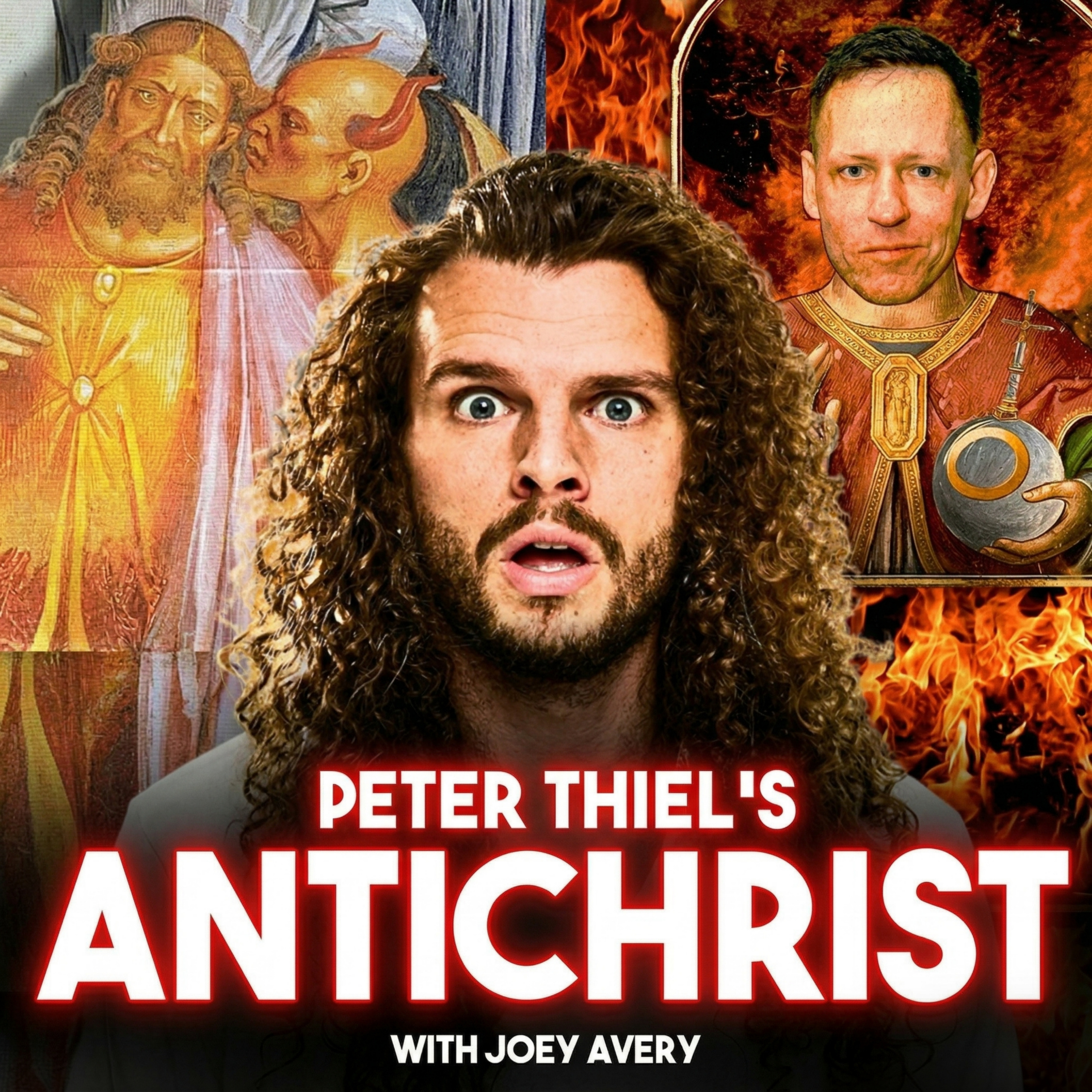
There's a good chance you believe that billionaires are trying to control the world. But what if one of them thinks that he understands the end of the world? Well, today we're diving into the mind of Peter Thiel. He's a PayPal founder, the Palantir architect, and one of the most powerful figures in all of tech. And now he's giving these secret invitation only lectures about the Antichrist. And there was no one better to talk about this episode with than my good pal Joey Avery. Of course, he grew up in California, in the Bay Area. He knows many of these Silicon Valley tech guys. And we're talking about this same dude that built tools that can track the entire population. Yes, how Palantir actually works and how it is being rolled out. We're also going to look into Peter Thiel's claims that the Antichrist isn't actually the devil, but maybe it is the system that controls everything. We're going to talk about Peter Thiel's company, Palantir, and basically how it is built to literally surveil every single person in our entire society. We're also going to talk about how he's funded a lot of political campaigns and a lot of the other work that he does behind the scenes. And we'll talk more broadly about the PayPal mafia, this infamous group of billionaires that started at PayPal that have gone on to build basically every tech product that we use today. But what is Peter Thiel talking about? Is it just philosophy or is this some type of prediction for the future? Well, today we dive into all of it. So sit back, relax, and welcome to camp. What's up, people? And welcome back to camp. My name is Mark Gagnon. And thank you for joining me in my tent, where every single week we explore the most interesting, fascinating, and controversial stories from around the world. From all time forever. Yes, that is what I do in this tent. I try to get to the bottom of every. Of everything that's going on in the world. And there's a lot of stuff going on. It happens every single day. But before we go any further, I just want to say a few things. One, thank you so much for clicking on this video because every time you click comment like, you keep the lights on at the tent, you keep the fire burning here at the campsite. Also, I have great news. We have an inner sanctum. Yes. If you thought this tent was as close as you could get to the action, well, you can get even closer. Gather around the campfire. And that campfire is@patreon.com campgagnon and it's also probably the best place if you want to get additional content from this show. If you want to do monthly live zooms where we all just, like, hang out and talk, and if you want to connect with more people like you and feel more like yourself, that's probably the best place to be. You're also going to get a good chance to talk with the man to my right. His name is Christos Papadopoulos. How are you? What's up? All right, Christos, look, we don't have time, okay? If you want to talk to people, you go to patreon.com you can talk with them there, all right? I'm not going to let you hijack this show to do that and sign up. So, guys, we have an amazing episode, all right? We're going to be doing a little deep dive on a man that is, I mean, probably going to take over the world if he hasn't already. His name is Peter Thiel, and there's no person better to do this with than the man in front of me, Joey Abraham.
- [03:44]
B
Great to be here, Mark. You know, it's always nice being in the tent. Obviously, I'm here promoting my special Joey Live in San Francisco, one of the best specials of the year.
- [03:53]
A
And some are saying we're going to expunge that. We're going to sponge that from the record. This episode not about Joey Special. This is about Peter Thiel, okay? And figuring out the tech oligarchs to run the world. All right, where's the. Where's the special gonna be?
- [04:06]
B
It is on YouTube right now. You can watch. It's also great talking to Christos. How are you Shut the hell up. All right, dude, that is fun.
- [04:14]
A
Don't do that.
- [04:15]
B
No, he's a good guy.
- [04:16]
A
He is a good guy. The hell's wrong with you?
- [04:18]
B
I'm just making myself. It's been a while since I've been in the tent, so I'm just making myself comfortable.
- [04:22]
A
It's been a long time. I apologize. It's been so long. The last episode we did, we talked about Haile Selassie the most. I.
- [04:28]
B
We did.
- [04:29]
A
And the comments are pretty good. I mean, let's go through some of the mean ones about you. Let's go through. Oh, French for seal. Said, Joey's the best. Oh, that's nice. That's nice. Okay, what else? Oh, this is gold. That's kind of nice. Oh, ja. Rastafari, King of kings conquering the lion of Judah. Yeah. Wow. Joey actually pronounced a lot of their names correctly.
- [04:54]
B
Wow. You know, that one even surprises me.
- [04:56]
A
Yeah, they were. They did not expect that.
- [04:58]
B
No, me neither.
- [04:59]
A
But, yeah, it seems like the feedback was pretty good. You know what? And. Oh, the best duo in the. In podcasting history.
- [05:05]
B
Wow. This is not what I was expecting from Internet comments. That's very nice.
- [05:09]
A
Me neither. I was looking for meaner ones, to be honest. Yeah, I. I was doing some research on Peter Thiel recently because he's. Yeah, this man right there. Mm. What a looker. Yeah, he's formerly of the PayPal mafia and he's the. The founder of Palantir Technologies and also
- [05:26]
B
in the running for least hot gay guy of all time.
- [05:29]
A
Okay.
- [05:30]
B
Yeah.
- [05:31]
A
I mean, maybe he's got a body. I bet you he's got a body.
- [05:33]
B
He might have a little bond on him.
- [05:35]
A
He's got it right.
- [05:36]
B
Might be a glory hole legend. I don't really know. I'm just saying, does he have a
- [05:39]
A
shirtless pick of Peter, too?
- [05:40]
B
Most gay dudes at least wear moisturizer. Yeah, and I wouldn't rip on his appearance if I didn't think he wasn't trying to ruin the world.
- [05:48]
A
Yeah, well, I was just hearing him talk about, like, I think.
- [05:51]
B
Sorry, I double negative there.
- [05:53]
A
We'll both deploy it.
- [05:54]
B
Okay.
- [05:54]
A
It's fine. So. Oh, okay. No, What?
- [05:58]
B
That's. Oh, damn.
- [05:59]
A
That's. That's. Oh, is Peter till married.
- [06:02]
B
Okay, why is that?
- [06:03]
A
Why is that surprising?
- [06:05]
B
Hey, money. Money gets you a good one.
- [06:08]
A
Oh, yeah.
- [06:09]
B
Guys, a piece up. Jeff Peptides.
- [06:12]
A
Yeah, we should get on that.
- [06:13]
B
Yeah, 100%.
- [06:14]
A
Yeah, I. I was just doing research on. On this guy because I, like, I had heard of Peter Thiel. You kind of know, like, all right, this guy's like, a big, like, tech billionaire. He's connected to PayPal. He was in the Epstein files, sort of. And he starts this company that everyone hates. That was kind of like my understanding, like, two months ago, I was like, what's going on? So I'm looking more into Palantir and trying to understand really what it is. And then I'm hearing him do these, like, invitation only lectures, talking about the Antichrist.
- [06:44]
B
Yeah.
- [06:44]
A
And I was like, what is happening? And I just started watching a bunch of, like, long form deep dive videos. There's a bunch online if you want to see, like, people that do, like, actual journalism today. Basically, my goal is to kind of summarize who Peter Thiel is, what his goal is, and try to get to the bottom of this whole Palantir situation, why he's floating these ideas about the Antichrist and ultimately have some fun along the way. Yeah.
- [07:07]
B
And his deep, deep connections with the current administration and J.D. vance. There's a lot there.
- [07:13]
A
Y. Yeah, yeah. Yeah. So basically, for just kind of some key facts, his net worth is $27.5 billion. Pretty good.
- [07:22]
B
That'll buy you a private island.
- [07:24]
A
Yeah.
- [07:25]
B
Who's the heir to the private island throne?
- [07:28]
A
Jeff.
- [07:28]
B
Yeah.
- [07:30]
A
Hey, I bet you Jeff is the best time.
- [07:33]
B
But. So now you pulled up a different spouse. Is his spouse named Matt? Because I saw Jeff looked hot, but then I saw you pull up on Google. His spouse is named Matt. This is probably not the most important part of the Peter Thiel saga. No.
- [07:46]
A
But I think we're going to educate the audience a little bit about how sometimes gay relationships work. Yeah. Sometimes there's a couple. A couple folks in the mix. Oh, Matt. Okay, so Matt is the husband. Shout out to Matt.
- [07:58]
B
Yeah. Matt Danzen.
- [08:00]
A
And they seem like.
- [08:02]
B
Is that Barry Weiss in the photo?
- [08:06]
A
That's Tim Dillon dressed as Barry Weiss. Yeah, that was Tim. Matt.
- [08:10]
B
Matt. Peter Thiel, his husband, and Tim Dillon all in one photo.
- [08:14]
A
Just a couple of gays prancing around. I love it.
- [08:18]
B
I mean, that's. Barry Weiss is a lesbian as well, right? Or is that just a vibes thing?
- [08:24]
A
Yeah. Based off of only seeing her glasses, I'm gonna say yes. I honestly, I have no idea. Can we get a fact check on that?
- [08:31]
B
Yes.
- [08:32]
A
Okay, well, she identifies as a lesbian.
- [08:35]
B
Okay.
- [08:36]
A
I like when people do that. It's like she identifies as.
- [08:39]
B
It's like she is co founded the Free Press with her significant other.
- [08:46]
A
Oh, that's interesting.
- [08:48]
B
Lesbians would give birth to an Online paper, you know what I mean?
- [08:54]
A
Exactly. Yeah. They co founded a media company, had children. Oh.
- [08:57]
B
Oh, that's Tim. That's not.
- [08:58]
A
Yep, friend of the show.
- [09:00]
B
Tim looks good. That's a really good Barry. Shout out to him.
- [09:07]
A
He's so funny.
- [09:08]
B
He's. He's the best.
- [09:09]
A
Back to, back to Peter till. Yeah. Basically 1998, he founds PayPal. He actually founds like a, like a, like a Palm Pilot payment thing before that flops in like the late 90s, they called it like the worst company founded that year. And like he's like in the Silicon Valley world, he goes to Stanford, yada, yada. But they see, they're like, oh, this is the worst company. And then that becomes the precursor for PayPal, which becomes the biggest company.
- [09:37]
B
Yeah.
- [09:37]
A
And what's interesting about PayPal, especially in that time, is that we kind of see it now is like, oh yeah, obviously like you use it like send money, it's easy. That's like Venmo.
- [09:43]
B
Right.
- [09:44]
A
At the time it was almost like crypto because it's unregulated, non governmentally surveilled money. So I can send money to you in Switzerland and like no one's really checking on it. You can evade taxes. Like, like it's gotten more regulations now, but in the back in the day it's kind of the wild west and you could just move money around and no one could really see it. And PayPal was like just the escrow for all of this cash. So they became like a bank and like a crypto. Like it was basically the precursors kind of to the crypto philosophy in a way. So he's in that world and then he founds Palantir in 2003, which we'll discuss more. And then he just founds the founders fund and then he's the first outside investor in Facebook. Jesus.
- [10:27]
B
Yeah, and this not to derail us here, but I mean even looking at the PayPal mafia, these. I obviously, I grew up in the Bay Area, so like everyone who, who's in tech knows the PayPal mafia because these guys went on. It was Peter Thiel, Elon Musk, I believe Jeremy Stoppelman who found, went on to found Yelp.
- [10:45]
A
Can we get all the.
- [10:47]
B
Yeah, because they've all gone on to have rather significant impacts.
- [10:51]
A
Yeah.
- [10:52]
B
In the world.
- [10:53]
A
I mean, I was reading the thing that like the amount of money that the PayPal mafia has made, like rivals country, like it's like the most of any like clique of people.
- [11:04]
B
And it is crazy because when we think about tech that transformed society. We don't really think about PayPal. We think about the stuff that these guys did after. But they all got their money doing that.
- [11:13]
A
Yes. You got Peter Thiel. You got Elon Musk. Reid hoffman, founder of LinkedIn. Max Levchin, the co founder known for his role in PayPal's antifraud.
- [11:24]
B
Founders of YouTube.
- [11:25]
A
Stephen Chen, Jawad Kareem, and Jawed Kareem. And then Chad Hurley, the founders of YouTube. Stoppelman, founder of Yelp. David Sachs, the founder of Yammer, which is, like, a really popular. I forget exactly what he did. I remember Yammer back in the day when defined.
- [11:41]
B
David Sachs has done some other shit, too. And then Roloff Botha became a partner at Sequoia Capital, which is one of the hugest venture funds in.
- [11:49]
A
Ever.
- [11:50]
B
Yeah, ever. So, yeah, they've gone on to.
- [11:53]
A
They're doing all right.
- [11:53]
B
Do everything. They've gone on to run the world. PayPal Mafia.
- [11:58]
A
It's crazy. PayPal Mafia also created YouTube Insane, which is also where your special is going to be.
- [12:06]
B
That's it.
- [12:07]
A
But we are not here to talk about that, okay? Come on.
- [12:10]
B
What a layup.
- [12:11]
A
Why are you. Why are you just using this show just to pimp my audience for your special? All right. That is disgusting.
- [12:15]
B
That is disgusting.
- [12:17]
A
I'm not gonna lie.
- [12:17]
B
Yeah.
- [12:18]
A
And I would never do this.
- [12:18]
B
You would never do it.
- [12:20]
A
I will never clip this in when I do a podcast run, like, two years for my special. I would never do it.
- [12:25]
B
You would never do that.
- [12:26]
A
What's up, guys? We're gonna take a break because I want to talk to you about something that happens in your late 20s, early 30s, that no one tells you that basically your ability to handle a night out drinking with the boys completely changes, bro. When I was 22, I could go out on, like, a Thursday, sleep three hours, wake up, go to work, then go to the gym, feel completely normal, and then do it again the same day. Like, I felt invincible. And now I have, like, two glasses of wine, and the next morning I wake up and I'm like, what did I do? And the craziest part is I can actually, like, see it now. Like, I literally will wear, like, a whoop. And I can see my sleep score that night and be like, oh, I had two beers. So now I'm have, like, a 5% recovery.
- [13:05]
B
Recovery.
- [13:05]
A
My body's trying to recover from alcohol in a bunch of different ways. Not just dehydration. I mean, it affects, you know, brain chemistry. And your liver has to Process everything you drink. And that is why I started using Cheers Restore. Now, Cheers Restore is unbelievable. I'm not even the biggest drinker, and this absolutely has saved me on multiple occasions. All right, this is an after alcohol aid that's designed specifically to support your liver and your brain after drinking. So the key ingredient is something called dhm, which researchers started studying for how it interacts with alcohol in the body. Cheers was actually invented by a student at Princeton, and now it's everywhere. I mean, it's been on Shark Tank, 50 million doses, 30,000 stores. It also has thousands of five star reviews on Amazon and has been backed by doctors and PhDs and clinicians and all this stuff. And the idea is very simple. You're a normal adult, you're having a couple drinks, all right? Cheers helps support your body so that you feel way better the next morning. And all you do is you take three capsules after your last drink or before bed. And obviously, this isn't for, like the insane, you know, college nights, all right? If you have like 12 tequila shots, I don't know what to tell you, but if you're a responsible adult, having a couple drinks at a wedding, it's going to make a huge difference. And honestly, for me, the biggest thing is that, you know, I just wake up feeling like a functional person that's still able to get stuff done. I'm able to recover better and I'm still able to have fun with the boys at night. So same night out, but a way better morning. And that is with Cheers. So for a limited time, our listeners are getting 20% off their entire order when they go to cheershealth.com and they use the code camp. So you just go to Cheers Health, use the code camp and you're going to get 20% off. And after your purchase, they're going to ask where you heard about Cheers. Please tell them it was from the good people over at camp. Gagged on it really helps us. It keeps the fire burning. It keeps the lights on. Thank you guys so much. Cheers has been amazing. I can't handle the uneasiness of the next day. And Cheers makes it all possible. Now let's get back to the show. What's up, guys? We're gonna take a break because I gotta give a shout out to Brunt Workwear. All right? These boots surprise the hell out of me. Now, if you've ever worn work boots, you know the deal. You can either get durable or you can get comfortable, all right? Either they're durable and they destroy your feet. Or they're comfortable and then they last for like a week and then they fall apart. But with Brunt, you don't have to choose. I put these on right out of the box. Sorry, they're a little dirty because I was shoveling snow with them a little bit earlier. They have no break in you. You can put them on and they fit immediately. They're comfortable immediately, and they're extremely durable immediately. Now, look, I'm not a blue collar guy, all right? But Brunt was started by that guy, Eric Girard. And because these big workwear brands stopped listening and turned into, like, fash company, so he built an actual boot for people that actually work, and it shows. These things are built incredibly well. They're waterproof. They have a safety toe, soft toe, pull on, lace up. Whatever job site you're on, whatever place you're working at, they've got what you need, and they stand behind it because you can wear them to work, and if they're not right, you can send them right back. That alone tells you how confident Brunt is in their product. So if you're sick of uncomfortable boots that don't last or extremely durable boots that hurt your feet, Brunt is the way to go. I'll be honest. It's freezing cold in New York and it's snowing. These have been incredibly good for me to be shoveling snow outside. So right now, if you're listening to this program, I got great news for you. You're going to get $10 off when use the code camp. You're going to go to BruntWorkware. That's B U R N T workwear.com camp. Use that code at checkout, and you're gonna be getting $10 off your order. And if you don't like them, hey, no harm, no foul, you send them right back. That is how confident Brunt is that you're going to love these boots. Now, let's get back to the show. March 2026. He delivers these, you know, speeches on the Antichrist. He does it in Rome right next to the Vatican. It's like symbolic, eschatological, end times shit. And he did another one in Paris, did another one San Francisco. And it's this. It's this weird convergence of, like, end times plus, like, French Catholic philosophy with, like, religious stuff, with technology. And he's like, tying all these things together. He named Palantir after Palantiri, the in from the Lord of the Rings. Yeah. Which. That was a thing I had never heard.
- [17:16]
B
The All Seeing Eye.
- [17:18]
A
Yeah. Like you're just, like you're just doing this on purpose. Like you're making, you're making like the conspiracy theorists just stroke.
- [17:27]
B
Yes. Yeah.
- [17:29]
A
That.
- [17:29]
B
And also every one of your engineers is going to be like, it's actually a Lord of the Rings. It's a, it's a metaphor. It's a, it's an allegory for the
- [17:38]
A
Lord of the Rings. Yeah. If it does fire up your nerds.
- [17:41]
B
And you do need to fire up your nerds in the tech world.
- [17:43]
A
Yeah, that's a good point.
- [17:44]
B
You know what I mean?
- [17:45]
A
That is a good point. So by 2026. Ice. You know ice. Yeah. Friends of the show, they awarded Palantir new contracts to power the next generation deport case management and analytical systems.
- [18:02]
B
So they're getting their new tech.
- [18:05]
A
Starting a business can seem like a daunting task unless you have a partner like Shopify. They have the tools you need to start and grow your business. From designing a website to marketing, to selling and beyond, Shopify can help with everything you need. There's a reason millions of companies like Mattel, Heinz and Allbirds continue to trust and use them. With Shopify on your side, turn your big business idea into Sign up for your $1 per month trial at shopify.com specialoffer chronic migraine 15 or more headache days a month, each lasting 4 hours or more can make me feel like a spectator in my own life. Botox Onobotulinum toxin a prevents headaches in adults with chronic migraine. It's not for those with 14 or fewer headache days a month. It's the number one prescribed branded chronic migraine preventive treatment prescription Botox is injected by your doctor. Effects of Botox may spread hours to weeks after injection causing serious symptoms. Alert your doctor right away as difficulty swallowing, speaking, breathing, eye problems or muscle weakness can be signs of a life threatening condition. Patients with these conditions before injection are at highest risk. Side effects may include allergic reactions, neck and injection site pain, fatigue and headache. Allergic reactions can include rash, welts, asthma symptoms and dizziness. Don't receive Botox if there's a skin infection. Tell your doctor your medical history. Muscle or nerve conditions including als, Lou Gehrig's disease, myasthenia gravis or Lambert Eaton syndrome and medications including botulinum toxins as these may increase the risk of serious side effects. Why wait? Ask your doctor, visit botoxchronicmigraine.com or call 1-844botox to learn more. Why would they call it not that funny? It's not funny.
- [19:43]
B
No, no, it's not funny.
- [19:44]
A
These are real people. Yeah.
- [19:45]
B
It's not fun. Yeah. And I'm against it, but, you know, joke was there.
- [19:49]
A
Friends of the show. Anyway, so where does it all begin for old Peter Till? He's born in 67 in West Germany.
- [19:56]
B
Can. I'm sorry, before. And I do want to get into his whole life, but when I know we're going to get into the. The Antichrist thing. Just a quick summary. Isn't his. His Antichrist speeches are basically saying that other people are the Antichrist. Right. People who are fighting technology are the Antichrist.
- [20:15]
A
More or less.
- [20:16]
B
Okay. So basically he sees himself as on the right side of things, but a lot of people see him as maybe being more closer to the Antichrist than his enemies.
- [20:26]
A
Yeah. I mean, he just has an interesting arc which again, we'll discuss more, but like, he kind of is like a libertarian and is like very much against centralization. Yeah. And then he has this moment where he's kind of just like, eff it.
- [20:38]
B
Yeah.
- [20:39]
A
Like, I'm not going to reform the system. I'm just going to replace it with me at the top. Okay. More or less.
- [20:44]
B
If we get there, we'll get there.
- [20:45]
A
That's how I interpret it. And then the Antichrist stuff. Yeah. I mean, we'll discuss further, but basically he's just kind of like, look, the Antichrist is not going to be a devil. It's not going to be a guy with red horns. It's going to be the people that don't want my company to be the biggest company in the world. Yeah.
- [21:00]
B
It's really convenient. It's really convenient. How that works a lot in. In business and politics, how people are like, they basically weaponize theology and, and politics to just be like. Anyone who doesn't agree with me is clearly wrong, and it's me.
- [21:15]
A
Now, for the record, I haven't gone to one of these lectures. I haven't heard the lectures.
- [21:18]
B
And I just almost surprises me. I honestly, I would have thought and I would go. I went to the one at the Vatican.
- [21:23]
A
I would. One million percent I did. Molly, in the. The event that I'm invited, I would love to attend. Yeah.
- [21:29]
B
And as a journalist, do you think he goes pyrotechnics? Do you think he, like Erica Kirk said, where he just like, yeah, yeah, yeah.
- [21:36]
A
If I had to guess, he'd be like, antichrist.
- [21:38]
B
Yeah. Pretty sick.
- [21:40]
A
But I. Yeah. Again, I don't want to like draw too harsh of a judgment without knowing all the information. But my suspicion is that he's kind of framing this for a specific reason to kind of curry favor with a specific. Specific group or demographic.
- [21:53]
B
Yeah. And if he wants my demographic, he needs to hire Avicii's lighting guy.
- [21:58]
A
He may have.
- [21:59]
B
Yeah.
- [22:00]
A
But we're gonna get to that in a second. What we've just done right now is created an information gap, which is great for retention. So we're gonna keep on going. And then people are like, well, are they gonna talk about the other thing?
- [22:09]
B
We will.
- [22:09]
A
We're breaking down the meta. He's born in West Germany, which is very funny to me. Just off rip, like, he's born not into Germany, but he's born in the specific part of Germany, pre. You know, Berlin Wall coming down. Yeah. Which I just always find to be kind of a charming little detail. You know what I mean? Like, oh, you live in a country that wasn't really a country, or it's not a country now. Right. And then his family immigrates to the United states when he's 1 years old, and he lives in Cleveland, Ohio. And then they're living in Ohio for a little bit, and then they moved to South Africa, and then they moved to Southwest Africa, modern day Namibia, before settling in Foster city, California, in 1977. And then he goes to Stanford, gets a philosophy degree, and then becomes a lawyer, which is an interesting ripple because a lot of the tech guys are. They're like computer science dudes. They're not philosophy guys.
- [22:57]
B
You know who's another philosophy guy?
- [22:59]
A
Tell me.
- [22:59]
B
Alex Karp.
- [23:01]
A
Wright Palantir man, the CEO. Yeah.
- [23:04]
B
And he actually got one of his degrees from a college in Germany.
- [23:10]
A
Oh, wow.
- [23:11]
B
Interesting overlap here.
- [23:13]
A
Well, that's a good point. Yeah.
- [23:14]
B
And he wrote it in German, his
- [23:16]
A
thesis defense, which, for the record, Alex Karp, I feel like if I met him in college, I'd be like, oh, this guy's like a G. Like, he's just like the chillest dude ever.
- [23:26]
B
I think he was a G in college. But.
- [23:30]
A
Wait, why'd you laughing?
- [23:32]
B
You calling him a G? Because he's half black, Mark. Is that why you're doing it?
- [23:37]
A
Oh, wait, that's right. He is. He is.
- [23:39]
B
Yeah.
- [23:39]
A
He's Malcolm Gladwell.
- [23:41]
B
Is Malcolm Gladwell half black, half Jewish?
- [23:44]
A
Yeah, I think. I don't know if he's half Jewish, but his mom is Jamaican. Malcolm Gladwell. I'm pretty sure.
- [23:50]
B
Wow.
- [23:50]
A
I mean, I might be speaking at school here, but he's. Yeah.
- [23:53]
B
$10,000.
- [23:57]
A
The outliers, brother.
- [23:58]
B
Outliers.
- [23:59]
A
He yeah, he like, would seem like
- [24:02]
B
when he was in college in Jamaica,
- [24:03]
A
Alex Carp was like a mother and he was fine. Yeah, Jamaican and Nigerian. Crazy, right? But he like, Alex Carp was like Loki, like a socialist in college. Yeah. So he's coming up on like the socialist vibe.
- [24:17]
B
But if you're not a socialist in college, do you even.
- [24:20]
A
Yeah, right. That's kind of the whole point of the real question, just to see what being a socialist is like. Just trying it out.
- [24:26]
B
You have nothing and you're learning a lot. Why not?
- [24:29]
A
So while he's at Stanford, Peter Thiel. Yeah, he's. He's living. When he's in South Africa specifically, he's living in like this German enclave. And it's kind of like a lot of post, you know, Third Reich exiles that are kind of like, they moved out of Germany because there's a lot of stuff going on.
- [24:48]
B
Yeah, let's head to South Africa, get
- [24:51]
A
away from all the mess. Yeah, let's just go to some place,
- [24:54]
B
some accepting views on race.
- [24:57]
A
Exactly.
- [24:57]
B
Yeah.
- [24:58]
A
And they're kind of living down there for a while. And then he goes to Stanford, like at the peak of like, liberalism. And he basically is like, reading all this stuff where like, all the stuff they're talking about at Stanford at the time is stuff people are talking about now, which is like, oh, everyone's so afraid of like, saying the wrong thing and offending people that no one's saying anything at all. College is supposed to be a place of challenging ideas, which is literally what we're talking about in 2026.
- [25:25]
B
Right. So he was like pre anti woke.
- [25:28]
A
Yes, exactly. He was anti woke before it was even cool. And he goes so far as even start, like a libertarian campus paper called the Stanford Review.
- [25:35]
B
And he's just like, kill Tony for philosophers, basically.
- [25:39]
A
He's just like going like, anti mainstream within the Stanford space and like, kind of dominating an entirely new lane. So instead of like changing himself to fit into the lane to then change it from the inside, he's like, fuck it, I'm just gonna. I'm just gonna start my own thing and then change discourse that way. So this to me indicates a few things. One, he sees like, the value of media management at like 19, 20 years old, where, like, ideas are something that are powerful, and if they're put in the right setting, told in the right way, it can really change the way people think about stuff. And like, I don't know anyone that started a newspaper, you know what I mean? Like, I don't know anyone that started a Newspaper specifically for like a political agenda.
- [26:18]
B
Yeah.
- [26:18]
A
At 19 years old. So to like, it just indicates something to me where it's like, oh, this guy understands how people are operating from a philosophical level and he has an agenda and ideas he wants to espouse.
- [26:30]
B
Sounds quaint and old timey. I can't imagine anyone in this generation founding a paper or reading one.
- [26:35]
A
Yeah, it's like Ben Franklin, Alexander Hamilton.
- [26:39]
B
Yeah. And this guy Peter Deal.
- [26:40]
A
Yeah. Did Ben Franklin start a paper? I might be thinking of Jefferson. I don't know, Google that.
- [26:44]
B
He flew a kide.
- [26:46]
A
He also took a class with French professor Rene Girard. That is a very important name because Rene Girard develops this thing called mimetic theory. Can I. Did you, did you get my fact check? And yes, Ben Franklin did create the Pennsylvania Gazette. And Alexander Hamilton founded the New York Post. Look at that. Isn't that crazy?
- [27:08]
B
Wow.
- [27:09]
A
Like a shitty tabloid. Didn't know that is an ancient, like American.
- [27:12]
B
Yeah, Alexander Hamilton founded it and now it's crazy.
- [27:17]
A
Yeah, it's just Mom, Donnie with boobs. Yeah, like, look at these.
- [27:21]
B
Donnie into bimbos too.
- [27:24]
A
I hope that's. That's correct. I'm kind of riffing here, but Alexander. Alexander, New York Evening Post. Which then becomes, yeah, the New York Post. So this guy, Rene Girard develops this thing called mimetic theory. And Teal has described this as a foundational intellectual influence in a bunch of different interviews and different essays. And we can talk more about mimetic theory in a second. But after he's at Stanford, he leaves and he goes to work as a judicial clerk and then as a securities lawyer, then as a speechwriter, and then like a derivatives trader for like a Swiss bank. And he's just kind of like bouncing around to all these jobs that don't have a ton of like, you know, potential future elevation. And now he's coming into the six, like the mid-90s and he's like, all right, stuff's happening in Silicon Valley. This tech thing is like really heating up and he wants to get involved. So he founds Teal Capital management and then 98, he co founds PayPal with Max Levchin and Luke Nosek. And then in 2002, they sell PayPal to eBay for $1.5 billion.
- [28:27]
B
Damn.
- [28:27]
A
He's the CEO at the time of the sale. And then this is where we get obviously the PayPal mafia that we mentioned before. And then after that, he's now just a regular billionaire living his life. Founded an insanely successful company and continues to just push on. That's the thing that I always find so fascinating. Like, if you sold a company for 1.5 billion, what are you doing?
- [28:48]
B
Probably chilling, but that's not the mentality that gets you to found and sell a company for 1.5 billion.
- [28:54]
A
Exactly.
- [28:55]
B
It's a bit of a never is enough thing.
- [28:56]
A
The story of Achilles, right. What makes us great also destroys us.
- [29:00]
B
And as a man who tore his Achilles, it resonates. I'm sorry about that.
- [29:03]
A
How'd you tear it?
- [29:04]
B
First time I ever played pickleball.
- [29:06]
A
First time. Yeah.
- [29:07]
B
I was nasty at it too. I thought it was going to be my future. I was like, dude, I'm the best at this game ever. Won nine straight games. Snap my Achilles.
- [29:15]
A
That's crazy.
- [29:15]
B
Yep.
- [29:16]
A
How is it now?
- [29:17]
B
You know, it's okay.
- [29:18]
A
Do you feel it from time to time?
- [29:19]
B
Well, like, I can do not. This is not going to be a whole Achilles tangent, I promise. But it's like I can do. I can run, I can jump, I can do all that. But if I'm doing like a single leg calf raise, I'm like, oh, it's just not back.
- [29:31]
A
Yeah. Damn.
- [29:32]
B
Yeah, it's unfortunate.
- [29:33]
A
Anyway, Peter Thiel founds Clarium Capital, which is like a big hedge fund, peaks at 7 billion in managed assets, and then co founds the founders fund and then is one of the outside investors of Facebook right after that. This is crazy. He buys a 10% stake. Technically a 10.2% stake. How much did he buy it for in Facebook in 2004?
- [29:56]
B
In 2004, 10% of Facebook. I would say like 40 mil.
- [30:01]
A
500,000.
- [30:03]
B
Me in the.
- [30:05]
A
Yeah.
- [30:05]
B
What?
- [30:06]
A
Like kind of. I mean, this guy's got the all seeing eye.
- [30:10]
B
He's got the balance.
- [30:11]
A
He's able to SCRY and be like, oh, this little Zuckerberg kid. Got something figured out here. 500,000 to get 10%.
- [30:19]
B
Now, the funny thing is, how many investors do you think have read that story and just been all hopped up on Adderall and then just yeeted like 3 million into some social media media app that never turned into anything? Yeah, like what was the one that everyone was doing conference calls on? There was a period of time when people thought it was going to be popular.
- [30:37]
A
It was over Covid. Zoom.
- [30:39]
B
No, not Zoom. It was a. It was a social media app that had a. A period of time and like everyone was on it. We were just talking about. Tim Dillon was all over it.
- [30:49]
A
Oh, substack.
- [30:51]
B
Nope, nope. That's writing. It was a It was only very
- [30:54]
A
popular famous companies that are still around.
- [30:56]
B
Yeah, no, I'm gonna look it up because it was so big that I actually sketch about it.
- [31:02]
A
Quibi.
- [31:02]
B
No,
- [31:06]
A
it was popular in co.
- [31:07]
B
There was a period of time where people were like, this is the new thing. And it was live conversations and everyone could call in. And it was actually a lot of like venture capital people were on it and it was like supposed to be this new thing and then it just never hit.
- [31:20]
A
Discord.
- [31:21]
B
Nope. You're again, these are all successful companies.
- [31:24]
A
Is it Reddit.com?
- [31:26]
B
okay, it's not Reddit.com service in here
- [31:29]
A
is a little rough. It's always something with you. What am I? Do you want me to search?
- [31:35]
B
Oh, here we go.
- [31:35]
A
Clubhouse. I vaguely remember Clubhouse, but there was
- [31:39]
B
a time when Clubhouse was supposed to be a thing.
- [31:42]
A
Yeah. It was like a space. Yeah, yeah. It's a place where people could go and like yap.
- [31:46]
B
Yes. Get on and yap. And everyone tries to Periscope is another one of these people thought was going to be live. And so. So people. You know, he may have had the all seeing eye. He may have put 500k into some other. That didn't work. But yeah, he had the one that hit.
- [31:59]
A
But it is crazy. 500. 500K. What about David?
- [32:02]
B
What about David Cho? Oh, yeah, he just painted the mural and took equity and now he's incredibly rich and I think still seeking something in terms of fulfillment and happiness, which Peter Thiel is too.
- [32:16]
A
Right.
- [32:16]
B
Happiness is not at the end of the money rainbow.
- [32:20]
A
I bet you for me it is. Well, look, someone give me a bill. Well, that's a thing is like, I wouldn't be happy.
- [32:26]
B
Money doesn't make you happy, but it gives you a better chance than if you're poor. Probably.
- [32:31]
A
Yeah. It's worth rolling the dice on money. Right.
- [32:33]
B
Although you say that and then like, if you go visit, like rural Africa and you're hanging out with a tribe of people, you're like, oh, they're way happier because their brains aren't elsewhere thinking about their email or their phone or whatever.
- [32:44]
A
Yeah. And they tell you stories about this white guy that used to live in their town back in the day. Yeah. What was his name? What did he look like?
- [32:50]
B
Peter Thiel, the Antichrist.
- [32:53]
A
The white devil himself.
- [32:55]
B
The white devil himself.
- [32:56]
A
He.
- [32:57]
B
Why are you gay?
- [33:03]
A
The Gawker story with him is crazy.
- [33:05]
B
I don't know this.
- [33:06]
A
You don't know this? No. Okay. So, I mean, Chris says, I'm gonna need your help with this. Basically Gawker outs Peter Thiel. And you're familiar with Gawker, right?
- [33:17]
B
I am.
- [33:18]
A
Basically got Hogan ended them.
- [33:20]
B
Right.
- [33:21]
A
With the help of Peter Thiel. Oh. So basically, I mean, it's crazy. This is why Peter Thiel is kind of a G. Yeah. And like, Larry Ellison kind of a G. Like, I understand people don't like them because they're, like, taking over the world and yada, yada. And I think there's genuine things to criticize them for. Sure. But you see some of their moves and you go, they're good. Move.
- [33:44]
B
They're. They're good at what they do. I mean, it's. It's like people hate on LeBron, right? Because they're like, he's not the goat, or he does this or that. Like, when you're. When you have that many people looking at what you're doing, people aren't gonna like it or they're gonna have a different opinion. And I don't know that he's been a net positive for society. But if. If I knew someone who was, like, friends with Peter Thiel and he was inviting me to his, like, cool houses, we'd probably all be metaphorically sucking his dick, you know, and being like, dude. I mean, Teal. Like, I know people don't like him, but he's a pretty cool guy, dude. And he lets me drive his Ferrari, and we, you know, like, yeah, like, you. You. If he was here, we'd all be listening to him.
- [34:23]
A
Yeah, well, I definitely wouldn't be telling him about him.
- [34:25]
B
Well, that would be it.
- [34:26]
A
Thanks, Mr. Teal.
- [34:27]
B
Oh, that's very interesting.
- [34:29]
A
Basically, Gawker is like this gossip magazine from back in the day or gossip website. And they out, Peter Thiel's gay in 2007. And Peter Thiel's kind of takes it. He just goes, okay, let me rephrase that. Peter Thiel basically just eat. Peter Thiel just wears it.
- [34:48]
B
Yeah. All over his face.
- [34:50]
A
Okay, all right. Peter Thiel just lets it slide.
- [34:55]
B
All right.
- [34:57]
A
Peter Thiel.
- [35:01]
B
Peter Thiel just takes a pounding.
- [35:03]
A
Okay. Absolutely.
- [35:06]
B
He just lets it go wherever it wants. He's probably a top too, which is funny about this, but keep going.
- [35:16]
A
So he doesn't do anything. And then in 2012, Gawker posts a sex tape of Hulk Hogan, and Hulk Hogan sues. But behind the scenes, Peter Thiel sees about this whole thing. He reaches out to Hulk Hogan and says, hey, great news. We might not be friends, but we have the same enemy, so we're actually closer than friends. How would you Come over here. Let's split a bottle of wine, see where things go.
- [35:45]
B
Fan of your work. Watch the tape come through. I'm gonna come.
- [35:55]
A
Peter Thiel reaches out to Hulk Hogan, says, hey, I will bankroll your lawsuit. And in 2016, the jury awards Hulk Hogan $140 million. Gawker can't pay $140 million, so they file for bankruptcy, the company gets sold off, and the whole thing dies. And Thiel was backing it the entire time.
- [36:15]
B
Yeah, he was.
- [36:16]
A
And, yeah, that's basically, it's. It's a good move for a few reasons. One, he takes on an OP because he hates Gawker and never forgot that. Secondly, it also acts as, like, strategic deterrence. It's like, hey, next time you want to, like, like, spout off some personal about me, watch what happens.
- [36:33]
B
And as critical as I am about some of his views on society, your
- [36:39]
A
stories, like, you know, people are misunderstand. People are complex. Right. People are nuanced. What?
- [36:43]
B
No, what I was going to say is as critical as I am about his. Some of his views on society and what he uses his businesses for. I. It's deeply uncool for a publication to just out somebody who doesn't want to be. Yeah.
- [36:55]
A
I mean, it's. Look at Kristi Noem's husband. Yeah, he got outed dude.
- [36:59]
B
As a dude with some nice milkies. He's a guy who enjoys, as he would put it, huge, huge, ridiculous boobs.
- [37:07]
A
That's a direct quote, dude. The part of that whole saga, just as a short aside, we'll get back to it. Yes, the whole thing about the Kristi Noem thing. For anyone that doesn't know Kristi Noem's husband, this guy Brian, spelled with a B, R, Y, O, n. Yeah.
- [37:20]
B
My thought about this is, you know, you spell. Everyone thinks it's fun to, like, spell your kid's name something weird. And then it's like, what are the ramifications of that? Maybe putting a big, bulbous O right in the middle of his name made him love big, big, huge, huge, ridiculous boobs and want to wear them. He's obsessed with putting big O's where they don't belong.
- [37:39]
A
These things are ridiculous. Yeah. Yeah. For anyone that doesn't know Kristi. No, she's the former head of the dhs. Trump cabinet member. No longer in that position. Kind of got given, like, an envoy kind of soft landing BS position. But her husband, this guy Brian, is a crop insurance guy in South Dakota and has a fetish for bimboism and was outed by models that he was talking to. The story of this is crazy. He's into the bimbo stuff. He has a interesting sexual proclivity. I would remiss. I'll recuse myself from saying that he's gay or trans, because I don't know if that's even that. I think he just has a fetish, at the very least. And he's reaching out to these women, these models that are bimbo models online, and he's telling them about his fetish and he's sending them pictures and he's chatting. He spends $25,000 chatting with them.
- [38:26]
B
And then light work.
- [38:29]
A
Yeah. I mean, for him, dude, considering Kristi Noem stole $225 million for an ad campaign.
- [38:33]
B
Right. And considering she's also having an affair with Corey Lewandowski, it is truly light work.
- [38:38]
A
Yeah. So one of the women. He's doing, like, phone calls with these women. Yeah. And one of the women call him and it goes to voicemail and says, hello, you've reached Gnome Insurance. Please leave a message. And she goes, what is that? And so she's like, this guy's like an insurance eldman. Google's his name. Gnome Insurance sees this, and she goes, wait a second. This girl that's in Trump's cabinet's husband is sending me pics of him with giant fake knockers. And he's actually pretty handsome.
- [39:07]
B
Yeah.
- [39:07]
A
Her comment was, I didn't know hot guys did this. What?
- [39:12]
B
Shout out, Brian.
- [39:13]
A
Now, allegedly, one of the models that leaked this to the Daily Mail is an illegal migrant. Is an illegal migrant sex worker and was like, I hate these motherf ers.
- [39:25]
B
Right.
- [39:26]
A
And says to the Daily Mail, hey, I got a store for you. And then sells the story off in one of the correspondence. Allegedly, he says, I have a family. I love my family, I love my wife, and I want to get better for them. And would go offline for a period of time and then come back.
- [39:42]
B
He's trying.
- [39:43]
A
And that kind of broke my heart. Yeah. Where I was like, this is a guy that has, like, this weird addiction fetish thing and can't stop it and now is outed on the Internet because of his wife's politics.
- [39:55]
B
I'm worried about what's gonna happen to him. Like, but, you know, but also one of those things where it's like, yeah, you know, as given that she's partaken in tearing some families apart, I think people are having a little bit of fun with hers and the fact that she's apparently openly having an Affair. That's, you know, not great either. So I. But I feel bad for him because he didn't necessarily want all this smoke.
- [40:19]
A
No, but also, it's like, yo, stop sending face pics to models online.
- [40:23]
B
He's. Yeah, but, like. But he looks beautiful.
- [40:28]
A
Also, that, you know, and, yeah, in a way, he, like, really damaged his. His spouse's career. So perhaps he is a bimbo after all.
- [40:36]
B
And then the other question is, like, you know, I don't know. Is there blackmail going on whenever you get to the government level? It's like, what. What could this all be?
- [40:45]
A
Well, who had this first fun fact in that same article? There's a CIA. A former CIA operative, this guy Mark Paul Meropoulos, who is actually a friend of the show. Had him on a few early on.
- [40:56]
B
Is he a beautiful, sissy slut bimbo as well?
- [40:58]
A
No, he's actually just a tough guy in the CIA that will.
- [41:01]
B
Okay, great. That's why I asked. I didn't say. I didn't say.
- [41:06]
A
But they asked him, and they were like, hey, what do you think about this from, like, a national security perspective? He was like, look, if a news publication can pick this up, there's no doubt in my mind that intelligence probably knows about this.
- [41:16]
B
Every time I've talked to a cybersecurity person, even, like, low level, I'm like, is there anything I can do? Or is it all. And they're like, oh, everyone has it. Like, yeah, whatever you've done, that's weird. It's basically out there.
- [41:29]
A
Yeah.
- [41:30]
B
So just know that.
- [41:32]
A
And when you say.
- [41:33]
B
And when I say out there, I mean, like, in the hands of intelligence, who will probably just use it if you act up.
- [41:38]
A
And how did it get there? A man named Peter Thiel. Yes. So back to the story. All right, basically, what's up, guys? We're gonna take a break really quick because you know what time it is. It's time to level up. And Bluechew just dropped something wild. Okay? Bluechew's been rocking with us from the beginning, so of course, we have to rock. Pun intended.
- [41:58]
B
With them.
- [41:59]
A
All right? And what they've just done is change the game. All right? This is next level Gold Medal Energy. This Blue Chew gold if you never heard of it. This is the newest innovation from the number one chewable Ed brand. All right? This isn't the little blue pill that your grandpa used. This is the four in one beast that is setting the gold standard for performance. We're talking two ingredients to keep the good times rolling, okay? Mixed with Apomorphine and oxytocin that are going to turn up the arousal and the connections in your brain as well as the ingredients to keep the blood flow to keep everything thing pumping, okay? Bluechew Gold dissolves into your tongue and works in as little as 15 minutes. And that means you're going to be rocking quicker and staying in the game longer. Let me just say. That's how we put this tent up every single episode. We give Christos a bluechew, and you know What? We have this 10 rocking all year round, okay? That's what it takes. Now, I recommend this in a, you know, a married Christian relationship, but you know what? You guys can do whatever you want. Bluechew is the ultimate service to get you these chewables to your door in a discreet way to keep the bedroom on fire. We have a special deal for the listeners of this program. You're going to get 10 off your first month of Blue Chew Gold if you use the code Gagnon G A G N O N. That's promo code Gagnon G A G N o N. You can visit bluechew.com for more details and important safety information. And thank you so much to Bluetooth for keeping the lights on and making this show possible. Now let's get back to it. What's up, guys? We're gonna take a break really quick because I just want to state the obvious. You're not going to hire a chiropractor to do brain surgery. And if you're gonna go fight in the octagon, you wouldn't hire a guy that watches a lot of ufc. And if you have a personal injury case, you're not gonna just, like, hire your buddy. That's good with contracts because you know that when you're hurt, it's because someone else was negligent. You don't want just, you know, lawyer Y vibes. You want real lawyers. And that's where Morgan and Morgan comes in. They are America's largest injury law firm with over 100 offices nationwide and more than 1,000 lawyers. Crazy thing, they've recovered over $30 billion for over 500,000 clients. They've got a real track record of fighting to get people full and fair compensation. So if you are ever injured, you can check out Morgan and Morgan and their fee is free unless they win. Yes, free. You literally don't pay anything unless they win your case. That's how confident Morgan Morgan is that they can get compensation for you and your injuries. So for more information, go to for the people.com Gagnon, that is f o r the people.com g n o n or dial pound law that is £529 and let them know that you got sent by the people here at the campsite. Also, this is a paid advertisement. Now let's get back to the show. This guy, this guy Peter Thiel was obsessed with Renee Gerard. Now Rene Gerard is a French philosopher, literary critic, Catholic, and created this framework called Mimetic Theory. Now Rene Girard worked at John Hopkins. He was born in the 20s, but he lived to like 2015.
- [45:01]
B
Founder of memes.
- [45:03]
A
Founder of Memes in a way, in a way, Memetic Desire. He worked at Stanford and then that was like his last thing. He was a devout Catholic intellectual and he would work with a bunch of different scholars and publish his ideas. Basically the idea behind Memetic Theory is that from Rene Gerard's perspective, that basically humans have desires that are imitated, so everything is imitation. So we don't organically come up with desires. Just like one person might have a desire organically and then the other people mimic that desire or there's some type of like, like cohabitational force where two people are desiring the same thing simultaneously and then everyone else mimics that. So you basically just create this convergence of desire where people want stuff, stuff and wanting of those things creates rivalry. And from that rivalry creates violence. Now Rene Girard has a theological component to this where he's like, the way that you absolve that violence is through the revelation of the Gospels, through the power of Jesus Christ. Right. Peter Thiel has kind of co opted this whole idea to say there's intrinsic rivalry and competition and violence. And the way to solve that that is with Palantir Technologies.
- [46:18]
B
Really.
- [46:18]
A
I mean sort of I'm taking a leap here, but he kind of is saying like he's building on this idea in this like Catholic intellectual framework to be like, we need a way to stop this violence. And how do you stop it? Well, the gospel thing, that's not going to work.
- [46:33]
B
Jesus Christ, I ain't going to do it.
- [46:34]
A
It's not going to do it. So we need some other way and it's maybe some type of surveillance system where we can see terrorism before it happens. We can see people that are going to commit crimes.
- [46:43]
B
Do you think it's by creating one strong power so there's less incentive for that dangerous conflict?
- [46:50]
A
Well, that's where his whole philosophy is weird because everything I've ever read is like he's kind of against hyper consolidated power. Structures.
- [46:58]
B
He was. He was interested in, like, seasteading and shit like that.
- [47:01]
A
Yeah, exactly. But it seems like that's kind of shifted. And he's had this moment where he's like, all right, we're gonna go a little. I'm less worried about the consolidation of power as long as the people that are consolidating are, like, doing the right thing. It seems kind of like the vibe and. Which is where, you know, this whole, you know, this whole Palantir surveillance system is kind of coming from. So Peter Thiel takes Gerard's class at Stanford, learns this theory, plus many other theories, and he says it's transformative. And then he writes about Gerard in a ton of different essays and speeches and all this stuff. Right. He even writes for major Catholic magazines referencing Gerard's work because, again, Gerard is a Catholic, you know, philosopher. And then he introduces JD Vance to Gerard's ideas. And then Vance has since credited Gerard as one of the influences on his path to Catholicism. And literally, he told that to none other than Barry Weiss. Now, Gerardian ideas are part of what led Vance to, like, embrace Catholic ideals and, like, become, like, a Catholic intellectual in his own, you know, sort of, which. I thought he was raised Catholic, but
- [48:07]
B
apparently I think he was just raised by pills. I never saw Hillbilly Elegy or read it, but me neither. Yeah.
- [48:15]
A
Is he, like, do people like the movie?
- [48:17]
B
I don't know.
- [48:19]
A
I, I.
- [48:19]
B
It's so. I don't really know. But as I understand it, it was like, kind of a very, like, popular Hollywood thing for a period of time, because it was a little bit of, like, let's understand these mountain whites, you know what I mean? And it felt like a fun way to do that. And then J.D. vance has become what he's become, and now everyone hates it.
- [48:39]
A
Right. That's.
- [48:40]
B
That's my basic understanding. Without.
- [48:42]
A
That's just me catching vibes.
- [48:43]
B
But I think I'm right.
- [48:44]
A
We should watch him.
- [48:45]
B
Do you want to watch it? Should we do a Watch Club Hillbilly elegy?
- [48:49]
A
Let's do it on Clubhouse. Jesus. Oh, this is it.
- [48:53]
B
Okay. 24% from critics and 81 from the audience.
- [48:59]
A
I need to see the critics score the year it came out. Maybe people didn't like it, but are
- [49:04]
B
people still reviewing it?
- [49:05]
A
That's the thing. I need to see the reviews from the day it came out.
- [49:09]
B
Yeah, I saw John Oliver posted a. He was discussing J.D. vance, and he showed a clip from it, and it was a pretty rough clip. And he was like, you know, we Love Glenn Close in this house. But that was a tough watch.
- [49:25]
A
Well, why? Because the.
- [49:26]
B
It was just wasn't good. It was a bad club.
- [49:28]
A
Oh, really? Like, it didn't look good.
- [49:29]
B
Okay, so people didn't like it.
- [49:32]
A
Oh, wow. They slammed the film over shallow adaptation
- [49:36]
B
of the memoir leaned into Americana miserablism. Now that is an interesting phrase I've never heard.
- [49:44]
A
I love journalistic fluff.
- [49:45]
B
That's sweet. That's like also a great band name. But I like the concept of Americana kind of miserableism.
- [49:51]
A
Yeah, that is nice. That is kind of like the Fentan.
- [49:53]
B
That's kind of what I feel like Trump and J.D. vance are, you know, kind of do. Right. It's like this.
- [50:01]
A
This.
- [50:01]
B
They've turned the middle of the country into a hole.
- [50:04]
A
Terrible country, I hate to say it.
- [50:07]
B
They hate you. They hate you. They hate all of you. And they're gay and we hate them.
- [50:15]
A
I mean, so that brings us to the present day. Like, you kind of get like the beats of his life thus far. And now he's doing these lectures where he goes, you know, Rome, Paris, San Francisco, and he's doing lectures on the Antichrist. And each lecture kind of builds on the other one. And he's like, kind of like publishing them and he's putting out these essays like he co authors an essay, Voyages to the end of the World. And he then reportedly follows up with a European series and CNN and Fortune and like a bunch of different journalists are going to it. And basically it's this invitation only closed off to, you know, video or audio recording closed off to media at an undisclosed location. And basically they're, you know, it's described as anchored in science and technology while commenting on theology, history, literature and politics of the Antichrist Christ. Language attributed to invitation materials reviewed by the Associated Press. So there's a ton of different references, according to people that have gone. There's things like obviously talking about Renee Gerard, talking about Francis Bacon, talking about Carl Schmidt, a bunch of like 19th
- [51:25]
B
century Catholic theology who I. I remember the name Francis Bacon. What did he do?
- [51:31]
A
You know the name.
- [51:32]
B
I know the name.
- [51:33]
A
If you had a guess, wild guess.
- [51:35]
B
It feel he was a scientist who discovered something huge, as I wrot recall.
- [51:40]
A
Exactly right. But what was it he wrote him? Not sure how to tackle your taxes. Are you sweating the small print?
- [51:50]
B
You may be experiencing FOMO, the fear of messing up the answer using TurboTax
- [51:57]
A
on Intuit credit Karma. They help you get your biggest refund and then we help you do more
- [52:02]
B
with it with a personalized plan designed to help you hit your money goals. It's time to take your taxes to the max. Start filing today in the Credit Karma app. No, no, no, no, no.
- [52:17]
A
That's not. It couldn't be it.
- [52:19]
B
I hear the Bacon and Ham corollary here. Did he have anything to do with Christianity? Because it's kind of crazy to just rub that in Jews and Muslims face and be like, yeah, my name's Bacon.
- [52:29]
A
Can you give us a fact check on this?
- [52:31]
B
What do you do?
- [52:32]
A
Francis Bacon was a figurative painter and
- [52:37]
B
he was.
- [52:38]
A
Hold on. Major work. Scroll down.
- [52:41]
B
Of course he died of a heart attack.
- [52:44]
A
He became one of the most expensive living artists.
- [52:46]
B
Okay. I thought he was a scientist or some shit. He was a painter. Oh, okay.
- [52:53]
A
Damn.
- [52:55]
B
But I remember the name. I think. I think Bacon is just good branding.
- [52:58]
A
Now. I think that legit. This is going to sound crazy. I think this is in reference not to the painter, but to the person allegedly behind the works of Shakespeare. Oh, have you never heard this?
- [53:11]
B
No. I've heard some people try to make Shakespeare a lady.
- [53:15]
A
Yeah.
- [53:15]
B
No one just lets Bill be Bill. Dude.
- [53:17]
A
Yeah.
- [53:18]
B
What if it just was Billy Shakes?
- [53:20]
A
I think the idea is that never actually was Billy Shakes because people have said that Shakespeare is actually a euphemism for masturbation.
- [53:26]
B
Shaking your spear.
- [53:27]
A
Yeah. Like, it was like an old, like, Victorian English. So the Baconian theory of Shakespeare authorship comes from the mid 19th century that says Sir Francis Bacon, a renowned philosopher and statesman, wrote the plays and poems attributed to William Shakespeare. Proponents argue that Bacon used Shakespeare as a frontman to avoid the social stigma and.
- [53:45]
B
Okay, then you are.
- [53:46]
A
You were right.
- [53:47]
B
I thought you were goofing.
- [53:48]
A
Now, do you know what the Antichrist is
- [53:52]
B
via context?
- [53:54]
A
Pretty easy.
- [53:55]
B
The opposite of Christ.
- [53:57]
A
The opposite of the Uncle Christ.
- [53:59]
B
Uncle Ankh.
- [54:01]
A
Not the Auntie Christ.
- [54:03]
B
Oh, my God, guys, that's not bad. That is bad.
- [54:07]
A
That's not bad.
- [54:08]
B
Maybe you need a joke writer.
- [54:11]
A
Give me your guy. Give me your Francis Bacon immediately. I liked it. I like it. Yeah.
- [54:17]
B
No, no, it's good.
- [54:18]
A
It just took me a second. Yeah, see, you're projecting. You're mad at me because you didn't get my genius. That's all it is.
- [54:24]
B
Yeah.
- [54:24]
A
Now the Antichrist. See, now you're like, I do be thinking about it.
- [54:30]
B
Okay, Auntie.
- [54:31]
A
Okay. The Auntie Christ.
- [54:32]
B
Yeah.
- [54:33]
A
Is the false messiah who appears before the second coming of Jesus Christ.
- [54:38]
B
Yeah.
- [54:39]
A
Referenced in John Thessalonians, Revelations. Also referenced in Muslim and Islamic eschatology. This idea of the Dajjal that basically comes Back and does effectively the same thing prior to the return of Jesus Christ to then kill the Yajuj and Mejuj, to then usher in ultimately the Day of Judgment where all people go back to Jannah with Allah.
- [55:01]
B
Yep.
- [55:02]
A
You knew that.
- [55:03]
B
And it's a good concept because people can trot it out and throw it at a lot of people.
- [55:08]
A
Yeah. Now doesn't he throw it at Greta Thunberg? Which is the funniest part.
- [55:12]
B
That's really funny.
- [55:12]
A
A lot of people would say that the Antichrist perhaps already happened. A lot of people believe that the Antichrist that is referenced in Revelation specifically is talking about the Emperor Nero and that like the mark of the beast and all that stuff is actually a reference to this Roman emperor that was killing Christians. Right. Other people would say, like, no, this is a metaphor for literally the end times. You have to watch out for the, you know, the Antichrist and what he's going to do. He's basically going to deceive the world. Everyone's going to love him, set himself up as a God and then lead human beings astray.
- [55:41]
B
Yeah.
- [55:42]
A
And everyone's going to fall prey to the Antichrist.
- [55:45]
B
I love how smart Peter Thiel is, but then he's like kind of just having like a boomer political take where he's like going on these lectures and using like science and philosophy and all these things. And he's just like this fucking Swedish bitch who wants us to use plastic straws as a fucking twat. That's ultimately.
- [56:04]
A
But that's a better take. Cause that's something that I'm like, yeah, I get it. I agree. Right.
- [56:08]
B
But that's just, he's just dressing it up in fancy language. It's just a boomer political take. And I'm not saying Greta Thunberg should be running global policy, but I just think it's funny to be like, I
- [56:18]
A
don't know if she's the Antichrist. She's the Antichrist, dude. So in the classical understanding of the
- [56:24]
B
Antichrist, it is autistic 13 year old girl from Sweden.
- [56:29]
A
I mean, God has a sense of humor. Yeah. He'll be like, hey, I know who the Antichrist is. Yeah.
- [56:33]
B
I wonder if people would even be able to correctly identify like Christ or the Antichrist these days. Because people would just be like, they're
- [56:39]
A
just a little neurodivergent. Yeah.
- [56:40]
B
Just a little different.
- [56:41]
A
Right. It's also like the Antichrist is supposed to like unite. Like everyone's gonna love the Antichrist apparently.
- [56:46]
B
Right.
- [56:47]
A
I don't know. If that's possible.
- [56:48]
B
No, not at first.
- [56:49]
A
Who does everyone love?
- [56:50]
B
No. Yeah.
- [56:51]
A
Keanu Reeves.
- [56:52]
B
But Keanu Reeves, the second everyone loves you. Like your Brian Gnome moment will happen. Like, like there's all. We don't want to love people.
- [57:02]
A
This is kind of why you build
- [57:03]
B
them up and tear them down.
- [57:04]
A
You kind of need to appreciate the haters of the world, right? Because they ensure that no one is the Antichrist and there's no Antichrist, then there's no end of times.
- [57:12]
B
Now that's, that's a take.
- [57:13]
A
That's genius, right? Yeah. Yeah. Thank God for haters.
- [57:15]
B
Shout out. Shout out to the haters.
- [57:16]
A
Give me, give me a guest spot, one of these lectures. Come on, Pete.
- [57:19]
B
Shout out to the haters.
- [57:20]
A
Come on, Pete. The classical understanding of the Antichrist, that it's a singular evil individual, it's just one guy that comes back that embodies. It's basically Satan that embodies the opposite of Christ, but unites all the people. Now people obviously will debate on the specifics, but there have been alternate versions. And this is kind of more what Peter Thiel takes up is that the Antichrist is a, a pattern or a movement or a system. So for example, John 1st, John 2:18 says that there are many Antichrists to come and many Antichrists have come before. Basically that it's an organizational structure of people. Now Thiel's version, and this is kind of paraphrasing from his essays and stuff, is that the Antichrist may not be a person, but it is the system and it is a global government structure, which is an interesting point that he says. It's a global government structure that takes control through exploiting fear and exploiting fear around AI, modernity, technology, and that framing these things as existential threats is actually the most damaging thing you could do. And that, that is Antichrist ideology because
- [58:27]
B
it's hampering his technology, which is actually based on the reverse fear, right? Which is the fear of everything else. And that's why you need to give total control to, you know, his all seeing eye of data and whatever.
- [58:40]
A
Perhaps he's, he's more skeptical of mainstream climate discourse. Like those are the things where he's like, this is where, you know, this is where the, the Antichrist actually is, that people are going to surrender freedom and privacy and autonomy to someone that comes around and promises safety.
- [58:57]
B
That's what he does.
- [59:00]
A
Look, it's a little pot calling the kettle, my brother. All right, as they say. But it's one, it's like he's creating
- [59:10]
B
a little Michael Richards call in the pot.
- [59:12]
A
Whatever. It calls whatever comes to his mind when he's having a bad whatever. He's riffing that basically he's like, look, some guy is going to come around and be like, AI is going to destroy you. The climate's, you know, the world's on fire.
- [59:24]
B
How about yours?
- [59:25]
A
Yeah,
- [59:27]
B
that's the way I like it.
- [59:28]
A
Don't stop going. I won't stop going. Stop coming. And basically he's like, look, people are so fear driven that some charming, charismatic guy is going to be like, hey, I'm going to protect you from all this evil stuff and like nuclear war, climate change, AI. And then that person is going to be able to get everyone centralized against these forces and then be the Antichrist.
- [59:52]
B
I mean, it's interesting because like, he's not wrong in a way. I mean, I don't think that's the Antichrist, but like you, you can see the way that people are turning on these technologies. And if you're, your entire ethic is the advancement of technology, then you're like, hey, we're shooting ourselves in the foot.
- [60:10]
A
Yeah.
- [60:11]
B
But the flip side is there are really good arguments against the shit that he advocates for.
- [60:16]
A
I think that's generally his philosophy. If I had to guess again, I don't know the guy, so I'm gonna hedge here, but I'm assuming he's like, look, technology is Christ. Technology and modernity is what I'm on earth to do. And it's what human beings should aspire to do is to make the world better through technology. Right. And anyone that is against technology is against making the world better. Therefore, they are doing the work of the devil.
- [60:40]
B
So, and that's where I think, where a lot of this came to a head is that clip from the Ross Douthat interview where he's like, do you think humans should exist? And Peter Thiel's like, have you seen that?
- [60:53]
A
Yeah, it's a softball question that you think he would have had a better answer to.
- [60:57]
B
You should be able to dunk that one.
- [60:58]
A
Yeah, yeah, that one should be a complete layup. Just like 100% love humans. Yeah.
- [61:03]
B
But he's kind of like, and I'll give him credit, like, if you're really trying to answer something in an interesting way, you're gonna think for a little bit. But that shouldn't be a thinker.
- [61:13]
A
The problem is that Peter Thiel is a philosopher.
- [61:16]
B
Right?
- [61:16]
A
Or at least I think he thinks of himself as a philosopher.
- [61:18]
B
I think that's True.
- [61:19]
A
And less of like a, you know, like a politician.
- [61:22]
B
Right.
- [61:22]
A
And that he's like, the politician answer is like, I love humans and I love everyone watching. Right. But the philosopher answer is like, what do you mean by should? What do you mean by human? Right. And it's like, that is an interesting discourse.
- [61:34]
B
But. And I think the average person is like, right. But there's also a people answer. There's like a being, a human answer, which shouldn't require that. Yeah, but I do understand. I mean, when you get on the mic, you're trying to do certain things,
- [61:46]
A
you know, And I think he's just like, yeah, I'm a philosopher.
- [61:49]
B
Like, if you ask me, a philosopher is not true.
- [61:53]
A
Sure.
- [61:54]
B
I think it's possible. He's not sure.
- [61:56]
A
But that is.
- [61:56]
B
We are part of. We are part of a system of technology and who knows where it's gonna go and all that.
- [62:03]
A
And it's also an interesting question because, like, humans didn't exist for most of the earth's existence.
- [62:08]
B
Right.
- [62:10]
A
And I think that was a thing.
- [62:11]
B
This is all interesting from a philosophical standpoint, but then when you realize the companies that he's running and his deep connection with the government in this country. Yeah.
- [62:21]
A
Freaks out his. The.
- [62:22]
B
The fact that he has impact on policy. And the government is supposed to be for the people.
- [62:28]
A
Yeah.
- [62:29]
B
And not for this guy's weird, you know, desires.
- [62:33]
A
Yeah.
- [62:33]
B
That's where it gets a little wonky.
- [62:35]
A
Yeah. Now, he's also been influenced by a guy named Carl Schmidt. Now, Carl Schmidt is a German political theorist. Now, he lived from 1888 to 1985. There's an interesting time to be a political theorist in Germany. In Germany. So he was a member of the Nazi party, and his ideas are still controversial.
- [62:59]
B
Art from the artist.
- [63:02]
A
And you got to separate politics from the politician. You know what I mean? That's my big thing. Yeah, totally. Who can not like Trump, you know what I mean? But what he's doing is obviously sick,
- [63:15]
B
but he's objectively killing it. And we can. And by it, we mean the economy
- [63:20]
A
and a lot of the people live here.
- [63:22]
B
Yeah.
- [63:22]
A
Yeah. But this guy Carl Schmidt has.
- [63:27]
B
But no one's talking about Epstein anymore, are they? And that's very nice.
- [63:31]
A
Which is good. I mean, think about how many people are reading about this terrible stuff. You know what I mean?
- [63:34]
B
So you think Vibe. Vibes, wise people are like, well, at least now I don't have to read or think about the potential that he was involved in that. So really, he's helping people sleep better on A spiritual level.
- [63:45]
A
Yeah, exactly.
- [63:47]
B
And that's the takeaway from the episode.
- [63:50]
A
Exactly. I hope people know that we're being sarcastic.
- [63:53]
B
Anyway, this episode about Peter Thiel is called the Gay of Hormuz.
- [63:58]
A
I like that. I like that. There's another one.
- [64:03]
B
But, yes, we're being sarcastic.
- [64:04]
A
The Horror Moose. Now, Carl Schmidt has a bunch of other things. To be honest with you, I'm not an expert in Carl Schmidt.
- [64:10]
B
That's okay.
- [64:11]
A
Schmittian philosophy, but he has ideas around political theology, that modern political concepts are secularized religious concepts. So things we talk about in, like, the, you know, political sphere are basically just the things we've always been talking about, just reframed. So the sovereign is he who decides on the exception. So real power is basically whoever declares the emergency. So if you're able to point to some type of emergency, then you now have the ball in your court. This is Carl Schmidt's ideas. Yeah, yeah. Now this applies to Peter Thiel. To Israel. Exactly. See, now you're on board. Now you're getting. Now, Peter Thiel is basically saying that the Antichrist as a system, is by declaring permanent emergency. So climate, AI, security, nuclear war. Now, this is interpretive synthesis based on his writings and lectures, not literally a direct quotation. So he hasn't said this outright, but it's based off the same framework. And he has mentioned this guy, Carl Schneider. So basically, he's saying that you have one side that is making all this fear and basically trying to collectivize people against a fear, and that system is the Antichrist. And that's building off of Girard's work as well as Schmidt's work being like, look, these people are just declaring this emergency, and when they declare the emergency, they're able to change the life as we know it. You know what I mean? If they're like, hey, the climate's getting destroyed. No one's able to use electricity anymore. You're not allowed to use water. You know, like, they all of a sudden can change the way that humans in society are operating because of this existential threat. Threat, Right. Whether this is real or not or justified. Above me. Yeah.
- [65:45]
B
I think it's like, I personally, I'm like, I don't know if I trust who's applying it and how they're applying it, but the philosophical concept feels roughly correct.
- [65:55]
A
I mean, this is more or less what his lectures are talking about. Now, what's funny is that the Catholic Church has gone against him pretty directly in a few different ways.
- [66:05]
B
He's a gay mama Mia, what are we gonna do? He's eating the meatball.
- [66:14]
A
He's a ravioli. He's stuffed every night. You can't do this. Yeah, it's, it's interesting. The church, like basically there's a newspaper in the Vatican. It's not directly connected to the Vatican, but it's written by top cardinals and stuff. And basically they're like, they are tops. That one is funny. They're basically saying like, Peter, like, they basically said a few things. One, they were like, the Vatican has nothing to do with this. We're not condoning this. It's just near us. Secondly, they were like, this guy has, he's an agent of chaos. And then they also said that some of his teachings, this is a little bit out of context, but basically more or less that it has a long standing legacy of heresy. And even the catechism itself discusses basically caution against premature identification of the Antichrist and trying to not project the Antichrist.
- [67:03]
B
It's like an Antichrist.
- [67:04]
A
Antichrist, exactly.
- [67:06]
B
Double Antichrist.
- [67:06]
A
The real Antichrist is saying everyone's the Antichrist, right?
- [67:10]
B
Yeah.
- [67:11]
A
So even the church is like, he
- [67:12]
B
has brought this smoke upon himself in a way, bro. Just talking to Antichrist all the time. And then people like, wait, what are you doing Exactly? Because he does serve to everything he's talking about. He serves to benefit greatly from and consolidate power more and more and more.
- [67:26]
A
Coincidentally. I mean, it's kind of a monkey paw situation, you know, I mean, he's like, show me the Antichrist. Yeah. And he's like, uhoh, uhoh. It's in the mirror. Whoops.
- [67:34]
B
You know, they say that the things we hate the most in the world are the things we recognize in ourselves.
- [67:41]
A
That's not true. Say it. It's not true, dude. I don't hate Big Fat D. I don't hate that.
- [67:52]
B
There it is.
- [67:53]
A
All right. Now popes for years have basically gone against, you know, global cooperation and, and you know, trying to stop tyranny by global cooperation. Like, the church is now creating a lot of distance from a religious perspective. Because now it's interesting because he's invoking this Catholic theologian for his framework. And then the Catholic Church is like, that's not what we believe.
- [68:13]
B
Yeah.
- [68:14]
A
And you're bastardizing this.
- [68:16]
B
So it's like chapel roan in the gay community.
- [68:19]
A
Why?
- [68:19]
B
I don't know. I think she gets. Sometimes because people are like, you're doing drag. And she just beats the out of a 10 year old that.
- [68:27]
A
Wait, she did?
- [68:28]
B
No, she yelled at some like little girl and everyone's mad at her. I remember, I barely pay attention to this. I don't really care.
- [68:33]
A
There's a security guard in Brazil and now her career is getting destroyed.
- [68:36]
B
Yeah. She's got, like a history of a few weird things. I guess she makes hits.
- [68:41]
A
People will be back. I've heard people say that this is a smear campaign because of her political stances.
- [68:46]
B
It's possible that's a thing.
- [68:47]
A
That's a real.
- [68:47]
B
What's behind anything?
- [68:48]
A
There's a fun little conspiracy here. Yeah.
- [68:50]
B
I mean, whether you're putting on drag makeup or fake boobs, people are coming after you for your political beliefs.
- [68:55]
A
It's also something funny about.
- [68:57]
B
Let people come. Just let them come.
- [69:00]
A
Come. Yeah. There's something funny about just being a woman and people being like, you're in drag. And she's like, yeah, I'm just a woman.
- [69:07]
B
They're like, no, come on, untuck it.
- [69:10]
A
She's like, I'm a woman.
- [69:11]
B
Yeah.
- [69:12]
A
No, come on.
- [69:13]
B
But I do think that. Anyway, it was a good point.
- [69:19]
A
So this is kind of what's going on with, like, the religious stuff. But then people are bringing up the Palantir thing because they're like, wait, you're talking about, like, fear of, like, there's a bunch of different things going on that I think a lot of people, myself include, are having a difficult time squaring. So, like, early on, he's talking about, like libertarianism and kind of promoting libertarian ideals. Like, let people do whatever they want. Let me be free. As long as you're not hurting anyone, it's fine. And then that's kind of. He's still kind of doing that with the Antichrist stuff, where he's like, don't let all this global cooperation come together under these false pretenses of AI security and anti nuclear war. Like, these people are going to use your fear to exploit you. And that's very bad. Right. But then he's created this company called Palantir. Now, if you don't know what Palantir is, basically, Palantir is a data analysis software that is used by governments and institutions. They have two major products. One of them is Gotham, and then the other one is Foundry. Gotham is used by intelligence and military and like NYPD and stuff like that.
- [70:21]
B
Foundries for the biz.
- [70:22]
A
Exactly. Foundries used by, you know, companies and stuff like that. And basically the idea is that you're able to take and absorb all this data and then it's able to take all these messy data points and then Draw connections between them. So if you just had a big database of like phone records and travel data and you know, like traffic tickets and like custody reports and like grades, like, it would just be too much data to understand. And he's on the forefront of taking all this stuff and amalgamating it to then create a comprehensive database on individuals and then predictive behavior about what they're going to do. Yeah.
- [71:00]
B
The concept is it unsilos data.
- [71:02]
A
That's a good way to put.
- [71:03]
B
So you've had data in a bunch of different buckets. Like you said, the government has all these different things and they're not even necessarily allowed to share. Palantir somehow without, there's some sort of encryption that allows the data to actually be separate in terms of what people are able to view, but it's able to put it all together and give you like a more clear picture.
- [71:24]
A
And you can basically talk to the software and be like, who is this person? Who do they know? Who do they talk to a lot? Where have they been recently?
- [71:33]
B
And do they like, like huge, huge ridiculous boobs?
- [71:37]
A
And if we arrest them for this, for this insane claim, like, who will defend them?
- [71:44]
B
Oh really?
- [71:45]
A
Like there's predictive modeling where it's like, hey, this person has close connections with this person. So if you go at them, you're. It's like chess.
- [71:51]
B
That's crazy.
- [71:52]
A
It like kind of maps people like chess pieces where it's like, if I go at this person, this person's over here. That'll probably come to their defense because he's literally been talking to this person for weeks. And we have these phone records that up.
- [72:02]
B
And this is what the founders envisioned when they wrote the Constitution was a government that was playing chess against each one of its citizens at all times.
- [72:12]
A
Precisely, yes. Which is why they want us to have guns. Roll Tide. So who's using it? I'm glad you asked, Joey. Any three letter agency you can imagine, throw one out.
- [72:23]
B
C. M.
- [72:26]
A
Wait a second.
- [72:30]
B
Ass. Anything you put into like a Pac man game. I mean. Yeah, yeah. CIA, FBI, dhs, they're all ice.
- [72:40]
A
Yeah, I guess. Ice. No one ever calls it ice.
- [72:42]
B
No, they don't. They call it ice.
- [72:45]
A
I. I'm going to start doing ice,
- [72:46]
B
which is funny enough, what you're not supposed to drink in Mexico. So there's something there.
- [72:51]
A
Is that why. Yeah. Is that why they did that?
- [72:53]
B
I think so.
- [72:54]
A
That's crazy. So this is what's weird is that Teal's over here talking about, you know, warning about global surveillance and control and these systems that will exploit your fear in order to take away your freedom. And then he's also the chairman of Palantir. And in early 2026, Palantir was awarded new ICE contracts for deportation cases. And Palantir literally describes itself as an operating system for the modern government. So, I mean, that's like, straight up from, like, the investor presentations, and that's the language that they're using. Yeah. So every new crisis, terrorism, you know, pandemics, border patrol crossings, it drives more government demand for Palantir and its tools. Now, Palantir also has a robust political network. They were a major donor to Trump and contributed not only to the 2016 campaign, but to many other campaigns along the way. Relationship with J.D. vance. They were an early backer of Vance's Senate campaign. Longtime mentor and literally, Thiel introduced J.D. vance to the Girardian philosophy and has given him career and financial support. Now, David Sachs, former PayPal colleague, appointed chair of the President's Council of Advisors on Science and Technology. So you're seeing the connection here. David Sacks, PayPal Mafia, one of the original employees with Peter Thiel. Peter Thiel is, you know, funding Trump's campaign. David Sachs, former PayPal guy that's friends with Peter Thiel, is now the advisor of Science and technology. Elon Musk obviously held multiple advisory roles within the current administration.
- [74:34]
B
Yeah, and these motherfuckers are all like, the Joey Chandler and Ross of the Epstein files, because they were all in that pitch also that Reid Hoffman, too. Yeah, pivot, pivot.
- [74:46]
A
Yeah. So now people are, like, saying, like, all right, this is weirdly hypocritical that you're worried about mass surveillance and, like, government, you know, international government collusion while also creating the machinery to do international government collusion. And then he knows what he's built, and he understands how it can be weaponized. And some people are saying, like, oh, is he kind of doing, like, the warning from the inside thing? Like, he hasn't said this, obviously, but people are, like, pointing out, like, you know, Sam Altman has come out and been very concerned about AI and he's like, oh, is AI bad? Like, AI is uncontrollable. Like, is there. It's one of these things where, like, oh, is he trying to, like, signal that from on the inside? Like, he's built up this company, but as a libertarian, he's like, this is bad, right? Like, what exactly is his driving force? And no one really knows.
- [75:31]
B
Yeah, it's always interesting. People want to assume those things, and then These people remain like, like, very much committed to their ideology and advocating for their companies. And then their whole thing is like, it's bad, but we're the ones who could actually save it. And so then it creates an incentive for people to be like, well, if they're calling, at least they're the good guys.
- [75:49]
A
Right.
- [75:49]
B
We trust that.
- [75:50]
A
And then is it perhaps that Palantir is actually not the sword, but it's a shield. So if you take like all of his writings and a lot of the libertarian stuff, maybe he thinks that his surveillance tool. Tool. Protects against the globalist cabal. Surveillance tool, that is the Antichrist, and that his company is basically going to protect the nation state, protect the autonomy of individual sovereign nations against this global tyranny. I mean, he talks about global government surveillance, or the global government is kind of the term that he uses. And he doesn't use surveillance explicitly, probably because. Because of the proximity to, you know, his work. Right.
- [76:32]
B
Palantir, they talk and Alex Karp talks a lot about we are here to defend the west is usually how they put it. So it kind of ends up being us, Israel, and I presume, our other allies, although I don't know if they're existing anymore. Whoever used to be part of that
- [76:51]
A
group, they'll come back around. You know, they'll come back around. We need them. And if they don't come back around, we know. Know everything about them and we know what they Google and we know what their husbands are up to.
- [77:01]
B
Yeah.
- [77:01]
A
You know, so people say, like, all right, like, you're building this shield, but the shield could become a sword if someone else gets a hold of it. Right. Or if someone exploits you. So, like, yeah, you're building up this thing, but actually it's gonna go rogue. Or, hey, if you think what you're doing is bad, like, why don't you just come out and say it or try to stop it instead of like, cryptically talking about the Antichrist. So people have gone against him and kind of, you know, been critical of his positioning. But to this day, no one really knows exactly what the situation with him and what his real agenda with all this Antichrist talk is.
- [77:36]
B
Right.
- [77:36]
A
I have my theory. What is it that I think he wants? I think it's really complicated, to be honest. I do think on the one hand he is, like, low key libertarian, where he's like, I don't want a global government. I do think he's a little bit, like, wrapped up in his development as a human, where he's like, I can Save the day with my global government system.
- [77:58]
B
Right. And then it's just giving him all of his incentives, which ends up being so powerful that it's the same thing for the average person.
- [78:08]
A
Yeah. It's like he's basically like, we don't want any kings. But then he's like, wait, we have to have a king, so I might as well be king.
- [78:13]
B
Yeah.
- [78:14]
A
And so. All right. But I guess, you know, if we're gonna have a king, like, is a good king better than a bad king? This is a more existential question. I don't know if he's the one. All I can say on that, furthermore, is that I do think he's trying to get Christians and he's kind of heat checking Christians in general and like, religious people around the world. And he's basically being like, hey, I know you're afraid of AI and I know you're afraid of, like, what I'm building, but you guys should be on board because it's actually not me that you should be afraid of. It's the people that are against me. So he's kind. He knows that, like, Christians are going to be resistant to this stuff under like, the mark of the beast and like, revelation style.
- [78:52]
B
I think he should shut the up. And what I mean is, like, he has no Riz. Like, if he's very smart at picking the right companies, at understanding the future of technology, at maneuvering behind the scenes again, he's pulling the strings behind a lot of our government. He's pulling the strings behind a lot of our. Of the biggest companies. He needs to stop speaking.
- [79:15]
A
Yeah.
- [79:16]
B
He should not be doing interviews. He should not be talking about the anti. I'm just telling him if he wants to be king, you know, then that would be a much smarter way to do it because he's effective at consolidating power. But every time he starts running his yap, he freaks everybody out and we don't like it. But remember, has no Riz.
- [79:31]
A
Remember, he's at Stanford, very liberal school. And what does he do?
- [79:34]
B
He yaps.
- [79:35]
A
He creates a newspaper to who espouse libertarian conservative ideas.
- [79:39]
B
Right.
- [79:40]
A
So he's not the type.
- [79:41]
B
He likes to push back.
- [79:42]
A
Yeah. He's like, I didn't even mean that one. Come on, bro.
- [79:47]
B
I didn't even mean that one. That was not. Bro.
- [79:49]
A
He's gonna watch this.
- [79:50]
B
I didn't mean that one. Palantir is gonna watch it. He's not gonna watch it. He's just putting. It's going into a file.
- [79:56]
A
Yeah.
- [79:56]
B
With my Porn searches. Guess what? I like bimbos. Suck my dick. Who cares? I will come to whatever I wanna come. Not a you hot take.
- [80:06]
A
I actually don't like bimbos.
- [80:07]
B
I don't either.
- [80:08]
A
MILFs? Sure.
- [80:09]
B
Oh, there's all sorts of things that I'll jerk off to bimbos just don't. I just, you know. Suspension of disbelief maybe. I don't have a creative fantastical brain.
- [80:17]
A
I think being too into boobs is a little bit. It's juvenile.
- [80:20]
B
It's old school.
- [80:22]
A
Yeah. There's just something immature about it. Like mommy.
- [80:26]
B
Yeah.
- [80:26]
A
Like 16 year old boys like boobs.
- [80:29]
B
Men, Men like.
- [80:30]
A
Oh, men. Men like ass.
- [80:35]
B
Yeah.
- [80:35]
A
It doesn't matter who's ass.
- [80:36]
B
It doesn't matter who's.
- [80:37]
A
And that's something I think we can all agree on.
- [80:39]
B
Yeah.
- [80:39]
A
I don't care if you're you, me, Peter Thiel.
- [80:41]
B
I'll just tell you. If Peter Thiel becomes a king, his husband is getting his head chopped off because he's not siring a firstborn.
- [80:47]
A
That is a good poster. I mean he's not like King Henry viii. He's like beheaded, beheaded, beheaded, beheaded.
- [80:56]
B
Killing a bunch of dudes who can't give him.
- [80:59]
A
Give me a son.
- [81:00]
B
Give me a son. I've been coming your ass for years. Where's my boy?
- [81:06]
A
Give me an ad to the throne.
- [81:08]
B
Does he have kids?
- [81:10]
A
Peter Thiel? Yeah. It's a wonderful question, Christos. Remember what I told you about the kids I was telling Christos about whether or not he had kids.
- [81:17]
B
I'm betting no.
- [81:18]
A
It's funny you bring it up because I literally told Christus earlier. Christos, what did I tell you about Peter Thiel's kids? You told me
- [81:25]
B
they are parents to young children. And it was noted that he limits their screen time to one and a half hours per week.
- [81:31]
A
It's probably for the best in the
- [81:34]
B
context that he really should. You know what? And as much as we're capable of being critical of him and wondering whether or not he's the Antichrist, I like that he keeps his family private and we will leave it there.
- [81:44]
A
Maybe he's a good dad, you know? Yeah, I hope so. I actually didn't know if he had kids or not. I was kind of bluffing to see if Christos would Google it.
- [81:51]
B
That was good.
- [81:51]
A
Thanks.
- [81:52]
B
That was well done.
- [81:53]
A
So there's another little ripple in all this is that he did have many. He had a couple mentions in the Epstein files. Yeah. So with all these files, were they bad?
- [82:05]
B
And I don't Want to be an apologist for anything. But there were some people that were mentioned because he just asked a question about them or, you know, had something like. Not everyone was doing the most heinous act.
- [82:15]
A
Right. Yeah. No, of course. If your name's just in it. Right. Like, I've mentioned this before. There's a guy from my college who's in the Epstein files.
- [82:21]
B
Oh, nice.
- [82:22]
A
A person that I went to school with. What were they?
- [82:24]
B
What did they say?
- [82:26]
A
They submitted. I. I searched my college's name.
- [82:29]
B
Yeah.
- [82:30]
A
And only one person came up. And I was like, this guy, and it was his resume.
- [82:35]
B
He was trying to work, and then, like, he's like, I'm an Island Bartender 2017.
- [82:41]
A
He, like, sent off a resume to someone, and it showed up in some. It doesn't show who he sent it to or where. It just is his resume.
- [82:47]
B
That's crazy.
- [82:48]
A
And just. He shot it off to someone.
- [82:51]
B
Didn't you send your stand updates into the email to see if it would show up in the fil. Nothing. Nothing. They probably stopped collecting or what? Because it wouldn't. It's not a live feed of his email. It's whatever came out in the tranche. So if they do another release, maybe. But the email is probably a mess now because I bet people be sending stuff.
- [83:10]
A
Well, if you go to, like, the top of the Epstein file, like, J Mail dot world. Yeah. The top email is like, you're dead now. Good riddance, you dirty fuck. And it's like some random guy that got his email.
- [83:23]
B
I love just like, feel like that dude is probably off like a. Like a 40. Just been drinking 40s. And he's like, you know what, dude? This Epstein guy.
- [83:31]
A
No one's gonna ever see this. This guy found his email.
- [83:34]
B
Yeah.
- [83:35]
A
Fired it off.
- [83:36]
B
Dude, you.
- [83:37]
A
And then now he's reading the files. You're like, whoa. How'd they get that? Yeah, I sent this. What?
- [83:43]
B
Forgetting that you emailed Epstein after he died, and then it shows up in
- [83:47]
A
the FBI and everyone loves him too. He, like, became like, a little online celeb.
- [83:50]
B
That is incredible.
- [83:51]
A
It's like, who is this guy?
- [83:52]
B
And let's just take a moment right now. Don't let the war in Iran distract you. We still. They still owe us an entire second dump.
- [83:58]
A
I think it's more than a second dump. Millions of files. It's like, crazy.
- [84:01]
B
Will they do it? Probably not, no.
- [84:04]
A
Now reporting showed Teal's fund, Valar Ventures, accepted $40 million from Jeffrey Epstein. And then the money went into funds managed by Valor Ventures not directly to Peter Thiel. The investment later grew to $170 million in value. So it's one of these things where it's like. Like he got money from Epstein. Did he know who Epstein was? Does he just take money from people? And if you're getting 40 million bucks and you're growing it like he's operating a fund.
- [84:30]
B
Right.
- [84:30]
A
Is that good or bad? Who knows? Yeah. Now, he did correspond with Epstein between 2015 and 2019, including on the topic of Brexit. Now, I should say, in the interest of legally absolving myself, accepting investment is not culpability in Epstein's crime times.
- [84:48]
B
Right.
- [84:48]
A
And many in the financial world intersected with Epstein pre 2019 exposure.
- [84:53]
B
Now, granted to get crazy with this, but like Epstein was a creep to young women. So the chances Peter Deal did any of that horrible with him is probably less likely.
- [85:03]
A
Yeah. He's like, I'm gay. I'm not a monster. Yeah. So it does. It just kind of it. To me, the biggest thing with this is it does kind of overlap him. Him just with the wealthiest, most powerful people. Like you're literally talking about Peter Thiel, who doing these lectures on the Antichrist, part of the PayPal mafia. He's starting a surveillance company. Has a surveillance company that is basically contracted by every big government agency. And he's also boys with Epstein.
- [85:29]
B
And Epstein was also open about how more insecure global situation was better for the investment class of which Peter Thiel is a huge part of. And it shows you the incentives that some of these people have that go against the. The populace.
- [85:45]
A
Yes. Now let me say him and Epstein were not boys. That's probably a too casual of a term to use. But that they corresponded and worked in professional level in some capacity. All that we're talking shop.
- [85:56]
B
Yeah.
- [85:57]
A
I mean, but also I think about like if someone was talking about me and Epstein, you know what I mean,
- [86:01]
B
I hope they'd be like, we.
- [86:04]
A
He was just a fan of his work. You know, they weren't boys. Yeah. And I was a fan of his work. But there's also another little interesting ripple here. New Zealand. So in 2011, Peter Thiel was granted New Zealand citizenship after spending only 12 days in the country. And it was really controversial when it was disclosed in 2017. Now, some people have speculated, it has not been confirmed by Thiel that this is his end of the world escape hatch. That when everything goes to shit, he's going to New Zealand along with many other billionaires to have bunkers built there.
- [86:36]
B
Wow.
- [86:37]
A
New Zealand Yeah.
- [86:38]
B
And where did. What do they film in New Zealand?
- [86:42]
A
Lord of the Rings? Palantiri?
- [86:46]
B
Paler. Dude. Maybe it's. Maybe it's just open.
- [86:49]
A
That's wild.
- [86:50]
B
Yeah.
- [86:51]
A
We're in, people. Where's Goat Island?
- [86:54]
B
Goat Island.
- [86:55]
A
Let me see this. This is a fun little conspiracy. So on the conspiracy tip, there's a fun little New Zealand conspiracy. And Peter Teal. So you remember the man who killed Charlie Kirk?
- [87:09]
B
Allegedly.
- [87:09]
A
Allegedly Tyler Robinson, which, as it seems, there has been a report that says that they weren't able to match the bullet to the gun.
- [87:15]
B
Yes.
- [87:15]
A
Which doesn't mean a ton, because it's possible that the bullet was so bold. Yeah. But this did happen another time in history with the assassination of Martin Luther King Jr. Just an interesting ripple.
- [87:25]
B
And of course, the magic bullet with JFK is another weird one.
- [87:29]
A
Yeah. Now, I don't know if they were able to match that one or not, but regardless, let me tell you this. Tyler Robinson is the person that is currently the main suspect for the killing of Charlie Kirk. There's a picture of Tyler Robinson. One of the most famous pictures of all is this image here. You've seen this one?
- [87:44]
B
I know where this is going, but yes.
- [87:45]
A
Do you know it's on his computer?
- [87:47]
B
I do believe it is an island. And on that island.
- [87:51]
A
It is an island. Where is the island?
- [87:53]
B
I don't. Is it New Zealand?
- [87:55]
A
It's Goat island off the coast of New Zealand. And on that island is a resort called Valhalla. Valhalla. Now, what does Kash Patel say what he's talking about?
- [88:03]
B
That's easy, brother. We have the watch. We'll see you in Valhalla.
- [88:08]
A
Where is Peter Thiel, recently a citizen of. After only living there for 12 days?
- [88:11]
B
New Zealand.
- [88:12]
A
What other billionaires have properties in New Zealand? Christos, Take it away. A bunch, actually, that are very relevant. Like who? Okay, roll up a little bit.
- [88:22]
B
Wait, is this the PayPal mafia or is this.
- [88:25]
A
Oh, my God. Prominent billionaires with New Zealand ancest or New Zealand citizenship. Hold on. Scroll up, scroll up. No, up the other way. Thank you. Open with New Zealand property. Okay, so these are people with New Zealand property. That's Peter Thiel. Bill Foley of the Vegas Golden Knights.
- [88:40]
B
The Golden Knights. Go Sharks. Go Sharks.
- [88:43]
A
James Cameron, filmmaker, of course. Graham Hart, New Zealand's wealthiest man. Julian Robertson, a hedge fund manager. Larry Page, Google co founder. Sam Altman, Open CEO, plans to have a retreat in New Zealand of. Reid Hoffman, obviously of the PayPal mafia. Shania Twain. I'm going to give her a pass.
- [89:01]
B
Let me. Let me just say real quick, while interesting, three of those are people who are from New Zealand. Sam Altman just might have a retreat there. I mean, like, you know, devil's advocate. There's a lot of billionaires who own homes in Hawaii, too, of course, because it's nice. Now, New Zealand is very far away, which makes it interesting. But, you know, know, there's probably some. Some legal reasons for some of this too.
- [89:23]
A
Yeah. Now, I also think that there's a. It seems like, according to BBC, it says tech billionaires are prepping. Should we be worried?
- [89:36]
B
Yes. I see Apocalypse insurance. Many see New Zealand as a safe, isolated haven for survival in the event of global disaster or collapse. I mean, it is true, like Covid being one example. And without diving into COVID policy, New Zealand was a place that was able to, like, keep it off the island for a while.
- [89:53]
A
Right.
- [89:54]
B
So it just is a stronghold. And as far as billionaires preparing for it, they could be seeing something coming. Or is it just one of those things where. When you already have everything, why not hedge?
- [90:05]
A
Right. You know what I mean? So now all of this information in general, again, we don't have a cohesive, like, thread as to what's going on or why, because people are still speculating, circulating. But you have one of the most powerful people in the world, a massive influence on Trump's administration in terms of political donorship. Also a mentor and funder of JD Vance, the second most powerful person in America right now, has built a surveillance apparatus system that helps American surveillance agencies and American intelligence agencies. That says he's a libertarian, that's against global cooperation, that is also spending a significant amount of time lecturing about the Antichrist behind closed doors and is also invoking all these, like, kind of rogue philosophers, you know, Rene Girard, Carl Schmidt, and has a bunker in New Zealand.
- [91:00]
B
When you put it like that.
- [91:02]
A
What is going on? Yeah, like, this is really what's. What people are questioned like, this is. Is. Why are we doing this, Peter? What? What's. You're scaring everyone, Peter. He's freaking everybody out.
- [91:13]
B
You're freaking out the host. Why don't you just, like, have a beer and go to a game? Can you calm down a little bit?
- [91:19]
A
Oh, you started a company and you named it after a seeing stone from Game of Thrones that are really dangerous, not because they show lies, but because they show the truth selectively. Yeah. Only what the dark Lord wants you to see. You're scaring the hoes. Yeah.
- [91:33]
B
And you're also. And while this is good parenting. You're telling your kids, hey, man, stay off technology.
- [91:38]
A
Yeah.
- [91:38]
B
We don't know how old his kids are. One and a half hours of screen time per week. That's not even a full Hollywood film.
- [91:43]
A
Yeah. Especially now. Yeah. Which in my opinion, running way too long.
- [91:46]
B
Yeah.
- [91:47]
A
Maybe he's keeping them on the classics and showing them, like, possible.
- [91:49]
B
Yeah, he's watching, like, some John Candy
- [91:51]
A
movies, things like that. Yeah, Things that are kind of more fun. Dude, where's my car? Yeah. 90 minute run time, that's all you need. Yeah. I mean, that's a digression. But you see the point that we're making, right? It seems like Hollywood's just kind of gone crazy.
- [92:00]
B
Yeah.
- [92:01]
A
Anyway, why is all this happening? Okay. Why is Peter Hill doing this?
- [92:05]
B
Do you have an answer to that?
- [92:07]
A
I don't know if anyone has an answer. I mean, the cynical part of me is like, yeah, of course tech billionaires just want to enslave all of humanity. So he's trying just want to have fun. Exactly. If that's true, then what I said is true. Right. Like, it's one of the same. I'm like, he just wants to take over the world. And just like every other tech billionaire, he wants to take over the world in his way. And he's got this great apparatus to do that. He's tight with the administration. He's got this company that does surveillance. The more problems that occur in the world, the more his company surges. So he's almost in the interest of, like, chaos and destruction because more people need Palantir services. So when the Catholic Church calls him an agent of chaos, I'm like, yeah, low key. And then the Antichrist thing is to basically get people on board so there's not as much resistance to his ideas so that people are bucking this idea of, you know, stopping it. I mean, the funniest thing is calling Greta Thunberg a legionnaire for the Antichrist. At least he said, perhaps she's a legionnaire for the Antichrist.
- [92:55]
B
Perhaps.
- [92:56]
A
Maybe she is, maybe she isn't.
- [92:57]
B
Who knows?
- [92:58]
A
It's just a funny way to frame it. Like, sure, Greta Thunberg is annoying.
- [93:01]
B
Annoying, yeah.
- [93:02]
A
But is she literally the Antichrist? Probably not.
- [93:05]
B
I'd lean against. Yeah.
- [93:06]
A
And it makes you sit in the situation where you're like, if he's so against Greta Thunberg, then it's like, what is his agenda now? Maybe he's like, greta Thunberg is working for this system that exploits people's fear and that she doesn't know what she's doing. She thinks she's doing the right thing. But meanwhile, the actual people that are going to exploit this fear and, you know, control the whole world through fear are just utilizing her and propping her up.
- [93:27]
B
And also, gay guys have little use for girls who aren't glam.
- [93:30]
A
Also that, you know, what is, what is the point of this girl? Right.
- [93:35]
B
You might think she's chaperone in the way of my business.
- [93:37]
A
Exactly. So I'm like, that's what the cynical part of me. There's another little part of me that wants to hope, like maybe he's a well intentioned rich guy that thinks that his system is going to actually help people and protect American sovereignty and autonomy.
- [93:53]
B
I think most people think they are doing the right thing even when they are doing something evil.
- [94:02]
A
Yeah, I think that's probably true. Hitler was like, yeah, I'm gonna. There's always this place up 100%. That's what he said. That's what he said.
- [94:10]
B
I don't think that disagree with his ideas there and his policies.
- [94:13]
A
Yeah, yeah. Like the cars. Yeah.
- [94:16]
B
But I think that's why you need this. Right? The cars were good.
- [94:22]
A
Porsche, Volkswagen. Yeah. But now we're glazing.
- [94:26]
B
Yes. And it wasn't good because. Yeah, nothing is worth that. But everyone thinks they're doing the right thing, which is why you need checks and balances on certain power. Because it cuts people down from centralizing too much power. Which is both his point and the criticism of him.
- [94:44]
A
Yeah, it just is. He's like a bit of a.
- [94:46]
B
Maybe he needs to like try Buddhism or something.
- [94:49]
A
Something.
- [94:49]
B
Because I do feel like there's. There's also this part that's just externally searching. I'm the richest guy in the world. I'm the most powerful guy in the world. But now all I'm seeing is how other people are richer and more powerful and that's not acceptable. So I need to keep doing these things because if other people have it, then we're in danger and it could all go away at any moment. And maybe that's the story of every human being throughout all of history.
- [95:14]
A
Me and Peter aren't so different, huh? No.
- [95:17]
B
No. Maybe I'll do nine podcasts this week. Maybe I'll start every kind of camp there is. Religion camp, history camp. Food camp.
- [95:25]
A
Yes.
- [95:26]
B
Fat camp. Oh, that's what you should call food camp. That's actually good. You'd never do food camp. Fasting camp. Let's talk about the. The top 12 meals we didn't eat today.
- [95:36]
A
Oh, my goodness. You know you've been fasting too long when all of a sudden you feed the cat and you're like, smells delicious.
- [95:42]
B
Mark Gagnon with a relatable take. Very few people are gonna understand me and the poor knowing you've been fasting, dude. What if Peter Thiel became a modern day Buddha? Siddhartha Guatama, who for forsake, forsook all of his power and riches and realized that happiness and fulfillment was, was on the other side of owning everyone's data.
- [96:08]
A
That would, that's not going to happen.
- [96:12]
B
Just saying.
- [96:13]
A
If my mom had wheels, she'd be a bicycle.
- [96:15]
B
Right, but this is just where every political conversation goes back to, like a spiritual one, because at some point it's like his, you know, inner workings are there too.
- [96:26]
A
I mean, as the great Carl Schmidt said. Right.
- [96:28]
B
You know what I mean?
- [96:30]
A
Every political conversation is kind of a religious one. Just, just repackaged. Yeah. So, yeah, I'm, I don't know. I see your point. I hope that maybe he'll see the light. Maybe he's. The fact he has kids makes me a little hopeful. I trust people more when they have kids because I'm like, I think he
- [96:48]
B
is certain he's right and smarter than everybody. Like, I, I, I don't actually think he has super dark motives. I just don't know if giving anyone all this power is good. And I don't necessarily know if he actually has everyone's best wishes in mind.
- [97:07]
A
Yeah, yeah, I mean, I agree. I, I also recognize that, like, maybe his intentions were good, especially back in the day when he's writing all these libertarian things like, hey, let people be free and short. There's issues with libertarian ideology, right? Like roads. But I get that, like, maybe this is where he really was. And then all of a sudden this thing becomes really successful and now he's trying to square these things in his mind. And as we know, power corrupts absolutely, as the great Lord Anton said. So it's like, like, I don't know, I could see him being like in a, in a weird little pickle where he's like, everything.
- [97:36]
B
I bet he'd love that.
- [97:37]
A
K Pop Demon Hunters, Haja Boy's Breakfast Meal and Hunt Trick's Meal have just dropped at McDonald's. They're calling this a battle for the fans. What do you say to that, Rumi?
- [97:46]
B
It's not a battle.
- [97:48]
A
So glad the Saja boys could take breakfast and give our meal the rest of the day. It is an honor to Share. No, it's our honor.
- [97:55]
B
It is our honor.
- [97:56]
A
Larger honor. No, really, stop. You can really feel the respect in this battle. Pick a meal to pick a side and participate in McDonald's.
- [98:07]
B
While supplies last spring fest is heating up at Lowe's. And for a limited time, we have the extra big deals you need to impress guests. Get your outdoor space ready and save $50 on a select Cobalt 24 volt blower kit now $79. Plus save $80 on the Char Broil Performance 4 burner grill now $199. It's springtime and our best lineup is here at Lowe's. Valid to 413 while supplies last selection varies by location.
- [98:40]
A
We'll be right back. It just is funny that he's. Yeah, I think he just touches stuff and it turns to gold. I think he's a modern day Midas. And maybe he has these ideologies, but then he creates stuff that then gets used. And it's like an Alfred Nobel or a Cecil Rhodes where Alfred Nobel creates dynamite. And he's like, damn, this is going to be my legacy. That's not good. He didn't mean to create this weapon that was going to kill all these people. He was like, oh, I'm just trying to put this stuff together, see what happens. Heavens. And all of a sudden it's bad. And so he's like, I'm going to create the Nobel Prize. So people remember me as being a peaceful guy. Same with Cecil Rose. De Beers diamond company literally is raping all of Southern Africa of their gold and money. And just a real kind of a. I won't curse here. But he's a bad guy. Yeah. And then he's like, I'm gonna create the Rhodes Scholarship. And then starts funding all these people to go to college and is recognized as a great guy.
- [99:41]
B
The Brown family, I was gonna say. We just discussed this when we were in Providence.
- [99:45]
A
Right.
- [99:45]
B
Last week.
- [99:47]
A
Famous slave traders that then rehashed their image by creating an Ivy League college. So I wonder if Peter Thiel's kind of in that spot where he's like, I'm doing this thing. It's really successful and it doesn't really square with my values, but maybe there's a way to make it work.
- [100:02]
B
So you think that's why he's on about the Antichrist. But I feel like his whole Antichrist thing kind of is in support of Palantir and the stuff that he's doing.
- [100:10]
A
Exactly, because this is him trying to squish it.
- [100:13]
B
Right.
- [100:13]
A
Like I. I Don't know.
- [100:15]
B
But these, the people you're talking about kind of did something different to try and unwind something they did. It seems like what he's doing is all kind of in support of his continued power consolidation.
- [100:27]
A
Yeah.
- [100:27]
B
And he's. I think it was at Stanford he wrote something that was kind of like anti. Like he doesn't really believe in democracy or the nation state. And he's. He does have this very, very bleeding edge of like, tech founderism, like, we should exist outside of borders type.
- [100:45]
A
Yeah.
- [100:46]
B
Seasteading. Again, like this idea that they were going to create colonies where you could live at sea so you can do whatever you want.
- [100:52]
A
Yeah. Epstein coded.
- [100:54]
B
But I digress.
- [100:54]
A
Yeah, yeah, that's the issue. It's like, yeah, the idea of, like, personal freedom to literally do whatever you want sounds awesome until you meet terrible people and you're like, oh, we need law. Yeah, we need daddy.
- [101:06]
B
Yeah. Do you know who your neighbor would be in the middle of the ocean? Not ideal.
- [101:10]
A
Yeah. Yeah. And I don't know. I. I would love to chat with him, to be honest with you. Yeah, no, I would love to know what he's really kind of chewing on because he probably is very thoughtful and very smart and the most generous thing is like, yeah, he's trying to square, like this massive successful company he's built that's arguably one of the most transformative country companies in the last. Last, I don't know, 50 years or at least has on the verge of becoming that. And he's trying to be like, well, am I the bad guy? Am I ushering in this bad thing? Right. I can't be ushering this bad thing. So actually I'm ushering the good thing.
- [101:41]
B
Do you think he's smarter than you?
- [101:44]
A
Yeah.
- [101:45]
B
Right. Isn't it interesting? Because I do too. Like, I have no illusion that if he was in the room and we were having this conversation, I. I don't know, I probably would have definitely done less gay jokes. And then I also think that he probably would have had interesting retorts to all the things that I had to say. But that doesn't necessarily make him right.
- [102:03]
A
No, it might just an interesting. He might not be right. I might be righter than him.
- [102:07]
B
Right.
- [102:07]
A
I might have done like on the, like, if we're even taking like a Egyptian style end times weighing my heart versus a feather type thing, my heart might be lighter than his, but he's definitely smarter.
- [102:21]
B
Right, Right.
- [102:22]
A
But also maybe he's had more. More of opportunity to do terrible things and has done less terrible things in the delta of his opportunity. So perhaps he's actually done more righteous things by refraining from all the evil that he's capable of. Right.
- [102:36]
B
It's complex.
- [102:37]
A
I mean, a farmer that's like, I would never commit a genocide as less noble than a dictator that never commits a genocide, you know?
- [102:46]
B
Right.
- [102:46]
A
Because you never had the opportunity to in the first place.
- [102:48]
B
Right.
- [102:50]
A
So. So maybe he's more moral and maybe he's smarter, but he'll never understand the beauty of making love to a woman. And that is where I have the upper hand. Anyway, Joey Avery, thank you so much, brother.
- [103:04]
B
Thank you very much for having me, Mark. Always good to be back. And yeah, please check out my comedy special, Joey Avery Live in San Francisco. Or check out my podcast, the Joey show, and I'm on tour. Joeyavory.com Tons of cities up.
- [103:17]
A
Also, I appreciate you commenting on this video. People can see your comment.
- [103:22]
B
I will comment on this video and
- [103:24]
A
I'm sure it's getting a lot of likes because I know you said something very witty, even though the video is not out yet. Yeah, I know.
- [103:31]
B
What timeline are we in? I will leave a great comment on this video.
- [103:34]
A
Well, you already have because people are seeing it now.
- [103:36]
B
This is me up.
- [103:38]
A
You've already commented in the time that the audience is consuming. Right. And it's a good comment. It's a great comment.
- [103:44]
B
I have left a great one.
- [103:46]
A
I heard it.
- [103:46]
B
What a great comment. Yeah, my best.
- [103:48]
A
Best.
- [103:48]
B
Maybe my best comment. One of the best.
- [103:51]
A
Anyway, God bless you, my friend. To all the people at home, what do you guys think? I would love to know your thoughts. Please drop a comment. If there's anything that I missed, anything that I glanced over again, I'm not an expert. I'm not some type of political scientist. I'm not a journalist. I'm just a comedian with a wi fi connection. I'm curious about weird things. So please let me know if I missed anything or overlooked or maybe if there's something you didn't know, let me know if your mind was changed. I appreciate you all dearly. I have great news. News. We talked a lot about the Antichrist. We have episodes about the Antichrist. Not only the Christian Antichrist, but also the Muslim Antichrist, the Dajjal over at religion camp. That is where basically I try to figure out where we all came from. What does everyone believe on this planet, Right? Where are we going? And of course, I also have history camp. That's where I deep dive in all the craziest things of History from all time. If we, if you want to know more about South Africa or West Germany, great news. We have a bunch of episodes on that and that's basically everything that's ever happened. I try to figure out all the stuff in the past and then if you just rock with the interviews and the deep dives and the conspiracy stuff. Well, great news here at Camp Gagged on the main channel. That's where we figure out what's going on right now.
- [104:48]
B
And if you want, I'm gonna force Mark to start something called Drunk Camp where I make him drink beers and then we do a podcast and then go out in New York.
- [104:57]
A
You know Rusty Featherstone?
- [104:58]
B
Yes.
- [104:59]
A
He's the man.
- [105:00]
B
He is the man.
- [105:00]
A
Also went to my school. Went to college. Yeah, went to college, man.
- [105:02]
B
He's great.
- [105:03]
A
He's the man. But yeah, Rusty ranks beers. Yeah, we could do.
- [105:06]
B
Do that. That'd be awesome.
- [105:07]
A
We just crush a six pack. I also want to do a walking pod.
- [105:10]
B
I would walk.
- [105:11]
A
Have we talked about this, Christos? Nope. Well, you're gonna hear better. Right now, I think we strap a GoPro to Christos's backpack and we both put on mics and then we walk around New York and we do a pod. Just kind of like sauntering around the city. I love it.
- [105:24]
B
Kevin Nealon does a hiking one exactly similar.
- [105:27]
A
Imagine that. But urban vibes.
- [105:29]
B
It's fun.
- [105:29]
A
And by urban I mean I know Calling the kettle there it is. So I think we do that. And where is that going to be available? Christos patreon.com Kagnon exactly right. And sign up on a web browser,
- [105:43]
B
not the App Store app.
- [105:45]
A
I love how you try to save the good people money. Anyway, appreciate y' all so much and I will see you in the future. God bless. Stay weird. Ryan Reynolds here from Mint Mobile with a message for everyone paying big wireless way too much. Please, for the love of everything good in this world, stop with Mint. You can get premium wireless for just $15 a month. Of course, if you enjoy overpaying. No judgments. But that's weird. Okay, one judgment. Anyway, give it a try. @mintmobile.com Switch upfront payment of $45 for 3 month plan equivalent to $15 per month Required intro rate first 3 months only, then full price plan options available, taxes and fees extra. See full terms@mintmobile.com Peace out.