Loading summary
Transcript6 lines
- [00:01]
A
This episode is brought to you by Athletic Brewing Company. No matter how you do game day, on the couch, in the crowd or manning the snack table, Athletic Brewing fits right in with a full lineup of non alcoholic beer styles you can enjoy bold flavors all game long. No hangovers, no buzz, no subbing out for water in the second half. Stock the fridge for tip off with a variety of non alcoholic craft styles. Available at your local grocery store or online@athleticalbrewing.com you can near beer fit for all times.
- [00:34]
B
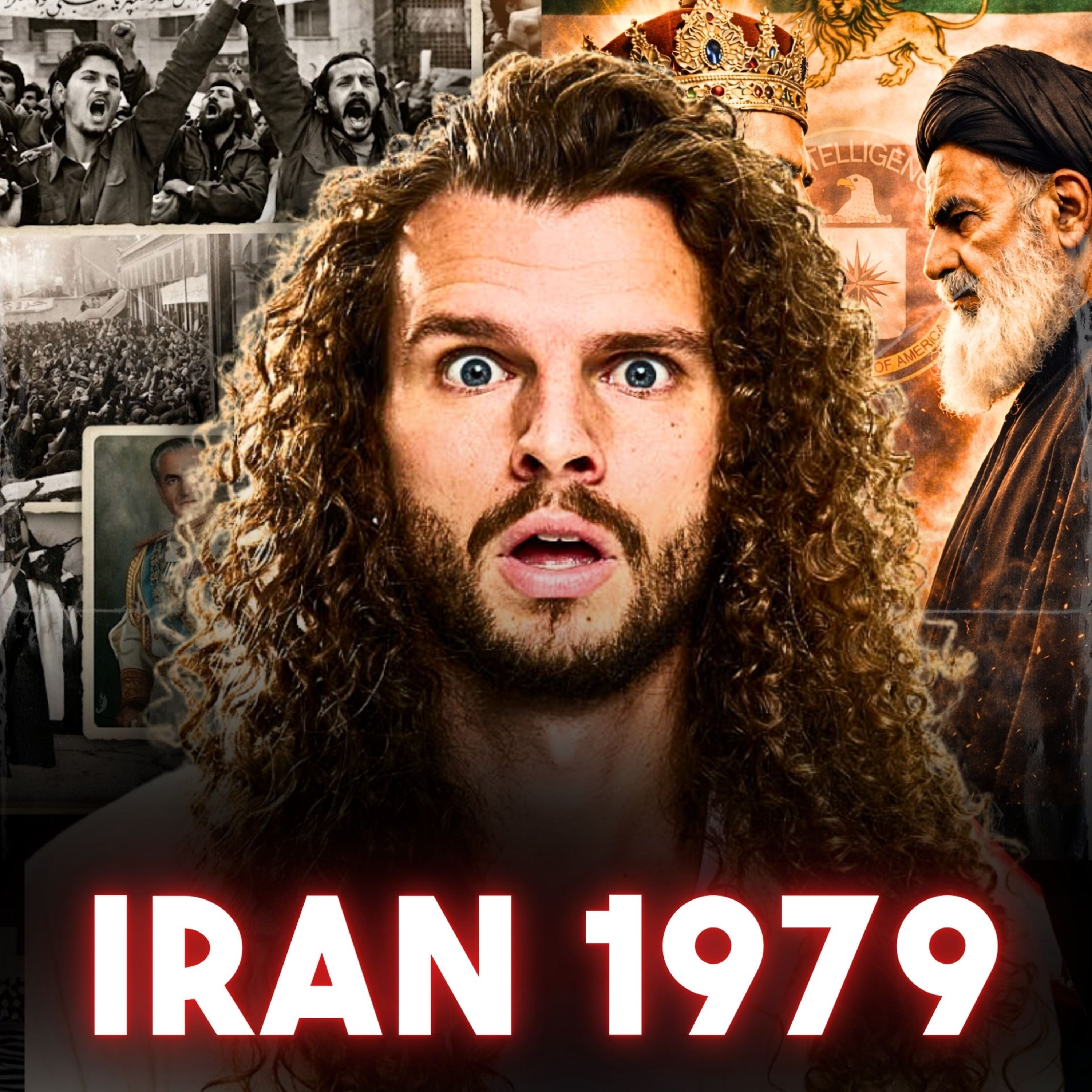
Just go in the streets and question anybody you will see. The whole country has joined the movement. January 16, 1979. Mohammad Reza Pahlavi, the Shah of Iran, the king of kings, boarded a plane and left his country forever. He had ruled as the Shah since 1941 and as an unchallenged monarch since 1953. He had transformed Iran from a poor, largely agrarian country into this emerging industrial power. He also crushed his enemies with a secret police force trained by the CIA. He had accumulated vast personal wealth while positioning himself as a guardian of his people. And now he was fleeing, sick and broken and despised by the millions who had once cheered his name. Two weeks later, a 78 year old cleric named Rahula called Khomeini would land in Tehran to a crowd of several million people. And within months, Iran would become an Islamic republic, the first modern theocracy governed by religious law and ruled by clerics. The Iranian Revolution of 1979 didn't just change Iran, it challenged the entire world. It reshaped the Middle east, redefined the relationship between religion and politics, and created tension that still dominate the world to this very moment. This is the story of how it all happened in 1979. So sit back, relax, and welcome to History Camp. What's up people? And welcome back to History Camp. My name is Mark Gagnon and thank you for joining me in my tent where every single week we explore the most interesting, fascinating and controversial stories from all history, from all time, forever. Yes, that is what I'm trying to do here is I'm trying to understand everything that that's ever happened ever. And there's a lot of stuff and every day more history is made. So I'm just in a constant game of catching up. But I'm glad that you joined me because every time you click on a video or support the show in any way, you truly make my dreams come true. Keep the lights on, you keep the fire burning and you keep on putting hundreds of thousands of rubles in Christos pocket. Right? I like to call them Shekels, but yeah. Whoa. Hell yeah, Dude. You're taking APAC money? How much? How much to get you to flip for APAC? Not a lot. 100 bucks. 125. Chipotle gift card. That's half used. I'll take it. Well, you have your price anyway. Let's move on. All right, guys, I don't know if you've seen. The world order has shifted fundamentally once again, and there is currently a conflict. No one has been brave enough in an official capacity to call it a war yet, but that's probably what it is. And it's happening right now in Iran. A joint strike has been carried out from the United States and Israel against Iran. And now many American allies have been hit in a retaliatory horizontal escalation. What does that all mean? We'll have to see. But where did it all. Where did it all start? Where did this happen? Okay, where's the. The genesis of this entire conflict? Well, it goes back a long time. Okay. A very, very long time. We try to pick up the story in 1953 with our most recent episode where we discuss Muhammad Mosaddegh and the coup that was carried out by the CIA to basically install the Shah. Now, we're going to rehash that a little bit, but today we want to talk specifically about 1979. And this is ultimately the revolution that turned Iran into the regime that it currently is, and ultimately the regime that was recently decapitated in the strikes from the United States and Israel. But in order to understand this revolution that happens in 79, you have to understand this coup that happened in 1953. So in short, again, we did a longer episode on this. You could check that out. Just the last video that we did. But to give people a refresher, if you don't know, basically, in 1953, the CIA and British intelligence overthrew the democratically elected Mohammed Mossadegh as Iran's prime minister. Now, Mosaddegh had committed the unforgivable sin that every leader should never do, which is trying to nationalize your country's oil. You can't do it. All right, I'm sorry. As long as America exists on this globe, if you try to nationalize your oil, you're going to be. You're going to be having some real problems. All right? Now, this wasn't necessarily initiated by the United States. This was actually started by the British. And the British owned Anglo Iranian Oil Company that is known today as bp. That was basically about to lose a ton of their money. So they were able to convince the United States to go in and, you know, basically do what they had to do. Now, the coup reinstated Muhammad Reza Shah with vastly expanded powers and really paved the way for an absolute rule for many decades. But it also planted a seed of resentment and anger that would grow for 26 years. The Shah who emerged from the 1953 coup was not the nervous young man who fled to Rome when the first coup attempt failed. He returned emboldened and determined to never be weak again. And how do you, how do you do that? How do you rule when you have a bit of a chip on your shoulder? Well, he consolidated power, he eliminated rivals, he built a security apparatus that would make opposition basically impossible. I mean, once again, I don't want to just paint the shop purely as a simplistic villain, right? But I just want to make the situation clear of why this happened, why the revolution in 79 basically gets precipitated. What was the Shah doing that made the people feel like revolution was the only option? Well, let's discuss. The centerpiece of this oppression apparatus was the savak. This was the National Organization for Security and Intelligence. And it was established in 1957 with training from the CIA. Savak became notorious for pervasive surveillance and torture. Savak had broad power, censoring media and screening job applicants that were trying to apply for government positions, and surveilling dissidents and according to numerous documented accounts, torturing political prisoners. I mean, that's electric shocks, sleep deprivation, beatings, mock executions. I mean, just insane stuff. And by the 70s, Savak employed on the order of several thousand full time agents, plus a large network of informants, and it's Gestapo esque. Its reputation was so fearsome that many Iranians believed it was omniscient, that no, no conversation was safe, everyone was extremely paranoid and no dissident went unnoticed. The Shah justified this repression as necessary. We had to have this. It's the only way. And this is what we need to modernize Iran and to protect it from communism. His western allies, specifically United States, they didn't really give a. I mean, they don't really like empires, don't really care. As long as, like you're serving the empire, then kind of do whatever you want. So as a result, America largely looked the other way. And then in January 1963, the Shah launched what he called called the White Revolution, A comprehensive program of social and economic reforms designated and designed to modernize Iran from above. The reforms were ambitious and in a lot of ways Genuinely progressive land reform basically redistributed agricultural land from, you know, a small group of, like, feudal landlords to, like, roughly like 2 million peasant families. The Shah personally handed out land deeds in ceremonies across the country, and people loved that. Women gained the right to vote, to run for office, to serve as lawyers and judges. The minimum marriage age for women was raised to 15 years old. A literacy course sent educated young Iranians to rural villages to teach reading and writing. Literacy rates rose from 26% to 42%. A health corps extended medical care to remote areas where doctors had never practiced. I mean, nationalization of forest and water resources funded massive infrastructural projects, so dams and highways and railroads, all that stuff. And the results economically were impressive. Real GDP grew rapidly, often close to double digits in the 60s and the 70s, and per capita income tripled roughly. And a new middle class was emerging in Iran. Small business owners and professionals and factory workers with profit sharing plans. But the White Revolution also created a bunch of new problems. The land reform, while breaking the power of the old kind of aristocracy, often gave peasant plots too small to sustain themselves. Many just ended up selling their land and migrating two cities, which then created these, you know, sort of bloated urban slums. And this rapid industrialization enriched a new class of factory owners, while traditional merchants, like, you know, people that ran the bazaars, were now increasingly marginalized. And then, of course, secular reforms antagonized the Shia clergy that were, you know, very prominent within the country. They saw their influence over education and family and, you know, the law and basically the public, and that morality was basically being stripped away. And perhaps most dangerously, the reforms created exactly the groups most likely to challenge authoritarian rule. An educated intelligentsia, an urban working class, and university students exposed to revolutionary ideologies from around the world. The Shah had effectively modernized Iran and also had a secret police that was very oppressive. But through this modernization, he created forces that would ultimately destroy him. Now, Ruhollah Khomeini was born in 1900 in a small town known as Khomein. His father was murdered when he was 2 years old, and he grew up studying the Quran, eventually becoming a high ranking Shia cleric, an ayatollah, and a respected scholar of Islamic philosophy and mysticism. For decades, Khomeini was primarily known as a teacher and as a writer. But in 1963, everything changed when the Shah announced the White Revolution. Khomeini emerged as its fiercest critic. He denounced the land reforms as a plot to destroy the influence of the clergy. He attacked the entire reform package in general, including the enfranchisement of women as contrary to Islamic law and going against the Quran and a capitulation to America. He accused the Shah of being a puppet of the United States and of Israel. And on June 3, 1963, the holy day of Ashura, commemorating the martyrdom of Imam Hussein at Karbala, Khomeini delivered a blistering sermon comparing the Shah to Yazid, the hated tyrant who actually killed Hussein. And to Shia Muslims, this was the most damning possible accusation, literally calling him Yazid, the terrible tyrant who killed one of the most important people in Shia Islam. Two days later, SAVAK agents arrested Khomeini and protests erupted across Iran. The government responded with force. Estimates of the dead range anywhere from a few dozen into the hundreds. And the Shah basically faced a choice. He can either execute Khomeini and risk making him a martyr, which then can cause a bigger political issue, or exile him and hope that he would just fade into obscurity. And so the Shah chose exile. In 1964, Khomeini was sent first to Turkey and then to Najaf in Iraq, one of Shia Islam's holiest cities. And there for basically the next 14 years, he would develop the political philosophy that would ultimately reshape Iran. His central idea was Velayete Faqi, the Guardianship of the Islamic Jurist. Khomeini argued that the absence of the Hidden Imam, basically a messianic figure in Shia Islam, without this governance should fall to qualified religious scholars, a system in which a supreme Islamic jurist has ultimate authority over elected institutions and everything within the country. This was revolutionary even within Shia Islam. At the time, many senior clerics disagreed with Khomeini's interpretation. But in the charged atmosphere of the 1970s, his uncompromising opposition to the Shah made him an icon, a rallying point for everyone who hated the current regime. From Iraq, Khomeini's sermons were recorded on cassette tapes and smuggled into Iran by the thousands. In mosques and bazaars, in private homes, university dorms. Iranians listened to the Ayatollah, denounced the Shah as a tyrant and as a puppet and as an enemy of Islam. The Shah could silence his critics in Iran, but he could not silence the voice coming from Najaf. Now. By the late 1970s, the Shah's position was weakened on multiple fronts. Economically, the oil boom of the early 1970s had created rampant inflation. Housing costs were going up, and the gap between the rich and the poor became more visible. Politically, the Shah had banned all political parties, except, of course, his own party, the Rastakhis Party, eliminating any legitimate outlet for any dissent at all. Internationally, a new American president, this guy Jimmy Carter, was emphasizing human rights. The Shah, under pressure, relaxed some restrictions on political expression. He may have hoped that maybe this would satisfy the critics or, you know, give them an outlet, but instead, it just emboldened them. And In October of 1977, Khomeini's son Mostafa died suddenly in Iraq. His supporters blamed savak. This again is that secret police that Pahlavi has. A memorial service in Tehran turned into a political demonstration, and then protests started. On January 7, 1978, a government newspaper published an article attacking Khomeini as a British agent and as a reactionary. Theological students in the holy city of Qom protested, and police opened fire on them, and several students were killed. In Shia tradition, mourning ceremonies are held 40 days after a death has occurred. The calm morning turned into brand new protests, and those protests produced even more deaths. And then 40 days later, more mourning, more protests, and more death. This cycle of violence that was building throughout the, you know, 1978, and each round of mourning produced new martyrs and each new martyr produced new outrage. And the Shah was starting to lose options. You know, he tried concessions. He replaced hardline officials with reformers. He promised free elections. He acknowledged the past mistakes, but at this point, none of it worked. And as a matter of fact, the opposition actually started to smell the weakness. And on August 19, 1978, an event occurred that would prove decisive, though its true nature would be disputed for decades. What's up, people? We're going to take a break really quick because I want to tell you about a sponsor we have that I'm so stoked about. Yes, it's Chubby's. If you never heard of Chubby's, I've been wearing these since legit, like, late high school. Yeah, I'm so stoked. I started this podcast because I wanted a deep dive on crazy stuff in history and just, you know, random wormholes that I got into on the Internet. And now I'm working with a brand that I've literally worn for 10 years. Because Chubby's one of those brands that you put on and you go, oh, this is comfortable. They're like the OG Like, I'm going to the beach. I'm chilling on the boat. I'm walking through Soho in the summertime shorts. I mean, they are the best. Their stuff is super breathable. I mean, the stretch is like, og they're like one of the first ones to start that. And I mean, you can actually move, you can sit like you can exist without just being absolutely swamped. And they don't just do shorts. They got everything. I mean, they got polos, they got sweaters, they got anything you can imagine. And it's all that, that wrinkle resistant, quick drying, antimo microbial greatness that basically makes all their stuff, you know, the most, basically the mix between, like, I'm the most comfortable I've ever been. I could go to sleep right now. But also, I'm a functioning adult. That looks amazing while I'm at work. And great news, this is the 15 year anniversary and they're bringing back the originals. These are literally the shorts that started the entire thing. Same iconic fit, the same inseam options and that same energy, like, yo, I'm just gonna pull up and, you know, crack a brew on a Friday. That type of vibe. So whether you are weekending, weekday ing, going to the beach, barbecue, or just living your life, Chubby's has you covered. So for a limited time, Chubby's is giving the listeners of this program 20% off with the code camp. If you go to chubby shorts.com that is 20% off your order with the code camp. C a m p@chubbyshorts.com. i mean, if you guys trust anything I ever say, Chubby's is fantastic. The shorts are truly amazing. And you're getting 20% off. What are you waiting for? Go check them out now. Let's get back to the show. What's up guys? We're gonna take a break really quick because I just want to state the obvious. You're not going to hire a chiropractor to do brain surgery. And if you're gonna go fight in the octagon, you wouldn't hire a guy that watches a lot of ufc. And if you have a personal injury case, you're not gonna just like hire your buddy that's good with contracts because you know that when you're hurt, it's because someone else was negligent. You don't want just, you know, lawyer y vibes, you want real lawyers. And that's where Morgan and Morgan comes in. They are America's largest injury law firm with over a hundred offices nationwide and more than 1, 000 lawyers. Crazy thing, they've recovered dollars for over 500,000 clients. They've got a real track record of fighting to get people full and fair compensation. So if you are ever injured, you can check out Morgan and Morgan and Their fee is free unless they win. Yes, free. You literally don't pay anything unless they win your case. That's how confident Morgan Morgan is that they can get compensation for you and your injuries. So for more information, go to for the people.comgagnon that is f o r the people.com g a g n o n or or dial pound law that is pound 529 and let them know that you got sent by the people here at the campsite. Also, this is a paid advertisement. Now let's get back to the show. In the city of Abadan, a Cinema Rex movie theater was packed with a bunch of people going to see a movie called the deer. And at 8:21pm four men barred the exits, doused the building with jet fuel and set it ablaze. Between 377 and 470 people burned to death, and it remains one of the deadliest peacetime arson attacks on civilians in history in any country. The government blamed Islamic militants, and of course the opposition blamed the secret police, savak. Subsequent research and court testimony point strongly to Islamic militants, including Hossein Taks Balazadeh and three accomplices as the arsonists, though the episode remains contested in public memory. But that's not what many Iranians believed. In 1978, the opposite version, that Savak had murdered hundreds of innocent people to discredit the revolution, spread instantly. Khomeini supporters declared that thousands have been massacred by Zionist troops. In this atmosphere of mistrust and anger, the truth doesn't matter. What matters was ultimately what people felt or what they believed. And they believed that the Shah had killed their families. This Cinema Rex fire radicalized millions of Iranians who had previously just stayed neutral. As one historian put it, Suddenly, for hundreds of thousands, the movement was their own business. Three weeks later came the point of no return. On September 7, 1978, the Shah declared martial law in Tehran and and 11 other cities. The announcement came late at night, and many Iranians didn't hear it. The next morning, Friday, September 8th, thousands of protesters gathered in Jala Square in Tehran, unaware that demonstrations were now illegal. So when soldiers ordered them to disperse, they refused. And then the army opened fire. Official government figures claimed that 86 people died. Opposition leaders claimed that thousands died. The most reliable estimates, based on later research, suggest that around 64 protesters and 30, 30 security personnel were killed in Jala Square that day, with additional deaths elsewhere in Tehran. The opposition, however, broadcast far higher numbers. Of course, rumors spread that Israeli soldiers had been brought in to massacre Iranians. And this was largely discredited and thought to be a fabrication, but was widely believed by the people at the time. Black Friday, as it would be called, created what historian Irvan Abrahamian described as a sea of blood between the Shah and the people. Any possibility of compromise with the Shah and with the public just completely died in Jalis Square that day. And from that point forward, the protests would only grow. The Iranian Revolution was not initially an Islamic revolution. It was a coalition. Khomeini's followers, organized through mosques, primarily funded by, you know, merchants at bazaars and mobilized by religious networks, formed the largest, most disciplined faction. But they were not alone. The National Front, a political movement of the martyred Mossadegh, brought liberals and nationalists who wanted democracy and a constitutional government. The Today Party, the leftist party, basically, and other leftist groups brought communists and socialists who wanted economic transformation and an end to Western influence. The People's Mojahadin, a radical organization blending Islam and Marxism, brought young militants willing to fight. University students brought numbers and energy. Bazaar merchants brought money and organizational infrastructure. And what united them was ultimately the hatred of the Shah and also the opposition to American influence in their affairs. What ultimately divided them, and there were many things that divided them, was just temporarily set aside. Khomeini, from his exile in Paris, he had actually been expelled from Iraq in October of 78, was deliberately vague about what would come after the Shah fell. I mean, he spoke of freedom and justice and, you know, good old fashioned Muslim values. Different groups heard what they wanted to hear. Ultimately, the liberals believed that there would be democracy. The leftists believed that there would be economic revolution. The Muslims believe that there would be, you know, good moral rule brought back into the country and only one group would be right. And even then, kind of none of them were right because by late 1978, the Shah's regime was just disintegrating. In October, oil workers went on strike, and this was devastating. Oil experts provided the vast majority of the government's wealth. And without any oil money, the state couldn't pay for soldiers or bureaucrats or anything. And in November, the Shah appointed a military government under General Gholam Reza Azari. It was meant to try to bring some order, but instead it just convinced Iranians that the Shah had nothing left to offer but just more force. And on December 10th and 11th, the holy day of Tasua and Ashura, millions of Iranians marched in the largest demonstration in the country's history. Estimates again vary on this, but some say 6, some say 9 million people marched across Iran with well over a million in just the capital of Tehran alone. They chanted, death to the Shah. Independence. Freedom. Islamic Republic. The Shah was paralyzed. I mean, at this point. Also keep in mind he had cancer. This was a secret that he and his people had kept for years and was increasingly medicated and indecisive. And his generals asked permission to crack down even harder, but he refused. And his advisors urged him to compromise with the people. He couldn't decide what he could even offer them. And then on January 3, 1979, the Shah appointed Shapur Bakhtiar as Prime Minister. Bakhtiar was a liberal opposition figure, a member of the National Front who had been imprisoned by savak. The Shah hoped that maybe this would be a good gesture to kind of show like, hey, actually this, you know, this other guy, this more liberal guy, he's in charge, okay? But it didn't, it did basically nothing. The National Front expelled Bakhtiar for collaborating with the monarchy, and Khomeini denounced him as illegitimate and just another piece of the Shah's rule. On January 16, 1979, Mohammad Reza Shah Pahlavi left Iran. And officially it was a vacation. Everyone knew that, you know, he was never going to come back. And so the Shah wept on his plane as it lifted off from Iran for the last time. Two weeks later, on February 1, 1979, Ayatollah Ruhollah Khomeini's plane touched down in Tehran. An Air France 747 carried the 78 year old cleric from Paris. Several million Iranians lined the route from the airport to the city center. And when a journalist asked Khomeini what he felt upon returning to Iran after 14 years, he answered nothing. The revolution was not complete yet. Prime Minister Bakhtiar still controlled the government. Technically, the military had not yet declared its allegiance. Some generals were plotting their own coup in order to restore the Shah. But the momentum was just unstoppable. And on February 9th and 10th, armed clashes broke out between pro Khomeini guerrillas and units of the Imperial Guard. And the fighting just continued to spread across Tehran. It seemed like there was going be maybe a civil war. And on February 11, the military supreme Council declared its neutrality. The generals would not fight for a regime that had already lost. The monarchy was done. The Pahlavi dynasty, which had ruled Iran since 1925, was over. Bakhtiar fled the country. He would spend the rest of his life in exile in Paris until agents of the Islamic Republic assassinated him in 1991. The Shah wandered from country to country from Egypt to Morocco, the Bahamas, Mexico, the United States, briefly for a cancer treatment, Panama and then back to Egypt. And he died in Cairo on July 27, 1980 at the age of 60. In the immediate aftermath, Khomeini moved carefully. He appointed Mehdi Bazargan, a religious but moderate figure, as the prime minister. And this really reassured liberals who hoped that, that, you know, the revolution would lead to democracy. But parallel to Bazagaran's government, Khomeini established revolutionary committees, revolutionary courts and of course the Revolutionary Guard institutions directly loyal to him and him alone that operated outside the normal government channels. A referendum on March 30th and 31st 1979 asked Iranians to approve the Islamic Republic. The ballot offered only two choices, yes or no. Officially, 98.2% voted yes. The referendum offered no alternative to an Islamic republic and occurred in a highly charged, non pluralistic environment, leading many observers to question really how free or how fair this vote was. Over the following months, the coalition that had made the revolution ultimately fractured. The liberal nationalists and the leftists and the moderate clerics all were systematically marginalized or eliminated. The revolutionary courts executed hundreds of former regime officials and then thousands of political opponents, including many who had fought against the shah himself. On November 4th, 1979, radical students stormed the American Embassy in Tehran and they took 52Americans hostage. This crisis would last 444 days and ultimately would define American perceptions of Iran for generations to come. Khomeini used the hostage crisis to consolidate power, labeling anyone who opposed him as an American sympathizer. The moderate Bazargan who tried to negotiate with the Americans, resigned in protest. The new constitution, approved on December of 1979, established Khomeini as the supreme leader, a position above the president, above the prime minister, above parliament, above everyone. The guardianship of the Islamic Jurist. That is who he was and now he is the head and the law of the land. Iran had gone from this absolute monarchy to a theocratic system in which a supreme jurist stood above elected institutions. The Iranian Revolution of 1979 reshaped the entire world and the ways that it did that are still unfolding to this very moment. It demonstrated that in the modern era of religious ideology could mobilize mass movements and overthrow powerful states. It inspired Islamist movements across the Muslim world and it really terrified secular governments from Egypt to Indonesia. It poisoned American Iranian relations for decades. The hostage crisis, the shooting down of Iran, Air Flight 655, a nuclear standoff, all were profoundly shaped by this specific moment in 1979 it really transformed the Middle east balance of power. Revolutionary Iran positioned itself as the champions of Shia Muslims everywhere and really, as, you know, the champions of Islam itself, backing or, you know, cultivating Shia movements such as Hezbollah in Lebanon or the Houthis in Yemen and various militias in Iraq. And it raises questions that remain unresolved to this day. Was the revolution inevitable? Was there a path that Iran could have taken to become a democracy rather than a theocracy? Did American support for the Shah make his fall more likely? Or was it just irrelevant to the deeper forces that were already present in Iranian society? The Shah believed that, you know, he was saving Iran from backwardness and, you know, this old agrarian state, he was trying to modernize it. Khomeini believed that he was saving Iran from Western influence and corruption. Both claimed to speak for the Iranian people. And unfortunately, the Iranian people caught between these two visions made their choice in the streets of 1978 and 1979. Now, whether that choice led to liberation or to a new form of oppression, it really just depends on who you ask. And it remains one of the most contested questions in modern geopolitical history. Now, the Iranian revolution wasn't simple. It wasn't just a simple story of good versus evil, though many have obviously tried to paint it that way. In my opinion, the Shah was a, you know, a modernizer who was building universities and hospitals, and also a dictator whose secret police tortured thousands of people. Khomeini was a scholar and a mystic, and he inspired millions of people, and also a revolutionary whose regiment would execute thousands and thousands of more people. The revolution succeeded because Iranians of vastly different beliefs, communists, capitalists, liberals, Muslims, secular people and religious clerics united against a common enemy. And ultimately it betrayed almost all of them in the end. Now, we should also mention how the existence of Israel definitely played a role in the revolution and of course, the aftermath of the revolution in Iran. Now, one of the big shifts after the revolution was Iran's explicit relationship with Israel. You see, under the Shah, Iran had maintained quiet but significant ties with the Israeli state. The two countries cooperated strategically as a part of Israel's periphery doctrine, which basically sought alliances with non Arab regional powers. Iran supplied Israel with oil, and Israeli intelligence cooperated with Iranian security, security services. These relationships were largely hidden from the Iranian public, but became a powerful symbol for critics of the Shah, who portrayed them as evidence that the monarchy was aligned with foreign interests like America or Israel against the Muslim world. After the revolution, those ties were done. Iran severed relations with Israel, expelled its diplomats, and handed the Israeli Embassy in Tehran to the Palestinian Liberation Organization, also known as the plo. The new Islamic Republic adopted strong support for the Palestinian cause as a central element of its foreign policy. And the Ayatollah basically never recognized Israel as a state. Now, what had once been a quiet strategic partnership became one of the most defining rivalries in Middle Eastern politics. And this is again, a hostility that continues to shape regional conflicts to this very moment. What remains to this day is a country that, you know, now, 45 years later, is still living with these consequences. International isolation and sanctions and internal repression, and this new, younger generation that barely remembers the Shah, but increasingly questions the Ayatollahs. The revolution that promised freedom delivered just theocracy, and the theocracy that promised justice delivered its own form of injustice. And the Iranian people, resilient and educated and angry, continue to struggle for something better. And to be honest with you, this story is not over. As a matter of fact, it's probably just beginning. And that is a brief overview of the revolution in Iran of 1979. I mean, yeah, it's one of those things where it's like, ah, yeah, it just seems like everyone kind of sucks here. You know, like, there was a oppressive, you know, monarch that was doing bad things, but also was doing some good things. And, you know, the people took a gamble and they said, you know what? We're going to get rid of this guy in order to put in a new person. And they were so optimistic. They believed that this new guy was going to do great things. But unfortunately, this is one of those cases where the cure was worse than the disease. And I don't know. I don't know how it could have been avoided. I mean, I guess you could have gone with another way, but, you know, you got sold a bill of goods, and it sucks. I don't. I don't even know. I mean, it really goes back to 53, with America overthrowing, you know, overthrowing Mosaddegh. Like, I wonder what Iran would have looked like if Mosaddegh stayed in power. And this never happened at all. And just democracy was kind of put in. There were elections, and it was able to operate as, you know, just a normal democracy. Would it have been better for the people? Tough to say. It's just heartbreaking, though, you know, like, you have so many people in America today, and, you know, there's an Iranian diaspora around everywhere that that can't go back to this place that they feel so connected to their own home country and, you know, see their relatives and extended family, because they're kind of just locked in this regime now once again. It's just. It's kind of the story of everything where it's like, okay, you have two factions that are competing for power. They both suck, one of them sucks more. And ultimately the people that pay the consequence are the innocent people of Iran, many of which, you know, the vast majority of which are just good, humble, hard working, kind people that, as always, are the ones that pay the consequence for the rich and the powerful jockeying for these power positions. But, yeah, I don't know, Christos, you learn anything? I just will. Say, the hostage crisis, it's illustrated in the movie Argo. Oh, is that what that's about? Yeah. Yeah, maybe I should watch that. Yeah, I probably should, right? Ben Affleck, boy, he's in it. He directed it as well. And he won a best director at the Oscars for it. And he's one of the Islamic militants that goes in? No, he's the guy tasked with getting them out. Oh. I would have cast myself as one of the terrorists. Were they terrorists? Is that what we call them? Insurgents? If you hold 440 people hostage for 400 days, like, that's not. It's not the best. Look. What. What embassy were they in? They were in the Canadian embassy. That was the American embassy. No, they escaped the American embassy. Oh, really? Close your eyes. Exhale, Feel your body relax and let go of whatever you're carrying today.
- [37:29]
C
Well, I'm letting go of the worry that I wouldn't get my new contacts in time for this class. I got them delivered free from 1-800-contacts. Oh, my gosh, they're so fast.
- [37:37]
B
And breathe.
- [37:38]
C
Oh, sorry. I almost couldn't breathe when I saw the discount they gave me on my first order. Oh, sorry. Namaste. Visit 1-800-contacts.com today to save on your first order. 1-800-contacts New Year, new me. Cute. But how about New Year, new money? With Experian, you can actually take control of your finances. Check your FICO score, find ways to save and get matched with credit card offers, giving you time to power through those New Year's goals. You know you're going to crush start the year off right. Download the Experian App based on FICO Score 8 model offers an approval not guaranteed. Eligibility requirements and terms apply subject to credit check, which may impact your credit scores. Offers not available in all states. See experian.com for details.
- [38:19]
B
Experian, I believe so. I'm invoking a fact check. What'd you find? They were in the Canadian ambassador's residence. CANADIAN AMBASSADORS RESIDENCE what happened to those people? Did any of them die? Gotta watch the movie to find out. Fine. I'll just do a camp episode about it. All right? It'll be the next one. What do you guys think? Is there anything that I missed? Are there any. Any Persians that listen to this episode? Is there anything that you've been told by your family or through your own research that you feel like is pertinent and relevant to for this discussion? Please drop a comment. I read all of them. I really don't care if you correct me if I said something that was wrong. I implore you to do that because I only want to know the truth, and I'm not an expert on this stuff, so I'm just a guy trying to figure it all out. So please drop a comment. If there's anything I missed, anything I overlooked, I would love to know what that is. And if you're not Persian, you didn't know about this at all. This is kind of your first time hearing about it because you're seeing what's going on in the news. What did you learn? Let me know what you think. Does this have any type of proxy or, you know, facsimile to your own country or to your own people? Or is this something that you've seen in history before? How do you think it ends? What happens next? Thank you guys so much for tuning in. I have great news. Throughout this episode, we talked a lot about different religious topics. If you like the religious beat, we got religion camp. We talk about all the religions, all right? Not just, you know, Christianity, you know, of course we would talk about that, right? The one true faith. But we talk about all of them. You know, Islam, Mormonism, Judaism, Hinduism, all the isms except racism. Am I right? Christos, you bigot? We also do Camp Gagged on. That's where I do interviews with people way smarter than me that can actually break things down with expertise. And I also do deep dives on all the most interesting things going on at this moment. But if you just rock with history. Great news. We drop these episodes every single week here at History Camp. And, yeah, hit that subscribe button. I'll see you guys next time in the future to talk about the past. God bless you.