Loading summary
Transcript10 lines
- [00:00]
A
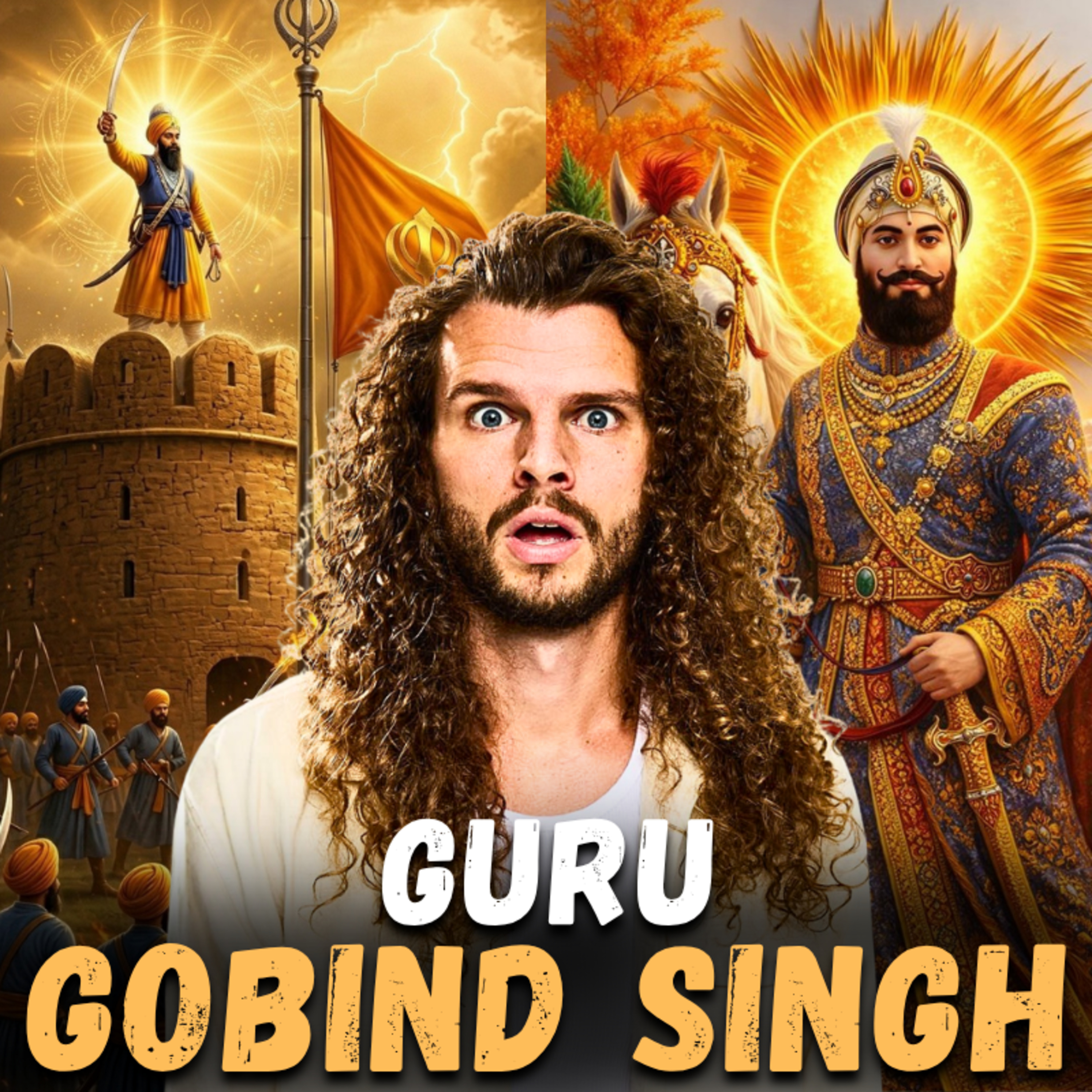
He lost all four of his sons, but he never broke. He watched his family be torn apart and built a faith strong enough to outlive empires, persecution, and exile. He carried a sword into battle, yet he also fed the hungry and stood for equality across every class and caste. He held absolute spiritual authority, yet humbled himself before his own followers and asked them to initiate him. His name was Guru Gobind Singh, the tenth and final human guru of the six, and the architect of a transformation so powerful that more than three centuries later, his legacy is still instantly visible in the identity of millions around the world. If you're interested in how one man's vision forged a community that could survive anything, this is the episode for you. Sikhism and Sikhi are some of the most interesting philosophy to me. I find it fascinating, and I love Punjabi people, broadly speaking, and the Sikh faith, and I find it to be admirable in many, many senses. And Guru Gobind Singh is an exemplar of that. So without further ado, sit back, relax, and welcome to Religion. What's up, dude? Welcome back to Religion Camp. My name is Mark Gagnon, and thanks for joining me in my tent, where every single week, we explore the most interesting and fascinating and controversial stories from every religion from ever, for all time, for always. Yes, I do this show for a few reasons. One, I need to understand what everyone believes. I don't think you can understand a person or a people without knowing the God that they worship. And so in my attempt to be a better human being on this planet, I'm trying to figure it all out. On top of that, I think that there's a lot to be learned from every major religion, you know, whether you didn't grow up with it or maybe you did grow up with it. I do think that religion practice in its purest form is generally pretty good, and there's a lot to be gained from that. So with that said, I try to learn from Hinduism, Judaism, Christianity, Islam, all the isms, and Sikhism is no exception. Now, today, we're not going deep into the philosophy of Sikhi. I did a whole episode on that, if you guys want to see that. We also did a whole episode on Guru Nanak Dev Ji, the founder, you could say, of the Sikh philosophy. And those episodes were amazing. But today we're talking about another guru. This is the 10th and the final guru, and I'll explain everything that you need to know about this guy and kind of the whole philosophy, but a few things up top. One, I'm not sick. I was not raised in Punjab. I don't have Punjabi family. And this is everything that I've just learned online and talking to my Punjabi Sikh friends. So if there's anything I missed, please don't hesitate to drop a comment. Let me know if I overlooked something, didn't include it. It's oversimplified, missed the nuance. I'm open to learning. I'm not here trying to tell anyone what to think. I'm just trying to learn for myself and share what I learn as I go. Additionally, I just want to give a big shout out to my dear friend Christos. How are you, Bill? Doing great. All right, Christos, look, we don't have time because we got to jump into Sikhism. We got to talk about Guru Goind Singh. Also, if you want to talk to Christos, I have great news. We have a patreon. Patreon.com Camp Gagon. If you want to talk to Christos, you can talk to them there, right? Like, you're on there. You're talking to people, very active. So that's. Don't jump in. All right? If you guys want to talk to Christos, you know where to find them. It's not here at Camp Gagnon. All right, so over on the Patreon, the campfire, that's where people gather. Okay. And I would love to see you guys over there. So tap in. We got a link in the description. Now, in order to understand Sikhi, the gurus. Gobind Singh, we need to kind of understand sort of the whole landscape and try to understand what's going on and what was being reshaped. So Sikhism was founded in the late 15th century by Guru Nanak Dev Ji, a poet, spiritual teacher in Punjab, who basically looked at the religious world around him, and instead of seeing beauty and enlightenment, he just saw, like, hollow formalities. Not that Hinduism and Islam are wrong or a lesser philosophy in any way, but that for, you know, himself. And at the time, rather, he felt that there was a reduction in the. The cosmic connection, that there was less of a divine relationship and rather just ceremony and social performance and basically people utilizing the faith for negative reasons to basically just reinforce class structure and hierarchy. So it was rituals without meaning, and it just bummed him out. So he developed his own philosophy to bridge the gap that he saw in people's spiritual formation and basically tried to make sense of the spiritual world around him. And the central claim of Sikhi is radical in its simplicity, that there is one formless, timeless God. That's the main thing. The Name of this entity or this God is called One Way Haguru. Then beyond all human categories is this being. And all human beings have equal access to the divine without needing priests or rituals or pilgrimages or intermediaries or anything like that. And this sounds maybe strange, but its message was explosive for the time, claiming God was formless, beyond human categories, that you don't need a priest or an imam or rituals or anything else to gain access to this God. It basically disregards all of the religious frameworks and the hierarchy and the structure and the institutions that existed in this time, specifically in his culture. So now, according to Guru Nanak, caste was now illegitimate because again, caste is sort of this religiously reinforced social framework where certain people were born into a Brahmin or a priestly class and other people were of a warrior class. And all the way down until you have Dalets or untouchables that basically have no status at all and you're just born into it. And that is what the gods or the God has basically allocated your life to be. But now with this new philosophy that all people have equal access to the divine, what are these casts? Like, what is the purpose of this? Women and men were now spiritually equal. All humans were now equal. You don't need a Brahmin priest to interpret scripture or a mullah to tell you how to pray. Salvation came through devotion to God's name and ethical living and grace, not through the right social cues are forming the right ceremonies or anything like that. It's maybe similar to. It's not a perfect comparison, but like the Protestant Reformation with Catholicism, not perfect. So don't take it as one to one. But Martin Luther comes, comes around and basically says, like, hey, you have the Catholic Church, it has all these rituals and indulgences and corruption, da da da. You don't actually need the institutional church. You just need access to the scriptures because the scripture is, you know, sola scriptura. That is, everything in there is true. And that is the totality of God's communion with humans is in that book. You need faith alone. You don't need to do all this stuff like just have a relationship with God, go be free. And that's basically kind of what's happening here. You have Guru, Guru Nanak Dev Ji, that's like, hey, we can just like, this is a good quote actually that I think captures it well. Truth is high, but higher still is truthful living. So it wasn't enough to know what is right. You have to live it. And you don't have to operate within an institutional framework. So by the time Guru Gobind actually is born in 1666, there had been nine gurus in succession, each building on the teachings of the previous one. So the Sikh community was literate and organized around institutions called the Gurdwara. And this is basically the gateway to the guru. And they were quite self aware of their distinct identity, the Gurdwara, you could think of it as like a Sikh temple. But their community was also increasingly vulnerable. Belief alone doesn't stop armies, right? Devotion doesn't protect you from political persecution or execution. So let's move forward to Guru Gobind Singh. The Mughal Empire in the late 17th century wasn't just a political power. It was a state where political authority and religious authority were deeply fused together. So the emperor, this guy Aurangzeb, ruled from 1658 to 1707. He was a deeply conservative Muslim who believed his legitimacy came in part from his role as a defender and an enforcer of the Islamic law. And he reimposed the jizya tax on non Muslims. He destroyed temples and pressured conversion in some ways. And non Muslims who refused to convert weren't just religious dissenters in his empire. They were a political problem that had to be dealt with. Now, Sikhs had been a problem for the Mughal state for a while. They rejected caste, which offended, you know, the Hindu social order. They rejected the authority of their Muslim rulers, which was a religious and political rebellion. So everyone in the region which is predominantly Hindu and Muslim hate this new sort of third group that's kind of bridging the gap between them because they're sort of in the middle. They're not Hindu and they're not Muslim, and they're this third thing, and they don't like it. So in 1675, when Guru Gobind Singh was just eight years old, his father, Guru Teg Bahadur, was arrested and brought to Delhi. The pretext was that he had spoken out against the forced conversions of the Kashmiri Hindus. And this guy Aurangzeb summoned him and demanded that he perform a miracle to prove his divine favor, or, and, you know, convert to Islam or die. Basically, the leader of the Mughal Empire goes, hey, you can either prove that your God's the real God, you can worship my God, or you can die. Those three things, whatever you want to do. And Guru Tegh Bahadur refused all three options. He was not going to convert, but he would not renounce his faith to save his life. So as a result, he was publicly beheaded at Chadnay Chowk in the Heart of Delhi as a warning to anyone else. So Guru Gobind Singh became the guru immediately after his father's execution. But he was just a child, and suddenly he inherited this community that was being systematically pressured and threatened and attacked by the most powerful empire in all of India. Now, the question facing. Facing the Six was straightforward and very brutal. Could they survive as Six? Or would they have to convert or go underground or assimilate or get killed? What's up, guys? We're gonna take a break because I gotta give a shout out to Brunt Workwear. All right? These boots surprise the hell outta me. Now, if you've ever worn work boots, you know the deal. You can either get durable or you can get comfortable, all right? Either they're durable and they destroy your feet, or they're comfortable and they last for like a week and then they fall apart. But they. But with Brunt, you don't have to choose. I put these on right out of the box. Sorry, they're a little dirty. Cause I was shoveling snow with them a little bit earlier. They have no break in you. You put them on and they fit immediately. They're comfortable immediately. And they're extremely durable immediately. Now, look, I'm not a blue collar guy, all right? But Brunt was started by that guy, Eric Girard. And because these big workwear brands stopped listening and turned into, like, fashion companies, so he built an actual boot for people that actually work. And. And it shows. These things are built incredibly well. They're waterproof, they have a safety toe, soft toe, pull on, lace up. Whatever job site you're on, whatever place you're working at, they've got what you need and they stand behind it because you can wear them to work. And if they're not right, you can send them right back. That alone tells you how confident Brunt is in their products. So if you're sick of uncomfortable boots that don't last or extremely durable boots that hurt your feet, Brunt is the way to go. I'll be honest. It's freezing cold in New York and it's snowing. These have been incredibly good for me to be shoveling snow outside. So right now, if you're listening to this program, I got great news for you. You're going to get $10 off when use the code Camp. You're going to go to Brunt Workwear. That's B U r n t workwear.com camp. Use that code at checkout, and you're going to be getting $10 off your order. And if you don't like them, hey, no harm, no foul. You send them right back. That is how confident Brunt is that you're going to love these boots. Now, let's get back to the show. His father's execution wasn't just a personal tragedy. It was the crux of their religion's survival. It was a theological crisis. So Guru Gobind Singhs and his entire religious vision was shaped by a simple, brutal reality. Faith under siege cannot survive on piety alone. And it might seem a little counterintuitive, it did to me, at least. I used to assume that all gurus were just about like, peace and love and like they were pacifists and they wanted enlightenment and all that kind of stuff. And that's sort of true, but that's not the case in Sikhi. Like, Guru Gobind Singh knew that this was a moment where his people would need to take up arms and defend themselves or they were going to get wiped off the face of the planet. And he wasn't the first one to promote this either. I mean, earlier gurus, specifically the six Guru, Guru Hargobind had already been basically arming his followers. And Guru Hargobind wore two swords, one representing the spiritual authority called the piri, and then one representing temporal or worldly authority called the miri. And the message was clear that Sikhs needed both. They needed the religious authority and they also needed a worldly authority. And so Guru Gobind Singh took that concept and made it systematically a part of their faith. He made it theological. He made it like an element of the core identity of what it meant to be sick. And his central insight was that belief had to be paired with discipline and the willingness to act. You could not just say you believed in justice and equality and then do nothing when those principles were violated right in front of you. You could not claim to worship a God beyond caste and then tolerate a social system built entirely on caste hierarchy. You can see the, the dichotomies here, right? From the outside, the militarization of the Sikhs can look like the start of a holy war. But Guru Gobind Singh never argued for forced conversion or conquest or taking more land, only for self defense, just armed resistance when the peaceful options were exhausted. He called this the principle of the saint soldier. And in Punjabi they call it the Sant Sipahi. You were supposed to be both things at once. You were supposed to be a saint in the sense that you, you know, meditated on God's name and you lived ethically and you rejected ego and material attachments and maintained a spiritual discipline and a soldier in the sense that you were physically trained, mentally disciplined, and ready to act when necessary. You were able and willing to defend yourself. And the two weren't in tension. They were in complement. They were a balance to each other. For many modern Sikhs, the principle still defines their place in the world. It's why Sikh communities have such a strong tradition of seva, selfless service. And it's why they run these langars, which are free community kitchens that feed anyone, regardless of your religion or your cast or your background or anyone in the world can just go to a lengar. And the biggest one is at the Golden Temple in Punjab, and they will feed you, and you can have a meal and you can even contribute and help feed other people and help wash dishes. And it's why Sikh volunteers often show up first when there's a natural disaster or some humanitarian crisis. Because according to their faith, being a saint doesn't stop you from also being a soldier. In 1699, Guru Gobind Singh called on all Sikhs to gather at the Andapore Sahib. And this is a place in Punjab basically for a spring festival known as Vaisakhi. Thousands came from across the region. And he stood before this massive crowd with a sword in his hand, and he asked the question that must have seemed crazy at the time. He basically says, who among you is willing to give me your head? Like, straight up, who's willing to get their head cut off?
- [15:28]
B
K Pop Demon hunters. Saja boy's breakfast meal and hunt tricks meal have just dropped at McDonald's. They're calling this a battle for the fans. What do you say to that, Rumi? It's not a battle. So glad the saja boys could take breakfast and give our meal the rest of the day.
- [15:42]
C
It is an honor to share.
- [15:44]
B
No, it's our honor.
- [15:45]
A
It is our larger honor.
- [15:47]
B
No, really stop. You can really feel. Feel the respect in this battle. Pick a meal to pick a side
- [15:56]
A
and participate in McDonald's. While supplies last
- [16:00]
C
spring fest means more sun, more fun, and more free at Lowes. Keep your yard in line with an additional free EGO 56 volt battery when you buy a select ego mower trimmer or blower. Plus keep landscaping fresh with stay green 1 cubic foot garden soil. 5 bags for $10. Our best lineup is here at Lowe's. Valid through 4 a while supplies last selection varies by location. Soil offer excludes Alaska and Hawaii.
- [16:29]
A
And it was silent. And then one man stands up. Daya Ram a Khatri from Lahore and basically said that he was willing. And Guru Gobind Singh took him into a tent. And there was a sound of the sword striking something. And the Guru emerged alone. His sword was dripping in blood. And then he asked the question again. Who's willing to lose their head? And another man stood up. Dharam Das, a Jat from Hastinapur. And the same thing. And then a third, Mokham Chand, a tailor from Dwarka. And then a fourth, Sahib Chand, a barber. And then a fifth, Himat Rai, a water carrier. Now, you are noticing something here about these guys. These five men come from different castes and different regions and different occupations, different ethnic enclaves. And in the rigid social hierarchy of the time, they would never have been equals. And then Guru Gobind Singh brought all five men out of the tent alive and completely unharmed. And the test had never been about actual death. It had been about commitment and willingness, about whether they truly meant what they said when they claimed to follow the Guru's path. These five men became known as the Panj Piare, the five beloved ones. And then Guru Gopind Singh did something remarkable in the history of religious leadership. Something that is really strange even for the modern day. He asked them to baptize him. He, the Guru, the Enlightened One, knelt before them and asked them to initiate him into the order that he was creating. This wasn't a coronation ceremony. This was an action representing mutual commitment. He was establishing that he was not above the community, that he was a part of it. He gave them authority and then he submitted to that very authority himself. He was their Guru, yes, but he was also their brother. They were all equal in the khalsa. This again is that baptism ceremony that he was asking them to initiate him into. And in that khalsa, they were all connected. The ceremony that Guru Singh created that day was called the Amrit Sanchar, the Nectar ceremony. Water was mixed with sugar crystals and stirred with a double edged sword while prayers were recited and drinking. It meant basically making a complete commitment to the Guru's path. If you took Khalsa initiation and if you took Amrit, you agreed to follow obligations that would be codified across centuries into what is known today as the Rihat Maryadha. And you basically gave up your caste identity entirely. And men took the surname Singh, meaning lion and name, declaring courage and strength. And woman took the surname Khor, often translated as princess or sovereign, declaring a dignity and an independence from any man's name or lineage. So today, many Punjabis have a family name, but most of them will have a middle name that is either khor or Singh, depending on if they're a man or woman. You were no longer primarily identified by family, region, caste. You were khalsa. You were in this baptismal family. This was your primary identity, and that was an identity that stood in equality. And when you do this, you also commit to wearing the 5Ks, 5 art articles of faith that all start with the letter K in Punjabi. First you have the keshe, this is your uncut hair. Then you have the kangha, this is the wooden comb. And then you have the kara, this is a steel bracelet that is basically worn on the wrist. And then you have the kachera, this is a specific type of undergarment. And then you have the kirpan, this is a sword or a dagger. And these items weren't worn as decorative symbols. They are daily physical reminders of one's commitment to their faith. The uncut hair meant that you couldn't hide your identity when being sick became dangerous or inconvenient, that you basically just had to stand on, you had to rep your set. The kirpan is probably the most misunderstood of the 5Ks, especially in the modern context, where carrying a weapon is seen as threatening. But for Guru Gobind Singh, the kirpan wasn't about aggression, it was about responsibility. If you carried a weapon, you accepted the obligation to use it in defense of the vulnerable and basically just standing up for what is right and protecting people that can't protect themselves, either physically or in spirit. Right. If you see someone being made fun of, what if you could step in for them? If you see, you know, someone being picked on, could you stand up to a bully? And by making all initiated Sikhs basically keep their uncut hair and wear the same five articles, Guru Gobind Singh made caste distinctions irrelevant. Within the khalsa, you literally couldn't tell who had been born a Brahmin or who had been born a Dalit. Everyone looked the same, everyone was khalsa. And the visibility was strategic. Though it seems kind of counterintuitive in a climate of persecution, it would have been much easier to hide and blend in. And you can't tell if someone's Muslim or Punjabi or Sikh or Hindu, whatever. But Guru Gobind Singh deliberately rejected that option. He made Sikh identity something that you wore on your body, something that you couldn't take off when things were hard. And that definitely made life for the six more difficult and more dangerous. But it also made compromise impossible. There was no spiritual mediocrity. You were either fully in or you were out. There's no middle ground. And then in 1704, Guru Gobind Singh faced a series of losses that would have broken most people. He had been leading battles against the Mughal forces and their allies in the hill states of Punjab, and the battles were not going well. The Mughal Empire had resources and numbers and military infrastructure that the Sikhs simply just couldn't match. And after a prolonged siege at Nandpur Sahib, he was forced to evacuate. And in the chaos, his family was separated. His two younger sons, still children, and the younger, barely five or six years old, were captured along with their grandmother, Mata Gudri, and they were taken to Sirhind and brought before the Mughal governor, Wazir Khan. He offered the boys what sounded to be a reasonable deal. He said, convert to Islam and live in safety and comfortable. But the boys refused. They said they were Sikh, son of the Guru, and they would not abandon their faith. Even as kids, they understood their identity and what that meant and who their family was and that caste or any of this, you know, sort of performative infrastructure that they believed was happening wasn't for them. They were locked in so tragically, Wazir Khan had the boys executed. Now, the traditional sick story. I don't know what I can say on YouTube without getting demonetized, but basically this was a slow and public death that people that he wanted people to see. Basically, they were placed inside a wall, basically put in there and mortared up while they were alive, and that's how they were killed publicly. And when their grandmother heard what happened, she died from shock. That same year, Guru Gopind Singh's two elder sons, 18 years old and just 14 years old, died fighting in the Battle of Chamkur against overwhelming Mughal forces. They died with SW in their hands, fighting to allow their father and a small group of other men to escape. Now, within a matter of weeks, Guru Gobind Singh had suddenly lost all of his sons, all four of his sons and his mother. He was only in his late 30s at the time, leading a community that had been slowly destroyed, and his entire family was gone. And that type of pressure and trauma would make most people go crazy, but he didn't break. There are stories that when he was told about his son's death, he said something like, what is there to mourn? The Khalsa are my sons. Now, every initiated sick is my child. Whether he actually said those words or fell to the ground weeping or whether, you know, they're historically precise or theological interpretations. The point is very clear for people that read it later. He did not collapse. He did not abandon the khalsa, and he did not stop resisting. And this matters because Guru Gobind Singh's theology was being tested by his own life in the most brutal way imaginable. It's not just about the religion or the faith anymore. It's his own family. Right? It's easy to talk about faith and justice and all these things when you know life is good enough. But it's infinitely harder when you've literally lost everything, the things that are the most important to you, and when the cause you've dedicated your life to seems to be failing. And when people are trying to destroy you, you know, they're literally killing your kids, it's hard to continue that faith. Now, what's incredible about this is that he did not turn vengeful. He didn't abandon his ethical boundaries or what he truly believed. He didn't become more extreme or double down. He really held that saint soldier principle really closely. And even under these conditions, that would have justified any type of retaliation. What's up, people? We're going to take a break really quick because I got to give a shout out to the good folks at Dylan Optics. I mean, for the longest time, I've been wanting a sunglass partner, and I'm so glad that it's a great sunglass brand. All right, if you've ever seen me on stage, ever, or just on this podcast with my hair down, I always have sunglasses. I use them to keep my hair back. But now with Dylan Optics, I can also use them on my eyes because I swear, when I put these things on, life was in hd. All right, They've got this patented matte lens technology that kills internal reflections. My least favorite thing is when you're putting on glasses, you can, like, see glare on the side. And these are amazing. There's no glare, no weird, like, seeing your own face thing. When the sun hits it just right, it is a clean, crisp vision. The founder is the most American dude ever. He was literally in the Air Force, and then after, he started experimenting with lenses because he didn't like the sunglasses that he had and literally was baking the lenses in his mom's oven. I mean, that's America. And now they design and manufacture by hand, and they've got these matte lenses and stabilized resolution lenses that adjust to light and make everything a little sharper. So if you want sunglasses that actually make you see better, that look great and also rock with us, over here at the campsite, you're going to go to DillonOptics.com that's D I L L O N Opt.com and if you use the promo code Camp CMP, you're going to save 10% off. So go check it out. Thank you, Dylan Optics, for making this possible. And let's get back to the show then. In 1705, from a small village in Punjab, Guru Gobind Singh composed a letter to Emperor Aurangzeb. And it's called the Zafarnima, which translates to the letter of victory. And the title is pretty ironic because militarily he had been defeated, his sons were killed, his forces were scattered, yet he titled the letter as if he had won. And the letter is written in Persian, the language of the Mughal court, using the literary forms that Aurangzeb himself would actually have respected. It's structured as a moral and theological confrontation. Guru Gobind Singh accuses Aurangzeb directly and personally of breaking oaths and betraying promises, of safe conduct and killing children, violating every principle of justice that he claimed to uphold as a Muslim. He quotes from the Quran to remind Aurangzeb what his own scripture says about justice. And he doesn't beg for mercy. He doesn't ask for negotiation. He lectures the emperor as if the emperor is the one who should be afraid of divine judgment. He even included verses of genuine praise for Azeb, separating the man from his deeds, as if to say, you were capable of better than this. Literally, like a disgruntled parent, like, hey, I'm disappointed. And it's really a master stroke of, like, rhetoric and strategy and, you know, like, really just the game. Like, it's brilliant. The tone completely tears down the power dynamic that Aurangzeb and his system was basically built on. In the Mughal Emperor, the Emperor was literally understood to be God's representative on earth. Like, there's a borderline, like, divine legacy that kind of goes through, even though it's not really in Muslim theology. Like, functionally, that's how the government was. And so to challenge the Emperor was to challenge this kind of divine order in and of itself. But Guru Gobind Singh writes as if the. You know, basically as if the Emperor is just another dude. And Aurangzeb received the letter, and according to several accounts, it shook him. And a few months later, he issued instructions for the guru safe passage and sought a meeting. But he died in 1707 before the meeting ever happened. For modern six, the Zafarnima is still read and recited and quoted. It's a reminder that moral courage doesn't depend on having armies or political influence. And it's a reminder that the way you respond to a loss and to suffering is more defining to your character and identity than the loss itself. Later, in October 1708, Guru Gobind Singh was wounded by an assassin's blade in Nandead, and he was basically dying. And he made his final and perhaps most revolutionary decision. He declared that after his death, there would be no more gurus. Well, let me say, no more human gurus. Instead, spiritual authority would rest in two places. It would rest in the Guru Granth Sahib, the scripture whose final definitive form he himself completed, incorporating hymns of the Sikh gurus and his own father's compositions and revered Hindu and Muslim saints and poets. And the Guru Panth the collective body of initiated Sikhs. And this was really unprecedented. In most religious traditions, spiritual authority is held by living people, people that can kind of, you know, work with the times and interpret things in the modern day, whether that's a priest or a rabbi, a monk, an imam. But Guru Gobind Singh rejected that model. He said that text and community or sufficient, that's all that his people needed. There would be no individual who could claim to speak for God the way that the 10 gurus before had. Now, this meant that Sikhi couldn't be captured by a single charismatic leader or driven to do terrible things. It couldn't be corrupted by a dynasty passing authority from one father to their son, and so on and so forth. It couldn't be fragmented by competing claims over who had the legitimate right to lead. There have been important Sikh leaders since Guru Gobind Singh, like military commanders and, you know, political figures and religious scholars and reformers. But none can claim the authority of a guru. None can rewrite doctrine. None can demand obedience based on spiritual authority or any of that. And this is why Sikhi has remained relatively unified despite centuries of persecution and diaspora and political upheaval. There's no central figure to split away from, no pope whose decision half the community might reject, no caliphate to fight over. The Guru Granth Sahib is fixed, the text is settled, and it can't be changed. And the Guru Panth is basically the community, and it makes decisions collectively. And in practice, the guru garment sahib is treated as the living guru. It's ceremonially opened in the morning and put to rest at night. It's treated with the same respect that you would show a human guru or a living teacher. When Sikhs have a question about how to live, they turn to the Guru Granth Sahib, and they read this text for guidance. But Guru Gobind Singh was the one who really took a faith founded on equality and devotion and ethical living and just made it impossible to erase. Like, he inherited it, of course, as a guru. But the legacy that he left is maybe almost as profound as Guru Nanak, because what he did was cemented it into the legacy of humanity. He made Sikhi, like the identity, visible and undeniable. The turban, the uncut hair, the 5Ks, these aren't cultural decorations or, you know, ways to look cool or to signal moral superiority. They are commitments to this philosophy that can't be undone. He made Sikh identity voluntary. The khalsa isn't something that you're born into. It's something that you choose no matter who you are or where you're born. He made Sikh identity communal. The Guru Panth, the collective body of initiated Sikhs, the community holds collective authority, united in their faith and in their identity as the Sant Sipathi, the saint soldier. And he made Sikh identity durable by ending the line of human gurus and transferring authority to scripture and community. He ensured that Sikhi wouldn't be decapitated, that you could just get rid of one guy, and the whole thing goes into disarray. Today, There are roughly 25 to 30 million Sikhs in the world. The khalsa remains the ideal form of Sikh practice. The 5Ks are still worn, the turban is still tied every morning, the kirpan is ideally still carried, and the zarfarnama is still read out loud in gurdwaras around the world. And the saint soldier principle still shapes how Sikhs understand their place in the world. It's why Sikhs are overrepresented in the Indian military. Guru Gobind Singh took the foundations of the Sikh faith, and really, you know, that started with Guru Nanak and designed them to endure anything or any type of persecution. And that is a brief history of the life of Guru Gobind Singh and the impact that he made on the world, specifically through his codification of Sikhi. I mean, it's an interesting thing to lose your four kids and your mom and still, like, uphold the principles, like, truly shows, like, a devotion. That's wild. And I. I don't know, I find it. I find it to be a really interesting philosophy. I just, like. Like, six. I like Punjabis. I find them to be very nice. And, like, they're extremely, like, they'll go out of your way to, like, really help you. I love, like, the longer you've seen like the Golden Temple in Punjab. It's this massive kitchen where like they serve like they feed like hundreds of thousands of meals. Like a week or a day or something crazy like they're feeding tons of people. I really want to go. The Golden Temple in Punjab, that's like one of my, it's one of my goals because it's just a really interesting place and it's basically in my estimation, Guru Nanak Dev ji did a good job of basically splitting kind of the difference between what he saw was like these corrupt versions of faith and creating a more pure version. And again, I don't know what the context of the time was. I don't know how it was functionally operating. But he sort of reformed it into a way that he felt was more in line with what's best for humanity. It's like borderline, like socialist in a way where like it's a very collective. The power rests in the people. You know, there's like a food and a volunteering component and a self defense component. Like it's really kind of ahead of its time in that regard. I don't know. I find it to be fascinating. And on top of that, like, turbines are kind of comfy. They look sick. I like that. I wore one for Akash's wedding and it was, it was sort of cozy. It gets a little hot though. You also have a lot of hair, so. So do six. Exactly. That's what I'm saying. Dude. I might, I could be sick Loki. What do I do in that situation? That's a good question. I don't know. I guess you can lose your hair, but you can't cut it. Unless they're all in finasteride. Maybe they're all in hemps and they're just like, you got to keep your hair. That's the only way you can really be sick communicated. If you lose it, got alopecia, then what do you do? Yeah. Not even your fault then. So I'm saying, dude, that's, that's wild. Anyway, what do you guys think? If you're sick or Punjabi or you, you know, grew up in Brampton, let me know what you think. If there's anything I missed, please drop a comment. Let me know if you've never heard about this before, you didn't know anything about it, please let me know. Drop a. Drop a comment. Update me. Schultz has a great joke about, about the cab driver. Yeah, the cab driver joke. That's great. We should maybe link that or something. You guys should check it out if you search like maybe we end on that or something. Should I include that we're not going to get copyrighted by Schultz? I don't think so. Okay. I don't think so. I thought it was a funny joke. Again, I'm, I'm a big fan of using comedy to educate the people. And yeah, basically six will wear the cut the. And yeah, they wear it on their wrist kind of as like a, it's part of the case and it kind of is like a, you know, like a shield or like a arm covering. And it's sort of the reduced version of that. And Schultz is a great joke. Maybe we'll include it at the end. But anyway, if you guys like this content, great news. We drop Religion Camp every single Sunday. If you like history content, great news, we have History Camp. We deep dive on all the most interesting things that have ever happened in history. If you like more deep dives and interviews of people way smarter than me, we have Camp Gagnon. That's the main channel where we go through all that stuff. And I mean, if you just like to rock with us here, Religion Camp, you are always welcome. We also got the patreon Camp Gagnon. Patreon.com Camp Gagnon Camp R D. You can check out this shirt and many other pieces of merchandise and then also see me on the road. Mark Gagnon Live. Come holler at your boy, shake my hand. Enjoy one hour of stand up comedy. People have said it's great. Not me. I think it's terrible. But for some reason, people like it. Anyway, God bless you all. I will see you in the future. Peace be with you and have a blessed Sunday. See you next.
- [37:23]
B
Your next chapter in healthcare starts at Carrington College's School of Nursing in Portland. Join us for our open house on Tuesday, January 13th from 4 to 7pm you'll tour our campus, see live demos, meet instructors and learn about our Associate degree in nursing program that prepares you to become a registered nurse. Take the first step toward your nursing career. Save your spot now at Carrington Edu Events. For information on program outcomes, visit carrington. Edu Sci Fi.