Loading summary
Transcript1 lines
- [00:00]
A
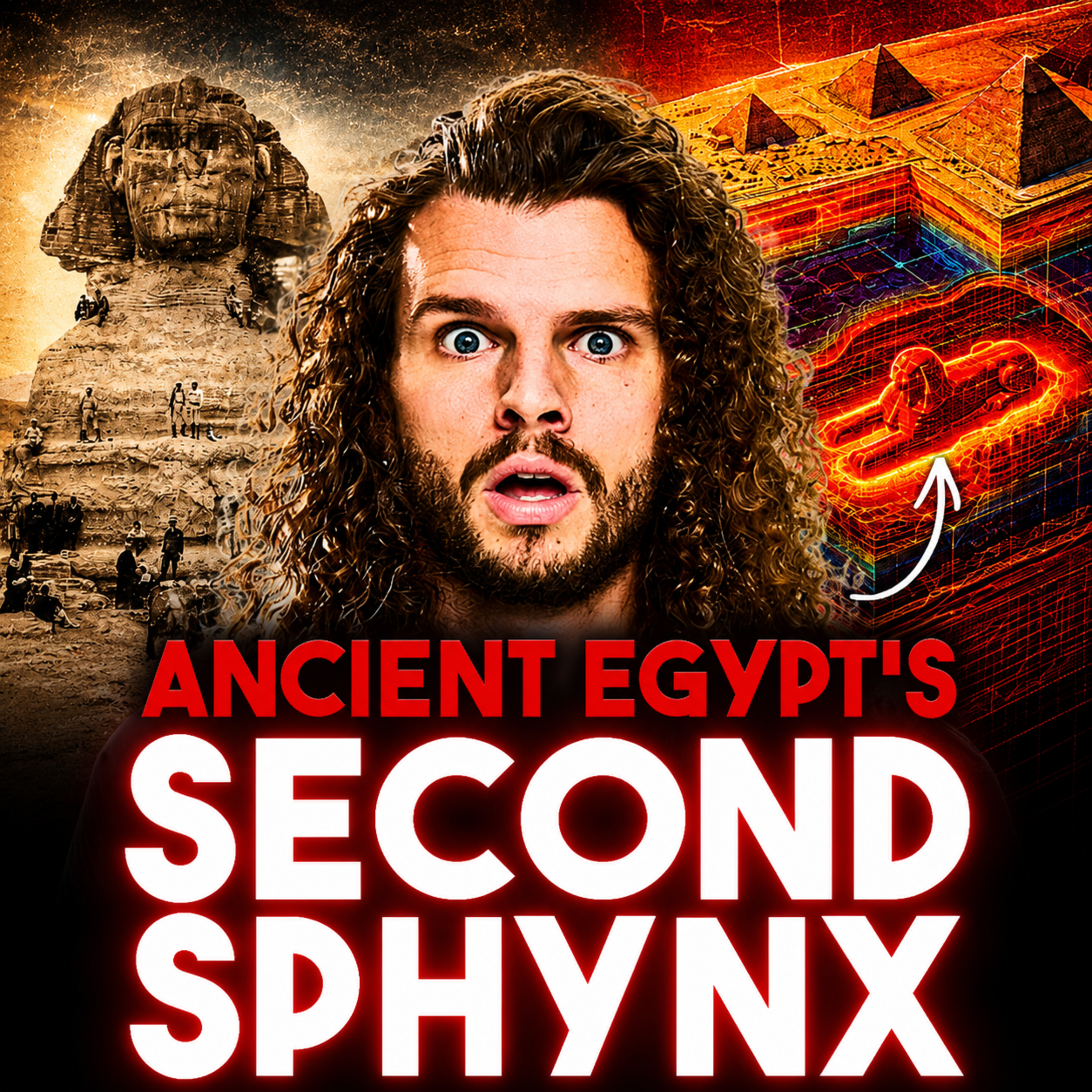
In ancient Egyptian mythology, the guardian of the horizon is said to be a lion. But it wasn't just one lion. It was two. Two lions sitting back to back, one facing east and one facing west, holding up the sun between them. And the Egyptians had a name for this creature. They called it Acre. And it's one of the oldest gods in the entire Egyptian pantheon. So when an Italian researcher went on a podcast and claimed that his radar scans had detected a second sphinx buried under a giant mound of sand at Giza, a lot of people notice something strange. Because the second sphinx, if it exists, sits at roughly the exact position you'd expect to find the second lion of Acre. And it's not just this researcher that thinks so. The stone slab between the Sphinx's front paws placed there by a Pharaoh in 1401 BC shows not one sphinx, but two. And we have a geologist who claimed the Sphinx is over 7,000 years older than Egyptologists say. And he argues that the erosion pattern makes this entire official story fall apart. This is the story of the second Sphinx and the mythology that ties it all together. So sit back, relax, and welcome to camp. What's up, people? And welcome back to camp. My name is Mark Gagan, and thank you for joining me in my tent, where every single week, we explore the most interesting, fascinating, controversial stories from all time, forever and always. That is what I do here. I deep dive, dive into the unknown, the mysteries of the abyss. And, oh, boy, today we have a fantastic episode. But before we jump in, I just want to give a few camp bulletins. All right, first off, I want to say thank you to you. Yeah, dude or lady, I appreciate you tuning in to this show because every time you click on an episode or comment or like or any of that stuff, you help keep the lights on in the tent and you help keep the fire burning. Truly. Thank you so much. Also, I want to tell you about a secret society, maybe the most secret society of all societies. It's so secret, there's very few members. It's just kind of like me and. And my parents and a couple other people. My, my. You know, just some homies of mine. And it is called patreon.com Camp Gagnon. This is the secret society where you're going to get every episode of this show ad free. You're also going to get monthly zooms with me and the rest of the squad. You're also going to get bonus episodes that the public doesn't see. And yes, this comes at a cost, a sacrifice to you. And that sacrifice is Just a cup of coffee every single month. Yes. One day out of the month, you're gonna have to skip coffee. And that will get you access to all of this additional content, plus the robust community here at the campsite. Now, let's jump in, because I don't know if you'd notice, I've been on a little Egypt kick. I've been truly fascinated by what is happening within the realm of the pyramids. And this one is an interesting deviation that I don't think a lot of people pay enough attention to. And that is the story of the second Sphinx. But before we can talk about the second Sphinx, we got to talk about the first one. Yeah, we're talking about the Great Sphinx at Giza. This is a massive 240 foot long, like 60 or 70 foot tall, like lion thing with, you know, the face of a human. It's crazy. And it weighs about 20,000 tons. It's carved out of a single piece of limestone bedrock. It sits in a U shaped pit at the eastern edge of the Giza Plateau. And it faces directly east towards the rising sun. Now, mainstream Egyptology says it was carved around 2500 BC during the reign of the pharaoh Khafre. And this is the same pharaoh who actually built the second largest pyramid at Giza and sitting directly behind the Sphinx's head. But now, what's interesting about the Sphinx is that there is no inscription anywhere on it that actually says that the Pharaoh Khafre is the builder. It's not on the body, it's not any like the surrounding temples. It's not in any contemporary text from the fourth dynasty. So this whole, you know, Pharaoh Khafre built the Sphinx theory is based on three things. One, it's near his pyramid. So people obviously connect giant megaliths that are near each other. And the face kind of actually looks like him. And a damaged inscription on a slab between his paws mentions his name about a thousand years after the Sphinx was built. And that's kind of it. And the last point, the slab, this is where the entire story actually starts. So in 1401 BC, there's this young pharaoh named Thutmose IV. And he basically placed a giant granite slab between the front paws of the Great Sphinx. And it's about like 12ft tall, it weighs 15 tons, and it's made of red granite. Now, Egyptologists will call this the dream Stel, or sometimes like the Sphinx Stel. And you can see a picture of it here. And a crazy thing about this is that the slab itself wasn't even originally made for the Sphinx. It's actually a recycled, like, door taken from Khafre's mortuary temple nearby. So you can actually still see the hinges on the back of the stone where the door once swung open. So when Thutmose basically, you know, grabbed an old piece of this temple and re engraved it, this is where it stood. And the story carved onto this, you know, door. Stella thing is pretty crazy. According to the inscription, Thutmose was a young prince out on a hunting trip in the Giza plateau. And he gets tired around like 12 o'. Clock. And he lays down in the shadow of the Sphinx, which at that point was buried up to its neck in sand. And, and he falls asleep. And then in his dream, the Sphinx speaks to him. The Sphinx introduces itself as Horemiket, meaning Horus on the horizon. And basically tells the prince that if he cleared the sand off of his body, that he would become the pharaoh. So Thutmose woke up, he cleared all the sand away and became pharaoh. Or at least that's the version that, you know, everyone tells. But what a lot of people don't talk about is that what's actually depicted at the top of the stele, the part that's above the writing, called the lunette. Now the lunette above the inscription actually shows Thutmose IV not just one time, but twice. And he's making offerings to the Sphinx on the left and, and on the, on the right side. And the Sphinx itself is also depicted twice. Two sphinxes sitting back to back on a single high pedestal facing opposite directions. Now mainstream Egyptology has a very clear explanation for this. This is symmetrical religious art. So ancient Egyptians loved symmetry. And the double image is supposedly just the same God depicted on two sides to give B composition. But there's another interpretation that has been floating around since the 70s. And it's the entire foundation of this second sphinx theory. What if the artist wasn't being symbolic? What if they were drawing two physical sculptures, two physical megaliths? Now to understand why that interpretation isn't actually that crazy, we have to understand who Ocker was. Aker is one of the oldest gods in the Egyptian religion. And he actually shows up in the pyramid text, which are the oldest religious writings on earth, dating back to around 2400 BC. OCAR is so old that he predates the cult of Osiris. And basically what everyone thinks of as like Egyptian mythology. Most of Akor's job was guarding the horizon, specifically the gates of the underworld. Through which the sun God Ra travels every night. So he guards the east where the sun rises, and he guards the west where the sun sets. But here's the thing that matters for this combo. Ocker is almost never shown as one lion. He's always shown as two, sitting back to back, holding up the disc of the sun between them. And in later depictions, like the tomb paintings from the 18th Dynasty, this is the same dynasty as Thutmose IV. Acre is depicted as two sphinxes with human heads facing in opposite directions. And interestingly, the Egyptians actually had a separate name for this dual form. They called it Ruti, meaning two lions. Now, by the late New Kingdom period, a few hundred years after Thutmose IV actually placed the dream stele, that giant inscription, the Great Sphinx had a nickname, and the local Egyptians called it the lion of the Horizon, which is basically Auror's job title. Right? Like, so you have this, you know, religion in which the guardians of the horizon is always two sphinxes facing opposite directions. You have a monument that is literally called the lion of the Horizon. And you have Estelle placed between the monuments paws showing two sphinxes on. On a single pedestal. And that is kind of the foundation of this theory. And it's also why mainstream Egyptologists have been pushing back on it for so long. They argue that the double image is just a representation of okra as a, like a concept, not literally two different monuments. The Sphinx, in their view, is just a single statue that represented, you know, the dual horizon God, not one half of a pair, which is a valid argument until someone does a radar scan. So in the early 2000s, an Egyptologist named Bassem El Shama started publicly proposing this second Sphinx theory. And El Shama's argument wasn't just based on the dream, Stella. He actually went deeper and started pulling from ancient Egyptian records and mythological texts that describe a lightning strike hitting the Sphinx at some point in deep antiquity. And his theory was basically that this lightning strike wasn't metaphorical. It was an actual recorded meteorological event. And he argued that what got hit wasn't the Sphinx that we see today. It was actually the second monument, one that was either heavily damaged or destroyed, possibly after being struck by what the Egyptians interpreted as the wrath of God. So El Shama's framework, the second Sphinx, may have crumbled or, you know, been so badly damaged by some type of event, or been quarried for stone, or maybe has just been, you know, buried by sand and forgotten, or maybe all the above. But the first Sphinx, the one that we know survived. And the dream stele preserved the memory of the pair even after the second one was gone. And then in 2017, El Shamas claims got enough attention that Dr. Zahi Hawass, Egypt's most famous Egyptologist and the former Minister of Antiquities, publicly had to dismiss him. Now, Hawass said that the Giza Plateau had been excavated for over a century with no evidence of a second Sphinx, and that the area was, in his words, unique in Egypt and the world. And that was supposed to end the conversation like, hey, we searched around, we were digging in the sand, no second Sphinx, just move on. But in 2021, the theory gets second wind from a very unexpected place. And it gets it from a man named Reda Abdel Halam, who at the time was the director of public relations for the Giza Pyramids district. And you know, Reda basically tells a Cairo based media outlet that a second Sphinx has been discovered in the sands near the Great Sphinx. And the description he gave was extremely specific. He claimed that the buried statue was 246ft high, which is massive, I mean, especially compared to the Great Sphinx, which is only like 66, and that the head itself was 67ft tall and that the paws extended over 50ft. He claimed a scientific study from Egypt's Zagazig University had confirmed it. But when the media press for an actual study, things get weird. So Zahi Hawass, again the public face of Egyptian Egyptology, told the newspaper that that, you know, the supposed Zagazig University study never existed and that nobody in Egyptology circles had ever heard of it. And so Halim's claim slowly disappeared from the official narrative. But then he doubled down. He told the outlet that the second Sphinx's existence had been deliberately covered up and that the inscription describing it had been erased from the Great Sphinx itself itself in order to hide it. So now things get weird because you have three different independent lines pointing in the same direction. You have ancient mythology, you have the dream steadily imagery itself. And then you have a former Egyptian government insider all talking about this buried second monument, but still there's no physical evidence. But then that changed in March of 2026. Hey guys, crazy story. So the good people at Brunt Workwear sent me boots. They actually sent me two pairs. And I'm not making this up. They said, hey, wear them to an actual job site, beat them up, and if you don't like them, just send them back for a full refund. I was like, there's no way that's true. One For a few reasons. First off, I don't work on a work site. I. I do stand up comedy. So these have been in pristine condition, I will say. But I gave some to a friend of mine who's a carpenter. He just works with his hands all day and just destroys his shoes. And he literally hits me up two weeks later and goes, these are the most comfortable boots I've ever gotten. Thank you so much. So I'm probably going to charge them for them, but regardless, what I'm saying here is that Brunt Workwear has maybe the most comfortable, durable boots ever right out of the box. They last super, super long, they're super comfortable, and they look great. So here's the deal. This guy Eric, he's the founder, he grew up blue collar. And his buddies in all the trades kept telling him how, like the big boot brands, you know the ones I'm talking about, they became like these fashion companies and they stopped doing the product that they all needed. So he was like, fine, I'm going to build one that actually works. And he named everything after actual tradesmen he really grew up with. So they're waterproof, they got a safety toe, they got a soft toe, they got pull up, lace up. You got all the options that you need. Now, right now, if you go to bruntworkwear.com, you're going to get $10 off if you use the code camp. So you can save money. You can buy boots, wear them to work, and if you hate them, here's the crazy thing, you just send them back. There's literally nothing to lose. If you don't like them, you send them back for a full refund. That is the Brunt guarantee. So go to bruntworkwear.com camp, that is C A M P camp, and use the code camp. Save money, buy the boots, wear them to work, and if you hate them, you're going to get a full refund. Just send them back and they'll give you your money back. There's literally nothing to lose. I don't see why you wouldn't just give it a try. I mean, my friends love them, I love them, but, I mean, I'm not doing manual labor, but they still look great. Anyway, that is bruntworkwear.com camp. Use the promo code link is in the description and tell them that the good people here at the campsite sent you. Let's get back to it. So on March 26th of this year, an Italian radar engineer named Filippo Biondi appeared on the Matt Beal limitless podcast and said something that really shook up Egyptology circles. He claimed that satellite based radar scans of the Giza Plateau had detected a structure buried under a large mound of compacted sand. A structure that, in his words, mirrors the layout and the dimensions of the Great Sphinx. So to understand why this got taken so seriously by some people and then immediately dismissed by other people, you need to understand who Biondi is. So he's a radar engineer at the University of Strathclyde in Scotland and is a part of a group called the Khafre Research Project, which has been scanning the Giza Plateau using a technique called synthetic aperture radar tomography. And it's basically a fancy word to describe the same general family of technology used for satellite mapping and missile silo detection and like underground bunke imaging and stuff like that. And this isn't the first time that Biondi had made headlines. So In March of 2025, he and his colleague Corrado Malanga of the University of Pisa held a press conference claiming that they found an entire underground city beneath the Khafri Pyramid. And this was a, you know, this is what people online call the spiral column theory. And the claim was that eight massive vertical shafts spiraling downward to two square like cube shaped chambers, each about like 300ft per side, were sitting roughly 2,000ft below the surface. I mean, it's an insane claim that there's a massive silo and underground bunker beneath these pyramids, so deep, 2,000ft below the surface. However, that announcement was rejected almost immediately by mainstream Egyptology and by independent radar experts. So Professor Lawrence Connors, a radar specialist at the University of Denver, told the Daily Mail that the technology used couldn't penetrate the ground to those depths and called the interpretation just a massive exaggeration. Now, Zahi Hawass called the underground city claim nothing but fabrications. So Biondi already had a track record of contested findings going into this 2026 second Sphinx announcement, and of course was very popular by people online, but very unpopular by people that exist within mainstream Egyptology. Now, here's what Biondi actually claims to have found. His team drew a line from the center of the Pyramid of Khafre to the existing Sphinx, and that gave them a geometric reference point across the plateau. Then they mirrored that line using the Great Pyramid of Khufu as the reflection point. Where it landed, according to the scan, is a 108 foot tall mound of hardened compacted sand right in the middle of the Giza Plateau. Now, Biondi's argument isn't that this is a random pile of sand. He claims the radar returns from inside this mound show organized geometric formations, vertical shafts and interconnected horizontal passageways. And at the heart of it, he says, is a buried structure that mirrors the proportions of the Great Sphinx. He used a phrase that was pretty specific to describe what he found. He said 100% geometric correlation in this symmetry. Now he also pointed out something that in my opinion is one of the more compelling parts of his argument. The existing Sphinx sits in a depression. This is like a U shaped pit that is carved down into the limestone bedrock with the body of the Sphinx sitting below the surrounding areas. This is partially why the Sphinx gets so covered up by sand, because it's actually buried into this pit. Now, the mound that he's talking about is elevated above the same plateau. So if you imagine the two together, one carved down into the ground, one, you know, buried inside, like this elevated mound, they'd be mirror images of each other in vertical position. So sunk into the earth on one side, but built up on the other. And this is the exact type of symmetry that Egyptians were obsessed with. Now that's the part that's hard to just write off as a coincidence, even if you don't believe or trust these radar interpretations. Now immediately beyond A puts out this statement and starts receiving pushback. So Newsweek ran a fact checking on this second Sphinx story story and claimed that it was false and that there was no confirmed archaeological evidence or excavation or peer reviewed study or any type of official announcement from Egyptian authorities. However, the big issue is the depth. What the 100 meter or 300 meter or 600 meter depth claims that beyond his team have been making for, you know, years are far beyond what this technology has been independently verified to do. That's really the biggest issue with all this. Professor Conyers, the radar expert from Denver, put it pretty bluntly in an interview with afp. He basically says radar waves gradually attenuate in the ground, meaning the further down you go, the weaker and less reliable the return signal becomes. So at extreme depths, you're not really, you know, imaging structures. You're kind of like interpreting noise the best you can. So National Geographic also reported that the specific satellite based SAR technology that Biondi is using hasn't been independently verified for ultra deep detections at archaeolog sites. So that's the scientific case against all of this. And the honest version is that there's a real radar anomaly under a real mound of sand. But the interpretation of what that actually is hasn't been confirmed by any Independent team. And the technology being used to make that interpretation is pretty contested. I mean, this could all be solved with just digging up some sand. But to this day, no one has drilled. No one has put down, like, a borehole where basically, like, you just put, like, a little hole into it and, you know, put a camera down there. And no one has produced, like, a single physical artifact. But that's also been true of, you know, every other contested Giza site for the past century, which is why this conversation still keeps on going. Now, here's where the second Sphinx theory connects to something even bigger. And this is the age of the original SPHINX. So in 1991, there's a geologist named Dr. Robert Shock of Boston University, and he publishes a study arguing that the Great Sphinx is actually way older than mainstream Egyptologists are claiming. And his evidence was water erosion patterns on the body of the Sphinx and the walls of enclosure. So Shock and author John Anthony west pointed out that this deep, smooth, vertical, you know, channel that was carved into the surrounding stone is characteristic of prolonged rainfall, not of wind and sand erosion. Now they're noticing what they claim is prolonged rainfall. And the issue with that is that Egypt hasn't had that type of climate since around, like, 10,000 BC. So shock's redated estimate puts the Sphinx construction somewhere between 7,000 and 5,000 BC at the earliest, meaning that the Sphinx might be at least 2500 years older than Khafre, or possibly even much older than any of that. So Shock's team also ran seismic studies around the base of the statue and, you know, using, like, a sledgehammer on this steel plate to send sound waves into the bedrock and trying to measure how deep the weathering goes. He concluded that the subsurface weathering was consistent with. With an older monument. Now, mainstream Egyptology again rejects Schoch's idea. They blame the erosion on what they call haloclasty, which is salt crystal expansion from groundwater, bringing materials and minerals up to the surface. And here's why it matters for the second Sphinx theory. If Schoch is right and the Sphinx predates dynastic Egypt by thousands of years, then the question of who built it and what was built alongside it now becomes totally different questions. The second monument from the same era could have eroded down to nothing, or it could have been deliberately buried or accidentally covered in sand just over time, or it may have been quarried for stone over thousands of years. The window of time in which something could have disappeared from the historical record is suddenly much longer. And that's the part where the radar anomaly and the mythology and the lightning story I talked about and the erosion hypothesis all start to kind of look very similar. I mean, none of them confirm each other, but they all kind of are compatible and they leave room for each other. So what are the realistic probabilities? Okay, option one is that this massive thing that was found by Biondi is just a sand dune. That's the easiest explanation. It's also the most boring one. So I don't like that. Now, the Giza Plateau is obviously, you know, accumulated drifting sand for thousands of years. And the Sphinx itself was buried up to its neck multiple times throughout history. I mean, you can see pictures of it online of the Sphinx buried up to its neck within the modern era. And that also includes when Thutmose IV first encountered it. So, you know, 108 foot mound is pretty large, but it's not impossible for it to just be a dune. Well, let's do a more interesting theory. Option two is that it's a buried ancient structure, but not a sphinx. So as we know, the Giza Plateau was filled with stuff. I mean, it's like one of the oldest civilizations and civilization areas in the world. And so there's massive structures and megaliths and temples and tombs and quarries that are scattered across the area that no one has dug into even to this day. So the radar scans could be picking up on an unrelated structure. It might be a smaller temple or an industrial site from the construction of the pyramids. And Biondi's team is interpreting this through the lens of their prior theory and just confirming what they already believe. But then there's option three. And option three is obviously the most exciting because it is that that this idea that there's a buried second Sphinx. Now that would mean that the dream stele depicting the literal pair of monuments is accurate. And that would mean Bassem El Shama and Red Abdel Halim and Bayandi are all pointing out the same thing from different angles. It would also mean that Egyptology has been missing or intentionally covering up one of the most significant monuments in human history, sitting in plain sight for thousands of years. But the honest answer, as always with Giza, is we don't know. And the only way to find out is to dig into it. Now, what's interesting about this whole story as we wrap up is that even if a second Sphinx existed, it almost certainly wouldn't look like the first one today. So get this. The original Sphinx has been re carved and repaired and even refaced multiple times throughout its history. So the current head is actually believed to be disproportionately small for its body, possibly because the original head was much larger and when it was recarved, carved, it basically, you know, was shrunken down by a later pharaoh. With some researchers claiming that the original head may have even just been straight up a lion's face. Which again goes back to this idea of a care. So if our boy up top has a twin under the sand somewhere, it could be so far eroded or far more intact than anyone expects. But once again, no one knows. Now this is what frustrates everyone. The Egyptian Supreme Council of Antiquities has the exclusive authority to approve or disapprove any excavation on the Giza Plateau. And for the second Sphinx site specifically, they have yet to approve anything. So Biondi has publicly stated that on site investigation with geologists is essential before any definitive conclusions can be drawn. He's not claiming victory, he's not saying, I found it, name it after me, any, anything like that. He's just simply asking for permission to dig into the second Sphinx. Egyptian authorities are kind of reluctant to say anything. They haven't said yes, but they also haven't said no. They've just kind of been quiet about it. And there's a few reasons as to why they're being so vague, you know, without being a full on conspiracy. So one is that the Giza Plateau is one of the most carefully protected archaeological sites in the world. And any excavation has to go through multiple channels of peer review approval processes. So the Coffee Project's findings haven't been published in a peer reviewed journal, which makes the formal approval extremely unlikely. Also, it's worth mentioning, excavation in this type of compacted sand at that scale is massively expensive and slow and I mean even politically risky. If they dig and find nothing, it can actually be an embarrassment to the government and the people that are involved. And if they dig and find something, it changes the official narrative of one of Egypt's most important national monuments. And of course, Zahi Hawass, arguably the most powerful person in Egyptology, has been openly against this entire theory for over a decade. So the sand sits there and the scans keep on happening and the theories keep on changing and evolving. And the only thing that could actually resolve the question is put a camera in there and it continues to not happen. Now it's easy to write off the dream Stel's double imagery as just symmetry. You know, that's part of the element of, you know, this story that's easy to Write off. But when you have the Egyptian mythology where Aur, the actual God of the horizon, is explicitly depicted as two lions, the it gives it a lot more weight. And you can even dismiss ochre as a metaphor. But the Sphinx itself was historically called the lion of the Horizon, which is Ocker's exact title. And you could claim El Shama was just a fringe conspiracy theorist, except a sitting Egyptian government tourism official stepped forward to say the exact same thing and even backed up these specific dimensions. And of course, you know, this Italian dude beyonding, maybe his radar scans are flawed and they're making a false conclusion. And if so, it is just a massive coincidence that his geometric mirror calculation lands exactly on a real physical 108 foot mound that clearly, you know, seems a little suspicious if nothing else. I mean each individual piece of evidence has its problem, but there is a pattern that keeps recurring and lining up. And the question that everyone keeps saying is why not just dig a hole and find out? I mean this 108 foot mound isn't going anywhere. And the dream Stella is obviously not going anywhere. And Akra has been sitting in the Egyptian record for 4, 000 years guarding the horizon, and he's not going anywhere. So the only thing missing is permission to look. And we haven't gotten it yet. But hopefully we'll do an updated video once that actually happens and we can find out what's actually underneath the sand after all. And that, my friends, is the story of the second Sphinx hidden in Egypt. I mean this is a fun one, dude. I like just a good old fashioned Egypt conspiracy, right? No one gets hurt. Hurt. We don't have to blame any type of ethnic or religious group. We can just be like, you know what, there's something cool out there. We don't know what it is. And that gets me excited. There's so much going on in Egypt that we still have no idea about. And this idea that there's another sphinx, I'm like, yeah, probably, I don't know, maybe, maybe I'm not taking this seriously enough. But I'm like, yeah, dude, 100. It's exactly mirroring the opposite side. I mean, look at the OG Sphinx right there. This is taken way back in the day when the thing was covered all the way up to its neck. Basically like the old Easter island heads. You know that those Easter island heads actually have a full body down there, just dug deep into the ground. But look, the sand blows around it, covers it up. And that's what it looks like because it's kind of Dug into a pit. Now, the theory is that you go to the exact opposite side of this and there's a massive 100 foot dune that has nothing inside. I'm like, it probably does. The Egyptians loved building things with symmetry. You got three pyramids of Giza sitting right there, spread across, looking beautiful. You got the, you know, giant sphinx in front of it. It's probably a giant sphinx behind it. Why not? Like, am I crazy for not taking this more seriously? I'm like, yeah, and it probably doesn't even look like that, dude. It probably looks like a totally different person. If it got covered up way long ago, which it might have been, then maybe it's a. You know, maybe it's like a lion or something. My theory on this, if I can, If I, if I can venture out and throw a guess in, I'm gonna say 90 chance there is a second sphinx. I'm gonna say 30 chance it's still there, intact. I'm gonna say. I want to say there's something under that sand. I. I think it's probably a second sphinx, but I don't think it's in good shape. That'd be my theory. I bet you it's been, like, quarried. Or maybe there's just a foundation left. And I bet you it doesn't. You, if you saw it, you'd be like, oh, that's just a crappy hill, you know? But who knows? I would love to know what you guys think. If you're an Egyptologist and you have deep theories or opinions about what's going on over there in the Giza Plateau, please drop a comment. YouTube and Spotify, I read all of them, so be nice and civil in the comments, okay? If you want to argue, take that to Twitter, whatever. But I would love to know your thoughts. If there's anything I missed or overlooked. Again, I'm not an Egyptologist. I'm just a comedian with a wi fi connection. So please don't hesitate to correct me. I'm always interested in being less dumb and learning the truth. And if you like history content, kind of like how we covered today, well, great news. We have an entire channel dedicated to. It's called History Camp. And if you like religious content, kind of like how we talked about Raw and Osiris, well, we have an entire channel dedicated to that. It's called Religion Camp. And if you just like, you know, deep diving on the craziest mysteries and most controversial stories going on right now, well, you're always welcome here at Camp G. Thank you. So much. I appreciate you all dearly. Check out The Secret Society patreon.com Camp Gagon check out Mark Gagon live. You want to see him on the road? And I will see you next week. God Bless. Athletic Brewing Company crafts award winning non alcoholic beers for those who want to be part of every round with over 185 flavor awards awards. They're exceptional NA beers that fit your lifestyle and any social occasion. Summer's full of good times and Athletic fits right in. Go to athleticbrewing.com to have brews delivered to your door or find them at a bar, restaurant or store near you. Near Beer Athletic Brewing Co. Fit for all times.