Loading summary
Transcript89 lines
- [00:00]
Sponsor/Ad Voice
This episode is brought to you by Facebook. So you were scrolling on Marketplace, and there it was, the bike you'd been searching for. You sent a message and it turned out the seller was super chatty, kind of funny, and an avid cyclist. The next thing you know, you're in a cycling crew. Well, a community cycling group. The thing about Facebook, you might find more than what you're looking for. From a browse to a bike ride this summer. Find more on Facebook.
- [00:30]
Mark Gagnon
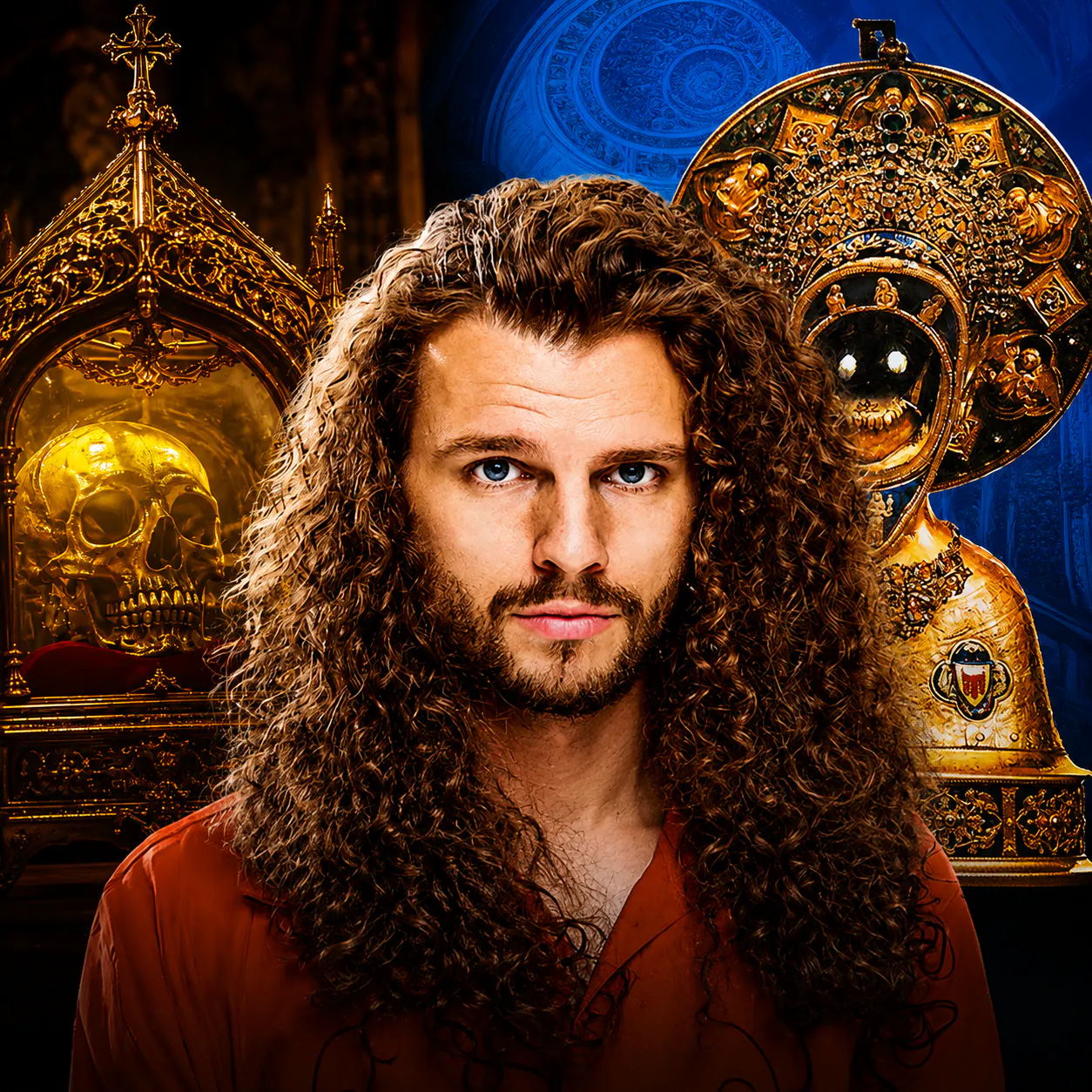
Locked inside a golden vault in Naples is a vial of human blood. It is 1700 years old, and three times a year, in front of thousands of people, it turns back into liquid. In Padua, a golden case displays a human tongue. It's 800 years old and it's still red. And in Assisi, pilgrims line up right now, today to see the body of a 15 year old kid in jeans and Nikes who the church just declared a saint. Body parts, blood, gold, coffins, corpses in glass cases. And 1.4 billion Catholics all call these objects holy. What are these relics that claim to hold the power of God? And why is the Bible full of these kinds of stories? Well, today we are diving in and uncovering this weird tradition that seems superstitious and seems to act like magic. I mean, from the medieval black market where monks stole dead bodies, to the relic that seems to heal people to this day, to the cloth with the imprint of Christ's face that science still can't fully explain, we are breaking down the theology, the history, and the wild church argument that shaped this entire practice. And finally, the question that so many of you have been wondering, do Catholics worship saints? Well, all of that and more will be answered. So sit back, relax, and welcome to Religion Camp. What's up, people? And welcome back to Religion Camp. My name is Mark Gagnon, and thank you for joining me in my tent where every single Sunday, we explore the most interesting, fascinating, controversial stories from all religions, from all time, forever. Yes, that is what I do in this very tent as I try to figure out what everyone believes. And I do this for a few reasons. One, I want to just be a better human being. I meet people all the time that have different religious backgrounds, different religious traditions, and they behave in different ways. And I feel like the least I could do as another human being is to know why they do it. For so many people, God or at least the culture that their God believes in, even if they're not practicing, might be the most important thing in their life. And for me to not know the very basics seems a little irresponsible. You know, additionally, I like to take all the good stuff I hear from every religion and apply it to my own life. You know, the devotion of Muslims, the scholarly traditions of the Jews. I mean, the mystical philosophy of Hindus. I mean, there's so many great things that I like to take and apply to my own life and try to kind of put together this tapestry of what reality really is. And, oh, boy, today I get to actually talk about something that I kind of know, because we're talking about Catholic relics. And as you know anything about me, I am a Catholic. I was born Catholic, raised Catholic, baptized in the one holy Catholic and apostolic Church. And today I'm here to tell you why we have this whole relic thing, because from the outside, it sounds pretty weird. And I had a lot of debates growing up with all my Protestant friends. I did. I bag on the Protestants. They're good people, but it's just funny, you know, and they would always be like, oh, why do you guys worship these saints? Why do you worship all these objects and stuff? Isn't that pretty pagan? Isn't that pretty sacrilegious? Well, I'm going to explain where it comes from, why we do it, and what it really means and how different Catholics feel about all these different things. Now, let me just say a few things. One, I'm not a priest. I'm not a deacon. I don't hold any type of ecclesiastical, you know, status. I'm just a, you know, regular old Catholic comedian trying my best. So some of this stuff is new to me, and if I misrepresent anything, I apologize to all my Catholics. And please drop a comment below if I do that. Now, I also want to say thanks to you for tuning in, because every time you click on an episode, you keep the lights on in the tent. You keep the fire burning here at the campsite. Now, of course, I can't do this alone because I have to give a shout out to the Greek legend sitting right behind me, the Greek Orthodox hero himself, Christos Papadopados. But of course, he's not here. No, he's still on a vacation right now in Greece. I think he's off the coast of Sardinia on a yacht or something to that effect. So instead, I got the old Pagan Miles McCreary.
- [04:21]
Miles McCreary
It's an honor to be here.
- [04:23]
Mark Gagnon
Miles, do you know anything about Catholic relics?
- [04:25]
Miles McCreary
I know nothing.
- [04:25]
Mark Gagnon
You've heard of the Shroud of Turin?
- [04:27]
Miles McCreary
Yeah.
- [04:28]
Mark Gagnon
You've heard of trying to think of other ones that you would know. Oh, the Tilma of Guadalupe sitting Right next to me.
- [04:36]
Miles McCreary
I don't. I've heard of it, but no, I don't know that one as well.
- [04:39]
Mark Gagnon
Well, I guess it's. I don't know if it's really. It's kind of a relic. Yeah, from a Marian apparition. I guess it would be considered a relic. Well, I'm going to explain to you what relics are and please feel free to pepper in with questions if it doesn't make any sense, and we'll have a spirited discussion afterwards, pun intended. Now, we got to start from square one with this because unless you grew up devout Catholic or in a Catholic family or an environment, the whole relic thing sounds pretty weird. Now, if you grew up in like Italy or Spain or France, like, you're probably much more familiar with relics. You understand holy sites, you understand kind of how this interfaces with culture. But if you grew up in America or you're not Catholic, it might sound creepy or superstitious. Well, relics are sacred objects that Catholics basically deem holy or meaningful or special to the religion. Like if you've heard of the Shroud of Turin, like I mentioned before, that is a cloth that people claim covered the face of Jesus. That is a relic. There are relics that are kept and put on display by the Church all over the world. And people often make special pilgrimages just to see them because they are said to be holy objects. And these are what they believe to be channels for the power of God. And we'll talk more about that word channel and why it's important to understanding what it all means. So the word relic comes from the Latin word relique, meaning remains or things that are left behind. And the Catholic Church, doing what they do, has organized them into three classes, basically like a system. So you have a first class relic. This is the most holy. It's any part of the body of a saint. So like bones, blood, hair, stuff like that. There's even a famous tongue of a saint in Padua that is a relic. Then you have a second class relic. These are a little bit less hardcore. It can be anything that like the saint owned or something that they use. So maybe a rosary from, you know, like Padre Pio or a martyr's chains or clothing or anything like that. And then you have a third class relic. This is any object that has been touched by a first class relic. So the basic rule here is that holiness is in a sense transferable, like a little cloth square that gets touched to a saint's bones. They are handed out to ordinary Catholics all, all over the world. Not exactly like, for good luck, but as a meaningful and holy thing to hold onto. Now your first reaction. And I say this because I. I get it. I. It sounds weird. It sounds like, hey, the magic. You guys are just doing magic now. You touch the holy object and you receive met. No, this is a big misconception that you gotta. This is not true. Relics do not have any power on their own. A relic is not a battery for holiness. It doesn't contain, like, holy juju in the way, like, a jar contains, like, honey. So if a miracle happens near a relic, that is God doing it. The relic is just a meeting point. It is a channel. It is never the source of the holiness. But. Okay, where do Catholics even get the idea? Catholics are always making up stuff. You guys are crazy. We should kill you again. I'm sure that's what you're thinking. But look, it comes from the Bible. And to be clear, it's not like the Bible ever said, like, thou shalt make relics and go into the church and stand in line and pay 20 bucks. It doesn't do that. But there are examples of times where people in the Bible have treated the body or objects of people in the Bible as sacred. So, for example, you go to the Book of Second Kings, chapter 13. There's a story where the prophet Elisha is dead and buried. Some Israelites are burying another man when raiders attack. So they panic. They toss the corpse into the nearest tomb and they run away. The nearest tomb happens to be Elisha's tomb. And the text says that the moment the dead man touched Elisha's bones, he came back to life and stood up. That's in the Bible. An entire resurrection just caused by contact with the prophet Elijah's bones. So that's an example from the Old Testament of God's power manifesting through a relic. Now, the New Testament actually doubles down. Like there's an entire story where a woman was sick for 12 years, pushes through a crowd, touches the hem of Jesus's cloak. Not Jesus himself, just his clothing, and she's healed. Now, in this story, Jesus actually says that he felt the power go out of him when she touched him. That's important. And I'll circle back to that in a minute. I. Also, in the New Testament, you have the Book of Acts, chapter 19, that goes full on relic lore. It tells about how people would carry handkerchiefs that had merely touched the apostle Paul, and when they'd give them to sick people, the sick people would get healed. But the text makes sure to frame it again. That these are miracles that God did through Paul, through the cloths that were acting as a channel. So let's pause and take a look at what just happened. Bones that raise the dead. First class relic, Jesus robe that heals the sick. Second class relic, strips of cloth that had touched the apostle Paul and healed the sick. That is a piece of cloth touching a first class relic, therefore making them third class relics, all of them described, all used in the New Testament itself. So when Catholics are venerating relics, remember the word venerating, not worshiping, venerating. In their minds, they are not adding something to Christianity. We're just kind of continuing something that's described and used in the scripture itself already. So to them it's like, yeah, it's in the New Testament. We'll just do the same thing now. There's actually a deeper layer here, and in my opinion, kind of beautiful. The whole basis of Christianity is that God became human, came down from heaven, took on a human body, including all the crappy things about being human. Getting tired, you know, getting hungry, bleeding. And that is called the incarnation, the process of God becoming human in the person of Jesus Christ. And this is where I want to return to that story in the New Testament where the sick woman touched Jesus cloak and felt the power go out of him. That detailed Jesus saying he actually felt the power go is really important because it's telling the audience that Jesus is God. Because remember, the relics are not powerful on their own. They are channels for God's power made holy by God himself. So when Jesus says I, he felt the power leave him, that's him basically saying the cloak is not just a relic because I'm not just the channel, I myself am God. And why is that so important? Well, the incarnation of Jesus becoming, you know, being fully God and becoming fully human affects the whole way that Catholics see matter. Truly, the way that Catholics see like physical reality itself. Like if God was willing to become flesh and bone, then flesh and bone can't be unimportant. By this metric, matter has the capacity to be sacred. That is the opposite of Gnostic belief. The Gnostic Christians believe that the physical realm is evil and is a ruse created by a demiurge that we have to escape. Now, we did a whole episode on Gnosticism. You can check that out. So to sum it up so far, Catholics believe that God became physical. So that affirms that the physical world is important and not only important, but meaningful, including certain physical things that can be channels for God's holiness. And that is the incarnation. And then, of course, you have the second central claim to Christianity that is super important for understanding relics. It's one that Christians recite all over the world every Sunday in the Apostles Creed, and that is the resurrection of the body. If you never heard this before, this is referring to the afterlife. Christian theology doesn't believe that when you die, your soul, like, floats off as a ghost forever. It also doesn't believe that you just cease to exist. It says that at the end of everything, bodies are actually raised from the ground, made whole and healed by God, and are reunited with their souls, which have been waiting in heaven for this moment of the resurrection. Which means that saints bones aren't just discarded shells of who they once were. Like a snake skin left in the grass. They are, in the church's language, a temple of the Holy Spirit, just on pause, waiting for reunion. And the resurrection will happen for every believer, not just the saints, but not every believer's body is a relic because it's not holy like the saints are, if that makes sense. So incarnation two, resurrection of the dead, these are two beliefs affirmations of the physical realm, and they are central to Christian theology, and they're so central to understanding how Catholics view relics. Now, however, relics are not uniquely Catholic. Now, Eastern Orthodox Christians have a relic tradition just as intense as Rome's, maybe even more. To this day, an Orthodox priest generally can't celebrate the liturgy without a cloth containing a relic on the altar. I mean, Islam preserves hairs from the prophet Muhammad, peace be upon him, his beard. At the Topkapi palace in Istanbul, Buddhism built an entire temple in Sri Lanka around a single tooth. So the whole relic thing, it's not just Catholics. I mean, you know, we kind of take it to a different level, but it's kind of a human thing to hold on to things that matter, to remember and cherish people. That made such a big impact on humanity. And we do this right all the time, right? Like you and I do it to a similar extent. Like, we hang up souvenirs. We, you know, you might buy like a game worn jersey. You might buy like a baseball card with a piece of a bat that a player used. And you're not saying like, oh, this bat has power, but you're looking at it and you're like, this is powerful to me. This. This is sacred to me. Relics just have a special kind of holiness and power. We believe is basically created and channeled through them by God. Hey guys, we're gonna take a break really quick because I want to talk to you about the thing in your back pocket. That's probably a disaster.
- [13:39]
Miles McCreary
Yeah.
- [13:39]
Mark Gagnon
This episode is brought to you by Extra and the new Wal Wallet Pro. I switched to this and I'm not going back. This is genuinely the wallet that I use every day. It is next gen Italian leather and it's got this metal ejector trigger. So you hit the button with your thumb and all your cards instantly fan out one hand instant. No more digging around at the counter. And yeah, you're not going to be holding up the line next time you're trying to like cash out. And here's what gets me. It's the slimmest leather wallet that Extra has ever made, but it actually holds more. Yeah, up to 14 cards plus your cash. And it sits flat in your pocket. No plastic anywhere. It is all recycled aluminum and real leather and it comes with a lifetime warranty. So, yeah, this is basically the last wallet that you will ever buy. And here's the kicker. It is Ekster's 10th anniversary sale right now. So you're going to get up to 40% off through August 17th. You go to partner extra.com camp gagnon. It's linked in the description too. And use the code GAGNON20 to get an extra 20% off. On top of that. Yes, it comes with Extra's 100 day money back guarantee. So there is literally zero percent risk. Upgrade that beat up wallet that you have that's falling apart, get this wallet that is perfect Italian leather. It smells great, it has no plastic and it holds everything you need and more. You will thank me later. Now let's get back to the show. Now to continue our story of understanding relics. You got to go back in time because here's a little mystery. How did a persecuted underground movement like the early church turn honoring the dead into the beating heart of an entire civilization, AKA the whole Roman Empire? Well, in Rome in the second century, Christianity was illegal. Getting caught could, you know, cost you your life. You would potentially be burned at the stake or beheaded or fed to animals in front of like a crowd of people. Yet Christians continued to gather in the safest places they could find. And generally those were tombs. The catacombs of Rome are these mass like giant hand dug tunnel networks, hundreds of miles of them with where the dead rest in little like holes kind of carved into volcanic rock. And down there in the torchlight. Many early Christians did something that would define Catholicism forever. They celebrated the Eucharist on the tombs of the martyrs of their faith. The grave of someone who died for their Faith literally became like their meeting place. And that little feature didn't just stay like a interesting historical footnote. You can still see the remnants of that today in Catholic practice. So for most of Catholic history, every altar in every Catholic church was required to contain a relic sealed inside a small cavity called an altar stone. The rule has kind of softened in the modern era, like post Vatican ii, but it's generally still the norm. So if you walk into any Catholic church built before your grandparents were born, there's a really high chance that there is a fragment of a martyr in some sense inside the altar or perhaps a saint or some other type of relic. The Mass is still in sense being celebrated on a tomb or, you know, near the resting place of a human being to some extent. And we know exactly how early this reverence started because we have a record of it. So it's called the Martyrdom of Polycarp, and it's one of the oldest Christian documents outside of the New Testament. Now, Polycarp was the bishop of Smyrna, and this is why he's a big deal. He was a student of the Apostle John, like that John, like the Gospel of John, John. Around 155 AD the Romans arrested him and demanded he curse and renounce Christ. And his answer is legendary. He says this 86 years I have served him and he has done me no wrong. How can I blaspheme my king who saved me? So of course they understood this and completely let him go wrong. They burned him alive. Afterwards, his followers, AKA the church at the time, gathered up his bones, calling them more precious than jewels and finer than gold. And they laid them where the community could meet every year to celebrate the anniversary of his death. And they celebrate the anniversary of his death because they call it his birthday into heaven. It was inspirational for them, an example of what it meant to truly follow Christ, to put your life on the line for your beliefs. So you have the beloved dead, the treasured bones, the annual feast day. That's the entire relic tradition in its earliest form. And it didn't start hundreds of years later like some other traditions in the church. It happened very close to the time of Christ. To Jesus's apostles apostle. That's like the grandson of Jesus's lineage, if you can look at it that way. And then in 313 A.D. everything in the Roman Empire flipped. Emperor Constantine legalized Christianity and the faith came roaring out of the catacombs and out of the tombs. And what did this newly legal, newly wealthy church built? First, they built more tombs Massive tombs, the great Basilica of Rome. They weren't built on prime real estate. They were built on top of graves. Over the following centuries, Christians began physically moving saints remains. The technical term for this is translation. Out of their hidden cemeteries and into these big, beautiful churches that were built to hold them entire cities reorganized their calendars, their economies, their statues, their identities around whichever saint whose remains were in their local church. I mean, the most obvious example here, St. Peter's Basilica, the largest church in the world, sits at the exact spot right there for one reason. The ancient belief that Peter, the chief apostle, was crucified in Nero's circus and buried on that exact spot on Vatican Hill. Constantine built the first basilica directly over the grave on terrain so awkward that his engineers had to shear off part of the hillside just to manage it. The current altar sits stacked like nesting dolls over altar after altar after ancient shrine. And here's where the story kind of brings us to the modern day and becomes almost like an adventure, because in 1939, workers who were preparing a papal tomb beneath the basilica broke through into something that no one expected. An entire buried Roman necropolis. A street of pagan and Christian tombs sealed underground for 16 centuries. Now, Pope Pius XII ordered a secret excavation in the middle of World War II, digging straight towards that spot under the highest altar. And what they found there was a modest ancient shrine, a graffiti wall scratched with Peter's name, and a set of bones. A robust man believed to be in his 60s, wrapped in cloth of purple and gold. Archaeologists still argue about who those bones belonged to to this very day. But in 1968, Pope Paul VI announced that the relics of Peter had been identified, quote, in a way we can consider convincing, which might be like the most carefully lawyered sentence in all of Vatican history. So all that to say the church basically says that it's Peter, and they say that they have no reason to believe that it's not Peter. But the truth is, at this time, if we're being fully candid, you can't really know for sure. I mean, you can visit the site to this day, by the way. It's called the Scavi Tour, and it is booked months in advance. And it ends with you standing in the dark a few feet away from a case of bones directly beneath the dome of St. Peter's now, whether or not those bones actually belong to this actual Galilean fisherman, think about what they represent. To them, it is an unbroken chain of people 17 centuries long who cared so much about where one man was buried that they built the largest Church on earth on top of him. So after the Roman Empire, when these were getting built, by the early Middle Ages, every church wanted a relic. Every altar needed one. Every town's prestige and pilgrimage and protection from plague insurance, and all of that rode on the power that they believed that these bones held. Relics had become the most valuable objects in Rome during the Middle Ages, like in medieval times. And people knew this so well that even when Joan of Arc was literally killed, when she was executed, her ashes were thrown into the same river, specifically so that no one could collect them. And by the way, we did an entire episode on Joan of Arc on History Camp on the other channel. So if you want to check that out, go look. But now we're left with a slight problem. There are only so many saints, and demand is about to massively outrun the supply. So when demand outruns supply, humans, even good Catholics, turn to a not so great alternative, and they start to steal. So in the medieval world, a famous relic wasn't just a spiritual treasure. It was, in a lot of ways, infrastructure, not just for the church, but for the entire city, because a major relic would draw pilgrims, and pilgrims need food and lodging and souvenirs. And so these whole towns would rise and fall on relic tourism. So Santiago de Compostella in Spain, built around the claimed tomb of the Apostle James, generated a pilgrimage route so massive that people still walk it today were bought, relics were faked, and, of course, relics were stolen. And this started to happen so often and so shamelessly. Medieval writers even had a name for it. They called it forta sacra, literally holy theft. And the thieves didn't even really hide it either. Like, they would brag about it. Monasteries published, like, glowing official accounts of how their monks heroically went and got a saint's body from some other town. And the theological spin that they put on it, too, was just amazing. They said that the saint is powerful, so if the saint didn't want to have their bones transferred to a different church, the theft would have failed. So a successful heist meant that the saint had consented, the relic wanted to move. Of course, it was just. They were just stealing. But the most famous holy heist in history was probably in Venice. In 828 AD, two Venetian merchants were in Alexandria, Egypt, then under Muslim rule, when the body of St. Mark, the gospel writer, had rested there for centuries. And they convinced the shrine's keeper that the relics were in danger. And so then they swapped the body out and they smuggled it to their ship in a basket here's. The crazy part. According to the story, they buried it under a load of pork, specifically, so that Muslim customs inspectors would not touch it and just kind of wave it through. Pretty wild. And Venice is like the absolute like. Like, they were stoked on this whole thing. Venice made Saint Mark, the stolen saint, the patron of the entire city. They built St. Mark's Basilica. They put his lion on the flag and spent the next thousand years just being absolutely insufferable about it. The heist is celebrated in a golden mosaic on the basilica itself with the pork scene included. You can even go see it to this day. Is it the right move? Is it the wrong move? Is it wrong to lie, to do something good? That's up to you to decide. I don't know. By the late Middle Ages, Europe had so many alleged fragments of the true cross. This was a massive issue in this time that people would just create counterfeit relics, like, so many pieces of the true cross that, you know, this is the cross that Jesus died on that the reformer John Calvin even made a joke that there was enough wood from the true cross to fill a ship. Also, multiple churches claim to display the head of John the Baptist. And at a certain point, there was four heads. Like, literally four different heads in four different places at the same time. There are so many vials of, like, Mary's breast milk that Calvin joked that that, too, he basically, like, the. The relic racket was such a common theme at the time that by the 1350s, there was its own comedy in Boccaccio's Decameron, a story about a con man friar who tours the countryside selling a feather from the wig of the archangel Gabriel. And then, I'm sorry, but this is a hilarious one. This is a true one. And, Miles, you're going to want to hear this. There was allegedly the holy foreskin from the infant Jesus claimed by as many as 18 different churches at the same time. That's crazy.
- [25:20]
Miles McCreary
That's awesome.
- [25:21]
Mark Gagnon
Just being like, yo, we got Jesus a little. Little piece of deal over here, Bishop.
- [25:25]
Miles McCreary
Deal. Check it out.
- [25:27]
Mark Gagnon
Come on, dude. Now, we gotta be fair, because they're, you know, some of the potentially fake relics. Like, you know, the skeptics have occasionally overreacted to this whole thing. So in the 1870s, a French scholar named Rehaut Des Flory got annoyed by Calvin's, you know, true cross line, where he's like, there's so much wood, you can make a ship. And he did the tedious thing that no one had bothered to do. He cataloged every Known surviving fragment of the true cross. And he added up the volume. Now, this is what he did back in the day. His total came out to a small fraction of one actual roman cross. He was like, no, if you count up all the wood, it's barely one cross. Now, of course, that doesn't prove that all the fragments are genuine, but it proves that this whole, like, oh, there's enough wood to be Noah's ark, yada, yada. It was just a diss. It wasn't like, an actual measurement. So one of the scandals of the relic trade isn't necessarily that the math was impossible. It was that for centuries, no one was bothering to do the math at all. And then the medieval church, you know, they weren't blind that this was an issue. They knew that it was a problem. And so the Fourth Lateran Council, in 1215, they officially banned the sell of relics outright, and they required papal approval before any new relic could actually be venerated. Selling sacred things has its own category. They call it simony, named for simon magus, a guy in the book of acts who tried to buy the power of the holy spirit with cash. And that ban still stands to this day. Under catholic canon law, you cannot buy or sell a relic, which is why when relics surface on ebay, Catholic organizations will kind of quietly buy them anyway just to rescue them, which is like a weird little modern echo of this forta sacra kind of thing, like this holy theft. But the rules never touch the deeper rot, because the biggest money maker was never selling the relics. It was the access to them. So here's how it worked. Medieval catholic theology held that even forgiven sins carried a leftover consequence, like time in purgatory, which is the state of purification that your soul goes to before you can go into heaven. And so the church taught that you could remit some of the time in purgatory through indulgences. And the one way to earn indulgence was to venerate relics. Specific collections of relics carried specific value, like, almost like a reward thing. So people would pay for access to be able to venerate relics. So this system of basically saying, hey, you can get time out of purgatory if you go venerate a relic, but you have to go pay money to venerate the relic. This allowed people like Frederick the wise prince of wittenberg, Germany, to make a lot of money, because by the early 1500s, he had amassed one of the largest relic collections in all of Europe, over 19,000 pieces of holy relics. And, of course, he would Charge people to come in and see them. Pilgrims who venerated his full collection could, on the right feast day, by the arithmetic of the time, knock out close to 2 million years off their stay in purgatory. 2 million. His grand annual display happened every All Saints Day on November 1st at Wittenberg's Castle Church. And the crowds would pour in and of course, so did the money. Now, there was one local Catholic German monk who didn't like this, and his name was Martin Luther. And he wanted maximum attention for his 95 theses attacking the indulgence system. So he chose his moment with extreme precision. That's why he did it. On October 31, 1517, this is the Eve of All Saints. The night before the relics went on show at the exact church. His protest was aimed straight at the money machine that those 19,000 relics was basically propping up. And so when the Reformation came, it did not treat relics nicely. Reformers didn't just critique them, they hauled them into town squares and they burned them. Shrines that had stood for thousands of years were just gone. To Protestants, this was liberation from fraud. This was liberation from a money making scheme of a corrupt church and corrupt people within the Church. So to Catholics, this was desecration. And honestly, after everything we've talked about, like the fakes and the thefts and the Purgatory, you can understand why they were so harsh. Well, what happens next? Great question. The Catholic Church, they're probably a little embarrassed. Did they quietly stop talking about relics and wait for everyone to forget? Not at all. Instead, they had the Council of Trent, which was the Catholic Church's massive Reformation era emergency meeting. The Council of Trent didn't abolish relics, it reaffirmed them while explicitly ordering all their bishops to stop the abuses and the superstition and the corruption that had existed around the system. And the cleanup never stopped. As recently as 2017, the Vatican issued detailed new rules for authenticating and protecting relics. Which once again begs the next question. After the frauds and the thefts and the Reformation bonfires and the Church's own internal purges, what still survives to this day? What are the relics that came through all that scrutiny and are still here? Well, there are a few. Let's go through some of the major ones and some of the most controversial. But for the purposes of this episode, I, we're just going to name them and sort of describe what they are. Each one has its own crazy, fascinating history and each one could use its own episode. Like, if you want to see a specific breakdown on them, like Just comment which one you like the most. But of course, the first one we should talk about is the Shroud of Turin. This is perhaps like one of the most important relics to all Catholics. A 14 foot linen cloth bearing the faint full body image, front and back of a bearded man who appears to have been scourged, crowned with thorns and crucified. And the claim is that this is the burial cloth of Jesus Christ himself. And we won't get into all the details here, because the Shroud of Turin has like a really long and documented history, and we'll do a whole episode on it. But the documented history starts in 1354, a small French town called Luray. Within a few decades, a local bishop even wrote to the Pope claiming that it was a painted forgery. But regardless, it persisted and people would go to the Shroud as a veneration. And then in 1898, an amateur photographer named Secundo Pia was allowed to photograph the Shroud for the first time. And when he developed the plates in his darkroom, he almost dropped them. The photographic negative showed a positive image, detailed and anatomically coherent and so lifelike. The image on the cloth behaves in some ways like the negative itself, which raises the question that has haunted the Shroud ever since. What medieval forger paints a negative 500 years before photography even exists? And then in 1988, was the showdown. The Church allowed a corner of the cloth to be snipped and sent to three independent labs in Oxford, Zurich and in Arizona. All the researchers did radiocarbon dating and all the results were the same. The linen dated to roughly 1260 to 1390 AD right in line with this whole forgery theory, Right in line with what that one French bishop had said to the Pope, like, hey, I think this is a forgery. And headlines went around the world and said, hey, case closed, the Shroud is fake. Except it hasn't stopped. In the decades since, researchers, including some with no religious stake, have argued that the corner that they tested was from an edge that was repeatedly handled and repaired and likely rewoven after fire damage, and might not represent the main cloth at all. Others fire back and say that the repair theory doesn't hold up. Meanwhile, nobody, whether a believer or a skeptic, has convincingly demonstrated how the image was made in the first place. It isn't paint in the ordinary sense. The coloration sits on the topmost fibers of the cloth, microscopically thin. And the argument continues in peer reviewed journals to this very day. And the Church's official position on the most famous relic in the world. Well, remember Paul VI's carefully lawyered sentence about Peter's bones? They said basically the same thing. The Vatican never declared that the Shroud is fully authentic. Popes venerate it carefully as an icon, a very powerful image for contemplation. And kind of leave the question of what it actually is to science skeptical of the object devoted to the meaning folded in a climate controlled case in Turin, Italy. Just remember, this is just sort of the, the, the broad overview. You should check out the whole episode on that. Now, of course, other relics you have the incorruptibles. Not just one object, but an entire category. These are saints whose bodies, when exhumed years or even decades later, were reportedly found without normal decay. So the most famous is Saint Bernadette of Lourdes, a French girl whose visions of Mary in 1858 created maybe the most famous healing shrine on earth. Bernadette herself died in 1879. Her body was exhumed three times over the following decades with doctors and witnesses present, and many reports were filed. And those reports describe it as remarkably intact. Now, full honesty, because this is where believers sometimes will oversell it. The body displayed in Nevers, France today is real, but the serene face and the hands are covered with thin wax masks made in the 1920s after exposure to air started to affect the coloration of the skin. And the church didn't hide this. It's in the exhumation records. And skeptics will point out that soil conditions and burial environments and natural mummification can occur and they might preserve a body with no miracle required. And plenty of non saints have turned up similarly preserved. And the believer's counterpoint is like, sure. But the sheer number of these cases amongst the saints, often in just like regular ordinary graves, it keeps the question very interesting. So wherever you land, I'll tell you that standing in front of Bernadette, a woman who died before the light bulb, and seeing her look like she's just sleeping, it's very strange and kind of like a sort of a bizarre experience to be like, wow, this is a. Basically a mummy that looks like she's just laying there. Hey guys, we're gonna take a break real quick because this episode is sponsored by Brunt Workwear. I got the Marin boot right here. And what immediately stood out to me about this is the quality. They feel substantial, they are genuinely comfortable. And just being honest, they are a really good looking boot. I like them, I wear them. This is even the pair that I wear. The pair that I wear is at my house. And they're absolutely dirty right now. But this gear is made for people working demanding jobs in, like, actual trades. But you don't have to work on a job site to recognize when something is built really well. And right now, Brunt is giving one lucky winner $50,000 in the Brunt Potty of Gold Sweepstakes. Yes, that is the actual name and yes, it is a lot of cash. If I won 50 grand, I would go towards probably upgrading the campsite. I would get some new cameras. I would send Christos back to Greece, probably. And what's awesome is that entering is completely free. But just create a Brunt account or log in with your existing account to start earning entries. And you can earn additional entries by following Brunt on social media, signing up for their emails and their texts, or even picking up some new gear. So you can also earn extra entries for every dollar you spend through September 18, 2026. And here's what you do. You go to bruntworkware.com camp, use the code camp, and you will get $10 off and enter the Brunt Potty of Gold Sweepstakes for your chance to win $50,000. Oh, and here's another thing that I love about Brunt is that they actually let you wear your boots before you decide if you want to keep them. And if the boots aren't right for you, you can return them for a full refund. It's a 100% risk free trial. There is no reason not to do it. It was started by this guy, Eric Girard. He literally grew up blue collar and he kept hearing the same complaints like, hey, all the major brands aren't making boots for actual work. And one more time you're going to get $10 off at Brunt when you use the code Camp at checkout. So head to bruntworkwear.com camp, use the code camp and enter the sweepstakes for a win. $50,000. No purchase is necessary. The sweepstakes end September 18, 2026 and official rules apply. Go check out Brunt now. Let's get back to the show. And now, of course, another relic you have. The blood of Januarius San Geneiro to the locals, was a bishop beheaded around 305 AD during Rome's last great persecution. Now, a vial of his dried blood has been kept in the Naples cathedral for centuries. And on three feast days a year, the archbishop brings it out before these packed crowds. And the solid mass of the sort of coagulated dried blood, it liquefies usually, but it's a Very, very bizarre relic. You should check it out. Now, the whole city treats this as almost like. Like a. Like an omen from heaven. When the blood liquefies, Naples exhales like, the whole town is like, ah, okay, it did what it's supposed to do. And when it doesn't, and there have been years where it doesn't, the people of Naples brace for some type of catastrophe. The local lore keeps a running list of disasters that followed false liquefactions or failed liquefactions, rather, including the devastating 1980 earthquake. Science has a explanation, of course. The vial might contain a thixotropic substance. Thixotrophy is a real property in certain gels that liquefy when they're shaken. And in 1991, researchers published a recipe for a gel using materials available in the Middle Ages. The counterpoint, that is basically, the church never allowed the sealed vial to be opened and tested, so no one actually knows what's inside. The liquefaction doesn't reliably follow the handling. Some years the archbishop will shake it, and nothing will happen. So it remains generally unexplained for most people. And more importantly, Naples doesn't really care what scientists say. When the blood moves and it liquefies, the entire cathedral will roar. And then, of course, you have the tongue of Saint Anthony. Saint Anthony of Padua was the greatest preacher of his age. He was beloved. And when he died in 1231, the city nearly rioted over who gets to keep his body. And then in 1263, his remains were exhumed in the presence of Saint Bonaventure, a heavyweight theologian, not like a gullible nobody. And the body had gone completely to bone, except, reportedly, the tongue. And the tongue, according to reports, is still soft and still red. And you can see, obviously, the poetry here. The tongue of the greatest preacher outlasting the rest of him. And now Bonaventure reportedly wept and declared it as a sign of how God blessed this man and was praising God with this very tongue. It sits today in a golden reliquary. A. You know, this is basically a. A feature that will hold a relic, and pilgrims will file past it every single day. Now, of course, the crown of thorns. In 1238, the French king Louis IX, the only French king who's also a canonized saint, paid a staggering sum to acquire the venerated crown of Thorns from the Byzantine emperor, who was broke and was giving away, you know, his imperial relic collection. Now, Louis didn't just buy it, he built it a house. The Sainte Chapelle in Paris, arguably the most beautiful interior in all of Europe, was constructed essentially as a giant reliquary. And here's an interesting detail. The crown that survives today is essentially just a woven circle of branches because the individual thorns were removed and given away as relics themselves over the centuries, one by one. So that kind of tells you everything about how valuable these relics were during this time. Now, centuries later, the crown of thorns was actually moved to Notre Dame in Paris. And on the night of April 15, 2019, the world watched Notre Dame burn. A chaplain of the Paris fire brigade named Jean Marc Fournier went into the flames with a team to carry the crown of thorns out. Now that brings us to the last thing about relics that most people outside the Church don't realize. Relics are still happening, and new relics are being made official all the time, not just ancient objects from saints in the past century. So Pope John Paul ii died in 2005. Vials of his blood were preserved, and after his canonization, they became first class relics that now tour the world. Relics of Mother Teresa, who died in 1997 and was canonized in 2016, are distributed through her order. And then In September of 2025, the church canonized Carlo Acutis, a 15 year old Italian boy who died of leukemia in 2006. He built websites cataloging eucharistic miracles, and the press called him God's influencer. His body lies in a glass case in Assisi, dressed the way that a normal kid is dressed, in jeans and sneakers and a kind of like a track jacket. His heart, I'm serious, is already preserved in its own reliquary, a brand new first class relic. In the 2000s, millions have visited. Pilgrims, including a lot of teenagers, line up to see the Saint who played PlayStation. And 2,000 years later, after Polycarp's bones were gathered up like jewels, the Church is still doing the same exact thing. The reliquaries have climate control to preserve the environment and make it stable. And the human instinct to protect valuable objects has certainly not changed. So now you can probably see that relics have a logic behind them. Maybe you don't agree, but there is some type of logic and a system and a significance based in scripture and in Christian history. But you might be thinking, dude, what about the statues? Don't Catholics, like, go in front of statues of like, Mary and other saints and they light candles and they kiss the feet and they touch the toes? Isn't that like worshiping idols? Like, isn't that literally in the Ten Commandments, well, I'll tell you, the answer involves a golden snake and a Civil War painting and one of the oldest disagreements in all of Catholic theology. Let me explain. The commandment in the Bible says, you shall not make yourself a graven image. You shall not bow down to them or serve them. That is the second commandment, or part of the first, depending on how your tradition numbers it. Yes, Catholics and Protestants literally number the ten Commandments differently, and yes is related to this exact fight. So Catholics fill their churches with images, and they might bow or kneel and potentially even kiss the toes or the feet of some of these statues. But before we even get to the Catholic defense of this, there is a problem inside the Old Testament itself. So God commands images to be made. So in the Book of Exodus, chapter 25, God hands Moses the blueprints for the Ark of the Covenant, the single holiest objects in all of Israel, and orders two golden statues of angels hammered out and mounted on its lid. Then in Numbers 21, when the Israelites are dying of snake bites in the desert, God tells Moses to make a bronze statue of a serpent, put it on a pole and have people look at it to be healed. A commanded God ordained miracle working golden statue of a serpent. So the ban on graven images can't be a ban on making images, or God would have contradicted himself within, like, a few chapters. The ban is on worshiping them, on treating them as a God in and of themselves. The bronze serpent story actually has a sequel that no one really hears. So centuries later, in the book of two kings, chapter 18, the Israelites have started burning incense to the serpent itself, and they even gave it a name. They call it Nehushtan, treating what was supposed to be like the channel of God as the source of God. Now they're going into idolatry. And that is the moment that the line gets crossed. King Hezekiah smashes the statue to pieces, and of course, the Bible praises him for it. And this basically represents the entire Catholic theology of images in just one story. God approved an image when it was pointing to him and the strength of God. But then it was destroyed the moment that people were worshiping it. In order to really avoid any type of accidental idolatry, the Church actually came up with three technical terms to define what we mean by worship. The first is latria, which essentially means adoration. It's worship in the full sense of the word. This is total surrender to God alone and to absolutely nothing else. Giving latrea to anything created a statue, a St. Mary, a relic. Your football team. Anything is idolatry, and the church condemns this. The next category is dulia, which is described more as, like, veneration. This is paying honor. It's what you give to saints. It's the way you would honor a war hero or, you know, revere a mentor. But dialed up to the max because these are, in Catholic belief, living members of God's family who happen to be on the other side.
- [45:14]
Sponsor/Ad Voice
And then the howdy shoppers fire up that propane grill and settle in for a new season of Hulu's hit animated series King of the Hill. Hank and Peggy are staying active in retirement.
- [45:23]
Mark Gagnon
That's a dog. You will not have to lift a finger.
- [45:26]
Sponsor/Ad Voice
Bobby and Connie hard launch their relationship.
- [45:29]
Mark Gagnon
Now that we're dating, it's important your parents know I'm a man.
- [45:32]
Sponsor/Ad Voice
And the alley guys are. Well, they're still the alley guys.
- [45:35]
Miles McCreary
Yep.
- [45:36]
Sponsor/Ad Voice
Watch the new season of the Hulu original series King of the Hill, now streaming on Hulu and Hulu on Disney plus for bundle subscribers. Terms apply. This has been a paid advertisement.
- [45:45]
Mark Gagnon
Third and final one is called hyperdulia, which is the highest form of that honor, and it is reserved for Mary alone. Though she's still infinitely below God, she is considered above all the saints, but because it's technically defined as the highest level of honor and veneration, it's still not worship or idolatry. Now, you could be saying, oh, that's just lawyer talk. There's guys, you know, in front of statues, and it looks like they're worshiping him. Well, maybe forget the Latin and look at, like, your own life, because most humans already make this distinction all the time. You probably have a photo of, like, your grandma maybe on your desk at work, and you might think highly of her, and, you know all the family members that came before you. And you would never speak poorly about her because you love your grandmother so much. And so when your buddy visits, he doesn't think that you're worshiping your grandmother, right? He sees, like, oh, he loves his grandma. He's respecting her. He's trying to keep her memory alive. Maybe your dad gave you a watch, and then he passed away, and then all of a sudden, your house is on fire, and you go inside the house to grab this watch that your late father gave you. It's not idolatry. You're not worshiping the watch. It's just love and sentiment and meaning and using this physical thing that is the watch as a connection to the past, to things that are Potentially bigger than you. So a Catholic lighting a candle before a statue of Mary is doing exactly what you would do with that photo, except the statue is a photograph of someone that they believe is alive and listening. Nobody thinks that the photo hears them, and no Catholic thinks that the statue is listening to them. And this isn't like my personal opinion. This is just what Catholic kids are taught when they're growing up. Ask anyone who was to Catholic school. We don't worship statues, we don't worship saints, we don't worship Mary. We ask saints to pray for us on behalf of us, in the way that you might ask a friend to pray for you. The catechism says it flat out, whoever venerates an image venerates the person portrayed in it. The honor never terminates in the plaster itself. The idea that honor passes through images isn't modern. It's over 1600 years old. And the Church didn't arrive at the idea easily. They fought a civil war over it. So in the 720s, the Byzantine emperor Leo III decided that images had become idolatry and ordered all of them to be destroyed. And what followed was iconoclasm, which literally means image breaking. And this was a time period where, you know, for decades you had icons that were burned and mosaics chiseled off of walls, and any monk who defended the images were persecuted and killed. And this wound partially became one of the tensions that eventually split Christianity. I mean, we did an entire episode on the great schism of 1054, and this fight is part of the backstory. So the images war was settled at the Second Council of Nicaea in 787, the same city as the famous Creed Council, which drew the line the Church has held to this day. Borrowing the formula from Saint Basel, the honor given to the image passes to the prototype. So you venerate an icon of Christ and the honor goes to Christ. You worship the wood itself. And now you're building another idol. You know, you are building something that is not to be worshiped. And now it needs to be destroyed. Now, ultimately, an image and a relic are the same theological instinct arguing that the physical world can carry the sacred without itself being sacred. The statue is just a window. The relic is just a channel. Neither is ever the source of this holy power. And here's the last thing that we should mention before we wrap up, and it's the importance of images. For most of Christian history, your average person couldn't read. The Bible was hand copied. It was rare to even have one. And it was largely in Latin. So how do you teach the faith to millions of people and children who aren't priests or popes or going to seminary? You had to show them. So statues and stained glass windows and frescoes. The medieval church itself was the illustrated Bible. It was the movie adaptation of the Bible that you could walk around and live in a visual picture that taught theology to an entire illiterate population. So around 600 AD, when a French bishop started smashing his own church's images, Pope Gregory the Great wrote to stop him and said something very powerful. He said, the images are the books of the unlettered. So, again, the intention was to never make them objects of worship. Rather, they tell the story of the gospel and the history of the gospel, which applies to every Christian who ever has walked through a cathedral and at the end of the day, the Protestant chapel and the Catholic Basilica. They're not disagreeing about God, they're disagreeing about matter, whether physical stuff can be trusted to carry holiness or whether it will always be worshiped by mistake. And that is the fault line that runs through this entire story, from the bronze serpent in the Old Testament to reformation bonfires to St. Peter's bones. So before we wrap up, let's just try to, you know, return to the question that we all started with. Why would a church devoted to an invisible God hold on so tightly to these physical things? Well, like we said in Catholic belief, God isn't just a God of the invisible. He's not just a God in heaven, a bodiless spirit. God is embodied in the person of Jesus. He's a God of the physical who affirms humanity by embracing it and by joining it. And by doing that, God showed us that our experience in this world is valuable, that we matter. That even at the end of things, God's not just going to throw away the physical world. We aren't just going to be immaterial souls floating around forever. Remember the resurrection of the body. God promises to redeem the physical world. The broken, the sickness, the pain, all that will be fixed. Because Jesus resurrected. That was God's first step in resurrecting not just all of his children, but also his entire creation. The earth, animals, the entire universe. So at the end of the day, that is why Catholics respect relics. They're not just pieces of the past that, you know, have, like, a weird attachment to. They are representations of a promise of God's love and power and holiness and that God was with us in Jesus and that God's holiness is still with us, channeled through these objects. And now, of course, the images of saints, they are not worshiped. They are remembered and respected as members of the family of God who came before us, who inspire us, who are praying for us, and, you know, trying to perhaps serve as reminders in our own journey of salvation. I mean, the Smithsonian displays the blood stained gloves that Lincoln carried the night that he was shot. And people file past them in silence just to see it. Steel beams from the World Trade center were sent to towns all across America so that people to this very day can line up and touch them. And no one calls it idolatry. We just kind of understand this is a respect for an event and for a memory and connecting us to something bigger than ourselves. And that, ladies and gentlemen, is a brief synopsis as to why Catholics have this weird little tradition called relics. I mean, I remember going to churches when I was with my parents, like going to France and stuff, and they'd be like, that's a skull of a saint. And being like, what? That is crazy. It always felt like, very kind of like strange, right? And then you kind of read the biblical account and you're like, oh, okay, these objects, according to the Bible, can perhaps channel some type of, you know, divine power. But it's still kind of a funny thing. Like, if anyone else told you this, you'd be like, well, that's crazy. Like, if someone was like, dude, I got, I got the Elephant Man's bones in my house, you'd be like, well, I want to see him. But also, it's a little weird.
- [52:57]
Miles McCreary
It's a legitimacy play, I think. You know what I mean? Like, what do you mean? Like, if you have something and the church says it's true and like, it's the, you know, mid centuries and you're like, it's medieval times. And you're like, yeah, we have the skull of so and so. And everyone else is true. You're like, they are pretty powerful people, huh? Like, I think it's like a. It also. Yeah, I think it like legitimizes like a whole city. Yeah.
- [53:23]
Mark Gagnon
Like, you'd be like, dude, our city has this thing.
- [53:26]
Miles McCreary
Yeah.
- [53:27]
Mark Gagnon
So that means our city's Liz.
- [53:28]
Miles McCreary
Oh, yeah. Shroud of Turin.
- [53:30]
Mark Gagnon
That's got the name it.
- [53:31]
Miles McCreary
Yeah.
- [53:31]
Mark Gagnon
You know, I mean, it's got the art. We got the thing from the guy from. It's in our city. Like, and people come to our city all around the world just to see this thing. So that's definitely part of. I mean, I think like the economy of relics is you can't ignore that. And then for any Christians that are like, dude, I believe the whole Bible, but I don't rock with the relic stuff. It's like, well, the woman touched the hem of Jesus and she was healed, so there's something to it, you know, like they threw bones in with Elisha and the guy was resurrected. So if you believe that. I don't know if the relic thing is that much of a leap. You know what I mean? If you're on board with that one, it's like, all right. And then a lot of other religions have a version of it, you know, maybe it's not to the same degree. I don't know the extent of how, you know, like Muslims treat like any relics from the prophet.
- [54:13]
Miles McCreary
But no, I think there's relics and prophets within Jerusalem for both Jews and Muslims within the same like building structure.
- [54:25]
Mark Gagnon
Really?
- [54:25]
Miles McCreary
Yeah. I'm not mistaken. I watched Rick Steves Israel Palestine videos recently.
- [54:32]
Mark Gagnon
Well, you gotta imagine, right, if you were like, hey, we have the bones of Abraham.
- [54:35]
Miles McCreary
Yeah.
- [54:35]
Mark Gagnon
That's a relic for everybody.
- [54:37]
Miles McCreary
Yeah, yeah, that's true.
- [54:38]
Mark Gagnon
It's like that's. Yeah, all of us claim that guy.
- [54:41]
Miles McCreary
Also, you people keep relics all the time. Like humans. Like your grandmother dies, you have the ashes somewhere.
- [54:49]
Mark Gagnon
Yeah. I mean, look at this tent.
- [54:51]
Miles McCreary
Well, yeah, I just mean like, of like a dead person. Like an actual dead person. Like, why do we keep the ashes?
- [54:57]
Mark Gagnon
Had her dad's ashes in a necklace and she would wear it all the time.
- [55:01]
Miles McCreary
Why do we do that?
- [55:02]
Mark Gagnon
Like it's a human feature.
- [55:04]
Miles McCreary
Yeah.
- [55:04]
Mark Gagnon
Like, it's like Khaliks get like the most kind of flack for it because we're kind of loud about it. But all human beings do this to an extent. Like if someone gave you a game worn jersey from LeBron James.
- [55:14]
Miles McCreary
Yeah.
- [55:14]
Mark Gagnon
You would frame it immediately.
- [55:16]
Miles McCreary
Yeah, yeah.
- [55:17]
Mark Gagnon
Right. Like you wouldn't be like. Like maybe you're like, oh, this has monetary value, so I'm gonna sell it. But like, odds are you'd probably just frame it for a while.
- [55:25]
Miles McCreary
Well, yeah, that's what I'm saying about the ashes thing. Like that has no monetary value at all.
- [55:30]
Mark Gagnon
No. Especially if like your dad or like someone in your family, it's like, no,
- [55:33]
Miles McCreary
you'd have to pay someone to get rid of it.
- [55:35]
Mark Gagnon
Yeah. I don't want to touch this. It's a human body. Like, what is that inside of us that wants to hold on to something that existed in a time, you know?
- [55:41]
Miles McCreary
Yeah. I don't know. It's such a fascinating thing because Relics are sort of goofy, but also just inherently baked in.
- [55:50]
Mark Gagnon
It's just a human thing. It's like.
- [55:51]
Miles McCreary
It's weird when it's the tongue.
- [55:54]
Mark Gagnon
Yeah. But if someone gave you Lebron James
- [55:56]
Miles McCreary
a tongue, Michael Jordan just.
- [55:59]
Mark Gagnon
That's what I'm saying. He's going for the famous tongue.
- [56:01]
Miles McCreary
Yeah.
- [56:01]
Mark Gagnon
A little bit of blue Gatorade on it. You'd be like, that's sick as hell. You would frame it probably.
- [56:06]
Miles McCreary
Oh, I don't know.
- [56:08]
Mark Gagnon
You don't think you would show people. What would you do with it?
- [56:10]
Miles McCreary
The FBI would come and find me
- [56:12]
Mark Gagnon
and be like, look, Michael Jordan passed away. This is a hypothetical. He's still alive. But let's say he passed away. Someone gives it to you as a gift. They're like, dude, I love the Flagrant podcast. You're my favorite producer. I'm connected to the Jordan family. And here's his tongue. And it's in a nice case.
- [56:30]
Miles McCreary
Ugh, I don't know.
- [56:32]
Mark Gagnon
You would look at it.
- [56:34]
Miles McCreary
Yeah, Yeah. I would open the box and it's in a nice.
- [56:37]
Mark Gagnon
It has a plaque on it.
- [56:38]
Miles McCreary
Ugh. Human remains freak me out. So I don't know.
- [56:43]
Mark Gagnon
What, you would sell it.
- [56:45]
Miles McCreary
Yeah, It'd probably be worth the money, and I would like the financial monetary gain. But if it had. If it was just some random guy's tongue, it would immediately be gone.
- [56:55]
Mark Gagnon
I would wear it as a necklace. Are you kidding me? That's crazy. I would rock that thing.
- [56:58]
Miles McCreary
Your lucky rabbit's tongue.
- [57:00]
Sponsor/Ad Voice
Exactly.
- [57:00]
Mark Gagnon
I put on my keychain, I'd be like, dude, this is Michael Jordan's tongue right here. Isn't that crazy? Yeah, that'd be the coolest thing ever. I have an air tag attached to it. It'd be awesome. Yeah, I'm just saying. I mean, stamps. Yeah, exactly, right? Yeah, dude, you would use it as like a. Maybe you'd, like, close up envelopes with that.
- [57:15]
Miles McCreary
Yeah.
- [57:16]
Mark Gagnon
I went to the post office to mail something and the guy was like, by the way, is your letter sealed? And I go, no, it's not. And so I take it and I open it up and he goes, don't lick it.
- [57:24]
Miles McCreary
Yeah, I'm sure they hate the idea.
- [57:25]
Mark Gagnon
I was like, licking stuff. That's a good point. I was just about to lick something and hand it to you. I was like, why do you. Why do you say not to lick it? He goes, you'd be surprised how many people just spit all over this thing and hand it to me. He's like, I have, like, a little damp cloth Thing I can just use.
- [57:37]
Miles McCreary
Yeah, any water will work.
- [57:38]
Mark Gagnon
I was like, it's a good point.
- [57:40]
Miles McCreary
Yeah, fair.
- [57:41]
Mark Gagnon
I mean, what do you guys think? If you're Catholic, is there anything you learned about this that you feel like, enlightened or broadened your worldview about how relics work or who we are as Catholics? If you're not Catholic, if you're perhaps of a different faith tradition, is there anything in your faith that kind of connects back to this? And if you're not any religion at all, you're agnostic or perhaps an atheist, what do you think of this whole thing? Do you feel like there's a connection to some type of human inclination to want to hold on to things from the past that we feel like gives us some type of guidance or perhaps inspires us to live a certain way? I'd be so curious to know what your thoughts are. If there's anything I missed, I apologize. Please don't hesitate to correct me on the record here in the comments. YouTube, Spotify, just please be nice about it. Sometimes I read a mean comment, it really bums me out. So just be a human being. Anyway, if you're interested in history content, great news. We have a whole channel dedicated to history. It's called History Camp. If you like crazy deep dives and myths and conspiracies and all sorts of crazy things, well, that's what we do over at History Camp. If you got like a. An itching to learn about like some pyramids or like a guy that's like a psychic or something, that's going to be for you. If you just like to rock with the religious stuff and try to become a better human being on this planet with all these different beliefs and try to apply the good stuff to you, well, you're in the right place. God bless you all. Have an amazing Sunday. I and I'll see you next week.
- [58:46]
Sponsor/Ad Voice
Peace.
- [58:46]
Mark Gagnon
I'm on the road. That's right. My stand Up Comedy tour continues at the end of this year and I'm going to a bunch of cities. In October, I'm going to Plano, Texas. I'm going to Chandler, Arizona. In November, I'm going to Pasadena, California. I'm going to San Diego. And in December, I'm going to Detroit, Michigan. And in January, I'll be in Salt Lake City. I genuinely cannot wait to see you guys. I hang out after every single show. I would love to grab a photo with you and just chop it up and talk about the podcast life, whatever it is. So come on out, come hang with me see the show and say what's up afterwards.