← Catholic Saints & Feasts of the Liturgical Year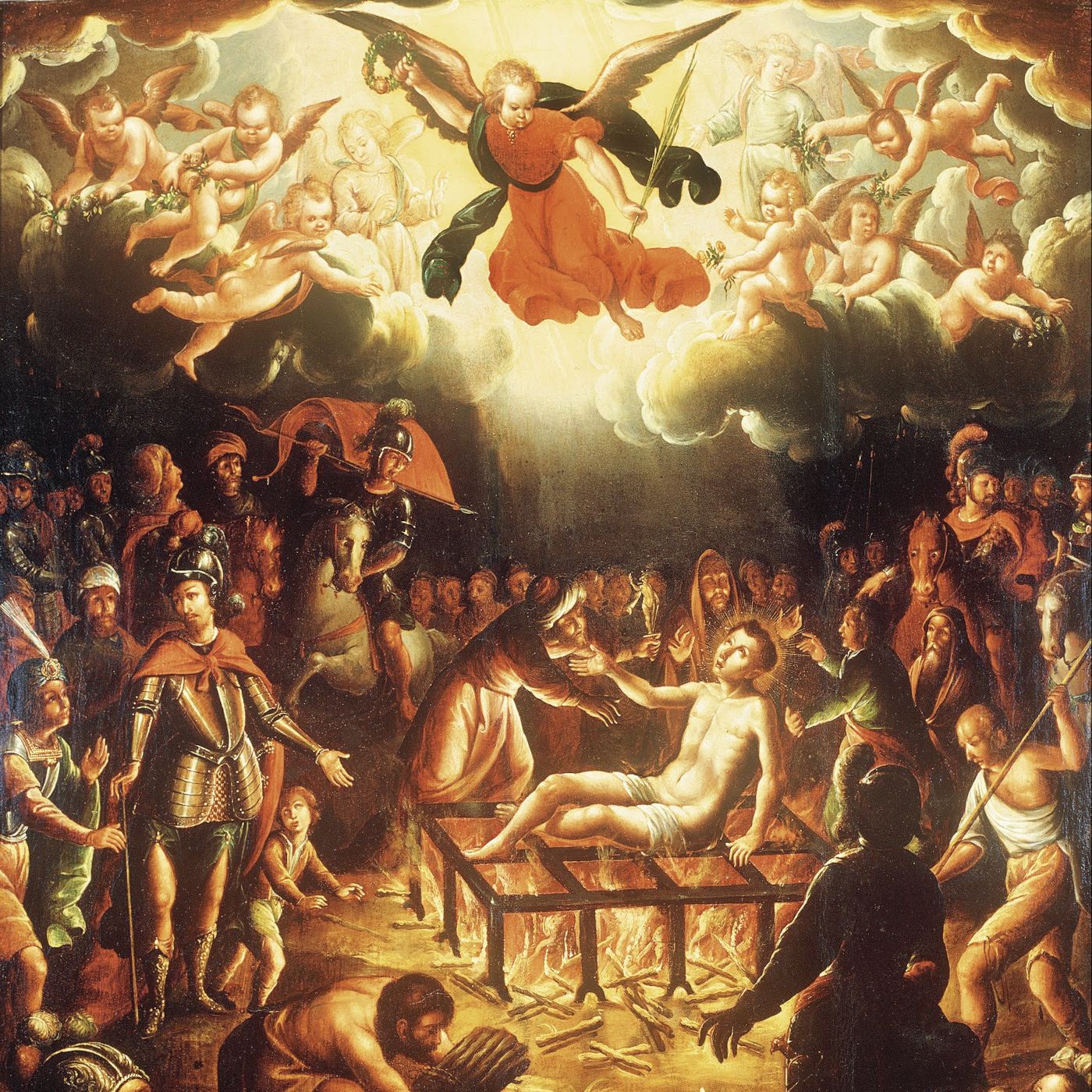
Catholic Saints & Feasts of the Liturgical Year
August 10 - Saint Lawrence, Deacon and Martyr—Feast
00:11:43
https://mycatholic.life/saints/saints-of-the-liturgical-year/august-10---saint-lawrence-deacon-and-martyr/ August 10: Saint Lawrence, Deacon and Martyr—Feast c. 225–c. 258 Patron Saint of archivists, armories, book lovers, brewers, butchers, cooks,...
Loading summary
Transcript1 lines
- [00:00]
A
Foreign. Welcome to saints and feasts of the liturgical year from My Catholic Life Aug 10St Lawrence, Deacon and Martyr Feast circa 225 to circa 258 Patron Saint of archivists, armories, book lovers, brewers, butchers, cooks, comedians, deacons, glaziers, laundry workers, librarians, firefighters, poor people, restauranters, school children, seminarians, tanners, vine growers, winemakers, and Rome invoked against fire and lower back pain Pre congregation canonization Such gold the holy martyr Lawrence preserved for the Lord, for when the treasures of the Church were demanded from him, he promised that he would show them. On the following day he brought the poor together. When asked where the treasures were which he had promised, he pointed to the poor, saying, these are the treasures of the Church, and truly they were treasures in whom Christ lives, in whom there is faith in him. These treasures Lawrence pointed out and prevailed, for the persecutors could not take them away. Lawrence, who preferred to spend the gold of the church on the poor rather than to keep it in hand, for the persecutor received the sacred crown of martyrdom for the unique and deep sighted vigor of his meeting from St. Ambrose of Milan. Today's Reflection Though not much is known for certain about St. Lawrence, he has been highly revered as a martyr and deacon from at least the 4th century. Most of the legends come from the detailed writings of St. Ambrose, who served as Bishop of Milan from 374 to 397, more than a century after St. Lawrence's death. His writings are likely more of an imagined telling of the story than a literal account. Another early source of St. Lawrence's life and martyrdom comes in the form of a Latin poem written by the Christian poet Prudentius, who lived circa 348 to circa 405. Finally, the later Passio Sancti Laurenti gives other details about St. Lawrence, which come from an anonymous Spanish author who most likely did not Write until the 5th or 6th century from these three sources, as well as from the writings of others such as St. Augustine of Hippo and Pope St. Gregory the Great, great reverence and devotion to St. Lawrence and have flourished throughout the centuries. He is even one of the few early martyrs named in the Eucharistic prayer. 1 the Roman canon. It is for these reasons that today's celebration holds the rank of a feast within our church. According to these legends, Lawrence was born in Spain, perhaps in Asca in Aragon, near the foot of the Pyrenees mountains. Both of his parents are believed to have been martyrs as a youth he is said to have been Brilliant, studying humanities and theology in Zaragoza, where he met the future Pope, Saint Sixtus ii. After Lawrence completed his studies, he and the future Pope traveled to Rome. In Rome, Lawrence was ordained one of the city's seven deacons, most likely as the head of the seven deacons, the Archdeacon of Rome. As Archdeacon, Lawrence was put in charge of the Church's material possessions and was responsible for distributing alms to the poor. By the time Pope Sixtus II was elected Pope in 257, he and Deacon Lawrence are believed to have had a strong friendship. In 253, Valerian became the Roman Emperor. At first he tolerated Christians. However, in 257 he issued an edict that began a fierce persecution of the church. St. Cyril, then the bishop of Carthage, North Africa, who also died a martyr under Valerian, described the persecution this The Emperor Valerian has consigned to the Senate a decree by which he has determined that all bishops, priests and deacons will be immediately put to death. I communicate to you that Sixtus suffered martyrdom on 6 August together with four deacons while they were in a cemetery. The Roman authorities have established a norm according to which all Christians who have been denounced must be executed and their goods confiscated by the Imperial Treasury. The Liber Pontificalis identifies two other deacons who were martyred with Pope Sixtus for a total of six deacons on August 6, 258. Januarius, Vincentius, Magnus, Stephanus, Felicissimus and Agapitus. According to St Ambrose's account, Deacon Lawrence was martyred four days after his close friend and spiritual father, Pope Sixtus ii, and the other deacons who were put to death. Ambrose records this exchange between the two prior to the Pope's. St. Laurence wept when he saw his bishop Sixtus led out to his martyrdom. He wept not because he was being led out to die, but because he would survive Sixtus. He cried out to him in a loud voice, where are you going, Father, without your son? Where do you hasten to, holy Bishop, without your deacon? You cannot offer sacrifice without a minister. Ambrose records Pope Sixtus as responding. I will not leave you. I will not abandon you, my son. More difficult trials are kept for you. A shorter race is set for us who are older. For you who are young, a more glorious triumph over tyranny is reserved. Soon you will see. Cry no more. After three days you will follow me. After Pope Sixtus and the other deacons were martyred, Deacon Lawrence was arrested because he was in charge of the riches of the Church. The Prefect of Rome demanded that Deacon Lawrence hand over to him all the treasures of the church. Lawrence requested three days to gather them, during which time he distributed all he could to the poor. After three days, Deacon Lawrence appeared again before the prefect and pointed to the poor, the crippled, the blind, and the suffering of Rome, saying, these are the treasures of the church. This infuriated the prefect, who had anticipated receiving gold and silver. He ordered that Deacon Lawrence be burned on a gridiron. St. Ambrose Records Deacon Lawrence's last act of heroic virtue and defiance of diabolical oppression. This way, however, after three days, he was placed upon the gridiron by the tyrant whom he mocked and was burnt. He said, the flesh is roasted. Turn it and eat. So, by the courage of his mind, he overcame the power of fire. What is known for certain is that St. Lawrence of Rome gave his life for Christ. After that heroic act of selflessness, God raised St. Lawrence back to life, not physically, but spiritually, making him an icon of Christ to inspire others. Because St. Lawrence is believed to have been burned on a gridiron, he had become known as the patron saint of cooks and tanners because he cared for and hid important documents of the church before dying. He is the patron saint of archivists and librarians. And because of the humor Lawrence displayed while dying, as recorded by St. Ambrose, he is the patron saint of comedians. From the third century onward, St. Lawrence has been highly venerated in Rome and is considered a patron of Rome after Saints Peter and Paul. After Constantine the Great legalized Christianity in the 4th century, tradition holds that he built a basilica over the tomb of St. Lawrence that became one of the seven main churches in Rome, the Basilica di San Lorenzo Fiori le Mura. As we honor this legend of heroic virtue within the Roman Church, ponder not only his courage, but also the way that God has used him to inspire many throughout the centuries. Though acts of courage may be difficult at the time they are performed, the good fruit of such heroism lives on. Seek the intercession of St. Lawrence today, asking him to pray for you so that you will have the courage to do all that God asks of you, even using humor when helpful, so that you will find joy in in everything, even persecution and suffering. Let us pray. St. Lawrence, you gave your life to Christ at a young age and followed him to your death with courage. You executed your duties to the poor with fidelity and saw them as the true treasures of the Church. Please pray for me that I will have the courage that you had to say yes to Christ, no matter what he asks. Of me. St. Lawrence of Rome. Pray for me, Jesus, I trust in you.