Loading summary
Transcript108 lines
- [00:01]
A
So I want to tell you about an experience I had recently. I woke up one morning, walked into my closet and realized I don't really have any clothes. At least not clothes that look good or fit me. And the reason it's gotten to this point is because I don't want to spend a bunch of money on clothes and I don't want to buy cheap clothes that don't look good. Well, it turns out there is a solution to this problem. I recently got put in touch with a company called Quince. Some of you probably already heard of this company, maybe you already use it, but Quince has nice, good looking, affordable stuff and, and it's versatile. They've got 100% linen shorts and shirts starting at $34. I live in the south and it's important for stuff to be lightweight and breathable and comfortable. And this checks all those boxes. And what's crazy is that they are not just a little bit cheaper than their competitors, but like 50 to 80% cheaper. And to me, there's a difference between inexpensive and cheap. Quint's is inexpensive. The stuff is not cheap. It's well made, it's comfortable and it looks good. I recently got a linen button down from Quince and it fits perfectly. No awkward spots where it's tugging or too tight. It's extremely comfortable, it's breathable. And again, you can stock up your wardrobe for a pretty low price tag without sacrificing quality. Refresh your everyday with luxury you'll actually use. Head to quince.com familylore for free shipping on your order and 365 day returns. Now available in Canada too. That's Q-U-I-N c e.com familylore for free shipping and 365 day returns. Quince.com familylore
- [01:24]
B
Everyone learns a language for different reasons. Maybe you want to watch K dramas without subtitles or talk with family members in their native language. Your life is unique. Your language learning should be too. Rosetta Stone, the trusted leader in language Learning for over 30 years, just launched Rosetta Stone Sapphire, a new app that combines its proven immersion method with the latest innovation in technology to help you learn faster, personalize your lessons, and have more fun along the way. Most language apps reach the same generic topics. Sapphire helps you focus on what you actually want to talk about, whether that's travel, family, work, or your favorite hobbies. If you want to take your language skills to the next level, don't wait to try Rosetta Stone Sapphire listeners can get 20% off their Rosetta Stone Sapphire subscription. When they sign up today, you'll get unlimited access to all 25 Rosetta Stone languages plus all the new Sapphire learning tools. Visit rosettastone.com audio to redeem your 20% off. That's rosettastone.com audio and start learning a language for real.
- [02:31]
A
In our last episode, we heard from a gentleman from the Netherlands named Paul Post. In his retirement, Paul became a researcher and a self taught investigator. He used his father's journals to uncover information about a man named Friedrich Katkin, who served as a sort of Nazi finance guru. Katkin reported to the Nazi leader, Hitler's second in command, Hermann Goering, and together, Goering and Kotkin stole a myriad of precious items, including diamonds and art. After the war, Hermann Goering was convicted at Nuremberg before killing himself in his jail cell with a smuggled cyanide capsule. Friedrich Khatkine, however, escaped. At the end of the previous episode, Paul had traced Khotkin's movements to Mar del Plata, Argentina, where they discovered a piece of art that the Nazi had looted and smuggled into the country. And with that piece of art, Paul Post's family story intersected with the story of another family. In today's episode, we're going to hear from that family. I'm Lloyd Lockridge and this is family lore. So could you tell me your name and where you're from?
- [03:44]
C
Yes. My name is Charlene Von Sayre and I was born in the UK and currently live in Connecticut it in the US my family came over to the US on the QE2. My sister, my parents and two dogs and the car all on the QE2. I know my parents were happy and ready to start life in the US and we have been in Greenwich, Connecticut since 1975.
- [04:18]
A
For Charlyn von Sayre, growing up in Connecticut was a pretty idyllic experience. She remembers learning how to ride her bike on Todd Lane, her parents running alongside her as she wobbled forward with nervous excitement. In the winter, Charlynn's mother, Marais Von Sayer, a retired figure skater, taught her to ice skate.
- [04:38]
C
So when we joined the skating club, it was kind of a big deal for everyone to see my mom skate around. And then, you know, my sister and I took lessons there and I continued
- [04:51]
A
because I liked it, she liked it and she was very good at it. As she got older, she began competing at a very high level, the highest in fact. Charlyn and Nancy Kerrigan trained under the same coach. And in 1993, Charlyn won the gold medal at the British Championships. In 1994. She competed at the Olympics in Norway. But unlike her friend Nancy Kerrigan, Charlyn didn't represent the United States. Ultimately, she decided to represent England, her place of birth. And those probably weren't her only two options, because Charlyn's background is somewhat complex. She was born in England to a father who was born in Amsterdam but raised in America, and a mother who was born and raised in West Germany, which no longer exists, apparently.
- [05:38]
C
My first language was German, but when my sister and I entered school in the US we didn't understand anything because we were speaking German, and my mom said, no more German in the house, only English.
- [05:53]
A
Despite losing the German, Charlyn was always aware of her European roots. As a young girl, she and her sister would go to Holland to visit their paternal grandmother, Daisy.
- [06:03]
C
I loved my grandmother Daisy very much. My sister and I visited her in the summers often.
- [06:12]
A
And there in Holland, Charlyn would pick up bits and pieces about what her grandmother's life was like growing up.
- [06:18]
C
Her mother was a very famous soprano in Vienna, and Daisy grew up in Vienna amongst a very affluent inner circle, people like Freud, Klimt. Klimt, in fact, drew a portrait of her, and I think she learned her first, you know, brushstroke from him. Yeah, they were socializing among a very elite class.
- [06:48]
A
Tell me, as a grandmother, what was she like?
- [06:52]
C
She was extremely generous, gracious, nurturing, loving, warm and cozy. You know, she was that sort of warm and fuzzy grandmother, but a little bit fancier. She was easy to hug, let's put it that way.
- [07:09]
A
And occasionally, Charlyn's grandmother would talk about life in the 1930s, when she was still married to Charlyn's grandfather, a man named Jacques Goudsticker. In a sense, Jacques was one of the reasons Daisy had moved back to Holland in the first place.
- [07:25]
C
I think she just felt perhaps closer to Jacques, who was her true love. But she spoke about Jacques and how wonderful he was and how much he would have loved us. She always said that. And she also told me that he loved food, and he would sort of satisfy his cravings by reading cookbooks.
- [07:52]
A
So he was, like, way ahead of his time. Nowadays, everyone sits around watching the cooking channel or reels or whatever.
- [07:57]
C
Exactly.
- [07:59]
A
And what else did she tell you about him?
- [08:01]
C
That he was romantic and, you know, gave her lots of beautiful little gifts and jewelry and was very loving. I don't know why, but I didn't think to ask more in depth questions, maybe because we were just enjoying each other's company and in the present. So I don't know why I didn't. And I do regret not asking more. But clearly she didn't want to tell me or talk about it. Otherwise she would have.
- [08:35]
A
But still, Daisy would take Charlyn and her sister down memory lane, and we
- [08:41]
C
would jump in her car and drive by Ninerota Castle and Oostamir, which was their actual home that they lived in, and Herngracht 458, which was my grandfather's place of business, his art gallery. And she would tell us that these properties were once hers. And I guess as a kid, I never understood then why they weren't still hers. And I do clearly remember she would look at me and my sister and she called us like her sweet. She would say, my sweet. Things were different before the war. And that's really all I got from her on that.
- [09:30]
A
As a child, Charlyn didn't quite understand why her grandmother was reserved in talking about the love of her life. Shock. And she didn't pry. She had a loving relationship with Daisy, and that's all that really mattered to both of them. In 1996, when Charlyn was in her 20s, Daisy passed away and Charlyn went to Europe to pay her respects. While she was there, she obtained her grandmother's diary. And in the pages of that diary, Charlyn encountered for the first time a full picture of her grandmother's life, especially the aspects of her life she didn't want to talk about. Charlyn's grandfather, Jacques Goudsticker, did not merely run an art gallery. He was a prolific art collector, dealer, and aficionado with arguably the most respected business in Amsterdam. Charlyn now had an intimate account of what happened to that business and what happened to Jacques.
- [10:24]
C
Everything started to come together. I understood why she didn't want to talk about things, but I started to understand the magnitude of the situation. And I just became really angry.
- [10:52]
B
We all belong outside. We are drawn to nature. It calls to us. Whether it's the recorded sounds of the ocean we doze off to or the succulents that adorn our homes, nature makes all of our lives richer, calmer, and frankly, better. Despite all this, we often go about our busy lives removed from it. But the outdoors is closer than we realize. With all trails, you can discover trails nearby or trails worth traveling to and explore confidently with offline maps and on trail navigation. Whether you're looking for a laid back walk with family or something more adventurous to get your heart pumping, Alltrails gives you the tools you need to get out there and find your outside. Download the free app today and make the most of your summer with alltrails. What if everything you learned in history class was only half the story? I'm Dr. Harini Bhatt, host of Hidden History. Every Monday I go where history gets mysterious vanished civilizations, doomsday prophecies, paranormal phenomena and events that science still can't fully explain. On Hidden History. I treat these moments like open case files. Not myths, not superstition, just incomplete explanations waiting for a closer look. Listen to and follow Hidden History available now wherever you get your podcasts do you love your pets? Do you love suspense? Do you love it when your pets keep you in suspense because they ate something mysterious? And who knows what the vet visit will cost? If you answered yes twice and then no, you should protect your pet with Lemonade Pet Insurance. It can save you up to 90% on vet bills for checkups, emergencies, diagnostics, all the stuff that leaves you financially on the edge of your seat. Get a quick and Easy quote@lemonade.com pet and get your suspense somewhere else, like from a riveting podcast.
- [12:55]
A
So prior to obtaining her grandmother's diary, there were details Charlyn knew about her grandmother's background. She knew that her grandmother Daisy was in Holland when World War II broke out. She knew, of course, that because Daisy and Jacques were Jewish, they had to flee when the Nazis invaded. But the details were shrouded in mystery. Then, after Daisy passed away and Charlynn came into possession of the diary, the shrouds lifted and Charlyn got a firsthand account of their lives.
- [13:22]
C
I think they were again part of the upper class, and I truly believe that they didn't think the war would really affect them. They would not be taken to a concentration camp. Simon Goodman wrote a great book called the Orpheus Clock, and it was quite evident in that book that a lot of the upper class Jews were even socializing before the war with people that ended up being Nazis, but it was just not even recognized. So I think they kept waiting and waiting because they really didn't think anything was going to happen.
- [14:10]
A
Then, on the morning of May 10, 1940, Dutch citizens woke up to the roar of German bombers flying overhead toward the North Sea. As the planes passed, the residents of Amsterdam would have assumed that the Luftwaffe was headed to England. But soon after passing by, the planes began to bank, turning 180 degrees, headed straight for the Netherlands. The Germans began dropping bombs and paratroopers all across the country.
- [14:39]
C
I can't say exactly when, but I have some translations of Daisy's diary and she talks about how the atmosphere is changing, and she is feeling unsafe. But Jacques doesn't want to leave. Doesn't want to leave everything that he's built with his business and his life there. But I guess at a certain point, they had no choice.
- [15:06]
A
What was their route of escape?
- [15:08]
C
They took my grandfather's car. I think it was like a Lincoln Zephyr or something like that. They had to leave it on the side of the road. There was too much traffic. And they ultimately made it on the last ship out.
- [15:25]
A
Daisy and Jacques fled on May 14, 1944, days after the surprise invasion and one day before the Netherlands signed a capitulation agreement with Hitler, leaving the nation under full Nazi control. They left with only a few personal belongings, including a little black book which contained the inventory for all of Jacques art. Jacques kept the book in his jacket pocket, and strapped to Daisy's chest was Charlyn's father, Ado, who was only about a year old. Everything else, their beautiful home, the gallery, the furniture, the art, it was all left behind.
- [15:59]
C
There was a lot, a lot of beautiful things that were left behind. I mean, my grandmother packed like a little beach bag and threw some jewelry in there and some diapers for my father, and they left.
- [16:16]
A
With regard to these possessions, especially the art that was left behind, what becomes of it? What happens next to the art collection in particular?
- [16:25]
C
Hermann Guring had sort of scouted out all of the top art collections, I think, prior to the war. So he knew exactly where his first stops would be. So Hermann Goering and Alois Meadle basically took over and stole all of the artwork. Miedel stayed and ran the gallery with Jacques, you know, entire infrastructure in place. Because he was very well respected.
- [16:57]
A
The Nazis took over the gallery. They sold some pieces and looted others. The marvelous business Jacques ran was completely desecrated by Hitler's second in command, Hermann Goring, and a man named Alois Meedel. Meedel was actually married to a Jewish woman, and the couple had initially moved from Munich to Amsterdam for fear of rising anti Semitism in Germany. But as the Nazis invaded, Miedel was able to curry favor with Goering, and his Jewish wife was designated an honorary Aryan. And Alois Miedel not only commandeered Jacques's gallery, he moved into the Goudsdicker home, where he once hosted a gala to celebrate Hitler's birthday. But despite their best attempts, the Nazis did not erase all traces of Jacques Goudsticker, because on the back of each painting, there was a literal Goudsticker stamp of approval. It was a little Red wax seal which guaranteed the authenticity of each individual work. And knowing the value of a goud sticker, imprimatur. The Nazis left the stamps alone.
- [18:01]
C
I didn't understand at the time why all the labels on the backs of the paintings weren't peeled off. You would think that would make sense. That way no one could recognize where they once belonged. But my grandfather had stickers and a red wax seal that he put on the back of each of the paintings. And they left those in place because it proved the value of the pieces since he was so well respected in the art field.
- [18:37]
A
As the Nazis took control of Amsterdam, Jacques and Daisy were on board an England bound ship.
- [18:43]
C
And one evening, a couple of nights after they were on there, my grandfather went up on the deck for some air. And the lights were turned off because the boats were being torpedoed all around. And my grandfather fell into a hold and fractured his skull. And my grandmother was down below with my father and asked the crew members to find her husband. And ultimately one of the crew members also fell into the hold on top of. My grandfather did not die because he was cushioned by Jacques's body. And then my grandmother had to continue on the journey without her husband.
- [19:37]
A
The ship arrived in Falmouth, England, but Daisy was not able to get off. This was because her passport was issued by Austria, where she was born, and she was considered an alien enemy. So Jacques's body was taken off the ship and Daisy was not allowed to accompany him.
- [19:54]
C
She was able to plan the funeral, though. In Falmouth. I think that's the southwestern coast. Beautiful, beautiful place. She was not allowed off the boat, and she made sure that he had a good spot overlooking the water and that they play his favorite song, which was Cole Porter's Night and Day at the funeral. And she was lucky because at that time, most people were just thrown overboard if they died.
- [20:29]
A
Man, that is just. You know, I'm just trying to imagine what your grandmother must have been thinking. I mean, weeks earlier, you know, life was great.
- [20:38]
C
Yeah, life was amazing. A few weeks earlier.
- [20:42]
A
It's hard to fathom such a swift and devastating turn of events. It was spring in Amsterdam. I imagine the tulips were in full bloom, the cafes were exploding onto the sidewalk, and packs of cyclists poured through the streets like synchronized schools of fish. Daisy and Jacques were in love. They had a beautiful home, a thriving art business, a vibrant social life, and a newborn baby. And over the course of just four days, they have to leave it all behind. Then, after escaping by the skin of their teeth, Jacques, a loving husband and father, dies in a freak accident, and Daisy can't even be there to lay him to rest. The last time she sees him, he is being carried off a ship. Alone in a foreign land, and with little money and even fewer options, Daisy sets sail to the Americas.
- [21:33]
C
She continues on. She lands in Canada and spends some time there before making her way to New York. And that's where they stayed for quite a while.
- [21:47]
A
In 1945, the war finally ended, first in the European theater. As the Allies converged on Berlin. Hermann Goering, the Nazi leader who stole much of the Gouds ticker collection, surrendered in Bavaria. Upon his capture, he was carrying suitcases filled with stolen items and works of art. Without much delay, Daisy started the process of reclaiming her possessions. The Allies had already begun returning stolen items across Europe. But in Holland, things were not so simple.
- [22:17]
C
The Allies returned a lot of the art that they found in Germany and other places to the country of origin and those countries. Holland, in our case, was supposed to return everything to the rightful owners. And they did not do that.
- [22:35]
A
And do we know why?
- [22:37]
C
I believe they felt that the transaction was voluntary and not involuntary. And they, I think, were more interested in their post war collections and kept things for themselves.
- [22:55]
A
So following the war, the Dutch government made the case that much of the Goud sticker collection was legally sold and no longer owned by his estate. And because Jacques Goudsticker was deceased, they probably anticipated little resistance to that position.
- [23:10]
C
I mean, my grandmother was a young, single, at this point, Jewish woman. I think they just didn't think that she would fight.
- [23:20]
A
They took the opportunity to portray this as a voluntary sale, which it was obviously a coerced sale. And because Jacques was no longer alive, they thought nobody would come back to reclaim it.
- [23:31]
C
Exactly.
- [23:32]
A
And how much time and effort did she put into dealing with the Dutch government, recovering the art?
- [23:38]
C
She tried very hard until 1952, and she signed an agreement. But in the agreement, she specifically states that she does not agree with. With how things were handled and that she does not give up her rights to the Gurring portion of the collection.
- [24:02]
A
The Gurring portion being the portion of the collection that was looted by Hermann Guring?
- [24:06]
C
Yes, the larger and more valuable portion of the collection.
- [24:12]
A
Okay, so after signing that document, does she continue to try to track down the Goering portion, or does that just proved too difficult?
- [24:21]
C
She ran out of money. She couldn't. She was wealthy before the war, but not after, and she ran out of money. She couldn't spend all of her money trying to get her possessions back.
- [24:33]
A
As you're learning this as an adult, you're learning about these incredibly tragic events. Your grandmother having this rich life. And I don't mean just money. I mean this very vibrant life that falls apart very rapidly, resulting in her having to flee with the love of her life, who dies on the voyage, and she has to go off on her own. I'm wondering, as you're learning all of that, how did it change the way you thought about your grandmother?
- [24:59]
C
I think that I really learned what a tough cookie she was, like, what a strong, independent woman she was, and how. How sad she must have been. I know she was depressed a lot. I know that from my dad. And I mean, how could you not be?
- [25:24]
A
At the time of daisy's death in 1996, Charlyn didn't know the half of this story. And her father, who probably knew more than her, died only six months after his mother, Daisy, after a long battle with leukemia.
- [25:37]
C
We were going about our lives, and a year after my father passed away, we received a call from a Dutch journalist named Peter Denhollander. And in so many words, he said, do you realize you have a claim against the Dutch government? And we looked at each other, and my sister was there, too. And we were not quite sure what he was talking about. So before we knew it, he was in Connecticut. He came over to our home, and we had, you know, a long discussion. And then he said, oh, do you have any of the paintings in your home? And we did. We had one small painting, and he said, can you please show it to me? And it was upstairs in my mom's bedroom. And we went up, and he took the painting off the wall and turned it around and showed us the back, which we had never done. We didn't even think to look at the back of a painting. And there was the red wax seal and the stickers that my grandfather used to identify his paintings. And Peter then explained to us that there were many, many more of these that were in the possession of the Dutch government that shouldn't be, and that we had a claim to them.
- [27:07]
A
But how would Charlyn and her mother know which pieces of art to look for? Yes, there was the red wax seal, but what if those had been removed? And what about the more scattered and elusive portion that was looted by Hermann Goring? Finding them would be hard enough, even if they knew exactly what they were looking for. Well, to deal with that challenge, they were left with an item almost like a treasure map. It was something that Daisy had been holding onto since the day Jacques died. Until the day she died back in 1940. After Jacques died tragically on the boat he and Daisy had boarded to escape the Nazis, Daisy had to identify his body. And as she said her last goodbye to Jacques, she reached into his pocket and removed something from his jacket.
- [27:52]
C
When Jacques's body was recovered, Daisy had the wherewithal to take his little black book out of his jacket pocket, which inventoried the entire collection.
- [28:07]
A
The entire collection. Jacques had recorded everything in this little black book, and Daisy had held onto it for all those years, maybe as a keepsake, a kind of totem that connected her to the love of her life. Or maybe because somewhere deep down, she knew that someone might someday pick up the torch.
- [28:39]
B
You know that thing where you get an amazing pair of shoes at a really great price and want to tell everyone about it?
- [28:45]
C
Yeah. So do we.
- [28:47]
B
Here at Designer Shoe Warehouse. We'll give you something to brag about, like the latest styles from brands you love or the trends everyone's obsessing over or shoes that make you feel like, well, you. So go ahead, show off a little. Find shoes that get you at prices that get your budget. Head to your DSW store or dsw.com today. DSW. Let us surprise you.
- [29:09]
A
This episode is brought to you by Progressive Insurance. Do you ever think about switching insurance companies to see if you could save some cash? Progressive makes it easy. Just drop in some details about yourself and see if you're eligible to save money. When you bundle your home and auto policies, the process only takes minutes and it could mean hundreds more in your pocket. Visit progressive.com after this episode to see if you could save Progressive Casualty Insurance Company and affiliates. Potential savings will vary. Not available in all states. When Charlyn and her mother embarked on this journey to recover their family's possessions, it was the late 90s. Information in general was not as accessible as it is today. And if you wanted something, you often had to go out and get it. When they were approached by the Dutch journalist Peter Denhollander, he invited Charlyn to accompany him to the Washington archive to speak to an elderly archivist who knew a lot about wartime theft.
- [30:02]
C
And he pulled out after quite some time, came out with a large cart of files that some were. I mean, they must have been unclassified at the time, but they had the stamps on them originally that they were classified. And Peter and I started to go through them and, yeah, that's where I saw some of the correspondence and the dealings that had gone on. And I think that is when I officially knew things were not, you know, taken care of properly after the war and that my family was not treated properly. I felt a little bit like an investigator. And Peter, who was an investigative journalist, we got to a point where we said, we can't keep doing this. Let's take what we have and let's move on. You know, let's go home. Let's come up with a plan on next steps.
- [31:04]
A
And what plan did you come up with?
- [31:07]
C
So we went. My mom and I went back to Holland and we interviewed some attorneys, and one of them laughed at us and said, you will never get anything back that the Dutch government possesses now. Like, don't waste your time. But then we did find some attorneys that were great.
- [31:31]
A
And around the same time, upon hearing that Charlyn and her mother were up to something, the Dutch government proactively reached out to the Von Sayers.
- [31:38]
C
I think we met at the Dutch consulate. They told us not to bring our attorney. They flew all the way to New York to discourage us from pursuing our claim and told us not to bring an attorney, but brought their attorney. It was just very odd. And I think at that moment, we kind of realized they were scared. And it almost really fueled the fire.
- [32:08]
A
But their first recovery did not come from the Dutch government. It was May of 2001, and Christie's was auctioning a piece of art by the Flemish painter Jan Willens de Koch. The Von Sayers team cross referenced the painting, saw that it was on their list, and swooped in. Sure enough, there was a gap in the provenance and on the back of the painting, a red wax sticker. After 60 years, the painting was returned to its rightful owner, the descendants of Jacques Goudsticker. The title of the painting was the temptation of St. Anthony. That's St. Anthony, as in the patron saint of lost items.
- [32:48]
C
That first painting coming back sort of set the stage. It sort of made everything become a reality. And at least for me, I thought, okay, this really is happening. We really are going to do this. And if it's one piece at a time or a group of paintings from the Dutch government, whatever, we're going to keep going, and we're going to fight for this.
- [33:16]
A
Right. So you've got some wind in your sails after this, right? And what's the pace going forward? Are you recovering things all the time? Is it slow and steady?
- [33:24]
C
No, it's slow and frustrating. Yeah, very slow and frustrating. And I know my mother, at least along the way, sometimes felt like we should throw the towel in, but we didn't. And I think she's happy that we didn't. And she's been pretty strong along the way. And it worked out and it's still working.
- [33:50]
A
From 2001 to 2006, the paintings trickled in. It was frustrating, as Charlin puts it. But in 2007, after almost 10 years of legal maneuvering, the Dutch government returned the Goudsticker collection to the von Sayers. 202 paintings worth millions. So I want to know what it was like to hang one of those paintings in your home.
- [34:16]
C
It felt like we had restored a little bit of my grandfather's legacy. We had corrected an historical injustice. It felt amazing to hold something in my hands that my grandfather once held and once loved. Yeah, it just. It was a very good feeling.
- [34:46]
A
The Von Sayers are still tracking down pieces of art. Usually something will appear at an auction, and in most, if not all cases, the art will have changed hands many times before it resurfaces. But to that rule, there is one very special exception. And it starts with our guest in the last episode, Paul Post. If you didn't have a chance to listen. Paul is a Dutch retiree who spent the last decade or so investigating a case of missing diamonds. The diamonds were stolen by Nazis from the Diamond Bourse in Amsterdam. And Paul's father, who worked at the Diamond Bourse, had left behind a diary and documents with various leads.
- [35:22]
C
It begins, I believe, with a gentleman, Paul Post, who had found a diary in his father's attic.
- [35:33]
A
And very quickly the diary led Paul to a mysterious Nazi officer named Friedrich Kotkin, who was an advisor to Hermann Goring. Paul believes that Kotkin made off with a significant sum of diamonds which he used to make safe passage to Argentina where he lived out the rest of his days.
- [35:49]
C
He saw this name in his father's diary and started to research. And he found that there were sales between him and Meadle.
- [36:03]
A
To refresh your memory, Meadle was the man who took over the Goudsdicker collection and moved into the Goudsdicker home, among other abominations. In his research on the diamonds, Paul stumbled upon information that showed Miedel had sold a Goud sticker owned piece to Friedrich Kotkin. This is Paul Post.
- [36:21]
C
I found a database in Holland of the dealing with stolen art in war. And I went into that database and I looked for the name Khatkin and I found two hits.
- [36:39]
A
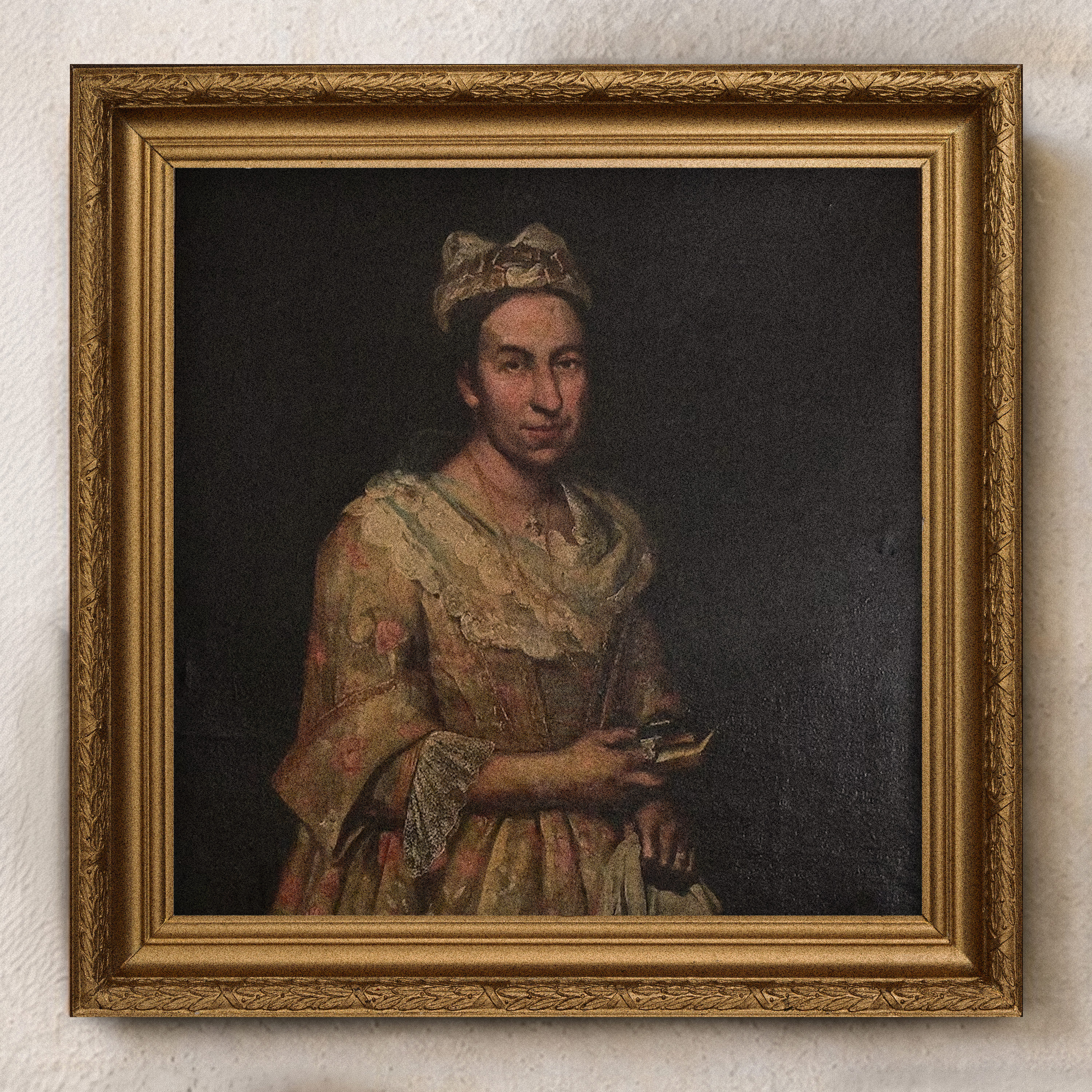
One of the hits was Portrait of a Lady by the Italian Baroque painter Giacomo Cerrutti. Paul knew that Friedrich Khotkhin had a daughter who lived in Mar del Plata, a beach town south of Buenos Aires. So with the help of a Dutch journalist, he asked an Argentinian journalist to go down to Mar del Plata and see if Patricia Kotkin would be willing to answer any questions about the missing art.
- [37:00]
C
Well, that was a bit tricky because, well, you can ring on the bell, but they never open for questions to a journalist.
- [37:10]
A
Patricia Kotke never answered the door, and pretty soon she wouldn't be expected to answer the door, because apparently Patricia was hoping to move. There was a for sale sign in the front yard. So out of idle curiosity, the journalist went on the listing and started perusing pictures of the home.
- [37:28]
C
They went to the website for the estate agency, and they saw all the pictures of the interior of the house. And on one of the pictures, they saw the painting hanging in a photo
- [37:41]
A
of the living room. Hanging above a green velvet couch in the home of Friedrich Kotkin's daughter was the missing portrait of a lady painting.
- [37:50]
B
An Italian painting stolen by the Nazis from a Jewish art dealer in Amsterdam has been been spotted on the website of an estate agent selling a house in Argentina more than 80 years after it was taken. An online photo shows.
- [38:04]
C
It's a good story. I just. It is just amazing that this painting was found in the manner that it was found. Some experts did a formal report and have also confirmed that it is the painting that once belonged to my grandfather and was stolen by the Nazis.
- [38:32]
A
I guess I want to ask, you know, does this portrait of a lady case feel like just another case, just another retrieval, or does this one feel different?
- [38:42]
C
This one feels a little bit different for me because the painting has been in the hands of. Of a Nazi's daughter for all of these years. A lot of the other paintings that we've recovered along the way, people perhaps bought in good faith and didn't know. Not everyone, but some of them. And this one, again, I don't know how much this woman knew about her father and his past, but she is the daughter of a Nazi, and he stole possessions. And I'm sure, I mean, he was a Nazi, he indirectly murdered a lot of people. So it just feels a little bit closer to history rather than the pieces that have changed hands over the years. This one hasn't really changed hands.
- [39:45]
A
As of March 20, 2026, the painting is still in the custody of Argentinian officials. Charlyn and her attorneys are working to have the painting returned. Patricia Kotkin did not respond to our requests for an interview. To date, Charlyn and her mother have recovered about 350 works of art, roughly a third of Jacques Goudsticker's collection. It's not a bad start. Thank you for listening to Family Lore. If you have stories you'd like to share about your family, please email me@familylorepodmail.com that's familylorepodmail.com family lore is an Odyssey Original podcast. It is written and narrated by me, Lloyd Lockridge. Our executive producers are Leah Reese, Dennis and I. Our lead producer and sound editor is Zach Clark. Our story editor is Katie Mingle. Additional sound editing, mixing and mastering by Chris Baseline and production support by Sean Cherry. Special thanks to Maura Curran, Josephina Francis, Kurt Courtney, Hilary Schuff, and Laura Berman. Thanks again for listening to Family Lore, and if you have time, we'd love for you to rate and review the show.
- [41:21]
B
Some Follow the Noise Bloomberg follows the money because behind every headline is a bottom line. Whether it's the funds fueling AI or crypto's trillion dollar swings, there's a money side to every story. And when you see the money side, you understand what others miss. Get the money side of the story. Subscribe now@bloomberg.com
- [41:48]
C
it is not hard to destroy a college.
- [41:51]
B
Last season, the podcast Campus Files brought
- [41:54]
C
you stories of fraternity drug rings, stolen
- [41:56]
B
body parts, campus cults, and more.
- [41:59]
C
And now Campus Files is back for another season.
- [42:02]
A
There's a guy screaming into his phone. He's like, I just saw Charlie Kirk get assassinated right in front of me.
- [42:07]
B
Every week is a new episode and a new story.
- [42:10]
A
It was so chaotic, it's almost like
- [42:11]
B
a university under siege. Listen to and follow Campus Files, available now.
- [42:16]
C
Wherever you get your podcasts.