Loading summary
Transcript98 lines
- [00:00]
Progressive Insurance Announcer
You're listening to this podcast, so I know you've got a curious mind. Here's a helpful fact you might not know yet. Drivers who switch and save with Progressive save over $900 on average. They make it super simple. Pop over to progressive.com, answer some questions and you'll get a quick quote with coverage options tailored to your choices. Plus you'll see which discounts you may qualify for, like the online quote discount or savings for paying in full. In fact, 99% of Progressive Auto customers earn at least one discount. See if you could save when you switch to Progressive. You'll feel good about making a savvy choice. Visit progressive.com and see if you can enjoy a little extra cash back. Progressive Casualty Insurance Company and affiliates national average 12 month savings of $946 by new customers surveyed who saved with Progressive between June 2024 and May 2025. Potential savings will vary.
- [00:50]
DSW Advertiser
You know that thing where you get an amazing pair of shoes at a really great price and want to tell everyone about it?
- [00:56]
Lloyd Lockridge
Yeah.
- [00:56]
DSW Advertiser
So do we. Here at Designer Shoe Warehouse. We'll give you something. Brag about, like the latest styles from brands you love or the trends everyone's obsessing over or shoes that make you feel like, well, you. So go ahead, show off a little. Buying shoes that get you and prices that get your budget. Head to your DSW store or dsw.com today. DSW. Let us surprise you.
- [01:26]
Lloyd Lockridge
Over the next couple of episodes. We're going to hear stories from people who made discoveries about a family member after their past. And we're going to see what happens when a living descendant decides to take on their unfinished business. I'm Lloyd Lockridge and this is Family Lore. Okay, so to start, could you tell me your name please, and where you're from?
- [01:58]
Paul Post
Okay. My name is Paul Post. I'm living in the Netherlands in a small city. Driehaus.
- [02:06]
Lloyd Lockridge
Paul Post is a man in his late 60s. He's retired after 30 years with Hewlett Packard where he was a full time troubleshooter. When you communicate with Paul over email and in person, he comes across as affable and friendly, laid back. And I think he really is those three things. But there's another side to Paul because in his retirement he has become a dogged researcher. I think at this point it'd be accurate to call him an investigator. And Paul did not anticipate or even necessarily want this second career. It was instigated by a journal he inherited from his parents. Could you tell me the Names of your parents?
- [02:47]
Paul Post
My father was. His first name was Wim W I M and my mother name was Ans
- [02:55]
Lloyd Lockridge
A N S And tell me about your father. What did your father do for a living when you were a child?
- [03:02]
Paul Post
Well, when I was a child I only knew he was in a firm for veterinarian food and he was the one who had to buy in the stuff to make the food possible for production. And he didn't tell many things about the time before.
- [03:23]
Lloyd Lockridge
So as far as Paul knew, his father's job and expertise pertained to the production of food for animals. Paul knew that his parents lived in Amsterdam during World War II. In fact, Paul was born in Amsterdam, but he didn't know much about what they did there.
- [03:37]
Paul Post
There were no talking about what happened during the war, only the misery they had that there were no food enough and that stuff, but not really the real life is not discussed.
- [03:51]
Lloyd Lockridge
Did that make you curious?
- [03:54]
Paul Post
Not at that time. And when you grow up and you get older, you are more interested, well, what happened with my parents in the past.
- [04:09]
Lloyd Lockridge
But sadly Paul didn't have much of a chance to talk to his father about his past. Wimpost died in 1976 when Paul was only 25 years old. But his father left something behind. It was a collection of personal journals stored in a cupboard.
- [04:26]
Paul Post
When I came at my mother's house after his death, I noticed them in a cupboard so I knew they were existing. But, well, at that time I wasn't interested in reading them and opening them because there were many other things to do.
- [04:44]
Lloyd Lockridge
Paul carried on with his life. He got married, started a family and had a long successful career with Hewlett Packard. He would at times ask his mother what life was like before he was born. What was life like during the war?
- [04:57]
Paul Post
I wanted to know that history and well, there were no many details about their lives in the wartime and before that, only the pleasant times when they met each other and they, they danced together and that stuff, you know, but not the real life, how it was during wartime. Exactly.
- [05:20]
Lloyd Lockridge
Then in 2007, Paul's mother passed away. And following her passing, Paul had to decide what to do with not only her belongings, but the belongings of his father, which she held onto for all those years.
- [05:32]
Paul Post
Well then at that moment I noticed again his diaries. And when I stopped working in 2010, I thought, well, why don't I just take a look at it? And I went through them and there were three big books and then I knew exactly, well, how did they live and what was happening in their lives? In the years 40, 45.
- [06:02]
Lloyd Lockridge
Suddenly, Paul had an intimate and contemporaneous account of his father's almost daily life. During the war, he worked at a munitions factory until it became a high risk target for bombings. He wrote stories about the continuous struggle to obtain food and clothes. In one entry, Wimpost talks about riding his bike 90km north of Amsterdam in the dead of winter in an attempt to procure food from a farm. He was successful. He got the food, loaded it onto his bike and returned to the city. Another 56 mile bike ride in the freezing cold.
- [06:38]
Paul Post
And when they entered the city again with their bikes, that the Germans took away the food they had gathered with the farmers. So that was really emotional to read how that went.
- [06:57]
Lloyd Lockridge
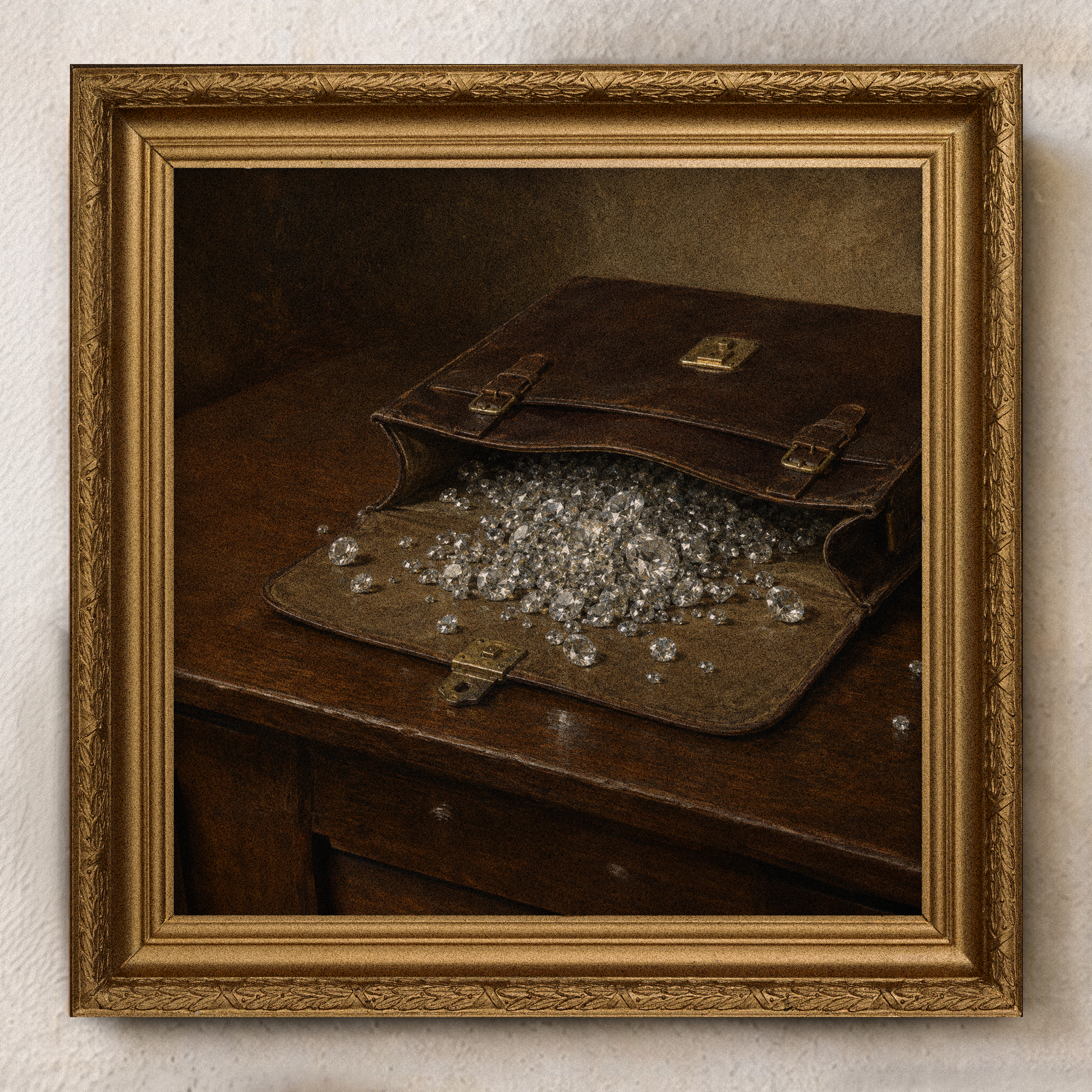
As Paul continued reading the journal, he discovered another chapter of his father's life, one he knew nothing about. After working at the munitions factory, Wimpost took a job at the Amsterdam Diamond Bourse, the oldest diamond market in the world. Some of you may already know this, but Amsterdam is known as the City of Diamonds. And it's had that moniker for a very long time, like 400 years. Something else worth noting is that the diamond industry in Amsterdam and around the world really was largely pioneered by Jewish people. There's a few reasons for this, and the history here is actually pretty interesting. So the first reason is that back in medieval Europe, Catholics were forbidden from charging interest on a loan. This left money lending to the Jews. As collateral for a loan, people would often use jewelry. So the Jewish lenders had to become experts in evaluating the worth of precious gems. The second reason is that most crafts like masonry and blacksmithing, were regulated by Christian guilds. One had to be Christian to do these jobs. Because diamond cutting was a relatively new craft, it was not protected by religious law. It was simply a job that Jews were allowed to do. And lastly, because the Jewish people have been persecuted routinely for the past 2,000 years, they've had to flee their homes and communities, sometimes with a moment's notice. This created a need for portable forms of wealth. You can't flee with your livestock or your house or your land. Even precious metals like gold could be cumbersome. But diamonds, however, are the most concentrated form of wealth on the planet. With diamonds, you could flee with a fortune in your pocket and to bring it back to Amsterdam. The Netherlands was historically a tolerant nation. In the 16th century, it was a refuge for Jewish people fleeing the Catholics as they expelled the Moors and the Jews from Spain. And later on, it was a refuge from the pogroms of Eastern Europe. All that in a very small nutshell is why Amsterdam is the city of diamonds. Home to the oldest diamond exchange in the world, the Amsterdam Diamond Bourse. And it was here at the Diamond Bourse that Paul's father, Wim Post, worked in the early 1940s. His role was administrative. He would log daily transactions and balances.
- [09:20]
Paul Post
He had to write down how many diamonds a certain trader had in his possession and how many were sold, how many they had to bring into the work to work on the diamonds.
- [09:36]
Lloyd Lockridge
For the most part, Wim's experience at the Diamond Bourse was pretty uneventful. But that changed on April 14, 1942.
- [09:46]
Paul Post
He described the event that the Germans came into their office, their diamond agency. And they requested or they demanded that the diamond traders should come into the office and turn in their diamonds at that moment. And they have to give it in completely. And he described that in his diary.
- [10:13]
Lloyd Lockridge
And so what does he say about the experience of having Nazis arrive to confiscate the diamonds?
- [10:19]
Paul Post
He was emotional about that because he saw how the diamond traders reacted on it. Because that's their lives. And it was not only the Jews, it was all the diamond workers and diamond traders. And I think 70, 80% is Jew. But he described their emotions, what happened because. Well, they lost control over their lives.
- [10:46]
Lloyd Lockridge
Did they resist at all or was there no opportunity to resist?
- [10:51]
Paul Post
No, exactly. There was no opportunity. There were people with guns around. And so it was no resistance. He was shocked. He was really shocked. But it was only one page in his diary.
- [11:06]
Lloyd Lockridge
Paul was deeply moved and intrigued by this journal entry. He wanted to know more. But there was just the one entry. But as Paul continued going through his parents belongings, he found something else. It was an envelope. It was sealed. Nobody had ever opened it. And the contents inside the envelope would define the next decade of Paul's life. Zootopia 2 has come home to Disney. Let's go get ready for a new case.
- [11:42]
DSW Advertiser
We're gonna crack this case and prove we're the greatest partners of all time.
- [11:45]
Lloyd Lockridge
New friends.
- [11:46]
DSW Advertiser
You are Gary the Snake.
- [11:48]
Lloyd Lockridge
And your last name.
- [11:49]
DSW Advertiser
The Snake Dream Team Hidden NEW HABITATS Zootopia has a secret reptile population.
- [11:57]
Lloyd Lockridge
You can watch the record breaking phenomenon at home. You're clearly barking at. Zootopia 2. Now available on Disney. Rated PG.
- [12:07]
DSW Advertiser
What if everything you learn in history class was only half the story? I'm Dr. Haruni Bhatt, host of Hidden History. Every Monday I go where history gets mysterious. Vanished civilizations, doomsday prophecies. Paranormal phenomena and events that science still can't fully explain on Hidden History. I treat these moments like open case files. Not myths, not superstition, just incomplete explanations waiting for a closer look. Listen to and follow Hidden History available now wherever you get your podcasts.
- [12:37]
Lloyd Lockridge
You thought this was your Run Club era. Turns out it was more of a thinking about Run Club era. The good news, someone's marathon training is about to start. Sell your workout gear on depop. Just snap a few photos and we'll take care of the rest. They get their race day fit and you get a payout for trying. Someone on Depop wants what you've got. Start selling now, depop. Where taste recognizes taste. It was 2010. Paul's mother had passed away. Paul had recently retired and he was going through his father's wartime journals, learning for the first time that his father had worked in the Amsterdam Diamond Bourse on the day the Nazis barged in. Paul assumed the one journal entry was all there was pertaining to this incident. And then he found an envelope I
- [13:32]
Paul Post
got in my mother's possessions after her death, a closed envelope of the time he was in the Diamond Bureau and the envelope was fully intact, never opened. And in that I found a declaration of him and two colleagues of what happened with the diamonds after they were taken away from Amsterdam. So that he described in detail, it
- [14:02]
Lloyd Lockridge
was a statement detailing exactly how much the Germans had taken from the Diamond Bourse.
- [14:08]
Paul Post
He wrote exactly in that declaration. How many diamond carats, how many carats were brought from Amsterdam to the city of Arnhem, and that was 71,500 carats.
- [14:24]
Lloyd Lockridge
71,500 carats. Assuming those were high quality diamonds, which if they were at the Amsterdam Diamond Bourse, they probably were. That's about a billion dollars worth of diamonds in today's money. And the declaration went into more detail. It said that 31,000 carats were sold by the Germans, leaving 40,500 carats in their possession. With this information, it was now clear to Paul that his father had witnessed one of the biggest heists in history. So he continued researching. And as he did, one name kept coming up.
- [14:59]
Paul Post
All the details, what was happening with the stolen diamonds in Amsterdam. And there was his name every time mentioned. Katkin with a question mark.
- [15:13]
Lloyd Lockridge
Katkin, K A D G I E N. Paul thought that whoever this guy was, he must have been important. And he was a little surprised at someone that important would not have a name that he'd recognize.
- [15:27]
Paul Post
I am interested in history itself and mostly in World War II history. I know a lot of names in the Nazi organization out of the books. And when I was in the archive and I noticed this document that described the 30,000 carats of diamonds sold during wartime. And I noticed two times the name Khadkin with a question mark. I didn't know who he was. I never saw this name before. I thought, well, that is a third of the total of 30,000 that is in the possession of this Mr. Kotkin. Who is he?
- [16:14]
Lloyd Lockridge
Nobody that Paul spoke to in the Netherlands knew who Mr. Kotkin was. All they knew was that somehow he wound up with 10,000 carats worth of diamonds. Again, assuming these were high quality diamonds, this could be worth over $100 million in today's money. Paul had to figure out who this guy was. So after striking out in the Netherlands, Paul contacted an archivist in Germany.
- [16:38]
Paul Post
And I asked for a German archive if they have some details on Mr. Katkin. And I got a complete file of Mr. Kotkin. And I knew exactly his career from when he stopped studying in the university until he worked into the Nazi organization. It was completely described.
- [17:05]
Lloyd Lockridge
The man's full name was Friedrich Kotkin. And now Paul had a detailed dossier on his life before and during the war. To Paul's genuine surprise, Mr. Katkin had an extremely important job in the Nazi regime. He played a key role in something called the Four Year Plan. History buffs may recognize that term, but if it doesn't ring a bell, The Four Year Plan was an initiative to rebuild Germany's military and prepare it for four years of economic self sufficiency. The program was initially meant to run from 1936 to 1940, but it outlasted that term and transformed into the government's apparatus for financing the rest of the war.
- [17:44]
Paul Post
He was very high in the organization of the four year plan, just below Mr. Goering. He was an advisor of him and that he was in charge of the exchanges.
- [17:59]
Lloyd Lockridge
Hermann Goering was Hitler's second in command, designated successor, head of the German air force and overseer of Germany's economic rearmament. Friedrich Kotgin reported to him directly and his job was to figure out how to fund Germany's war chest. He was essentially the Nazis finance guru. And as Paul poured through the various documents, he noticed something else. The Dutch archives documented how many carats were returned after the war. But those numbers didn't line up with the numbers recorded by Paul's father.
- [18:32]
Paul Post
And there was a big difference between those figures, between the government figures and my father figures. And that was for me, interesting to find out what is really happening after the war with the diamonds, because there was a difference of more than 20,000 carats between the government figures and my father figures. And, well, that was, for me, a reason. Hey, I want to continue. Want to know what happened in his work. He wrote it down in a. In a declaration. And he didn't do that for nothing. He wanted to have it known after the war. And, well, I thought it is my task now to find out what really happening with that big amount of money would have never returned to the Netherlands.
- [19:27]
Lloyd Lockridge
So Paul had a new question to answer. A big question. What happened to the 20,000 carats? Do you know if your father made any effort to figure out what happened to the missing diamonds?
- [19:40]
Paul Post
No. No, he didn't. Because in January 45, his first son was born. And he changed jobs immediately after war. And he just wanted to build up his life with his wife and his family. And he'd never investigated what happened during wartime with the diamonds.
- [20:06]
Lloyd Lockridge
So you decide that you want to try to figure out what happened to these missing diamonds.
- [20:12]
Paul Post
Yeah, exactly, exactly. Because also my background is administrative. And I thought, well, I can continue where my father had to stop.
- [20:24]
Lloyd Lockridge
Paul continued to hit dead ends in the Dutch archives. So he returned to Germany. There he found more documentation which indicated that Friedrich Katkin had obtained an additional 11,500 carats.
- [20:38]
Paul Post
So in total, he had more than 20,000 in his possession. And that is exactly what never returned to the Netherlands. So that was, for me, a reason to continue searching.
- [20:53]
Lloyd Lockridge
How long did it take you before you found what you were looking for?
- [20:56]
Paul Post
So, in total, that was six years of investigation to get to the amount of carats in Khadkin's possession.
- [21:07]
Lloyd Lockridge
So Paul figured out that Khatkin had obtained about 21,500 carats, which is exactly what was never returned to the Dutch government. I don't want to keep harping on the value of these diamonds, but because most people, including myself, aren't intimately familiar with the value of carats, that means that this seemingly obscure Nazi finance guy had in his possession probably around $200 million worth of diamonds. So what happened to Friedrich Katgen? Did he go to Nuremberg? Did he escape? Was he killed? Did he, like so many other Nazi officials, kill himself? What about the hundreds of millions of dollars worth of diamonds? Well, as Paul continued his research, he encountered yet another surprising discovery. Friedrich Kotkin might have been unknown to Paul, his fellow researchers, the general public, and Even World War II history buffs, but in the years after the war, Khotkin was very well known to some very powerful people. Some follow the noise.
- [22:14]
DSW Advertiser
Bloomberg follows the money because behind every
- [22:18]
Lloyd Lockridge
headline is a bottom line.
- [22:20]
DSW Advertiser
Whether it's the funds fueling AI or
- [22:23]
Lloyd Lockridge
crypto's trillion dollar swings. There's a money side to every story. And when you see the money side,
- [22:30]
DSW Advertiser
you understand what others miss.
- [22:32]
Lloyd Lockridge
Get the money side of the story.
- [22:34]
DSW Advertiser
Subscribe now@bloomberg.com
- [22:40]
Lloyd Lockridge
Ryan Reynolds here from Mint Mobile with a message for everyone paying big wireless way too much. Please, for the love of everything good in this world, stop with Mint. You can get premium wireless for just $15 a month. Of course, if you enjoy overpaying. No judgments. But that's weird. Okay, one judgment anyway. Give it a try@mintmobile.com Switch upfront payment
- [23:01]
DSW Advertiser
of $45 for 3 month plan equivalent to $15 per month required intro rate first 3 months only, then full price plan options available, taxes and fees extra. See full terms at Mintmobile do.
- [23:13]
Lloyd Lockridge
In September of 1945, four months after Germany surrendered, Friedrich Kotkin was living in Switzerland, hoping to avoid capture. But his whereabouts were known to the Allies. In fact, while he was in Switzerland, he was interviewed by an American Legation. And their determination was what exactly?
- [23:32]
Paul Post
Well, they didn't trust Katkin at all because he, well, you know when you ask a question and the answer is, well, not exact, what you ask. And he did that the whole time. And they said, okay, he didn't want to tell everything he know. And they described him as a snake of the lowest sort because he didn't answer on the questions in detail what was asked to him. He gets away with everything. That's why he was described like that.
- [24:11]
Lloyd Lockridge
What the American Legation was trying to determine was whether or not Kotkin should be sent to Nuremberg to be tried for war crimes. Clearly, Friedrich Khotkin played a major role in the Nazi regime. At the very least, he presided over the theft of hundreds of millions of dollars worth of diamonds. Okay, so the finding of the American Legation in their interrogation of Friedrich Khotkin is that he's not telling the truth. He's a snake and he should be tried at Nuremberg.
- [24:40]
Paul Post
Yeah, that was their conclusion.
- [24:43]
Lloyd Lockridge
But that conclusion was in conflict with another piece of information. Prior to the American Legation's interview with Kotkin, the one that suggested he should be sent to Nuremberg. The Legation had received an air Grammy. An Airgram is a hand delivered message for official business. And the Airgram had been sent by a man named Jefferson Caffrey, a career diplomat who served as the United States Ambassador to France in the post war years.
- [25:07]
Paul Post
Jefferson Caffrey had Already his statement in that Airgram, he wrote already in that air gram that Katkin was not a real Nazi and, well, he was maybe helpful.
- [25:23]
Lloyd Lockridge
So the Legation had to reconcile this dilemma. We think Kotkin should be interrogated further and potentially tried at Nuremberg. But we have this error gram from Ambassador Jefferson Caffrey telling us that he's not a real Nazi and that he could be useful. What are we supposed to do here? Well, this is where the story gets a little conspiratorial and you can believe what you want to believe. Friedrich Kotkin was in charge of a German oil firm called Continental Oil, and he had a counterpart in Switzerland named Ernst Imfeld. In fact, the reason Kotkin had found safe harbor in Switzerland is because he helped supply Switzerland with oil during the war. But anyway, on the day that Khotkin was being interrogated by the American Legation, his Swiss counterpart, Ernst Impfeld, was in Paris, where Jefferson Caffrey was located. And on that very same day, Impfeld traveled from Paris to Washington D.C. according to his customs forms, he was there for governmental business.
- [26:22]
Paul Post
So it was exactly the same date that his companion was interrogated by the American Legation. And that is a bit, well, coincidence.
- [26:35]
Lloyd Lockridge
What does that coincidence mean to you?
- [26:38]
Paul Post
I think there is a complete plan how to make use of Mr. Kotkin and his wealth on gold and diamonds and bonds and money. And that must be a very big amount of money.
- [26:54]
Lloyd Lockridge
And according to Paul, there was another major American political figure interested in Allen Dulles, as in future, head of the CIA, Alan Dulles. In 1945, he was the OSS station chief in Bern, Switzerland, and he was monitoring the flow of Nazi money in Europe following the war.
- [27:14]
Paul Post
Alan Dullest said that he wanted to talk to Katkin to know what we can do after so post war for Germany. And I think Katkin was very interesting for purposes of money. And that's why I think he was in the interest of the CIA to get the help of Katkin's fortune.
- [27:42]
Lloyd Lockridge
And we don't really know the specifics of what happened here. We know that Friedrich Katkin started a company with Ernst Imfeld, the guy that went to D.C. on the day of Kotkin's interrogation, and another guy named Ludwig Haupt. The company was called Imhauka, combining the first part of their three surnames, Imfelt, Haupt and Katkin. The company operated out of Switzerland with offices in Rio de Janeiro, Brazil, and Buenos Aires, Argentina. And they were allegedly using the company to transfer Nazi plunder to South America so that it wouldn't be confiscated by allied forces. In 1950, five years after the war, Kotgin was still living as a free man in Switzerland. And in January of that year, he traveled to Rome.
- [28:25]
Paul Post
Katkin went to Rome in 1950, in January, by plane. And he was. It was very curious that he could travel because he was still on a wanted list.
- [28:40]
Lloyd Lockridge
Which wanted list was he on from
- [28:42]
Paul Post
war criminals to be brought for justice. And when he came back from Rome, within a month, he was on a boat from Jenova into Montevideo. He could travel in his own name. He didn't change his name and he was on a wanted list.
- [29:03]
Lloyd Lockridge
And just like that, Friedrich Katkin, the finance guru of the Nazi regime, joined thousands of other Nazis in South America. But unlike most Nazis, Khatkin didn't escape through the secret routes known as rat lines. He just left on a boat under his own name. Despite being wanted for war crimes, over the years, Paul has uncovered a good amount of documentation detailing Kotkin's prolific theft as a Nazi officer. In addition to stealing diamonds, he was thought to have stolen other valuable commodities like gold and art. He was believed to be in possession of a piece of art from a prolific and well respected Jewish art dealer in Amsterdam named Jacques Goudsticker. The piece is called the Portrait of a Lady. But despite all of this, nobody ever went looking for Friedrich Khatkhin. He lived a comfortable life in Argentina. His company, imhauka, purchased an 85,000 hectare ranch in Brazil. The company also helped import weapons and machinery for the dictatorship of Juan Peron. And many believe the armaments were also used in right wing coups around South America. Throughout the course of Paul's research, a lot of people thought Paul was on a wild goose chase or that maybe his suspicions about Kotkin were overblown or conspiratorial, maybe even a little crazy. Was there any public awareness of who Friedrich Kotkin was prior to your investigation?
- [30:33]
Paul Post
No. There's one person in Switzerland and that is a woman investigator. And we had contact with each other and she helped me also with some documents out of the Swiss archives. And she was aware of Mr. Kotkin, but I never had any other person talking about him. When you know you are right somewhere and nobody wants to give you the credits, then you go on. That's my drive.
- [31:08]
Lloyd Lockridge
So Paul pressed on. He was able to determine that Friedrich Kotkin, who died in 1978, had two daughters. And he was actually able to locate the home of Khotkin's daughter Patricia, who lived in Mar del Plata. A small coastal town south of Buenos Aires. He knew that in all likelihood the diamonds would not be there. He wasn't really looking for them. According to Paul's theory, Friedrich Khotkin would have sold the diamonds in order to get to Argentina and to establish himself there financially. But what about the looted art?
- [31:39]
Paul Post
It is maybe a possibility that you try to find out if the paintings are in Argentina.
- [31:47]
Lloyd Lockridge
To most people this seemed like an absurd theory, that the painting, like the diamonds, would have been sold or maybe even lost on the transatlantic voyage. Regardless, Paul contacted a Dutch journalist to see if he'd have any interest in trying to make contact with one of the daughters.
- [32:04]
Paul Post
And he said, well, that's interesting and maybe we can send our correspondent in Argentina from Buenos Aires to Mar del Plata.
- [32:15]
Lloyd Lockridge
So the journalist took a five hour bus ride to Mar del Plata and rang on the doorbell of the home of Khotkin's daughter.
- [32:22]
Paul Post
Well, that was a bit tricky because, well, you can ring on the bell, but. But they never open for questions to journalists.
- [32:33]
Lloyd Lockridge
But while they waited for somebody to answer the door, which never happened, they did notice something in the yard. It was a for sale sign. Out of idle curiosity, the journalists looked up the listing online as they scrolled through the photos. They paused on a picture of the living room. It was a cozy space with exposed beams and antique furniture. A glass coffee table decorated with gold figurines and what looked like a marble ashtray. And pressed against the wall was a plush green velvet couch. And hanging above the couch was a painting. Paul Post was right. He'd spent over a decade researching and tracking the crimes of Friedrich Kotkin. Some people thought he'd fallen into a barren rabbit hole. But not anymore.
- [33:23]
Paul Post
Well, I went almost to the roof, I think, because nobody wanted to believe me on the case of Katkin. He was an unknown person for a lot of people now. Not anymore. I had to do it on my own from the beginning, in the diaries of my father, until this. And now I got proof that I was right. So that's, you can imagine, I jumped onto the roof.
- [33:54]
Lloyd Lockridge
As for the diamonds, the object of Paul's primary mission. He is in the process of requesting documents from the American government. Most recently, Paul has requested records pertaining to Khotkin from the CIA. In response to those requests, the CIA has said that it can neither confirm nor deny the existence of such records. And as for the discovered art, now it had to be returned to its rightful owner, the family of the Jewish art collector from Amsterdam, Jacques Goudsticker. And that family has its own story. That's next time on Family Lore. If you have stories you'd like to share about your family, please email me@familylorepodmail.com that's familylorepodmail.com Family Lore is an Odyssey Original podcast. It is written and narrated by me, Lloyd Lockridge. Our executive producers are Leah Reese, Dennis and I. Our lead producer and Sound editor is Zach Clark. Our story editor is Katie Mingle. Additional sound editing, mixing and mastering by Chris Baseline and production support by Sean Cherry. Special thanks to Maura Curran, Josephina Francis, Kurt Courtney, Hilary Schuff and Laura Berman. Thanks again for listening to Family Lore. And if you have time, we'd love for you to rate and review the show. Security program on spreadsheets, new regulations piling up, and audit dread. It's time for Vanta. Vanta automates security and compliance, brings evidence into one place, and cuts audit prep by 82%. Less manual work, clearer visibility, faster deals, zero chaos. Call it compliance or call it compliance. Get it. Join the 15,000 companies using Vanta to prove trust. Go to vanta.com calm I'm Kiana and
- [36:04]
DSW Advertiser
I leveled up my business with Shopify. Once I figured out that Shopify was a thing, I never turned back. I can create a site with my eyes closed. Shopify thinks ahead of us, you know, and it thinks about the customer more than anything. Every day I'm thinking about some other new business, but Shopify is doing it to me because it's so easy to use. It's like I can't stop. I'm addicted. Start your free trial@shopify.com.