Loading summary
Transcript95 lines
- [00:01]
American Express Business Gold Advertiser
Membership means more with American Express Business Gold. Earn four times Membership Rewards points in your top two eligible spending categories every month, including eligible U.S. advertising purchases in select media and U.S. purchases at restaurants, including takeout and delivery. What are you waiting for? Get the card that flexes with your spending every month. Terms and points cap apply. Learn more@American Express.com Business Gold MX Business Gold Card built for business by American Express
- [00:31]
State Farm Advertiser
this episode is brought to you by State Farm. You know those friends who support your preference for podcasts over music on road trips? That's the energy State Farm brings to insurance. With over 19,000 local agents, they help you find the coverage that fits your needs so you can spend less time worrying about insurance and more time enjoying the ride. Download the State Farm app or go online@statefarm.com like a good neighborhood, State Farm is there.
- [01:14]
Lloyd Lockridge
You might Remember back in 1999, the United States Mint started producing specialty quarters. On the back of each quarter, instead of an eagle spreading its wings and looking off to the side, you'd see a unique design representing any given state. For example, on the back of the Massachusetts quarter, you'd have a Minuteman. The Virginia quarter featured ships arriving at Jamestown in 1607. And on the back of the North Carolina quarter, you had a man lying prostrate on a primitive airplane with another man watching from below. This, of course, was a depiction of the Wright brothers and their inaugural flight at the small beach town of Kitty Hawk. At the top of the coin is the inscription First Flight. This is a story that virtually all Americans know. The Wright brothers were the first to fly. The Wright brothers invented the airplane, or at the very least, the Wright brothers were pioneers in the field of aviation. But there's another story you probably haven't heard that makes the origins of American aviation a little more complex. I'm Lloyd Lockridge, and this is Family Lore. This story begins in Louisiana, a state not known for aviation. Quite the opposite, really, with its bayous, swamps, labyrinthine coastline, and the nation's biggest river, the state is known for its boats. Cajun P. Rogues, flat bottom airboats, paddle steamers, the Higgins boat. But the Louisiana man at the center of this episode's family lore was not interested in boats. He was not interested in navigating the water. Before the advent of airplanes, this man dreamed of navigating the sky. His name was Charles Frederick Page, and to hear his story, we have traveled to Alexandria, Louisiana, in person to speak with one of his descendants, Charles Frederick Page's grandson. So let's just get started. Could you tell me your name, please.
- [03:14]
Joseph P. Page
Joseph P. Page.
- [03:17]
Lloyd Lockridge
Joseph Page is 87 years old. He's a veteran of the United States Air Force, and his military background shows his house is tidier than a nuclear submarine. And Mr. Page stands with a certain posture, one that conveys not only physical strength, but a kind of strength of character. He's the kind of person who, without saying a word, makes you want to take your hat off when you walk inside. We were greeted by him and his wife of 65 years. We sat down in his living room and immediately launched into a conversation about his early life.
- [03:48]
Joseph P. Page
Well, I grew up on Highway 28 east in Pineville, so we lived in the country. And about 100 yards away, Joseph came
- [03:56]
Lloyd Lockridge
of age in 1950s Louisiana, an overtly and unapologetically racist environment. Despite living in Pineville, he had to commute across the Red river to Alexandria in order to attend the only all black school in the area. And to add insult to injury, even if he were the first person at the municipal bus stop, he'd have to wait for all the white passengers to board first, only to pass them all on his way to the back of the bus. Indignities like that were a part of daily life. And this kind of blatant discrimination was a confusing experience for young Joseph Page because his neighbors out in the country were white, and he'd play with his neighbors all the time. But if they saw each other in the town of Alexandria, they'd have to pretend like they didn't know each other.
- [04:39]
Joseph P. Page
I didn't quite understand it as a child. In my mind, I knew it was not right as to why we could be friends and hang out together in the country when nobody was around. But we could not associate with each other when we were in Alexandria.
- [04:57]
Lloyd Lockridge
And as a child, you remember thinking, this doesn't make any sense.
- [05:01]
Joseph P. Page
Yeah, I did. Something was wrong. I couldn't exactly put my hands on it, but by the time I got to junior high school, I knew for a fact it was wrong and I recognized it as discrimination.
- [05:15]
Lloyd Lockridge
Joseph was grappling with these issues in the midst of a national reckoning. The Civil Rights act of 1964 was on the horizon and. And the movement for racial equality was gaining momentum. But Joseph had no illusions about the reality of his situation. Despite the promises of civil rights, Joseph's parents told him that he'd need to work twice as hard as white people to achieve the same results. And this was not some abstract lesson. It was inextricably connected to the story of the family's Patriarch Joseph's grandfather, Charles Frederick Page. Charles Page was born in 1864 in Rapides Parish, Louisiana. He was born into slavery, which means that Joseph Page's grandfather, not his great great grandfather or some distant relative, but his grandfather was at one point enslaved.
- [06:03]
Joseph P. Page
I share that story with my grandchildren. Now to underscore the point of slavery was not that long ago. Think about that.
- [06:12]
Lloyd Lockridge
So tell me one of the first things you remember learning about your grandfather, Charles Frederick Page.
- [06:18]
Joseph P. Page
Well, my parents and my aunts and uncles always talked about it when I was a small kid. He was a bigger than life figure in my mind as a kid. They always told us about inventing in the first airship.
- [06:35]
Lloyd Lockridge
In case you didn't catch that. Joseph said that he was always told that his grandfather invented the first airship.
- [06:42]
Joseph P. Page
And Rupert Durgas school kids would do. We would go to school at elementary school and say my grandfather built the first airship. And the other kids would laugh at us and say, you know, that's not right. The Wright brothers built the first airplane. So as a kid, you don't want to be embarrassed by your friends, right? So you stop talking about it.
- [07:02]
Lloyd Lockridge
This claim that Charles Frederick Page invented an airship prior to the Wright brothers inventing the airplane, this was a strong piece of Page family lore. It's something the family believes to be true. But a lot of people outside the family are skeptical. At best, those who knew Charles Page respected him, but for other reasons. He was a renaissance man. He was a timberman, a cobbler, a botanical farmer. He established a cemetery for the black community in Pineville, the first of its kind, the Lincoln Cemetery. He had a vision for diversified farming where a tenant farmer could slowly gain equity in the land he was working. But what a lot of his peers didn't know is that he also had a mind for engineering.
- [07:42]
Joseph P. Page
He would have been a great engineer. My grandmother used to complain about when she would tell my grandfather she needed a new chicken coop, he needed to build her a new chicken coop. He would get out the ruler and a pencil and paper and he would design it and he would do all this stuff. All I needed is a simple chicken coop. It did not have to be like perfect, you know.
- [08:10]
Lloyd Lockridge
But Charles Page had bigger ambitions than state of the art chicken coops. And one evening while sitting on his porch, he got an idea from an unlikely contributor. The mosquito hawk. Those big gangly, slow moving, mosquito looking insects that you tend to see in the spring and fall.
- [08:27]
Joseph P. Page
The story I heard repeatedly was that he would sit on his porch in the evenings and watch the flight of those mosquitoes, mosquito hawks. And that inspired him to figure out how he could duplicate that and fly himself and figure out how to do that.
- [08:46]
Lloyd Lockridge
And in the ensuing weeks, months or even years, nobody knows for sure. Charles Page worked on a way to fly, and he had a deadline. He needed to design and build something in time for the 1904 Louisiana Purchase Exposition, which was held in St. Louis, Missouri. You might not have heard of this event before, but it was a huge deal. The exposition lasted seven months. It dominated the newspapers. It doubled as the location of the 1904 Olympics. It saw 19 million visitors who feasted their eyes on the most cutting edge inventions from around the world. And there were competitions for various categories. For example, the person with the greatest achievement in aviation was walk away with a $100,000 prize, about 3.5 million in today's money. Well, the Page family has always maintained that prior to the Louisiana purchase exposition of 1904, Charles completed designs of his airship. But that's not all. They say he also used his self taught construction and engineering skills to build a workable full size airship. The Page family doesn't know how long it took Charles Page to build the ship or how exactly he procured all the necessary materials. But according to the family, the vessel was built. And after it was built, Charles Page signed up for the Louisiana Purchase Exposition and made arrangements to transport the ship. In those days, the fastest way of getting something that big to a city 600 miles away was to put it on a freight train.
- [10:15]
Joseph P. Page
Obviously, he could not ride on a freight train with the ship. So he had it put on the train, thinking that it would arrive in St. Louis and at some point he would arrive there.
- [10:27]
Lloyd Lockridge
But after parting ways with his airship, he got word that it never arrived in St. Louis. He received no explanation. All he was told is that his invention was not received at its destination.
- [10:39]
Joseph P. Page
Why didn't it arrive in St. Louis? What happened to it? And of course, speculation says it was lost. How can you lose something that big? I mean, it's not like a matchbox, you know, this is a full scale model that he built to put on that train. So how do you lose something that big? You can only speculate that it was stolen or destroyed, or it was taken by somebody and examine for its mechanical engineering configurations.
- [11:20]
Lloyd Lockridge
Whether the ship was stolen, destroyed, or somehow spontaneously flew off into the sunset on its own, the invention was never seen again. And according to his descendants, Charles Page never built another one. We're not sure why. Perhaps he wanted to, but couldn't dedicate the time and resources while trying to support 11 kids.
- [11:39]
Joseph P. Page
Inventing the airplane was a side gig. His main focus, to take care of his family. He was a timberman and a farmer. He was a good enough timberman to look at a tree and determine how many feet of lumber he would get out of that tree.
- [11:57]
Lloyd Lockridge
And in addition to being a timberman, Page was remembered by his friends and family as a community leader. In 1911, there were threats of race riots when a black man murdered a white man in Pineville. Charles Page helped lead a meeting to unite the community, expressing deep regret for the death of the victim, condemning all violence, and pledging to bring the guilty party to justice. And thanks to Charles Page, cooler heads prevailed. His daughter Eva once said in an interview, he always thought people were more important than airships. Charles Page passed away in 1937 at 73 years old. His obituary describes him as a deep thinker who had many visions which he attempted to put into execution. But the extent of those visions was known to very few outside the Page family in the black community in Alexandria and Pineville. By and large, his contributions to aviation were not recognized, and many who were aware of the story simply didn't believe it. Over the years, Joseph Page and his family have tried to raise awareness. But at some point, if people don't believe you and you don't have much in the way of hard proof, what more can you do? Well, there in Alexandria, just a few miles away from Joseph's home, was a local history buff who specialized in setting the record straight. And this guy had just stumbled upon an old, forgotten article about someone he'd never heard of.
- [13:19]
Michael Wynn
So I looked at this story. It starts talking about him exhibiting at the Louisiana Purchase World's Fair in St. Louis or attempting to and patenting an airplane. I said, oh, my God.
- [13:37]
State Farm Advertiser
This episode is brought to you by Welch's Fruit Snacks. Big news for your kids.
- [13:42]
Podcast Advertiser
Lunchbox.
- [13:43]
State Farm Advertiser
Welch's fruit snacks are now made without any artificial dyes. A snack parents can feel good about and the same delicious taste kids can't get enough of. All made with no artificial dyes. Try Welch's Fruit Snacks today.
- [13:57]
Podcast Advertiser
It is not hard to destroy a college. Last season, the podcast Campus Files brought you stories of fraternity drug rings, stolen
- [14:06]
Lloyd Lockridge
body parts, campus cults, and more.
- [14:08]
Podcast Advertiser
And now Campus Files is back for another season.
- [14:11]
Lloyd Lockridge
There's a guy screaming into his phone. He's like, I just saw Charlie Kirk get assassinated right in front of me.
- [14:16]
Podcast Advertiser
Every week is a new episode and a new story.
- [14:19]
Lloyd Lockridge
It was so chaotic. It's almost like A university under siege. Listen to and follow Campus files available now.
- [14:25]
Podcast Advertiser
Wherever you get your podcasts, you tell
- [14:28]
yourself no one wants your college era band tees. But on Depop, people are searching for exactly what you've got. You once paid a small fortune for them at merch stands. Now a teenager who calls them vintage will offer that same small fortune back. Sell them easily on Depop. Just snap a few photos and we'll take care of the rest. Who knew your questionable music taste would be a money making machine? Your style can make you cash. Start selling on Depop, where taste recognizes taste.
- [15:02]
Lloyd Lockridge
Easily. My favorite part about this job is traveling to unfamiliar places and talking to strangers. Even if the interview doesn't go well. And some of them haven't. Trust me. As it turns out, cops don't love it when you ask them a thousand questions about why they couldn't solve a murder. But one thing I've learned over the years is if the person you're talking to walks out of their house to greet you rather than waiting for you to come to the door, it means the interview is going to go just fine. And that's how we were greeted by Michael Wynn.
- [15:30]
Michael Wynn
My name is Michael Wynn, and I guess these days I'm the unofficial historian for central Louisiana.
- [15:40]
Lloyd Lockridge
After a long career in law enforcement, Michael spends most of his free time researching local history. But his passion for recording history didn't start with central Louisiana. As a teenager, Michael developed an obsession with interviewing older relatives.
- [15:55]
Michael Wynn
I love when I hear somebody says I have a boring family history. I don't know. I don't know. They didn't do anything. I said, it's because you don't know anything about your history. Everybody has a story no matter what you think. Everybody has a story if you're willing to listen to them. And I came up with what I felt was perfect history books on my family, and I'm very, very proud of them. But then after I published them, I realized, what's next.
- [16:26]
Lloyd Lockridge
So Michael decided to just zoom out a tad. He'd recorded his family history. Now how about his community's history? He was under the impression at the time that the history of central Louisiana was pretty well written. But still, he decided to take a look.
- [16:40]
Michael Wynn
And I remember reading in the Chamber of Commerce magazine they had this did you know? Section. And one of the things in the did you know Section was John Wesley Hardin, the West's greatest criminal, was housed in the Alexandria city jail. Well, what was he in jail for?
- [16:57]
Lloyd Lockridge
So Michael did a little research. He called a John Wesley Hardin biographer out in California who had written several books on the guy and asked him if he knew why Hardin was arrested in Alexandria, Louisiana.
- [17:08]
Michael Wynn
He starts laughing at me. He was never in that Louisiana. I know almost his day to day movement. He was never in Louisiana. What the hell do y' all have over there? And I realize the first story I hit that I wanted to write more about, I'm debunking.
- [17:26]
Lloyd Lockridge
And so Michael's first encounter with central Louisiana history sort of recalibrated his mission. He wasn't really writing central Louisiana history, he was correcting it. So Michael kept digging in the local archives looking for other peculiar stories.
- [17:41]
Michael Wynn
And I see this mentioned in 1906, an interview with a black man. Now let me back up a little bit. African Americans have always been treated poorly, were particularly treated poorly back then and were particularly treated poorly in central Louisiana. I have basically never seen an interview before 1920s with an African American in a newspaper in central Louisiana. It's all white. You'd never know there was a black person in Pineville.
- [18:13]
Lloyd Lockridge
This 1906 article was published in the Alexandria Town Talk. It was about a Pineville resident named Charles Frederick Page. Michael, a man who'd spent years interviewing people in central Louisiana, had never heard of him. The headline reads, pineville Colored man has invented an Airship. It goes on to say that Charles Page made an application for a patent and that it was granted to him by the federal government in April of 1906. As Michael read the article, he wondered, how have I never heard of this?
- [18:41]
Michael Wynn
I searched my library through history books and everything and other sources, references, vertical files, not a damn word on this man.
- [18:52]
Lloyd Lockridge
So Michael began digging through records, piecing together a biography of Charles Frederick Page and trying to figure out what the deal was with the so called airship. Charles Page was in fact born into slavery. He grew up in Pineville and received no formal education.
- [19:05]
Michael Wynn
But he was able to teach himself to read and write and decipher, as they used to say in the old days, which was arithmetic.
- [19:13]
Lloyd Lockridge
Michael then tracked down various other details, including a 1974 interview with Charles Page's daughter, Eva Page.
- [19:20]
Michael Wynn
And at some point in the 1890s, according to his daughter Eva, he was looking up at a mosquito hawk one day and said, according to her, if a mosquito hawk can fly, I can fly. Now here is a poor man working a farm with a gigantic family in a very depressive community, and he decides he wants to build himself an airship, something that did not exist. And here is this man saying, I'm going to do it.
- [19:55]
Lloyd Lockridge
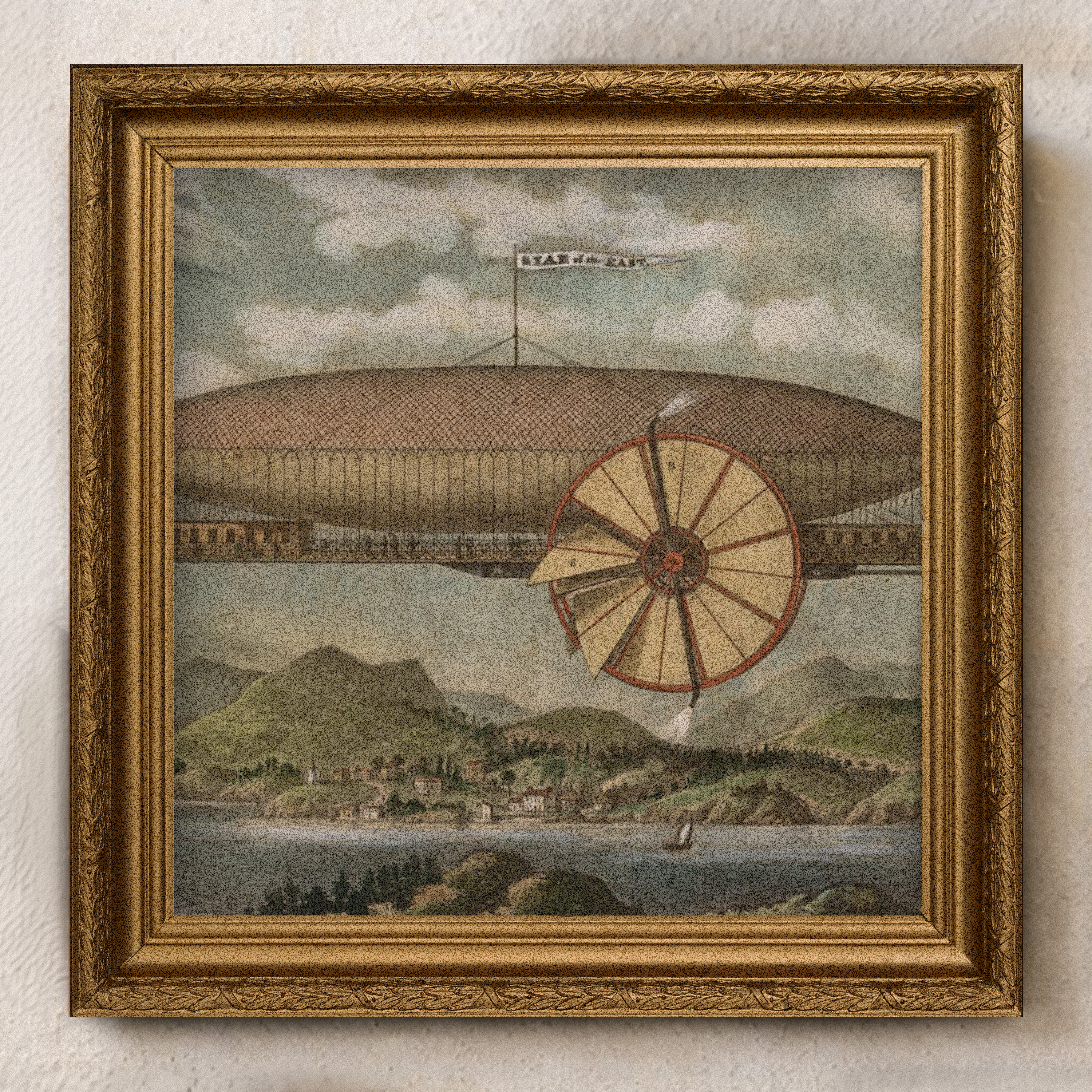
Ava Page also had the original patent papers, including the approved design for the airship, which have since been scanned and shared with us. The design drawings for this airship are truly a magical sight. It looks like something out of The Imaginarium of Dr. Parnassus or Peter Pan or something. The hull of the ship is made out of wire with an oiled canvas stretched over the wire like a drum. Then bursting out of the ship are two enormous balloons or gas bags, which are powered by an intricate system of pumps, valves and pistons. On the back of the ship is a propeller and a rudder. I'm not sure how to put this, but even on the page, this black and white two dimensional drawing of an airship appears to be flying. The text on the patent says that Charles F. Page of Pineville, Louisiana, has invented certain new and useful improvements to airships. And then proceeds with a long, meticulously detailed description of how the airship works. And in the interview, Ava Page says the same thing. We heard from Joseph Page, that Charles Page built a full sized airship. And he entered the 1904 Louisiana Purchase Exposition in St. Louis, which offered at least $100,000 in prizes for aviation. So he shipped his airship on a freight train, and for reasons that were never known, the airship did not make it.
- [21:11]
Michael Wynn
And this is where the mystery occurs and we have to rely on family stories. The ship never made it there. And the only thing I can think is the massive prejudice of the time. Somebody stole it and destroyed it. And that's what the family says. I see no other reasonable alternative. The train didn't wreck along the way. And I think because of this disaster, the loss of his airplane, he had a major investment in this. I think he lost heart in it and he gave up on it.
- [21:46]
Lloyd Lockridge
I wanted to know how things might have gone if Charles Page and his airship had arrived at the Louisiana Purchase Exposition. So I did some research and this thing was a spectacle. So the main airship competition was actually a race. The favorite to win the race was a fabulously wealthy Brazilian man named Alberto Santos Dumont, AKA the Wizard of the Air. It's unclear to me if that nickname was given to Santos Dumont or if he gave it to himself. In any case, Santos Dumont had already flaunted his airship at an exhibition in Paris. He arrived in St. Louis to a crush of reporters and fans clamoring to see the man who had reportedly flown. You're probably picturing a small man in a suit with a mustache and a bowler hat. And that's exactly right. That's exactly what he looks like leaning into his penchant for drama and flair. Santos Dumont told the St. Louis Dispatch, if the World's Fair accomplishes nothing more for science than to stimulate the conquest of air by man, it will have served a noble purpose. Dumont's main competition was a man from California, also wealthy, named Tom Baldwin, who had designed an airship he called the Arrow. It's worth mentioning that none of these airships look like Charles Page's airship. They have oblong cigar shaped balloons with skimpy metal scaffolding that converge on a tiny seat for the pilot beneath the balloon. And somewhere in there you'll find a propeller and a rudder. It's more of a guideable blimp than an airship. And the competition itself was very eventful. After testing his airship, Tom Baldwin, the Californian was attempting to tie down the vessel when the crew lost control of the ropes. The airship took flight without a pilot and was discovered days later in a field miles away. But despite this one blunder, Baldwin's airship was making very impressive test runs around the Exposition's grounds. Baldwin appeared to be a real contender. And that's when scandal struck. In the middle of the night leading up to the much anticipated airship race, someone had gone into Alberto Santos Dumont's hangar and slashed his balloons with a knife. At first, the detective assigned to the case suspected it was someone hired by a competitor. But the hangar was heavily guarded. The detective ultimately deduced that nobody could have slashed the balloons but Santos Dumont himself. But why? Because Santos Dumont feared losing the competition and couldn't tolerate the embarrassment. Santos Dumont was outraged by the accusation. He left in a huff, taking his torn up balloons back to Paris for repair, vowing to return to St. Louis to prove his aeronautical prowess. When the airship race finally took place In December of 1904, Santos Dumont had not returned. And of the remaining contestants, nobody was able to complete the course. The $100,000 prize was left on the table. But just take a second to imagine how surprised these well heeled, swashbuckling pioneers of the sky would have been by the arrival of Charles Frederick Page, a black man with no formal education, very little money, and an airship that in my personal opinion, is far more elegant than anything else on display. Would Charles Page of Pineville, Louisiana, have beaten the likes of Captain Thomas Baldwin or another contestant named Count Henry de la Vaux? We'll never know. Charles Page never made it to St. Louis, and neither did his airship. However, on April 10, 1906, two years after the winnerless Louisiana Purchase Exposition, Page's airship patent was formally approved by The United States government.
- [25:10]
Michael Wynn
Now, what's fascinating is the timing. That was the 1904 World's Fair. It took three years for his patent to go through. It also took the Wright brothers three years for their patent to go through. Charles Frederick Page's patent for his airship, his controllable vehicle for the sky, beats the Wright brothers by one month in being issued. He gets a patent one month before the Wright brothers. Oh, my God.
- [25:41]
Lloyd Lockridge
Now, these are different devices. One is an airship, and the other is an airplane. One heavier than air, one lighter than air. But still, the fact that Charles Page got his patent for a flying vessel before the vaunted Wright brothers it was is pretty remarkable. We will probably never be able to prove that Charles Page built and flew his airship. And we'll probably never find out why it didn't make it to St. Louis. And maybe most mysterious of all, we may never know why Charles Page stopped pursuing his airship. Because even if there wasn't a physical ship, people were very interested in his patent. Michael Wynn was able to recover three pieces of original correspondence regarding Charles Page. Less than three weeks after Page's patent was approved, he received a letter from a businessman in Pennsylvania named CG Crispin asking if the patent was for sale. Then a couple weeks later, CG Crispin wrote another letter. And this time, he had a lot more to say. Crispin writes, we have investigated your patent very thoroughly, and our judgment is it ought to sell for $30,000. This airship easily excels anything also in its line that is on the market today. And the third piece of correspondence was between Page and someone else. All we have for that third person is an envelope with a return address. Arthur's Patent Exhibition, 209 State Street, Chicago, IL. On the back of the envelope is a handwritten note that says, received from A. Arthur, September 24, 1907. We don't know what became of those dealings between Charles Page, C.G. crispin, and A. Arthur. All we have are those three pieces of correspondence, One of them stating that the patent for Page's airship was worth an estimated 30 grand, about a million dollars in today's money.
- [27:25]
Michael Wynn
I have zero information why it never happened. I believe it was an honest offer, but we have zero information.
- [27:34]
Lloyd Lockridge
The story of Charles Page's airship certainly has its fair share of unanswered questions. But despite all that, Michael thought that what was known about Charles Page's achievements was certainly worth sharing. So he started writing articles and appearing on any local news media that would have him.
- [27:49]
Michael Wynn
I'm on television a lot here on radio and everything. And I was talking about Page and I get a call from Joe and he said, I'm his grandson. I said, I hope you're happy with everything I'm doing. He says, I'm ecstatic with everything you're doing. I've tried to fight this when I was young, trying to get the word out. And people just. It's either one of two things. They don't believe you or they don't want to believe you.
- [28:14]
Lloyd Lockridge
But there was a historian inventor on the east coast who did believe Joseph and Michael. And furthermore, he believed that if Charles Frederick Page's airship can disappear, then it can reappear.
- [28:36]
Ollie Advertiser
Who cares about your poops? Ollie does. That's why Ollie's science backed Gut health lineup helps support your family's regularity. From daily probiotics to fiber gummies your kiddos will love. Find it all on olli.com that's o l l y dot com. These statements have not been evaluated by the Food and Drug Administration. This product is not intended to diagnose, treat or cure or prevent any disease.
- [29:02]
Michael Wynn
Where is Daredevil A minor.
- [29:06]
American Express Business Gold Advertiser
Don't miss the return of Marvel Television's Daredevil Born Again.
- [29:10]
State Farm Advertiser
So what's next?
- [29:11]
Lloyd Lockridge
I feel liberated.
- [29:13]
Michael Wynn
We're gonna take this city back over
- [29:15]
Lloyd Lockridge
medicated in an all new season now streaming only on Disney.
- [29:19]
State Farm Advertiser
They're hunting us. It's time we started hunting them.
- [29:23]
Lloyd Lockridge
I can work with that.
- [29:26]
Michael Wynn
This should be tons of fun.
- [29:27]
Lloyd Lockridge
Marvel Television's Daredevil Born Again now streaming only on Disney. In 2016, Time magazine published a special issue featuring the 100 Most Important Adventures of all time. A man named James Howard was checking out at the grocery store when he noticed the issue on the magazine rack.
- [29:46]
James Howard
And on the front cover of this special edition, you saw the likely heroes. You saw the Edisons, right? You saw the Fords. You know, you saw the Teslas and the Alexander Graham Bells. And you even saw present day heroes like Steve Jobs.
- [30:07]
Lloyd Lockridge
James was not looking through this magazine as a casual reader. For 35 years, he has taught design and design history. He's an inventor himself with over 35 patents to him. The Time magazine list presented a great opportunity to honor inventors who in the past had not gotten their due because of racial prejudice.
- [30:25]
James Howard
Now, Lloyd, I'm okay with not necessarily seeing a black face on the COVID I open up this magazine and I see not a single black face.
- [30:36]
Lloyd Lockridge
Finally, James made it to the last page. And on the last page, there is one tiny thumbnail image of a black inventor who upon casual Observation could pass as white. And James felt he had two options. He could be angry and hope that the next time around, lists such as these would include black inventors, or he could take action. He chose the latter and got to work on developing the country's first Black Inventors hall of Fame. He and a team of other experts would make their own list. In our conversation, James gave me an abridged history of black inventors in America. And it was clear to me that I had not been taught this history before. Time magazine is not the only guilty party in omitting or overlooking black inventors. Their accomplishments have been overlooked for centuries. Take this example. One of the first major contributions by a black innovator in the United States can be traced back to a man named Onesimus. Onesimus lived in Boston during the 1721 smallpox epidemic, a disease which killed 30% of its victims. And as the disease decimated Boston, Onesimus recommended a novel procedure. The procedure entailed rubbing pus from a smallpox wound into an open wound on the arm of an uninfected person. This provided a way to introduce antibodies. And in one key study, the fatality rate dropped from 1 in 7 to 1 in 40.
- [31:55]
James Howard
And he went on to save the town of Boston from the ravages of smallpox with his introduction of the inoculation procedure that would go on to eventually become the world's first. First patented vaccine. Except he did not receive credit for it.
- [32:14]
Lloyd Lockridge
And this pattern of developing an innovation and receiving no credit essentially defines the experience of black inventors in America. By 2023, James was deep into the planning for the Black Inventors hall of Fame when he received an email from a board member.
- [32:28]
James Howard
One of my board members sends me a link on Charles Frederick Page. It has a little video caption and everything. And that was my first time ever hearing and learning about Charles Frederick Page. And the link that he sent me included Michael Wynn. I was so moved by it that I got in touch with Michael Wynn as soon as I got back to the office.
- [32:52]
Lloyd Lockridge
Michael Wynn was thrilled. He shared all of his research with James, who spent weeks absorbing the story. The man who was born into slavery, who became a self taught engineer who invented and reportedly built an airship, sending it off to the Great Louisiana purchase exposition of 1904, only to have it mysteriously disappear when we learned that Charles
- [33:12]
James Howard
Frederick Page airship had disappeared and it never arrived at its destination. Within that, you have a lot of mystery, right? As to, okay, well, what happened to it? You know, where did it go? Well, we don't have to be rocket scientists to sort of surmise where it went. It was purposely sequestered, it was purposely held back. There was no way that the powers that be, particularly in that particular region of the of the United States at the time, was going to take a chance on the acknowledgment of this black man who has the audacity to be building a freaking airship. At the same time Orville Wright and Wilbur Wright were building this, their flying machine had the audacity to ship it off. He had hoped to win that prize. And you're talking about a dream deferred. You can't get any more deferred than that. That has become the storyline that sort of encapsulates dozens upon dozens and hundreds upon hundreds of black inventors that came before him as well as those that have come since him.
- [34:30]
Lloyd Lockridge
So I want to go back to that Time magazine issue, the one that motivated James to help enshrine the accomplishments of black inventors. The editor talks about what makes a great American inventor. It's quote, to invent and commercially succeed in shaping the world's first mass society. As Steve Jobs puts it, to put a dent in the universe, to commercially succeed. That phrase brings me back to those letters that Michael Wynn recovered. The correspondence between Charles Frederick Page and two men who were interested in shopping his patent. CG Crispin from Pennsylvania and A. Arthur from Chicago. These letters represent Charles Page's attempts to commercially succeed with his ideas. But neither panned out and Charles Page stopped trying to why? I did a deep dive on both of these men to see if I could find anything relevant with respect to Page or other inventions they might have been selling. Who were these guys? What were they up to? Let's start with the first one, CG Crispin. Crispin was a very well respected businessman and inventor out of Berwick, Pennsylvania. He was a Cornell graduate, the president of Berwick's First National Bank. He invented a water valve that was used across multiple industries. A very well respected guy. It's possible that Charles Page granted Crispin permission to exhibit his patent and nobody bought it. Or maybe for some reason Page didn't send it in. We don't know. The more mysterious character though was a. Arthur. All we have is that envelope with a return address. And on the back of the envelope there's a handwritten note that reads, received from A. Arthur on September 25, 1907. It took me a long time to find anything about A. Arthur, but after a while I was able to figure out that this guy's full name was Adam Arthur. Adam Arthur specialized in hosting and promoting patent exhibitions. But in early 1907, the building housing his exhibition burned to the ground, pushing Arthur to the brink of financial ruin. And that's when I came across an article about Arthur from the Chicago Tribune. The article was dated October 25, exactly one month after Charles Page's correspondence with him. The headline reads, wife, Creditors and Federal Officials Hunt for Adam Arthur denounced as a swindler. Apparently, Adam Arthur was writing to inventors saying, if you send me a deposit, I will exhibit your work. And if your work doesn't sell, I'll send your money back. Except he wasn't sending the money back. He was pocketing everything, including, I believe, Charles Page's deposit. I believe Charles Frederick Page was scammed. I think the evidence strongly suggests that he sent in the deposit expecting to have it returned. But the money never came back. And as a timberman in Pineville, Louisiana, with a wife and 11 kids, Charles Page decided that dealing with untrustworthy strangers in far flung cities was not something he could afford to do any longer. That's why Charles Page couldn't commercially succeed with his intellectual property. He was taken advantage of. As a poor black man in Louisiana, he had no means for recourse. Perhaps if Charles Page were not born into slavery and thrust into the nightmare of Jim Crow, he would have met the criteria for TIME's 100 most important inventors. Charles Page's whole experience, the disappearance of his machine, the obstacles that prevented him from profiting from his invention, the lack of recognition for his scientific achievements, it all represented a highly emblematic story for the Black Inventors hall of Fame. And as a result, James has decided to make Charles Frederick Page a centerpiece of the museum.
- [38:08]
James Howard
You're going to be able to go in there and you're going to be able to learn of Charles Frederick Page's story. There's going to be a little theater in there where you can sit on a bench and see a six to eight minute recapturing of his story when he first learned that his airship had disappeared.
- [38:24]
Lloyd Lockridge
But as James planned the Charles Page exhibit, he couldn't seem to take his eyes off those original patent designs, the beautifully drawn renderings of this magical flying ship. Yes, James is a historian, and yes, he is developing a museum, but he is also a working inventor. So he decided to do some experimenting.
- [38:42]
James Howard
I took a look at the patent drawings and I challenged my model maker and said, listen, let's take these and let's extrapolate them into 3D renderings. 3D models. Then I say I want to take it one step further. Let's extract these into built information modeling akin to architecture drawings, right? Where you can literally sort of like build the building before you physically build it. And I saw the credibility of his propulsion system and his guiding system and then the brilliance of the balloons and the tethers and the deck and everything. I said to myself, you know what? This has to be built, but not a model. I told my board, I say, listen, we need to build a full size replica.
- [39:28]
Lloyd Lockridge
It was a bold idea and one which presented an obvious challenge. Who do you hire to build a 120-year-old airship? Well, James happened to have a relationship with a London based company that helped him with a replica of a P51 fighter plane for a Tuskegee Airman exhibit. The company is called Spirit in the sky, and they specialize in aerial filming solutions for feature films, music videos, TV productions, and commercials. You've actually probably seen their work in movies like Mission Impossible, Dead reckoning, or the 007 movie no Time to Die, or the Apple Masters of the Sky. These guys are the real deal. So James showed the page renderings to his point of contact there.
- [40:06]
James Howard
I'd like to show you these models that we built in the computer. And can you extrapolate this into an actual full size item? Then I told him that I wanted to have it on display in my museum. He looked at all the drawings. He called me back and said, james, listen, man, why would you want to put it in your museum? He says, why don't you go ahead and let us make this baby fly? And I said, well, Tom, we can consider that.
- [40:31]
Lloyd Lockridge
And now to actually build the ship, James has partnered with an engineering group in Maine. At the time this episode was released, the ship was still under construction. But what seems clear to both James and all the engineers involved is that the airship can fly. So I asked James, you know, there's some speculation on whether Charles Frederick Page flew the original airship, whether or not he actually got it off the ground. Do you have an opinion on that?
- [40:58]
James Howard
I do have an opinion. I'll be honest with you. I think that as a inventor, you have to understand your invention becomes one with you. You live it, you eat it, you breathe it, right? And I firmly believe, I firmly believe that Charles Frederick Page attempted to lift this airship up off the ground and fly. And then you have to think about this. You go back and read the requirements of the Louisiana's World Fair competition. It's a requirement that whatever it is you present has to work. Why? Because at the World's Fair. It was the intention to showcase these not on the ground, but in here. Right? So if you trace it all the way back to what the moment required, this man felt confident enough to measure up to that moment. He was just never given that opportunity.
- [42:02]
Lloyd Lockridge
But about 120 years after it reportedly disappeared on its way to the Louisiana Purchase Exposition, Charles Page's airship will reappear. Though he will not be there to enjoy it, Page's work will be on display for the world to see. And if someone really did destroy Page's airship, that person would will have ultimately failed to suppress this man's undeniable innovative brilliance. In the beginning of this episode, I mentioned those specialty quarters released by the United States men. The back of the North Carolina quarter shows the Wright Brothers as it should. The Wright brothers have a completely legitimate claim as leading pioneers in aviation. But they weren't the only pioneers in aviation. There were others who had to overcome more than just the force of of gravity. Well, on the back of Louisiana Specialty Quarter you will see two a map of the Louisiana Purchase, the epic land deal that was commemorated by the Exposition of 1904. And above that you'll see a bird. Though it was not intended this way, I hope those two images always remind you of a great American inventor named Charles Frederick Page. Thank you for listening to Family Lore. If you have stories you'd like to share about your family, please email me@familylorepodmail.com that's familylorepodmail.com Family Lore is an Odyssey Original podcast. It is written and narrated by me, Lloyd Lockridge. Our executive producers are Leah Rees, Dennis and I. Our lead producer and sound editor is Zach Clark. Our story editors are Matty Sprung, Keyser and Katie Mingle. Additional sound, editing, mixing and mastering by Chris Basel and production support by Sean Cherry. Special thanks to Maura Curran, Josephina Francis, Kurt Courtney, Hilary Schuff and Laura Berman. Thanks again for listening to Family Lore. And if you have time, we'd love for you to rate and review the show.
- [44:15]
Bloomberg Advertiser
Some follow the noise. Bloomberg follows the money. Because behind every headline is a bottom line, whether it's the funds fueling AI or crypto's trillion dollar swings. There's a money side to every story. And when you see the money side, you understand what others miss. Get the money side of the story. Subscribe now@bloomberg.com
- [44:41]
Podcast Advertiser
looking for the best place to shop this Mother's Day? Go with the brand. That makes it easy to send something thoughtful to everyone on your list. 1-800-flowers.com right now at 1-800-FLowers. Order one dozen roses and get another dozen free. More flowers mean more smiles. All backed by the quality, attention to detail and trusted delivery experience that make 1-800-flowers my top choice to send something, something beautiful mom will love. Make Mom's Day at 1-800flowers, com Spotify. That's 1-800flowers, com Spotify.