Loading summary
Transcript148 lines
- [00:00]
A
Best thing that's ever happened to you financially. Go easy.
- [00:03]
B
Sold my car on Carvana. Amazing offer, really.
- [00:06]
A
I hit 200 on a scratcher.
- [00:08]
B
Did the scratcher come to your house and hand you a check?
- [00:11]
C
No.
- [00:11]
B
How many scratchers did you hit to get that? I hit a button on Carvana.com once.
- [00:16]
A
Okay, that's fair.
- [00:17]
B
It's like the lottery, except you always win.
- [00:21]
A
Not like the lottery at all, actually.
- [00:23]
B
Exactly. Inexplicably good offers worth bragging about. Sell your car today on Carvana. Pick up fees may apply.
- [00:30]
D
Summer break is here. I want my kids to have fun, but I also want them to keep their skills sharp between vacations and sports. I need something that fits our busy schedule without adding stress. That's why we use ixl. IXL is an award winning online platform that helps kids truly understand what they're learning. Whether they're building math confidence, strengthening reading and writing skills, or reviewing science concepts from Pre K through 12th grade, IXL offers personalized, interactive learning that adapts to each child's level and pace. It's proven to improve grades and one subscription covers every child in the home, saving us time and money. It's trusted nationwide and in fact, IXL is used in 96 of the top 100 school districts in the U.S. make an impact on your child's learning. Get IXL now and listeners can get an exclusive 20% off IXL membership when they sign up today at ixllearning.com audio Visit ixllearning.com audio to get the most effective learning program out there at the best price.
- [01:38]
E
To start Tell me where you're from. Where were you born?
- [01:41]
A
I was born in the Bronx in New York City.
- [01:46]
E
This is Diane Patrick.
- [01:48]
A
When I was a small child, I lived with my mom. My mom was poor. She was a single mom. She was on welfare growing up.
- [01:58]
E
Diane's mom never took her to museums. But over the years, Diane would occasionally go on school field trips to the American Museum of Natural History in Manhattan.
- [02:08]
A
I've always hated that museum. They used to take us there as kids in school, and I hated that museum so very much.
- [02:17]
E
Why?
- [02:17]
A
Because it was dark and it had animals and insects displays. I was not interested in that. Oh, it was awful. And I dreaded going there. And I vowed I would never go there as an adult.
- [02:32]
F
When Diane visited the Natural History Museum as a kid, she almost certainly wandered into the Akeley hall of African Mammals. It's the big room in the middle of the building.
- [02:41]
E
It's dimly lit with a herd of
- [02:43]
F
taxidermied elephants standing in the center, like they just wandered in off the savannah, frozen in time. Surrounding the elephants on each wall, there are big dioramas behind glass built to look like real African landscapes. Lions crouched in tall grass. A leopard dragging its kill up into a tree. Gorillas standing in a misty forest clearing.
- [03:02]
E
Whether you're compelled by these exhibits or
- [03:04]
F
unsettled by them, one thing is they're incredibly lifelike works of art and craftsmanship.
- [03:10]
E
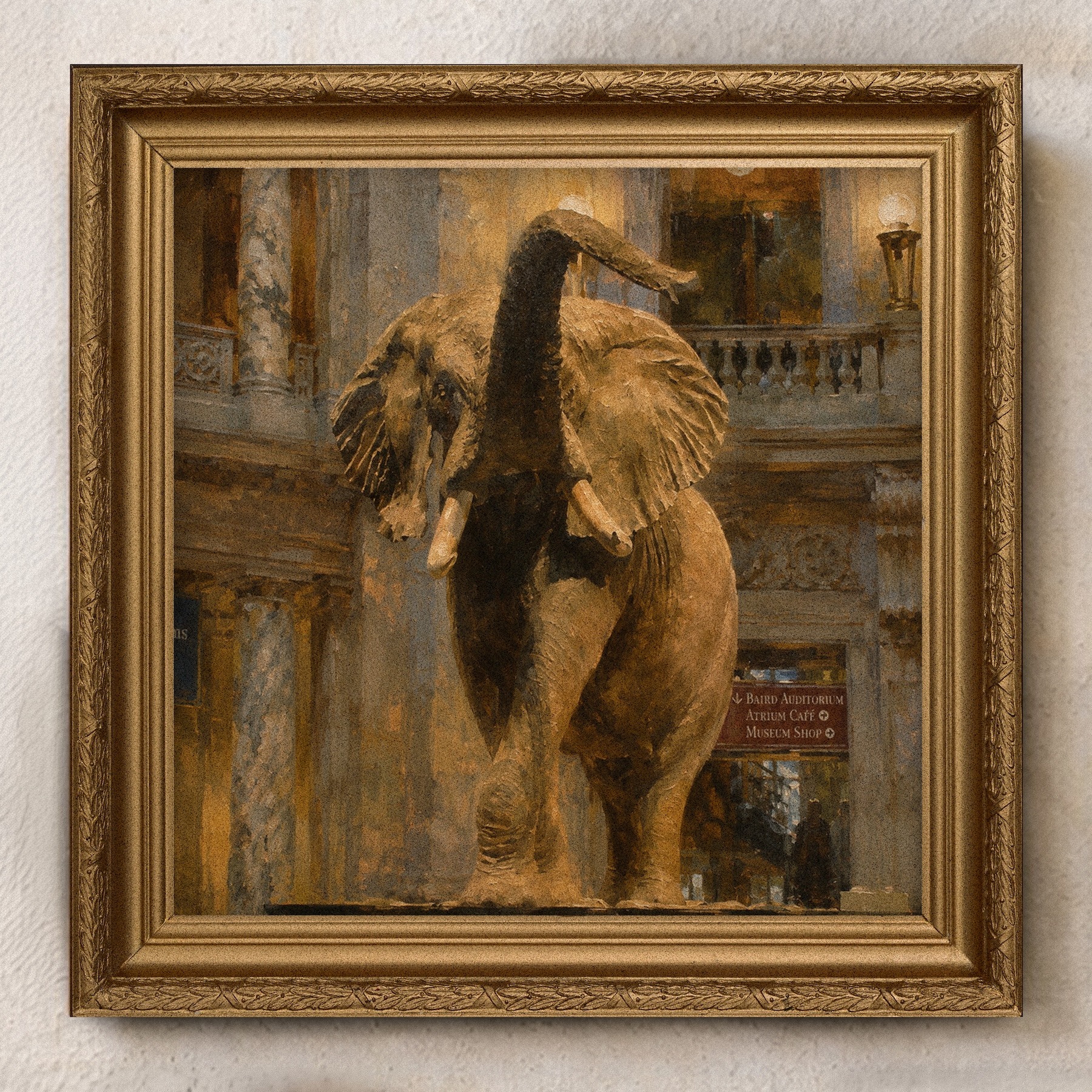
But young Diane was not impressed. Not because the exhibits in Akeley hall weren't impressive. It just wasn't her thing. Or at least that's what she thought at the time. What she didn't know then was that her grandfather, who she'd never met, was famous in this museum. His name was Sinclair Clark, and he was a master taxidermy tanner, who helped create many of the museum's most astonishing exhibits, including the herd of elephants in the center of the hall, which are still seen by many visitors today.
- [03:40]
C
On a typical summer day like Today, there'll be 10,000 or so folks who come through the museum, and, you know, the overwhelming majority will come through that hall. The elephants in particular, just. They're iconic, right? I think they're among the things that people think of when they think of the museum. They have been highlighted in movies ranging from Night at the Museum to, you
- [04:07]
E
know, Malcolm X. Diane's grandfather's legacy in this museum is so significant that the president of the museum made time to talk to us on very, very short notice.
- [04:17]
C
I'm Sean Decatur, president of the American Museum of Natural History. And this is something that I feel a great deal of pride and importance as someone who identifies as African American, that, you know, it was a black man who played a role in these iconic elements of a hall that sort of continues to be amazing for visitors today.
- [04:41]
E
Sinclair Clark's legacy has become Diane's family lore. But you can't have family lore before you know your family. And it would take Diane a long time to discover where she came from.
- [04:52]
A
It doesn't happen when you're 12. It doesn't happen when you're, you know, 20, because you're out there. It's hard growing up. You gotta figure things out.
- [05:04]
E
I'm Lloyd Lockridge, and this is family lore. What do you remember about your mom?
- [05:18]
A
Not a lot. The main thing I remember about her, which is so strange, is that she mispronounced words, and that was obvious to me. And I was a child, and to this day, I ask myself, where did I come from that I knew as a child? That a human adult was mispronouncing words. And that was because she was from the south, you know, and we lived in a place where a lot of people were from down south. And they all talked the same, you know, they had certain accents. I found out later that some of them were from the Gullah, Geechee area of Georgia. Yeah, yeah, exactly. Cause that's where my mother was born, which I found out much later when I was a grownup.
- [06:11]
F
Yeah, that's where Clarence Thomas is from.
- [06:13]
A
Well, don't blame that on me. But. So she would say things. To my ear, it sounded like she was saying, we have apple time. And I'm thinking she was trying to say, we have ample time, you know, and, you know, just little words. And I would correct them in my head. So it was just funny that that was my little snobby internal conversation.
- [06:40]
E
As a kid, Diane felt critical of the way her mom spoke, and she wasn't sure if her mother knew how to read. No one at home encouraged Diane to love books, but she did.
- [06:49]
A
I was, like, the best reader in the school, you know, and the librarians loved me. And the library was beautiful. It was up on a high floor in the school. And there were those. You know, the tall windows with the wooden window frames and those pendant lights. You know, the schoolhouse pendant lights with the milk glass. Oh, my God, I loved being in there. And the smell of the wood and the bookshelves and the librarians. So I went there, and I would just peruse the stacks.
- [07:21]
E
When you were a kid, did you know anything about your father?
- [07:24]
A
Absolutely nothing. And there was one time, I remember, when my mother and I. I was with her, and she was going, I think, to the maintenance office in the projects to pay the rent or something, and walking down the block, and she stops. She says, oh, my goodness, look over there. There's your father. Go say hi. But in my head, I'm thinking, what the hell are you talking about? I never met him. Where are you pointing? And who is he? Which of the people over there is he? And I just said, you know what? I didn't say it to her. I was not disrespectful. But I sort of froze and made like I wasn't gonna move, you know, And I didn't.
- [08:07]
E
All Diane had was her mother. It was just the two of them in their small Bronx apartment. She did have a half brother, Joseph, but he was 24 years older than Diane, and they didn't see him very often. But one day when Diane was about 8 years old, her mother had to go to the hospital for several nights. So Diane went to stay with her half brother and his wife.
- [08:28]
A
So I was taken to their house. And then one day I went there after school. And I think my brother said to me, he said that your mother died and she's not coming back, and you're going to live with us.
- [08:45]
E
Now, Diane wasn't aware of this at the time, but her mother had breast cancer and had already received a double mastectomy. Her decline was gradual. But to Diane, her mother's death, which occurred on the eve of Valentine's Day in 1963, would have felt terribly sudden. She was used to life without her father. Now she would have to get used
- [09:07]
F
to life without her mother.
- [09:09]
E
Were you scared?
- [09:11]
A
Well, I. I was not scared, but I do remember the overarching thing there was that I was in a new environment. They lived in a tenement building, but that's better than projects sometimes. They had a two bedroom apartment, very long hallway, kitchen at the far end next to a living room. And I'm like, oh, my God, these people are rich.
- [09:42]
E
Diane's older half brother was old enough to be her father, and his wife, who was technically Diane's sister in law, became sort of an evil stepmother figure in her life.
- [09:52]
A
You felt like, don't walk on the floor, don't sit on the couch, you know, because she was so fastidious. But I did not like living with her, with my sister in law. She never really spoke to me unless she had to. And over the years, she started using me as a, you know, the Cinderella figure. You know, here do the dishes, here do the laundry. I was not included in any family things, you know, not even come sit down to the table and eat with us. It's like she would leave my food on the counter, and then after they finished, I would go in and eat. But I was respectful because I was aware that I was a, you know, intruder almost in their home. You know, I'm an extra person who. Who signs up for that, you know, so I was being very deferential to her, but it didn't make any difference. Never made any difference. So I. All I wanted to do is get out.
- [10:48]
E
But you were only eight years old when you got there. Typically that means another 10 years in this joint.
- [10:55]
A
Mm.
- [10:56]
E
So tell me about wanting to get
- [10:57]
A
10 years of planning, baby.
- [11:04]
E
In all seriousness, how do you deal with a decade at a place where you don't feel welcome?
- [11:09]
A
Well, you do have to go to school every day, and the house was full of books that was another contrast to my mother's house. They had the World Book Encyclopedia. Yes, please. They had Childcraft Encyclopedia. Yes, please. They had albums. Right. And so when they were not there, I would partake of the things. I'm like, you gonna leave me alone here? Okay. I'm gonna have fun. You know, you don't have to take me to wherever the hell they went. They would go on vacations to the Caribbean. They would take me. It was like exclusion. It was active exclusion. And I so got used to it. And I said, you know, I read, I write. I would write little stories. I'd read all the books.
- [11:54]
E
Yeah, it's kind of funny that with no supervision, you do what most parents
- [11:57]
F
want their kids to do.
- [12:00]
A
Well, what can I say?
- [12:02]
E
Yeah, that's pretty cruel. Yes, it's a pretty cruel way to treat a child. And you're making it sound like you were impervious to this cruelty, but I
- [12:14]
F
imagine at some level it affected you.
- [12:15]
A
Of course it did. But, you know, the other thing is I'm an Aries. And the other thing is that my sister in law's mother had to babysit us. And she. She was the angel. She would say to me, you call me Grandma because you're my granddaughter, too. And she was that beautiful star for me, because she was kind.
- [12:45]
E
Diane describes her grandmother as a beautiful star, and without a doubt, she was a great source of comfort. But stars are only visible some of the time. For the most part, Diane had to find ways to escape, and literature became her getaway car. Diane's bookishness eventually helped her find a
- [13:02]
F
way out of her half brother's apartment.
- [13:04]
E
She grew up and got a good job as a paralegal. And once Diane was far enough away from the instability of her childhood, she started to be more curious about where she'd come from. She was hesitant to search for her father's family based on the very little she knew about her dad. She was wary of what she might find, so she started with her mother's side. Her half brother Joseph was able to answer some questions about their mother, and Diane did her own research, too. She even traveled to Georgia and found a woman who had known her mom and had exchanged letters with her after she moved to New York. But as far as deeper family history, Diane wasn't making much progress on her mom's side.
- [13:41]
A
So after that, I said, you know what? I'm at a dead end here. I might as well look for my father's people.
- [13:46]
E
Which you were trepidatious about. You were kind of careful what you wish for, careful what you look for here.
- [13:52]
A
Exactly.
- [14:03]
G
Tyler redick here from 2311 Racing.
- [14:06]
B
And Bubba Wallace.
- [14:07]
G
You know what's the worst part of a race? A rain delay.
- [14:10]
B
Sitting around waiting for the track to dry is dull.
- [14:13]
G
But instead of waiting, we hang out
- [14:15]
B
with Chumba Casino Social Casino, slots, bingo, solitaire. Plenty of fun to keep us entertained.
- [14:21]
G
So why let a rain delay slow you down? Play now@chumbacasino.com let's Chumba.
- [14:27]
E
Sponsored by Chumba Casino.
- [14:28]
B
No purchase necessary.
- [14:29]
E
VGW prohibited by law 21 terms and conditions apply.
- [14:33]
H
Hey there, it's Jill Schlesinger. I'm launching a new show. It's called Money Moves. And your money is going to move. We're going to help you make better financial decisions. We're going to call out the B.S. you're finding all over social media. We're going to give you actionable guidance to make your financial life clearer, less stressful. We're going to answer your financial questions and take the mystery out of your financial life. Follow and listen to Money Moves with Jill Schlesinger wherever you get your podcasts,
- [15:04]
B
summer routines live or die by how easy they are. And honestly, if something takes too much effort, I'm out. That's why Groons is my go to. It's one daily pack of gummies covering my greens, vitamins and minerals. Plus it has 6 grams of prebiotic fiber, which is more than 2 cups of broccoli. No mixing powders, no giant pills, no hassle. Just rip open the pack and I'm done. They taste good and it makes it easy to stay on top of my health even when life gets busy. Save up to 52% off with code podcast at Groons co. That's code podcastruns co.
- [15:37]
E
As Diane started the search for her father's family, she says she wasn't looking for some tearful reunion with them.
- [15:43]
A
I didn't do this so I could meet other family members. I did this selfishly just to know why I am the way I am.
- [15:51]
E
Diane had one clue to go on. Back when she was in high school and living with her brother Joseph, she'd been snooping around, looking through some of his stuff.
- [15:59]
A
When they were gone, I would look through their bookshelves in their bedroom, which was, you know, I probably shouldn't have been there, but I looked at their bookshelves and one of the books was my brother's high school yearbook from Morris High School in the Bronx, 1950. And I see in the classroom photos, you know the portraits of the students. There was a boy, and this boy looked exactly like me.
- [16:31]
E
The boy's name was Vincent Clark. The only thing Diane knew about her father at the time was that his name was Sinclair Clark. Of course, this was also her grandfather's name, though Diane didn't know that yet. Diane eventually asked her brother Joseph about the boy in his yearbook.
- [16:47]
A
And I said, was this guy Vincent Clark any relation to my father? And he said, yes.
- [16:59]
E
Joseph, who remember, had the same mom as Diane, but not the same dad, told Diane he had never met her father and didn't know much about him. But he was able to tell her that there was also a third Clark brother, Melvin, who had been a policeman in Harlem. Diane had stored this piece of information for years. This was her one clue as she began her search.
- [17:20]
A
So I took the clue about the policeman. I called the nypd, I gave them his name, and I said, I'm looking, you know, I'm trying to reach out to this person. And they looked it up. They said, oh, he's retired, but if you'd like, you can send us a letter and we will forward it to him. I said, bingo. I wrote just a greeting card and basically introducing myself. October 24, 1996. Dear Melvin Clark, if you are the Melvin Clark, who is the brother of Vincent and Sinclair, then you are the person I am seeking. My name is Diane Patrick.
- [17:59]
E
Diane went on to explain that her father was Sinclair Clark, that she'd never met him, but she was interested in finding out more about his side of the family.
- [18:07]
A
Why did I want to find you? Well, when I reached 40 years old, I became sentimental, wanted to learn whose blood runs through my veins. I would love to speak to you. Parentheses. I hope I haven't surprised you too much. Sincerely, Diane Patrick. And I put my address. I sent it off and went about my business. And 30 days later, I get a phone call. And the voice says, hi, Diane, this is your uncle Vincent. Vincent Clark. Guy in the photograph. Guy in the yearbook photograph. And he said, now, you know, this could have gone either way. But he said, we always knew about you. We just didn't know where you were. So he said, well, he said your father died. He said he had too close of a relationship with Johnnie Walker. And when he said that, I knew we were related because nobody has a sick sense of humor like that has to be related. And so he told me all the names. He said, but your grandfather's alive and he wants to meet you. He's 95 years old.
- [19:20]
E
Vincent told Diane he Would send her some family pictures, including some of her grandfather, who, like her father, was also named Sinclair Clark. When they arrived, Diane flipped through them until she got to a series of photos which showed her grandfather posing with various taxidermied animals. In one, he was standing underneath an elephant in the rotunda of the Smithsonian. You see your grandfather in front of some mounted deer heads. You see him standing in front of
- [19:45]
F
the elephant at the rotunda in the Smithsonian.
- [19:49]
E
Do you just assume that he's got something to do with these animals?
- [19:52]
A
Well, he was underneath the elephant's armpit.
- [19:55]
E
He was not standing where a visitor would normally stand.
- [19:58]
A
That's exactly correct.
- [20:00]
E
Diane asked her uncle about the photos, and he told her her grandfather had worked in taxidermy. But he didn't elaborate.
- [20:06]
A
And I thought, okay, I'm gonna ask him all about this. I got my questions. We're gonna meet soon. And so I get there. It was at my uncle's house, and we're sitting, you know, I was ready to interview him. Problem is, he was 95, and he wasn't really a talkative man, and he smiled a lot. I could tell he was happy to meet me, but we never got a chance to talk.
- [20:31]
E
Meaning he just didn't say much when you met him?
- [20:34]
A
No. And I knew it wasn't personal. He was just not a talkative dude.
- [20:39]
E
And he's really old.
- [20:41]
A
Yeah. And I was disappointed, but I said, okay, you know, whatever. And, you know, two years later, he passed away, and I went on with my life.
- [20:54]
E
Diane continued her work as a paralegal, and then she became a freelance journalist. And as a side hustle, as she calls it, she worked as a convention staffer for a temp agency. And 16 years after meeting her grandfather, she was working at convention at the Jacob Javits center in New York.
- [21:10]
A
And I'm giving out badges. So, you know, there's a badge machine that spits out the badge. You put it in a holder, give it to the person, keep it moving. And so a badge comes out, and it says, tom delfico, taxidermist. And I'm thinking, oh. And I just making small talk, I said, oh, my grandfather was a taxidermist. He worked on the elephant in the Smithsonian, which is really all I knew about him. And this man says, was your grandfather Sinclair Clark? And I couldn't believe what I heard. I looked at him, and I said, how the hell do you know my grandfather's name? He says, he was amazing. He had the biggest hands, and his deltoids were amazing. And he was he's so beloved in the taxidermy industry. And that is how I found out about my grandfather's renown in the taxidermy industry. Not from the family, but from a random stranger.
- [22:23]
D
There's never been a better time to get outside and experience the benefits of nature, discover nearby trails and explore. Explore the outdoors with alltrails. Download the free app today and find
- [22:36]
I
your outside I'm Serena Williams and I'm healthier on row. I've lost 34 pounds in a year. With GLP1's diet and exercise on row you can access GLP1 options including the first FDA approved GLP1 pill for weight loss. Go to Ro Co Journey to see if you qualify. 14 to 20% average weight loss in one year in non diabetics with obesity or overweight with a weight related medical condition versus 2.2% to 3.1% in placebo arm Rx only. To stay informed about serious side effects, go to RO Co Safety.
- [23:11]
E
So after Diane's chance encounter at the Javits center, she embarked on a deep dive into her grandfather Sinclair Clark's life.
- [23:18]
A
He left Barbados in 1924 on a ship where he was the second messman.
- [23:28]
E
Diane still doesn't know if her grandfather had ever done any taxidermy or tanning work before he left Barbados, but what she does know is that it didn't take long for him to find his way into the job once he arrived in America.
- [23:40]
A
The ship stopped in ellis island in 1924 and by 1925. I have a 1925 work card from the Museum of Natural History. And what I do know is that he was working with James L. Clark, no relation, a well known taxidermist whose studio is in the Bronx. And so I can only imagine maybe he arrived and somebody said, oh, this guy James Clark needs someone to carry heavy things. And I'm sure he had a good work ethic and that I totally identify with because that has been my entire work history all my life. You show up, you do the work and you get called back.
- [24:32]
F
Sometime after starting work for James Clark, Sinclair met Carl Akeley, who is considered to be the father of modern taxidermy. In 1914, Akeley had begun work on the hall of African Mammals at the American Museum of Natural History. This was a time when museums played an even bigger role in the public's access to knowledge.
- [24:51]
G
In a lot of instances, taxidermy was the only way that people can see some of these animals. That was really the intent of natural history dioramas specifically.
- [25:02]
F
This is George Dante, an experienced taxidermist himself and president of a nonprofit that's dedicated to preserving the history of exhibits for natural history museums. He says Carl Akeley revolutionized the way taxidermy was done.
- [25:15]
G
Akeley basically saw what we were doing with taxidermy at that time and understood that it was very crude. We were. I don't like to use the term stuffing animals, but if you imagine taking a skin and, you know, trying to fill it with a loose material, whether it be cotton or sisal or hay or something like that, you're not going to get a very accurate animal. So Akeley understood this and thought that the only way to create an accurate piece of taxidermy was to do a sculpture of that animal's anatomy. And he refined that by basically re articulating the animal's skeleton and then using clay to create the muscle and all the forms over the articulated skeleton, making this beautiful sculpture of this animal's anatomy.
- [26:09]
E
From this sculpture, Akeley would create lightweight, hollow mannequins that the tan skin of the animal was then mounted on. Skins that were tanned by Sinclair Clark.
- [26:18]
G
Sinclair started, you know, working at the American Museum of Natural History. He was a young kid. Sinclair was tanning skins that Akeley was mounting. You're taking an animal's hide, a raw hide, and turning it into leather.
- [26:32]
E
Back in those days, museums would collect specimens from the wild, which is a nicer way of saying they would send people on expeditions to kill large game for the museum.
- [26:41]
G
If an expedition was taking place, you would have prepared the animals in the field and the skins would have been salted. So the museum would have received crates of salted skins, and Sinclair would have been tasked with taking these salted skins, rehydrating them. So basically, you would rehydrate these skins in a bath and sometimes a bathroom salt water. Then they would go into an acid pickle where they would start to relax even further and swell. And then he would be tasked with taking these skins out of this pickle and shaving them.
- [27:16]
E
The original four elephants in Akeley Hall's main exhibit were all tanned by Sinclair. But he didn't stop there. He went on to become a pioneer in the world of tanning and taxidermy. Henry, the elephant in the great hall at the Smithsonian. Sinclair did that one as well.
- [27:32]
G
He had such an incredible career. I mean, I think he shaved his last skin at like 90 something years old. Remarkable. You know, it was a hard job. You know, it was back breaking labor. It was miserable work. Can you imagine a skin that's the size of a bedsheet, and you taking a knife the size of maybe a kitchen knife and having to shave little bits of leather off of this until the whole skin was a uniform thickness. You know, I had a friend that worked with Sinclair when he was young, and, you know, he remembers being at the tannery with him late in the evening, you know, hoisting skins out of vats with block and tackle. Just him and Sinclair. And he was like Sinclair. His muscles were just incredible. You know, he was just this thin muscle man that was all sinew, all muscle. He was just a gifted person.
- [28:32]
A
His work is viewed by millions and millions of people every year, and nobody knows his name. So I wanted to make sure other people knew about him. Those little kids who see those elephants every day, I wanted them to know that a black man did.
- [28:52]
E
As Diane was learning about her grandfather, she began to feel like his work wasn't sufficiently recognized. It was as if there were these famous works of art admired by countless people over the course of decades, and nobody knew the name of the artist. Over the years, Diane has tried to raise awareness about her grandfather's life's work.
- [29:09]
A
I submitted his name to the New York Times Overlooked Obituary, which is a series that they started maybe 10 years ago, honoring people who should have had obituaries in the Times but did not. And so they accepted it.
- [29:26]
E
The obituary quotes an exhibition developer named Victoria Lee, who says the way he handled every knife, tool, and machine was masterful. You heard at the beginning of this episode that Diane didn't exactly love going to the Natural History Museum as a kid.
- [29:41]
A
Mm. Mm. Not my jam.
- [29:43]
E
To say she has a totally different relationship with it these days would be an understatement.
- [29:48]
A
Now. Oh, that's my museum. I do feel like that's my museum right now, and I act like it when I. When I go there.
- [29:59]
E
Diane will tell anyone who's willing to listen, including various security guards over the years, this is my grandfather's work.
- [30:06]
A
As a child, I just hated it. And now I love it because it's where my grandfather's work is, and his work was so important, and it's still there to be seen. And it's also sort of unsung. You know, he's an unsung worker, of which there are many.
- [30:32]
E
This is true.
- [30:33]
F
There are many unsung workers.
- [30:35]
E
In general, there are many unsung people.
- [30:38]
F
In fact, the lives of most people are not commemorated with a New York Times obituary, nor are they chronicled in our history books. This is our last episode in season one of Family Lore and one of the things I've learned in the making of this podcast is that the unsung figures of history have a beautiful song to sing. History is so much more than all its familiar chapters.
- [30:59]
E
It is mostly made up of people
- [31:02]
F
who lived in relative anonymity. It is a vast and constantly expanding mosaic of life, an endless gallery wall of porch portraits whose collective contributions have formed the world we live in.
- [31:14]
E
I started this podcast with a quick
- [31:16]
F
anecdote about a pistol that my grandfather showed me when I was about 12 years old.
- [31:20]
E
It supposedly belonged to a great uncle
- [31:22]
F
who received the pistol from the US Government so that he could defend himself against Bonnie and Clyde should they barge into his bank. I don't know if this story is true. What I do know is that it captured my imagination. It animated an irretrievable moment. Holding this heavy revolver in my hand, I felt connected to people I've never met, to moments I'd never witnessed, like I had somehow stepped off the linear continuum of time and into a realm where the past is present. We are all equally connected to moments like these.
- [31:54]
E
Since the beginning of human history, there has never been a single solitary second
- [31:58]
F
when one of your ancestors was not alive.
- [32:02]
E
Your family has lived through every era,
- [32:04]
F
every age, every epoch. All of history is ours to share.
- [32:10]
E
And I want to thank the people
- [32:12]
F
who shared their stories with us. Our guest, Michael Wynn, who you may remember from the episode on Charles Page's airship, was right. Everyone has a story if you're willing to listen. As always, thank you for for listening to Family Lore.
- [32:38]
E
If you have stories you'd like to share about your family, please email me@familylorepodmail.com that's familylorepodmail.com family lore is an Odyssey Original podcast.
- [32:51]
F
It is written and narrated by me, Lloyd Lockridge.
- [32:54]
E
Our executive producers are Leah Rees, Dennis and I.
- [32:57]
F
Our lead producer and Sound Editor is Zach Clark. Our story editor is Katie Mingle. Additional sound, editing, mixing and mastering by Chris Basel and production support by Sean Cherry. Special thanks to Maura Curran, Josephina Francis, Kurt Courtney, Hilary Schuff, and Laura Berman. Thanks again for listening to Family Lore.
- [33:19]
E
And if you have time, we'd love
- [33:21]
F
for you to rate and review the show.
- [33:27]
J
Looking for a simpler way to explore medical weight loss options? Orderly Meds connects you online with licensed healthcare providers so you can learn about GLP1 treatment options from home. It's convenient, straightforward, and designed to fit your lifestyle. Get started today@orderlymeds.com podcasts that's orderlymeds.com again orderlymeds.com podcasts compounded medications are not FDA approved. Results may vary. Consult a licensed healthcare provider to determine a treatment is appropriate for you. Restrictions apply.