Podcast
CEO BrainFood
Hosted by Michael Langhout · EN
CEOs successfully leading growth companies require continual learning, new thinking and a guided approach. CEO BrainFood was created to be a resource and guide for entrepreneur founders and CEOs seeking insights and useful tools to help them build enterprise value, generate higher profits, and develop the talent needed to consistently win at the Great Game of Business.
10episodes
Episodes
Newest firstAll episodes
025 Maintaining Resiliency in the Face of Stress and Adversity with Susan Drumm
May 14, 202000:41:17Tap to summarize01:44 – Michael introduces today’s guest, Susan Drumm who speaks to the origin story of her organization Meritage Leadership Development09:20 – Michael and Susan reflect on the impact of the ongoing coronavirus pandemic 12:47 – Building resilience in the face of adversity, stress and anxiety 25:33 – The importance of effective delegation and the OURS system29:30 – Susan speaks to the many assessment tools that she utilizes in her work with leaders 33:37 – Michael and Susan speak to their unique experiences as growth and leadership coaches 38:34 – Where listeners can follow Susan 40:00 – Michael thanks Susan for joining the show and where listeners can find his Functional Team Scorecard TWEETABLE QUOTES“I would say it’s more critical than ever that leaders spend time engaging with their team in this [remote] format because people feel isolated.” (10:11)“What I was curious about is what makes some leaders able to handle stressful situations more gracefully while others just get their buttons pushed and become reactive or lash out. And, is it innate? Can it be learned and, if so, how?” (15:58)“I recently heard a statistic that the average life expectancy for a police officer after they retire is ten years. Think about that. Because of the wear and tear from such high stress situations that they’ve had to deal with, the toll that’s taken on their bodies without the ability to build the resilience, can really make a difference.” (23:15)“The way you think drives your actions.” (26:50)RESOURCE LINKSMichael’s LinkedInMichael’s WebsiteThe Functional Team ScorecardSusan’s LinkedInMeritage Website
Transcribe →
024 Ethics, Value, & Purpose with Albert Erisman
Mar 2, 202000:41:49Tap to summarize00:55 – Michael introduces today’s guest, Albert Erisman03:23 – Al talks about why he started Ethix Magazine & The Theology of Work Project 06:25 – Why purpose, meaning and focus outweigh the importance of profits 09:21 – Al talks about his book, The ServiceMaster Story, and the Four Objectives20:09 – The concept of ‘Shingles on the Roof’ 22:42 – The importance of leaders understanding the value of service workers 27:37 – Al explains that leaders aren’t perfect 29:11 – The importance of training 32:34 – Diversity of culture and religion 35:44 – Al speaks to how his company dealt with exponential growth through acquisitions while honoring the four objectives 38:08 – Michael thanks Al for joining the show and for the great work that he’s doing40:15 – Where listeners can follow Al41:04 – Where to find Michael’s Functional Team Scorecard TWEETABLE QUOTES“I think the whole idea of purpose, meaning and focus is the central idea and then profit is the means by which you do that.” (08:31)“What happens to a company that has a focus on its employees, its purpose, and its meaning? And what happens when that shifts and becomes about profit?” (11:12)“He wrote that, ‘ServiceMaster had cracked the code by the way the service industry is perceived because they alone were able to instill purpose, meaning and value into the work of a service worker. It changed the way they saw their work and, therefore, it changed the results for the customer.’” (25:07)“If you build a system that will only works for perfect leaders, it will fail because there are no perfect leaders.” (28:15)RESOURCE LINKSMichael’s LinkedInMichael’s WebsiteThe Functional Team ScorecardAl’s LinkedInTheology of Work WebsiteEthix WebsiteBOOKS MENTIONEDAl’s Book – The ServiceMaster Story
Transcribe →
023 Mastering The Great Game with Jack Stack
Jan 15, 202000:56:53Tap to summarize01:01 – Michael introduces today’s guest, Jack Stack04:21 – Jack’s origin story and the goal of The Great Game of Business14:25 – The importance of forward-thinking forecasting20:29 – The secret sauce of The Great Game of Business27:50 – The importance of the critical number34:14 – Jack speaks to a story in his latest book, Change The Game38:03 – The importance of creating jobs39:59 – Michael and Jack discuss the value of culture45:13 – Jack provides some final observations and takeaways on business49:34 – Jack talks about the state of the economy53:57 – Michael thanks Jack for joining the show and for the great work that he’s doing54:23 – Where listeners can follow Jack56:08 – Where to find Michael’s Functional Team ScorecardTWEETABLE QUOTES“I began to realize there’s two ways of leading a company. One is by a product and service and then one is these people look at the company from a totally different set of metrics. I’m trying to make a precision flywheel and they’re trying to make a precision balance sheet.” (07:26)“If you’re not creating new businesses in your companies right now, your survival’s gonna be very very small in the future.” (21:38)“If you can forecast, you can actually control the world.” (24:40)“You need sales. There’s no question you need sales, ok? But sales without margins is just more work.” (33:04)“Selling EBITDA is like selling a house with only one bathroom.” (39:34)“When you appeal to the highest level of thinking, you get the highest level of performance.” (45:47)RESOURCE LINKSMichael’s LinkedInMichael’s WebsiteThe Functional Team ScorecardJack’s LinkedInJack’s WebsiteBOOKS MENTIONEDJack’s Books – The Great Game of Business & Change The GameGet In The Game
Transcribe →
022 Coaching with a Purpose with Mark Green
Jan 6, 202000:55:09Tap to summarize00:54 – Michael introduces today’s guest, Mark Green03:55 –Coaching for Results vs. Coaching for Growth07:04 – Michael promotes Mark’s book, Activators10:29 – Mark speaks to hidden growth killers17:56 – Universal quantifiers20:35 – Mark talks about three different types of fear26:08 – Mark lays out the five symptoms of fear32:45 – Mark tells the story about his Grandpa Ben and the importance of changing your neighborhood37:55 – The value Mark places on purposefulness and the link between purpose and strategy46:13 – Mark speaks to his personal purpose and the process it took to figure it out50:50 – Michael encourages the audience to pick up a copy of his book, Activators51:59 – Mark talks about some projects he’s currently working on, including a new book53:06 – Where listeners can follow Mark54:00 – Michael thanks Mark for joining the show54:24 – Where to find Michael’s Functional Team ScorecardTWEETABLE QUOTES“When the hidden growth killers are operating and you’re not aware of them, you’re actually not really at choice, right? You’re surrendering choice to operate on your habits, your beliefs, your motivators.” (16:18)“If you have fear that’s affecting you, there’s no way that you can feel like a great CEO when you know that you’re not addressing the behaviors that actually weaken your business.” (24:02) “We use logic to justify our thinking. So, we’re typically blind to our fears.” (29:16)“Often what I’ve observed is we maintain status quo networks, comfort zone networks… And, the truth of the matter is, in many cases, you’ve become among the most expensive houses in all of your neighborhoods. And then you wonder why you’re not growing as fast as you want to grow.” (34:47)“Purposefulness is a chronically under-utilized resource, often at great expense.” (39:30)“My purpose is to unlock human potential.” (46:16)RESOURCE LINKSMichael’s LinkedInMichael’s WebsiteThe Functional Team ScorecardMark’s LinkedInMark’s WebsiteLink to Harvard Business Review Article on PurposeBOOKS MENTIONEDMark’s Book WebsiteStart with Why: How Great Leaders Inspire Everyone to Take Action
Transcribe →
021 The Great Game Interview with Rich Armstrong and Steve Baker
Dec 9, 201900:55:18Tap to summarize00:58 – Michael introduces today’s guests, Rich Armstrong and Steve Baker01:41 – Michael promotes Rich and Steve’s latest book, Get In The Game03:41 – The origin story of The Great Game of Business08:48 – How Jack Stack began the process of teaching the language of business to his team12:08 – Steve addresses the concept of open-book management15:31 – Jack’s philosophy of lifetime hiring18:16 – Building a dominant workforce20:49 – How to engage employees to become better business thinkers24:24 – How scorecarding works27:39 – Benefits of a company getting into The Great Game31:58 – Key principles and elements of The Great Game of Business38:52 – The concept of a self-funded bonus44:02 – The importance of a healthy culture51:03 – Why Michael loves to highlight The Great Game of Business52:06 – Michael thanks Rich and Steve for joining the show and praises the work they’ve done52:17 – Michael encourages the audience to visit The Great Game of Business website53:08 – Michael promotes the upcoming Great Game of Business Conference54:01 – Where to find Michael’s Functional Team ScorecardTWEETABLE QUOTES“It [The Great Game of Business] was all about productivity. It was about quality. It was about building a solid product, but not necessarily building a company.” (06:38) (Rich)“The dominant companies in the next ten years will be those who are dominant with their workforce.” (18:25) (Steve)“People want to be in the know, and they want to know what they can do to contribute.” (22:55) (Rich)“If you would have invested a thousand dollars, if you were brave enough to invest a thousand dollars back in 1983, that thousand dollar investment is worth close to eight million dollars in value today.” (29:06) (Rich)“Business is like a game. To play any game, you gotta know what the goal is. That’s the critical number. And then you have to know what game you’re in so you gotta know and teach the rules. You’ve got to follow the action and keep score.” (34:46) (Rich)“Let the slackers and the dead weight go work for your competitors.” (46:30) (Steve)“The company is the product. And, if that’s the case, if the company is indeed the product, building a great company, you will have the best quality, the best service, the best of everything. And that’s a great place to work if you ask me.” (50:03) (Steve)RESOURCE LINKSMichael’s LinkedInMichael’s WebsiteThe Functional Team ScorecardRich’s LinkedInSteve’s LinkedInThe Great Game of Business WebsiteBOOKS MENTIONEDThe Great Game of Business, Expanded and Updated: The Only Sensible Way to Run a CompanyGet In The GameChange The Game
Transcribe →
020 Achieving Financial Independence with Paul Adams
Dec 3, 201900:42:18Tap to summarize01:01 – Michael introduces today’s guest, Paul Adams02:17 – Paul talks about his upcoming book, Your Business Your Wealth03:55 – Michael speaks to his experience working with CEOs who take a salary that is lower than the market rate09:15 – Two common mistakes entrepreneurs make when it comes to valuing their business11:49 – The danger of not thinking about an exit strategy16:45 – Michael talks about the ever-expanding role of today’s CEO18:27 – Paul speaks to interviews he’s done with various financial publications20:50 – Paul poses an interesting thought experiment to determine financial independence24:40 – How Sound Financial Group identifies and works with their ideal client28:41 – The architect example34:13 – Paul speaks to the purpose of his podcast entitled, Your Business, Your Wealth37:35 – Paul provides a special offer to listeners of CEO Brain Food38:04 – Michael thanks Paul for joining the show and praises the work he’s done40:54 – Michael encourages the audience to visit Paul’s website41:30 – Where to find Michael’s Functional Team ScorecardTWEETABLE QUOTES“All too often, business owners spend most of their time focused on just growing their business. And the more successful their business is, they assume it’s just gonna work out on their personal balance sheet.” (03:43)“It’s not a competition between what assets you can buy outside your business and how good the return is inside your business. Everybody will agree, the best rate of return you have is in your business just right up until it’s not. And, when it’s not is when you need to be in a position to have financial independence.” (20:01)“You cannot have financial independence, you cannot retire on the business balance sheet. You have to transmit money from the business’ balance sheet to your personal balance sheet by more than the sale.” (22:07)“When we make a client an offer, we charge a fee like an architecture does. We build the design. We help you build the blueprints based upon the future that you want. And then, you have the blueprints. You can go implement that yourself.” (28:41)“Because what we [Sound Financial Group] want to be able to do is have people that are wildly satisfied with us. And what we don’t wanna do is charge a fee to anybody that we didn’t provide significant value in return.” (34:00)RESOURCE LINKSMichael’s LinkedInMichael’s WebsiteThe Functional Team ScorecardSound Financial Group’s Website for a Financial Inquiry Call - Info@sfgwa.com (Inquiry in the subject)Sound Financial Group on FacebookSound Financial Group on LinkedInPaul’s LinkedInPaul’s WebsiteBOOKS MENTIONEDSound Financial Advice (Paul’s Book) – Sound Financial Advice: How to Recapture the Money you are Losing and Add it to Your Family's Wealth
Transcribe →
019 Purpose is Central to Strategy
Nov 11, 201900:23:27Tap to summarize00:58 – Michael introduces today’s topic, making purpose central to strategy02:00 – Michael recalls working for an absent manager whose purpose and values were misaligned 04:07 – Why making money should not be the sole purpose of an organization 05:46 – How the CEO of Michelin incorporated purpose into strategy 07:40 – The rise of entrepreneurship 10:03 – The pursuit of purpose crisis that our society is facing today11:14 – Risks we face when we do not have a purpose 11:45 – Identifying your quest 12:58 – Attributes of exponential organizations 14:41 – The Massive Transformational Purpose (MTP) 15:31 – Examples of great MTPs 16:06 – The Disney Example 16:56 – What makes Massive Transformational Purposes so powerful and impactful 18:30 – The benefits of capitalism 19:13 – Michael recalls his past interest in starting a medical technology company 21:10 – How Michael found his own purpose 21:55 – Michael leaves the audience with a self-inquiry question to consider 22:08 – Where to find Michael’s Functional Team Scorecard TWEETABLE QUOTES“In recent years, purpose has become something that we’re all focused on. But once it’s discovered and articulated, oftentimes it gets relegated to the periphery of the business.” (01:35) “The idea that making money as a primary goal or purpose, in and of itself, is good and worth pursuing has proven to be man’s downfall since biblical times.” (04:07) “Purpose is no longer just the foundation stone or integral part of the DNA of your company. Today, purpose is becoming central to strategy.” (05:35) “Today, the facts are, seventy-five new businesses start every hour, unbelievably. And eight out of ten of them fail in the first eighteen months.” (08:15) “Many aspiring entrepreneurs are leaving the so called ‘security’ of their jobs – and I say that in quotes – in favor of working for themselves in pursuit of a dream. People are attracted to the idea of becoming an entrepreneur because of a deeper yearning for a sense of purpose.” (10:08) “The truth is we all have a desire for purpose. It’s that thirst for a mission, a yearning for a quest, and then to fulfill it. Having a sense of purpose gives us a better chance at having a longer life than almost anything else.” (11:27) “A Massive Transformative Purpose…is bigger than a mission statement. It’s why you do what you do, why you get up in the morning, and why your organization exists. It’s a higher aspirational purpose and it’s about thinking big.” (14:42) “‘Delivering Happiness’ as a purpose for Disney at the central of strategy in that company has allowed that company to branch out from cartoons and animations all the way through to theme parks, animated movies, film, and many other divisions and revenue streams.” (16:10) “The MTP acts as a guiding compass when decisions get made. It actually helps to lower transaction costs. And, this is critical to culture and I have to really emphasize this, it depoliticizes the organization.” (18:14) “I would quote Sir Richard [Branson] by saying that, ‘When the dreams don’t scare you, then your dreams are too small.’” (21:45) RESOURCE LINKSMichael’s LinkedInMichael’s WebsiteThe Functional Team ScorecardStrategy + Business Article featuring Jean-Dominique SenardTEDx Video on Entrepreneurship featuring Mark LerusteEntrepreneur Magazine Article featuring Salim IsmailBOOKS MENTIONEDExponential Organizations: Why new organizations are ten times better, faster, and cheaper than yours (and what to do about it)Built to Last: Successful Habits of Visionary Companies
Transcribe →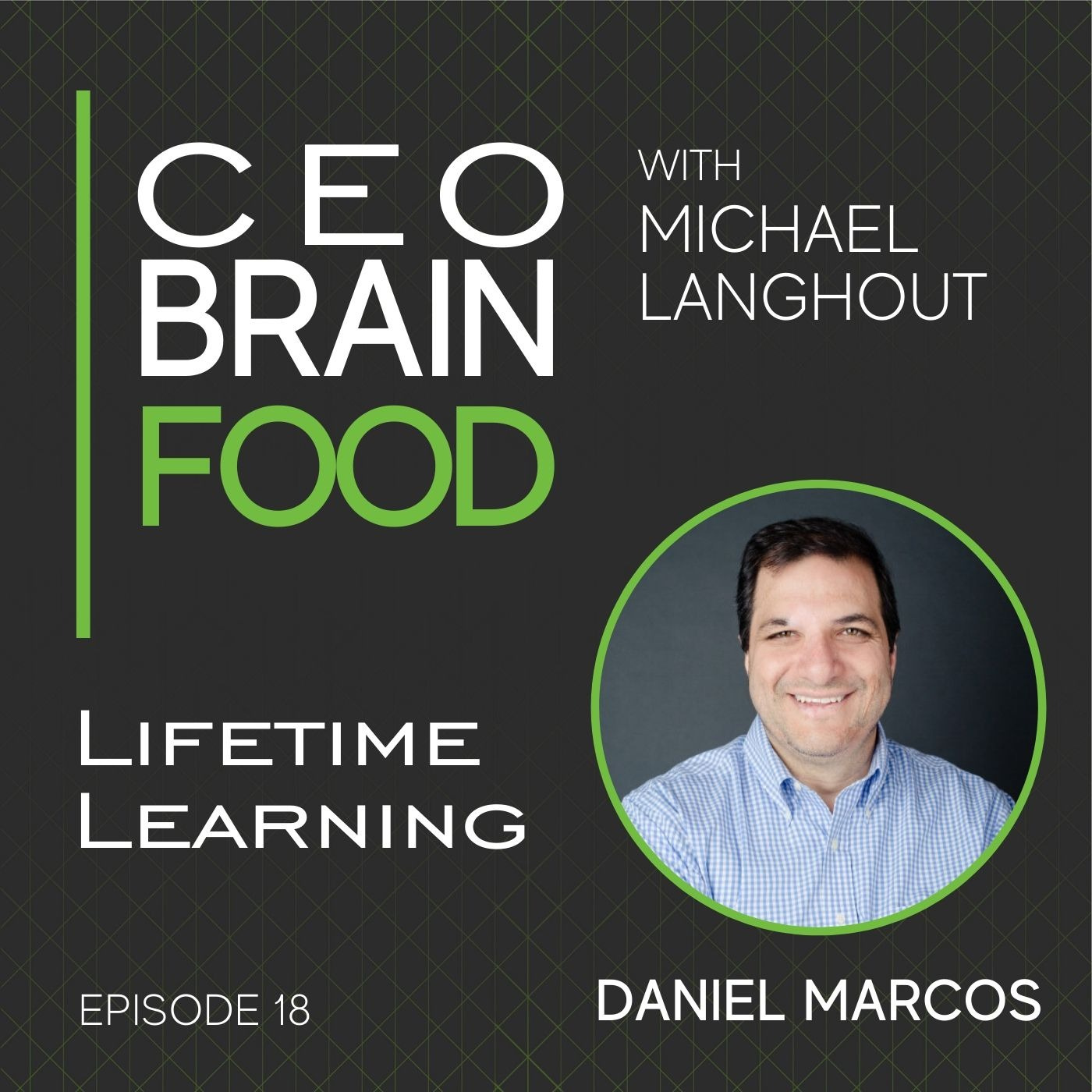
018 Lifetime Learning with Daniel Marcos
Oct 21, 201901:03:38Tap to summarize00:53 – Michael introduces today’s guest, Daniel Marcos02:47 – Why everything starts and ends with the CEO05:10 – Daniel speaks to why the strength of the founder usually becomes the weakness of the company07:12 – Level Five Leaders09:39 – The Southwest Airlines example10:56 – Daniel’s entrepreneurial journey16:50 – The importance of coaching20:45 – Daniel speaks to his fundraising prowess25:39 – Keeping up with the speed of scaling as a CEO30:01 – The decision to leave his company, travel, and go back to school32:13 – Daniel opens up about his mortgage company that failed in 200835:21 – Building the Growth Institute37:44 – The value of learning through reading39:14 – The importance of self-care40:41 – Stages of growth45:39 – Understanding that business plans change46:04 – The second growth stage: sales48:47 – The third growth stage: scaling and infrastructure51:13 – The fourth growth stage: dominating your industry52:03 – Differentiating between being an employee and owner of a company54:56 – Michael and Daniel discuss core values59:20 – Michael encourages the audience to visit Daniel’s website59:50 – Daniel talks about his Master of Business Dynamics Program1:02:37 – Michael teases the topic of the next episode of CEO Brain Food1:02:52 – Where to find Michael’s Functional Team ScorecardTWEETABLE QUOTES“Usually what I’ve found is the strength of the founder becomes the weakness of the company.” (05:16)“We as coaches need coaches. We cannot coach ourselves.” (19:46)“So whenever you’re doing something you want to do, something that is a challenge, you do it well. When you see it as a problem, then you’re gonna do it well.” (31:16)“And, by the way, the more I learn and the more exercise I do in the morning, the better day I have after.” (39:01)“People believe they can do a business plan and they’re going to execute the business plan exactly as they thought. No way.” (45:39)“So that’s when you begin scaling, after sixteen to twenty employees. And you have to build and invest in infrastructure. And then you have to align and simplify the operation.” (50:12)“The only way to bypass this growth is really throwing a lot of money to fix mistakes and problems.” (57:30)RESOURCE LINKSMichael’s LinkedInMichael’s WebsiteThe Functional Team ScorecardDaniel’s LinkedInDaniel’s WebsiteBOOKS MENTIONEDGood to Great: Why Some Companies Make the Leap and Others Don'tMastering the Rockefeller Habits: What You Must Do to Increase the Value of Your Growing Firm
Transcribe →
017 Three Execution Disciplines
Oct 7, 201900:21:51Tap to summarize00:58 – Michael recaps the last few episodes of CEO Brain Food01:29 – Introducing today’s topic: Three Execution Disciplines 03:25 – The strategy horizon05:09 – Discipline One: Priorities 06:51 – Discipline Two: Data Metrics 10:25 – Creating a mini game to identify the critical number 11:19 – Key Performance Indicators (KPIs) 13:28 – Discipline Three: Communication Rhythms 15:59 – The value of operating as a team 16:54 – Line item ownership 18:32 – The weekly huddle 20:46 – Michael teases the topic of the next episode of CEO Brain Food21:05 – Where to find Michael’s Functional Team Scorecard TWEETABLE QUOTES“I like to think of strategy in a three-year planning horizon. Thirty-six months, twelve quarters, three years. That’s your strategy horizon.” (03:25) “So, if we have an aspirational differentiator out there – something that we’re not doing today that we need to be doing in the future to be different than our competition – then it follows that we need to be working on elements of that differentiator today in the current year.” (05:39) “Your activities in the organization should all be focused on improving or driving one primary objective in the current period that is critical to the ongoing success of the organization.” (06:38) “People support what they help create.” (09:07) “The right KPI is a number that directly influences that critical number and is gonna help predict the outcome.” (11:24) “It’s important to understand that the daily meeting is not a problem-solving session. Instead, it provides an opportunity each day at a specific time for the team to communicate with each other on specific topics.” (14:53) “With empathetic listening, we’re building trust on the team which is a very very powerful concept.” (16:18) “Make no mistake about it. The CEO is the metronome that will help you achieve your objectives and make your goals and help you scale your company.” (20:06) RESOURCE LINKSMichael’s LinkedInMichael’s WebsiteThe Functional Team ScorecardKPI Library🎙️🎙️🎙️Podcast production by FullCast
Transcribe →
016 Driving Growth with KPIs
Sep 30, 201900:34:23Tap to summarize01:09 – Introducing today’s topic: Driving Growth with KPIs01:33 – Reinforcing the importance of tracking your critical number 02:28 – Defining the critical number 07:12 – Michael invites listeners to take a moment to reflect on their critical number 07:44 – The factors that influence and drive positive action towards your critical number 11:24 – The importance of financial literacy 13:21 – The Weekly Huddle 15:18 – Sharing the profits 17:54 – The importance of execution 20:13 – Developing KPIs 20:58 – Michael articulates the difference between accountability and responsibility 23:36 – The value in forecasting critical numbers in advance 25:02 – Michael provides examples of leading indicator concepts 26:25 – KPIs, priorities, forecasting and measuring 29:38 – The Five Scoreboards 32:13 – The importance of setting goals that will make organizations stronger 33:27 – Michael teases the topic of the next episode of CEO Brain Food33:38 – Where to find Michael’s Functional Team Scorecard TWEETABLE QUOTES“The critical number provides a focus on what’s most important. And, in fact, it’s the determining factor critical to the company’s success.” (03:35) “The driver is a number that directly influences the critical number.” (10:55) “You want your people to be engaged in forecasting the number. You want them to really own that number.” (12:05) “You want to be sharing with the employees the profit that they help you create, but only after a threshold level of profit is made.” (15:18) “The critical number is what you want to achieve. The drivers are how it’s going to be achieved.” (17:17) “When we’re developing the KPIs, first we want to identify the problem to be solved or we want to identify an opportunity that we’re going to leverage.” (20:13) “Accountability cannot be delegated, but responsibility can.” (20:54) “What gets measured gets done.” (30:16) “The critical number provides us a learning opportunity that becomes part of our everyday process of running the business. Everyone in the company should know the critical number.” (33:08) RESOURCE LINKSMichael’s LinkedInMichael’s WebsiteThe Functional Team ScorecardJim Collins' WebsiteFour Characteristics of a Strong Critical Number 🎙️🎙️🎙️Podcast production by FullCast
Transcribe →