Loading summary
Transcript32 lines
- [00:03]
Jana Peel
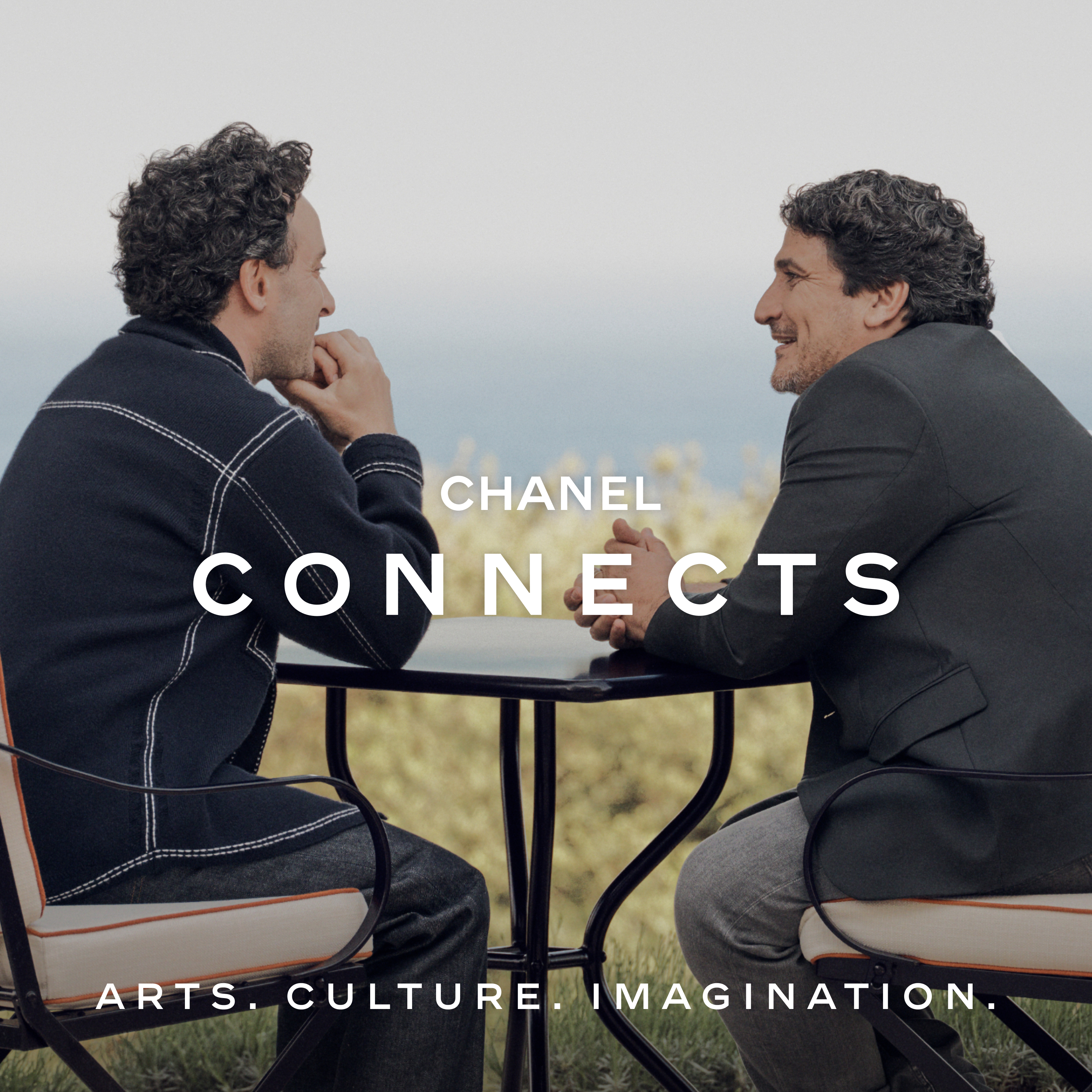
Welcome to Chanel Connects. I'm Jana Peel, president of arts, culture and Heritage at the house. For season five, we journey to La Pausa Gabrielle Chanel's villa on the French Riviera. We'll hear artists and innovators discuss the future of creativity and the innate curiosity that powers their work. In this episode three Michelin star chef and UNESCO ambassador Mauro Colagreco connects with artist and maverick Matthew Lutz Kinh.
- [00:38]
Matthew Lutz Kinh
I'm Matthew Lutzkenoy. I'm a visual artist working across many disciplines. I'm working in painting, ceramics, performance and collaborating a lot with people in all those disciplines. And well, I'm happy to meet you because I think we share a lot of interest in terms of working with others and also an interest in the ecology of our work and the practices we put into place for a healthy environment.
- [01:09]
Mauro Colagreco
Well, pleasure to meet you. I'm Mauro Colagrico, I'm a chef. I work near the nature practically from the beginning of the creation of my restaurant. I have the luck to work with fantastic people inside of the restaurant in very cosmopolitan team. But as well as you say, we have plenty of things in common because we collaborate with people who are artisans. Your work touched me a lot because I love ceramics. And what is the beautiful of the ceramic is you can feel the people behind the ceramics. You can feel the expression of the hands or the expression of the control. The temperature of cooking in our restaurant is huge. The quantity of different ceramics we have. So I hope one day you have one of you or yours.
- [02:17]
Matthew Lutz Kinh
I'm curious to see who you're working with and what all those things are. I don't know. I have a friend who's a fisherman and he said like, if you have this pole, you can be friends with anyone in the whole world because you go everywhere and you can fish everywhere and you can find your community and your beauty and your place and your food. When he told me that story, I thought, this is the same with ceramics. This is something that can take you to every place of the world. And in those places you can find a common ground.
- [02:50]
Mauro Colagreco
No, but for sure. And it's something very common with cooking as well. Because cooking is something who all the cultures do it. I was in some place where I didn't talk any worth of the native language. And when the food arrived, everybody understand each other with the signs, with the smiles, with the energy. That's actually. It's one of the things who I love the most in my profession is this possibility of huge pallets of people. You Meet and then with the people who. We cook for them. You know, we have this connection who you. It's an act of love, practically for me. So that is what I love the most in my profession. And I think it's the same with what you do.
- [03:47]
Matthew Lutz Kinh
Yeah, I'm always curious about that, actually. Well, this is something interesting that I wanted to talk to you about, this idea of the stage. And it's something that I was really curious to know more about, because for me, like, when I was started my work in experimental theater and was producing my paintings as backdrops, they were like large format backdrops. And I would fold them up and put them in the back of a taxi, show up at a nightclub, stretch them in the nightclub, organize the dance, and then, okay, time's up. And then everything collapse down and go home. And I was working with musicians like Sophie and other artists like Chelsea Culprit. We were working in nightclubs curated by Hendrik Folkerz, and. And in museum auditoriums with Lauren Cornell. And this type of temporal space was so interesting to me. And then when the pottery began in my work, and it started with my collaborator, a friend of mine named Natsuko Uchino, and we worked together doing ceramics, and the plate, like, became this stage, like, it became this platform. And I realized, like, okay, you can have, like, it can also. Because it's like expanding. It's a multiple. So, like, it's something that kind of expand and contract. You have like a stack of plates, you kind of spread it out, you create this kind of platform, and then it kind of collapses again.
- [05:22]
Mauro Colagreco
But what do you say about this movement between the plates? Is the movement for me as well in what happened in a table? Exactly. The stage, in the table and the room, we open the plates and the party happen. The people are happy. It's crazy how in a restaurant that can happen twice a day.
- [05:53]
Matthew Lutz Kinh
When I've organized dinner events and things like that, it's like, I make it, so I do it rarely, so it's always a big effort. I make all the ceramics. I have to find the chef, I have to find the people to work with. I make the paintings, all this stuff. And the last one I did in London, we did like, actually, I was very amazed because here in La Pausa, you have these ceramics laying around the house. This is a specific type of ceramic that I was researching going between England and Japan. That started as a dialogue with the minge movement. And when I saw those plates here in the house, I was like, oh, my gosh, this is so crazy. So the last project I did with those ceramics, we worked in London. We produced everything in London. We researched historical British techniques of decoration and plate production. And then we worked with British food and British chefs from this restaurant, Cafe Deco. And so we worked with them to create the menu and create the evening. And so. But what I meant to say is that each time is kind of. It's almost like I make this script, you know, to kind of construct this kind of event or a thing that's kind of centered. But like, in your case, it's so continuous. Do you think, like, okay, this season I'm gonna focus on this subject.
- [07:08]
Mauro Colagreco
Once a year, we make a program for the year.
- [07:15]
Matthew Lutz Kinh
And what's the starting point of the program? Like, how do you say, okay, this is the thing that, like, informs.
- [07:22]
Mauro Colagreco
Everything can be different things. For example, many years ago, I wanted to. Deep in the seaweed universe, we started.
- [07:33]
Matthew Lutz Kinh
To.
- [07:35]
Mauro Colagreco
Develop and research and working on totally different kind of use of seaweeds from the starters, mains, desserts, flavors, textures, cook row. So what's super interesting? Always I say in a manner, if you have all the dish are. It's like the music. No, if you are all the same tone, it's boring. But you need this high and low in a manner, because that gives to the guest this emotion, you know?
- [08:32]
Matthew Lutz Kinh
Okay, because you use this word a lot. You talk about, like, emotions. I always feel I'm kind of conscious of the construction of space, you know, like the restaurant is a constructed space. You create a kind of space of experience. And so inside of this controlled environment, you know, you are playing games. You, you know, you're playing with the audience. You're playing with their feelings, you're playing with their perception. But inherently, you are dealing towards, you know, a kind of politic of ecology. You know, you discuss biodiversity, extinction. And so, like, this conversation is like, deeply prescient and political.
- [09:15]
Mauro Colagreco
You must come to miracle because it's totally what we try to do. And I'm totally convinced we can change the world to the good or to the bad, depend of what we decide in the future or what we will eat. And we need to decide now. It's not in the future. It's now practically even too late. But it's crazy how the nature changed fast and become life. So is. But it's for sure a political action. And it's what we try is to express our. Of course, it's a moment of joy. Must be a moment of joy when you go to the restaurant. But I need this moment of practically Cries in the experience, the shock in the experience. And I look always for this little shock to provoke the guests in something more deeper, more out of the box of the wall of the restaurant. And we have two phases because we are as well, producers, we are farmers. I say always, I make the comparison between la mode. You dress your body for external and I dress your body inside. It's what you say? No, it's very powerful. But how you can dress with amazing dressing is very important for me. This aspect of confidence to put something in your body, you know.
- [11:15]
Matthew Lutz Kinh
Oh, like you have to make this safe space for them. Yes, yes, definitely. For me, I think about this. Maybe you think about that with food is like the hybridity and the possible. Like kind of hybridity and philosophies about human interaction.
- [11:32]
Mauro Colagreco
Of course. And it's what happened with me in Mirazul when I'm Argentinian born learn training in France, moved to Mentone when I was 28, in a place where I never be before. When I arrived, I didn't know the seasons here, the products, the producers. So it was for me like star from a white page, totally free. No, Even the border between Italy and France, for me it wasn't a border, it was an opportunity. It was a place of richness, of fusion, you know. And more I was involved in this vision and more I understood the opportunity and the liberty I was lucky to live. More I understand the way of the creation of the tradition and the evolution of the tradition. And this mix of cultures, this immigration, this contamination is part of. From the beginning of the history of the humans. And to be part of that, of this evolution is continually evolution. Yeah, Even as a farmer, I study that. No, the mille who is Milo in.
- [13:14]
Matthew Lutz Kinh
The wheat and the flower.
- [13:15]
Mauro Colagreco
Yes, they're moving because the movement of population thousands years ago, because the climate change already. So today, in my garden, I will allow you visit. You can find between the very classic Mediterranean vegetables, like tomatoes, carrots, olives, rice, you will find bananas, papayas, passion fruits. Because.
- [13:50]
Matthew Lutz Kinh
Because it can grow now.
- [13:51]
Mauro Colagreco
It can grow now. No, can grow with the climate change. And I find this evolution super interesting. And it's why I believe we will reach something more interesting in the future. I totally believe in the capacity of the humans to adapt himself to survive and to be more performant.
- [14:20]
Matthew Lutz Kinh
Yeah, I agree. When I was preparing for our conversation, I was thinking of this idea of aesthetic experiences or constructed space. I thought about which is like I was. And I hadn't asked myself this question in a while, so I was kind of Happy to ask myself this question, which was, okay, so today. And it's always changing. So I thought, today you're going on this trip. You know, we're in a kind of crazy time right now in the world. Lots of uncertainty, lots of violence. So, Matthew, how do you define beauty? And I thought maybe today I would define beauty as seeing the world clearly, or maybe what I could kind of describe as what beauty is, which doesn't only include pleasure, but also includes reality.
- [15:23]
Mauro Colagreco
For me, I push myself always to see the beauty even more in these days, in those days, because we need to have island of hope, and we need to build these islands of hope in every individual person. Even in the worst situations, we must keep in mind something beautiful around us happen. And in your work every day, you have somebody who inspire you or.
- [15:59]
Matthew Lutz Kinh
Yeah, I think that there's like two. There's like, definitely two parallels, you know, because I have to say that I'm probably the most influenced by the people I work directly with. I would, like, be lost in this world if I don't think of all of the important collaborators that I've had, from my first band working with Sophie, to the dancers I've worked with, and choreographers like Isabel Lewis. And so I think that there's this, which is extremely important. All of the kind of living people who touch us and we touch back to make our work in the world, which I think are ultimately the most influential. Yes, I mean, when I was developing my ceramic project, we talked about, like, you mentioned, like Picasso. But actually, the starting point of my ceramic project was Judy Chicago, a feminist artist who's alive today, who created one of the most impressive sculptures that I had seen as a child growing up at the Brooklyn Museum called the Dinner Party, which is a giant table dedicated to real and historical feminist figures. And each table setting is dedicated to a woman. And there's a table placing with text. I think that's also part of my interdisciplinary approach, is that always kind of creating balances to things. So there's like always this kind of interest in. I think historically finding a sort of merge. But me personally, most of my inspirations have been female figures, I think in the arts because they tend to work more collaboratively and work more collectively. So, yes, the ego probably is less dominant. I recently got to exhibit with the drawings of Tricia Brown, so I got to place one of my large format works in the same space with her drawings, which are made as performances. And she. They're actually kind of scores. The drawing itself is a sort of trace of Movement and a score so hard to say. I mean, there's so many important influences. But I think a lot of my core interest comes from. Yeah, maybe feminist movement, I would say so nice.
- [18:34]
Mauro Colagreco
And I understand totally your point. And for me as well, the people who you work with mark a lot your career. And I think about all these very cosmopolitan team who I have some of them with me for more than 15 years. They changed my way to think as well. In the kitchen you learn constantly. But then it was as well women's. I was Beatriz Chomnales, who is still a great cooker in Argentina, who from my early age she take care of me and she bring me here in France to learn French cuisine. But again, it's not only chef as well, you know. Somebody who marked me a lot is Masonabu Fukuoka, who was a farmer, Japanese farmer, who write few books. One of his book changed totally my vision about agriculture, but about as well the impact of the food in every step of our life in nature, but as well in the society who we live.
- [20:04]
Matthew Lutz Kinh
When I was listening to an interview with you, I thought of this chapter in the One Straw Revolution where he talks about the rice field. And there's this story in the book. He tells the story of the ecology of the landscape. But he talks about it because it starts with waking up one morning and the entire field is covered in spider webs. And then he talks about. But if you're going to have the spider webs, then you need also then the snails and you need these other insects. And like, if you're going to be an expert on rice, maybe you also need to be an expert on snails and spiders. And then we don't only need this, but we need the artists to represent because it's so beautiful when you see the whole field covered in spiderwebs. Who can capture this? So we need to get artists involved.
- [20:59]
Mauro Colagreco
Yes, yes.
- [21:00]
Matthew Lutz Kinh
In this chapter. I thought of it when you. Yeah, it's so beautiful. Yeah. And I thought of this when you were sort of describing your relationship to your garden and your farming.
- [21:12]
Mauro Colagreco
Well, no, it's super interesting. We can stay for hours, I think, to talk. I just want to introduce my universe to you. To have the opportunity to show you what we do. I think you have plenty of common things. My work open a door, not a door. Millions of doors of hopes, of possibilities. And it's the pen of us to keep these doors open and to continue to open more.
- [21:46]
Matthew Lutz Kinh
No, that's beautiful that you say it like that. Because I also was thinking, you know, the way that I like to work also as an artist, in the way I engage with people, is to open as many doors as possible, not only in terms of, like, an idea or a project, but also as, like, points of access and points of engagement, you know, to keep the things open so that people can enter.
- [22:13]
Mauro Colagreco
Yes. Yes. Super important. Thank you. Real pleasure.
- [22:20]
Jana Peel
This is Chanel Connects, available to listen on Spotify, YouTube Music and Apple Podcasts. Next time I sit down with artist and innovator Adam Pendleton.