← CHANEL Connects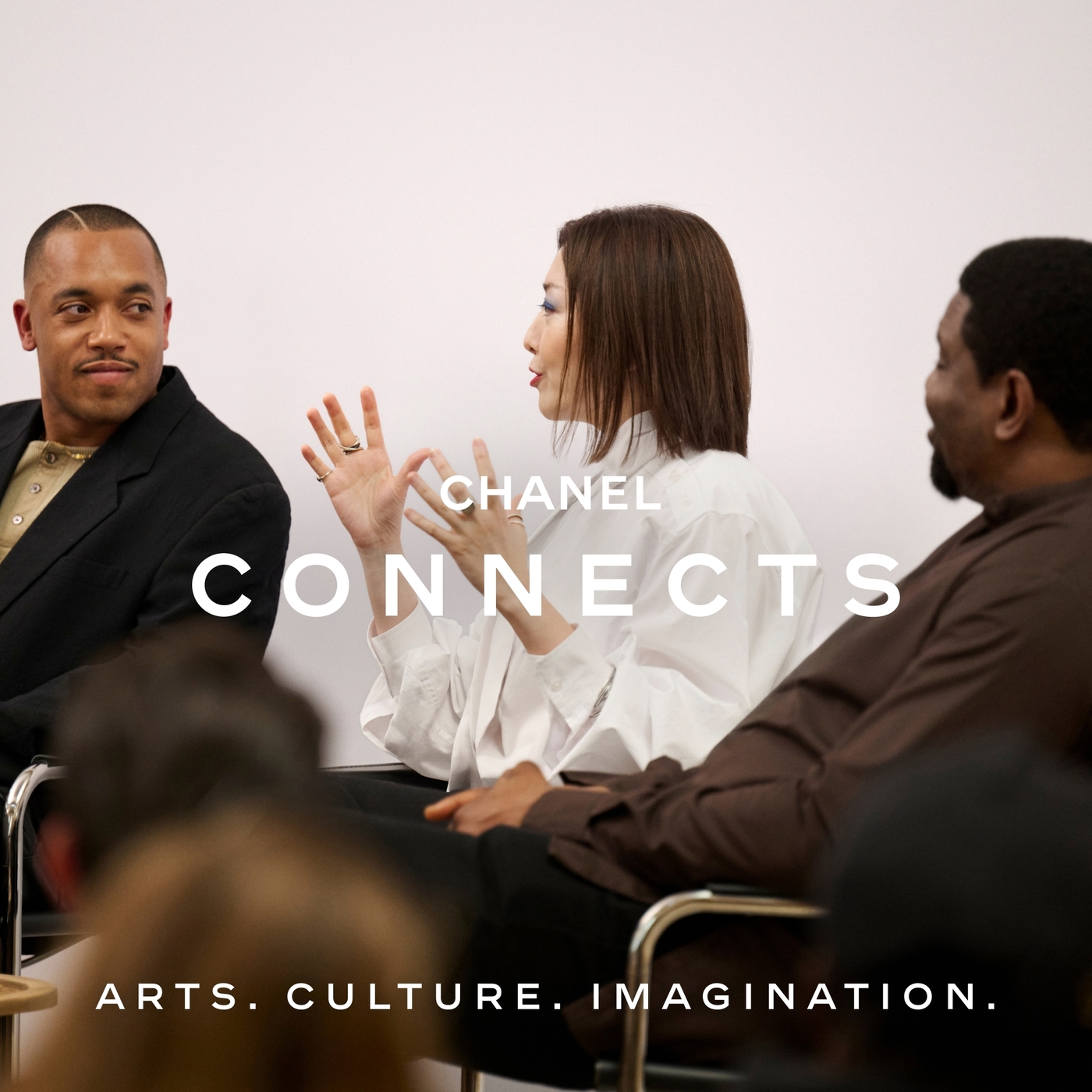
Loading summary
Transcript76 lines
- [00:02]
A
In humanity. I still hope we have that sense of empathy. I still hope we can still pull through as humans.
- [00:11]
B
We have to kind of make some extra space for this outer force driving us to somewhere we never expected.
- [00:20]
C
My brother was like and me was cockroaches. My father was nails. My mom was like Iron Fontaine.
- [00:29]
D
I'd love to start at the beginning and maybe starting with Ahyoung. Hear about your origin story and how you came to this career as an artist.
- [00:39]
B
Well, for some people, being an artist means that very spontaneously they become. But well, I tried so hard to become an artist. I studied communication design back in my country, South Korea in the late 90s, early 2000. I don't want to reveal my age, but yeah, I'm not that young and worked as a motion graphic designer for many, many years. And only later I realized that I need some self motivated project, more long term project that I can put some meaning to talk about word and contemporary conditions. And then I went to the UK to study further contemporary photography, semiotics and then later fine art. So in it took a while to become an artist and to be called an artist meant so much for me. So I achieved it.
- [01:30]
D
You achieved it and you chose it. And I'd love to hear from Paul who also I think had a very intentional path towards the arts.
- [01:40]
C
Yeah, I think it started quite early. I started to draw quite early and at some point I discovered, I think my staff like my passion inside art. With ceramics first, I think it was more towards the object and the idea of creating with my hands. That was the thing that led me after to painting. And I met an artist that kind of gave me the sensation of what could be the artist's life in a very stereotypical way. And having a studio and spending just time inside and experimenting. That was the moment I feel I was in the right way.
- [02:13]
D
And ameco your path.
- [02:17]
A
I think I got sucked into it.
- [02:19]
D
You got sucked into it. Okay, tell us more about that. Because these journeys were very intentional.
- [02:24]
A
No, I majored in graphic design.
- [02:27]
D
Have you met my friend Ah Yong Kim? Yeah.
- [02:30]
A
And I was quite happy doing my freelance graphics and stuff till I started listening to Lagos. So I think basically I was just recording and listening on my own. But it drew the attention of curators, especially BC Silver, who thought I was a sound artist. But I was like, listen, I'm just listening to sounds of the city. But she thought it was a good direction. A Nigerian artist working with sound and kind of referred me to be part of a colloquium in Cape Town where there were other curators. And when I presented my work, they thought it was a different kind of context to explore Lagos. And I started getting the example exhibition offers. So practically I didn't know what I was doing at the beginning. It was just sort of cool to work with the sound of layers, but that sort of like, set off the path and like they say, the rest is history.
- [03:26]
D
I'd love to explore with you a little later what sound can offer which ceramics or painting can't. But you mentioned Lagos as a city that has had such an influence on you. And I'd love to ask Ayoung or Paul if there's a particular city that has also had a big impression on your journey.
- [03:44]
C
Yeah, I think Salvador. Salvador de Baya in Brazil. One of the strangest place also I visited. It was my first time also in Brazil, and I didn't know how to speak Portuguese as well. I was kind of lost also in the. In the city. But so my. My farm, my. My mom is from Caraiba. So when I was going there a lot in. In Guadalupe, and the moment I went to Salvador, it was like kind of feeling this bigger. This experience was. Yeah, way bigger. And I. I could dig inside my own research, like completely in isolation.
- [04:12]
D
And if I'm not mistaken, was your mother also an inspiration, a painter who had you in her studio or at her knee? Can you tell us about that?
- [04:20]
C
Yeah, she was painting when I was a child. She was painting at home, but in a very naive way, I feel. I don't think she wanted to be that much to be an artist, but she felt the need of painting. She was sculpting as well, but with papier mache. She was painting in front of the TV and I was watching TV at the same time. So I kind of got nourish with both of it. With TV and painting running all the time at home.
- [04:45]
D
I love that I was speaking backstage to Payel Capadia, who's here as one of the next prize winners, and she was telling me that she too was in an environment with her wonderful mother, Nalini Melani, whose work is represented here at the Venice Biennale. So what I wanted to ask A Jung about was whether there's also a city, something that has really been a breakthrough for you, or been very impactful to how you bridged out to such a universal language.
- [05:12]
B
Since I was born and raised in Seoul, South Korea, it was only 26. I was only 26 when I left my country. And I experienced. Well, many European cities drifted around between residences to Residencies and you know, my work really respond to the environment where I'm residing in. Since I came back to my country in 2018 for the first time, I go deeper in what it means in living in the city like Seoul. It's a megacity and the speed is crazy. And well, since I moved back in my country, all my practice is really responding to this velocity and technoprecarity, how technology drives a single person into a precarious entity. Yeah, I think Sauri is still very interesting space for me.
- [06:06]
D
We'll touch on and mo and storm these characters later who really drive your work quite literally and figuratively. But I also wanted to ask what is the tool in your toolkit that you come to most often and what have you chosen to abandon?
- [06:24]
A
I will say the biggest tool is really my body in terms of how I use it as an interface to experience. My practice have shifted from just working with sound to incorporating other senses. For example, I do a lot of work with the glistatory in my migratory work and also the olfactory realizing how smell and how taste influences a big topic like migration. So yes, I will say in my toolkit my body is really the biggest tool. The interface that I used to experience and used to create works and ayung.
- [07:00]
D
Seemingly your tools are much more digital. As we stand on the edge of AGI ahead of us, what are you using and what are you excited about and what perhaps scares you?
- [07:13]
B
Since I work across so many different media, like I do a lot of live action shooting with actors on locations. The physicality is quite still important captured on lens based media and I use a lot of post lens based media, for instance CGI animation, game engine simulation and generative AI animations as well. And sometimes I scan the stretch with the LIDAR scan technology like a waymo.
- [07:43]
D
Tell us about your technology. What are you scanning? This.
- [07:46]
B
Okay, this light scan is a very simple technology embedded to the autopilot vehicles like Tesla and stuff. And then it emits the ultra red signals and then it touches to the surface of the object and then it comes back and the duration of the coming go and coming back. It makes the dist and it creates coordinates in three dimensions. Yeah, it creates half real, half virtual sequences. And I mix all those technologies to create my own speculative fiction. And yeah, I love this kind of crash and collisions in between those textures and layers of media. But what I don't do is actually painting. I love. I wish I would paint it. I learned but I stopped it. So probably in some time I'll go Back. Yeah, sometime.
- [08:39]
D
I love that because the three of you are so genre defying. And I want to understand how you explain to your parents what is the actual occupation which is so hard to define. Is artist accurate? Are there other descriptors that you use? Give us an idea. As your genre defying, if one ever had to pin you down, how would you like to be known artists? Okay.
- [09:04]
A
You know, because it's always easy to get dropped in a box and you end up sticking to that box, you know. But I've come to realize that if art reflects life or documents life, life is not experienced in one dimension. Right. That's why I brought some different senses into my practice. But it's hard to, like, let go of that tag sound artist. For me, you know, people still stick to that. And that is so funny because when in Nigeria, people, when you say you're a sound artist, oh, you're a musician, you know, it's this kind of straight, direct talk that you make music because what else are you gonna do with sound? But we also come from a culture where sound is quite very important. Igbo sound is very. Or I mean, the culture is basically like an oral tradition. And the term sound artist is really defined, really, from the Western perspective of galleries and museums.
- [10:02]
D
And of course, you've been in the Venice Biennale, Represented. What is the sound of Venice? That is a sound that this audience can close their eyes and envision.
- [10:10]
A
That's tricky.
- [10:12]
D
Lagos, Nigeria.
- [10:13]
A
Yeah, I think when you come from somewhere like Lagos every other place. I'm not gonna. I'm not gonna use the word boring. Every city. I still see cities. As a composer, every city composes based on how it's designed and how it's structured. Right. Venice. What I find interesting here is it's one of those cities where there are no cars. But there's something about Venice because you have to come from the airport with a boat. It's really about that smell, you know, that smell of the ocean. I mean, it strikes you when you are coming. So smell is actually quite a stronger sense for me to think about Venice. Like, I'm still trying to figure out what the absence of cars means or how that transmits in the sound experience here. So it's still kind of work in motion.
- [11:03]
C
And we'll be artists.
- [11:08]
D
Paul is such a world builder as well. And it's so fresh because we've just come from Berlin. As I mentioned, the artists here are from. From 10 different countries originally. But there's something in the water in Berlin, or maybe there's something in the music of Berlin that definitely has attracted this very vibrant community. You opened at the Boroughs collection. You took over an expansive space. And I'd love to ask you about that kind of world building filling rooms. Can you help us understand what it is when you take over a shingle pavilion or burros?
- [11:39]
C
Yeah, I think it started with Lafayette on Superstring exhibition, where they gave me this whole space. And it's a space that is very hard also to work in because you have all those bricks that are very typically Parisian type of color. You have a lot of noise visually. It was the idea at the beginning to hide all this space and to create kind of like my dollhouse. The idea of this exhibition is also to take all of the. Some members of my family as the actor of it. So they represented in different ways. Like, my brother was like. And me was Cockroaches. My father was Nails. My mom was like Iron Fontaine. And like, you have all those characters created in that space. And I really enjoyed it to see also the reaction of the people so going into that space and not recognizing it. And, you know, like, all the dimension also were changed, the color, etc. So it's a way also for me to, you know, like the material of painting and of sculpture. When I started, I played with those material, and when you give me a space, I play with it the same way. So it's just a continuation, I guess, of this research in a larger scale.
- [12:48]
D
Can you tell us a bit about the practice and whether it's a solitary endeavor? What is the practice in the studio? I'm sure everyone here has read Vasari's Life of Artists, and that ritual of making is really, really fascinating.
- [13:01]
A
The beginning is always solitary. When you are still trying to figure out things, when you are trying to embed itself in the research material that you have, you are really on your own. It's one of the loneliest points in the process of making art. You are really alone that time trying to figure out what direction this art is going to take. But I try to see art as something collaboratory. At some point, you are going to work with technicians, you are going to work with people. I, for instance, I try to create gustatory experiences, which includes craft beer.
- [13:38]
D
Gustatory, I love that. Okay, so your art includes brewing.
- [13:41]
A
I'm brewing. I can brew, I can distill. But there are people that do this every day. If I have to, like, start from the scratch, it's probably going to take me different trials to get what I want. But there are people that by the time I develop the recipe and scripts and hand it over to them, and to say, like, most of these recipes that I develop or flavonos that I develop come from research. Taking keywords from research, connecting flavor profile to each keywords, and being able to build this first recipe profile that I now take to a distiller or a craft brewer. And we take it from there. So the first part going through the research is very solitary. It's very lonely. You're alone with your thoughts and ideas because you really need to be able to communicate to whoever you're going to work with. I have to convince the distiller, listen, you are making art. You're making art for the palette, what people can taste and experience and enjoy. See that way and let it not be your typical routine, everyday thing that you are used to, that kind of also shifts the way they make that approach. So, yes, it starts from solitary moves to collaboration.
- [14:48]
D
Where can this audience enjoy the pleasures of your art? Is it in a museum? Is it in a gallery?
- [14:54]
A
We just finished the New York edition of the Migratory Note Gene. So what we basically did was look at the migratory routes to New York and then select botanicals from these places. And we made a gin. It's really all this idea of migration. So, yes, at the Fort Harvey distillery in New York, you can still experience a gene, but the food and the cocktail aspect is gone. It's like one evening of performance where we bring the crowd together. The whole idea is to explore migration, especially in these times where it seems to be like a forbidden word. The politicians are using it really as their weapon, especially somewhere like the U.S. so we had this evening where I invited a mixologist to create a cocktail depending on the different routes of migration. And I got a fine chef. Dining chef. A fine dining chef to also make food using those flavors. And then the community comes together to gather and enjoy. There are no speeches. It's just enjoy, mix, communicate, and leave us a community.
- [16:04]
D
Fantastic. It feels like Berlin may be a good city, maybe Venice, but I'm sure we can crowdsource some really good ideas later. It sounds like a beautiful collective endeavor. A solitary collective. We have next prize winners who are dancers and company directors. Andrea Pena. Marco de Silva. Your work is again, somewhere in those liminal spaces between performative and art. Can you share with us how you work together with your collaborators?
- [16:32]
B
Well, if I have some specific issue that I want to delve into, then I really try to find the right person to interview several times. For instance, for my Delivery Dancer series, For this delivery person, especially female delivery drivers, I met a person who is a very skilled woman and I followed her to her deliberate work. And then she kindly brought me on the streets, giving me a backseat of her motorbike.
- [17:04]
D
Let's chat for a moment, because your delivery dancer, Codex was the most extraordinary and epic takeover of MoMA PS1. And I think it was the biggest installation of such scale, which for an artist of such youth is really an extraordinary endeavor. Can you just explain what the delivery drivers do and these characters that keep coming back into your work, that seem so otherworldly and yet omnipresent across your exhibitions?
- [17:32]
B
So the series that I started from 2022 is called Deliberate Answer and it has many different iterations, from single channel video to multichannel videos and game simulation and motion capture performance that we had last year in New York as part of Performa Biennale. And a solo show was held in Moma PS1 last November until this March. And it brought most of the pieces in the series, sculpture, installations and on and on. In the center figure, there are two deliberate female delivery drivers. They're set in the fictional fictitious Seoul or some cyberpunk city called Navaria. And what they do is they try so hard to meet the shortest distant and shortest time condition governed by the algorithmic control by the platform, delivery platform. It's not obvious what they are delivering. Actually, it's not rebuilt yet forever. And what I wanted to touch upon was this. How technology change our bodily sensation, the perception of reality and perception of time, how sometimes, not always, the technological aspects put us into anxiety and we have to optimize our time and body condition. So it was part romance between two identical women, different versions of themselves. That's time to fall in love to each other. But also they have to get over the time dilation issues. And yeah, it's a fiction, cyberpunk, speculative fiction.
- [19:18]
D
It's a beautiful work in which you capture our reliance and anxiety around technology so aptly. I just finished Ben Lerner's transcription and in it he goes to interview his favorite 90 year old artist and his phone breaks and he is not recording. And you really feel this extraordinary angst as the object that we rely so much upon fails us, and yet it's so far outside of our body. Speaking of shows, we are here at the Venice Biennale, the 61st edition, and some of you have an experience with that. What is that like Emeke, what does it mean for an artist to be in a Biennale? And what is coming up next for you in terms of what you're excited about.
- [19:57]
A
Biennales are not just an exhibition platform when it comes to positioning. And visibility on the global scene is quite important for artists. So I don't see it just like an exhibition. Imagine like the whole world prepares every two years to descend in Venice. It's, of course, life changing. You know, people see your work, they want to show it elsewhere, it moves around. But then it also comes with this pressure. You know, a lot of people will run into debts to make works for Biennales, and there's never any guarantee of what the outcome would be. For me, it's always worked out.
- [20:36]
D
Sao Paulo 2025. You mentioned Brazil as an inspiration. Sao Paulo. Did that work out the way you wanted it to?
- [20:43]
A
100%. I mean, it was a piece where I moved beyond, just like I tried to bring in all the senses. So it was a piece that looked at deforestation, man's relationship with environment. So we built these loudspeakers that were embedded in cut tree trunks that were also burnt. It was installed in 12 channel voices of women singing. It was the earth's lament. And I come from a culture where the earth, Allah, it's the feminine energy, it's the woman. So for me, it was important to have that voice there or women's voice there, not men. But we moved just beyond installing sound. When you come into that space, there's smoke in the air. I wanted to create that experience that you get from deforestation or destruction of the earth. That is not just limited to writing the lyrics that this woman performed by taking keywords from research on environmental degradation. But we move that beyond just sound by including smell. So you walk into the space, there's a smell of the burning furnace. There's smoke in the air. There's this harsh red light. It's something you don't forget. The best part of that is when you leave, the smell stays on your body as a constant reminder of what we are doing to the earth. So this piece now will come to Berlin in September. It's been moving around in Brazil. So it worked out in that sense, being able to push certain boundaries on how you create experiences. It worked out for me as an artist. So for me, it was a big success.
- [22:17]
D
Ah Yung, what's next?
- [22:19]
B
Well, I may need to talk about this one a bit. It's not really about biennials. Well, I participated in Venice biennial back in 2015. It was a great, great experience. I was still very young and didn't have this big exposure. And it kind of changed my mentality. What art can be and art exhibition can be. And I learned a lot. It made me to grow, mature. And also there are really a bright side and dark side of biennials. You know, every event has got this double sided one. But I would like to talk a little bit about this one. I'm recently thinking a lot about artist autonomy. Well, artist is being considered the most autonomous. Being an occupation. We can do whatever we want. Research and accomplishment as artwork's vision. But then again, I sometimes think that, well, artists are always kind of in a selection by curators or by biennials. And somehow our life cannot go as we planned. There are some things just interfering in it. Very good exhibition. And then somehow I have to detour my plan a few years later. I have to do something different. And we have to kind of make some extra space for this outer force driving us to somewhere we never expected.
- [23:48]
D
So Ayung, what is your advice as we end this episode? Advice to a young artist?
- [23:54]
B
Sure. I think this really, really keep this anchor in our mind is so important, which never be floating around. It's very, very solid and dense, big roots. Otherwise you will be very easy to drift around and easily be blown out. So I think just being yourself and go deeper and deeper into your very darkest side or deepest side of yourself and keep it because it's so precious. Don't let anybody touch that part. Otherwise you'll be really easy to be dismantled. And once you have secured this position, this space, then you can do whatever, whatever outer force comes in, you're still yourself.
- [24:40]
D
Beautiful. And Paul, what's next? And a wise piece of advice, I don't really know.
- [24:48]
C
I mean, the next show is going to be in Villa Medici soon. But in terms of research, is that
- [24:55]
D
again an epic takeover of such an esteemed and historic place.
- [24:59]
C
I feel I want to close a certain chapter also. Like I was waiting for the residency time, also for me to change my painting in a way like to go somewhere else. And same with sculpture, so to play differently because the thing also by creating in such a short time, sometimes you get repetitive and you start to see yourself having certain type of automatic movements, which is not something that I think you desire. Also when you explore your own and your own mediums, I think you want to be excited by yourself and finding new stuff. So for now I'm waiting for my eye to be seduced by something and that gets me somewhere.
- [25:34]
D
Well, we'll be watching for Villa Medici and see where that takes us. I would just love to end with a quick fire round. So anything that comes to mind as I ask you these questions. What keeps you up at night?
- [25:49]
C
Tv.
- [25:49]
D
Tv. What are you watching?
- [25:52]
C
Damn.
- [25:52]
D
Damn. What aren't you watching?
- [25:56]
C
Yeah, shows. There are shows, A lot of shows. Yeah.
- [25:58]
D
French, Paris.
- [25:59]
C
American.
- [26:00]
D
American.
- [26:01]
C
American.
- [26:04]
D
We want to know what you're listening to, Emeka.
- [26:06]
A
I'm listening to a lot of stuff. I have playlists that runs for 47 hours. Yeah, a lot of work, a lot of research I'm doing now. I sort of focused on monitoring how things are going on the Earth. We're quite in a very precarious situation. And these are like data, news, information, feedback that I analyze, pull keywords. I'm writing lyrics for choirs to perform. And based on the negativity, you will wake up at night or you will find it difficult falling asleep, trying to process all these things. It doesn't really make sense.
- [26:43]
D
What makes you optimistic?
- [26:48]
A
I think optimism is quite a strong word at the moment. Humanity. I still hope we have that sense of empathy. I still hope we can still pull through as humans. This is who we are, you know, we are quite resilient. In as much as I used to categorize myself as an optimist, I tried to use the word. I mean, I'm realistic these days, and the reality doesn't look good, but I think the good will was still overcome. It's a tough period. So music is also where I get lost in, you know, and I just let my Spotify just the algorithms go with the flow without trying to curate everything all the time. It's really about letting go, you know,
- [27:33]
D
There was a beautiful quote, the late curator who dreamed this Biennale, of course, Koyoko said that in these times, we must improvise, like jazz man, to the movements of our times. So I will end with Aiyoung and find out either what. What keeps her up at night, what gets her up in the morning, or what skill you wish you had.
- [27:55]
B
Oh, my God. Well, the first question. Well, is boring answer. And these days, online meetings. Endless online meetings. Endless online meetings from different continents. I have to rotate the continents. Video calls, I think that's it.
- [28:13]
D
That's it. Fantastic. Well, thank you. It has been a pleasure and a privilege to have you here with us today.
- [28:19]
A
Thank you.
- [28:20]
D
Paul Iyoung and Emeka.
- [28:21]
B
Thank you.