
Podcast
Chaos Computer Club - recent audio-only feed
Hosted by CCC media team · EN
Der Chaos Computer Club ist die größte europäische Hackervereinigung, und seit über 25 Jahren Vermittler im Spannungsfeld technischer und sozialer Entwicklungen.
113episodes
Episodes
Newest firstAll episodes
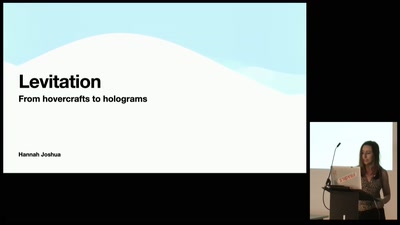
Levitation, from hovercrafts to holograms (emf2026)
4w ago00:31:02Tap to summarizeLevitation is a popular trope of magical media, but are we actually able to defy gravity and suspend things in the air? The short answer is yes. And the longer answer is we have lots of different ways. Using magnets, sound, light, and more we’ve levitated objects from single cells to entire passenger trains. We’ll go over the basic principles underpinning each approach, and consider their benefits and drawbacks, and we’ll also cover why you should care - because making stuff levitate can be useful for reasons you might not think, like making better drugs, creating holograms or improving transport networks between cities. Licensed to the public under https://creativecommons.org/licenses/by-sa/4.0/ about this event: https://www.emfcamp.org/schedule/2026/218-levitation-from-hovercrafts-to-holograms
Transcribe →
OBD-II: Obviously Broken Design, Too... My Introduction into car-hacking (emf2026)
4w ago00:19:35Tap to summarizeIs it still your car? With a modern car running between 100 and 150 small computers - ECUs - the question is hard to answer. In 2015 some hackers took control together with a baffled Wired reporter of the car he was driving, from miles away. This led to a lot more interest in those computers constantly talking to each other over CAN bus. There is a massive playground here and most people do not even know the gate is open. Maybe you already have a Bluetooth ELM-327 dongle visualising CAN data on your smartphone. That is the crack that lets you dig deeper. The next step is the Macchina M2 - which goes so much further. You get direct access to more vehicle interfaces than most hackers even know exist. I will show you SavvyCAN and Wireshark capturing live CAN traffic and we will decode what those packets are actually saying. Your own car, your own hardware, completely legal. By the end of this talk you will want to go straight to the car park and plug something in. Licensed to the public under https://creativecommons.org/licenses/by-sa/4.0/ about this event: https://www.emfcamp.org/schedule/2026/57-obd-ii-obviously-broken-design-too
Transcribe →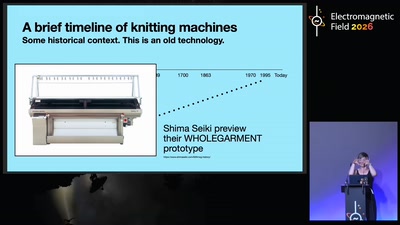
Did a Robot Knit Your Jumper? (emf2026)
4w ago00:22:51Tap to summarizeMachine knitting has grown in use and popularity over the past decade as domestic knitting machines have been rescued from dusty attics. Computerised knitting machines are now within reach for significantly less money than their older, more established industrial ancestors. But what makes an industrial knitting machine different from one you could have at home? What does it mean for it to be computerised? What is the difference between a ‘fully fashioned garment’ versus a ‘complete garment’? This talk will start with the fundamentals of how to knit a jumper and will walk through the industrial manufacturing history of knitting frames and machines, highlighting the mechanical engineering innovations that have allowed machines to move closer to replicating the agility of human hands knitting yarn. Did a robot knit your jumper? Probably not, but it is exciting to see how this technology is progressing and what it is enabling. Licensed to the public under https://creativecommons.org/licenses/by-sa/4.0/ about this event: https://www.emfcamp.org/schedule/2026/203-did-a-robot-knit-your-jumper
Transcribe →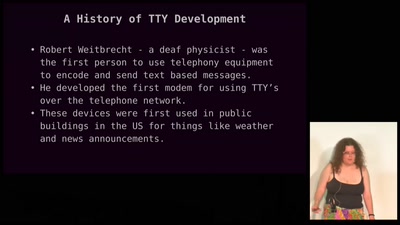
Phones for the Deaf (emf2026)
4w ago00:26:30Tap to summarizeHave you ever gotten a call from a relay operator who wants to connect you with someone who's using a text phone? Did you hang up? Stop it! I want to tell you about the past, present, and future of textphones, and how deaf people and people with difficulty speaking communicate with phone users. Finally, I want you to stop hanging up on me! Let's look at the systems behind different assistive technologies, how they are used, and the people who keep them running- people who are some of the last operators in the phone network today. From early POTS tone systems for the first landlines to modern apps, we'll see how a tiny but vital corner of the phone system works. This talk will be presented in spoken English with live captioning. I am a hearing English and BSL speaker. I have used textphones and relay phone services since childhood and have worked in phone technology and technology accessibility for a number of years. Licensed to the public under https://creativecommons.org/licenses/by-sa/4.0/ about this event: https://www.emfcamp.org/schedule/2026/76-phones-for-the-deaf
Transcribe →
Breaking in to buildings with boobs (emf2026)
4w ago00:30:13Tap to summarizeJames Bond would have been a better spy if he were female. I've broken into dozens of buildings, from banks and museums to law firms and medical institutions. Using social engineering techniques, I've gained access to restricted areas, connected to internal networks, and even walked away with company devices, all by exploiting assumptions people make, often simply because I'm a woman. I'm no criminal; I work in Cyber Security with a focus on simulating real-world attacks. In this talk, you'll get an insight into the world of social engineering and offensive Cyber Security, learn how attackers manipulate trust and human behaviour, and you'll even have the chance to work through a real-world scenario to see if you could successfully gain access to a building yourself. This isn't a talk on feminism; this is a talk about how using sexism and prejudice can make you a really great spy. Licensed to the public under https://creativecommons.org/licenses/by-sa/4.0/ about this event: https://www.emfcamp.org/schedule/2026/206-breaking-in-to-buildings-with-boobs
Transcribe →
They Forgot What Happened Last Time: hacking the Windows 365 Link (emf2026)
4w ago00:13:39Tap to summarizeThe Windows 365 Link is a thin client, running a special edition of Windows 11, that can only connect to a "Windows 365 Cloud PC" and is otherwise useless ewaste. When it was announced, Microsoft boasted its total vendor lock-in plan, which they described as "secure-by-design architecture": no admin rights, no local data, EFI Secure Boot locked on, BitLocker always enabled. The last time EFI Secure Boot was locked on was Windows RT devices, and that caused me to personally break the Windows bootloader chain of trust, several times. Challenge accepted. Licensed to the public under https://creativecommons.org/licenses/by-sa/4.0/ about this event: https://www.emfcamp.org/schedule/2026/93-they-forgot-what-happened-last-time
Transcribe →
Temperature in space - how and why we make consistently accurate measurements in the most inhospitable environment (emf2026)
4w ago00:19:07Tap to summarizeThis talk, from a space telescope electronics engineer, looks at the background of some earth observation and astronomy missions and dives into the technology behind them. Looking at real flight hardware developed at the Rutherford Appleton Laboratory in Harwell, I’ll discuss the importance of thermometry, how we measure incredibly accurate temperature from orbit, and how we know that these measurements are “true” and not garbage-in, garbage-out. We’ll look at JWST and the MIRI instrument, Sentinel-3 and the SLSTR instrument, and the next gen hardware I’ve been working on over the last few years. Finally, as I’m as much of a space nerd as the rest of you, I’ll be playing a high dynamic range recording of the NG-11 Antares launch out of Wallops AFB. Licensed to the public under https://creativecommons.org/licenses/by-sa/4.0/ about this event: https://www.emfcamp.org/schedule/2026/40-temperature-in-space-how
Transcribe →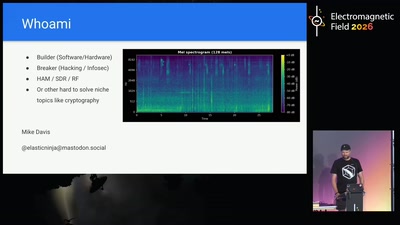
Taking the fun out of bird-watching: microphone array, beam-forming, and acoustic manifolds (emf2026)
4w ago00:26:36Tap to summarizeFor most bird-watchers, the fun part is watching birds in their natural habitat. For me it's all about the large-scale collection, analysis and visual representation of bird-song. In this talk I'll show you what inspired this project: visually representing the complexity and beauty of bird-song. We'll start with the slightly janky hardware I built to collect the audio then move on to the processing pipeline that tries to find each bird in a tree. Finally, we get to see what an acoustic manifold looks like in 3D video form. A large, hacky, microphone array, an FPGA, verilog, high-speed USB, lots of Python and a lot of swearing at an AI. This project was inspired by Lucio Arese's beautiful acoustic manifold videos: https://www.youtube.com/@lucioarese Licensed to the public under https://creativecommons.org/licenses/by-sa/4.0/ about this event: https://www.emfcamp.org/schedule/2026/83-taking-the-fun-out-of-bird-watching-microphone-array
Transcribe →
Turning the EMFcamp 2018 badge into a radiotelescope (emf2026)
4w ago00:19:54Tap to summarizeBoth the Sun and Jupiter and strong radio noise sources, and can be detected with fair simple radios. I'll describe how I hacked the badge to control a simple radio, while predicting if the Sun or Jupiter are in the sky and recording a portion of the radio spectrum to detect radio emissions from Jupiter's magnetosphere. Licensed to the public under https://creativecommons.org/licenses/by-sa/4.0/ about this event: https://www.emfcamp.org/schedule/2026/155-turning-the-emfcamp-2018-badge-into-a-radiotelescope
Transcribe →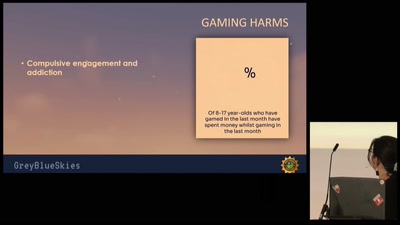
Mum, can I play Roblox? Navigating online gaming safety for parents and caregivers (emf2026)
4w ago00:23:50Tap to summarizeUnlike most adults, I play videogames professionally with children online all day, every day. I play the games children love, such as Roblox and Fortnite, many of which parents are not interested in - either giving their children total freedom with them or banning them entirely. I will immerse adults in my world for 30 minutes and give them confidence in navigating parenting in this modern age. In this talk I will help caregivers to feel more confident in setting boundaries and limits for their child’s online gaming, by explaining the main sources of harm in some popular platforms. I give tips on how to discuss boundaries with children (especially when 'everyone in my class plays it!'), as well as describe ways I have seen children get around restrictions. I will share the games I will and will not let my own children play - and you may be surprised as to why. I will describe how I try to keep them as safe as possible online, while maintaining friendships. Young people are very welcome to attend alongside their caregivers to spark the discussion moving forward. Caregivers should be aware that there is talk of the harms in online gaming, but that these are sensitively covered. Licensed to the public under https://creativecommons.org/licenses/by-sa/4.0/ about this event: https://www.emfcamp.org/schedule/2026/159-mum-can-i-play-roblox-navigating-online-gaming-safety
Transcribe →