← Cheeky Pint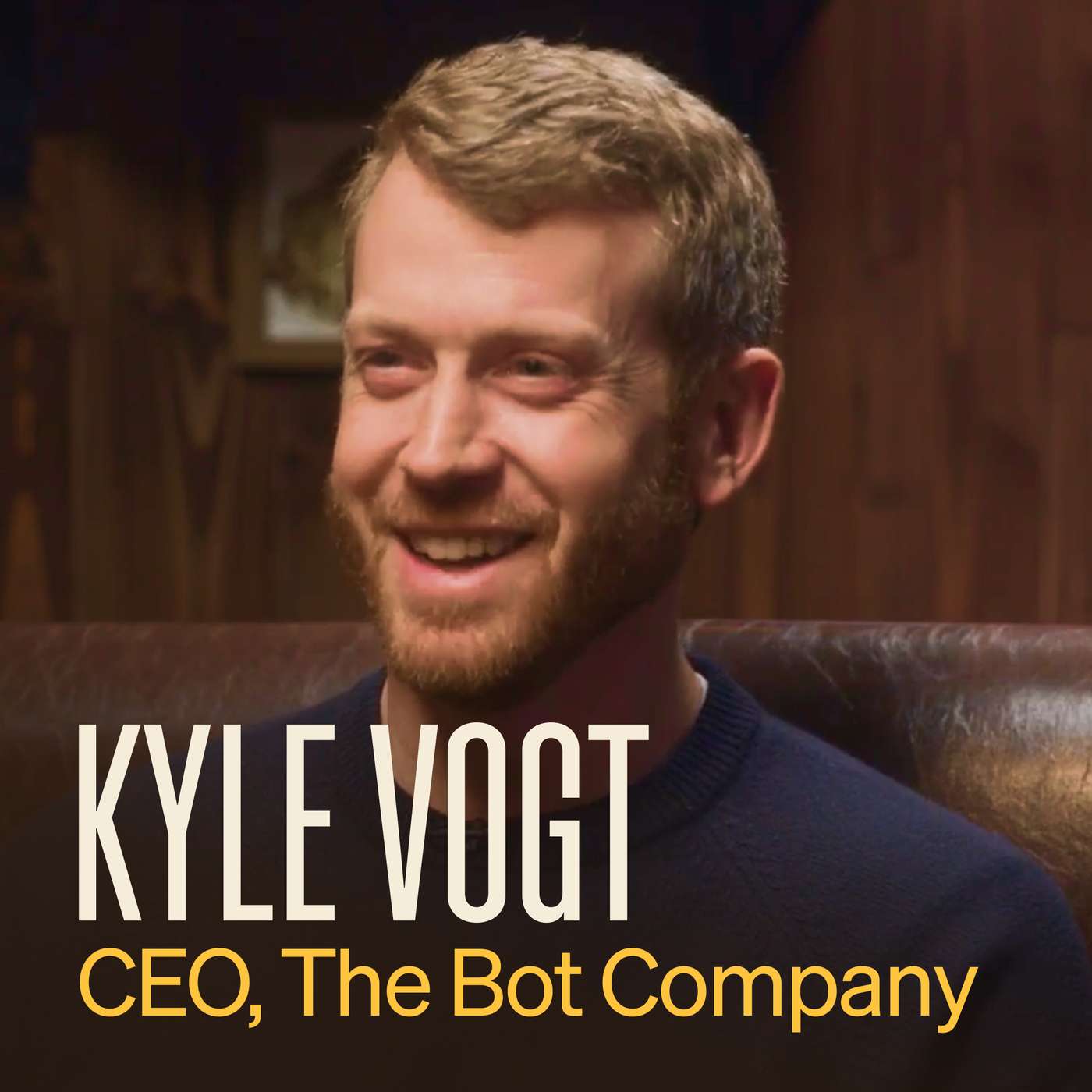
Cheeky Pint
The Bot Company founder and CEO Kyle Vogt on home robots and why he’ll never sell another company
00:22:31
Loading summary
Transcript85 lines
- [00:00]
A
Homes are just horribly difficult environment for robots.
- [00:03]
B
I mean, let me put it that way. It sounds like the ninja warrior obstacle course. I think it will be strange to move into a home or apartment in five years that doesn't have a home robot.
- [00:12]
A
So you're very serious about the small team.
- [00:14]
B
I think the next hundred billion dollar company that's created in 2025, 2026 will be under 100 people.
- [00:23]
A
Kyle is one of the only entrepreneurs to have started three separate billion dollar companies. He started Twitching Cruise and now he just started the BOK Company is trying to make household robots finally happen.
- [00:34]
B
Cheers.
- [00:37]
A
Okay, so let's back up.
- [00:39]
C
Yeah.
- [00:39]
A
What is the pitch for the Bosch company?
- [00:45]
B
Well, I don't like doing chores. I think five to ten hours a week people spend doing essentially unpaid, unskilled labor in their own home. Yet we all take that for granted and do it every day. And I think it's been the holy grail of robotics since I was a kid doing robotics to have the home robot that does everything. It was very clearly not possible up until very recently with LLMs and then end to end neural networks to control robots. I think just maybe, maybe this time is the right time to build this company and deliver this home robot that does all the things that you don't want to do.
- [01:18]
A
Okay, so this is vacuuming the floor, ironing the clothes, cleaning up after the pets, that kind of stuff.
- [01:25]
B
We're going to start very small, but it will continue to evolve as the state of AI evolves and be able to do more and more things in your house. I think it will be strange to move into a home or apartment in five years that doesn't have a home robot or you won't want to without one. And in the same way that it would feel weird to not have plumbing in a home, or a dishwasher if you can afford one, or laundry machines. These are all machines that had a huge impact on our lives. And these are all from the era of, I don't know, the 50s and 60s. And we haven't really had that. Next.
- [01:54]
A
Yeah, we had a big spurt for.
- [01:56]
B
A while and people were excited about it. There's all these like great ads of like, you know, the person in the kitchen being like, look at how much time I've saved with the microwave. And, you know, we've gone stagnant since then.
- [02:05]
A
You could be bearish on home robotics. And an argument I think you could construct is we are currently so underperforming what we could have in terms of household appliances and so dishwashers take forever to run and don't clean the dishes that well. And commercial dishwashers exist that are super fast and much more effective, but we don't have those in our homes. You know, the toaster can't tell when it's burning the toast, even though that seems fairly trivial to detect. Should this make one worried about future household robots?
- [02:36]
B
All of the things you described, the toaster, the dishwasher, these are like single function machines. And I think everyone, when they buy a single function machine or any machine, is thinking about like the cost and value, how much is it worth to me to have toasted bread? Maybe like $30 for a toaster, maybe not like 2000 for a multi toaster that can do it perfectly. But the question becomes, if you have a machine that is a multitask machine and can do lots of small things that you would Maybe even pay $0 for if it was a standalone machine, but when it's bundled into this general purpose machine that can, you know, pick up all the kids toys and clean the dishes off the table and put stuff in the sink and pick up your packages from the front door and bring them to the kitchen, like, I would never pay any money for a machine that just does one of those things. But when assembled, I think it becomes extremely valuable, or at least that is our theory. When you ask people, if you had a home robot, what would you want it to do? One of the top three things is like, you know, do my dishes or do my laundry. And I think those are great tasks to automate. I think there are very poor tasks to start with, counter intuitively. And the reason for that is laundry and dishes are things for which people are very particular about. And the cost of making a mistake is very high. You don't want to like ruin.
- [03:46]
A
So you don't want to start with those.
- [03:48]
B
You will not start with those. And that's because we have existing machines that do these things. And so you're competing with the dishwasher, you're competing with the laundry machine, but in between those tasks are like a thousand small things that we spend our time doing every day around the home. And it's our hope that solving those things really moves the needle for people. And then of course, over time, as the technology improves, and I can confidently say to you, we can do the dishes in the exact way that you want, then we'll deliver that experience, but not before there are people doing the other thing right now with humanoids and promising there'll be a drop in replacement for human labor and a drop in replacement for a housekeeper on day one seems really hard. That's reaching, perhaps.
- [04:24]
A
Yes, yes, we'll see. And okay. People in AI talk about the Turing Test, where basically, can you have a five minute conversation with the AI over text and be able to tell that it's an AI, is the loose meaning of the term.
- [04:41]
B
I was going to ask, when do we cross that threshold?
- [04:43]
A
Yeah, I feel like we've clearly crossed.
- [04:45]
B
It with no celebration or something.
- [04:47]
A
Exactly. No celebration, no fanfare in the past few years. And so what is the Turing Test for robotics?
- [04:54]
B
Well, where my head is drawn to is some of the toy problems in academia, like T shirt folding. And there are robots and neural networks now that can fold T shirts. And so perhaps in the same way that the Turing Test was crossed, and at some point in time, we're not sure exactly when, we just know it's behind us.
- [05:10]
A
If you have a set of robot arms that can fold T shirts, it feels like we have crossed.
- [05:14]
B
That used to be the holy grail of manipulation, because classically, robots are designed for repeatability and precision and picking up the same thing in the same place every time. And for that to work, the thing you pick up also has to be rigid. And so clothes are hard because you pick them up and they collapse and wrinkle and fold over on themselves. And so to get a machine that thinks in this very rigid world to work with such malleable items has been like this tough research problem for a long time. For anyone to be able to go buy a thing, put it in their home, and without any other instruction than like, my clothes are in my bedroom. Please put them in the laundry machine and fold them and put them away.
- [05:49]
C
Yes.
- [05:50]
B
That to me would signify. I think we've made it.
- [05:52]
C
Yeah.
- [05:52]
A
You've talked in the past about how homes are just a horribly difficult environment for robots. Like, you know, if you compare it to, say, a warehouse, where there's a decent amount of robotics already, a warehouse is very standardized and standardized to be easy for the robots, whereas homes are an extremely difficult and non standardized environment for the robots. They have stairs, they have rugs, they have kids and pets running around. How do you solve for this?
- [06:17]
B
I mean, let me put it that way. It sounds like the ninja warrior obstacle course in robotics, basically. And robots have to get through all this stuff. Well, I think what's different today? And actually, like one of the, you know, there's one takeaway for today in our conversation. I think it would be that robotics today is a Completely different field in a different industry than it was five years ago. Like all of the things we thought we knew, all the businesses that were tried and failed, all of the tools that have become best practices and standard are now either like, worthless or completely different. You know, today you don't need a robot that's repeatable. You need a robot that's adaptable, like powered by neural networks. And if it makes a mistake or doesn't approach this object at exactly the right angle, it doesn't matter. It can correct that. Like how a robot sees the world. Typically, it would have expensive laser scanners and try to perfectly reconstruct everything that we see and then use very complicated and hard to tune algorithms to plan how this arm should move through space and time to accomplish a task. And those systems are very fragile and easy to break if you're willing to completely let go of that and embrace today's tools. So you don't have to program anything. You have to show a robot how to do a task and it can mimic that and let essentially chatgpt like technologies instruct these things at a high level. With these tools, going into a home environment is no longer as much of a crazy obstacle course. And that I think makes it much more tractable than it was five years ago.
- [07:37]
A
For a device to save you work, it's like, probably needs to be able to charge itself, clean itself, manipulate stairs. You probably need some minimum set of functionality. And the early versions of roombas, I think part of what frustrated people is they probably spent more time cleaning the dog poop. They spread or it would have been faster for me to just vacuum it myself.
- [07:56]
B
I think it is dangerous to fall below the threshold creating more work or more value. I think that's probably the difference between a cool product and a delightful product that everyone loves. And I think some of the things you mentioned are what make this problem, as with many AI power problems, like deceptively simple looking from the outside, as.
- [08:12]
A
In, it's easy to have a cool demo and it's hard to have something that actually saves people time in their home.
- [08:16]
B
Yeah, yeah. And I mean, I worked on self driving cars for a long time. We saw this too. It's like, well, how hard could it be to keep the car between the two yellow lines on the road? And then you think about all the things that could go wrong or could happen while you're driving and you start making a list and then you have like three pages of stuff. Each one of those is a big technical problem to solve. And I think we're already seeing this. But a similar thing is true for a home robot that truly creates more value and frees you of work rather than consuming all your time or asking for help every five minutes.
- [08:42]
C
Yes.
- [08:42]
A
Is there a risk that home robotics have a similar character where that final 1% actually turns out to take a pretty long time?
- [08:51]
B
It's possible. I think what is different to me are a few things. I think first of all, just to build a car in a highly regulated environment and very capital intensive thing is very different than to build a small consumer product. But the other thing that I noticed is several months ago, one of our early prototypes, we would do this thing where we just like dump a basket full of kids toys in a room and say, hey, robot, clean this up. There's like 49 toys on the ground. And over the course of like 30 minutes, it took it a long time as a prototype, it cleaned up all the toys but one. And my thought in that moment was like, you know, what percentage success is that? That's 95% 19 of reliability. Yet everyone who was watching that was just like, where do I buy this? I need it now. And so the takeaway for me is like the bar for commercial success for self driving was like 5, 6 nines of reliability. And understand that each extra 9 of reliability you add, so 10 times better takes probably 10 times more engineering work.
- [09:47]
A
Robotics is perfect for getting overhyped on social media because it's very easy to have a compelling demo that does the numbers on a tweet. And all the work is in getting from that demo to actually working reliably enough to sell as a product. And so it feels like we're almost inevitably in for a hype cycle in robotics.
- [10:08]
B
Well, look, I love the demos. I think they're inspirational. They get people excited, they get more people coming into the industry, they get investment dollars. So I think they have a purpose. I think the problem is when you align customer expectations too squarely on what they see in a demo or even as an industry, if the robotics industry sets the expectations too high on a whole for what the next generation of robots will do, everyone's going to be disappointed. And I think it's without a doubt will happen in robotics and not because of any one bad player, more just like the natural way that these things go.
- [10:39]
A
What is your iteration loop for working on robotics?
- [10:44]
B
Well, I mean, you know, if you have a weekly release schedule or a monthly release schedule, what you're really doing is just like withholding all that useful feedback for an Arbitrary number of days, right. Or weeks. Doing hardware often requires a lot more upfront thought and planning. There's lead times, there's manufacturing times, all that kind of stuff. And so you have to use one process for that and it's more schedule driven and then another process for software, which is much more iterative because you can make changes on the fly. And so bringing those together can be tricky. But if you set it up right, you can actually have hardware development. Feel like software development and like simple hacks is you have everyone work in person in an office. You have lots of robots available for developers to like push code to in real time. And you make it like as frictionless as possible for people to like try out new stuff on a real machine. And so I don't think you have to walk more than 10ft in our office to like go from your desk to, you know, running code on a robot.
- [11:39]
A
I feel like one of the underappreciated aspects of Elon's playbook for building companies is how much of a commercial thinker he is. Elon's companies have actually always been surprisingly scrappy. I mean, famously with the Tesla master plan, they started with the Roadster, which was deliberately a low volume car, and then kind of worked their way up to higher volume cars with SpaceX. They were selling launches to orbit from a very early stage and then progressively moved from Falcon to Falcon Heavy to Starship. And so how do you pull the revenue forward as early as possible in a robotics company so that you're not kind of doing 10 years of R and D and then eventually selling a product?
- [12:21]
B
I think the way that you do that is by understanding where the absolute frontier is for technology and then understanding what is commercializable in the near term. And there's usually a gap. It can be a small gap or a large gap. And so if the technology has gone through enough cycles of investment by enough companies or you've done it in house and it's at the point where now it's affordable, robust and can work, then I think you can build a business and get to revenue quickly. The problem comes in when you have a business that is premised on or conditioned upon commercializing today's frontier of technology, because that will just take time and we don't know if that's like one year or 10 years.
- [12:59]
A
So let's talk about self driving. You co founded Cruise, which was acquired by General Motors. Is self driving the most capital intensive pre revenue product ever? It's hard to think of a counterexample.
- [13:19]
B
I don't have a good one either. I think it's insanely capital intensive and notably the companies who were making these investments were not startups that were just doing this by raising venture capital around. They were large corporations with R and D budgets or basically the pockets that were deep enough to make strategic long term bets that could significantly move the needle for the company, knowing that there's a significant activation energy to unlock that future value.
- [13:46]
A
Yet previously it was probably just governmental entities and only as of recently do we have companies that are willing to spend that much money per year revenue.
- [13:54]
B
The numbers coming out around large language models on the frontier though are getting up into that territory.
- [13:59]
A
They are getting up into that territory, but I think with pretty clear user economics where they actually sell a lot of AI these days.
- [14:06]
B
Self driving is a healthier business for sure. Exactly.
- [14:08]
A
Self driving is interesting because it was so unproven when all the capex was required. So self driving is having a real moment right now as we finally see a lot of deployment on the streets in volume. You worked on this for 10 years. How do your industry views differ?
- [14:31]
B
One is, I think, on the regulatory side and what it will take to truly reach large scale for these businesses. And right now there's a handful of players who have actually doing robotaxis or driverless trucking. And then the other is these seemingly diametrically opposed strategies of Tesla and Waymo, which everyone likes to talk about.
- [14:53]
C
Yes.
- [14:54]
B
So do the less interesting regulatory one first and get it out of the way. In the US it is still very much a patchwork of legislation. And what probably most people don't see like Waymo or someone doing is all the groundwork in each new city. And the groundwork that they're doing is because they don't know which small special interest group or union or local government or city council or state, whatever it is, they. There's probably two dozen lists of organizations that could meaningfully bring the thing to a halt in that community because there is no federal preemption, there's no real federal safety standards for autonomous vehicles. And so they have to win that battle with every single stakeholder in every single location. So I hope, and there's maybe some signs of this, that the federal government will get ahead of this and establish that it's pretty clear at this point the data, the data shows that these cars are saving lives and reducing crashes. And so if we think that's important as a government, maybe there should be federal preemption and we should ensure that this is open for everyone. In the U.S. if that happens, I think we'll see more self driving cars. Absent that, I think it's going to continue this really slow sort of city by city thing and in the interim a lot of people are going to get hurt because these aren't rolling out faster. And the other big perhaps a false dichotomy that people create is like lidar versus cameras. What I see is really Tesla as a company who kind of pioneered the end to end neural network approach to self driving, which I think is the right technical bet long term. But they put some constraints on it. They said, hey engineers, you can't have the best sensors like lidars and radars and the sensors have to look good when we put them on the car. Oh, and by the way, they have to cost like 1/10 as much as the guys down the street who are doing this. So they put some crazy constraints on that. So the right technical vector, but really being held back by just the weight of all these constraints that put on the system. But all of their technical approach from day one seems to have been pointed in the right long term direction. So that's good. With Waymo, they started off in the DARPA grand challenge era of self driving, which is old school classical computer vision, classical motion planning. And they built this highly validated robust system that's now on public roads. And it's great, but they know that it's the wrong technical approach and they need to move more in the direction of Tesla, of more neural networks.
- [17:22]
A
And it's the wrong approach because it's.
- [17:24]
B
Too expensive, because it is just intractable to maintain a 3D map of every square inch of the planet and update it in real time and then expect that every time you go somewhere the map is still accurate on one hand. And also probably unrealistic to assume that every car built in the future is going to have these giant spinning KFC buckets on the roof. To Waymo's credit, I think they know this and they've started moving towards a Tesla like approach. The challenge is they've got a validated safety critical system on the road and the last thing you want to do to a system like that is start changing stuff in it.
- [17:53]
C
Yes, yes, yes.
- [17:54]
B
Because that introduces risk.
- [17:55]
A
Now that you've a little bit of distance from the cruise experience, what are your reflections?
- [18:00]
B
Oh, well, many, I think a lot of people over rotate on things they would change the next time around. And so the bot company is a small company. I feel like I, like many of my peers got swept into the dogma of building a Silicon Valley tech company, which is lots of people, and you have the manager, senior manager, director, senior director, VP hierarchy, all these like structures that are designed to get a lot of people to work well together and they become horribly inefficient and it's very easy for them to become bloated.
- [18:30]
C
What else?
- [18:31]
B
I believe in the in person environment, I think everyone ran various experiments of remote work during COVID and has ended up depending on the company in terms of full return to work or remaining some.
- [18:41]
A
But that pairs also with the small company thing, right? Where I think anyone would say that if you're hiring a small team, it's very attractive. Like the reason companies tend to go remote or certainly go to multiple offices is just ultimately you need to hire so many people that diminishing marginal returns to being together.
- [18:56]
B
Well, not to harp on this one thing, but there's so many dimensions of it. Like I don't think most people building companies today have a conscious decision and say like, well, when we go from 80 people to 400 people, our productivity per person is going to drop by 90% and are we going to sign up for that and understand that it won't get better until we're past 400 people? I mean, that's the reality of the situation. Not many people like talking about it. And so I think that's a big one.
- [19:21]
A
You said you're never going to sell a company again.
- [19:23]
B
Yeah.
- [19:25]
C
Why?
- [19:26]
B
Well.
- [19:29]
A
Why is it not I'm going to be very careful to sell a company to the right acquirer with the right vision or a more nuanced statement.
- [19:36]
B
Let's flip this around. If you go through all the pain of starting a company and you do so knowing that you're going to spend 10 plus years of your life on something and it's that important to you, and you've told everyone you know about this thing and you've recruited all the best, the smartest people in the world that you know to work with you on this thing. Why would you stop or give up control of that thing? And so I think that maybe part of the dogma of Silicon Valley is you start a company, if you're lucky enough and it's growing fast enough, someone will make an offer to buy it and you sell it, and that's victory. And I think if financial outcomes are your reward, function or fame or whatever it is, then that's great. But I think you talk to a lot of people have gone through that and they miss building the company.
- [20:26]
A
They would prefer the robots don't want you to sell.
- [20:29]
B
Maybe they're sentient, but yeah. And I convinced myself when selling Cruise that at the time it was North America's largest automaker. And if our vision is to get self driving cars everywhere, isn't that true to the vision? And I think my heart was in the right place. But I was naive about the ability to get a large corporation. It's like an aircraft carrier. You can't steer it, you can't get it to change its focus. It's going to do what it wants to do or what it's already doing. It was naive of me to think that I could kind of hitch a ride on that scale and make this thing happen. But experience has told me now that that is not the path to make the thing happen.
- [21:10]
A
How generalizable is this view? Do you think fewer founders should sell their companies or is this a Kyle specific thing?
- [21:17]
B
I think selling a company basically means like I'm done working on the problem, like maybe. And there probably are cases where a founder is like tired of it. They have, you know, their personal relationships are falling apart, whatever. There's an external reason to stop going forward. Absent that. And if the intrinsic poll is still there, then I think it's a bad idea.
- [21:40]
A
In three years time, how many people is the bot company and what percentage are engineers?
- [21:46]
B
Less than 195.
- [21:52]
A
Oh my God. So you're very serious about the small team, all engineers.
- [21:57]
B
I think the next hundred billion dollar company that's created in 2025, 2026 will be under 100 people.
- [22:04]
A
That's quite provocative. How many people are there that have created $3 billion companies? Not that many.
- [22:11]
B
I have been very lucky. Like I said, good people, good timing. Yeah. Yeah.
- [22:16]
A
But still. Yeah. If your view is that it's much smaller headcount, we might be in for a new way of building companies.
- [22:24]
B
I hope so.
- [22:25]
C
Yeah. Okay.
- [22:27]
A
Thank you.
- [22:27]
B
Yeah, thanks for having me.