← Cheeky Pint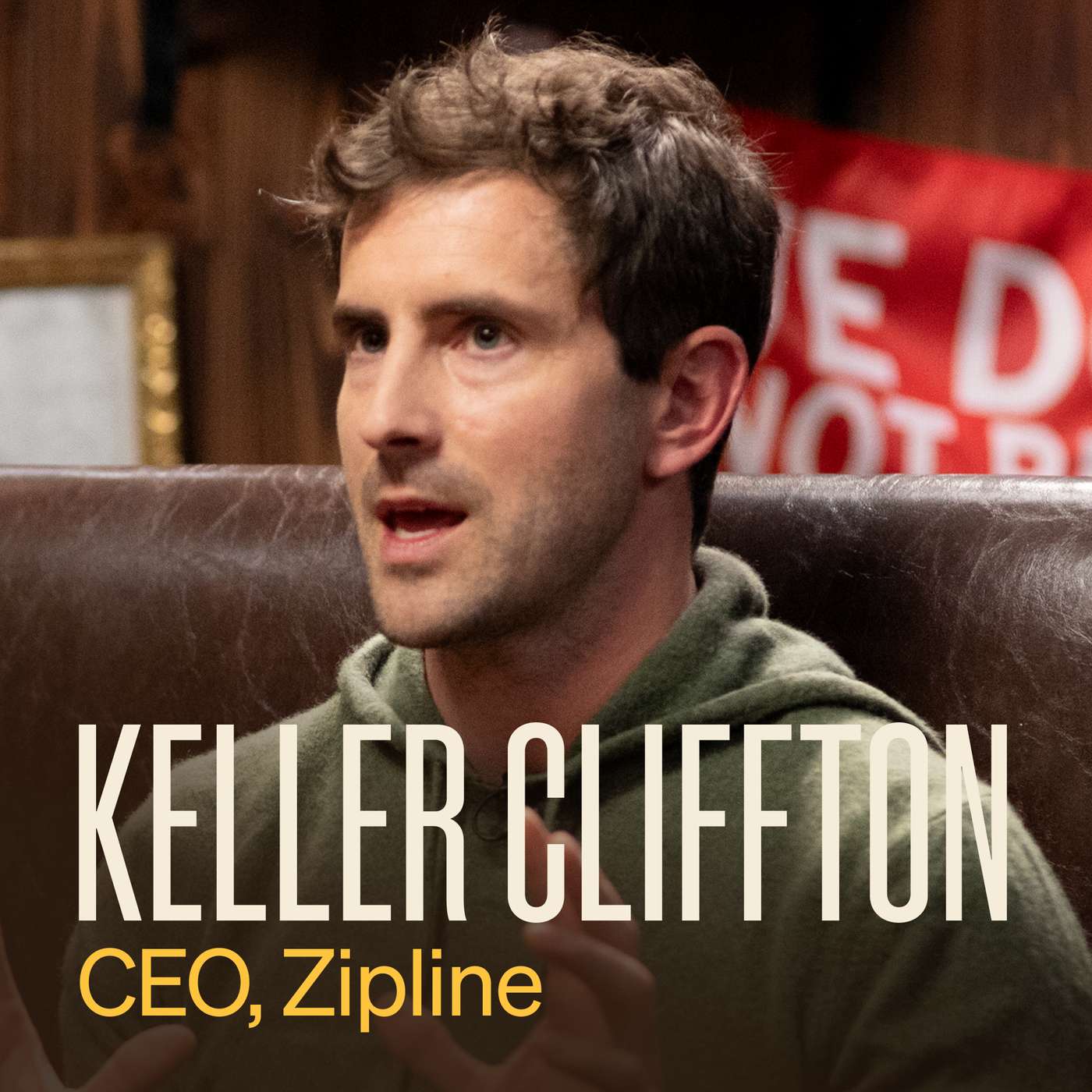
Cheeky Pint
Zipline CEO Keller Cliffton on air-dropping blood to Rwandan hospitals and getting to 50,000 aircraft per year
01:14:12
Loading summary
Transcript300 lines
- [00:00]
A
In how many countries today do you run your medical logistics network?
- [00:04]
B
8.
- [00:05]
A
Why is that not 80?
- [00:06]
B
You sound like our board, John. You're really putting the pressure on. And then we walk out the back of the warehouse and it's just a field of boxes as far as the eye can see. And I was like, what is this? And they're like, that's all the medicine that expired last year. What is Guinness?
- [00:23]
A
Guinness is stause Irish people would not call it beer. Do they know what the difference between stout and beer is? Keller Clifton is the co founder and CEO of Zipline, the drone delivery company. They started out with medical deliveries in Rwanda, but they're now expanding in many countries, including the United States, and have completed more than a million autonomous flights. Cheers.
- [00:42]
B
Cool. Cheers. Okay.
- [00:46]
A
I'm very excited to talk about Zipline. So you, previously, you were a professional rock climber. You studied biochemistry and computer science in Harvard. You, you had a previous robotics startup, but then in 2014, you started Zipline. Most people who do know Zipline probably know you for the medical deliveries in Rwanda and broader in Africa. You now also have operations. You just announced Chipotle and burrito deliveries in the United States. And you have a delivery takes place every minute and you have 100 million miles flown. Is that a good.
- [01:15]
B
I think like 110 or 120 now. Yeah.
- [01:17]
A
Okay. Yeah. So is that the good parted Zipline summary? Hold you out.
- [01:21]
B
What would I add? I mean, you know, when we were starting to build Zipline in 2013, 2014, our backgrounds were in robotics and automation and software. And it really seemed to us like it should be possible to build an automated logistics system for Earth. Like, when it comes to robotics, you really want boring and repetitive. Like, that's ideal, you know, like constrained problems, boring and repetitive. And logistics is about as boring and repetitive as it gets. But, like, it's this underlying infrastructure that affects everything in the world. It affects how people get access to health care. It affects, like, how people even choose where they live. It affects how much time people get with their families versus having to spend time driving around and, you know, buying things. And so, yeah, it was, you know, the idea was simple. The execution has turned out to be a bit more complicated than we were expecting.
- [02:15]
A
Yes. And you've made the point that, like, what does a UPS truck weigh? Like, you know, five tons. Yeah, yeah, yeah. It's like we've taken for granted that we just have these, like, massive vehicles trundling around our suburban streets as the best answer for delivering things. And it's obvious couldn't be improved from there.
- [02:30]
B
I think the best way to think about that is that when you're batch processing things and delivering things over the course of a day, that works pretty well. You can load tons of packages into a car and then the car, you know, the truck, over time can deliver things slowly to lots of homes. But obviously the thing we've seen over the last five or seven years is the rise of instant delivery. There are now five and a half billion instant deliveries happening every year just in the US and this is where we're using a 4,000 pound gas combustion vehicle driven by a human sitting in the front, moving the steering wheel back and forth to deliver something to your home that weighs on average five pounds.
- [03:04]
A
Yes.
- [03:05]
B
So actually you do not have to be a physicist to realize this is a really weird way.
- [03:09]
A
It's a bit over engineered. Yeah.
- [03:11]
B
Or under engineered, depending on how you think about it. But like this is, you know, this is. It creates traffic in our neighborhoods, it creates pollution in our neighborhoods, it creates safety issues in our neighborhoods. It's phenomenally expensive actually. And it's pretty slow.
- [03:26]
A
And obviously competing vision is the sidewalk robots that some people are pursuing. But I presume you think for many of these applications they're just too slow and you actually can't fit that many of them before they start clogging up sidewalks. Is that basically the argument you'd make?
- [03:38]
B
My personal opinion is that we should be giving space back to humans, not taking space away from humans. So, you know, we have already. I mean, I grew up, maybe you grew up. You know, we played in the streets, like we played street hockey. I wouldn't really let my kids like go play street hockey today. So something has mentally changed where that doesn't seem like as safe a space anymore.
- [03:56]
A
Yes.
- [03:57]
B
Sidewalks maybe are like the last place that are meant to be for humans. The idea that, okay, now the robots are going to take those over too and like humans are going to have to jump out of the way as these sidewalk robots go back and forth. Doesn't make a lot of sense to me.
- [04:11]
A
Why has the drone delivery vision taken so long? Where people were talking about tachocopter on hacker news in 2012, the big Amazon announcement was what year?
- [04:22]
B
2013.
- [04:24]
A
And so everyone has felt like it's just around the corner for well, longer than a decade now. Is it the FAA beyond visual line of sight rules? Is it like the tech was surprisingly hard? Just why is this happening now? You guys just announced Chipotle burrito deliveries. Why is that? Happening in 2025 and not 2015.
- [04:44]
B
I think it's similar to the question of why do we not have autonomous cars when certain leaders were saying, oh, it's right around the corner in 2015 or 2016. I think that with any advanced technology, there's always, what do they call it, the trough of disillusionment curve. It's kind of like you have the early hype. People realize something should be possible, it's really exciting, and. And then it goes completely craters because people realize it's really hard. And then everybody basically is like, well, that was a stupid idea, it's never going to work. And when people say it's a stupid idea, it's never going to work, that's when the actual hard work begins. And then there's like a decade of building all of the fundamental underlying infrastructure and technology that's required to actually make something work in the real world. And work in the real world is kind of like an easy way of putting it. But the reality is, whether you're talking about autonomous cars or autonomous aircraft, you have to figure out not just safety and reliability, you have to figure out regulatory. You have to figure out manufacturing and maintenance and supply chain, all of the software systems that are required to run behind the hardware to really make it reliable. And then you also need a good customer experience on top of all that. And then ideally, you also have to make the unit economics work.
- [05:55]
A
So the classic thing of producing convincing demo in hardware is relatively easy, but then getting something actually useful operationally is where the last 10% of the work is another 2, 2x or 3x from there.
- [06:08]
B
I think. I mean, Elon, I remember watching him for 10 years say again and again, because people would always say, like, oh, Ford's going to do what you do. You know, GM is just going to do it and, like, crush you. And he just kept saying, like, prototypes are easy, production is hard. Prototypes are easy, production is hard. I think it's deeply true in hardware. It's very easy for people to. And we've seen it again and again and again, right? Like specifically with drone delivery, someone will buy a quadcopter off the shelf, duct tape a Snickers bar to the bottom of it, manually pilot it. Like, when the weather's good, two miles landed it. It's like, we just did drone delivery and then get a journalist to cover that. But the reality is that what customers really want is teleportation, right? And they don't care at all about drones.
- [06:53]
A
Yes.
- [06:54]
B
This is kind of a counterintuitive thing about that we've learned. It's like when we're working with all these ministries of health or these governments or big companies like Walmart or big hospital Systems in the U.S. like Cleveland Clinic, or they all want to be able to just teleport things directly to patients or directly to a customer's home in a way that either saves a life or transforms the customer experience. We could be using whatever. They don't want it. They're not interested in drones. They don't care about drones. They don't want to deal with any of that complexity. All they want to know is something goes from point A to point B fast enough to solve a real problem. And so I think that a lot of the technology sits behind a curtain in order to enable a customer experience that is just like, jaw dropping and changes the way people live their lives.
- [07:39]
A
So demos are easy. Production is hard. You got started in production and really ramped up in Rwanda. How did that come about? Where people I can understand, maybe you might want to go outside the US For a more favorable regulatory environment, but most people will go to Mexico or Canada. How did you get to Rwanda? And maybe you can tell the story of scaling up operations there.
- [08:01]
B
Yeah, hard to frame. I mean, I think that when we were starting to build Zipline in 2013, we spent about two years building the initial version of the technology. And everybody told us this was a stupid idea. Everybody told us there was no way it was going to work.
- [08:16]
A
Was it hard to get funding, sir?
- [08:17]
B
Oh, incredibly difficult. Like, I remember we were begging people to invest $250,000 in the company.
- [08:24]
A
Who did? And what was the first big break in terms of who invested?
- [08:28]
B
Sequoia led our Series A and took this bet on us. This was actually before we started building Zipline, though. Oh, wow. Yeah.
- [08:35]
A
This is for your previous job.
- [08:36]
B
Yeah, well, same company actually pivoted. I didn't know that. Most people don't. And then as we were starting to build Zipline, I just think there was so much skepticism. I mean, it's like such a crazy idea. Like, what do you know about aviation? Nothing. What do you know about healthcare? Nothing. What do you know about operating in Africa? Nothing.
- [08:55]
A
Okay, well, it's like operating in Africa. Exactly. Stay in touch, you know, like smile and nod.
- [09:01]
B
Yeah, exactly. I think that, you know, our intuition was like, we needed a country that was as desperate as we were desperate as a startup. And maybe that sounds bad, which is like threshold question.
- [09:11]
A
Why didn't you start operating in the United States?
- [09:13]
B
There just wasn't a regulatory pathway to do so.
- [09:16]
A
Okay, Just the ban on drones.
- [09:18]
B
Yeah, totally impossible to do it in the US and also we really wanted to find, you know, we had this instinct that to convince a country to do this at scale, we needed to focus on life saving use cases. And so we really wanted to find a national healthcare system rather than like a fragmented private one like you have in the US So we were looking for a national healthcare system, healthcare challenges that were, that we felt we could really clearly solve and a country that would be entrepreneurial and fast moving alongside us. And so that to us, you know, had us looking at countries in East Africa. We were also talking to countries in Latin America. And you know, interestingly, I remember this meeting with the Minister of Health of Rwanda. You know, I mean, we were beyond clueless. Like, it's just like, you know, 24 year old, like showing up in East Africa like, we build robots. We think that this could work. And I remember this meeting with her where I was saying, hey, we'll deliver, you know, blood and vaccines and cancer products and all these different things. We could do it all instantly in a way that would be transformative and reduce waste and save lives. And I remember she looked at me and just said, keller, shut up, just do blood. And as she was explaining to me, 50% of blood transfusions are going toward moms with postpartum hemorrhaging. 30% are going toward kids under the age of five. And it is a super hard problem from a logistics perspective because you have packed red blood cells, platelets, plasma, cryoprecipitates, all these different types of each, A, B, A, B and O. They have all different storage requirements and shelf lives. Platelets only last six days, for example, when you get them out of a donor into a patient. So they gave us 21 hospitals and they said, just do blood. And that's what we did for the entire first year. It was a disaster, by the way.
- [10:59]
A
Why?
- [11:00]
B
Because we had no idea what we were doing. I think apropos of the flag behind us, we didn't know how to integrate with the national healthcare system. We didn't know how to integrate with the civil aviation authority. And we definitely didn't know how to build an aerospace grade product that was reliable yet. So we launched and we were pulling constant all nighters. We were flying back and forth between the US and Africa. You know, we had the entire Africa, the entire Rwanda team hired and the system only served one hospital for the first nine months reliably. And we were just trying Everything we could do to make the system work reliably for that one hospital.
- [11:36]
A
Why Rwanda? Out of all the sub Saharan African countries you could have picked.
- [11:41]
B
You know, we can answer that question now because we have a much better understanding. The reality is then we weren't smart enough, we just got lucky. The answer now is like Rwanda really is kind of like the Singapore of Africa. It has like a very technocratic leader with a very technocratic leadership team where they're taking really smart bets on technology and moving quickly. And it's a very, very entrepreneurial country.
- [12:01]
A
It's got a much stronger civil service.
- [12:03]
B
Yeah, super strong civil service. Like I can't even describe to you. I mean many times I would be on calls with like a minister or a chief of staff at like 9 o' clock on a Saturday, 11pm on a Saturday. I mean moving lightning fast. That's kind of what I mean. You know, there are many countries that are moving very fast because they know that the only way they're going to get ahead is by being aggressive and entrepreneurial and making bets.
- [12:28]
A
So it was messy at first. When did you crack operations in Rwanda? And you felt like, wow, this is really working.
- [12:34]
B
So after nine months of like all nighters, total desperation, everything that could break did break. It started working reliably for that one hospital, which was called Cub Guy Hospital by the way. That hospital was only like five miles away. So it was like we were doing the easiest possible thing and failing at it. It didn't feel great for nine months.
- [12:53]
A
But like when did Zipline get to the point where Rwanda would definitely not let you rip it out? Because they're like, oh, we rely on this, you know.
- [12:59]
B
So after nine months started working well for that hospital and then we rapidly added the other 20. So we were actually serving all 21 hospitals in the contract by the end of the first year. And then they asked us to expand to 50 hospitals and then 200 and then 500. Then we went from delivering blood to vaccines, cancer products, infusions, transfusions. Today we're like the sole distributor of 500 plus health products in the public health care supply chain. And then we started expanding outside Rwanda. Today we serve 5,000 hospitals and health facilities to become the largest commercial autonomous system on earth.
- [13:32]
A
If this model makes total sense, which I think what you're saying makes sense, there are various healthcare products where you may need them anywhere. You can't predict where you're going to need them and you need to get them in a time critical fashion. Why haven't other Countries followed. I mean you're starting to do this in other countries. But why as of 2020 was every country not beating down the path to your door saying oh yeah, we'll take 10 zipline systems, you know, for our health service. It's kind of interesting given that all countries healthcare needs are kind of the same as a lot of national healthcare systems. You would think more people would want to replicate the system.
- [14:06]
B
Yeah, I mean I would say they kind of were because it's starting in 2020. So it took us like, you know, three years to stabilize and grow it in Rwanda. And then it was also very helpful. We had a number of big academic institutions come in and want to do studies. So like University of Pennsylvania came in and did this big study across all the hospitals we serve and showed a 51% reduction in maternal mortality. This is like, you know, and that's pretty profound, pretty causal, very causal. I mean they, you know, they have their control group and their non control group. There are like interesting different reasons for it. It's a lot of it is around blood availability but also part of it is just that like increased trust in the health system. More moms give birth in hospitals when they know that the hospital is going to have access to the products they need. By the way, when we were starting to build zipline, we were told this was such a stupid idea, but if we had known we were going to get a 5% reduction in maternal mortality, we would have told you, hell yes, this is completely worth it.
- [14:58]
A
Victory condition.
- [14:58]
B
Victory condition. So the idea of a 51% reduction is it's something don't listen to the experts I guess is like a good takeaway. And so from there we also got these Additional studies showing 70% reduction in vaccine waste, 32 percentage point decrease in zero dose children. So these are kids who never get vaccinated. And so we actually did see Zipline then launched in Nigeria and Cote d' Ivoire and Ghana and Kenya started launching a lot of different countries in around 2020 the system started to scale very fast.
- [15:33]
A
Have you seen any induced demand when healthcare systems have zipline available to them? So you can imagine we can fulfill existing needs better. We need blood for a surgical procedure and we don't have it. And now with zipline we have it. But have you seen healthcare systems start to do things that they weren't previously doing because they have this cool logistics system available to them for sure.
- [15:57]
B
I mean that's like the main thing that we are observing happening. I think there's a lot going on that's all pretty interesting. And maybe we didn't anticipate all of it. I would say one big thing to realize is like with a health system, you're typically balancing access against waste. So if you want to make access really high, you send a ton of medicine out to the last mile and then access gets better. But now you start throwing tons of stuff out because all this stuff has shelf lives and a lot of it is like very expensive and cold chain dependent. If you want to reduce waste, you keep more stuff centralized. But now you have more people dying when they can't get access to the thing that they need. So one of the really crazy things with Zipline was we were able to show that by keeping things centralized and turning the entire logistics system over to a just in time system, you can actually move both up simultaneously. That's a big idea. Another idea is what you're saying, which is like the induced demand, you make it possible to vaccinate kids, for example, at a different layer of the health care system. In Rwanda we now serve, I think it's like 400 or 500 health posts in the country. And so these are like the layer below primary care facilities. It means that kids can get vaccinated way closer to where they live. More kids get vaccinated because it's just more convenient. The last interesting thing that we see is, and this is kind of on the opposite side of induced demand is actually when you had a logistics system that wasn't very reliable, you actually had a lot of systems that started to exhibit hoarding behavior. It's kind of weird, but basically what would happen is that there was never enough blood to go around and these health systems would have to place their order for blood every quarter.
- [17:32]
A
So they would over order.
- [17:32]
B
They over order because they know they're going to be cut back. And so they would order twice what they needed on the assumption that the government's going to send them half of what they actually asked for. And then that's just like a brinksmanship kind of thing. The numbers get bigger and bigger and you lose like all signal in the system. And so the really cool thing that we've seen is actually a lot of the demands have gone down because they're actually confident that they're going to get exactly what they're asking for.
- [17:55]
A
Yeah, it's the just in time framework. But for healthcare system, what is the business of what you're doing in Africa? Are you paid by the healthcare system? Is this NGO funded? How does the business side of things work.
- [18:08]
B
10 years of building the infrastructure in Africa. We always felt really strongly that we wanted this to be sustainable and we want it to be led by the countries. There's a lot of work that gets done in Africa by NGOs. They're funded by the US or by the international organizations. And I think what's kind of most amazing about Zipline is it's been entirely country led and entirely country, almost entirely country funded. So we sign contracts directly with the ministries of health, the governments themselves, and then we help those governments save lives and save money. So typically we can, for any given ministry of health or health system, we can save millions of dollars. Plus you can show extraordinary healthcare impact and that makes it a pretty easy decision for any country.
- [18:51]
A
Yeah, it's one of these amazing better, faster, cheaper tech use cases or tech value props where you go to a health ministry and you say we'll give you a better logistics system that delivers stuff faster and is cheaper than how you're currently moving things around. And I presume that's kind of hard to pass up. Running a healthcare system is expensive.
- [19:09]
B
Yeah, running a healthcare, yeah, exactly. Like these products are super expensive. Whether it's vaccine or cancer products. They're all cold, chain dependent, short shelf life, very expensive. And there is phenomenal waste. It's mind blowing. Like I remember one of the things that actually kind of inspired us like on one of my first visits ever, I won't name the country, it wasn't Rwanda. We went to this USAID funded medical product warehouse, distribution warehouse and we were kind of going inside and you can tell it's like whoa. These systems are like not good by the way, like all, you know, donor funded. And it's just, there's a separation from the customer I think is a way to think about it. But we were like in the warehouse, it's like kind of a disaster. It doesn't look like things are going well. And then we walk out the back of the warehouse and it's just a field of boxes as far as the eye can see. And by the way, it all says, you know, from the American people on it. And I was like, what is this? And they're like, oh, don't worry about that, don't worry about that. It's like, no, really, like what, what the heck? Like it was like vast scale and they're like, that's all the medicine that expired last year. And so I think we had this kind of like aha moment. It's like whoa. You know, and the crazy thing is that was happening in a country that was having massive shortages and, like, health care outcomes where people couldn't get access to these products. It was just very. You could kind of like see the two points.
- [20:26]
A
Yes.
- [20:27]
B
To just connect with a line.
- [20:28]
A
So what's the lesson, the generalized lesson here? Is it that existing aid supply chains are pretty inefficient right now and there's a lot of improvement possible?
- [20:38]
B
I think maybe one big generalized takeaway is that logistics is so boring and so in the background. We never think about it. If you're living in, I don't know, you know, the Bay Area, you're ordering stuff on Amazon, you have it delivered to you 30 minutes later or an hour later, whatever it is. Like, it's kind of like running water. You don't really appreciate it until you don't have it.
- [20:57]
A
Yes.
- [20:58]
B
And there are parts of the world that have crappy access to logistics, and then there is about, like 5 or 6 billion people on earth who have no access to logistics. And I think that is maybe like, the big realization is that maybe we think of it as something that's just ubiquitous or like something you don't worry about. But the reality is that if you don't have that strong layer of logistics, everything else is phenomenally difficult and expensive to do. So you mentioned the public healthcare institutions. They're all building verticalized supply chains in these countries. And it's many different supply chains. It'll be a different supply chain for AIDS drugs, different supply chain for, you know, maternal mortality, different supply chain for kids or, you know, neglected tropical diseases. And those systems don't run very efficiently.
- [21:46]
A
In how many countries today do you run your medical logistics network?
- [21:50]
B
8.
- [21:50]
A
Why is that? Not 80? Again, it just feels like something every healthcare system should want. And it's pretty proven at this stage where it's been working well in Rwanda and other places for several years.
- [22:01]
B
You sound like our board, John. You're really putting the pressure on what are our revenue growth numbers and why are we not growing faster?
- [22:07]
A
Exactly.
- [22:08]
B
You know, I think that there are a few things. I mean, one is that, like, we've always been pretty clear that it's one thing to save the lives of the people you're delivering to, but it's really important that we be safe for the people who are flying over. Zipline now has about 120 million commercial autonomous miles and zero safety incidents. And that's definitely hard to do. That has come from, I think, the company being very, just focused and like, step by step doing things in the right Way testing, validating, and making sure never to get over our skis.
- [22:40]
A
But the laws of aerodynamics are not different in Rwanda versus Algeria versus the.
- [22:44]
B
Uk so that's part of it. But then also it's kind of like, you know, I don't know, sometimes we talk about it internally as like a pig traveling through a snake. You know, it's kind of all about bottlenecks, scaling up hardware. I mean, we were really only ready for a lot of scale. I would say 2020 was when we started expanding into new countries. We then went from one to eight countries, went from like 100 health facilities to 5,000 today. So the system has been scaling very, very fast. The other thing that did happen is that like 2022, when you see interest rates spike in the U.S. it's like, oh, man, that's really inconvenient and annoying to us in the US In Africa, it creates like economic Armageddon.
- [23:24]
A
And it just, it feels like if you're running a medical system, what you're describing about having, like, I view you as not being in the drone business, but in this line of business, you are in the medical inventory management business. And you just have a much better inventory management solution because you're able to do this just in time stuff. And there are a few medical systems that don't want that.
- [23:43]
B
I just think it's becoming more and more clear that this is the infrastructure of the future. This is a smart thing for countries to be investing in. And so there is a lot that's going on, even just this year, that is leading to massive growth, both in terms of within countries, us adding new distribution centers and us adding new medical products, and then also adding new countries to the list.
- [24:03]
A
This medical logistics system we're describing is based on your Platform One aircraft. And the way the system works, as I understand it, is you have a fixed wing, battery powered drone that is launched off a catapult. You shoomph it off the catapult, and then it flies from a distribution center, flies to the hospital, it drops the payload with a parachute attached and they go grab it. And then the drone returns home and I presume just lands in the grass and you take it and plug it back in. That's roughly how Platform One works, right?
- [24:32]
B
Yeah. Doesn't land in the grass. I mean, we actually use something that is kind of inspired by aircraft carriers.
- [24:36]
A
Oh, you catch it?
- [24:37]
B
Yeah, we actually catch it out of the air.
- [24:38]
A
Okay.
- [24:38]
B
Looks kind of crazy.
- [24:39]
A
Or it's like the thing in Batman, you know, where they're recovering the what thing?
- [24:43]
B
From Batman? You mean the skyhook from Mission Impossible?
- [24:45]
A
Yeah, there's also a skyhook in Batman.
- [24:47]
B
Sometimes people think skyhook. You know, it basically like the vehicle is flying by at about 100km an hour and we can snatch it out.
- [24:53]
A
Oh, I've seen that.
- [24:54]
B
Yeah, it's snapcatch.
- [24:55]
A
Big poll.
- [24:56]
B
Yeah, yeah, big polls.
- [24:58]
A
It's like something out of a cartoon.
- [24:59]
B
Every time you see it. Yeah, it really does look like it's cartoon coded energy. Yeah, it does look weird. And every time you see it, you're kind of like, hallelujah. It's amazing that that worked, but now it works a thousand times.
- [25:08]
A
We got away with another.
- [25:09]
B
Yeah, we got away with another one. But the cool thing about autonomous systems is that we're using guidance, navigation control algorithms that are hyper precise. When you take the human out of it, you can actually achieve levels. Not that we want to take human pilots out. I know I'm not like, I realize I'm sitting with a talented pilot.
- [25:29]
A
But.
- [25:30]
B
Robots are really good at flying vehicles. And so actually you can achieve levels of precision that seem like very counterintuitive. Like the aircraft has a 1cm tailhook on the back of it, and we reliably catch that 1cm tailhook every single time as the vehicle's coming by.
- [25:46]
A
When you say robots are better pilots, I take no offense at that. Have you read the Right Stuff by Tom Wolfe?
- [25:51]
B
I haven't, actually.
- [25:52]
A
I really enjoyed it. Tom Wolf, fabulous writer, all his stuff would recommend. And certainly the Right Stuff, maybe for listeners of this podcast, is on the history of the Mercury space program. So before the Apollo program, the initial space program. But they describe how when they were making the spacecraft, their initial plan that was totally obvious to them was they would make them autonomous. And this is back in the 60s, but it was still kind of patently obvious to them that they would make them autonomous. And they faced rebellion from all the shithot Air Force fighter jocks they've recruited as astronauts in the program. Well, they just didn't want to be passive passengers. You know, we send monkeys up to space and monkeys don't do anything. Like, we're no better than monkeys. Just like sitting there, sit there and hope you survive. So they added manual controls for the spacecraft, like afterwards to the design, because.
- [26:44]
B
The pilots, like, the controls weren't connected to anything, but they could at least like, it' an elevator, right? You can like, push the close button.
- [26:51]
A
Exactly. Very funny. And so anyway, that was back in the. In the 60s and so. Yeah, totally. Yeah.
- [26:56]
B
But a slightly more serious note on that, which is that like today, the majority, I think you probably well know the majority of aircraft, you know, airplane crashes are caused directly by humans. Yeah, it's actually a bit sobering. I mean, but also I think it's just a sign that like, the safety of these systems has progress so dramatically that at this point, the last unsafe thing in the cockpit is the human themselves.
- [27:20]
A
So some questions on the tech and safety and how you do things. How do you avoid birds?
- [27:24]
B
We don't. Birds avoid us.
- [27:26]
A
Okay.
- [27:26]
B
Yeah, Turns out like birds have. Birds have pretty good detect and avoid systems of their own. And so they hear us coming.
- [27:33]
A
How fast are you flying?
- [27:34]
B
About 100 kilometers an hour. So about 20 miles. You're growing much smaller than airplanes. We're not like sucking birds into nacelles in the same way that a jet would.
- [27:41]
A
How do you avoid airplanes?
- [27:43]
B
So we avoid airplanes by basically it's like a multi layer deconfliction strategy. First of all, we're flying below the commercial aviation floor. So in the US that's about 400 or 500ft. So we're never conflicting with the kinds of normal airplanes that people who are listening would ever be flying in. We are also then on ADS B, so we're receiving ADS B. So as long as something is squawking on ADS B, we know it's there and can avoid it. We also then have cameras on board. And then we also do things like notams. So old term, but notice to airmen, basically telling people when we're operating in certain places. So all of these layers together combine to get us a safety profile that is super obvious that the FAA can improve.
- [28:26]
A
Super cool. And then can you tell if a battery's gone on fire?
- [28:32]
B
So the cool thing about the way the aircraft is designed is that, you know, there are 43 major sub assemblies on the aircraft. Every one of those sub assemblies is designed from scratch by zipline. So super, you know, vertical integration. And we really take inspiration from the way that planes are designed. Like we'll look at the way a flight compute on a, you know, Boeing 787 is designed. And they're of course using like multimillion dollar, like 20 year old components. We can talk about why that's so screwed up in a sec if you want. But like, the architecture is usually fundamentally sound. And then what we'll usually do is like just use cell phone components to build that architecture in a way that's about one thousandth of the cost. But Just as safe. And so you're kind of using a lot of those aerospace paradigms of being able to fail over and building redundancy into every flight critical system. So the aircraft, we have redundant nodes of the battery. One node can fail, the vehicle can still fly itself home. We have redundant flight compute architecture. So you can have a flight compute fail and fail over the second flight computer and fly home. You can actually reach into the aircraft while it's flying and cut any wire with scissors. The plane will still fly itself home.
- [29:38]
A
Because it's wired redundantly.
- [29:39]
B
Redundant can bus. So basically we're passing. Yeah, redundant can bus on the aircraft means that we're not, you know, you can lose any wire. We also haven't had a control surface.
- [29:50]
A
About mid air things or like mid air collisions or. Because just as a general redundancy strategy.
- [29:56]
B
General redundancy. I mean like you're not actually worried about someone reaching into the airplane with scissors. Usually that would be a hard thing to pull off. But what you are worried about is like vibration and connectors shaking loose. That's like a core failure mode for aircraft.
- [30:09]
A
So going back to the operations in like we're talking about these Platform 1 operations that you're doing in Africa and the medical logistics use case, what we described sounds pretty simple, but as you say, demos are easy, engineering is or production is hard. What was hard about getting, you know, from 90% reliability to 99.9% reliability? Like concretely.
- [30:33]
B
Yeah, very concretely.
- [30:34]
A
What kind of stuff were you solving?
- [30:36]
B
I think that with hardware, like everything that can go wrong does go wrong, you know, like at first, you know, first you have to get like a design that works and makes sense.
- [30:46]
A
And I would say of earlier design.
- [30:48]
B
Iterations that were wrong in subtle ways, we were unbelievable. Or not subtle ways. Like in retrospect, wow, we're like complete forward.
- [30:54]
A
The silly early design.
- [30:55]
B
Yeah. One really good example with Platform one was, you know, when the aircraft would land, we would swap the battery. The advantage of swapping the battery was we could then have the aircraft back on the launcher and like back in the air three minutes later. We put the GPS on the flight computer, which would like seem to make sense as a place for gps.
- [31:11]
A
We have to reacquire GPS every single time.
- [31:13]
B
So see, you're like smarter than we were basically. So the problem was that you have, you know, you get an order and it's like, wow, there's an emergency, like a patient needs this blood transfusion and so every second counts. So we immediately grab the aircraft, we Put the battery in, give me a minute, plugs in, the GPS turns on, and now the GPS is going to take 20 minutes to acquire all the satellites necessary for the vehicle to pass pre flight and launch. And so we realized how stupid this was and immediately iterated and put the GPS on the battery itself. So this didn't make sense from a bomb cost perspective because now you need two GPS units for every aircraft that's flying because one is sitting on the battery charger. But it really makes up for it because you just like doubled your cycle time on the aircraft. So there are a million examples. I mean, another examp, this stuff is so unfancy. It's almost like, embarrassing to describe. But like, when we Initially launched Platform 1, the aircraft had 43 different kinds of fasteners on. It turns out that is extraordinarily difficult to keep 43 fasteners in stock at all these different distribution centers where you're doing constant maintenance actions on them. So the next version of the aircraft had two total kinds of fasteners on the entire aircraft. So a lot of this is like, it's not fancy, but it's hard to learn without you just kind of like, learn by doing.
- [32:25]
A
Is there a component that's been really annoying? Like, if you could wave a magic wand and get a better version of some component, what would you ask for a better version of?
- [32:33]
B
I mean, every component we have iterated on many, many times, I would say, like today, probably more than anything, is like servos. And in fact, Zipline went and designed its own servo from scratch. You know, we also ended up going and designing, you know, almost every component of the aircraft. It was just kind of a matter of, like, when it made sense to do it. But over time, almost every component of the aircraft, every major sub assembly, has been designed completely from scratch.
- [32:56]
A
Why do servos frustrate you? Servos, for context, are actuators. Basically things that turn electrical power into mechanical movement.
- [33:03]
B
I think servos are hard just because, like, there was no industry. I think the way to think about, you know, people think about drones and they're like, oh, yeah, it's like a drone. But the reality is you have, you know, a thousand dollars quadcopter that will, like, take pictures and fly for 20 minutes, and the reliability and safety of it really doesn't matter at all. And then you have a $50 million Predator aircraft, which is actually surprisingly, also very unreliable, like Predator. You know, famously, I read this statistic which is like 50% of US military drones have, like, crashed due to operator error.
- [33:37]
A
Oh my gosh.
- [33:38]
B
You read these stories, they're like, they didn't realize they were flying upside down. I mean it's like crazier than you think.
- [33:42]
A
The DJI inbuilt collision avoidance is now much better.
- [33:45]
B
Not working. I don't know.
- [33:46]
A
The new ones will.
- [33:47]
B
Yeah, I think that the reality is those are two different sides of the spectrum. And what Zipline really needed was like we think a lot about automotive grade, which is actually almost think of it like a sacred area of cost and quality. Because automotive grade is super. Is generally very low cost and very, very high quality and reliability. And that's really where servos are. Like you can get servos that are totally crappy that you'd like use in consumer, I don't know, like toys. And then you can get like extremely expensive servos designed in Germany and they cost $1,000 each and they're way over engineered. But what we needed was something that was like extremely cost effective and that would last for like a million cycles and that doesn't exist in the world.
- [34:31]
A
And so you're now producing your own servers.
- [34:32]
B
And so we designed it completely from scratch and now that's what we use in Platform two.
- [34:36]
A
That's fine. Will you end up just selling drones for other applicants? Like right now you are a. Did you know Boeing and United used to be the same company? Like it was full vertically integrated aviation where they're not on that. Yeah. Wow.
- [34:49]
B
I feel like I'm embarrassed.
- [34:50]
A
The airframe and the airline. Yeah. And then they were split up and like kind of there was a big antitrust. Antitrust was emerging as a domain kind of at the time and as part of that they were forced to split it up. Anyway, you are the Boeing and United, Right. You know, you provide the service and you produce the aircraft. Might you ever just sell the aircraft?
- [35:05]
B
I don't think so, for like a number of reasons. I mean, I think the most important one is kind of what I was alluding to before, which is none of our customers care about drones. Like if we were out there trying to sell drones, I mean it just is not solving the problem that people actually care about. Like Walmart, Cleveland Clinic, the government of Rwanda. None of these customers want to be like managing a fleet of autonomous aircraft.
- [35:26]
A
Oh no, I don't think you'd sell the drones to your current customers. I think to be new customers where maybe I want to build a crop dusting service and your drones would be the best for doing crop dusting. So I buy your drones and they have all the safety equipment and the high quality servos and things like that. But you're not currently in the crop dusting market.
- [35:41]
B
Yeah, I mean, the second reason I was going to say is I just don't think selling hardware in that way is a very good business. But I also think the third thing to consider is that like, it's a bit like asking someone, it's like, oh, you know, Jeff Bezos, like early days of the Internet. Are you also going to like build other Internet businesses? You know, it's like the Internet is just a technology platform and Amazon was building obviously, you know, a new kind of retail company. And I think that, you know, drones are a technology platform. Zipline is a logistics company. Like we are really focused on building automated logistics for Earth in a way that you want to build the first logistics system that serves all people equally. Like we would happily use any different kinds of technique. Like if someone invents teleportation tomorrow we'll switch to that because that would be better.
- [36:22]
A
Your logistics platform adjusts the big unsolved space. Was drones. Will you ever do a modality that is not drones?
- [36:30]
B
Very possibly.
- [36:32]
A
What would that be?
- [36:34]
B
We have lots of ideas.
- [36:35]
A
Have a few more sips. Yeah, exactly.
- [36:39]
B
I think that ultimately if you really want to be a new kind of logistics provider, you probably have to be even more integrated. Like certain things are not going to go via the air, certain things are going to go via the ground. So there's definitely a world. Yeah, you should be multimodal. UPS is multimodal. Perhaps Zipline should be multimodal.
- [37:01]
A
Keller's describing here how Zipline got its start in Africa, but they're now up and running with drone deliveries in the United States. And this is a technology pattern you see again and again. Drone Delivery, mobile payments, WhatsApp, QR codes, these are all technologies that started in emerging markets first. And it's going to be the same with stablecoins. So here at Stripe, we're all in on stablecoins. We recently acquired Bridge, the leading stablecoin orchestration platform and Privy, the best crypto wallet infrastructure. We're already seeing a ton of stablecoin adoption, especially with companies that want to build cross border financial products. We're working with companies like Ramp to build a global stablecoin backed spend card, SpaceX for global treasury management and Shopify to enable payments on Shopify stores from every country. And then breakout startups like Chipper Cash and DollarApp, they're offering dollar access to people in Africa and Latin America. But we don't think stablecoins are going to stop there. Stablecoins are a programmable, low cost, high throughput financial system that'll have applications everywhere. I know from my experience, when I talk to CEOs, they're all interested in the applications of stablecoins. Stablecoin supply is up 50% in the past year alone. They're definitely not a flash in the pan. So if you're a company building with stablecoins or you're just thinking about your strategy there, come talk to Stripe. We have been describing Platform one, which is, like we said, fixed wing catapult launched, Skyhook recovered, operating for the last decade in RADA. You now have just launched Platform 2, which is vertical takeoff and landing. Looks more like a traditional multi rotor drone that people might picture when they hear a drone though there's also a wing.
- [38:39]
B
Yeah, it's a hybrid.
- [38:40]
A
Okay, so it's a. I forget what you call these, but yeah, there's a.
- [38:43]
B
Wing and there's vertical takeoff and landing. So vtol.
- [38:45]
A
Yeah, vtol fixed wing thingy. And you are using this for deliveries in suburban America? Many questions on this. First off, why construct a whole new modality? It seems to me that what you were doing with the precision air strikes of little packages under parachutes would also work for my Burrito. So why not do Platform one with my burrito?
- [39:12]
B
I mean, in fact, it did. The crazy thing is that when we initially started building Zipline, we kind of thought, oh, we're going to have to build this very fancy, complex technology. It'll have to be a vertical takeoff and landing, fixed wing vehicle. We have to be able to deliver things very precisely and gently. And then when we were talking to all these early customers, we realized, and this is the power of just going and talking to customers directly. They only cared about cost and speed. Basically. They wanted to cover like maximum range, they wanted to be fast and they wanted to be really cheap. And so we kind of ended up thinking like, hey, perhaps we should just design this very simple fixed wing system that would be to a certain degree very unfancy. Like, when you see the way we're delivering there, it's just like this, you know, cardboard box with a wax paper parachute. It is amazing to me that that system worked that well and scaled for 10 years to like 5,000 hospitals and health facilities and became the largest commercial autonomous system on Earth. You know, when we say 100 million commercial autonomous models, I don't think people fully get like, that's going to the moon and back 200 times.
- [40:11]
A
Yeah. And I presume, I don't know, I always find comparisons of the moon and back really nos not that helpful.
- [40:18]
B
Okay, not that helpful. Here's another.
- [40:19]
A
No one knows how far away the moon is. I presume your average sortie is order of 100 miles in Africa. And so you're basically talking a million flights.
- [40:27]
B
Like 1.5 million.
- [40:28]
A
Yeah, 1.5 million flights. So I think that's a pretty good number.
- [40:33]
B
So anyway, not to digress, but it's kind of amazing to me that Platform one scaled as far as it did. What this delivery experience was like super unfancy. And ultimately, as we were scaling that like crazy through 2020 and 2021, there were all these big customers in the US who all were kind of saying, hey, like we want teleportation, we would use that here in the us. And so I think that this was kind of our realization that like it was time to expand basically and say, okay, if we were going to build a product that can deliver directly to homes, what does that need to look like? And the design considerations for that are pretty different in our opinions. We need to integrate really well with existing buildings. Couldn't build distribution centers like we did with Platform one. We had to be able to basically plug into the side of any existing hospital or primary care facility or warehouse or even restaurant. And then from there you needed to be able to deliver two homes in a way that was fully automated, zero emission, 10 times as fast. And most importantly, we want it to be silent because we think that people. This is a kind of important thing. I think sometimes people think drone delivery, oh my God, it's gonna be so annoying, this like non stop buzzing of drones. Because that is how people experience drones today. But the reality is that it doesn't have to be that way. You can design systems that are actually way, way quieter than receiving a delivery via car.
- [41:51]
A
And the crazy thing, sorry, that I forgot to mention in my description of Platform 2, is that the drone does not come, the aircraft does not come anywhere near your house. It sits up at 300ft above your house and then long lines the payload down to you in little droid thingy and that drops it off. But as a result, the drone is hovering 300ft above you. But I presume it's just inaudible.
- [42:17]
B
Basically, it's nearly inaudible. It looks crazy. I was talking to an investor the other day. The sound is crazy. Yeah, I know. And I was talking to an investor the other day. He wrote us this nice email and he said, like, hey, we really want to meet you because we think Zipline has built like a fundamentally jaw dropping consumer experience. I do think when people come and see it for the first time, it's pretty wild because you just never really experience something like zipping down to you from a football field above your head.
- [42:41]
A
Science fiction.
- [42:42]
B
Yeah, it's kind of science fiction. But the advantage is that droid that you described, the little robot on the end, is actually controlling its position in X and Y axis. So this is really important because it's often windy, it's going to be blowing, you have different environmental conditions you're trying to control for. And we want to be able to deliver with dinner plate level accuracy to any home. And so this enables us, even when the wind is blowing really, really hard, this enables us to like very reliably, safely and precisely deliver something even in a very, very tight area.
- [43:10]
A
Okay, so the reason that you needed to develop a Platform two for suburban deliveries in the United States was one, the place you're delivering from, the Chipotle, you probably can't fit a catapult there, at least not in everyone.
- [43:22]
B
I'm pretty sure you can't.
- [43:23]
A
And then, well, some of them you could, but it's a parking lot, you know, but not reliably. And then for the Target, again, it might be accurate enough, but the new system is definitely accurate enough.
- [43:36]
B
Yeah, I mean, in fact, like the very first Walmart store that we ever integrated, we actually integrated with Platform one. And that was even more shocking to me that customers loved like basically having like their stuff bombard them, you know, like from 30ft up. I mean, it's like, honestly crazy. I think that was like the clearest signal to me of like, man, if people were willing to put up with that delivery experience to get something delivered autonomously, wait until they see Platform two.
- [44:01]
A
So the reason that we haven't had drone delivery in the United States for a long time is the FAA did not provide any rulemaking beyond visual line of sight operations. And they're your regulators, so you probably can't criticize them in public. I'll criticise them for you. I think the FAA was slow and roundly criticized for being slow in not having any commercial drone frameworks. So the old Part 107 stuff for hobby drone operators and Line of sight is the test where it has to be a light drone, less than £55, and you have to be like there controlling with your remote control, which obviously is not viable for commercial drone operations. So for the longest time they Sat on commercial drone operations and didn't do anything. Just now. In the last month, we've seen Sean Duffy, the Secretary of Transportation and acting head of the FAA, announce new part 108, beyond visual line of sight commercial drone rules, or at least the notice of proposed rulemaking. What do you think of the current FAA and the rules they're proposing?
- [45:02]
B
Yeah, I mean, first of all, part 108 is kind of like codifying something that has already been happening over the last three to four years, which is, I think that about four years ago, on an ad hoc basis and via exemptions, which is that about four years ago, Zipline started seeking regulatory approval in the U.S. we were able to go to the FAA and say, hey, we have 100 million commercial autonomous miles and zero safety incidents. We think at this point, you have the data you need. And they agreed. And so very much to their credit, this is what really unlocked Zipline starting to scale aggressively in the U.S. we've done that via exemptions. There are things called 4407, which is a different process. Rather than getting an aircraft type certified, if you really want to talk about something that's broken, we could talk about type certification of drones or aircraft. Both. Yeah. I mean, so far.
- [45:49]
A
Do you see the mosaic stuff?
- [45:53]
B
I'm not.
- [45:53]
A
It's amazing. They fix part 23. That is really cool certification by making part 22 much bigger.
- [45:59]
B
But type certification has been this interesting blocker, which is if you wanted to operate commercially in the US you couldn't operate under 107. Or if you wanted to operate commercially beyond visualized site, you had to operate under part 135. I fear that we're getting. We're really in the weeds now. But I guess the main point here is that you needed to get an aircraft type certified. And this is kind of the definition of a very painful regulatory process. It takes five to 10 years to get aircraft type certified. And it's really based on this idea of a regulator is going to look at every component of the aircraft and independently verify that that component is meeting certain standards that were set by the regulator. That might imagine trying to do that in a world where every year you have a radically new and better version of the technology. It just.
- [46:46]
A
You guys are doing progressive hardware development and constantly figuring out two fasteners is better than 43 and other such innovations.
- [46:53]
B
You just have really, really fast iteration. And so in a world where type certification takes five to 10 years, you're dead on arrival. And that's kind of what we saw for like, five or 10 years. None of this innovation happened in the U.S. i think the good news is that in, like, 2020, the FAA kind of, like, woke up to this. They realized, like, hey, this is going to become one of the most important industries in the world. The US Needs to be a front runner here. We cannot be a laggard. And the FAA actually started to move super fast. I mean, the FAA has been. I know you think maybe I'm just saying this, but the FAA has actually been a great partner. There are so many people there who want to win and who want to see the US Win.
- [47:26]
A
I think the FAA is full of awesome people trying really hard. I think the ruling has been slow, and I think exemptions and waivers are not a substitute for a good regulatory framework.
- [47:35]
B
Yeah, well, there you go. I mean, 108 really is, like. I think there have been these exemptions made that luckily enabled Zipline to, like, invest aggressively in the US over the last four years and experience pretty explosive exponential growth, which we can talk about. But, like, you know, 108, it is cool to see that now be codified. That is just the beginning of a process. Right. Because now the FAA has nine months to, like, actually operationalize and execute based on that rulemaking, and we'll see how that goes. But I think it's, like, it's super important. I mean, I think you and I probably both have grown up reading about, like, the SR71 program or a lot of these programs, like, to design airplanes. I mean, there was a world where, like, the US Was iterating incredibly fast in aviation and aerospace, and we've largely lost that. Like, our grandparents got to grow up in a world where they could fly on supersonic jets. We can't. You know, I think people have this sense that, like, the world moves inexorably forward. It doesn't. I think. Weren't. Didn't you have a tweet about this? Maybe? Like, you know, I think about it every day. Like, actually, no. Sometimes we literally move backwards.
- [48:36]
A
Yes, yes.
- [48:37]
B
And in aviation, like, what plane did you learn to fly on?
- [48:40]
A
I Learned to fly ancestry. 152.
- [48:41]
B
How old was that aircraft?
- [48:42]
A
Yeah, it was from the 1970s, I want to say. Yeah, what the hell. No, I was actually just ogling the carbon Cub ul, which uses a new Rotax engine. So there's this awesome new engine technology out of Germany, this company, Rotax, that makes them there, and it hasn't been in the US Certified market because it hasn't been worthwhile to go get the engine certified and now they're selling it in the LSA regime because it's exactly, it is possible there. And so I think we're just going to see this wave of interesting because the kind of pent up technologies that haven't been certified yet, such as Rotex engines, which are better in every way.
- [49:21]
B
Have we lost like 98% of the audience now by talking about 108 and 135? I guess. But just to share one thing, to try to make it even more general interest, what really inspires me, you know, is you think about like skunk works, right? And like the teams that built a lot of.
- [49:38]
A
Is the Lockheed Martin factory that made or kind of group, tiny group that made all the fun new stealth aircraft, F104 and stuff like that.
- [49:47]
B
SR71 even more famously like the U2. Yeah, exactly.
- [49:51]
A
And they didn't make the F104, they made the F111.
- [49:53]
B
Sorry. Yeah. And just to give like a specific example and a couple examples, one, like the first modern passenger aircraft that was ever built, the DC3, I think I'm getting everything right. Like DC3 was built originally. The entire design cost for that aircraft was like two and a half or three million dollars. So even when you convert into today's dollars, that's like 75 million to design a passenger airliner. The 787 cost $32 billion to develop. Oh yeah. DC3 was like napkin sketch to finish aircraft. I think in two years, you know, the 787 took 20, 25 years, $32 billion. It's literally become 500 times as expensive to build an airplane as it was for our grandparents. And I think the crazy thing is you're going to be like, oh, well, it's like the 787 is a much more complicated airplane. Yeah. The iPhone is also much more complicated than it was five years ago.
- [50:43]
A
So if you think about the causes, I think there's a great point to this. You know, the 787 certification process is so much more tortuous than the DC3. If you think about why that is, I think there is a few obvious things you could point to. One is, and the one people would point all the time is we have much less tolerance for unsafety than we used to. The second is the certification approaches are much more prescriptive. And so they require that you do specific things to prove how you're going to meet various tests and stuff like that. And then maybe you could say that just the paper turnaround times have Gotten slower. And there's a lot of back and forth. If you could wave a magic wand to fix aircraft certification either across drones or manned aircraft, again, you're put in charge of the faa. What would you actually do?
- [51:31]
B
I think the answer is actually really obvious. And the good news is I think this is largely already happening, which is that we need to move away from prescriptive regulatory requirements that are like, okay, now show me the life support system for the pilot. Should we lose whatever atmospheric pressure in the cabin, it's like it's a drone. There is no pilot. And then the FAA looks at you like, I don't know, like we can't move forward. You know, like, I think there are a lot of things are just, you have all these prescriptive rules about, like.
- [52:02]
A
You know, what's more performance based.
- [52:04]
B
You need performance based. So basically everything needs to transition to a world where like, the FAA is setting a statistical level of safety. And from there, like any company can, you know, basically self certify against that level of safety. You can imagine different ways of what kind of data you might have to provide to prove that you're meeting that level of safety. But there are a lot of different ways to build something that's safe. And what you want is engineering innovation. You want people trying new things. If you try something new and it's an amazing innovation, it's suddenly blowing it out of the water with a prescriptive, absolute regulatory framework. You lose all of that because it's basically like the FAA is just looking to make sure every subsystem that's like the way we've been designing airplanes for 100 years.
- [52:51]
A
The subsystem by subsystem stuff is crazy rather than performance based.
- [52:54]
B
Really painful.
- [52:54]
A
Yeah.
- [52:55]
B
So anyway, I know this might be like a little like whatever, you know, shop talk or whatever, but I think that it's really important. Like, and I also think you can probably see similar versions of this battle playing out in many different parts of like the US Government. You know, when you look at the way we build, like nuclear power plants, you know, we created. What is it called? The nuclear. Is it the Nuclear Regulatory Commission started in, I think like 1978. The commission is started to ensure that power plants are safe. And since then we've built zero power plants, I think. Or is it like one? I think it's zero.
- [53:27]
A
Yeah, yeah, yeah. It's definitely the rate.
- [53:29]
B
It's a bit painful.
- [53:30]
A
The rate slowed down.
- [53:31]
B
The commission achieved its goal, though.
- [53:33]
A
Yeah.
- [53:34]
B
Because we built zero and that's like painful, you know, as an American it's like ah, like that's maybe you're describing.
- [53:40]
A
Failure to engage with trade off space in an intellectually honest way where there's a trade off between safety and cost and you just have to actually address those questions and you have a trade off between speed and safety and these things.
- [53:53]
B
And the cool thing in aviation is that there's now 50 years of pent up technology that has totally not been put to work at all. It's actually very similar. I think it's why SpaceX is this enormous success because they're like, oh yeah, we'll just actually use modern microcontrollers or modern semicolons semiconductors. Whereas like, you know, ULA was building on a semiconductor architecture that I think was like 30 years old because they just didn't want to certify a new flight computer.
- [54:22]
A
So you've launched in Texas now? Just Texas in the United States?
- [54:26]
B
Well, we launched originally in Bentonville and now we're expanding in Dallas.
- [54:29]
A
Okay, so you're expanding in Dallas and delivering for people like Walmart and Chipotle. And where else should people be ordering from in Dallas?
- [54:37]
B
I mean you can just go to the Zipline app.
- [54:38]
A
Okay.
- [54:38]
B
So yeah, and we have all the different storefronts on there. You go to Zipline.
- [54:41]
A
But those are some of the biggest.
- [54:42]
B
Yep, those are the biggest. And I mean, you know, to give a sense, right now we're launching your explosive growth stats. I mean it's kind of crazy, it's really only the last three months, but we're now launching a Walmart Supercenter every week. You know, those stores are ramping extraordinarily fast. I mean, I don't know exactly how much I'm allowed to share. It's probably more for Walmart to share order of magnitude. I mean order of magnitude, you know. So the service is becoming quite large relative to the way that people receive.
- [55:11]
A
Like how many drones do you flying in the Dallas area?
- [55:13]
B
Yeah, so every, you know, right now we are integrated with about 10 Walmarts and we're launching one a week. And each aircraft, each Walmart will have somewhere between like 8 and 20 zips flying from it.
- [55:26]
A
Okay, hundreds of drones now delivering in.
- [55:29]
B
The Dallas area serving, you know, and I mean the crazy thing is any.
- [55:33]
A
Stroke can do hundreds of deliveries a day.
- [55:36]
B
Like tens. Yeah, high tens is the way to think about it.
- [55:39]
A
So you have the capacity for a thousand ish, thousands of deliveries per day.
- [55:43]
B
And that's growing rapidly. We're actually expecting to get to 10,000 deliveries a day in Dallas. That's actually the company's goal. We're moving as fast as we can toward that. Looking at the statistics, the service has been growing 25 to 30% week over week for the last three months. And the interesting thing, the last couple things, I mean really, it's only the last three months that like. Because we only launched in Dallas on April 1st or April 4th, I think.
- [56:05]
A
Yeah.
- [56:06]
B
So seeing it grow like that. The crazy thing is that about a month ago we were starting to have all these capacity issues because it's like we, you know, we can't do as many deliveries. It's growing really fast. So we decided to turn off all the marketing. We turned off the in app notifications, we turned off the field service marketing. Basically all the demand generation marketing we're not doing. And the service just like, you know, I mean we hit new records because.
- [56:27]
A
It'S just a much better product.
- [56:28]
B
Yeah. Saturday we hit a new record, like all time daily delivery record. And then on like two days ago and then yesterday we blew that record out of the water by 20%. It's crazy. So I think that you know, a couple takeaways, like one is, that is amazing how quickly science fiction becomes entitlement.
- [56:47]
A
Yeah. Like, you know, we see this with Waymo in San Francisco.
- [56:50]
B
It's exactly like Waymo where people get in and they're like, oh my God, on my car, insane. And then three minutes later like they're, they're like scrolling on Instagram, you know. And I mean when you go to.
- [56:58]
A
Dallas, what's the version of that in Dallas?
- [57:00]
B
I think the version in Dallas is that like, you know, for the first day that we launch a new Walmart, you'll see people kind of like on the hoods of their cars, just like watching the service operating, you know, like people are kind of taking note and then three days later people are just totally going about their normal lives. Do not care. You've got this like installation of autonomous aircraft that are just coming and going nonstop at crazy volume. You know. I think the other example is like, I mean I visited a 78 year old grandma who's ordered 340 times from zipline over the last year. She's been like the county clerk.
- [57:30]
A
I'm gonna ask, are you saying induced demand? Those had like, this is induced demand. People are ordering more stuff.
- [57:34]
B
It's crazy. Like she's been, I think the county clerk for 40 years straight and you know, she's just showing me, she's like, oh yeah, like, let's place an order right now. And she's like, around on her iPhone, you know, putting everything into her basket. She's like, double click the side of the phone, face id, Apple Pay. She's like, it's on its way. It'll be here in eight minutes.
- [57:49]
A
You know, she's 78.
- [57:50]
B
She's. She's 78. And she's like, totally living in the future. And, you know, or you talk to, like, moms who are like, oh, yeah, this buys me back, like, three or four hours a week. I can just, like, be with my kids or, like, take care of the family rather than be, like, out in a car trying to shop or get something. I think a lot of families we're seeing now ordering like three to four times a week on average, where they'll do like a big grocery run once a week, and then they can do three to four. Sometimes they talk about them as, like, top up, where it's like, if you don't know what you're making for dinner or you like something unexpected or you have people over, you just get everything you need delivered autonomously.
- [58:23]
A
Why can we not have this in California? Why are you in Texas and not California? Because, like, I would have thought from a regulatory point of view, this federal preemption of the airspace, and so I would have thought all places are equal. Why is Texas a more hospitable environment for this than California?
- [58:37]
B
Could ask the same question about Rwanda. I mean, I think that, you know, zipline is probably the.
- [58:40]
A
Rwanda had a different regulatory framework. Like, drones are banned in the US Whereas drones aren't banned in California.
- [58:45]
B
No. However, a lot of what we do is still about a partnership with the community and the government.
- [58:52]
A
I see you need a permit from. For the base or whatever.
- [58:55]
B
Yep, exactly. We're still permitting the ground infrastructure, for example. It's a bit like Tesla building supercharger infrastructure in the U.S. so who do.
- [59:02]
A
I need to write a letter to? Is it by Mayor? Is it by.
- [59:04]
B
We're working on it. We're working on it.
- [59:05]
A
Or a local representative.
- [59:07]
B
Yeah, we're working on it. But to be honest, as someone who lives in the Bay Area and so like, 100% feels your pain, it's like, why is this not serving my house right now? Like, the vast majority of technology has first focused on serving, like, you know, whatever, the elite cities on the coast of the United States, I actually think it's okay that for once, like, technology is going to be.
- [59:25]
A
This works better in a low density area.
- [59:27]
B
It's going the opposite. Well, it's actually, I mean Dallas is very high density. Like, I mean it's not Manhattan, but it's probably denser than San Francisco. I wouldn't say it's as much about density. It is a lot about like, you know, we typically want to launch somewhere where people are freaking psyched to have a and where there isn't. You know, I do think there's a little bit of a flavor. I mean you had Kyle on here, right? And like seeing what cruise went through in San Francisco with the coning of the cars.
- [59:51]
A
Like, yeah, our war on electric scooters here in San Francisco.
- [59:54]
B
Hey, like.
- [59:55]
A
But we have a new mayor, Danny.
- [59:56]
B
I'm not judging. I know he's doing awesome.
- [59:58]
A
He seems doing great.
- [59:59]
B
I think that, look, I just think that sometimes cities might, you know, if they just assume that they're always going to have the best technology and like they don't have to, you know, do anything about or I don't know. I think that there are a lot of cities and states out there that are 100% aggressively courting infrastructure, new solutions. They want high paying jobs and they're unapologetically excited about new technology.
- [60:26]
A
So you're going to go to the cities that want you first and then you can get around to the cities that are more ambivalent.
- [60:31]
B
I think what's going to happen is that at some point, again, there are certain cities that are just extremely forward leaning. Like an example, I brought one of our board members from San Francisco leads one of the biggest funds in the world here in San Francisco to Dallas and he was looking at what we were doing and I could see the smoke coming out of his ears. He was like, oh my God, you guys are just doing things. We went to a site where we were building charging infrastructure and we had literally broken ground three days previously. There was a huge hole in the ground. And he was like, so when is this going to be online? And I was like, it's going to be online in 15 days before the board meeting. We had a board meeting in 17 days. He was like, that's insane. It is not going to be ready for the board meeting. What are you talking about? And it was actually ready like five days before the board meeting. Basically different kinds of cities have different requirements. And like there are places in the US where you can get things done super, super fast.
- [61:25]
A
Yeah, we are here in South San Francisco, just down the road from your aircraft manufacturing facility. Tell me about that. How do you build them? How many are you building how many will you build?
- [61:35]
B
The most important thing is the speed of engineering iteration. I think you'll appreciate this. That's something I think that's been very well understood concept in software companies. Not so well in hardware. Way harder to do in hardware. The way to do that is full vertical integration and then having engineering practically on top of manufacturing so that as you're rolling hardware changes through onto the line, you have the engineers who design those changes working with manufacturing engineers and then working with the people on the line itself to figure out how to make that work and get it into production. And so even though it seems like a bit of a weird thing to say, yeah, we're producing all these aircraft here in South San Francisco, the value of us being fully integrated in that way, what it does for the speed at which the plane can iterate and evolve, the product is way more valuable than like, oh, it's more expensive to hire someone in South San Francisco than it is in Nevada or something like that. So it's an easy trade. So, yeah, this facility we just expanded to 160,000 square feet, it'll be capable of building around 50,000 aircraft a year at scale, which should get us to near national scale in the United States.
- [62:43]
A
50,000 aircraft a year. And how many aircraft will a medium sized city require to support it?
- [62:49]
B
I think it's around 1000. Depends on the city. Cities come in a lot of different shapes and sizes.
- [62:56]
A
Okay. Yeah. So 50,000 a year is really a lot compared.
- [62:59]
B
You know, again, it depends what you're comparing to. If you're comparing to iPhones? Not really. But if you're comparing to like airplanes, then like, yeah, really a lot. Like, compared to the Cessna.
- [63:06]
A
Yeah, exactly.
- [63:07]
B
That you learned to fly in.
- [63:08]
A
Yeah. Okay. And so you'll be able to, in your current production facility in South San.
- [63:13]
B
Francisco, produce 50,000 drones a year, three shifts, 247 operations. We already operate our test sites. 24 7, huh?
- [63:20]
A
What do you do at the test site? What do you test?
- [63:23]
B
Yeah, I think when people come visit the test sites, I think that's one of the things about Zipline that is most mind blowing to people. And I think it's just, it doesn't really look like anything people have seen before. People often ask us, they're like, wow, 120 million commercial autonomous miles and zero safety incidents. Why don't other people do that? It turns out that designing something that's safe is hard.
- [63:46]
A
You have to think, very reusable rocket. That's a good idea.
- [63:48]
B
Yeah, exactly. It's like yeah, everybody should just do it. It turns out some of these things are hard to do. And I think the way you do it is it's all just like, none of this is fancy, it's just practical problem solving. And so for us it was like having three major layers of testing and validation. So the first layer is like software testing. We do a huge amount of testing at 10 or 100 times real time speed to test all the different software systems that we are constantly iterating. And there's 10 times as much software as there is hardware.
- [64:20]
A
This is like the airplane avoidance you were describing. It's like you input a signal of like, oh, you're near an airplane and check that it avoids the airplane in a quick fashion.
- [64:28]
B
Autonomy, computer vision, guidance, navigation controls, communications architecture, all the back end cloud services, like these can all be. You can do a huge amount of software testing because I think the other major way to think about what is the problem we're trying to solve. Do you know how long it takes Boeing to do a software update?
- [64:50]
A
No, you don't want to guess too horrified.
- [64:52]
B
Come on, guess, guess.
- [64:53]
A
Like from when to when, from when.
- [64:55]
B
They real, for example, from when they realize that their planes are falling out of the air and killing people to when they can then have the software update out. And so the airplanes back in the.
- [65:03]
A
Air, I mean that was order of.
- [65:04]
B
A year, three years.
- [65:05]
A
Oh, it was that long?
- [65:06]
B
Yeah. Again, this is part of the problem of like how the FAA regulates software with those kinds of aircraft. But you know, Zipline right now is doing a few full new version, like we're releasing new software versions to the entire Global fleet every 30 days. And so validating that basically it might be 50 to 100 bug fixes, maybe 20 to 50 performance improvements and then like 5 to 20 major feature additions or upgrades. And that gets validated through the software testing layer. Then it gets validated through which is hardware in the loop testing. It's basically like all of the avionics of the aircraft assembled on shelves that are kind of like the brain of the aircraft connected to the matrix. They're all operating in simulation. We can detect like 95% of what's going to go wrong on an aircraft. We can detect in hittle before we then go to the final layer, which is the test sites. The test sites have hundreds of aircraft operating 24,7. So they never stop even, you know, Saturday at like 3am you could go to the test site and you'll see like the aircraft are just there and there are humans overseeing them.
- [66:11]
A
You're describing your build manufacture, testing infrastructure in the United States. One of the top discussed topics right now is American dynamism, the reemergence of American manufacturing. And when people talk in D.C. about the importance of American manufacturing and the criticality of the supply chain in the United States, the example they often point to as a supply chain that we have outsourced is obviously drones, where there is not kind of as serious.
- [66:47]
B
I thought you were going to say semiconductors.
- [66:49]
A
Oh well, semiconductors is like even more serious. Gets talked about a lot. Yeah, true, for sure. But you know, there's headlines about intel and everything. But people also talk a lot about drones and just how much more scaled up the Chinese drone industry is than the US drone industry. People also talk about the fact that it's not competitive to manufacture in the United States anymore because supply chain, I don't know. Did you read the Apple in China book? It was like a pretty good.
- [67:11]
B
I've heard of it, I haven't read it yet.
- [67:12]
A
It's great. And it's like a good history of.
- [67:14]
B
Why did this happen?
- [67:15]
A
Manufacturing in China. Yeah. And they described kind of the emergence of it, but in particular people sometimes thought of China as just low wage. Whereas the book correctly describes just how much agility there was in adapting supply chains and being able to manufacture there. And so you are a company manufacturing at scale in the United States. What do you think of this topic?
- [67:36]
B
Yeah, to put a finer point on it, in a week China makes more drones than the US Makes in a year.
- [67:43]
A
That is a finer point.
- [67:44]
B
It's a little spooky. And obviously you don't have to be a deep student of global events to understand that. Wow. This technology is clearly remaking not just industries, but remaking warfare.
- [67:58]
A
Yeah. And people watch the war in Ukraine where it is now all drone determined, totally 100%.
- [68:04]
B
Like everything is attritable and like you wouldn't want humans on the battlefield at all. And I think that, I think this is like a good news, bad news thing. So the bad news is like, yeah, it's true. You know, China has like massive manufacturing advantages and massive scale in this area that the US does not currently have. But that is mainly for like you know, plastic quadcopters that cost $1,000. Like it's definitely a different class of aircraft. When you look at like where this is all going, the systems that are really going to matter, whether it's like military or logistics, they aren't like thousand dollar quadcopters, they are more complicated technologies. They require really strong integration of like, you know, software AI solutions with the hardware itself. And again the hardware is only like 10% of the complexity of the overall solution. So in those areas the US is actually leading. The US is leading both in terms of I think drone delivery and logistics, but also leading on the software side. And so those areas being, I would say like more advanced hardware software integrations that are required for like really good products for military and really good products for logistics. Okay, so when we're Talking about the 50X, that's like because you have DJI in China or like they're building. So you think China, tens of thousands for drone light shows, those kinds of things. That is not necessarily the battlefield that is going to determine who really is the front runner in the industry that matters the most. And so I think that it's too early to say. I think China has obvious advantages and that they have massive manufacturing scale. You mentioned the Apple supply chain book. That is a huge reason. The fact that Apple outsourced so much of that manufacturing and so much of that knowledge and expertise is now in Shenzhen. Like now Shenzhen's ability to build phone adjacent products, which I think you could definitely describe drones, even cars you could describe as phone adjacent now as Tesla, Xiaomi. Yeah, or Tesla could attest. You know, it's actually those supply chains that make it possible to then like branch out and build a lot of these other products way faster. So that's the advantage that China has. The advantage the US has is like a lead in AI, a lead in more advanced hardware and software integrations. I don't know who's going to win.
- [70:18]
A
Yeah, the point the book makes is that Apple's direct investment in China is much larger even in inflation adjusted terms than the Marshall Plan in Europe where it's just kind of a huge investment in manufacturing capability.
- [70:33]
B
I was thinking about that on the way here, how that's going to look. With the benefit of hindsight. Corporations sometimes make the easy short term decision to maximize profit instead of the more strategic decision of how do we set ourselves up for long term success. It really does not seem like it would be that hard to achieve some of the company goals that a company like Apple wanted to achieve. But also ensure that you maintained manufacturing dominance and kept it at home or at least ensured that you kept that as a strategic option. The fact that we're now in a position where we don't have the ability to build our own smartphones, period, and where depending on what happens with Taiwan, we may not have the ability to even Build modern computers. It's spooky.
- [71:23]
A
Last question. You're one of the success stories that people hold up in hard tech, where you've built a product that is a successful business line. You found a good way to start that wasn't too capital consumptive. You were able to get a real product out there in the field and refine it from there. And now you have a product that people love in several countries. What advice would you have for hard tech founders starting out today?
- [71:50]
B
It certainly seems to me like the whole American dynamism, what do you call it, paradigm that we kind of see. I think it's making things easier. When I moved to the bay area in 2013 with the goal of kind of building Zipline, the most exciting company in the entire. In all of Silicon Valley, probably in the entire US was a company doing file sharing. It was Dropbox. They had the best engineers, the best growth story, the most ambitious vision. And it was, I think at that time, like a $5 billion company, which is like more money than I could possibly imagine, right? And that was like the pinnacle of what you could achieve in terms of building a startup in Silicon Valley. And so it's interesting to think that in just 12 years, like the scope and scale of human ambition has radically increased. I mean, whether it's Tesla or SpaceX or Stripe or OpenAI or, you know, Brian Armstrong was on here, right? He's like, working on New Limit. They're trying to make humans immortal. And a lot of these ideas are like, working and scaling. There are people building nuclear fusion power plants. I think that's like, kind of probably underappreciated just how much change has happened in just 12 years. And I think that, you know, I guess to answer the question, my biggest advice is that I think, especially when it comes to hard tech, like the whole challenge is just designing something like, incredibly simple and getting it into the real world quickly and learning by doing. It's very easy to be in a bunker or an R and D lab building cool technology. Really hard to like, force yourself into the real world and then learn by doing. I think that that, like Zipline, you know, we never thought we were the smartest team. We never thought we were certainly not the best funded team. But we always had this, like, deep conviction that we were the most practical team. And we had this mission that really inspired us. We knew exactly what we needed to do. It was like, deliver to those 21 hospitals. And we forced ourselves to launch something that, to even our own eyes, we were quite embarrassed it's like, oh, my God, like, is that going to, I mean, are people going to put up with that delivery experience? And it turned out that, like, even that very simple version of the product scaled very fast. And so I think that it sounds obvious when you say it, and yet it's extremely rare, especially in hard tech companies.
- [74:05]
A
Keller, thanks for coming by.
- [74:06]
B
Yeah, thanks, John.