Loading summary
Transcript96 lines
- [00:00]
A
It came off as like angry grandpa. But I still have Uber. I can still, you know, take Uber.
- [00:09]
B
I already pressed record. I think we should just start with that. Peter Harrell Emergency Podcast. The era of tariff by tweet is over. Question mark.
- [00:22]
A
Well, I don't think we're, I don't think we're ever going to persuade President Trump not to threaten tariffs by, by true social post. But it is very clear of today's Supreme Court opinion that his ability to actually impose those tariffs that he threatens by tweet is going to be constrained. And while he is going to be able to recreate some of his tariffs under other authorities, it's going to be harder, as he himself kind of acknowledged at his press conference just now.
- [00:52]
B
All right, I think we should start with the ruling.
- [00:54]
A
I don't know what.
- [00:54]
B
Yeah, what, what was interesting about it.
- [00:56]
A
Yeah, let's unpack the ruling. So you have a 6, 3 majority of the court finding that IIPA, this 1977 emergency power statute that Trump has used to impose his probably two thirds of his tariff, this is the statute that he has used for his universal and reciprocal tariffs. It's also the tariffs he used for the fentanyl tariffs on Canada and Mexico. It's the statute he would have used to impose tariffs over Greenland. It's kind of everything except the, the product tariffs where he threatens, you know, pro tariffs on steel or tariffs on semiconductors and all those other tariffs under aipa. And the ruling just concluded, AIPA does not have any power to tariff. Like, in some ways, it's actually kind of a narrow ruling. It, it, as Trump said at his presser, it still gives him the authority to embargo countries like to embargo Iran. It also doesn't constrain his ability to, to use other tariff laws to impose tariffs. It simply says under this statute, which he had relied on for 2/3 or 70% of his tariffs, zero tariff authority.
- [02:07]
B
We're getting refunds. What happens next?
- [02:09]
A
Yeah, so this is then the big question. So, you know, Trump came out. Trump seemed pretty, pretty fairly ticked, I think it would be safe to say at his press conference just now. He did say that the Supreme Court justices were still, in his words, barely invited to come to his State of the Union next, next Tuesday. So be interesting to watch that dynamic on Tuesday night. But he was fairly ticked. So, so what comes next? I, I think of that in two parts, Jordan. I think there is a question of what comes next. Of. Okay, he's going to try to recreate as many of these tariffs as he can under other authorities. And he talked about that a little bit today. He said very clearly he's going to sign an order under something 122 of the Trade act of 1974 to impose a 10% tariff starting in three days, he said, so clearly we'll have a 10% tariff on most of the world. That does mean if you're Japan or South Korea or the European Union, at least temporarily, your tariff rate's coming down. Right. Because you were at 15, you are now going to be at 10, at least temporarily. So that's what we're seeing in the short term. And we can talk about what he might do longer term, but that's his short term fallback. And then there's a question of, you know, if you're Walmart or Costco and you have paid, I don't know, you know, $500 for learning resources or learning resources, or you're a small educational toy importer that had filed this lawsuit, are you going to get your money back? That's question number two. Trump's answer to that today, which I fear is the correct one, is, oh, we'll just fight that out in court. Um, you know, so again, Jordan, the one true winner of Trump's trade policy is the trade lawy. That has been very true. That was true in 25. That's going to be true in 2026 too. I think at the end of the day, you look at this ruling, if I doesn't authorize these tariffs, these are, you know, then illegal taxes. I think at the end of the day, the companies that paid tariffs will be able to sue to get their money back. You know, that might take a year. Right. Our court system is not known for its rapidity.
- [04:26]
B
Where do we go next? We go next to Japan and Europe.
- [04:31]
A
Yeah. So if we're just kind of looking around the world. So we've talked domestically, you know, Trump recreating tariffs under, under authorities, trade lawyers getting rich, suing for refunds. You know, what else is going to happen in the world?
- [04:43]
B
Right.
- [04:43]
A
Well, so then the question comes. Well, Trump is, you know, Trump. Trump has something like 20 trade deals that he has announced around the world. I think we're up to seven that actually have like full text. We got Indonesia just a couple of days ago, and I got Taiwan a week or two ago. But I think seven are real texts. And then you have maybe another dozen or so that are kind of four page, you know, mouser term sheet. So then the question comes, if you're Japan, if you're, you know, Argentina, if you're Europe, do you walk away from your deal? Right? Do you decide, you know, what these tariffs are going away? Do I just walk away from the deal? I think there the answer is probably no, because, you know, Trump will be able to recreate some of these tariffs, as, you know, he already is doing with his 10% tariff. And then the other thing is, if you're Europe, you know what you got out of this deal by signing up to sort of a trade deal with Trump, you really got kind of three things. One is you had gotten a cap on your IPA tariff rate. The second thing you got was you got no section 232 tariffs, or you got caps on the section 232 tariffs for some products which matter to you a lot. So, Jordan, just to unpack, you know, we said 70% of these tariffs are IPA, but, you know, 30% of them are like the steel and aluminum tariffs and the car tariffs. And if you were Europe, one of the things you got out of this trade deal was you got your 232 tariff, which is still in place, reduced from 25% to 15%. And, you know, for Germany, that matters a lot, right? So, like, you don't want to blow that up by walking away from the deal. And then finally, like, no one wants to piss off, you know, angry Donald Trump who will, you know, threaten to embargo you. He'll threaten to, you know, if you piss him off too much, he'll threaten to embargo you. He'll threaten to, you know, withdraw you from US Military protection. Maybe he'll threaten to invade some of your territory, you know, anyway. So, like, I think they probably don't really walk away from these deals, even though Trump has now lost his magic tariff.
- [06:53]
B
Sharpie, what if you're Iran bullish or bearish?
- [06:58]
A
Oh, more or less likely to strike. I don't know. I'm not the geopolitical analyst. It looks to me like he's going to strike, Right? I mean, you know.
- [07:05]
B
Oh, just from the psychological perspective of now, he's pissed about this. He's going to want to take out the run someone.
- [07:13]
A
Yeah, it's probably not good for the mullahs. That's, that's actually probably fair.
- [07:17]
B
But I will say he, I in the press conference, like, he could have been more angry. Like, he was kind of jokey about it a little bit. I mean, it seems like he was prepared for this at, at some level.
- [07:32]
A
So they clearly are prepared. Well, actually, when he first came out, he seemed sort of tired and subdued in a way. He's not always when I watch him. And I agree that, you know, he clearly was prepared for it. You know, he claimed he'd read all the statutes. Count me skeptical. He's actually read all the statutes. You know, he said he'd, you know, personally read all the statutes here. But he certainly, you know, they have to have been prepared. They have to have been prepared, both in the sense of ever since that hearing, that hearing back in November in front of the Supreme Court had clearly, you know, it clearly went badly for them. So they have to have been prepared. And then they also have to been prepared in the sense of, you know, Trump said He has this one 22 he's signing today. Like, you didn't draft that starting at 1005 this morning.
- [08:27]
B
Why even do this press conference?
- [08:30]
A
I mean, he's tariff man. Like, you can't take this loss and not go out and talk about tariff. I mean, I just, you know, like, you know, what else? He's not going to go out.
- [08:39]
B
What else do you have?
- [08:41]
A
You know, this is his favorite thing in the world, right? I mean, like, his, his two, as best I can tell, his two favorite things about being president are his ability to impose tariffs and his, like, building monuments in Washington, D.C. you know, I mean, like, those are the things he actually cares about.
- [08:59]
B
And just calling people.
- [09:00]
A
I think that he does like that. That's true.
- [09:02]
B
Yeah. He's, he's gotten over the firing people thing. Now. He just jokes about it now. He's like, oh, Rubio, you did such a good job. We're gonna, we're gonna have to throw you overboard.
- [09:11]
A
I think he kind of liked the Board of Peace meeting yesterday, too. I mean, he seemed, you know, he had. Yeah. Like, people are musical interlocut.
- [09:20]
B
Yeah, he likes that.
- [09:21]
A
Exactly.
- [09:21]
B
I think that's the thing. Let's come back to the ruling.
- [09:26]
A
I don't know.
- [09:26]
B
There were some zingers in it. It was kind of fun read, you know.
- [09:30]
A
What stood out to you about it? I mean, I look at this as a lawyer, you know, on kind of unpacking the history and the text and the sort of debate around the Major Questions doctrine, which is, you know, sort of neither here nor there to whether it. The ultimate outcome.
- [09:45]
B
Yeah, I mean, I think it's just, again, it's. It still kind of blows my mind when we're just straight up citing like Alexander Hamilton and James Madison as if they matter in 2026, which I guess they do in this Context. I quite liked the as the government admits indeed boats the economic and political consequences of I repeat, tariffs are astonishing. The government points to projections that the tariffs will reduce the national deficit by $4 trillion. Brief in the President's view, whether or not we are a rich nation or a poor one hangs in the balance.
- [10:28]
A
My, my, my favorite part or one of the I think interesting quirks on that Jordan and I rem you know, those lines are drawn from some of the government's briefs. Right. When the governor, the Department of Justice was submitting briefs both to the lower courts and to the Supreme Courts, they made all these, you know, frankly, somewhat outlandish claims about the economic impacts of the tariffs. Like that the, that the, you know, it matters whether to whether we will be a rich or a poor nation. And the Justice Department never framed it as we the attorneys believe this. The Justice Department had consistently framed it as our boss believes this which was just like an interesting thing to see that they never wanted to own some of the Trump's Trumpian claims. They just, you know, put them in the words of Donald Trump, who certainly seems to believe it.
- [11:28]
B
What's the other fun one? We have a footnote. This is quite a no, no. Thousand times no. But should have sufficed to dissuade the principal dissent from invoking this case. Yeah, yeah, yeah, right.
- [11:42]
A
I mean one of the things you could really see in the opinion on a more serious note, you know, in it, obviously the outcome is what is important to most of us who have to deal with tariffs and have to deal with policy. But you see a very sharp debate among the justices about this thing called the Major Questions doctrine. Should it exist, should it not exist? That was kind of the big debate between the majority opinion and the concurring opinion. The majority with the three Roberts, Barrett and Gorsuch. They all basically said, you know, for something like this where there's a big government action taken relying on an old statute, Congress has to speak clearly if it wants to authorize that kind of action. And they've been developing this major questions doctrine over the last maybe decade or so. The liberal justices Sotomayor, Kagan opinion and Sotomayor and Jackson have been skeptical of the Major Questions doctrine from the beginning. They just don't buy it. And so you saw them reach the same outcome. No IIPA tariffs, but without adopting the Major Questions doctrine. This is really so relevant to the outcome in this case. But you can see the court kind of trying to talk about this doctrine, which may play out over the next couple of years. And then in the dissent, the dissenting justices, the conservative justices, Kavanaugh, Alito and Thomas, they all believe in the major questions doctrine, like they've said that for years. So they then had to figure out these kind of convoluted reasons as to why the major questions doctrine, which for example, they all agreed should overturn Obama era clean air regulations. They have to sort of like come up with a reason why major questions doctrine overturned that. But not, but not this. So you see that debate playing out for sort of legal people here. You see that debate playing out very much. You also see very much a. You can see Justice Jackson in her own individual concurrence. So the conservative majority of this court, and this has been true for a number of years. And when I was working on a brief for the members of Congress in this case, we were all thinking about it. The conservative members of this court don't really believe in legislative history. Like they don't want to read, you know, the statements of the congressman. You know, when they're, you know, going through the legislative process, they just don't like legislative history. Justice Jackson wants to bring legislative history back. So she had this kind of independent concurring opinion, the point of which was to unpack the legislative history here. But none of those things really affected the outcome.
- [14:35]
B
Why do the conservatives not like legislative history? I thought that was their whole thing.
- [14:39]
A
So they believe in originalism of like how it was. But they think you should, you should view that in the context of like, what did these words mean at the time they were adopted in kind of an objective rather than a subjective way. And they worry. So they'll like look at dictionary, you know, so one of the things the majority did here was they cited, I can't remember, that was 1976 or 1977. But you know, a dictionary definition from when Iipo was passed. But they didn't really go into the, like what the authors of IPA said.
- [15:18]
B
Okay, so it's like, so it's originalism is not just 1789. It can also be.
- [15:24]
A
Yeah, how do we.
- [15:25]
B
Early 1970s, we're citing rolling Stones as like, oh, this is how the words were used back in the day.
- [15:31]
A
Yeah. Whereas the worry they have about the legislative history, you know, going back to the Congressional Record to see what, you know, Congressman X said, is they worry that can be manipulated, you know, because like somebody that, you know, Congress doesn't agree fully. And this happens all the time, Jordan, you know, not every member of Congress agrees on what the statute means. And then if you just believe, like, what one person said about it, that's not necessarily what everybody who voted for it. That's the theory, anyway.
- [16:02]
B
Sure. What else should we talk about before I get. I'll close on my, my toy fair experience, but I want to hear about that.
- [16:13]
A
I mean, what else do we want? I mean, what's, what are going to be the big issue? I mean, the, the, the refunds are going to be a big issue. Like, people want their money back. And I think what's going to be hard for the government here is that as of mid December, 300,000American companies had paid IPA tariffs. And so is the government really going to want to have thousand different lawsuits filed getting their money back? Like, I don't envy the Department of Justice, even with its new Donald Trump banner over the, you know, over the front door, having to defend 300,000 different, you know, lawsuits. Or are they going to set, cave. You know, I don't rule out, I mean, Trump said sue us basically today. It is possible they kind of cave in a couple of months and set up some sort of administrative process to make refunds easier. That would be the, you know, reasonable thing to do. But, you know, they might just decide lawyers are cheap on their side and so, you know, sue.
- [17:22]
B
It's a lot of money.
- [17:24]
A
Yeah, I mean, it's like a real,
- [17:26]
B
like, deficit, like, relevant number here.
- [17:29]
A
Yeah, yeah. I mean, it's 140 billion, roughly, that we think of IPA tariffs. I mean, it is a lot of money. It's, you know, on the, or collected as of December. So it's probably higher now. I mean, the latest sort of official number was in this December court file. It was like 140 billion. It's a meaningful amount of money.
- [17:48]
B
What about Canada? We haven't talked about Canada yet.
- [17:50]
A
Yeah, I mean, this is like where Trump is going to find this most painful, as we were talking about earlier, Jordan, is that he can no longer. Well, I mean, Trump can go out on Truth Social and post whatever Donald Trump wants to post on Truth Social. It is still a free country when it comes to speech. And all of us, including the president, can go post whenever we want on social media. So he can certainly say, I'm mad at Carney and we're going to do, you know, 100% tariffs until, you know, Canada gives us Alberta or whatever his kind of current, you know, demand from Canada happens to be. It is going to be a lot harder for him to actually implement those. You know, he could do a Section 301 investigation and you know, probably impose 15 tariff on Canada or something. But like you can't impose unlimited tariffs under 301 and you have to do an investigation and that, you know, for his sort of hobby horses, he dislikes Canada, some of the European countries, he's just gonna like it's gonna be hard for him.
- [19:00]
B
Well, that's the, that's the question maybe is on the 301s, like, can you have Claude code do your investigation for you? What is the like, who can sue saying your investigation was B.S.
- [19:13]
A
yeah, so, so they have some options if we're going to unpack the fallback options. So 122, you know, she announced lets him impose up to 15%. He said today he was choosing 10 for 150 days. So they have, you know, if he signs that today, they're going to have what is that? March, April, May, June, July to late July to mid July to figure out something to keep the tariffs going beyond late July. 301 so you have to do a factual investigation. You have to find that a foreign country engages in an unfair practice that discriminates or harms U.S. commerce. There's not sort of a clear statutory definition of like how long that report has to be or that kind of thing. But we have seen they do, they have gotten litigated in the past and the courts have sort of said you do have to engage in fact finding. You have to have some, you know, quantification of the harm. And then you have to have a sort of a, you know, process for deciding what retaliatory tariffs you want to impose. So, you know, they, in some sense they're going to have to decide like what they by they, I mean ustr, they're going to have to decide what's the right balance between 301s that when they are sued over, are more likely to hold up in court. We've done more work, put more work into them and thus are more likely to be held up in court versus, you know, but maybe in 150 days you can only do 20 of those verse. We have Claude Code. Right. You know, 170 of them within five months. And you know, you know, we sort of take our chances in court and
- [21:05]
B
who can sue anyone who has to pay the section 301.
- [21:09]
A
Yeah. So, yeah. So the lawsuits going forward actually get murkier and are going to be even more lucrative for the trade lawyers because they're murkier. Again, the one true winner of Trump's tariff policy because so with, with the IPA tariffs You know, basically the argument the plaintiffs were making is IPA doesn't authorize any tariffs, and so all of the IPA tariffs should go away. The way the 301s work is 301 clearly authorizes tariffs. So what you're going to have to do is, you know, if you're importing something from France, you're going to say sue and say, well, the, the France 301 was done badly. But even if you win on that, even if it comes out the France 301, the court agrees the France 301 was done badly. That doesn't have any bearing on whether the Vietnam 301 was done badly. Right. So it's going to have to be sort of country by country or 301 by 301 litigation.
- [22:11]
B
What a mess. Well, well, I guess the question is, like, to what extent is, you know, there's some narrative. I see. Oh, this is actually a blessing in disguise for Trump. This is an off ramp. They realize inflation is bad and now he gets to kind of roll things back.
- [22:29]
A
I'd be curious what you think of that. I mean, my view is there'd be a lot of logic to that view. Right. Like, this would be a nice opportunity for him to politically rethink. But, like, Donald Trump is tariff man. Like, he's just gonna, he's going to tariff.
- [22:44]
B
Yeah, well, it's, you know,
- [22:48]
A
I guess
- [22:48]
B
the question is like, to what extent are there other people in the, in the administration who want to reimpose something like what we have now? Because I could see him seeing this is an L, I'm getting distracted. I'm going to go on to other things like start new wars or, you know, pick different fights on Twitter or what have you. But, and it's clear, I guess, that Liberation Day was very much a him driven thing. You know, now that we do have a bit more of a process and we do have these deals, like, do we still need to play the game of having the, you know, giant tariffs hanging over everyone's head, which are not that credible? Like, like, okay, so then we're going to do all these Section 301s and then we're going to start, like, the fun part is the deals, the tariffs are like a means to an end. Right. And if we're already kind of getting the deals, can you just threaten the 301 tariffs? Does that still give you the leverage you need? I could see it both ways here, Peter.
- [23:50]
A
Maybe. I mean, we will see, I mean, what he will lose if he doesn't recreate the tariffs and just sort of relies on threats. He'll lose the revenue. And I do think, you know, to what we were just, you know, the revenue from. I mean, Trump sometimes goes out and talks about how these tariffs have brought in $30 trillion. I mean, he makes up numbers. But, you know, like it was. Was 140 billion between March and December of last year just on the IPA tariffs. And, you know, that was more in the second half of that period than in the first. So he is probably like, if he does, if he does nothing to recreate them. If he did nothing to recreate them, he'd probably lose 200, 250 billion in revenue, which is, you know, about 10% of the federal, you know, something on the order of, you know, maybe 5 to 10% of federal receipts. It's not zero.
- [24:50]
B
Anything else?
- [24:51]
A
No, I think we've covered it. I mean, you know, I'd love to do one of these with, with learning resources, sort of as we decompress from it, you know, maybe they'll bring the suit against the 301s. Be great.
- [25:05]
B
So I went to the toy fair, which is the largest toy convention, industry
- [25:11]
A
convention, because they're all still Chinese, right? Like that. We still buy most of the toys from China, if I understand correctly.
- [25:18]
B
Oh, absolutely, absolutely. What was, what was fun was talking to people about, like, why they can't make it anywhere else. And you know, it's, it's, it's just like lots of other sort of like electronics assembly things. Magnets was one thing that folks were saying was like, really hard to do because, like, mag. Like the entire magnet industry is in China.
- [25:40]
A
Right.
- [25:41]
B
Anyways, so that's where your supply gets. And then if you're bringing the magnet somewhere else, then you're just like doing transit and they're going to get you. There's a, there's like a, there's, there's pretty high sort of like safety. A safety bar you need to hit with magnets because if you.
- [25:58]
A
Or something. Yeah.
- [25:59]
B
Two of them, then they like clap together and, you know, blow up your intestine or something. And I think there's like, I talked to one factory that was making toys for adults, so like, you know, giant Hogwarts replicas made out of wood that only adults can assemble. And they're like, yeah, this is like a very skilled thing. The sort of. The pain of just like having the expertise and like the pain of setting it up in the other country. You can't have toys fail because there is this like, big safety part of it.
- [26:43]
A
That's a very good point. I mean, I hadn't ever thought about it that way, but. Right. You. I mean, because I sort of think of choice, you know, with young kid, or not that young anymore, but having had young kids. Like, I think of a lot of toys as being fairly cheap, you know, and cheaply made. But you're right. I mean, they are. Like there is still a lot of safety engineering that goes into that to make sure it doesn't like leak chemicals and, and all that kind of thing. Yeah, yeah.
- [27:07]
B
And they were saying, like, there's still parts of the manufacturing process which you need humans to do. Like sometimes they paint on the glue, sometimes they paint on the decals. And you know, like, are you okay with like 1 in a thousand being screwed up? 1 in 10,000, or is that just not all right at all? And if you're going to have a workforce which isn't as experienced, then you're just going to struggle with that. The one thing that folks talked a lot about is the SKU challenges. So basically everyone was saying that this is the most boring toy fair of the year because there's far less innovation, because everyone's playing it safe, because they're working about keeping their businesses going and they're not coming up with the cool new toy, they're just making another animal set or pizza set or what have you. All right, so I walked up to, so learning resources, small business, fourth generation, family owned. I walk up to the desk, I was like, hey, can I talk to whoever was involved in the tariff case? And some guy says, oh yeah, Rick's over here. Walk up to Rick. You know, I've been walking around a little bit saying, hey, you know, I'm Jordan Schneider, I cover US China trade. Everyone's like, oh, you know, we're used to having like 6 year old influencers and you know, trade reporters and like, you know, industry toy analysts come here. But he was the first, he was super game, really friendly and it gave me real like profile and courage vibes. The fact that it took a small business and not like Mattel or Hasbro or any other of those, you know, tens of thousands of companies who paid these tariffs to be the one to step up is, is really a testament to, I don't know, American democracy that like some random small business owner can, can embarrass a president like this.
- [29:09]
A
So I very much agree with you on that. And it was striking to me last year, you know, when I first started talking about tariff litigation and talking to companies, you Know, most of the big companies were just completely intimidated by Trump. You know, they were not willing to stick a name out, trade associate. They were not willing to stick their neck out. Trade associations were kind of laying low and hoping this blows open. It was really. It was only the small businesses. It was Learning Resources Plus Consolidated Case or a couple of small businesses in, I think, New York and then some state governments, some democratic state governments, like, that's who was willing to. To sue because everyone else was just too terrified of, of Donald Trump. And I think it's a huge, you know, testament to the fact our system can and does work, that like, some small businesses can have this kind of victory over, you know, over something the government has, has done. I also hope that it sort of sends a broader message of, look, if the government does something that's illegal, you got to stand up to it. And like, you can stand up to it, and it's really not in your interest to just kind of cower on the sidelines.
- [30:15]
B
So a few days ago, I purchased for the Schneider household Spike the Fine Motor Hedgehog, as well as Peekaboo Learning Farm.
- [30:25]
A
There you go.
- [30:26]
B
In order to give my, you know, thanks in a monetary form to Learning Resources for putting this together. The other funny thing is, like, learning resources, very wholesome. Like, these are all kind of Happy Educational toys. And, you know, their big new product for this year is like a children's yoga ball, which is a ball that's maybe like a foot in diameter and has, you know, it's kind of like wrapped with a fuzzy thing. There's like a bear version and a tiger version, whatever. And Rick was telling me about it. He's like, we're really proud of this. It's like, helps kids learn to, like, calm themselves down and relax and be more mindful. Full what have you. As you're walking in there is like his, his yoga ball. And then fart time,
- [31:18]
A
like a. There's like a statue of a.
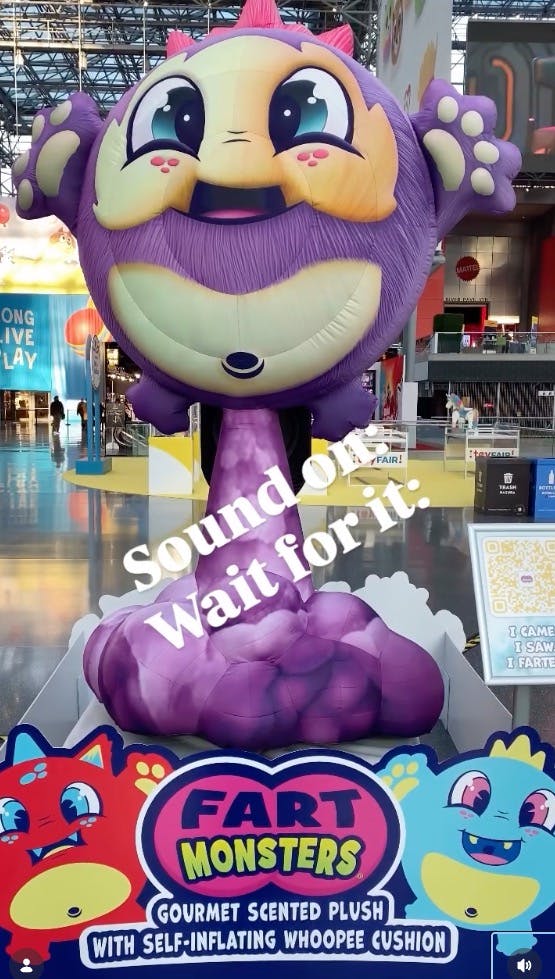
- [31:21]
B
Of some animal which is like, like maybe four feet up in the air because they have a giant purple fart coming out under them. And there was like a butt guy as well. I'll make this the, the thumbnail for everyone. So none of you guys missed this, but it was a fascinating contrast in this giant convention center, the Java center, from the, like, Happy Educational. We just want your kids to learn and develop and the, like, we're going to sell your kids, like, poops and farts and you're going to thank us for it. That's the one. The one dark Thing someone told me was the influence, like the influencers in this world are really young, like 10 and under. Oh, wow. And the way you get pressed now is like you pay for posts in this world and there's very much a child actor dynamic where you're not becoming an influencer at 6 unless your parent is pushing you to do it. And having a chat with some of the PR folks being like, yeah,
- [32:31]
A
some
- [32:31]
B
of them seem happy. Some of them seem like, why are we working here? I mean, maybe if you're like, you can just be like OD'd on toys. If you're seven years old, you're like, I'm aged out of this. Stop. Mom and dad. Let me. Yeah, yeah, let me out of here. So maybe we need some reform in that regard as well. No, no TikToks under 10 or, well, Europe's move. Right?
- [32:54]
A
A couple of countries are moving that way on like no social media for under 16.
- [32:57]
B
Right.
- [32:58]
A
So, you know, maybe eventually, yeah, I think so.
- [33:02]
B
Or maybe you can only make posts if they're about happy educational toys, not like poop and fart ones. That actually sounds like woke AI. All right, let's call it here. Peter, thanks for jumping on today, everyone. Tell Peter to start his freaking substack already so I can get off LinkedIn and stop reading these posts. It's always a pleasure.
- [33:29]
A
All right, thanks, Jordan.
- [33:31]
B
I appreciate it.
- [33:32]
A
Always a pleasure. Lifelock, how can I help?
- [33:35]
B
The IRS said I filed my return, but I haven't.
- [33:38]
C
One in four tax paying Americans has paid the price of identity fraud.
- [33:41]
A
What do I do?
- [33:42]
B
My refund though. I'm freaking out.
- [33:44]
A
Don't worry, I can fix this.
- [33:45]
C
Lifelock fixes identity theft guaranteed and gets your money back with up to $3 million in coverage.
- [33:50]
B
I'm so relieved.
- [33:52]
A
No problem. I'll be with you every step the of the way.
- [33:54]
C
One in four was a fraud paying American. Not anymore. Save up to 40% your first year. Visit lifelock.com podcast terms apply.