Loading summary
Transcript165 lines
- [00:00]
Jordan
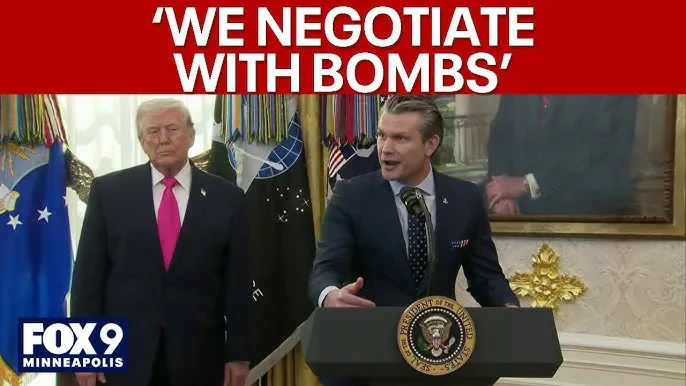
From moment one. And that's why we see ourselves as part of this negotiation as well. We negotiate with bombs. You have a choice. As we loiter over the top of Tehran, as the President talked about, about your future, the President has made it clear that you will not have a nuclear weapon. The War Department agrees. Our job is to ensure that. And so we're keeping our hand on that throttle as long as hard as is necessary to ensure the interests of the United States of America are achieved on that battlefield.
- [00:28]
Brian
I think Thomas Schelling got a Nobel Prize for. It's ripped from the pages of Arms and Influence. We're gonna, we got our hands on the throttle over Tehran and we're going to bomb the negotiators. I mean, what is war if not bargaining?
- [00:45]
Ian
That's right.
- [00:45]
Tony
Politics by other means.
- [00:47]
Jordan
I think Clausewitz would be fine with that quote.
- [00:50]
Ian
I think we would say politics is war by other means. I mean, I think that's what Hex asked Ian.
- [00:56]
Brian
Yes.
- [00:56]
Jordan
Yeah.
- [00:58]
Eric
Bombs are strongly worded letters by other means. So.
- [01:02]
Brian
And well, he has refuted. I think he's accidentally correct again in that. I think there is a spirit in American commentariat, often among left liberal spaces where diplomacy is this walled off form of international power. And then diplomacy gets handed off to war and then sometimes war gets handed off to the economy. And that's nonsense. Diplomacy is a means of communicating strategic bargaining. And yeah, you've got diplomatic professionals who do that exceptionally well, but it is all interrelated and that you do not wall off certain segments of your national interest when you are in these forms of competition or war fighting.
- [01:45]
Eric
Yeah, diplomacy is what happens when war fails, not the other way around in this case.
- [01:50]
Jordan
No, but I mean like it's the dime model, right? Like whatever they're calling it now. I'm sure they've added 17 letters to the acronym. Yeah, DIME, Phil, DCE. But yeah, like there was this whole idea that like during GWAT we went big M and little D, little I, little E. Like we didn't do any of the diplomacy stuff and we understaffed the everything else. I mean, he's not wrong in saying that, like, hey, we should be doing both at the same time. It's interesting that it somewhat refutes what the President's saying because like if the President's like, hey, we're going to call off the strikes because we're having these, these great talks. When you have Iran saying what talks we, we were not invited if we do not know who you're talking to.
- [02:33]
Eric
So There is like a bit of a. I think it's worth talking for a second about whether there are actually talks taking place. And I, I think there are. I, I think the reporting saying that, like, they don't want Witkoff and Jared is, is probably, yeah, it's probably valid. I also think it's probably in the interest of negotiators in Iran to not let, let the IRGC hardliners know what they're up to. I mean, again, I'm not an Iran expert, but I, I would say that if you have hardliner factions who are happy to operate in mission command environments where they just lob drones and missiles, I think it makes sense.
- [03:13]
Ian
Yeah, but the question is if, I mean, if the folks in Tehran are having these negotiations and they don't have the IRGC on board, the negotiations aren't going to go anywhere.
- [03:23]
Eric
Right.
- [03:23]
Ian
Because the IRGC is still the power center, even more so now in Iran. And the notional leader of Iran right now is an IRGC friend and supporter and loyalist. So I think it's unlikely that they're going to be able to have a successful negotiation unless the IRGC is involved in it or at least privy to what's happening.
- [03:43]
Brian
Yeah, there's concurrent chatter that there are lines of communication among some of the regional intelligence services like Egyptian egis, Turkish tnio, the Qatari Security Service, and then Iranian mois. But that leads to the same cul de sac we just elevated is that does Iranian mois, like their chief of station equivalent in Cairo, have the ability to communicate with IRGC hardliners who are actually employing the ordinance or that they have access to the ebb and flow of the war. So it is difficult to communicate with people that are out of the battle and not to continue to fall back on gwat, because we've all touched the gwat. Sort of a common point of orientation, but part of the Sunni Awakening, so to speak. In 2006-2008, the American Co option of certain non Al Qaeda tribal forces, some former REGINA elements and other segments of the Iraqi opposition to fight Al Qaeda and to sort of cease fire with the central government. A core component of this was that you had people who had been detained as part of, like Ansar Al Sunna and other hardline groups, but not quite Al Qaeda, were put back onto the streets as negotiators because they had American blood on their hands, they had Shia blood on their hands. They could communicate to breakable parts of the opposition. And the United States and Britain ceded these people deliberately as Part of a clear strategy. And there were Americans who, and Britons and other members of the allied force in the country who were disciplined enough to allow that to happen. I doubt that discipline exists now. I think that if there was a Quds Force member who was like, hey, I'm willing to be an intermediary, the second they pick up a handset, someone's going to kill them.
- [05:44]
Jordan
Yeah. I also wonder how much it, you know, when we look at what's been going on even before this negotiations were announced when like they lifted the sanctions on the four, whatever Iranian vessels that came out just from. Again we talked about like game theory. I don't know what the regime gets out of doing open talks right now or just doing talks in general. Unless the talks are. You're going to let us control the Strait of Hormuz from now. Like officially it's ours and we can charge taxes on everybody because they've already. I think the windfall from those ships being allowed to leave was like equal to the JCPOA repayments or something like that. Which again was like that just to back. Yeah, that's, that is one of the things that Trump ran on was the JCPOA was us being weak kneed and like giving them money.
- [06:38]
Tony
Giving them money.
- [06:40]
Jordan
And we have now effectively done the same thing.
- [06:44]
Ian
Interestingly, Mattis had the, the military dimension of this when they were doing the JCPOA negotiations. And he had deployed two carrier strike groups there. We had them there for a year. Like two carrier strike groups floating around the Persian Gul and the environs to pressure the Iranians to come to the negotiating table and actually go through with the agreement. So they didn't have to drop any bombs, but they deployed maybe half of what's there now to be able to really pressure them into this point where the exact same kind of agreement that we're trying to reach with them now after having expended God knows how much treasure to be able to generate the same outcome.
- [07:21]
Tony
You guys remember maximum pressure.
- [07:23]
Brian
That's right, maximum pressure. But Brian just elevated something that I saw a report in the Financial Times. I think it was 72, two hours ago now. But CSIS, the think tank in Washington D.C. is estimating that an entire year's worth of production of the joint attack standoff, the jassm, I'm mangling jasms, an exceptionally sophisticated standoff weapon with great range that was going to be critical to the defense of Taiwan is now we're effectively not BOLO on it, we're not Winchester. It's not zero, but a year's production is with used in the first six days of the renewed Iran war. And there's this.
- [08:08]
Ian
A third rate military power with zero air defenses.
- [08:11]
Brian
Yeah, exactly. We're using like these exquisite tools. And if we're talking about sort of Trumpian signaling in the 2024 election or even, you know, earlier about JCPOA, it was that a we're wasting treasure on the Iranians or we're wasting assets on keeping Ukraine free from Russian imperialism. And we finally actually crossed the threshold where American military support and military involvement in this campaign against Iran is actually depleting the critical war stocks that would be necessary to fight the People's Liberation Army Navy. And it's causing people in the defense industrial base to scramble because they recognize that hey, we are extraordinarily short on these critical weapons and we are just lobbing them into this third rate country that is conventionally defeated.
- [09:04]
Ian
Oh, sorry.
- [09:04]
Jordan
Go ahead, Brett.
- [09:05]
Ian
Yeah, I was gonna say part of this is also just a test run for all these new systems that we got. So in the same way that the Navy finally got to shoot down missiles with missile defense systems in the red Sea after 30 years of not ever having to do that here, we've got an opportunity to let's use these new weapons in a relatively safe environment so we can kind of show them off and make sure they actually work in a combat situation. So I could see maybe because like they use Prism too brand new, so surface to surface missile the army's developed, designed for these really contested environments, totally unnecessary for Iran. So this is partly I want to play with my toys because I think they're signaling to China, something which I don't really, I don't think these weapons signal anything to China. Although the, you know, arguably China is not in really any position to threaten Taiwan over the next couple of years. So maybe this was the window to go and do this while China was not able to culminate on on its ambitions. Yeah.
- [09:57]
Eric
If the assessment really is that the PLA is taking a re look at their ability to do it, then, you know, you can expend it. I don't think the analysis, that was the analysis that happened. I think it's just convenient that that's what happened.
- [10:09]
Ian
It's a nice post hoc rationalization.
- [10:11]
Brian
Yes.
- [10:11]
Eric
But also remember that every, you know, every BDA that we get out of this, the PLA gets their own too. Right. And so like what, you know, we didn't have in terms of assurances that the weapons work well they now have assurances that they can at least get some signature read or something off of these that they can build into their next round of iterations that they're doing.
- [10:31]
Jordan
There's also just, like, this whole, like, I. I get everything that bad that happens has to be the last administration's fault. But, like, when Hexeph yesterday, I think it was. Came out and said that the reason that we're so low on Tomahawks is because Biden gave so many to the u. The Ukrainians. Maybe he misspoke, but that's a big missp. Misspeak from the secretary to. Because obviously we didn't give Tomahawk to the Ukrainians. Like, yeah,
- [10:59]
Eric
we. We fam. Did not give them to the Ukrainians.
- [11:03]
Brian
Yeah, yeah.
- [11:04]
Jordan
So, like, to come out and say
- [11:06]
Brian
that no F35s lost in the Ukrainian air campaign.
- [11:11]
Jordan
Yeah, yeah. I mean, like, if you want to be mad at somebody, be mad at Kurilla for just, like, yeeting tea lambs at everything in the Middle east for, like, the last year of his time as the sitcom commander. Yeeting is the. Is the preferred term, I believe.
- [11:26]
Brian
Yeah.
- [11:28]
Eric
Yep.
- [11:28]
Brian
The Houthis being on the receiving end of lethality maxing from Eric Carolla.
- [11:36]
Ian
It's all an influencing campaign, which works
- [11:40]
Jordan
so well because the Houthis are now on our side. They're not doing anything right.
- [11:44]
Brian
They all moved to Miami and they're bone smash maxing now.
- [11:47]
Ian
Exactly. Oh, we don't need that clavicular reference there, but I think we were one
- [11:56]
Eric
of the earlier podcasts to reference clavicular, because I think I brought it up, like, back in November, God help us
- [12:03]
Jordan
all, again, willing things into existence that I wish we had never done.
- [12:06]
Ian
Exactly. You gotta be careful.
- [12:08]
Brian
Okay.
- [12:08]
Ian
Strategic.
- [12:09]
Tony
Strategic level. Trump, you know, he's doing these little. He's doing these little moves to Keep oil under 110. At some point, as long as this work keeps going on, it's not going to work.
- [12:24]
Ian
Physics matters, though. I mean, at some point, the material limitations of oil production are just going to. They're going to. The market's going to have to react.
- [12:32]
Eric
Also, this is, like, largely tied to his obsession with gasoline prices, which is not necessarily the real risk here for an economic standpoint.
- [12:44]
Tony
So the last time he said he was negotiating, he started the war. We have all these reports about the 82nd Airborne are out Marine Expeditionary Units kind of showing up. Last time we talked about how dumb it would be to be to do Carg Island. Do we even need to. I Think we've also talked about how dumb it would be to, like, try to, like, seize the, like, you know, Hormuz environs. So the only one that kind of makes sense, which is also a scenario we've covered before on, on second breakfast, is the, like, go into Isfahan and try to get all of the glowing goop. I mean, it seems like, like, I don't know if Trump would take the. They still have everything and they get to charge the tariffs and only 50% of the oil gets out of the Strait. So do you guys agree? Do you think something else needs to happen? Is. Is going into Iran with a few thousand dudes just, like, too crazy? Do you think they'll do it? Is there any way it's done smartly?
- [13:54]
Jordan
I don't know.
- [13:55]
Tony
Who wants to take on the. What happens next?
- [13:58]
Ian
Oh, I can talk about the, like, talking about how do we might clear or keep the Strait of Hormuz clear. I mean, I think the challenge right now is it's easy for them to pickle off a few weapons and, you know, make it sufficiently contested that shipping companies aren't going to want to use it and that you might actually have some real damage getting done to ships. And so that that threat, which has not been abated and continues, and at least from every war game and just my travels there too, it looks like it'd be very hard to completely eliminate that threat short of like, you know, the Israeli, northern or southern Lebanon campaign type thing. So we're not going to be able to do that. So we're going to end up having to escort ships and protect them from attacks and suffer some attacks on our own ships if we don't breach a negotiated settlement. There's just no way to keep that straight, clear short of the Iranians agreeing to do it and agreeing agreeing to do it. Now that we've done everything we've done to them, they're probably going to have to exact some cost out of the international community to keep the strait open, which is, as you know, as you're saying, Jordan, there's going to be a fee or they're going to have a toll gate there and people are going to have to pay to get their stuff out. I just don't see any other way that you incentivize the Iranians to keep it open because it's so easy to keep it closed. And at this point, it's hard to tell exactly who might be in control of those missiles and drones along the coastline anyway. So you'd have to really make it, you know, make it worthwhile for them. And from the IRGC's perspective, that's all about money because they're a business when it comes down to it. So they want money. They could be the perfect organization to run the toll booth and keep them happy. The leadership in Tehran would be happy that the IRGC is happy. The oil would flow again. The markets would be relatively happy. And then I think that's the only way you got out of this.
- [15:44]
Jordan
What does this do for freedom of navigation? I mean, realistically, like you're looking at the strait being closed potentially. Where they could close the strait. The US which part of our large navy that we've had is to have the freedom of navigation and secure it for international commerce.
- [16:00]
Ian
We would end up treating this like the, the Northern sea route.
- [16:04]
Brian
Right, right.
- [16:05]
Ian
It's like the Panama Canal. It's like the Suez Canal. It's like the Northern sea route, which right now the Russians control and charge fees for because they say that they have to keep it clear of ice and stuff like that. So it would be like other choke points where we've sort of given in to the fact that there's some international organization or country that's going to exert control over them. We have to pay them to allow us to access it.
- [16:26]
Jordan
Yeah, I think the long term geopolitical issues that you kind of see coming out of that are it's going to increase instability in the Middle east because that puts antagonistic Saudi Arabia and antagonistic Iran. It puts them in a master servant relationship to some degree because Iran would. Yeah, Saudi Arabia may have the oil, but they have one small pipeline that runs from east to west across the country. The majority of their oil goes out through the strait. Iran controls the strait. They can then just kind of like, hey, we don't like Saudi Arabian ships right now.
- [17:03]
Ian
Instead of building islands, they could be building pipelines.
- [17:07]
Tony
Our cigarette city.
- [17:09]
Jordan
Right.
- [17:10]
Tony
Is having like a few more of those pipelines, right?
- [17:13]
Jordan
Yeah, right.
- [17:14]
Ian
Massive infrastructure projects might, you know, be the, the, the. It's not as sexy but. But it could be just as valuable.
- [17:22]
Tony
What do you make of the reporting that Saudi wants the war to. MBS is cheering this on. He doesn't want it to end.
- [17:28]
Eric
Yeah, I.
- [17:29]
Brian
So it's not just him. It's all the locals are sick of eating shaheads and they want to see retribution.
- [17:38]
Eric
I think it's. I don't think it's as conspiratorial as some people will make it out because I don't think they wanted the war in the first place, but I think they definitely want it finished. And I also think what MBS does not want is to have to use his military in any sort of expeditionary fashion because it's not designed for that. And the last time it tried to go into Yemen, it ran into a buzzsaw. So I, I, and you know, I assume that based on the targets that they've shown in the highlight reels, again, who knows? Like, I assume most of Iranian ground forces are somewhat intact. So, you know, I, I, I think they want it finished, they want it to end quickly and they for sure do not want to have to use their own forces for this.
- [18:20]
Jordan
Yeah, I think, I think just exactly what we just talked about, like, if it ends tomorrow. Saudi Arabia is now beholden to Iran to move its oil out through the strait, which Shia Sunni divide pick the reason that that would be an issue for the region, I can't imagine, you know, you're going to strengthen Qatar because Qatar has largely been friendly to the Iranians over the years and they're antagonistic to ksa, even though Qatar has also been hit because Iran, again, they're just yeeting stuff to cause disruptions now at this point to some degree. But you have a potentially better position, Qatar, you have a weak in Saudi Arabia who has to go and ask the ayatollah, the Shia ayatollah, for permission to be able to move oil through from the birthplace of Muhammad. Obviously, again, all the issues that that's going to entail, they can't want it to end in a settlement that is the Iranians control this trade, in the end, we're stumped.
- [19:28]
Ian
But Jordan, to your original point, I do think what this does is it puts a valve on the output of oil from the Persian Gulf. There's going to even with a relatively acquiescent Iran, the fact that they're going to be charging tolls essentially, and there's going to be a toll booth and there's going to be inspections. And just like the tankers that they did allow out had to go out some circuitous route around the main traffic lane in the straight so they could be inspected. I hope that's why it was and not because there's mines in the strait. So they had to go through that. And so if that ends up being the case, it's definitely going to slow the traffic through there. You're not getting 120 or so tankers through there a day. You're going to get more like half that, probably.
- [20:10]
Eric
So, Brian, Kind of on the, on the mines front because I think I saw a reporting that maybe there's like a dozen mines in the strait of an oopsie. Right, right. Is the reason there's not more mines in the strait. Aside from that they blow up the mine boats because that's something you can't really take back. Like it's, it's. Any negotiation would have to. Right. Presumably require the street is open in some fashion and if they just left the mines in there. Mines are notoriously hard to recover.
- [20:35]
Ian
Yeah. So the. Right. So if you're careful when you put your minds in, obviously you're supposed to keep track of where they are and then remove them when the war is over. That's the legal way to do it. But the earthies are oopsies especially. They could be. I assume they're not drifting mines, you know, a la tanker war. But if they're moored mines, bottom mines, it's pretty easy to not have a good track, good location on them, especially if you did it quickly, you know, in the dead of night. So you may not know exactly where there are. So you're into a mine hunting operation to be able to clear the Strait. But that's why they wouldn't want to do it, because they would, they'd want their own oil to get out. So they would need to clear those mines at some point or at least know where the queue route is to go around them. And if you didn't plan place the mines carefully, you can't build your queue route unless you go and find the mines yourself.
- [21:22]
Jordan
It reminds me of like every once in a while you'd be doing like training or something like that. You'd go out and they'd like to set in an ambush. You always go out, put out a claymore. Sometimes the ambush doesn't go off, so you gotta go back and recover it. And then you're sitting there going, which tree did I tie that off to? It's one of these trees. I don't know which one.
- [21:39]
Ian
It's the one. It's the one with the bark on it.
- [21:41]
Jordan
Yeah, exactly.
- [21:42]
Ian
And the branches. Yeah, it was real dark.
- [21:44]
Jordan
It was the dark one. That's kind of close to the road.
- [21:46]
Ian
That's right. None of them are dark. It's daylight now.
- [21:50]
Jordan
Oh yeah, yeah, exactly.
- [21:53]
Tony
And I guess the thing is like, even if you do the crazy special forces raid and you get all of the nuclear material, you're still stuck with this Hormuz dilemma. Like it doesn't change anything.
- [22:08]
Jordan
Again, the biggest weapon that they've got is one, they've, they bought themselves Sun Attack 2, even without a nuclear weapon. Now they basically have seen that they can, to quote Eric, cut the throat of the global economy at any point that they want to and really impose costs. And then when I saw that it was the Pakistanis who were the ones that were offering to take the notes, I was like, oh, I wonder where they're going to get their nuclear weapon from. Also where I would be getting it from.
- [22:32]
Ian
The Pakistanis desperately need the oil. Right. They get 90% of their oil from the Persian Gulf. So they're not in a good situation right now. So they're very motivated to get the strait open again at some level and they're probably going to be willing to pay dearly.
- [22:46]
Tony
Started all of us.
- [22:47]
Eric
Right, yeah, well, and they've not been just on the Pakistani front, like, you know, because we really haven't covered the AFPAC campaign. Like they've not been in a good position for a while. There was the floods and they, they've had at least one exchange with India in the last few years and now potentially an oil shortage. Like they're, I mean, I assume that's probably the, whatever the fallout is from all of this in the long term. I assume it hits Pakistan pretty hard, which is always great when you have another nuclear armed state.
- [23:20]
Ian
Yeah. Running into tough times.
- [23:22]
Jordan
But I mean like, you know, dprk, during their legislative session or whatever they call it, it's not actually a legislative session because they don't actually do anything. But you know, Kim comes out and gives an impassioned speech about why it is only because they pushed forward and got nuclear weapons that they have been able to stave off the aggressive Americans and the aggression of Americans turned down because of the bite of the DPRK's nuclear weapons. Again, that's a lesson. You know, you can be Gaddafi and you can give it up or you can not be Gaddafi and you know, apparently be left alone. So again, I don't, I don't see a good ending to this. I would love to be wrong.
- [24:15]
Brian
My short term guess is that there's going to be something like a 30 day ceasefire to continue negotiating and then there's going to be this will they, won't they iteration in the future. But that's not a resolution. Were I the Iranians, I would also be concerned that a ceasefire or negotiation process was enabling the administration to move more assets into a position to kill more leaders. That we covered this in our last episode, but it is A game of the Prisoner's Dilemma. And the Iranians are justified in assuming the United States is going to defect every single time.
- [24:53]
Eric
Yeah. If you're the Iranians, presumably you want some sort of third party guarantee. And I don't know if anyone's noticed, but none of their allies are willing to do that. So I don't know from a negotiation standpoint what you do that actually validates that security.
- [25:10]
Brian
Shouldn't the BRICs be coming to rescue them? The formidable international alliance known as the BRICS that Goldman Sachs invented 25 years ago to sell higher yield debt instruments. And now all these goofballs coming out of graduate MA programs like, like mine thinking that oh, we finally have this counter to, to NATO. We have these countries with so much in common. Brazil, Russia, India, China, South Africa and then, and then a bunch of associate countries and that they are going to break neoliberalism one post at a time. Where are they?
- [25:51]
Eric
You know I, where are the bricks? I really thought shouldn't they be bound off the under. I really thought the brics had died by the time I finished undergrad. And then I watched it come back after Covid. It's fascinating to watch people when there are real, real threats and actual like organized blocks in the world for these things and the Goldman Sachs Co. Invent this, this BRICS thing as if there really was anything that tied South Africa, Brazil and Russia together. Other than really bad car industries.
- [26:27]
Jordan
God, he got nothing on it.
- [26:31]
Brian
Shouldn't the Global south be coming to rescue Iran? I see it on online all the time. The Global south is a uniform entity. It is a common conscience across humanity. Should they not be intervening? Or is it just attributing agency to something that doesn't exist?
- [26:46]
Eric
All right, I was assured by all of my friends in Brooklyn that they had solidarity.
- [26:51]
Brian
Yeah, just like the west doesn't exist. Be specific. Speak what you mean.
- [26:56]
Tony
Should we talk about the brain? The brain rot president?
- [27:00]
Ian
What was the.
- [27:02]
Tony
It was NBC this morning. Each day since the start of the war in Iran, US military officials compile a video update for President Trump that shows video of the biggest, most successful trikes over the past 48 hours. The daily montage typically runs about two minutes, sometimes longer. Fischl says one described each daily video as a series of clips of stuff blowing up.
- [27:27]
Eric
So I have to say I think to our pre show conversation, like highlight reels to impress politicians is not unique. Most of those politicians are not the commander in chief and I think that is a fundamental distinction between providing reliable information versus Trying to get appropriations funding.
- [27:47]
Ian
Well, it seems like the natural progression though, considering the President's daily briefing book had transitioned from being a notebook to a picture book to now it's like a two minute highlight reel that he can, they can show them on a t. On the TV screen in the, what used to be like the dining room or something and adjacent to his office. So it just seems like that's the kind of, you know, where we're going. Eventually it's going to be a TikTok of, you know, it's going to be 10 second clips, you know.
- [28:15]
Tony
Yeah, two minutes is a little long. 15 is. 15 seconds is better for the algorithm.
- [28:20]
Ian
Yeah, it seems like onto something here. Yeah, well, they can just put it on the, put it on the social media.
- [28:27]
Jordan
Where's he doing all his intelligence assessments though? In all his threat assessments? Because the DNI has said she doesn't do that and it's not the intelligence professionals who are doing it. So in the ballroom at the end of the day.
- [28:39]
Galiba
Yeah,
- [28:42]
Jordan
100% destroyed.
- [28:43]
Tony
Justin.
- [28:44]
Brian
Yeah, he just, he's getting the video straight from the Pentagon. But to Tony's point, this isn't necessarily new. The President's Daily Brief is not a document that is etched in stone. And every President gets the same material. The CIA, who has still artfully controlled that document even after intelligence reform in 2004, has always shaped that document to meet the expectations of their primary customer. And the length of the document, the style of writing, the confidence intervals have been changed substantially over the years. There was reporting in the, the peak of the 2024 presidential campaign about then Vice President Harris asking her PDB briefers about gender related language inside the PDB, which was completely, completely fair. Like she was engaging with her analysts in an intellectually rigorous way. That is what the process is supposed to do. The PDB is best thought of as a process, not necessarily just a specific document. But I at a point in my life worked for someone who was one of President Reagan's national security advisors, his actual deputy. And during the second Reagan term, it was increasingly difficult to get President Reagan to engage with the pdb. And at the start of his term he would get briefings from CIA analytic professionals. They talk, they engage. And by the second term that had ended and there was a process where the highly classified code review information would be dropped off and the President would take and say, okay, I'll get to it. And the, the agency recognized that the President was moving it around the Oval and moving it around the residency to give the appearance of him engaging with it, but he was really just moving it around. He rarely opened it. And they would always have a minder because it was extraordinarily sensitive classified information in it. And then when the President actually went to bed, they take it back. So the CIA in 86 or 87 started doing film reels because the President was a film aficionado. You know, he was head of sag, the. The actors union. He is an actor successful in his own right. So to talk about, you know, Soviet force disposition in Western Europe or Chinese naval exercises, they would do films and they would turn it into something closer to like CBS Evening News than just flipping through a pd. So Donald Trump getting like, animations of Lego figures throwing fireballs at each other is kind of just the next step in the maturation of the President's daily brief. So it is not new.
- [31:33]
Eric
And I would say that I think amongst all of us, we would probably, if we were in that position, we would all take the PDB differently, presumably. I know that I would want more written analysis because that's how I consume information mostly.
- [31:48]
Tony
But I mean, people want videos in VR. I don't know why I can't get the 3D. Can we put like, little 3D cameras?
- [31:57]
Eric
No, the. The metaverse is being retired, Jordan. That's. We can't do it.
- [32:01]
Jordan
Can I.
- [32:02]
Ian
Can I get the PDB in like, musical theater form? Can I get the kids from Glee to do it? Because that's right.
- [32:10]
Jordan
You got to listen to these episodes you get.
- [32:12]
Ian
I do. That's what I'm thinking.
- [32:14]
Jordan
Second breakfast.
- [32:15]
Brian
I mean, if the President wanted a performance of Evita, like the Navy Band is right there. Right? You can.
- [32:21]
Ian
That's a good point.
- [32:22]
Brian
Get a move.
- [32:22]
Ian
I mean, they are.
- [32:23]
Eric
I. I want all confidence
- [32:27]
Tony
every time a bomb goes off for those poor
- [32:30]
Jordan
Iranian missile years when they go to the describe some type of conflict in like sub Saharan Africa, it's the Sharks versus the jets. Just as whichever the different nation it is that's fighting.
- [32:40]
Brian
We got to think everybody likes to 80s hedonistic New York Broadway because that's the. The President's baseline. You've got to work through the cats.
- [32:50]
Ian
Cats, yeah, yeah, cats.
- [32:53]
Brian
Yep.
- [32:53]
Jordan
Mr. McGill or Ian McClellan's greatest greatest movie by far. God, so terrible.
- [33:04]
Brian
You know, we joke about it because it is a bit absurd, but.
- [33:07]
Eric
But
- [33:09]
Brian
is something that I think is important about our conversations is the Trump presidency is extraordinary and exceptional in a variety of ways. For anti constitutionality for the January 6 episode, for the extrajudicial killings in The Caribbean. There are fundamental breaks with American history that set this administration apart. That is absolutely the case. But there are other moments, like whether it is the President initiating military force unilaterally without going to Congress or the style of receiving intelligence or not receiving intelligence at all. This is nothing new. Early in President Clinton's presidency, a Cessna or like a small, like personal aircraft landed on the South Lawn of the White House and crashed into the. The residents. Like this actually happened. And I think the pilot, I seem to remember, was fine, but was arrested for being an idiot. But there was a joke throughout the American press in that it was actually James Woolsey, the then director of CIA, trying to get some face time with the President because Bill Clinton did not care. He was completely uninterested in engaging with the intelligence community or the military during his first term. So we are finding departments and agencies like the Pentagon that are actually giving the President material that he engages with. I mean, that's sort of a success story. What we don't know and what keeps me nervous is how much legitimate AI slop is being fed versus just highlight reels of airstrikes, which is pointless, but at least it's not a lie.
- [34:51]
Eric
On the advice of generals. Right? Is a common theme for anyone who goes through the policies wheelhouse of, of how do you, if you're a civilian commander or leader, how do you trust the advice of generals? And I. And I think that the AI manipulation of video or content adds a new layer to it of where not just this Commander in Chief, but the next one, if the Pentagon or somebody else, like how. How do you trust what is being provided to you in that format?
- [35:18]
Jordan
I think this, that's one of those areas too where what worry not what worries me but just like an observation is that the differences in having a group of people who you' willing to accept argument from and willing to accept argument on your positions from. And I think where the reporting probably is, the if, if the intelligence is all geared towards confirmation bias, the President thinks this, we need to support that. Cause you can make intelligence support almost any position. Like you can find an analyst who says based on this, I think, you know, polar bears live in the South Pole or whatever. You want to have a group of people that are around that are making these decisions, that are helping inform these decisions, that are willing to argue with each other and willing to have those type of confrontations. That doesn't seem to be something that's. That doesn't seem to be something that's allowed just based off the Reporting we see and that's the fastest way out of the circle is to disagree with the President. And, and that's where I think I would want to see more intellectual rigor on the assessments going in. Because if you're not going to have those type of fulsome debates on the inside and you're going to limit the Iran war decision to five people who are saying yes, I think this is a good idea, then you end up with the Iran war decision that we were faced with.
- [36:45]
Brian
Yeah. Or you end up with the movement to launch the Iraq war of 2003.
- [36:52]
Jordan
That exactly.
- [36:52]
Brian
Just to your point, the certain Presidents don't want like a panoply of views. Like they don't want different analysts coming in with different dispositions. They don't want to sift through confidence intervals. They don't want to read the ops traffic behind the human reporting. They just don't care. They want to be the decider. And Condoleezza Rice when she was National Security Advisor recognized her boss's predilections by virtue of that she neglect. She refused to hold NSC meetings or principals committee meetings over whether or not you should launch the invasion. She saw it as a foregone conclusion that she thought there was no need for a professional discussion among the various departments and agencies. We're just going to, we're just going to do it and be legends. And the President, the current President's decision making around war while not the way that a national security professional or somebody like you know, if I was in the room I would obviously do homes entirely differently. But this President is not the first person to have a bunch of yea sayers around them that validate the decisions, accelerate their worst impulses and just select based off of personality traits rather than like technical know how. So yes, the consequences are grave. And maybe saying it's not new. It doesn't excuse it. Oh, it doesn't excuse it. And it doesn't immunize the kind of political failure that we're in. But it is part of kind of a proud American tradition of presidents just sort of saying hey, you know, I got 270 electoral college votes. The Constitution gives me the right to do whatever the hell I want.
- [38:30]
Jordan
Yeah. The proud American tradition of ignorance is long and fulsome.
- [38:40]
Ian
I mean I will say that the obviously the campaign's been very effective at blowing stuff up up blowing up a bunch of stuff that the Iranians I think could have used to threaten their neighbors. Not really us, but certainly their neighbors. And they've certainly set back their conventional weapons capability substantially. The problem is, whoever was planning the execution of that operation did a great job, but did not convey or inadequately conveyed the fact that even if you do all of that, we could have always done that every. As we all know from our time in the service, this was a war plan that people had gone over thousands of times. And, I mean, I've been in, like, a dozen war games that looked at this exact scenario, so I know it's been evaluated to death. So we knew we could do this anytime we wanted to. The reason we didn't was because of the strategic consequences, which is Iran can always close the strait. You never really can eliminate the threat. How do you get rid of the nuclear stuff that's already been generated? And, you know, can you actually get this regime out of office because they've got such a stranglehold on the population? Those are the reasons why we never did this before. I think there's this expectation on the part of the current leadership that they were the first people to actually have the guts to do it. And it was not that. It was just previous administrations realized that, yeah, we could do this anytime we wanted to. It just doesn't work out very well in the end because we don't have a way to bring it to closure.
- [40:02]
Eric
Yeah. The problem with the hornet's nest is not that nobody's ever dared to kick the hornet's nest or they don't know how to.
- [40:08]
Ian
Right. Everybody knows how to.
- [40:11]
Jordan
Yeah. A really effective way to get honey is to reach into the beehive. That's right. The bees would disagree.
- [40:22]
Ian
So what do you think about this argument that people make about this all being bad for China?
- [40:27]
Eric
I think it's retroactive. It's retroactive airtime.
- [40:32]
Ian
Brian,
- [40:34]
Eric
I want to go on a rant about this because I've had policy staffers say this to me of, like, well, at the end of the day, it fucks with China, and it's like, yes, the immediate thing is maybe there's not another Chinese ally to which some China hands would argue. Well, technically, China only has one ally, and it's North Korea, and they're not doing so hot. And that the rest are strategic partners. Right. Yes. It is technically one less lever for the Chinese to pull in a war in the idea that they had that lever, which is also not for certain because the Iranians didn't pull this lever of closing the strait until they were attacked multiple times. I. I think it is a gross misunderstanding of the actual levers. The PLA can pull. And it is also gross misunderstanding of the lessons the PLA can take away from this and the global shifts that the PLA gains in its favor after this that make it even harder to have an effective quick fight against the PLA in the Pacific.
- [41:37]
Ian
I mean, the other thing I see is people talk about the effectiveness of the AI enabled planning processes that are being used to execute large numbers of strikes in quick succession, which is impressive and is more than we've ever done before. Okay, I'll give them that. But the thing is, I don't think the Chinese ever really expected that we couldn't strike a bunch of ships in the Taiwan Strait that were mounting an invasion. I think they sort of expected that we could do that. The difficulty is the weapons get shot down before they get there because they actually have air defenses in contrast to Iran and they just would have a way to overwhelm our ability to even get close enough to launch the large numbers of weapons. So I think the argument that somehow our C3 capabilities that we displayed in Iran are going to be the thing that convinces the Chinese not to mount the invasion. I don't think that washes just because they never thought our C3 was necessarily at risk because I think they've always been impressed by the C3 that the US has been able to pull together. It's the just physical ability to generate fires on target that make it there that is always the problem. Yeah.
- [42:41]
Eric
Also the, the PLA has, the pla, mss, et cetera, the entire interagency in under the CCP has the ability to do things like poison data sets. Right. Actually affect, you know, large scale infrastructure attacks. The things that we talked about the Iranians doing. But you know, they, it seems they either haven't pulled the trigger to last week or they aren't actually able to do at the scale that the MSS can.
- [43:07]
Jordan
I think too. I mean it's one of those things where if anything we're highlighting the tyranny of distance really is a thing because like we're not going to have two carrier strike groups off the coast of Taiwan.
- [43:20]
Ian
So for me you can.
- [43:21]
Eric
They'll just be underwater.
- [43:23]
Jordan
Yeah, yeah. For a very short period of time you can. But that to me is where like the counterargument is you have to deny everything else that's going on and just say but China won't be able to pull as much oil from the Middle East. And it's like, well yeah, that's one dimension, but there's all these other dimensions that if you were to factor them in. They don't necessarily. At a minimum, they negate the negative that you get from the first. Because a counterpoint would be Taiwan made this awesome decision about six months ago to close down its last remaining nuclear reactor on the island and move largely to coal, larger oil, liquid natural gas as their power source. That looks stunningly shortsighted even without an invasion. And now you couple that with the potential of an invasion, like, well, China's like, well, yeah, it hurts us a little bit, but we have potentially. Obviously, corruption's a thing. We don't actually know how much is in those reservoirs. They could all be empty. We'll know if people start getting fired soon that are involved in China's natural gas and oil storage consortiums. But Taiwan doesn't have those stockpiles, not in the, in those levels. So anything that hurts China in this regard is also going to hurt Taiwan, which again, if the whole point is to make that harder, you've made an embargo easier because they don't even have to worry about cutting off the oil now. Like, they. They literally don't have to do an embargo. And Taiwan's not getting oil and liquid natural gas. China didn't have to do anything.
- [44:58]
Brian
So, yep, China also demonstrated what strategic resilience investment looks like, that in the past four years in the United States, starting with the CHIPS act, moving to ira, moving to the accelerated authorities under Office of Strategic Capital of the Finance Corporation, a variety of policymakers have said, hey, United States is going to get into the strategic resilience business. But to what we talked about, you know, 40 minutes ago, and Tony elevated, we are now actively paying companies to not build forms of renewable energy in the United States. And we are going to other targets. Our strategic competitor, the People's Republic of China, went ham on strategic resilience, especially around solar. That them being able to put electrons into their grid, that does not depend on the proclivities of the Iranian Islamic Revolutionary Guard Corps is an act of strategic genius. Now, Xi Jinping is making a variety of other foolish decisions that are crippling his ability to lead. Well, you know, he's got a cult of personality generating. He's firing his subordinate military commanders. And China is beset with challenges, but we can see that their investment in modernizing their ability to generate domestic electricity is extraordinarily wise. And you could not have a greater contrast with the United States effectively shooting itself at its knee and saying, well, won't somebody give me a tourniquet? It's the meme of the guy on the bicycle who puts a stick in the spokes and eats it and says, who would do this to me? And right now it is American investiture, driven by the party in power that thinks that because Nightfall happens, solar is useless. Or because of bird holocaust, you can't have windmills. It is a form of strategic suicide. It's just as bad as, like, scuttling three aircraft carriers. It's absolutely foolish.
- [46:59]
Eric
And so I gotta hop here in a couple minutes. But, like, this has been like, I think a pet peeve of like, a lot of US national security. People say, well, why, why does over there matter? Why does fighting the PRC matter? Right? Why does securing the Taiwan Strait matter? Because of all of this. Because it turns out that it actually costs everyone a bunch of money and pain when we don't have accurate, you know, access to resources. Because it's a global economy. And it drives me nuts that I would have these fights over and over again with people of like, well, it doesn't really matter. How do you message to the American people that it matters? This, this isn't a case for isolationism. It's the opposite.
- [47:37]
Brian
Right?
- [47:39]
Tony
We should. This one was okay, I think we should have. Maybe we should have waited until the end of the week, or maybe we should have done a little more structuring at the beginning.
- [47:48]
Brian
But I think it was a little
- [47:49]
Eric
too all over the place.
- [47:50]
Tony
We'll still run it though.
- [47:51]
Jordan
It is a little all over the place.
- [47:55]
Tony
All right, second breakfast. I'll give you some musical theater to take us out.
- [47:58]
Ian
Brian, thank you. I appreciate it.
- [48:04]
Galiba
I've got 15 points, maybe more, maybe less. A beautiful plan. You can probably guess number one. Two and three are the same thing. You see? No nukes for the Ayatollah. That we can agree. They're talking, they're talking, they're talking. Such sense. I pulled back the bomb as a sign of good sense. They offered a prize. And I won't say just luck, but it's big. It's the straight. It's the whole homoscop, we call them on Sunday. Through Oman, through Qatar, through Turkey, through Egypt. Whoever they are. The speaker, Galiba, a very tough man, a former Aya gc, the mayor of Tehran. They want to make a deal so badly, they're dying to talk. And frankly and sadly, they should have done this months ago before Epic Fury stole the show. We negotiate with bombs. We negotiate with bombs. Military smoles at a podium with a state TV camera. Stage left, G off on the phone and no one like us will make a deal with you. Not now, not ever. This, we swear, is true. There are no talks. There is no phone. The American President speaks alone. I didn't say negotiate, I said listen. There's a difference, friend. A crucial distinction. Tell the Pakistanis we'll hear out the plan, but call it consultations, not talks. If you can, no talk, no deals, no surrender. No way. The Americans are trapped in their own quagmire. Today perhaps talk, perhaps Thursday in Islamabad. But say it's not talk. So the Supreme Leader gets mad. The mediator. The mediator's waltz sits down for the mediators. Waltz like a game. Turkey teaching editor in a formal dance, passing envelopes back and forth across the stage. Vance enters from upstage in a suit looking Ernest Witkoff and Kushner look slightly miffed. From the wings we're passing the next notes like it's seventh grade class. From Islamabad to Tehran and then back just as fast. 15 points in an envelope sealed with a prayer. Does anyone know if the other side's there? They asked for me specifically. Me. Not Winkoff, not Kushner, not Rubio. Me. Apparently I'm sympathetic to peace, which in this administration means I'll see everybody's involved. I said everybody. The President, and only the president, determines who negotiates on behalf of the United States. They click 40. 15 points. One side says they're talking, the other says they're not. The bombs are still falling, the straight is still blocked. The mediators waltz while the whole Gulf is rocked. We're deploying more Marines while we're drafting out the peace. It's a beautiful negotiation that may never really cease. They want it, they need it. They're dying to sign. We have not confirmed. There's a meeting at night. Weena, go negotiate with. 15 points. 15 points. 15 points.
- [52:43]
Jordan
15 points.
- [52:47]
Ian
Pet owner. Save this. TikTok has free training guides and behaviour tips. Tips, potty training tricks, healthy diet ideas. No expensive classes needed. Just scroll and learn. Download TikTok now.