Loading summary
Transcript26 lines
- [00:00]
A
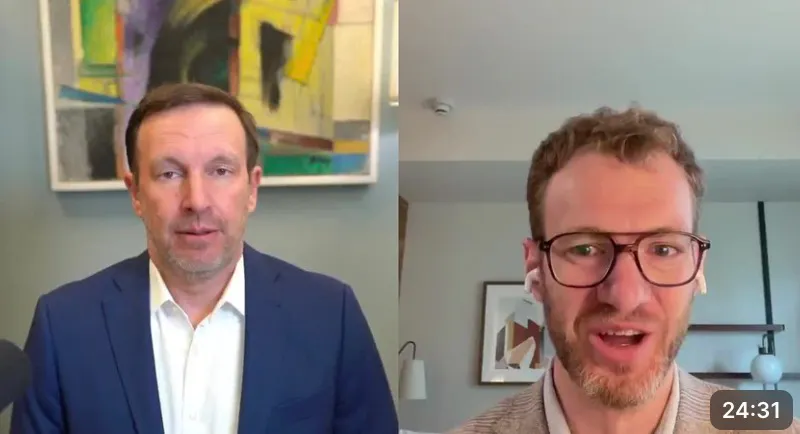
Chris Murphy, Senator from Connecticut and fellow substacker. Welcome to Chinatalk.
- [00:05]
B
Yeah, I'm a very infrequent substacker, but I am on substack and I do publish things there occasionally.
- [00:10]
A
And you got bangers, man. I mean, I've seen like 20,000 likes on these things. It's a remarkable, you know, this is, this is a remarkable skill set you have.
- [00:20]
B
I don't know that writing is a remarkable skill set, but I do write them. So I think to the extent that people read the stuff that I post or follow me on social media is because it's actually me. And, you know, often substacks and mostly in social media, when you're hearing from a senator, you're hearing from, you know, one of their communications staffers. This stuff is, is actually me coming straight out of my brain.
- [00:43]
A
Amazing. Well, let's start with one of the topics that has been resonating in your social media presence, as well as efforts on the legislative and corruption, how what has been the experience of watching the past year and a half of this develop as a minority, as a senator in the minority.
- [01:05]
B
So I feel, I feel like people are finally starting to understand that this is the most corrupt White House in the history of the country. I was very worried for much of the last year and a half that people were just looking the other way as Trump was essentially turning the White House into a 247 grift machine. And I spent a lot of time trying to understand why that was. Obviously, I think people had already priced in the fact that Donald Trump was corrupt and they chose him anyway, which is a reason for us to be all very introspective about why they felt a need to make that choice, knowing who he was. Second, I think that there's just an assumption that politics is always corrupt, that we're all corrupt, that we're all on the take, and that the only difference was that Trump was doing it in front of the cameras instead of behind the cameras. But then I think there's something more insidious going on, which is that in an economy which has become increasingly a winner take all economy, right. If you've won in the economy, there's really no expectation that you will have a shred of ethics connected to the decisions that you will make. If you're a CEO, you can trample workers, you can decimate communities, all in the name of shareholder and CEO profit. And I think that that kind of transfers over to our, you know, to our politics, in which we say, if you've won in Politics. Well, then I guess you just, you know, get your rewards, however big they are and however you get them. So I, I think that people are finally sort of starting to figure out that this has real consequences for them. Trump's corruption and the way that he's stealing from people actually impacts folks bottom lines. But it's taken a while for people to get wise to this.
- [02:50]
A
Yeah, I want to stay on that, like spiritual disintegration, to use a phrase of yours, tack in this, because I feel like you need more independent, variable, more variables pushing to allow what has happened over the past 18 months to happen besides just one man being elected president. I mean, we had a Supreme Court. We have this broader cultural thing of like, you know, giving back isn't cool. Thinking about other people isn't cool. So then the question is like, is it, are we going to need more than just like a different person in the White House or is even a Democratic House and Senate that passes some laws saying this stuff isn't legal, like actually going to really change the thought process and incentives of this president or the next one?
- [03:37]
B
Oh, well, like now we're getting into like a really deep conversation, right? And it's a really important one. But I think the answer is yes, because I do, as you hinted at, believe that there is, you know, a pretty significant spiritual rot happening in this country in, in which we really no longer believe that we have actual ethical responsibilities to each other. Modesty and restraint are just, you know, not values in our culture any longer. And you know what, what people perceive as good or as success is simply material accumulation and the means matter a lot less than they used to. So I think that that is really an, an economy and culture wide project to restore a sense that we have moral obligations to each other, that the sum of our own self worth is not simply how big our pile is, and that there should actually be consequences for individuals who amass enormous fortunes at the expense of others. This was a really vibrant debate in early, early America. Like the, the Puritans and the pilgrims who came here would like stone people to death if they price gouged. If you were charging people, you know, a few extra pence for a good, you would be excommunicated from the church. I mean, the idea was just nobody should get super wealthy in, through a means that puts other people into poverty. And I think that that's a broader conversation that has to happen. That if we, and we built an economy that was based more on shared prosperity, it would make it a lot harder ethically. For people to get away with what Trump gets away with because people wouldn't be looking the other way as they are today.
- [05:35]
A
Yeah, there's this, there's this idea of norms and like a sense of shame which has kind of gone away. I mean, you know, 10, 20 years ago, when you catch the person with the gold bars and money in the fridge, like they go away quietly. And then, you know, with one of your former colleagues now, it's like, oh, I've been, I've done nothing wrong. I'm going to fight it until the end because like, of course this is, this is my God given right to pull this stuff up. And that applies across lots of different branches of government nowadays, it seems in a way which wasn't necessarily part of the body politic where like, you'd be a little embarrassed for this sort of stuff. I don't know how you bring that, I don't know how you bring that back.
- [06:16]
B
Well, I think you were right at the outset to say there's, there can't be one single explanation for how we got to where we are today. You know, the gold bar thing is, is, is a famous one. But, you know, just 20 years ago in Connecticut, we had a governor that went to jail, you know, based off of corruption that would feel kind of middling. Today he, you know, got a free hot tub installed in his summer cottage. He had some lobbyists throw a couple card games to him to put some money in his pocket. And he, he just, he went away quick. I mean, the public turned on him. His approval readings went from 70 to 24. He resigned and race. And it's just pretty amazing that now Trump is, you know, literally getting away with, you know, a massive cryptocurrency bribery scheme out, out in the open. So here's the other piece of this and it's our zero sum politics. You know, today we have learned to define ourselves based upon our political identity. And we often perceive the other political party to be kind of an existential threat to, to our identity and to the nation. And so what happens in those cases is that you trained to never believe anything bad about the people that you support and to always believe the worst about the people that you oppose. And our politics, as they become tribal, do tend to sort of immediately exonerate and provide immunity to the party's leaders. So Republicans are just never going to believe that Trump is unethical because he is the leader of their tribe, of their cult. I think the same is less true in the Democratic Party. I think we're much more willing to call out our corrupt leaders. Witness, you know, what happened last week to Swalwell, that didn't happen on the Republican side. But I think that, I think that the looking the other way that we did a little bit with Biden is in part due to our tribal politics.
- [08:14]
A
So you brought up the Puritans. Let's take it maybe a little forward to Aaron Burr, right. Where there was this idea that even Hamilton, who couldn't stand this guy, who couldn't stand Jefferson, understood that having a man of integrity in the Oval Office was something that the institution was set up for. And if you don't have that, then it kind of all falls apart. And so I guess what's my question from that, like, pardon power, does it really need to change? Because if you are willing to pardon, like every political appointee who works for you, the bounds of what you can accomplish on a lot of different dimensions is just like not what the legislative branch, like, intended at all. And you, you just, you don't have kind of the con, the constraints if you don't have a Good Faith act.
- [09:03]
B
Yeah, I mean, I mean, go back and, you know, if you have a, if you have an extra hour and a half and you're feeling really pissy about the state of American politics, go, go watch the Netflix documentary Mitt about Mitt Romney in the 2008 and 2012 election. Not a lot that I agree with Mitt Romney on, but, man, you watch that documentary and you're like, well, there was a time not long ago when there was honor in politics. There were, like, really good people, even if you disagreed with them who ran for office. No, listen, I do think that laws can help here. I don't think we should just sort of give up on laws to set a higher moral standard. So the pardon power is just, I think, an unnecessary power. We already have a check on runaway judicial power. That's impeachment of judges. You don't need the pardon because there's already a check if a judge has gone off the rails. That one just seems like designed for supersized corruption. It's been a long time since we've updated the ethical laws that apply to the presidency or the Congress. So, you know, you could just make some clear rules that don't exist right now. Like, you know, members of Congress and the administration can't trade stocks. They can't be on prediction markets. I think that laws have two impacts. One, there's a practical implication people go to jail when they violate the laws. And so they don't want to go to jail, so they don't violate the laws. But they also signal to the broader public what the moral expectations are in our society. The reason the gun violence rates started going down really fast after the 2022 gun law, the first one we passed in 30 years, is not just because we put more bad people in jail and we kept more illegal guns off the street, but we kind of signaled to the country that, hey, we're serious about gun violence. We are setting a standard and an expectation that's different from what we had for the last 30 years. So I haven't given up on the ability of laws to intersect with conceptions of private and public morality.
- [11:08]
A
Let's do a little China, then. Has the China card lost its resonance in the Democratic Caucus? If you make arguments to support or be against legislation, like, because of a threat from China, is that losing a cachet that it maybe had three or four years ago?
- [11:27]
B
Well, I think it's losing potency, in part because there are more immediate threats present to our democracy than the takeover of international norms by the Chinese. So I think, you know, right now the country is in the grips of the greatest threat to our democracy and our elections since the Civil War. We are in the midst of the first new war in the Middle east in decades, one that is cratering the American and global economy. So from just a political standpoint, yes, arguments about China lose potency because people first want to know what the implications are for American democracy fighting back against Trump, and they want to talk about Iran before they want to talk about China. But I don't think that means those conversations are any less relevant. And one of the reasons I think that we should be talking about Iran in a really urgent manner is because China is likely. Well, China is one of the beneficiaries of this bungled war with Iran. So, yeah, losing a little bit of political potency, but not actually less important.
- [12:40]
A
Let's do Iran for a second, actually. War powers, is anything ever going to happen on this? Do you see enough excitement to maybe change the past, the trajectory we've been on for the past 25 years?
- [12:54]
B
Listen, I think this war is reaching a tipping point. Trump's hard base and even his soft base, I think, is always willing to give him the benefit of the doubt. And in part because Iran is a legitimate adversary of the United States, they were definitely willing to give him the benefit of the doubt, but they can't really mask or hide their incompetence any longer. And no matter how well Trump Says this is going like there's a scoreboard, right? And that's gas prices and fertilizer prices and soon to be grocery prices. And that scoreboard is telling only one story, that we're losing and the American people are losing. That, you know, catches up to our politics. There is still political gravity in this world. And so, yeah, we've had, what, four or five votes on war powers resolutions. None of them has succeeded. Only one Republican has voted for each one of them. But I just do think that eventually, especially as we get closer to the elections, there are going to be Republicans who are going to consider voting yes. Now, will that end the war? Probably not, because even a war powers resolution has to be signed by the President. But if the Republican Party does start to turn against him, it's just much more likely that he is going to bring a more expeditious end to this bungled conflict.
- [14:10]
A
Yeah, I guess zooming out one degree like we've had, you know, I think the most famous one was Obama with Syria, where the congressional leaders were basically like, don't make us vote on it. You do whatever you're going to do and we'll just like, be happy to sit here and criticize you. Do you see anything that could happen to, like, get Congress really excited about, I don't know, using, using some of, some more of what the. The Constitution gave them to, to be more vocal on these types of international foreign policy, national security?
- [14:44]
B
Well, but I mean, in this instance, we're not talking about Congress, right? We're talking about Republicans in Congress. I mean, Democrats are excited about using whatever powers are available to us to end this war. And the important part of that Obama story is that Obama decided that he did not have the power to bomb Syria without congressional authorization. He came to Congress. I was actually the first Democrat. It was in my first term in Congress, in the Senate, I was the first Democrat to publicly announce my opposition to Obama's request. And when he saw the writing on the wall that he wasn't going to get that authorization, he actually did not take military action against Syria. So it is important that there should be an expectation on presidents that they abide by the law. And the law says you cannot start military action without the consent of Congress. So I, you know, hope as we, you know, test out applicants for the White House in 2028, that we'll ask that simple question, are you going to start wars without prioritization from Congress? And for the time being, you know, as I said, the only thing that will really get Republicans to join us in these war powers authorizations is that the public just fully, completely and wholly turns against this war, which I think they are in the process of doing.
- [16:05]
A
Let's close on AI. I mean, is there any role for optimism? There's just like, seems to be a
- [16:10]
B
lot of kind of doom and gloom
- [16:11]
A
in the narrative, but at the same time, you know, you have hundreds of millions of Americans who are using this stuff in their daily lives. Where, where are you on the temperature? What, what's your thoughts on the role of government here?
- [16:24]
B
I mean, listen, I'm, I'm preternaturally optimistic, so I always see a path to get the impossible done. Um, but I do think we're in a little bit of a race here. The public is starting to figure out the con, right? And the con is this. These AI companies do not give a shit about the health of our communities or the health of our families. They are in this to amass as much money and power as quickly as possible. And so they're going to roll out technologies that are not ready for prime time, that are absolutely poisonous, that are job destroyers, and they don't care the consequences that accrue to the public. People are starting to figure that out. A lot of the pressure is coming to bear on data centers, which kind of become a proxy for all of the ills people see about to be visited upon them by AI and the power concentration that comes with it. I think there is going to be a lot of room for candidates to run on a promise to regulate AI, the data centers, the new technology to create firm lines around what can be rolled out and what can't, and win elections, win primaries, both on the right and the left, because this really isn't right now, a right and left thing. Trump's in bed with the AI companies, but his base isn't. So let's see, as we head into the 2026 elections and the 2028 elections, whether candidates who promise to get tough on AI are going to win and start populating Congress. The reason I say that we're in a race is because the AI companies know what's coming publicly, and they are spending gazillions of dollars in elections. Not gazillions, but they've promised to spend what looks like hundreds of millions of dollars to beat candidates who promise to regulate them and elect candidates who promise to give them carte blanche. And so I'm advising. There's sort of two schools of thought, and then I'll stop talking. There's two schools of thought in the Democratic Party about this one is let's just try to stay quiet about regulating AI and hopefully AI won't spend money against us. The other school of thought is let's take them on. Let's make this a campaign issue. Let's make their money a campaign issue. I am in the latter camp firmly. I think that the AI companies know the Democrats are much more likely to regulate them and trim their profits in power than Republicans. And so no matter how nice we are to them, they are still going to spend money on Republicans and on whoever Donald Trump tells them to spend money on. So we're better off making this a campaign issue. Making their money a campaign issue. I actually think it's a winning campaign issue. And my hope is that that's the choice the party makes. As we head into the 2026 fall
- [19:01]
A
elections, let's close on maybe two bills in a book. Bills you're excited about. Book you've read recently you enjoyed.
- [19:08]
B
Oh good. Two Bills in a book. So I just introduced legislation across the aisle with Josh Hawley that would ban these AI conversation bots from kids lives. I have teenagers and well, I don't think either my teenagers are really deeply integrated with these AI friendship bots. I know a lot of their friends are and I just think that we should treat them as cigarettes, we should just treat them as poison and take them off the map. The second area of legislation I'm interested in is the sort of intersection with private equity and our economy. Economy. I have a bill already to keep AI sort of keep private equity out of our hospitals. And I'm working on some legislation now to keep private equity out of youth sports. I just think that that's another really ripe area for bipartisan agreement keeping this sort of rapacious private equity out of some sectors of our economy. A book that I am interested in. That's a good question. What am I reading right now? I'm reading Wolfbane right now, which is like the first real foray into even sort of halfway fiction in a long time. Like I'm addicted to biographies and histories. But Wolfbane is this story about Thomas Cromwell, this historical fiction book about Thomas Cromwell in England in the era of Henry viii. So I'm kind of fired up about that book right now.
- [20:43]
A
Amazing. On your first bill, if you thought TikTok was bad, a third of the US AI companion ecosystem is run by Chinese firms. All right, Well I said 28 minutes. We made it to 23. But this was a wonderful interview. Thank you so much for your Time okay.
- [21:27]
C
I was lost in a federal cell Bound for a long cold spell My lord whipped my wife took flight the the pardon pen came through that night oh, the pardon pen the pardon pen Saves a sinner and his brother and his brother's men it don't matter what you did or when Send tribute to the president, you write again oh, the pardon pen. Crypto saints. Well, I bought a mean coin late one night Paid for the dinner, saw the light, the wallet moved and the charge moved too that's how the blockchain gospel's getting through A token in a case walks out A quiet hand to fold it around Ain't that a thing to sing about O the party the pardon pen saves a sinner and his brother and his brother's men A coin to dinner, a little grit the Lord's own hand delivers the gift oh, the pardon pin. The zip tied boy, he walks with me the flagpole saint he's finally free Silk roads prince is a martyr deer the general's memoir's in the clear the sergeant bled, the sergeant cried but the pen of mercy cannot like well, ain't that something? Ain't that right now the founders thought a man would feel the weight Thought the gaze of history would hold him straight But I reckon, brother, they were wrong Shame is dead and greed is strong and the pen don't know wrong from right it only knows who called last night oh, the pardon pen, the pardon pen Saves a sinner and a his brother and his brother's man A coin, a dinner A truth social post A loyalty test A grateful host A little sin, a little spin and the pen comes down and you ride again oh, the pardon pin. Oh, the pardon pin Sam.