Loading summary
Transcript55 lines
- [00:00]
A
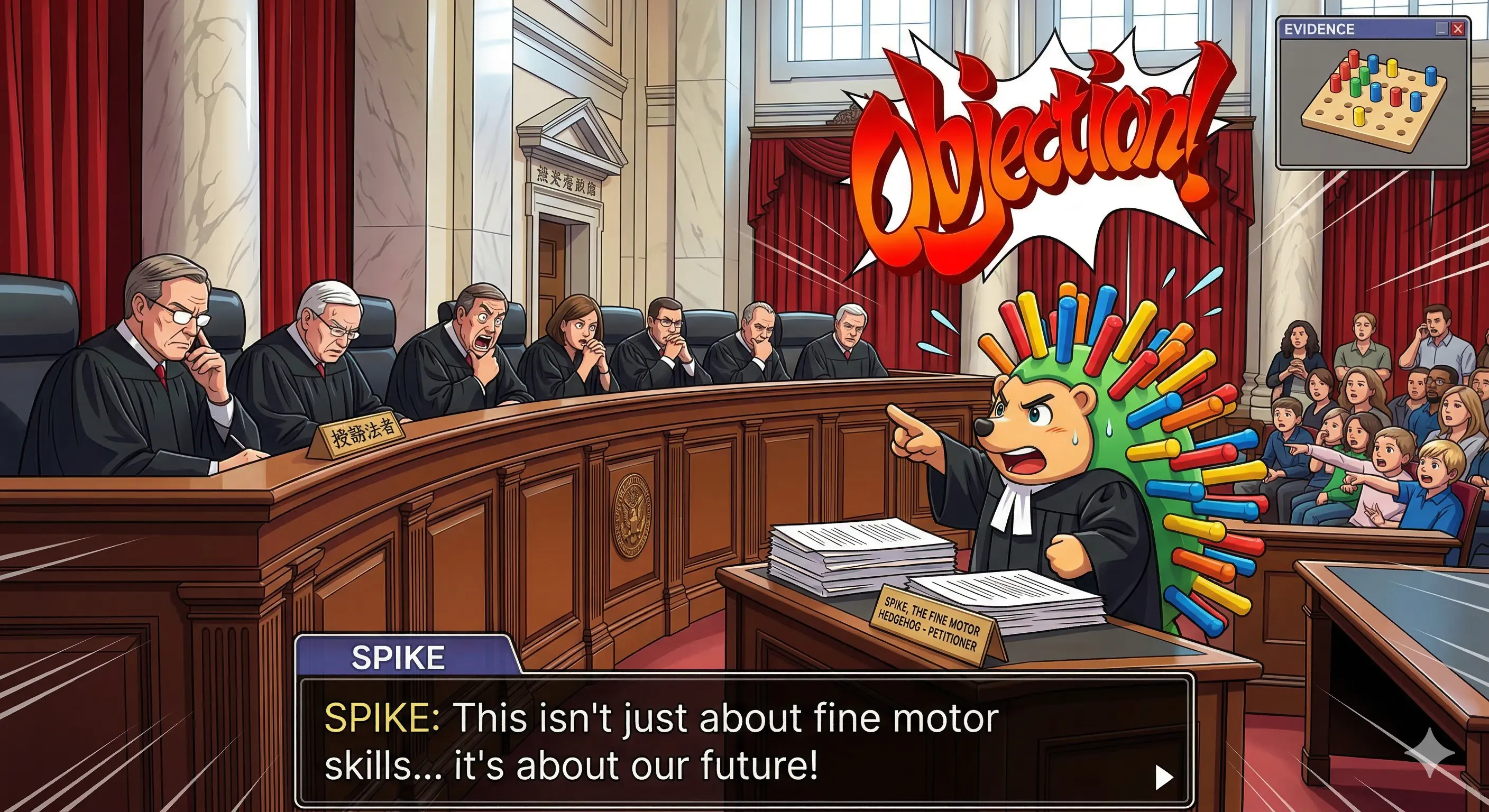
Rick Roldenberg, CEO of Learning Resources, creator of Spike the Fine Motor Hedgehog and Supreme Court successful plaintiff. We have joining us today as well, Peter Harrell, who also submitted an amicus brief on the tariff case that shook the world. First off, congratulations, Rick. How'd you celebrate?
- [00:29]
B
I think I celebrated by trying to see what was in my inbox. It kind of blew up. But it's been a whirlwind week. A lot of people wanted to talk to us about the victory. And I also got to go to the State of the Union address, which was coincidence, but good timing. So have participated in the democratic processes.
- [00:52]
A
Well, let's go back to the beginning then. So why did you decide to be the one to file the suit?
- [01:00]
B
Well, it comes from a bunch of different places. One of the places it came from is that in 2017, I was among the people who pushed back on the border adjustment tax. That was a Paul Ryan, Kevin Brady invention and it was set to be part of the Republican platform when Mr. Trump became president the first time around. That also would have killed us. And so we with some other people resisted that, tried to draw attention to the negative effects of it, and eventually it was withdrawn. But that was my education in this aspect of tax law. So when these tariffs got to the point in the week of Liberation Day of endangering the future of our business, I already had an opinion as to whether or not these kinds of taxes were lawful. I think the other thing to think about when understanding like my perspective is I'm part of a multi generational family business. Our education companies date back to the 60s, but our family business dates back to 1916. So strong sense of legacy there and relationship between the health of our business and the community that we live in. And then I think finally we're a mission driven business. And so, you know, when you work for a purpose driven business where your goal is to make the world a little bit better of a place, you have a sort of a deep attachment to the role that you play in other people's lives. And so I really was not prepared to allow a politician to ruin this. So I decided that the risks of doing nothing were greater than the risks of doing something.
- [02:48]
A
Let's do a little background on the firm and what the tariffs would have done to you guys.
- [02:57]
B
Well, when we did a plan, when we looked at how the tariffs would affect us based on our 2025 plan, if you took that as a run rate, the, the cost of tariffs would have gone from a little over $2 million in 24 actual to a projected at the height of like $100 million, which clearly was not survivable. I had to give thought to, like, what else could we do? Remember, we employ about 500 people. That's 500 families that are counting on us. And because of this scheme, I was literally staring out the windows thinking, what else could we sell? What else could we make? How else could we help children and schools? And so it was that level of catastrophe. And so that was obviously highly motivating. You have an acute awareness in a family business of families that depend on you. Because all the people that work here, choose to work here, have families that count on them.
- [04:06]
A
Sorry, we need a 101 on like what you make.
- [04:09]
B
Like, oh, I'm sorry.
- [04:10]
A
Like we're a toy business yet.
- [04:11]
B
Okay, okay. Well, learning resources and Hand to Mind are hands on learning. Companies specialize in experiential learning products. The origin of our company is that in the mid-60s, my father founded Hand to Mind to serve Montessori schools. And we don't do that anymore. But the, the experiential learning aspect of the Montessori system is what was left behind. And so we applied the concept of how people learn through experience, which is an adult thing as well as a child thing. Two basic subjects in schools. So early childhood math, science, reading, language, stem, social, emotional learning, coding and so on and so forth. And that's our specialty. We, we develop the products in the US we make most of our products overseas, although we do some manufacturing in the US for the school business. And we sell our products in over 100 countries. We have 50 people that work on our team in the UK. So we're both an exporter and an importer and we're, you know, small medium sized company, but we're global in our perspective and our activities.
- [05:30]
A
And why can't you make the chips? Excuse me? And why can't you make your products at America?
- [05:37]
B
Well, I think that the basic reason is that our product requires a lot of hand work. So our products are highly finished. And so after you injection mold them, you generally have to paint them or do other kinds of finishing activities. And then generally speaking, our products have to be assembled. And so that adds a lot of cost. That kind of labor is in short supply in the US and you can't really afford to live in the US if you make the wages of someone that does the hand assembly of toys itself for $20. And so this is just the wrong place to make the product. If this were the right place to make the product. Everyone would be making the product here because businesses respond to incentives, and so there's no way to meet that incentive. Many of our customers would like to advertise that they make things that are made, they sell things that are made in the US that's an old kind of marketing theme, particularly in the mass market. But if it were possible, everyone would be doing it.
- [06:41]
C
Can I ask you a follow up question? I obviously come at this discussion mostly as a trade lawyer and policy person, but one thing that has struck me just partly through the case, partly through other research, is how concentrated the toy industry got in China. And I'm curious why it was sort of there. And like, did you try to move to Mexico or some of the other lower tariff jurisdictions? Or like, how have you navigated the whole morass of tariffs that now aren't just on China, but, you know, sort
- [07:12]
B
of the whole world? Sure. So I was at the company when we first began to move to China. I think we had a small handful of Chinese vendors when I joined the company in 1990, and shortly after that we lost a big order. We had established a customer relationship and then they took all our business away and gave it to someone else who was able to sell similar products for a much lower price. So for us at that time, if we wanted to grow, we had to join everybody who was developing a lower cost base. So we had no choice, if we wanted to survive, to find a cheaper way to make our products. The reason that China succeeded is China has everything. So they have enormous, gigantic pool of molding machines. They have engineers, they have roads, they have inspectors, they have ports, they have tool makers. They have everything that you need, and they have them in enormous supply. And it's a giant fluid market where they filled in all the gaps. So when you make your product in China, there's really nothing you don't need that can't be sourced locally. Almost every other country has deficiencies and some of those can be quite significant. So you might not think about it too much. But like, transportation in India is terrible. And so it depends on the location of your factory, which sometimes can be sort of random. And getting your product from there to the port can sometimes take a tremendous amount of time. They have weather problems too. So we've had orders in India years ago where during the monsoons the roads would wash out. And you waited six weeks to be able to move the product to port. So hopefully some of those problems have been addressed by now. But the reason China won is China had everything and it was functioning really well, also it was the first country that, that we taught in the Asian basin to make products to the US Expectations for quality, consistency, value, finish. And so they understood and accepted what the US market wanted. And it wasn't an argument, you didn't have to justify it. They knew everybody wanted the same thing and they set their standards to that. They're very good at what they do. And of course we were always doing business with private companies, family businesses like us. And so these are folks who put their money on the line, risked their money. They were honest business people. They were, you know, competing in a hyper competitive market just like us. And so they were good partners, always have been, and they were, you know, entrepreneurial, so always looking for a way to be better.
- [10:02]
A
And, and how does that compare with the alternatives in Vietnam or India or Mexico?
- [10:09]
B
Well, I think that you have a critical mass issue. And so these other markets are, are still building up the critical mass. There are still things missing. And so the things that are missing have to come across borders, which makes sourcing very difficult. When you have a product that's brought in finished, but the components have to cross borders to become part of it. That slows things down. It introduces new levels of taxation, risks. You're introducing multiple countries, rules on quality, shipping, international relations. It's just all kinds of problems. And so you're a lot better off if everything comes from one place. Again, natural advantage to China.
- [10:53]
C
When do you think you're going to get your refund?
- [10:56]
B
Why do I think we're going to get a refund?
- [10:58]
C
When do you think you're going to get your refund? Which obviously includes the why. But how long do you think it's going to take to actually get back these now illegally collected tariffs?
- [11:09]
B
Well, I'm not in the camp of people that are wringing their hands. From my perspective, it's rather simple. Government over collected its taxes. There is law that governs return of over collected taxes. I think we have a right to the enforcement of those laws. Those laws are very often not even given much thought. People just assume that it will happen. After all, they took money that isn't theirs, they're not entitled to it. And so I believe that they just have to have an adult conversation with the two sides, come up with a process and then the court's job will really just be to oversee it and make sure it actually happens. And frankly, you know, if it was my job to hand out millions of refunds, it would be very difficult for me. But the federal government does this through the irs all the time. And so they know how to do this. They can do it. And so I believe that today the mandate was sent down from the Federal Circuit to the cit, so it's now all in the cit. CIT does this as part of their franchise. They know how to do it. And frankly, I'm expecting the DOJ to fall in line because we should not forget the words of Lincoln, Government of the people, by the people, for the people. The DoJ is not a foreign party. The DoJ is us. We sent our neighbors to Washington. We pay them with our money to do those jobs, administering those responsibilities. We have our money. They don't have our money. They are we, we are they. They took too much. They need to give it back. There are laws, they have to follow them.
- [12:56]
C
I have to say I completely agree with you, Rick. I've always found this sort of argument that maybe the government wouldn't have to give the tariffs back conceptually bizarre in the sense of, I think we would all agree that if the government came and kind of like announced it was doubling our income tax rate with no act of Congress, we'd be like, well, of course we get our money back once, once the courts throw that out, right? If the, if the Treasury Department all of a sudden said, I'm taxing you at 70%, we'd all agree you get your money back. I mean, there'd be no, no debate at all. And this is really conceptually no different. It's just another kind of tax. And then I actually had looked it up the other day on the kind of refund morass issue, and it was 120 or maybe 117 million refund tax refunds that the IRS processed in 2024, the most recent year that they've put the data out on. So like, this idea that they don't do this is impossible logistically, I find hard to believe.
- [13:54]
B
It's fear mongering and, you know, and hand wringing. I don't take it too seriously that the laws protect us and our case stands for rule of law. And I expect the court to get involved and to force them to do this. And it really doesn't matter what people's personal opinion is on whether this is right, wrong or indifferent. The Supreme Court has spoken. These laws, these taxes have been over collected. There are laws that are not controversial that govern the return of over collected taxes. So they have to do it. And I just think that we've got to move away from a political cycle where political speech is dominating what is Essentially a cut and dried governmental process.
- [14:44]
A
Can we come back to the decision to file the suit? You know, we, we recently met at the toy fair where walking around, you know, you guys weren't the smallest booth, but you also weren't the biggest. And you also aren't one of the biggest, you know, companies in the economy where basically every single company in America was impacted in some way by the tariffs. I mean, why was it you and not Mattel or Apple or any of the other firms who probably had much more easy access to the sort of legal resources that you need to file something like this?
- [15:25]
B
Well, I'm asked that question a lot. It's kind of hard to answer why other people chose to do this or to not. Ironically, a lot of people concerned about the cost, but from my perspective, cost was really not an issue. I hope my lawyers aren't listening. The reason is that the stated intent of this government was to have me pay these taxes forever. And so if you look at what that really means in the long run, it was not a hard decision to make. I don't know why other people did things for me. I have something that I felt was important to protect. And when I think about our business, again, we're a mission driven business, which is a business of a slightly different nature than other kinds of businesses. We actually believe, rightly or wrongly, that if we didn't exist, it would cause a little tear in the fabric of the universe and we just don't think we're easily substituted for. And so if you really care about what you do and it gives you meaning and a sense of purpose, you know, you'll stand up for that. As I said, there were personal aspects of it too. You know, our family has been a steward of this business for a long time and the jobs that people had with our company meant a lot to them. You see a relationship between what you do and keeping your business healthy and how your neighbors fare. And in a purpose driven business, you actually care about that stuff. And so much easier for me to say what was going through my mind than what was going through other people's. Lots of different reasons held out as to why they did or didn't do whatever they did. But it is in fact true. And it's a strange thing that we are the only people who paid tariffs. We were a victim of tariffs and used our own money to sue. The other nine lawsuits were governments, semi governmental institutions and interest groups with recruited plaintiffs. We put the money down.
- [17:44]
C
I have to say I admire you for it. I mean, I Remember in Washington back, you know, sort of February, March, April of last year, I had done some rounds with some of the big trade associations and corporations, you know, like, are you guys going to sue like this? Because I had been, I got into this because I'd been of the view from very early on that this was illegal, kind of as a matter of law and principle. And I was just, you know, sort of pro bono going around to see if anyone was going to sue. And like, none of the big trade associations, none of the big corporations were willing to stand up and actually file suit. And so it was, you know, great when you guys, from my perspective, when you guys decided to. And then, as you know, there was also state governments and then some kind of impact litigators who brought small businesses into it. But it was striking to me how no one just wanted to stand up and say, all of this is illegal and good on you for doing it.
- [18:41]
B
Well, thank you. You know, in a private business you get to make these decisions yourself. I don't need to worry about external factors if I don't want to, frankly. We also had a clear vision that our lawsuit was not a political statement and I didn't allow it to become a political statement. So we never took the view that it was us versus Mr. Trump. In fact, I've told people that it's not necessary for us to have a view of the policy. So we don't consider ourselves pro Mr. Trump against Mr. Trump. And we try as best we can sometimes difficult to not offer advice. So he has a hard job. I hope he does it well. We need him to be successful. But we've stayed away from doing things that we consider to be political. I feel as though we can take care of our own needs by just simply pointing out this was unlawful and stick to that. So it's possible that other folks didn't see that this kind of case could be prosecuted without actually having a so called bad guy on the other side. I don't need to have an opinion about whether they're bad or good. This is really about follow the rules, which are the basis of the society that we depend on.
- [20:00]
A
Republicans buy sneakers as well as children's toys, I hear.
- [20:04]
B
I hope so.
- [20:07]
A
I do think that just there is something kind of magical and remarkable that a small business can file suit and overturn, like the premier platform and policy instrument of like the most powerful person on the planet. It makes me, like proud that the American system still has this in them. That was my big takeaway.
- [20:31]
B
Well, that is the American system And I think that's really one of the very important takeaways of the case, is that in a rule of law system where everyone is equal under the law, you can win if you're right, even if the other guy prints his own money, has thousands of lawyers that actually we pay for. He doesn't. So he has the power, he has the money. He has the elite status. But the law doesn't care. The law doesn't care. The law makes us all equal. And so we bet that the rule of law would remain supreme and would reign supreme, and that our position was correct on the law, which is something we were very confident of. And so this was reaffirming that. I think the other thing that our case illustrates, which is, I think, a little more elusive, it's not really a legal point. It's really just more about how we think about the communities that we live in. So we live in communities that most of us cherish and value and would defend. The community could be like where you live, but it could be whatever you define your community to be. It could be your church, it could be your pickleball league. It could be whatever your family, whatever you decide it is. We all have a common benefit from these communities we value. But I'm not sure people really spend enough time thinking about the common responsibility that we have. And, like, what happens if you're, like, the only one in line or you're the last one in line? Russell's like, no one behind you. So if everyone agrees in the community that we need to do something about this, and everyone also agrees in the community that it should be someone else, not me. What if everyone thinks that? What if every single person does? I think you can find yourself in a. In a pickle. And it can be at times unusually, it can be a big pickle, a big problem. And so I hope, as people reflect on our case, I hope they'll actually give some thought to how does that land with them? And, like, what do they think their shared responsibility is? It's not for me to judge. It's a very personal thing, and it probably has to do with your family and your background and your life experiences and so on and so forth. But we'll have better, more stable, more enduring communities if at least somebody stands up when somebody needs to stand up. If everyone thinks it should be someone else, sometimes it's nobody, and that's when bad things happen.
- [23:17]
C
So I have to ask another question. Obviously, the president has announced that he is using fallback authorities. He's got these 122 tariffs at 10%, although he said he's gonna raise em to 15 and then may developing more tariffs under other statutes behind that. Since those tariffs expire at the end of July, do you. Do you think you'll be involved in another round of litigation or you think you've had enough of this so far?
- [23:45]
B
Well, I can tell you I don't think the President of the United States has the constitutional authority to be a taxing body. And so when the President of the United States goes on TV and speaks about the taxes he intends to impose on me based on his personal preferences in an endless dream never to end, I think based on not what I learned in law school, but what I learned in eighth grade, that's not right. So like, how do we stop it? Is a different question. And there's a lot of different ways to go about that. One thing that I think everyone should consider is like, who actually runs this country? And the people that run this country are the voters. And so it's all well and good for a member of the government to assert rights, but ultimately we collectively hold our future in our hands. So if we don't like this, if we think we're being lied to, or if we think this is going to cause us to have fewer jobs, not more jobs, we have a solution. Because every two years we go in the voting booth and we can actually take control. And so there's a number of different ways in which we can resist this. The devil's in the details. We won in the first case because the law was on our side. We have to carefully evaluate in each case how's that going to play out, what's the precedent, what's the venue, all of those things. These are careful things that must be thought through carefully and should be seen in the context of an overall democratic process that ultimately is behind all of this.
- [25:36]
A
What did your employees think?
- [25:39]
B
This has been a real shot in the arm. I think that my impression in talking to just lots of people, friends, family and others, that there's an unfortunate rise in a sense of despondency in this country where there's a growing lack of confidence in institutions that we used to take for granted and in processes that we used to take for granted and even doubt growing in other people, like, can you trust these other people? And so when we stood up and did something, aside from the fact in the beginning some people went, rick's lost his mind. But aside from that, you know, I think that the folks who work at this company are Very, very proud. They are. They're a small group of people who are closely associated with this win. They're witnesses to history, and it's a source of enormous pride. We don't have a whole lot of competition for standing up right now. And so it is a matter of pride. And it's satisfying to me that we've touched as many people as we have. I've heard from a lot of people. Many people I don't know, they send me letters, they send me emails and texts. And it's gratifying that if we're going to leave our mark on the world, that the mark we're leaving is a positive one. When it seems like they need to hear good news now, do you care
- [27:18]
A
to share one or two of them? Are they coming categories?
- [27:23]
B
They're generally just heartfelt notes. People are emphasizing that they appreciate that we stood up. I think people also respect that it's no slam dunk to sue in April and get a win at the Supreme Court in February. And so I think people were appreciative not only that we stood up, but that we, we made, we made it happen. And you know, when I say we made it happen, that is a large we. It's certainly efforts from this company. But we had fantastic counsel and there were other plaintiffs too. So we were not alone. And they had counsel as well. So I think everybody that gave it the old college try and was involved, and certainly the esteemed other plaintiffs and counsel involved in our Supreme Court hearing, everyone should take a bow, Everyone should claim victory and rejoice in that, because we did it. It's not an individual, it's not me, it's us. And we did it. And you know, Peter, that includes you as an author of an amicus brief. And everybody pitched in and we drove it across the line collectively. We don't have to divide up the spoils. Everyone can say, I was part of that. I made a difference. And I think they should. It was a big win for all of us.
- [28:48]
A
So are we going to get a legal themed three year old line? Is this something on the horizon?
- [29:00]
B
I think the answer is, I hope not. I'm hoping that 3 year olds can continue to learn through imaginative play. But imagining writing a brief or arguing in front of the Supreme Court. We'll save that for later.
- [29:17]
A
Keep it to the fives and sixes. Fair enough.
- [29:20]
B
Absolutely. When career, when career planning becomes more critical,
- [29:28]
C
You know, one of the, one of the small business plaintiffs and one of the other cases that came in is a clothing company Named Princess awesome that does kids clothing, that sort of brightly patties. My, my I have a 9 year old daughter is her favorite clothing company. And when I saw that they had been, you know, plaintiff back then, a couple of months, month or two after you guys filed and they came in, in one of the later lawsuits, I just wrote their customer support and said, you know, good on you, you know, appreciate you guys filing, filing suit here and got a, a nice note back and maybe I should follow up and say, you know, they should do a like dress with you know, justices of the Supreme Court and say, you know, tariff free because of, because of this or something on the clothing line, you know.
- [30:17]
B
Well, a friend of mine is one of the other plaintiffs in that case. And so those folks have their hearts in the right place. And you know, I think if sometimes I feel as though the issues we raised are somewhat marginalized because the companies that have stepped up are small or like in our case a small medium sized company, none of the big companies. And so it sort of seems like it's the little guy's problem. I, I don't know that I agree with that. After all, once we won, the companies that sued Revlon, Barnes and Noble, Costco, FedEx, these are enormous companies whose sums that will come back to them will be nine or even 10 figures. So this is really a problem that's touching every company that crosses borders. And in a, in a world where there's global trade, that's an awful lot of people and that's an awful lot of jobs. So you know, I think that I'd like to say it's, it's an oddity of this case that the companies were all small brands, small companies, but the issues are enormous and, and James Madison was, was very concerned about this issue that the executive could impose taxes. No kings.
- [31:42]
A
Yeah, I mean it is remarkable that like all these firms are now set to gain like literal billions of dollars back in taxes. But they were willing to sort of entrust the handling of this case to not, you know, that no one was willing, no one thought the cost benefit calculus was worth, you know, doing it themselves.
- [32:06]
B
It's the most American thing in the world to seek a tax refund. So I don't blame them. They should get their money back.
- [32:16]
C
Yeah, no, they should get their money back. I sort of feel like they should, you know, pay the lead plaintiffs, you know, finder's fee on this. But, but that's not the way the court is actually going to work.
- [32:24]
B
So I'm happy to take reimbursement of our expenses. That will be fine.
- [32:32]
A
Amazing. Anything else, Peter?
- [32:36]
C
No, I think that's a great. I think that's a great place to end it. I really enjoyed this.
- [32:41]
A
Well, Rick, congratulations. I hope you get yourself a championship belt at the very least. If not, your expenses were funded. This was a pleasure. And thank you so much for being a part of Chinatown.
- [32:55]
B
Well, thank you. Thank you for having me on. This has been a great adventure.
- [33:03]
A
To realize the future America needs. We understand what's needed from us to
- [33:08]
B
face each threat head on.
- [33:10]
A
We've earned our place in the fight for our nation's future.
- [33:14]
B
We are Marines.
- [33:15]
A
We were made for this.