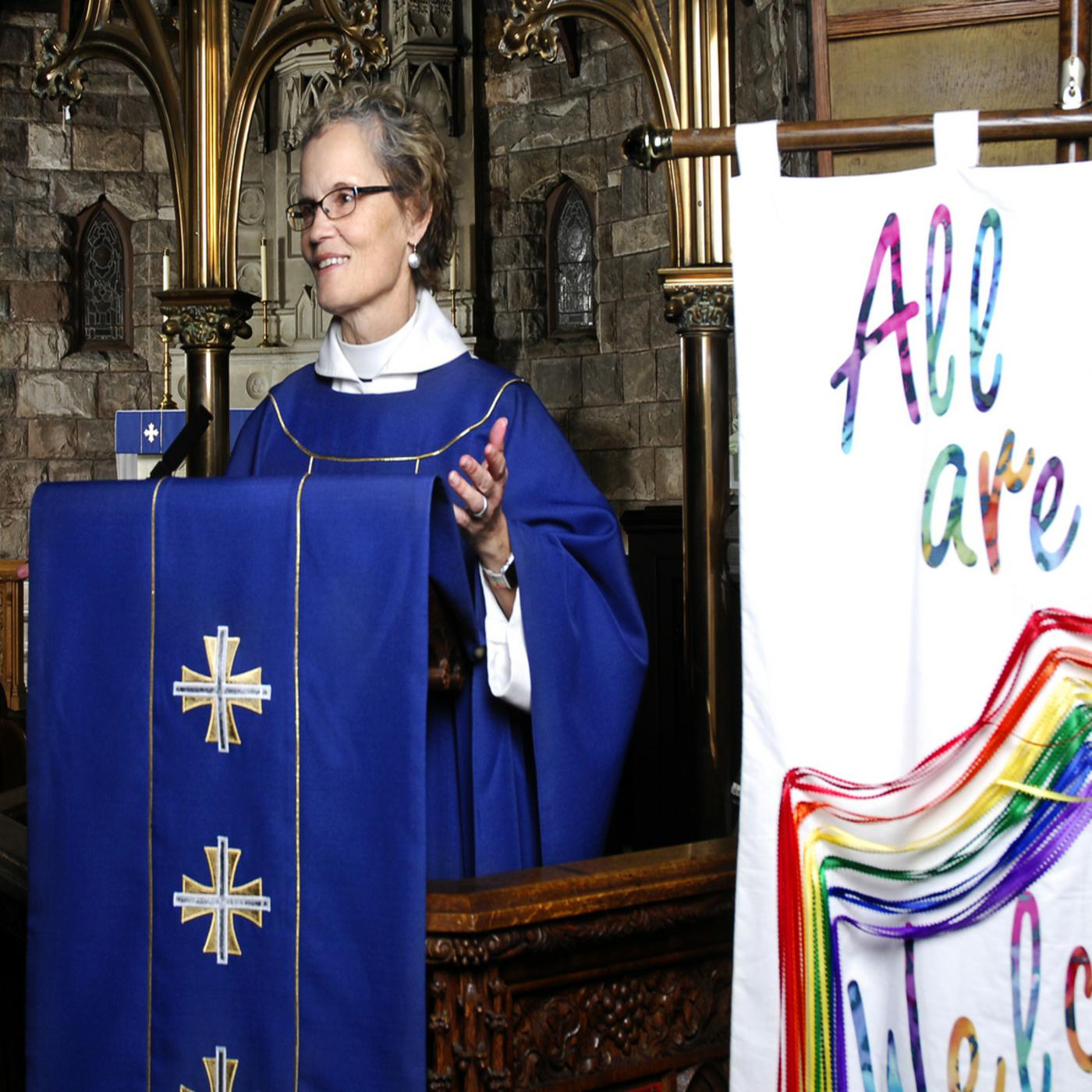
Podcast
Christ Episcopal Church
Hosted by The Rev. Diana L. Wilcox · EN
An Anglican Church Growing In Faith ~ Serving Our Neighbors ~ Creating Community
10episodes
Episodes
Newest firstAll episodes
“Choose, Go On With It, Wherever It May Lead You!”
Dec 16, 202400:18:00Tap to summarizeDecember 15, 2024: May God’s words be spoken, may God’s words be heard. Amen. Okay, here’s the thing…the gospel you just heard isn’t the one prescribed for this Sunday. The church would have us hear another passage about John the baptizer, and never hear the annunciation of Mary (except if you come to Lessons & Carols). It is the story of when the archangel Gabriel tells her she is to be the God bearer, the one to birth our savior into the world. Now, it seems to me that the lectionary folks could have put the two readings about Jesus’ cousin John into one for last Sunday, and given Mary more of her due. Instead, they reduce her story down to one tiny paragraph, which we will hear next week, about her visit to her cousin Elizabeth, John’s mom. As next week is our pageant, and I won’t be preaching, and as Mary is, after all, the chosen one to bear Jesus, I thought she should be given her due. So – if you want to know what you missed, you can go read about what John said in more detail: it is Luke 3:7-18. But, in short – he called everyone a brood of vipers, told them all to be just and kind, and that the one to come would baptize them in the Holy Spirit – but some would be in big trouble. There – now you are all caught up. So, let’s now turn our focus to Mary, the mother of Jesus – the annunciation, and what we will hear next week – her visit with her cousin Elizabeth, because we can learn a lot by her story. As we know, Mary is a young woman, the real meaning of the word virgin. Yet the depiction of her in art through the centuries brings most of us to think of her in her twenties. Scholars believe it is likely she was all of 15 or 16 – just a teenager. She is engaged to a man, Joseph. As for his age, well – my guess is that he was between 18-20, the marrying age for Jewish men at that time, but scholars vary wildly on that, putting him anywhere from 18-90. “The Rabbinic traditional laws said that men must marry by 18, and anyone over that age who wasn’t married was considered cursed, and courts had the authority to force them to marry.”[1] Which, makes you wonder about Jesus, right? But hey – he isn’t even born yet in our story, so let’s set that aside for now. Imagine a young unwed girl getting an appearance from the archangel Gabriel! That must have been frightening. Then Gabe says, “Greetings, favored one! The Lord is with you.” And no, she didn’t respond with “And also with you!” The text says that Mary “was much perplexed by his words and pondered what sort of greeting this might be.” Ya think? I mean, it’s like the scene from the movie “Dogma’ when Alan Rickman, playing the seraphim Metatron, appears suddenly in a woman’s bedroom in a big fiery entrance. Scared nearly out of her wits, she gets a fire extinguisher, sprays it all over him, grabs a bat and tells him to get the F outta there. So yeah… perplexed is one way to put what it might feel like to have one of these heavenly beings show up suddenly to announce something, but it was likely more like “Holy ____, well -you know!” Then, to hear that she will somehow become pregnant, and not by Joseph, and not after she is married…it all would be enough for most people to say to Gabe – hell no! Mary knew, despite being God’s chosen, the first for whom Advent came, that if she said yes to this request, she would be in danger. In that time, and even today, an unwed woman with child was subject to a so-called “honor killing.” This would have frightened even the most faithful person. Yet, what was her response? The text says that Mary replied “Here am I, the servant of the Lord; let it be with me according to your word.” She doesn’t know what this will entail. She doesn’t know how Joseph will react. She doesn’t know if this will lead to her execution. You have to wonder just how many other young teens Gabriel had to ask before he found one who would say “yes” to all of this. Still, Mary does say “yes” to God’s invitation – to being the mother of Jesus – the son of God. Trusting in God, she agrees, despite the dangers that lay ahead for her, to be the theotokos – the God bearer. And what did she then do? She went to her cousin Elizabeth, who was already pregnant with John. And as we will hear next week, there she received confirmation of all that Gabriel told her, which must have given her a sense of peace about all that she had experienced to that point. When she enters Elizabeth’s home, her cousin says that the child in her womb, John, leapt with joy at the site of Mary. We will hear this next Sunday, “Elizabeth was filled with the Holy Spirit and exclaimed with a loud cry, “Blessed are you among women, and blessed is the fruit of your womb. And why has this happened to me, that the mother of my Lord comes to me? For as soon as I heard the sound of your greeting, the child in my womb leaped for joy. And blessed is she who believed that there would be a fulfillment of what was spoken to her by the Lord.” And Mary responds with what we in the church call The Magnificat, from the Latin “to magnify,” from the first words she says “My soul magnifies the Lord, and my spirit rejoices in God, my savior.” Like the song of Hannah before her – it announces an overturning of the world order. Mary says “God has shown the strength of his arm, and scattered the proud in their conceit. God has cast down the mighty from their thrones, and has lifted up the lowly. God has filled the hungry with good things, and the rich have been sent away empty.” In other words – as I remind folks each year – Mary knew, so please stop mansplaining the birth of Jesus to her in that ridiculous Christmas pop song. So the stage is set – Mary is pregnant by the Holy Spirit and will bear Jesus, the Holy child of God. Elizabeth, her cousin, is near to giving birth herself to John, who will prepare the way for his cousin Jesus. Elizabeth confirms Mary’s call. What does all this mean for us now? We are nearing the bleak mid-winter, when it is cold and dark. And this year, it is something many of us feel not only deep within our bones because of dropping temperatures and shorter days, but deep within our hearts because of what is happening all around us. We, like young Mary, have a lot of reason to fear in the days ahead. People are being proposed to take positions of power in our country who have little regard for what is right, what is just, what is kind, what is truth. Nations abroad are at war, and children here are vulnerable to weapons of war in our schools. Massive wealth accumulates among the few, while many go hungry or have no home. Many who had begun to feel liberated from the chains of oppression are fearing the worst as those who want to deny, hurt, or marginalize them are soon to be given the means to do it without limits. So, we can understand a bit of what Mary must have felt. But we can also take note in what she did in response to her situation. Mary didn’t hide away in fear, but spent time in the presence of those who knew her, loved her, and understood her. Mary was vulnerable – but found comfort and strength in her family. And so too can you. Here in this place, among your parish family who welcome you, and nourished at this table by Jesus, who loves you just as you are – just as Elizabeth loved Mary just as she was. Here you come in the Advent of your life – when trouble is near, and hope is needed. Here you come to remember that by God entering into our human plane in Jesus – we have come to know that there is no darkness his light cannot overcome. Here you come to be given confirmation by others of your call, and the strength to carry on, just as Mary did. No, unless there is a star rising in the East around you, it isn’t that you are going to be the God bearer in the physical sense, but you are called to bear Jesus into the world. To be clear, it is likely your call was not announced by the Archangel Gabriel or the Metatron – and truthfully, that is a good thing because as I already said, these appearances were not like a sweet Hallmark moment, but would scare the wits out of you. Maybe God came to realize that humans these days need a little more of a subtle message. But however that message is delivered, you are called to bear Christ, and yes – most especially in times such as we face! ...
Transcribe →“Is Advent Possible For You?”
Dec 9, 202400:13:16Tap to summarizeDecember 8, 2024: May God’s words be spoken, may God’s words be heard. Amen. Well, we have made the annual Advent turn. You know, the turn our gospel just took for us. Today, we are not hearing about the second Advent, but the first. After weeks of his return, we are heading into weeks of preparing the way for his birth. We have made a turn toward Bethlehem. And this gospel author does set a scene for us – one that has deep meaning too. There is a reason he names all those political and religious leaders. It isn’t just to set the story in the context of time. The author name drops all the rulers and religious leaders of the places of the life and death of Jesus. The Emperor Tiberius ruled during the time in which Jesus was active in ministry, arrested, and crucified. Pontius Pilate was governor and a principal at his trial and execution. Herod Antipas is the “Herod” who engages Jesus most in the Gospels. And this gospel author is the only one to include Herod Antipas in Jesus’ trial. He should not be confused with his dad, Herod the Great, tetrarch of Galilee and Perea, who encountered the wise men, and ordered the massacre of the innocents. Nice guy, right? Although Caiaphas was high priest at the time of the arrest of Jesus, Annas’ presence still loomed large, which meant both had a big role in the proceedings that led to his being turned over to Pilate.[1] All this to say that the author of Luke wanted very much for us to see the ending at the beginning. Sound familiar? It is an Advent theme isn’t it. We are again in that scriptural cycle we have been in these past few weeks of the ending and the beginning being interwined. This litany of rulers also reminds us that God is at work in the real world, not some sort of fantasy land beyond our reach. God’s plan of salvation, God’s vision of peace and wholeness, that is played out in the context of human history. It is the thing of mortals, even if angels are involved in announcing what is to come. After all, the coming of God into the world was as one of us, Emmanuel, God with us, the Word made flesh. And this birth into our human sphere is proclaimed by a locust eating, camel hair wearing, miracle child, John, the flesh and blood cousin of Jesus. He takes this good news out into the wilderness – a place where spiritual seekers mix with those on the margins – and where one hopes to encounter God in the stillness of a barren land. This is what we wait for in Advent – when God breaks into the very real human world, announced by angels, proclaimed by human prophets, and into the fragility of human existence in the form of a child, born to us at Christmas by an young unwed mother. Yet as the pastor and theologian, Dietrich Bonhoeffer, preached in one of his sermons for this season: “Not all can wait – certainly not those who are satisfied, contented, and feel that they live in the best of all possible worlds! Those who learn to wait are uneasy about their way of life, but yet have seen a vision of greatness in the world of the future and are patiently expecting its fulfillment. The celebration of Advent is possible only to those who are troubled in soul, who know themselves to be poor and imperfect, and who look forward to something greater to come.” In other words – Advent may be a time of expectancy and hope, but to understand it, you must be troubled by what is happening to children of God and God’s creation, and to be sure, Advent is deeply troubling for some, because what it portends is going to shake the foundation of the world, rock your life, and scare the crap out of any earthly authorities who wield power without compassion – those the author of this gospel names, or those now. Advent should not be tamed into some sweet prelude to a joyous miracle birth at Christmas. It is an announcement that change is coming – transformational change that, if we are prepared for it, will be revolutionary for ourselves and for all the world. Remember the words of Isaiah, as John proclaimed, that “Every valley shall be filled, and every mountain and hill shall be made low, and the crooked shall be made straight, and the rough ways made smooth; and all flesh shall see the salvation of God.” “All flesh shall see the salvation of God.” That is the promise of Advent – that is the promise of our God – that God’s salvation is for everybody. It doesn’t matter what walls we humans build, who we try to push aside, who we desire to exclude – because God will not be boxed in by our smallness. God destroys those very walls and replaces them with bridges of love – unconditional love. All people shall see! All people!!! The word of God is coming to unexpected people and unexpected places, and that Word of grace and love is for everyone – no matter how much money you have, who you love, what language you speak, what gender you claim, or what faith you profess – everyone – all flesh – all of humanity – but most especially to those others have cast aside. Or, in the words of John’s dad Zachariah that we heard today “In the tender compassion of our God, the dawn from on high shall break upon us, to shine on those who dwell in darkness and the shadow of death, and to guide our feet into the way of peace.” God’s dawn is near. Christ’s light will break into our dark land. The Holy Spirit will guide our feet into the way of peace – for ourselves, and for all the world. So, as John tells us, prepare for what is to come, which always reminds me a bit of the scouting motto: “Be prepared!” I come from a big scouting family. My dad was a scoutmaster, my mom a Den mother, my brother a life scout, I was the President of Law Enforcement Explorers, all three nephews are Eagle scouts, and perhaps the biggest scout of all is my sister-in-law, who even received the prestigious Silver Beaver award (and just about every other one too) as a long time scouting leader. About that Silver Beaver award, it is given to those “who implement the Scouting program and perform community service through hard work, self-sacrifice, dedication, and many years of service. But most importantly, it is given to those who do not seek it.”[2] So, as you might guess, this motto is big in our family. But the motto is about more than just being ready. As noted in Scouting Magazine, Lord Baden-Powell “…wanted young people equipped to react quickly to an emergency. The Great War loomed, and soon the …Scouts — not a military organization but a service-minded one — would be called upon to play their part. “Their keen eyes were added to the watchers along the coasts,” Winston Churchill wrote in a piece published in Scouting magazine in 1955. “In the air raids we saw the spectacle of children of 12 and 14 performing with perfect coolness and composure the useful function assigned to them in the streets and public offices.” But Baden-Powell wasn’t just thinking about first aid and wartime emergencies when he coined the motto. This is from the Scout Handbook: “His idea was that Scouts should prepare themselves to become productive citizens and strong leaders and to bring joy to other people. He wanted each Scout to be ready in mind and body and to meet with a strong heart whatever challenges await.”[3] Think about that: “Be ready in mind and body to meet with a strong heart whatever challenges await.” I think John, cousin of Jesus, and prophetic witness, is also telling everyone to “Be prepared,” too – because we truly cannot know what is to come about in the days ahead. And so it is here, in this place, that we prepare. Here were we ready ourselves in mind and heart to receive Him. While those who prepare well for what is to come won’t receive a medal of any kind, nor, like recipients of the Silver Beaver, would we ever seek it, we do receive something far greater: Hope to quiet our minds in times of fear. Light to guide us in times of darkness. And love to cast away all hate. Which makes us all the more ready in mind and body to meet with a strong heart whatever challenges await. And...
Transcribe →“Stand Up And Raise Your Heads!”
Dec 2, 202400:15:20Tap to summarizeSouthern Ring Nebula (NIRCam Image) – Webb Telescope December 1, 2024: May God’s words be spoken, may God’s words be heard. Amen. Welcome back from the great Thanksgiving feast-a-thon! I hope yours was as wonderful as mine was – filled with good food, good friends, and a rainy parade. In the gospel (cheery again, right) Jesus says “There will be signs in the sun, the moon, and the stars…People will faint from fear and foreboding of what is coming upon the world…Now when these things begin to take place, stand up and raise your heads, because it’s December at the malls!” Okay, maybe not what Jesus was talking about in the gospel passage from Luke today, but if you have ever been in those crowds, it can seem like the world is coming to an end, right? Now, I know the stores are already in Christmas, but we are still in Advent. For us it is Advent 4, and we are well into that state of reflection and expectancy. But because the whole church has not yet taken on the original 7 week Advent, those folks are just trying to enter into that Advent space, and we welcome them. It is also the change over to a new lectionary year. It is Year C now – the year we hear my favorite gospel, Luke. Now, as I mentioned before, Advent, whether 7 or 4 weeks, always begins with the end, and we sure have heard a lot of that in the gospel readings the past several weeks, right? The thing is though, these end times readings are not really about an end at all, because the end brings about the beginning. That may sound like I have been nipping at the egg nog this morning, but that cyclical life that I was just referring to is exactly what Jesus is telling us in the gospel, and what we experience every day and every year. This passage from Luke, like the ones in the other synoptic gospels of Matthew and Mark, is about the return of Christ. Unfortunately, there are some who have taken this second coming in quite a linear way, predicting certain dates for the end times. These folks miss what Jesus is saying by taking a very linear view of this birth, death, resurrection, ascension, and return. But look at what Jesus is saying here: “Truly I tell you, this generation will not pass away until all things have taken place.” And they did! Now, that may seem strange to hear, but the truth is, Jesus has returned, and is coming today, and will come tomorrow. Of course, if we think about it, it makes perfect sense. I mean we do proclaim the mystery of faith, right? You know, “Christ has died. Christ IS risen. Christ will come again.” But have you thought about what that really means? In his death, his disciples thought they lost him (the Romans thought he was gone forever too), but Jesus returned for his followers and for the world. In their ministry, in becoming the body of Christ alive in the world in their time, Jesus returned continually through them. And Jesus returns continually through the ages in us – the saints of our day. It is a never ending cycle of love and relationship, of beginnings and endings and beginnings again. The incarnation is not a straight line thing, but a circle – a continuous circle of love. How does that change Advent for you – to realize that this isn’t some sort of remembrance play we act out each year about something that happened long ago – but that Jesus is continually born in us? How does it feel to consider that this return of Christ we hear about isn’t far off in some distant future – but that it IS happening now, happened yesterday, and happens tomorrow – and each of you are active agents in that continual returning incarnation of God? I don’t know about you, but it sure makes coming here, and then living my life out in the world, something more powerful than I could ever have imagined. And THAT – THAT is what Jesus was hoping he could bring to all of us – that realization of who we are – beloved children of God – partners with the Holy Spirit in the work God is continually doing. And this ever evolving truth is something we experience liturgically in the church – we wait for Jesus in Advent, celebrate his birth during the twelve days of Christmas, he is revealed to us in Epiphany as the Incarnate One, we follow him to Jerusalem in Lent, and stand at the Cross on Good Friday. We celebrate his resurrection and ascension in Eastertide, and the birth of the church at Pentecost. We experience the workings of the Holy Spirit in the early church in Ordinary Time. On All Saints, we celebrate the communion of Saints – those whose lives were lived in the knowledge of Christ. And then we are back in Advent, hearing about the second coming before we experience the first one once more. We begin with the end, and then the end brings about the beginning. This so called second coming isn’t an ending, but a beginning, and it happens all the time. It is a cycle of love and grace that continually sustains us. But before we get all cozy in this never ending story, let’s consider for a moment what this really means for us, because we aren’t called to treat this like a syndicated TV show – watching it over and over again from the comfort of our couches, or even our pews. No, Advent portends the coming of Christ, but as Jesus made clear, it’s going to shake the world up a lot. It did centuries ago, and still through to today. It is a proclamation of something big coming. Now, that might sound like something you’d hear on Game of Thrones, and the weather sure feels like someone is warning us that “Winter is coming!” I suppose that is apt, because, if you really think about it, we in the northern hemisphere are fortunate that Advent isn’t in July. It is in this season when it is darker and colder. It serves as a symbol of what is happening across our nation and around the world, and why we must always keep watch, as Jesus said. Because people are living in the darkness of fear and hate. So many are weighed down by the coldness of oppression, and the bitter storm of violence. And about all of this, Jesus says “Now when these things begin to take place, stand up and raise your heads, because your redemption is drawing near. “Stand up and raise your heads!” Now, how it is that Jesus could have known about our addiction to our mobile devices I will never know. I mean, we do literally need to raise our heads from whatever is distracting us from those we love, and from those we are called to love and serve in his name. We need to set aside the TV, text messages and email – whatever it is – and look instead at the Christ in your neighbor, in all of creation…and in yourself. The Christ that was, and is again – in you and in all the world. Because darkness hopes we don’t. Darkness hopes we don’t stand up – don’t raise our heads – don’t see what is happening to the children of God, don’t see the Jesus in our midst. Because that is how darkness and evil grows. There is a story I read about a pastor who felt lost and adrift spiritually. He said, “Once my spiritual foundation was gone, I no longer knew if God existed…[then I remembered a story told to me by a man I met in Russia]… Serge was living in a small village in the countryside and worked as a blacksmith, [and had grown up in the Soviet system of atheism]. One day, a man came to him and asked him to make a number of weapons – swords and knives. This man had very detailed specifications as to what metals he wanted used and how he wanted the weapons made. As Serge made these weapons, this man would sit in the corner of his shop and watch him. Serge recalled that there was this darkness or evil that seemed to emanate from the man, and he coul...
Transcribe →“Now Thank We All Our God”
Nov 24, 202400:16:44Tap to summarizeNovember 24, 2024: May God’s words be spoken, may God’s words be heard. Amen. This Sunday we enter into a week of thanksgiving to God for all of life. We gather with family and friends, and laugh, cry, cheer for our favorite teams, and argue over some thing or another. Perhaps though, you are wondering, with all the news of the past few weeks, what is there to be thankful for? Maybe it was hard for you to sing that opening hymn, “Now Thank We All Our God.” Perhaps though, the story of Martin Rinkart, will help. “German pastor Martin Rinkart served in the walled town of Eilenberg during the horrors of the Thirty Years’ War of 1618-1648. Eilenberg became an overcrowded refuge for the surrounding area. The fugitives suffered from epidemic and famine. At the beginning of 1637, the year of the Great Pestilence, there were four ministers in Eilenberg. One abandoned his post for healthier areas and could not be persuaded to return. Pastor Rinkart officiated at the funerals of the other two. As the only pastor left, he often conducted funeral services for as many as 40 to 50 persons a day—[nearly 5,000] in all. In May of that year, his own wife died. By the end of the year, the refugees had to be buried in trenches without services. Yet, [despite] living in a world dominated by [fear and] death, Pastor Rinkart wrote the following prayer for his children to offer to God: Now thank we all our God, With hearts and hands and voices; Who wondrous things hath done, In whom this world rejoices. Who, from our mother’s arms, Hath led us on our way, With countless gifts of love, And still is ours today.”[1] And that, you might recall, is the very first verse of the hymn we sung today in our processional, a hymn he wrote, even while serving Christ in the most dire of circumstances. Perhaps then we can take this hymn to heart in these difficult days, and remember, as he did, that no matter how dark things may be, the light of Christ is always stronger. This is not to say we must be all Pollyanna like every single minute of every single day. That is absurd. Even Jesus wept, got angry, had angst, needed time alone and away from everyone, and worried about his followers. We don’t get Easter without Good Friday – they are intertwined like darkness and light, or faith and doubt. In fact, that is our faith – that when we celebrate Christ’s birth, we are hearing also of his impending death. At Easter, Good Friday and the cross is ever present too. Being thankful is not about everything being good and right in our lives and in the world, but about recognizing that through it all – the good, the bad, and everything in-between – God is with us. Christ strengths us. The Holy Spirit dwells within us and guides us forward to a new day. Pastor Rinkart expressed this very thing, when in the second verse he wrote: “O may this bounteous God through all our life be near us, With ever joyful hearts and blessed peace to cheer us; And keep us in His grace, and guide us when perplexed; And free us from all ills, in this world and the next!” “Through all our life be near us, and guide us when perplexed.” Yes, that is a prayer we can all say, and one that is always answered. That God is always near us and guiding us when we are troubled – whether we take that guidance or not. I say that last bit because honestly, sometimes we are like that parody of horror movies when one sign says “Safety This Way!” and the other says “Warning – Danger Ahead!” and we think – what the heck, it doesn’t look all that dangerous to me. This is when God does a face palm. Yet despite our unwillingness at times to listen to the Holy Spirit guiding us, and despite the troubles we often find ourselves in, if we think about it, if we really give it some prayerful thought, we will find that there is, for most of us, quite a lot to be thankful for at this moment. If you lay your head down at night and you are warm, with a roof over your head, give thanks. If you do not leave your home in the day amidst bombs reigning down, air sirens announcing incoming drone strikes, tanks rolling through your street, or machine gun fire piercing the air at all hours, as those who live in war zones do, give thanks. If you are able to eat when you are hungry, drink when you are thirsty, stop taking any drug or alcohol with ease, or live without the internal demons of mental illness, give thanks. If you are not facing a first holiday season without someone you love, or are not spending those days in the hospital as a patient or caregiver, give thanks. If you are not facing deportation to a place you fled out of fear for your life and those of your children, or if your children were not kidnapped by our government at the border, give thanks. And if we cannot find it in our hearts to be thankful for what we do have, even if it is only a little, then let us remember and give thanks at least for those who labor for the food we eat, who toil to protect and care for others while we sleep, for our friends, for our family – however we define it, and for this place we call our parish home. That last one, well it isn’t a given you know. The pandemic and the early years afterward wiped out our endowment as we struggled to get our nursery school going again. And like many parishes, our average Sunday attendance – those who come here in person – is half of what it once was in the days before 2020. Yet by God’s grace, and the prayerful efforts of each of you, our parish leadership, and the staff of both the church and the school, we just may finally see a balanced budget sometime in 2025, and begin to rebuild the endowment for future generations. This is not a guarantee, of course, but I believe all of you will step forward out of gratitude for what this place means to you, and what it means to all who search for a church that will truly welcome them – just as they are – no exceptions. And so today, in that spirit of thanksgiving, we bring forward our pledges to this church – in support of the important work we do here and from here to love and serve Christ in all people. We also bring forward our gifts of groceries for those who are in need, and for animals and the shelters that care for them, our way of loving our neighbor, as we are commanded by God. We do this because we understand something about what Jesus was saying in the gospel we just heard this morning. In it, Jesus said, “I tell you, do not worry about your life, what you will eat or what you will drink, or about your body, what you will wear. Is not life more than food, and the body more than clothing? Look at the birds of the air; they neither sow nor reap nor gather into barns, and yet your heavenly Father feeds them. Are you not of more value than they? And can any of you by worrying add a single hour to your span of life? And why do you worry about clothing? Consider the lilies of the field, how they grow; they neither toil nor spin, yet I tell you, even Solomon in all his glory was not clothed like one of these. But if God so clothes the grass of the field, which is alive today and tomorrow is thrown into the oven, will he not much more clothe you…? Therefore do not worry, saying, `What will we eat?’ or `What will we drink?’ or `What will we wear?’ …But strive first for the kingdom of God and his righteousness, and all these things will be given to you as well.” It may seem that Jesus is a bit off his savior rocker with this – I mean, we do have real world concerns, do we not? How to keep that roof over our heads, how to care for those we love, how to take a step forward in these impending dark days of our nation and the world? But Jesus isn’t saying these hardships or concerns are not real, nor is he dismissing them out of hand, though the author would have it seem that way. What he is saying is that worrying will not help (or in his words, “not add one single hour to your span of life”). Doctors would tell you it will actually do the opposite – reduce your life span. Instead, Jesus tells us we should strive for the kingdom of God, and God’s righteousness, and all the other things will fall into place. Well, what the heck does that mean? Jesus was always tel...
Transcribe →“Lift Every Voice And Sing!”
Nov 17, 202400:17:06Tap to summarizeNovember 17, 2024: May God’s words be spoken, may God’s words be heard. Amen. Well, that’s a cheery gospel, isn’t it? If you ever doubted if the church’s lectionary was in Advent in this time, this text ought to be perfectly clear about that, because Advent always begins with the second coming of Christ – with these end times passages. But, I think we all can agree, it speaks to us now in a way that perhaps it hasn’t before. I mean, it could not have been lost on any of you the words of Jesus in the gospel this morning, and how strangely they echo through the centuries to our current circumstances. The gospel passage begins with Jesus, having done some smack downs of the leaders inside the temple, now outside of it with his disciples. To fully get what this setting was Jerusalem Temple Painting by Alex Levin like for them, you gotta understand that the temple in Jerusalem was no small building. It was an enormous and beautiful structure – beyond anything these backwater disciples had ever seen. They were admiring the huge stones, and all the magnificence of the whole thing as they stood in its shadow. Jesus tells them that all that they are admiring will be destroyed – “not one stone will be left here upon another.” Imagine how that must have sounded to them as they sat alongside this awe inspiring structure? Even though the first temple had indeed been destroyed, that was centuries earlier – far from their realm of possibility in their minds. Now imagine how that sounded to those living at the time this gospel was written – when that temple was indeed a pile of rocks, with only the Western Wall remaining. To the disciples, it must have seemed impossible, but to those earliest listeners of this gospel, it was their reality. And both would want to know something even more important – where then would God be found? Where is God if not in the temple? Because in that time, for the Jewish people, and for most other religions as well, God was found in the temple – in God’s house. If that house was destroyed – what then? Where is God amidst the ruins? This is a question that comes into the hearts and minds of even the most stalwart faithful in times like we are experiencing now – when the world seems out of kilter, dark, hateful, and dangerous. “Where is God?” And then Jesus continues to teach his disciples, telling them that there will be liars trying to deceive them, and there will be “wars and rumors of wars,” that “nation will rise against nation, and kingdom against kingdom” of earthquakes and famine. Liars trying to deceive are indeed all around us right now, and “wars and rumors of wars,” famine and disasters – well, they haven’t been rumors for a long time for us now, have they. If only they were. This is one of the scripture’s apocalyptic narratives. The Greek, apokálypsis means a lifting of the veil – a revealing. So what is Jesus revealing here? What is the good news for us in this time of darkness? Because Lordy, do we ever need some good news right about now, am I right? So many are asking “Where is God?” “What are we to do now?” That is when we need to hear the last part of what he says in this passage. Jesus, says “This is but the beginning of the birthpangs.” Well, I certainly hope those birth pangs aren’t happening in a state where you can’t get reproductive healthcare, or you might just end up bleeding out and dead. But staying with Jesus here, and remembering that this is a metaphor he is using, we get to that good news we yearn so very much for – then for those earliest followers standing in the rubble of a destroyed temple, and for us now. And maybe it would be helpful to be clear about why the temple Jesus is talking about was destroyed. It came as the result of the first of three rebellions of the Jewish people against the Roman Empire. Prior to this, the Jewish faith had been temple centric – both Second Temple Judaism and the Samaritans, who had split off, and whose temple was another location. For Second Temple Judaism – this temple in Jerusalem was the center of festivals, the destination for pilgrims on high holy days, and Jewish political power. It also was still standing during the time of Jesus, and Jerusalem was the center of the early Christian movement, known then as “The Way.” So, when this temple was destroyed by Titus during the Roman siege of Jerusalem, it was a cataclysmic moment for the Jewish people. Where was God? What are we to do? Where are we to go? But, as Jesus said, this was not the end, but the beginning. That is the way with things, isn’t it? Even in the fortune telling world of Tarot, the death card doesn’t foretell of death, but of change, transformation, new life. It means something must end for this new path to begin. And we know from our life in Christ that his death on the cross was not the end, but the beginning of new life – of resurrection. Through it, we came to know that light will always overcome darkness, love is stronger than hate, and death never has the last word. And folks, this is good news for us today. Because the truth is, these days since the election have left many of us barely able to stand in the rubble of broken dreams and shattered hopes. We are weighed down with the exhaustion of years and years of hate, violence, and lies, and the thought of even worse coming into view with this administration and the movement behind it, where cruelty seems to be the point, destruction the goal, and there are no remaining guardrails to at least curb their worst instincts. I was thinking about this a bit yesterday when I attended the Union of Black Episcopalians (UBE) Clara Horsley awards breakfast. And one of the first things we did was sing what is known as the Black National Anthem – we call it in the church, Lift Every Voice & Sing. I remember being at Convention the previous weekend, and as we sang it in the Eucharist service, I looked over and saw Tom Reynolds sing this with his eyes closed – all three verses. This is what this hymn means to people of color, especially those in the church. James Weldon Johnson Written first as a poem by James Weldon Johnson, and later set to music by his brother, J. Rosamond Johnson, it is also something we need to hold close in our hearts now. I was struck yesterday by the words, particularly with the 2nd and 3rdverses, which read: “Stony the road we trod, Bitter the chastening rod, Felt in the days when hope unborn had died; Yet with a steady beat, Have not our weary feet Come to the place for which our fathers sighed? We have come over a way that with tears has been watered, We have come, treading our path through the blood of the slaughtered, Out from the gloomy past, Till now we stand at last Where the white gleam of our bright star is cast. God of our weary years, God of our silent tears, Thou who has brought us thus...
Transcribe →“Souls To The Polls!”
Nov 3, 202400:17:29Tap to summarizeNovember 3, 2024 – The Feast of All Saints – May God’s words be spoken, may God’s words be heard. Amen. As I have said before, I just love that phrase from our collect of the day today: “ineffable joys.” Ineffable, which means “too great or extreme to be expressed or described in words.” I love it today especially because I feel ineffable joy, the change in the hour allowed me to sleep in an extra hour– thanks be to God! And we have collective joy as a community because today we celebrate All Saints – a high Holy Day in which we remember those who passed on into the Saints Triumphant – that heavenly company of heaven that, together with us – the Saints Militant on earth, form the communion of Saints. And that is an Easter story…and there is nothing more wonderful, more joyous, more love filled, than resurrection – for the saints who went before us…and for the living saints we are! And it is an Easter story we hear today in the gospel. In the Gospel of John read a moment ago, we heard the story of the one that Jesus loved – Lazarus. Now, I was raise Baptist, as you’all know, and because we did bible drills, had to memorize the books of the bible, and in particular, needed to be able to recite a passage by memory, this story was a fav, because back then we used the King James translation, and that meant that the part where it says “Jesus began to weep” was reduced to “Jesus wept.” The shortest verse in the entire bible. It was definitely the go-to verse for us kids in Vacation Bible School. But let’s look at the story itself. Jesus arrives after the death of his beloved Lazarus, and he is greeted by one of the sisters of Lazarus, Mary. He is taken to the tomb. He tells them to roll away the stone, to which Martha, Lazarus’s other sister tells him that “There’s gonna be a stench, I mean Jesus, he’s been in there for days!” (okay, so I am paraphrasing here, but it is a classic line, right?). He has them roll away the stone, calls out to Lazarus to come out. And here is the best part – out of the tomb walks this guy, covered in cloth, like a modern day mummy movie. What a great reading to have on All Saints, right? – the eve of which we call “All Holy Eve” or “All Hallows Eve,” otherwise known as…Halloween (All Saints Day actually being November 1st). So totally awesome reading for this day, right? Anyway, he comes out, and then Jesus does something we need to pay attention to…he gets others involved. He sends the crowd to unbind Lazarus. First he has them roll away the stone, and then he has them unbind Lazarus – release him from the bondage of death in which they themselves enshrouded him. And through that miracle, new life is given to many who were there, as they followed Him. Amidst all that is happening in the world today – this gospel is important for us to hear. Just last week, Lordy – can we just take a breathe and think about all the horrific rhetoric that we heard over the past week in the news? It started last Sunday night, on the Sabbath no less, the former President of the United States held a rally at Madison Square Garden that was reminiscent, likely intentionally so, of a pro-Nazi rally held in the same venue back in 1939. I say intentionally so, because the speakers that night echoed some of the same vile speech heard decades ago. One, a senior advisor, shouted that “America is for Americans, and Americans only.” That will be good news for Native Tribal folks who probably would say “don’t let the door hit ya on the way out.” Another made a joke about Puerto Rico being an island of garbage, which certainly matches the former guy’s own description of America itself, except we know why Puerto Rico was singled out at that rally, don’t we. The entire event was a hate fest – on the Lord’s day no less. As the New York Times put it, it was “a carnival of grievances, misogyny and racism.” It was also un-American. But more important for us to understand here today, it was un-Christian. I mean, one of the speakers at this event even held a crucifix as he railed against Vice President Harris, calling her the devil and the “anti-Christ.” Seriously, he held a crucifix on a Sunday and waved it around like a weapon at a political rally. I mean, you couldn’t make this stuff up – it is just too sick, too horrible, for a normal person to even imagine. The cross is a symbol of the brutality of empire against a people, and the victory of love over hate. This folks, is Christian Nationalism. As I have preached over and over again, and will until it is defeated, Christian Nationalism is antithetical to all that Jesus taught and is the biggest oxymoron of our time. Christian Nationalism is an attempt to align Jesus with empirical power – power that willingly abuses children of God, power that destroys God’s creation without regret. And let’s be clear, this idea of a Christian Nation, well, it doesn’t include people like us – like those gathered here. This is a diverse congregation of people from all over the world, LGBTQ+ people, and folks from a variety of economic circumstances. That is NOT what Christian Nationalism seeks – because it is a white, straight, citizen only movement, in which only men are empowered to make decisions about their lives. And – It must be stopped. We must do everything we can to call it out as wholly against all that Jesus taught. I may be just a simple priest, but I do know what being a follower of Jesus means – to feed the hungry, welcome the stranger, visit the sick and imprisoned – or in other words, love one another as he loved us. Love does not demean people from other countries. Love does not allow women to bleed to death in hospital parking lots. Love does not call for the execution of people who disagree with you. Love does not hate, threaten, abuse, neglect, or deny the dignity of another. Love weeps for the pain of others, not rejoice in their pain. Love does not seek power to hurt, but only grace to heal. And that brings us back to our gospel story today. Because clearly there are still tombs in which the dead, or nearly dead, have been pushed. There are still people bound by neglect, indifference, poverty, homelessness, addiction, depression, and oppression. There is still a stench of bigotry, hate, and violence that permeates everywhere. Jesus is weeping now, to be sure. So where is the good news in that? The good news is that Jesus moved through his grief to DO something about what he saw, what he heard, what he experienced. And the good news is that he invited those who follow him to join him in removing the stones of death, in freeing the captive, in experiencing resurrection. Jesus is inviting us too –calling us to join him in this work – to join us in this saint work, because that is what it is. To help us understand what I mean by saint work, as we do in our stewardship season, each of you will be given a gift, blessed at the altar, and today, you will be given a cardstock hand like this one, with the name and date of a saint from the Episcopal Church calendar. Some of these names may be familiar to you, like Sojourner Truth or Thomas Merton, but others likely will not be. If we want to know what Jesus is calling us to do today, we need to start by understanding what following Jesus really means when he calls us into our lives as his followers. The lives of these saints, while not perfect, are inspirational. These are every day folks who were called into extraordinary work in the name of Jesus, and their willingness to answer Christ’s call transformed the world. So, take this home, and even if you think you know about this saint, look them up to find out even more. Let their lives become a beacon of possibility for your own. And as you receive the Eucharist today, as you receive the love of Christ Jesus in it, let this gift be a reminder of all the saints who around the table stand united with us – the ones the church honors in our calendar, as well as all the ones we personally knew and loved – because they are all present here with us. Remember the words said just before the Sanctus “…therefore, joining with Angels and Archangels, and all the company of heaven, who forever sing this hymn…” While these saints are always present and available to us, it is in that moment of the Eucharist, that we know they join us here. But they are not the only saints present. Those who have left this earthly plane are the saints triumphant – that great cloud of witnesses who walk with Go...
Transcribe →“Disturbance In The Darkness”
Oct 27, 202400:17:30Tap to summarizePHOTO: Diana Wilcox October 27, 2024: May God’s words be spoken, may God’s words be heard. Amen. The lesson we heard from the letter to the Hebrews started with “The former priests were many in number, because they were prevented by death from continuing in office.” Nice, right? As you might guess, this priest isn’t planning on preaching from THAT text today. I would much rather talk with you’all a bit about the gospel reading from Mark 10, in which a blind man calls out to Jesus, is healed, and then follows Jesus “on the way” to Jerusalem. Now, there is a lot to say about this very short story, but one thing I saw in a commentary had me rolling. It read, I kid you not, “While a symbolic reading offers insight, it has blind spots.” Seriously? A symbolic reading about a blind man offers insights and blind spots???” Needless to say, we need not dwell on that too much. Instead, let’s begin by taking a look at just the first two sentences, because they are packed with subtext that we, with our twenty-first century lens, might miss. Remember, it said “Jesus and his disciples came to Jericho. As he and his disciples and a large crowd were leaving Jericho, Bartimaeus son of Timaeus, a blind beggar, was sitting by the roadside.” First – in this gospel that, as I have often noted, is always in a hurry and generally not one to offer long narratives, why the need to repeat a reference to the city of Jericho? Secondly, why the need to tell us twice that our blind guy Bart was the son of Timaeus? Yes, the actual text spells it out only once, but that meaning was already in the actual name: Bar-Timaeus. It literally means “son of Timaeus.” Before we begin, remember when it is that this gospel is likely to have been written. Most scholars point to a time around 68-70 CE, about 35-37 years after the resurrection. This is the first gospel to be written and comes after the letters of St. Paul, and at or just after, the time of the second destruction of the temple in Jerusalem. To this author, standing amidst the dust and rubble of the temple, the Western wall the only remaining part of what was once the center of Jewish faith life, the good news of Jesus, son of God, as he exclaims at the opening of the gospel, was critical for all to understand. Keep this in mind, let’s return to this story, and the opening lines. Starting with the first thing about Jericho…it cannot be lost on those earliest listeners of this story the meaning of this city to the faithful. Not only was Jericho only about 17 miles from Jerusalem, so clearly we are heading toward that important city whose temple walls were left in ruin, but Jericho itself is central to another time when walls came tumbling down. In that story, as we know, it was Joshua, who led God’s people, and the walls of the city of Jericho fell. That was a fascinating story to be sure, but what has Jesus to do with that? Well, it is all in the name – Joshua, or Yehoshua in Hebrew. The Greek translation of Joshua is, drum roll please…Jesus! So, what is the author up to? Well, perhaps he wanted his listeners to consider a question – whose shout will tear down walls now? Bartimaeus to Jesus? Crowds in Jerusalem shouting “Hosanna in the highest” and then “crucify him?” Jesus’ loud cry from the cross? The author just a few chapters later will tell the story of Jesus saying to his disciples, as they stood in the shadow of the great temple walls, “Not one stone will be left here upon another; all will be thrown down.’” So, what these earliest listeners would be primed to understand just by this reference to Jericho, is that a new Joshua was about to bring down some mighty big walls. And then we need to consider why the double naming of Bart. This is one that could have several possible meanings, but the one I think is most interesting and plausible is that it is a figurative reference to Plato’s Timaeus, who delivers “Plato’s most important cosmological and theological treatise, involving sight as the foundation of knowledge.”[1] Now, we sometimes think that folks in the time of Jesus had no knowledge of science or philosophy, but that is not the case at all. Greek philosophy and language spread throughout all of the known world during the Hellenistic period, and was not only well known to writers like St. Paul, who was university educated, but to the authors of the gospels. Greek philosophy also heavily influenced the earliest church theologians. So, enough of history, and back to Bart, or rather, to Plato and Timaeus. Timaeus is one of those in conversation with Plato in his dialogs about the nature of the world and of humanity. Timaeus, in his bit of the dialog “begins with a distinction between the physical world, and the eternal world.”[2] He says “The sight in my opinion is the source of the greatest benefit to us, for had we never seen the stars and the sun and the heaven, none of the words which we have spoken about the universe would ever have been uttered… God invented and gave us sight to the end that we might behold the courses of intelligence in the heaven, and apply them to the courses of our own intelligence, which are akin to them…that we, learning them and partaking of the natural truth of reason, might imitate the absolutely unerring courses of God and regulate our own vagaries.” So, why this reference to Timaeus, especially as we rarely get the name of anyone who is healed, including the previous guy back in chapter 8? Was he, as one scholar believes, throwing off the cloak of philosophy as he went forward to follow Jesus? Maybe. But perhaps it is simpler than that. Perhaps it is meant to remind people of what Timaeus said about sight. That sight allows us to “behold all that is before us, which in its vastness and beauty expose an intelligence beyond our comprehension, which draws us closer to God.” And Bartimaeus, being restored in his sight, beheld God standing before him in the face of Jesus Christ, and because he had that experience, he was awakened to his part in the cosmos, and followed Jesus on the way to Jerusalem and the cross. Now, all of this has been a lot of fun for folks like me who are biblical nerds and love exegetical deep dives into Greek texts and philosophy, but what does any of it have to do with us and our lives today? Well, one thing is that we might want to first consider what we are doing with our own sight? A few weeks ago, many across this area got to see something amazing – the aurora borealis, or Northern lights. It was absolutely stunning! But, one story I heard really struck me. It was at the Clergy Conference. We were blessed to have as a speaker and leader Dr. Deirdre Goode, an Academic Dean at two local seminaries, and biblical professor. She and her wife live up in Maine, and they were so excited to see the aurora, that they drove to a special place, but it was far too dark to even drive the roads. They came back to where they began and got out of their car. As they stood looking up, they couldn’t see anything. But as their eyes adjusted, Dr. Goode said that they saw a “disturbance in the darkness.” Getting out their telescope and phones and cameras, they were able to see the aurora that was waiting for them to behold. Many of us experienced something similar – that we could sense the presence of a change <...
Transcribe →“For Just Such A Time As This”
Sep 29, 202400:17:34Tap to summarizeSeptember 29, 2024: May God’s words be spoken, may God’s words be heard. Amen. In our first reading, from the book of Esther, we got to hear a small part of this incredible woman’s story. For the life of me, I cannot understand why our lectionary, the readings chosen for each week, and used by nearly all denominations, only gives us this little bit of this fantastic story. This is it – just this reading. Sure, we can have five weeks on a single chapter of the gospel of John every August in Year B (the year of the lectionary we are in at the moment), but we can’t give this story more than a single Sunday? Not only that, we don’t give you the full story, so it is hard to understand what is really going on here. So…let’s correct that error and give Esther her due. Now, I am going to have to leave some things out, but here is the story: There are still Jews are living in the Persian Empire following the Babylonian diaspora. Hadassah, called Esther for the remainder of the story, was an orphan in the care of her cousin, Mordecai. They lived under the realm of King Ahasuerus, or King Xerxes I, depending on the translation. The King was in search of a new Queen after the current one, Vashti, refused to obey a stupid royal order to put herself on display before lots of people at a banquet of the King. So, a royal beauty pageant of sorts was to take place to find this new Queen. Mordecai encourages Esther, who is young and beautiful, to enter this contest – but not to reveal that she is a Jew. She does, she wins, she enters into the harem of the King, and after a year of preparation, she is presented to him, and the king chooses her as his Queen. Mordecai keeps watch over her from the gate of the palace. Next we hear that Mordecai discovers a plot to assassinate the king. He tells Esther, who tells the king – plot averted. The king’s right hand guy, Haman, is a treacherous sort. Everyone bows and shows allegiance to Haman, but Mordecai refuses. This really ticks off Haman, so having been told that Mordecai was a Jew (but not knowing that Esther was his cousin), Haman tells King Ahasuerus that all throughout his kingdom are a people who don’t obey the laws of the king, and that they should be destroyed. The King authorizes Haman to do what he will with them. Haman issues a decree read far and wide that the Jews were to be destroyed and all of their goods to be taken. All the Jews, including Mordecai, were distressed and mourning what was to come. Mordecai sends a message to Esther, warning about the plot of Haman against the Jews, and imploring her to use her influence to stop the King from allowing this to happen. Esther reminds Mordecai that anyone who approaches the King without his invitation is killed, and the King has basically ghosted her – she hasn’t received an invite in over a month. Then Mordecai tells her that she herself will not be spared just because she is Queen. And he says, to her “Who knows? Perhaps you ended up where you are for just such a time as this.” Esther then tells Mordecai to have all the Jews in town fast and pray for three days on her behalf, and at great risk to her life, she goes in to the King without an invitation. Esther finds favor with the King, he asks her what she wants, and she tells him she would like to prepare a banquet for him and for Haman. Haman for his turn, is delighted and is also looking forward to killing his nemesis, so he has a gallows built to hang Mordecai. Meanwhile, back at the Palace, the King is having trouble sleeping, so he had the annals of the court read to him – well, that outta cure your insomnia, right? But instead, the King is reminded that a fellow named Mordecai saved his life. He summons Haman, and asks him, “What should be done for one the King wants to honor?” Haman thinks the king means him, so he says “Give him a royal robe, a horse to ride, and have him led through the city to be celebrated!” And here is the best part…so far anyway: The king then says “Great idea Haman…go do that for Mordecai!” This, as you might guess, did not make Haman happy. But we aren’t done yet. After he does all that, he now goes to the banquet that Esther has prepared for him and for the King. During the feast, the King asks Esther to name anything she might want, and it would be granted. And here is where it really gets fun: Esther begs for her life, and the life of her people, saying an evil man is plotting to kill them all. The King is furious, demands to know who it is that has done such a thing. And just like in a TV courtroom scene, Esther points to Haman and says “That guy!” And one of the Eunuchs tells the king that Haman even has gallows ready to hang Mordecai, the one who saved the king’s life! Haman is executed on the gallows he built for Mordecai. Mordecai is elevated to the position Haman had. The Jewish people were saved. And everyone celebrated in a new Feast day – Purim – and still do to this day. The end. Now is that a great story or what? Apparently, playwrights, screenwriters, and authors through the years thought so too, as you can find movies, plays, books, poems, and more that tell it in their own unique ways. And there is also this little interesting twist, that in the original Hebrew text, the book of Esther is only one of two in all the bible (the other being the Song of Songs) that does not explicitly mention God by name anywhere in the story. The Greek versions changed that a bit. Cool. But what does all this mean for us? The thing is, this story is sadly happening now. Each of these characters exist today – even in our own country. King Ahasuerus is the very model of power without bounds, and the effects of that on vulnerable people. All over the world, there is a rise of authoritarianism – rooted in fascist or Nazi ideology, which itself has racist, antisemitic, and misogynist foundations. And we have seen throughout history what can happen when these dictators take power – genocide, enslavement, mass deportations, and wholesale violence against a people. Haman’s also exist – especially within the inner circle of wanna be dictators. They guide the actions of weak leaders to their own benefit – and the people suffer. Yet there are also Mordecai’s – those who work behind the scenes to subvert the plots of evil doers. And lastly, there are Esthers and Vashtis – the ones who refuse to follow along, who stand up for their own dignity, and who risk their lives for others. Women like Malala Yousafzai, Harriet Tubman, Elizabeth Cady Stanton & Lucrecia Mott, Anna May Wong, Wangaari Maathai, Sherin Ebadi, and more. These were those who were meant for a time such as the one in which they lived – meant for our time now. There are also many men of course, but their names and stories are told far more readily, so I won’t mention them here, with one exception – Nelson Mandela. Imprisoned for 27 years for fighting against the unjust apartheid of his country of South Africa, he later rose to lead his people as President. This was something most in his country thought impossible in the time of the oppressive apartheid. Yet Mandela once said “It always seems impossible until it’s done.” “It always seems impossible until it’s done.” Now, that may seem only like we are asked to push through seemingly insurmountable obstacles until we achieve our goals, but think about that for a moment. Who has determined that the goal is impossible in the first place? The answer to that is the subject of a lot of philosophical and psychiatric work. It is the difference between objective and subjective reality, but more simply put – we are the ones who determine what we believe to be possible or impossible. We assume we make this determination based on experience and rational thought, but sometimes there is more to it. Sometimes it is based on fear. Esther thought it was impossible to appeal to the King. It wasn’t. Haman thought his power and favor of the King would protect him – it didn’t. The South African government thought they could quell the voice of Mandela and others – they could not. Many suffering under apartheid thought it would never end – it did. And in the church, many have proclaimed for decades its destruction – we are still here. “It always seems impossible until it’s done.” The story of Esther is a story for our time. For we can feel overwhelmed by the dangers we see swelling up around us. As we witness the rise of swastikas and confederate flags, the ...
Transcribe →“The GOAT”
Sep 22, 202400:16:57Tap to summarizeMay God’s words be spoken, may God’s words be heard. Amen. Gosh it is so good to be back here with all of you! While I really enjoyed my vacation, and needed it so very much, I missed you’all! I missed the choir too! And it is so awesome to be returning on Choir Appreciation Sunday. What an amazing sound they raise up to God every week! And, I am so happy to finally be able to truly welcome our new Director of Music, Ryan Bridge! Now, one of the things I had hoped to do while I was away was to get to Citi Field to watch my Mets play. I didn’t, but I did get a chance to enjoy watching them on TV. And if, like me, you are a baseball fan, you probably heard about a big event this past week – and no, not the three game stretch of the Mets scoring 10 or more runs, with every single 10th run being the result of a particular rookie in the lineup. While that WAS a big deal, something even more amazing happened, and sadly, it had nothing to do with the Mets. Shohei Ohtani, a player for the Los Angeles Dodgers, has done something that had never been done before in Major League Baseball. He hit 50 home runs and snagged 50 stolen bases! Prior to this feat, which he did while also going 6 for 6, with 3 homeruns and 10 RBIs (runs batted in), the big challenge for baseball players every season was to cross the 40/40 mark – 40 homers and 40 stolen bases. I mean, there has never been anyone to ever make it to 50/50. Did I mention he also pitches (though not this season)? It’s an insane level of playing that has everyone in baseball calling Mr. Ohtani the GOAT – Greatest Of All Time. The thing is, while there are arguments for or against the GOAT title for Ohtani, and many argue that the title is still in the hands of greats like Babe Ruth and Willie Mays, we sure do have a fascination with it lately. We see the GOAT label attached to all sorts of things – even an Optimum TV commercial (with another baseball legend – Derek Jeter). And it would seem that this desire to throw this label around is as old as humanity. Just take a look at our gospel today. Before we get to what we heard a moment ago, let’s look at what preceded it. Just before this passage we heard today, the disciples had tried to cast out a demon from a man’s son but failed. Why? Well, Jesus, after taking care of it himself, tells them that this strong a demon requires prayer to cast out. Now, that might seem like he was saying it wasn’t their fault, but when combined with what happens next, we see that isn’t the case at all. Just after this, the part we heard today, as they were going through Galilee on the way to Capernaum, Jesus was telling them again about his impending death and resurrection. They didn’t understand what Jesus was saying, but was too afraid to ask him to explain it. I suppose you could understand that, given the “Get behind me Satan!” response Jesus had to Peter the last time this subject came up. Still, they were unwilling to look like they didn’t know something, so remained quiet – at least about that anyway. Instead, they began to argue among themselves. When Jesus asks them what the argument was about, they wouldn’t answer because they were, if you can believe it, fighting over who was the greatest. Of course, this is a rhetorical question Jesus is asking. He knows the answer in the same way that parents often know what is actually going on when they ask the same thing of their children. I mean, at this point, you wouldn’t blame Jesus for just ditching them, and exchanging them for all the women and other outcasts who actually pay attention and understand who Jesus is. But, he doesn’t. Instead, Jesus sits them down and tells them bluntly – “Whoever wants to be first must be last of all and servant of all.” But more than that, he brings a child among them and tells them that this child is to be welcomed in his name – and those who do – welcome not only Jesus, but God. Now, it is hard to imagine how this came across to the disciples given that we have a different view of children today, in our society at least. In the ancient Near East however, at the time of Jesus, children were akin to slaves in worth (and it is quite likely that given the hour, this might have been the child of a slave – the lowest of the low). They were not images of innocence and playfulness as we see them now, but of poverty and powerlessness. And, Jesus sits down – at eye level – with the child – modeling for his disciples the way of life he expects of them. Jesus is breaking down the assumptions of the disciples about who they are, and what it means to be his followers. Assumptions that were blocking them from being able to live fully into their calling. The disciples thought that being a follower of the Messiah meant that they had privileges – the ability to heal, a special pass into heaven, the best seats at the table. They began to believe that following Christ was a path to privilege and power, rather than a journey of service and humility. Jesus was trying to show them what is required of them. For their master was at eye level in that moment with the lowest of the low in society, telling them that is where they needed to be too. That is where they will meet and welcome him. Why does Jesus do this? The lure to be powerful is an evil that lingers throughout all of history – in nearly all cultures and eras. It is a snare that can entrap even those who start out with the best of intentions. And once caught, corrupts absolutely. Which is why the seeds of humility must be planted early, so that the roots can grow deep and strong, before fame and money can begin to try to weaken the plant of a human soul. Perhaps that is why Shohei Ohtani’s first coach at Hanamaki Higashi, the High School he attended in Japan, had a rather unique approach to mentoring his charges. As reported in the Los Angeles Times back in 2017, “Higashi’s players live on campus, returning home for only six days a year. [Hiroshi Sasaki, the coach of the team,] assigns them chores. The pitchers clean toilets. Sasaki had a reason this particular assignment never changed. “The mound is the most elevated place on the field,” he explained. “It’s a stage. If you’re on that stage, you receive the most attention. You get interviewed and written about the most.” The coach wanted to teach his pitchers humility. “It might be a little different than what you do in the United States,” he added.1 Ha, you think? For Ohtani, it seems to have prepared him well for what was to come, as he is reported to be quiet, humble, and gracious. For those that are not baseball fans, I promise you, this is my last mention of it, sort of, but it does make the point. The closer we get to power, the more the power corrupts, and the greater our need to be rooted in the humility that will save us. For followers of Jesus, this is especially important. To understand why, we need to return to the moment before this one – where the disciples failed to help someone in need of healing. Jesus told them that this type of healing could only be done through prayer. What he is telling them was that it is one thing to say you are my follower and do the easy things, but to really make a difference, to really be my disciple, you are going to need to difficult work, which you cannot do on your own. Jesus is telling them that it is only through prayer that they will be able to truly heal in his name. Or to put it another way – they have to first recognize that they are not the be all end all. They must have the humility to see that only through God’s grace can real healing be done in the world. And folks, we need to understand this lesson we are hearing today as much as those earlier disciples, because we have some big healing work to do ourselves. For today there are those who claim to follow Jesus, but ignore his teaching in the pursuit of power – even to the point of wanting to create a Christian state in the US. And make no mistake about it – this Christian Nationalism is a demon that has infected part of the body of Christ in this country, and it is one that will require prayer and humility to exorcise. To be clear about these “Christians” (their description of themselves, not one I would use) – their “gospel” isn’t that of Jesus – the Beloved Community of God in which all are welcome, all ar...
Transcribe →“Dream A Little Dream”
Aug 18, 202400:17:31Tap to summarizeAugust 18, 2024: May God’s words be spoken, may God’s words be heard. Amen. One phrase we often hear, particularly in political punditry or business consulting, is that of “splitting the baby.” Have you’all heard that? Now, why on earth would anyone talk about doing such a gruesome thing? Well, glad you asked… because it was something that marked the early part of the reign of a long ago king. The very one we heard about in today’s reading from, appropriately, Kings. Specifically 1 Kings 2 & 3. This was a moment of transition. King David was dying, and Solomon, one of his sons, was made the next King. Sounds simple enough – if you just take the verses we get today. However, as I have often said, notice when there are gaps in the verses. Well, we get a boatload of them today. The short version of what is missing is how it was that Solomon came to be named the next King rather than his older brother Adonijah. It’s an interesting story of a bit of intrigue, deception, and murder. Not to mention Solomon marries the daughter of the Egyptian Pharoah and sacrifices at altars around town. It is then that we get to what we heard today – God appears in a dream to Solomon (according to Solomon anyway) and like some blue Genie out of Disney’s Aladdin, asks “What can I give to you – just ask?” Now, how many of you would love that to happen? And if it did, what would you ask for – money (for the church, right? – of course), or perhaps you might be thinking on a more selfless plane, and ask for world peace? I think I would want to be able to know all the languages of the world, including the language of music and animals. But the new King Solomon did not ask for any of that, but instead replies that, being a young new monarch, he wanted God to grant him wisdom to be able to serve well. As you might guess, God was very pleased with this, and grants it (even though in the asking, Solomon is showing he has what he has asked for already). Then God throws in a whole lot more – riches, long life, the whole nine yards. Geez! Solomon sort of got the trifecta (just to mix our sports metaphors)! If only earthly leaders of governments would follow Solomon’s lead and seek to have wisdom that they might serve their people well. In fairness, some have been very wise, and here is a short little story about one of them – President Abraham Lincoln. During the Civil War, he once got caught up in a situation where he wanted to please a politician, so he issued a command to transfer certain regiments. When the secretary of war, Edwin Stanton, received the order, he refused to carry it out. He said that the President was a fool. Lincoln was told what Stanton had said, and he replied, “If Stanton said I’m a fool, then I must be, for he is nearly always right. I’ll see for myself.” Lincoln then met with Stanton, and as the two men talked, the President quickly realized that his decision was a serious mistake, and without hesitation he withdrew it.” Now, I don’t know if this story about Lincoln is true, though it does fit with the overall way of our 16th President. The thing about what President Lincoln did was not about the change in his decision itself. No, the thing was that he was willing to listen to others to discern what was the right course of action – he didn’t think he knew everything. This fall, we will elect our 47th President along with others to serve in roles from Senator to Board of Education member. We certainly hope that those who win will be like Solomon – to know their need for God’s grace and guidance, and seek first to be wise and good leaders in service to their people. We know too that sadly, there will be those who are the opposite of all of these characteristics, and many will pay the price on account of their arrogance, selfishness, and ignorance. Solomon, for his part, was a bit of both – the wise and the unwise. Oh, don’t get me wrong – he started out really well. In fact, that’s when we get that whole baby splitting bit, right after he receives this gift of God. The story goes that two women came to him arguing over who was the true mother of a baby. Both had given birth at the same time and in the same house. One baby died during the night, and that mother swapped her dead baby for the other one. The two women argue back and forth before King Solomon, who then sends a servant to fetch his sword that he might split the baby into two halves, to be given to the women. Just then, one of the women says “No! Do not harm him. Give him to her and let him live.” The other woman, for her part, said “If I can’t have him, neither should she, so go ahead and split him.” Solomon gave the child – the whole child mind you – to the one who was willing to give the baby up for the sake of its life, saying that it was she who was the true mother. This little story is the nugget we are all told about in the church as proof of Solomon’s wisdom. It’s a great story too. I remember the artwork in my family’s bible that depicted the scene. Did any of you have one of those? Solomon, like his father David before him, wanted to do what was right by God, but sadly, also like his dad, he was deeply flawed and it showed in some of what he did during his reign – like using forced labor for his numerous building projects, over taxing his people, and building up extravagant wealth. The thing is though, it is the lack of perfection in these larger than life figures of our faith that can make them accessible to us, that can make their lives instructive to us today. And one of those lessons is that Solomon, as flawed as he was, initially had the insight to know that he needed help – that he was young and in over his head in this new role. In psychological circles, they say the first step toward health is recognizing you need help, right? Well…apparently Solomon knew it. However, he didn’t understand this wasn’t a one and done type of thing. He lost sight of what it was that made him make that request in the first place. He stopped using the first gift God gave him. And to be clear, it wasn’t really wisdom. You see, the Hebrew is a little more subtle than that – it says that he asked God to “Give your servant therefore an understanding heart to judge your people, that I may discern between good and evil; for who is able to judge this your great people?’” Solomon asked for an understanding heart, that he might have the ability to discern what was right as a servant of God’s people. Think about that – he wanted an understanding heart, the ability to discern what was right, and all to be a good servant to others. Now that is true wisdom. For wisdom isn’t about knowing facts or having a high IQ. Wisdom is really the recognition that we do not yet understand all things, and the desire to learn – not for ourselves alone, but that we might better serve others. And what is foundational to it, what is needed to be truly wise, is humility. As I have said before, humility isn’t about beating oneself up – that’s just crazy, not humble. Humility isn’t about letting someone else beat up on you either – that’s just abuse and it is wrong. No. Humility is rooted in truth – the desire to understand, to recognize that we do not know everything, to seek knowledge, to learn from all of God’s creation, to ask for forgiveness when we fail, as we inevitiably will do from time to time – and all that we might be better stewards of those we serve. This is an important attribute often lacking in today’s political leaders to be sure, but it is not meant only for them. While they, like King Solomon, are earthly appointed leaders that are meant to serve their constituents, we are divinely annointed leaders called to serve all of God’s creation. We, the body of Christ, annointed and sealed at baptism, are called to serve God’s people. And if we are to be successful, and Lordy, this is a time when we need to be successful, we have to have a little dream interaction with God ourselves – just like Solomon. Now, we may not actually have a dream like that, but that’s okay – God is waiting to listen in all sorts of ways if only we paid attention, if only we will have the humility to ask – to ask for discerning hearts. <p styl...
Transcribe →