Podcast
Churchianity
Hosted by Kingdom Preppers · EN
In this podcast series—which is a bit more extensive than our other offerings, as it requires a more thorough examination—we will cover the history of the rise and spread of what became Christianity throughout the earth, as well as the establishment and growth of the church system, both of which are corruptions of the original Hebrew culture that is the focus of the Scriptures.
10episodes
Episodes
Newest firstAll episodes
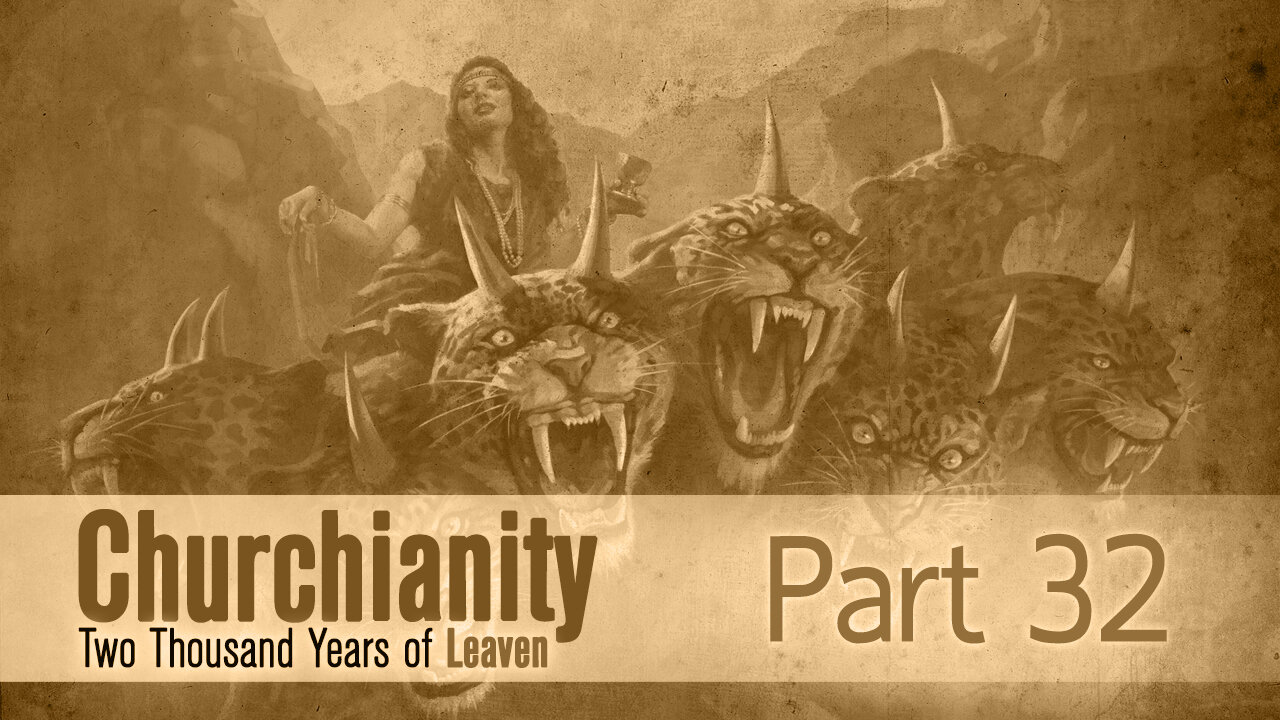
The Calling Out Process (Final Podcast)
Nov 22, 202000:31:51Tap to summarizeCapitalism is the final de facto religion to emerge on the world stage, which it quickly dominates. Meanwhile, Christianity, which is given two thousand years to flourish—as seen in key Scriptural events and prophecies—is integral to the system of the two beasts of Revelation 13. The identity of that second beast is also revealed, allowing us to mark our place on the prophetic timeline. The Calling Out Process Kingdom Prepper Download Show TranscriptShalom, and welcome to our history podcast. This is a production of Kingdom Preppers.org. I’m your host, Kingdom Prepper, and you’re listening to: Churchianity: Two Thousand Years of Leaven. We continue with our history. Last Episode First Episode All Episodes Part 32: The Calling Out Process (Final Podcast) Christianity emerged amidst European powers, and was therefore Eurocentric in its origin and throughout its formative years. That Eurocentric nature is even evident in the rise of America and other world powers, but this is also according to prophecy. While Christianity enjoyed its greatest European height during the most dominant years of papal supremacy, and it spread like a mysterious plague during the Great Awakenings, its power waned considerably in the twentieth century, being eclipsed by the new unofficial religion called Capitalism. Capitalism, it must be stated, reigns over the entire earth, making merchandise of nearly every conceivable thing, which it then incorporates into its all-consuming structure. Even politics is subject to capitalism—you need only look to Wall Street and the many deep-pocketed lobbyists who descend on Washington, D.C. to note that. But in order to see how this is all according to prophecy, even being fulfilled according to a specific timeline, you would have to apply prophetic symbols to their appropriate existing counterparts. Those who believe that the United States is Babylon, for instance—and use various analogies to prove that out—will not see the true prophetic purpose of America. Babylon is essentially a “beast rider,” not having enough power in and of herself to be considered a beast. She manipulates and influences beast powers. America, on the other hand, is large enough and powerful enough to exist as a beast, however, and does not ride something more powerful than itself. The rules of this great dynamic are carefully laid out in the books of Daniel and Revelation, which both state that beasts are in fact kingdoms, and their horns, kings. [2] “Daniel declared, ‘I saw in my vision by night, and behold, the four winds of heaven were stirring up the great sea. [3] And four great beasts came up out of the sea, different from one another.’ ” [19] “Then I desired to know the truth about the fourth beast, which was different from all the rest….” [23] “Thus he said: ‘As for the fourth beast, there shall be a fourth kingdom on earth, which shall be different from all the kingdoms….’ ” —Daniel 7:2, 3, 19, 23 [1] “And I saw a beast rising out of the sea, with ten horns and seven heads, with ten diadems on its horns and blasphemous names on its heads. [2] … And to it the dragon gave his power and his throne and great authority.” —Revelation 13:1 – 2 Unlike the harlot, Babylon, this beast from the sea is endowed with power from the dragon, who we know from Revelation chapter 12, is the devil: [9] “And the great dragon was thrown down, that ancient serpent, who is called the devil and Satan, the deceiver of the whole world.” —Revelation 12:9 The first beast of Revelation 13 arises from the sea because it emerges at a time when a multiplicity of peoples, speaking various languages, exist within burgeoning nations. This is none other than Europe, where Rome emerged as the dominant power prior to being overtaken by a spate of barbarian tribes. These various nations and peoples are represented as a sea, or waters. When the papacy began to manipulate European kings and steer the fate of nations from behind the scenes, this was the prostitute sitting on those waters, as pictured in the 17th chapter of Revelation: [15] “The waters that you saw, where the prostitute is seated, are peoples and multitudes and nations and languages.” —Revelation 17:15 But a second beast, which is mentioned in the very same chapter, arises not from the sea, but from the earth, signifying an absence of the complex dynamic of nation-states, feudal laws, a state religion, sophisticated economic trade between peoples, and other societal elements present in Europe. [11] “Then I saw another beast rising out of the earth.” —Revelation 13:11 Wherever this beast emerged, none of that was present. This cannot be said of the African continent, which was already inhabited by diverse peoples, various tribal nations, and filled with many languages. Asia too must be counted out for the same reasons. In fact, the only puzzle piece that fits are the lands that were inhabited solely by Native Americans, who had not created the kinds of complex and diverse societies seen elsewhere in the world. Other areas of the world could not be conquered in the way they were, and Europeans gazed on their holdings like virgin earth, or virgin territory. In his book, American Architectural History, author Keith L. Eggener writes: “The first European settlers in what is now the US saw the American landscape as virgin territory, raw and undeveloped. They brought with them tools and memories, patterns and conventions, which they used to shape their new homes…. Never again would the American continent seem so utterly and frighteningly void of design as it did to these first settlers, so in need of ordering systems for its habitation and successful exploitation.” And, as a second witness, Chris Gosden writes in his book Archaeology and Colonialism: “Virginia was a double play on words. It contai...
Transcribe →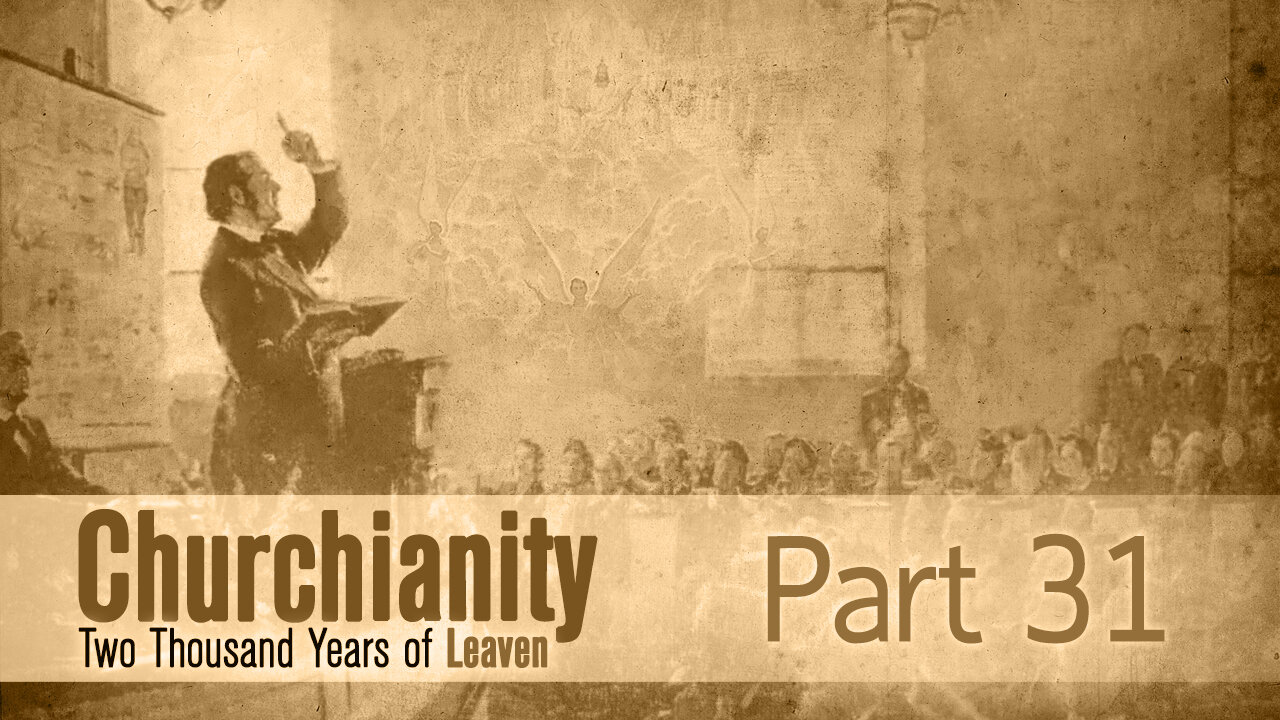
Awakenings and Disappointment
Nov 8, 202000:30:04Tap to summarizeAs Christian denominations spread throughout the colonies, sans the support or protection of any central government, they each found a way to gain a foothold while learning to tolerate one another. Within this new environment, and surrounded by unbelievers as they were, a series of revivals took place that led to two Great Awakenings. This in turn led to the birth of several new harlot daughters of Mystery Babylon. Awakenings and Disappointment Kingdom Prepper Download Show TranscriptShalom, and welcome to our history podcast. This is a production of Kingdom Preppers.org. I’m your host, Kingdom Prepper, and you’re listening to: Churchianity: Two Thousand Years of Leaven. We continue with our history. Last Episode Next Episode All Episodes Part 31: Awakenings and Disappointment Christianity flourished in Europe for hundreds of years, becoming the de facto religion of peasant and noble alike, with the state itself maintaining Christian laws. Church and state were fused in an age-old union that saw corrupt popes steering moral affairs (and sometimes political ones) while Christian emperors handled secular business (and at times interfered in ecclesiastical matters). This often happy arrangement was disrupted by the Protestant Reformation, which was a great upheaval to longstanding Christian traditions as well as affairs of state. In the place of Catholic order, princes rose up in various regions and attempted to fuse the state of their given nation to new Protestant churches. New laws supported and empowered these churches, some of which became oppressive by foisting new religious obligations on their members. When the way was opened to the new world, the prospect of new opportunities drew Protestants there in their thousands. A new Christian mode was developed in these new lands, but in time, attempts at establishing a central church on the order of the old model failed. Too many varying beliefs and distinct nationalities were present in the colonies to justify one established church. A case in point of this disparity would be New York, particularly the banks of the Hudson River, which, in 1646 was home to a host of people speaking no less than 18 different languages. All that these varying Christian groups had in common was their innate desire to obtain religious liberty and be allowed to freely proclaim their personal Christian viewpoint. But each Christian group was shoulder to shoulder with another that held a different belief. This meant that each had to learn to cooperate with and tolerate the other. What is also crucial about this time is that Christianity on a whole existed without the support of any established state. No king or prince with their army of knights, warriors, or hired mercenaries were there to protect Christians in America. The various denominations, which had no states forcing their particular religious views on the public, were now on their own. This meant evangelists had to volunteer to go out and win converts to their church through sheer persuasion, and they had to foot their own bills since there was also no state budget allotted to the cause. In this period, what is known as the first Great Awakening occurred. “What historians call ‘the first Great Awakening’ can best be described as a revitalization of religious piety that swept through the American colonies between the 1730s and the 1770s.” Writes Professor Christine Leigh Heyrman for the National Humanities Center. “That revival was part of a much broader movement, an evangelical upsurge taking place simultaneously on the other side of the Atlantic, most notably in England, Scotland, and Germany. In all these Protestant cultures during the middle decades of the eighteenth century, a new Age of Faith rose to counter the currents of the Age of Enlightenment, to reaffirm the view that being truly religious meant trusting the heart rather than the head, prizing feeling more than thinking, and relying on biblical revelation rather than human reason.” While Christianity permeated the colonies in various forms, and only church members could hold any office, which wasn’t subject to elections derived from voting, many remained unconverted to the religion and were considered destitute of faith. All such persons were deemed worthy of the fires of hell—hell itself being another misinterpretation of the Messianic Writings by Christians of the day. The Great Awakening had its beginnings in America among Presbyterians in Pennsylvania and New Jersey. It was among them—and in those colonies—that early religious revivals were initiated in the 1730s, chiefly in the form of fiery sermons given by clergymen of the Tennent family, who were Scots-Irish immigrants. Much like wildfire, the religious fervor spread to the Puritans—or Congregationalists—and Baptists of New England. “By the 1740s, the clergymen of these churches were conducting revivals throughout that region, using the same strategy that had contributed to the success of the Tennents.” Writes Professor Heyrman. “In emotionally charged sermons, all the more powerful because they were delivered extemporaneously, preachers like Jonathan Edwards evoked vivid, terrifying images of the utter corruption of human nature and the terrors awaiting the unrepentant in hell.” This was, let’s say, the first foray into fire and brimstone preaching, which would become wildly popular in future revivals. The first Great Awakening in America, meanwhile, continued to pick up steam with the entrance of George Whitefield, an ordained minister in the Church of England. Molly Worthen, an associate professor of history at the University of North Carolina at Chapel Hill, says of Whitefield: “He had a charisma that electrified his listeners and he capitalized on that. He relied on public opinion, not the church hierarchy to make him a celebrity. He developed a sophisticated ad campaign, and when he planned to preach in a town, his advance me...
Transcribe →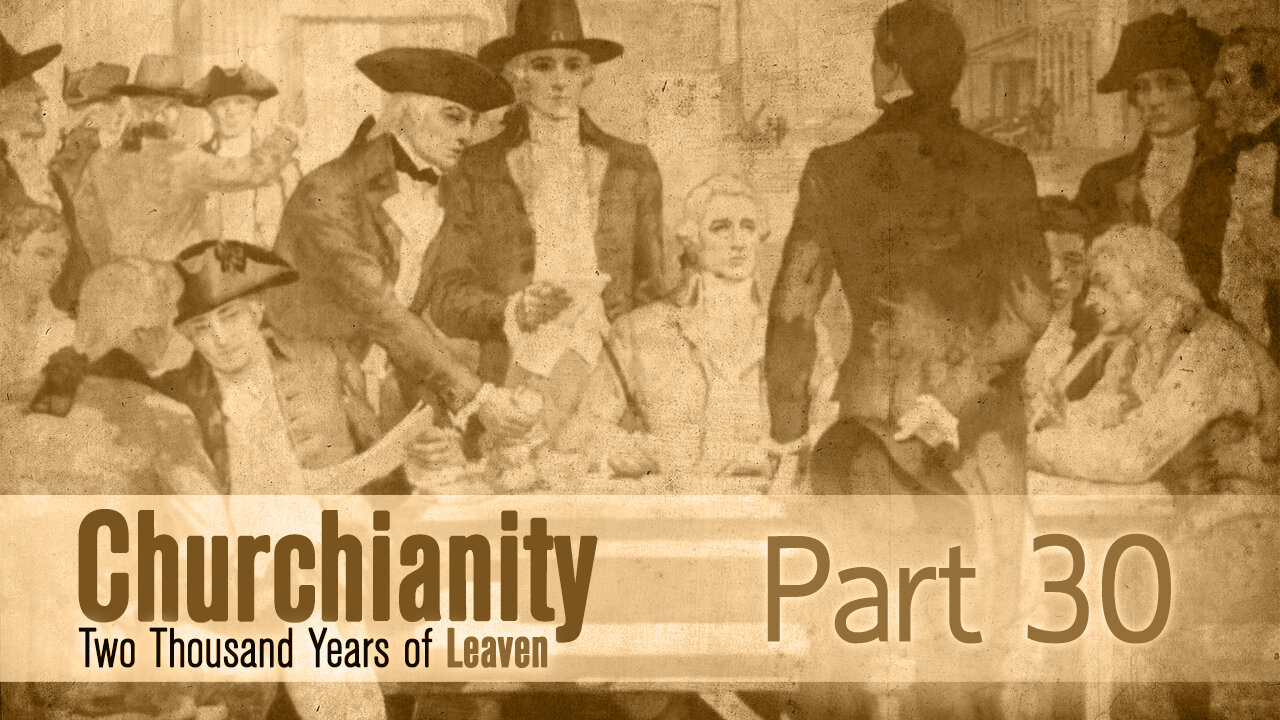
Capitalism: A New Religion
Sep 27, 202000:30:12Tap to summarizeThe harlot daughters of the mother church begin to spread across the American colonies and carve out individual paths to eventual separation from the old world. Slavery, meanwhile, thrives as a result of increased trade created in a new market system, which, with the establishment of the United States, gives rise to capitalism, a new and far-reaching religion. Capitalism: A New Religion Kingdom Prepper Download Show TranscriptShalom, and welcome to our history podcast. This is a production of Kingdom Preppers.org. I’m your host, Kingdom Prepper, and you’re listening to: Churchianity: Two Thousand Years of Leaven. We continue with our history. Last Episode Next Episode All Episodes Part 30: Capitalism: A New ReligionThe American colonies were all commercial ventures on the part of England, intended to prop up their burgeoning empire through slave labor. To facilitate this expansive endeavor, forests were cleared, and the fields they yielded had to be tilled. That required settlers. Christians of various denominations were attracted to the new world and therefore migrated to different colonies, spreading their European culture and custom, which subsequently established the foundations of what would become America. The Quakers settled in Pennsylvania, the Catholics in Maryland, and the Dutch Reformed in New York. Lutherans from Sweden, Huguenots from France, Baptists from England, and Presbyterians from Scotland later settled the colonies as well. What is little discussed today is that each and every one of these Christian groups were steeped in the barbaric culture of colonial slavery. They each depended on Israelite slaves in order to eke out an existence or else thrive on American soil, including the Puritans, who sought to establish a “new Zion” in the New England wilderness, and failed. With all of these various Christian groups clustered throughout the colonies, denominationalism began to emerge as a way to define the church as it then existed. The term denomination was popularized around 1740 at the time of the Evangelical Revival, spearheaded by men like George Whitefield and John Wesley, but the concept was well-cemented by Puritans of the mid-seventeenth century. The term differed from sectarianism, which implied that a particular sect was authoritative and enjoyed direct access to the Redeemer, and that sect alone. Sectarianism was exclusive, whereas denominationalism was inclusive. The argument that was eventually proposed (which amounts to conformity) was that a Christian group, being called by a particular name, was merely part of a larger group that comprised the entire church. And the church held all denominations. Of course, this view has since changed, and what Christianity has reverted to is sectarianism, even though each group still refers to itself as a denomination.While Christianity was sorting itself out in the colonies, England was digging its heels into the slave trade and growing into a behemoth thereby. Author Gerald Horne wrote a book titled: The Apocalypse of Settler Colonialism: The Roots of Slavery, White Supremacy, and Capitalism in Seventeenth-Century America and the Caribbean. In that book, Horne wrote:“[I]t is the seventeenth [century] that stands out conspicuously as the takeoff for London’s involvement in the nasty business of enslavement, which simultaneously delivered bounteous profits that set the stage for a racializing rationalization of inhumanity, while setting yet another stage for the takeoff of an enhanced capitalism. A recent study revealed that before 1581 there were no enslaved Africans brought to what was referred to as the ‘British Caribbean’ and ‘Mainland North America.’ From 1581 to 1640 there were scores brought to each. But from 1641 to 1700, 15,000 Africans were brought to North America and 308, 000 to the ‘British Caribbean.’ Similarly, trade from Dutch forts in Africa amounted to about 700 of the enslaved yearly between 1600 and 1644 but would increase sixfold by the late 1660s. Europeans generally enslaved some two million Africans during the seventeenth century, half of them from West Central Africa and most of the rest from the states abutting today’s Ghana and the Bights of Benin and Biafra.”Highlighting the subtitle of his book, Horne makes a further point that what has been praised as modernity actually bears the stain of slavery, white supremacy, and capitalism. “The bloody process of human bondage,” he stresses, is “the driving and animating force of this abject horror.”For many centuries, Christianity in its various forms was dearly held by commoners, nobles, and other elite citizens. But with the “discovery” of the new world, and the expansion of various empires to the Americas, trade and capitalism overshadowed the religious ideals of those in power. Political pursuits also ranked high among the leading colonists, who desired a new republic that was free of monarchs. And those monarchs were able to fill their treasuries with spoils from the new world. The Roman papacy too, which held the power to initiate the slave trade, and did, benefited greatly from slavery. In fact, between the years 1573 and 1826, publications that were critical of slavery were placed on the official List of Prohibited Books, or, as it is called in Latin, the Index Librorum Prohibitorum. Author John Francis Maxwell, who published his book, Slavery and the Catholic Church, in 1975, says that writers who were critical of slavery were placed on the index prohibiting their works without any particular errors being specified. All of their opinions were simply condemned.While the Papacy and the Spanish Empire reaped rich rewards through slavery and their devastating conquests of the sixteenth century, England eventually superseded them both, not only in terms of conquest, but through their control and expansion of the slave trade as well. But this too would not last.“London was a prime beneficiary of this [systemic] cruelty.”Writes Gerald Horne.“England had a 33 percent share of the slave trade in 1673 and...
Transcribe →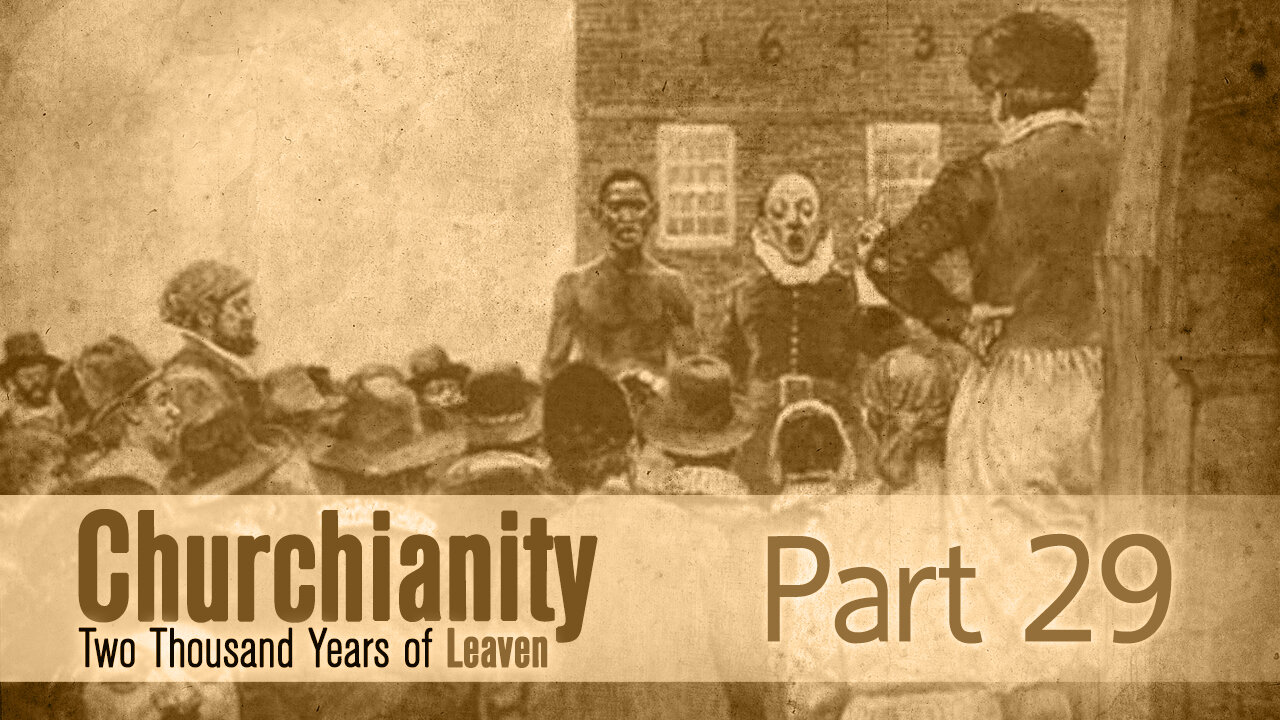
Prophesied Enslavement
Sep 13, 202000:27:44Tap to summarizeEuropean nations embark on an empire-building spree by founding new colonies in the new world, chief among them being the thirteen colonies established by Great Britain, which began with Virginia. Failed attempts at making the investment work eventually lead to the institution of slavery, which sees the first Israelites shipped to Jamestown in August of 1619. Millions more follow over time, fulfilling specific Scriptural curses and prophecies. Prophesied Enslavement Kingdom Prepper Download Show TranscriptShalom, and welcome to our history podcast. This is a production of Kingdom Preppers.org. I’m your host, Kingdom Prepper, and you’re listening to: Churchianity: Two Thousand Years of Leaven. We continue with our history. Last Episode Next Episode All Episodes Part 29: Prophesied Enslavement While the sixteenth century saw the rise of the Portuguese and Spanish empires, which had divided new conquered lands and peoples between them, the seventeenth century was occupied with other European colonial powers building up empires of their own in the new world. France staked a claim to Quebec and settled it in 1609. The first Dutch settlement was established in the Americas around 1615 along the Hudson, near what is Albany, New York today. New Amsterdam, or the southern tip of Manhattan Island, came next. It served as the seat of the colonial government of what was then called New Netherland and became capital of the Dutch province by 1625. Great Britain, however, eventually eclipsed all European rivals in this new arena of overseas expansion. The thirteen colonies, which would later become the United States, were among its first enterprises.Spain’s early conquests of the new world is often contrasted to that of Great Britain’s. The Spanish empire was able to exploit the vast riches of the Aztecs and Incas, and they forced large populations of natives to work the land. The British experienced none of this. The British had no hope of enslaving natives, who could flee into the wild interior to avoid capture. Instead, they looked to trade with the natives as a means of amassing wealth, but that was a bitter disappointment. Another solution was agriculture. Produce could be yielded from the land and exported to Europe to fill the coffers of the owners of the colonies. This initially required British indentured labor, since the land was owned by colonial companies and not free colonists at the time. But relying on white indentured servants was a problem. “White servants had not yet been brought over in sufficient quantity.”Writes Howard Zinn in his book A People’s History of the United States.“Besides, they did not come out of slavery, and did not have to do more than contract their labor for a few years to get their passage and a start in the New World. As for the free white settlers, many of them were skilled craftsmen, or even men of leisure back in England, who were so little inclined to work the land that John Smith, in those early years, had to declare a kind of martial law, organize them into work gangs, and force them into the fields for survival.”All around them, Native Americans were living off the same land, able to support themselves and were, in that sense, superior to the white settlers, who had better technology, but no means of creating enough food with it. The so-called savages had the advantage over the “civilized” invaders. It got to a point where white settlers deserted the colonists and joined forces with the natives. This frustrated the Virginians, who resorted to killing and torturing natives, and burning their villages and cornfields in a show of what they considered superiority. Regardless, their many failures forced them to look to yet another avenue for survival. “Black slaves were the answer,” writes Howard Zinn. And the first of those slaves were twenty and odd Israelites who were captured in the Kingdom of Ndongo in Angola and brought to Jamestown aboard a British ship on August 20, 1619. Zinn goes on to say:“And it was natural to consider imported blacks as slaves, even if the institution of slavery would not be regularized and legalized for several decades. Because, by 1619, a million blacks had already been brought from Africa to South America and the Caribbean, to the Portuguese and Spanish colonies, to work as slaves. Fifty years before Columbus, the Portuguese took ten African blacks to Lisbon—this was the start of a regular trade in slaves. African blacks had been stamped as slave labor for a hundred years. So it would have been strange if those twenty blacks, forcibly transported to Jamestown, and sold as objects to settlers anxious for a steadfast source of labor, were considered as anything but slaves.”We discuss the ramifications of that 1619 event in our Scripture study video 400 Years: Sentence Served.The enslavement of so-called blacks was prophesied in the Scriptures in several places. Jeremiah chapter 17 gives an interesting overview of the particulars of that national punishment, which, in the case of the tribe of Judah—the negroes and blacks who were a large percentage of the transatlantic slave trade—endured due to their sin and rebellion against Yah. Captivity and the loss of their heritage are two key circumstances they would suffer, as mentioned in the following verses:[1] “The sin of Judah is written with a pen of iron; with a point of diamond it is engraved on the tablet of their heart, and on the horns of their altars, [2] while their children remember their altars and their Asherim, beside every green tree and on the high hills, [3] on the mountains in the open country. Your wealth and all your treasures I will give for spoil as the price of your high places for sin throughout all your territory. [4] You shall loosen your hand from your heritage that I gave to you, and I will make you serve your enemies in a land that you do not know.…”—Jeremiah 17:1 – 4Historian Howard Zinn adds:“Their helplessness made...
Transcribe →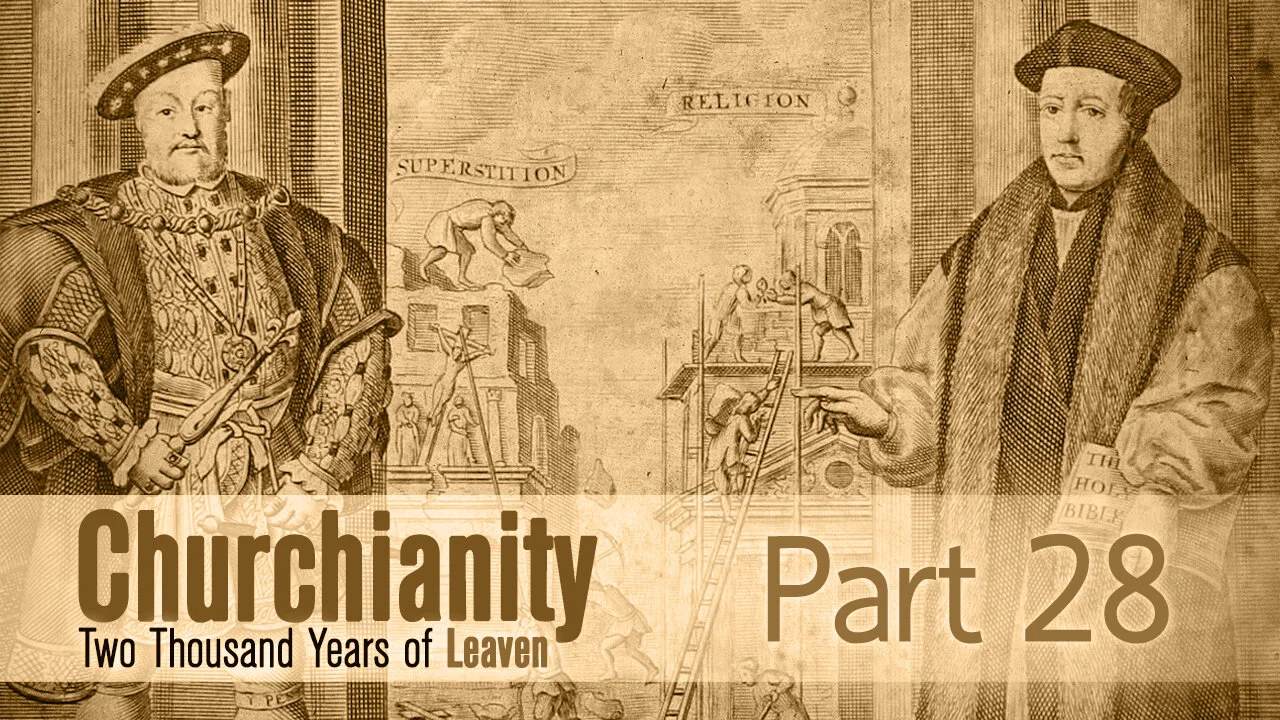
The Church of England
Aug 30, 202000:29:18Tap to summarizeWhile European nations are rejecting Catholicism far and wide on the grounds of theological disagreements, England finds fault with the mother church for political reasons. British succession to the throne draws the king of England into conflict with the papacy, forcing Henry VIII to split with the dominant religion and stand at the head of yet another branch of it. But opposition from Puritans further shapes the denomination. The Church of England Kingdom Prepper Download Show TranscriptShalom, and welcome to our history podcast. This is a production of Kingdom Preppers.org. I’m your host, Kingdom Prepper, and you’re listening to: Churchianity: Two Thousand Years of Leaven. We continue with our history. Last Episode Next Episode All Episodes Part 28: The Church of England While Lutheranism was conceived in a monastery by a disillusioned Catholic monk, Anabaptist notions at a prayer meeting, and Calvinism at the desk of a traveling scholar, the Church of England was born largely out of political affairs. The crux of the problem was that of royal succession to the throne. Well, that was the first English Reformation at any rate, the constitutional one under Henry VIII, who would simply reject the authority of Rome and leave the nation’s doctrines virtually unchanged. Of course, this move became the standard and course of many nations. The second, theological reformation of England would come with the Puritans nearly a century later.Unlike in other Protestant lands of the day, which had rejected Catholicism on the grounds of theology, England was not presently concerned with such things. The church of Rome and its repressive power over kings was at issue. The sixteenth-century state of affairs saw Scotland and France in close alliance, while England was an ally of Spain. Great Britain itself though existed as two British kingdoms at the time, divided between the Stuart kingdom in Scotland and England’s house of Tudor. Strong bloodlines ran between the two houses, but the intent was to unite the crowns at some point, though that would come during the reign of King James. During the sixteenth century, however, the British kingdoms were bitter enemies that were often at war. We discussed the reformation in Scotland at the end of the previous podcast, now we turn to the English reformation, which followed an entirely different course.“Catherine of Aragon, daughter of Ferdinand and Isabella, came to England in 1501, aged sixteen, and married, on November 14, Arthur, aged fifteen, oldest son of Henry VII.”Writes Will Durant in his book The Reformation.“Arthur died on April 2, 1502. It was generally assumed that the marriage had been consummated; the Spanish ambassador dutifully sent ‘proofs’ thereof to Ferdinand; and Arthur’s title, Prince of Wales, was not officially transferred to his younger brother Henry till two months after Arthur’s death. But Catherine denied the consummation. She had brought with her a dowry of 200,000 ducats (around $5,000,000). Loath to let Catherine go back to Spain with these ducats, and anxious to renew a marital alliance with the powerful Ferdinand, Henry VII proposed that Catherine should marry Prince Henry, though she was the lad’s elder by six years.”Then came the gross misinterpretation of Scripture by Catholic officials.“A Biblical passage (Lev. 20:21) forbade such a marriage: ‘If a man shall take his brother’s wife it is an unclean thing… they shall be childless.’ ”This of course refers to the case of representatives on all fronts, both brothers and the wife in question, being alive at the same time. A brother was in fact lawfully allowed to marry a deceased brother’s widow and raise up seed unto him, prolonging his name. The Catholics mistakenly thought that the first law was contradicted by this one:“ ‘If brethren dwell together, and one of them die, and have no child... her husband’s brother… shall take her to him to wife’ (Deut. 25:5).”Needless to say, this was all Israelite business anyway and had nothing to do with English kings or Catholic authorities. Regardless…“Archbishop Warham condemned the proposed union; Bishop Fox of Winchester defended it if a papal dispensation could be obtained from the impediment of affinity. Henry VII applied for the dispensation; Pope Julius II granted it in 1503. Some canonists questioned, some affirmed, the papal power to dispense from a Biblical precept, and Julius himself had some doubts. The betrothal—in effect a legal marriage—was made formal in 1503, but as the bridegroom was still only twelve, cohabitation was postponed. In 1505 Prince Henry asked to have the marriage annulled as having been forced upon him by his father, but he was prevailed upon to confirm the union as in the interest of England; and in 1509, six weeks after his accession, the marriage was publicly celebrated.”Seven months after this, Catherine would bear a child, which resulted in stillbirth. In another year, Henry rejoiced at the birth of a son, a promising male heir to the Tudor throne, but in a few short weeks the child died. Two more sons would suffer the same fate in 1513 and 1514, which urged Henry to consider annulling his marriage to Catherine. Not to be outdone, Catherine tried once more, this time giving birth to a girl in 1516. They named her Mary, and she would be a future queen. Henry was consoled by her birth and saw it as the promise of the sons he longed for, which would surely come now that one child had survived. But those heirs never came. The people of England were not thrilled with Mary’s birth either, since the previous queen stained her reign with bloody wars over royal succession.In 1525, Catherine was well past her prime at 40 years of age, and the lack of male heirs caused Henry to believe that a curse had befallen him for marrying his brother’s widow—the aforementioned misapplication of Leviticus 20:21. He even questioned whether Pope Julius was in error for approving the wedding. An...
Transcribe →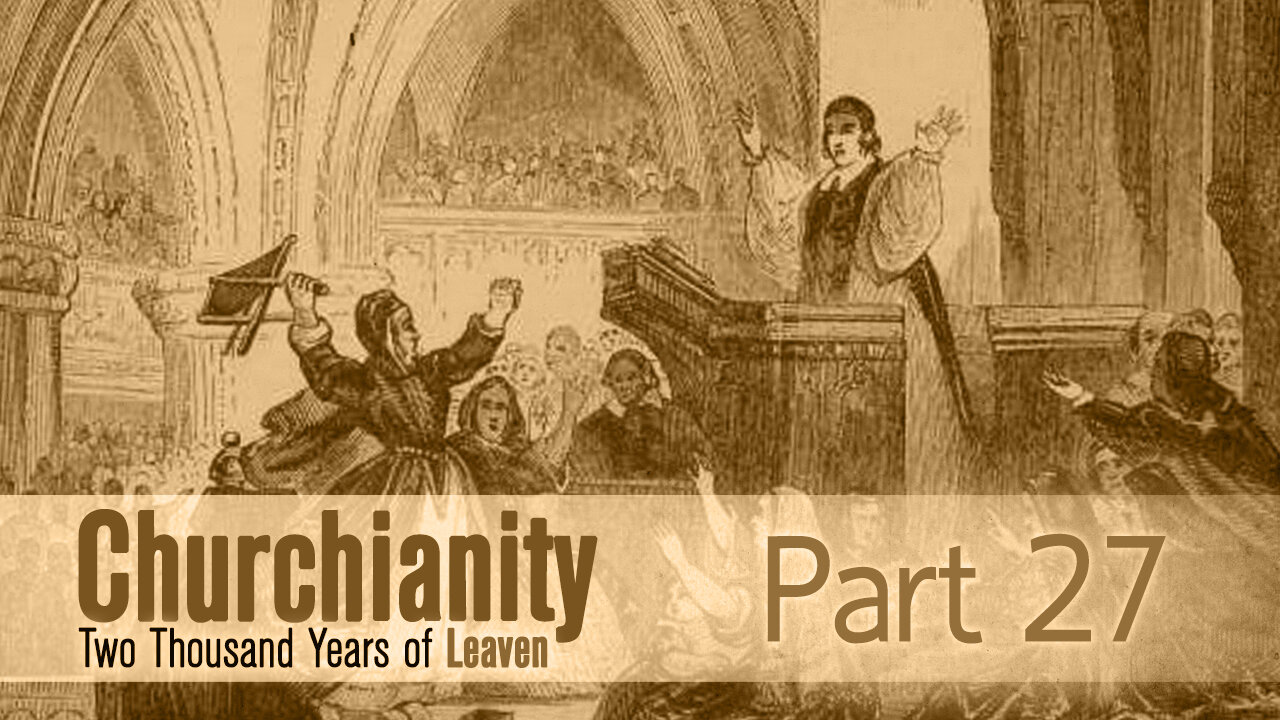
The Spread of Calvinism
Aug 16, 202000:27:57Tap to summarizeIntent on passing through Geneva after a one-night stay, John Calvin is asked to join the reform movement there. His efforts and leadership in effect resulted in a third branch of Protestantism: Reformed Christianity. In the late 1550s, a militant version of this movement spreads beyond Geneva and draws a large number of converts. The denomination reached its height in Scotland and migrated to America after engulfing Europe. The Spread of Calvinism Kingdom Prepper Download Show TranscriptShalom, and welcome to our history podcast. This is a production of Kingdom Preppers.org. I’m your host, Kingdom Prepper, and you’re listening to: Churchianity: Two Thousand Years of Leaven. We continue with our history. Last Episode Next Episode All Episodes Part 27: The Spread of Calvinism A reformer of what can be considered the second generation, John Calvin, a methodical thinker and systematizer of the sixteenth century, unified various Protestant theologies into a cohesive set of doctrines. While Luther was consumed by the Protestant theology of justification by faith, Calvin centered his focus on the sovereignty of the Most High and sanctification. At a time when Spain was at war with France, the young scholar was forced to end his studies in France and leave the country. He traveled through Geneva where he planned to lodge for a single night. The town’s reputation was not the kind that afforded solitude. It was a pleasure-loving city that was in the middle of an identity crisis, having rejected both secular and religious authorities, that being the Duke of Savoy and the Roman pope. Catholic masses were no longer held and citizens were hostile to the city’s bishop. A gaping vacuum was ready to be filled by an influential reformer who could infuse the city’s religious institutions with the spirit of the Reformation, as had been done elsewhere.A local reformer named William Farel had preached his brand of reform in the city for four years prior to Calvin’s visit, but not to great effect. Farel was familiar with one of Calvin’s publications, and when he learned that Calvin was in town, he rushed to his inn and urged the young man to remain in the city and aid in establishing a powerful reform movement there. When Calvin insisted that he must leave to continue his studies, Farel warned that he was only following his own wishes and, if he didn’t help the reform effort, the Most High would punish him for seeking his own interests. Calvin, stricken with terror, yielded, and immediately threw in his efforts for the reform movement in Geneva. He would eventually rise to a leadership position in what he called “the game,” and his brand of reformation, which was the third iteration after Lutheranism and the radical reform of the Anabaptists. Calvin spearheaded what came to be known simply as Reformed Christianity, also termed Calvinism. John Calvin, then, is the root of all Presbyterian churches, a good deal of Baptist congregations—which moved away from their Anabaptist origins—as well as many Congregationalists, and the Dutch and German Reformed Churches.The torch had been passed from Luther to Calvin one could say. But these were very different men with different approaches to the Reformation.“Luther dreamed of good princes, disliked law on principle, and had little interest in institutions. As a result, Lutheran churches ended up with a mishmash of governing structures.”Writes Alec Ryrie, in his book Protestants.“Calvin, by contrast, had trained as a lawyer, knew that structures matter, and favored more participatory government. He insisted that pastors should never have control over money…. More momentously, he distinguished pastors, the ordained ministers who preach and celebrate the sacraments, from elders, senior laymen who would take charge of discipline, and who become the sharp edge of a cultural revolution. Calvin saw the church as a covenanted community, a new Israel in which all were bound to be their brothers and sisters’ keepers.”Calvin, like many other Christian leaders, shaped his church and its doctrine on personal views, based on what was inferred from a reading of the Messianic Writings. While he took up Luther’s torch, Calvin’s reform efforts rather followed Zwingli’s in structure, and he was able to build on Zwingli’s work. Zwingli’s influence reached other reform leaders who sympathized with his view of the Reformation over that of Luther’s, thus Zwingli’s brand of reform was able to spread throughout and beyond Switzerland, reaching Strasbourg in Germany, where another reformer, Martin Bucer—third in importance in that country only to Luther and his successor Melanchthon—took up the cause of Zwingli. After Zwingli was killed in battle, however, his cause lost the impact it enjoyed under his direct leadership, thus the center of the Protestant Reformation moved to Geneva, the French-speaking Swiss city that benefited greatly from Calvin’s disciplined leadership.Calvin—who was bound for Strasbourg, where he was prepared to study and write—was offered the position of Professor of Sacred Scriptures by Geneva’s city council, and in this office he dug his heels into the work of reform. A confession of faith was drawn up, which those residing in Geneva would have to accept. He also drew up plans for education reform, and insisted on excommunicating all who refused to adopt a certain spiritual standard. “[B]ut the Genevans seemed to resist at every turn.” Writes Carlos M. N. Eire in his book Reformations.“The worst conflict was a power struggle between the clergy and the city council over the right of excommunication, which the ministers wanted to control, against the wishes of the magistrates. Having just rid themselves of what they viewed as an oppressive church, the elites of Geneva were not eager to see another one take its place. Unwilling to compromise, insisting on the clergy’s right to excommunicate, Calvin and Farel were expelled from Geneva in May 1538.”Calvin took that as a sign fr...
Transcribe →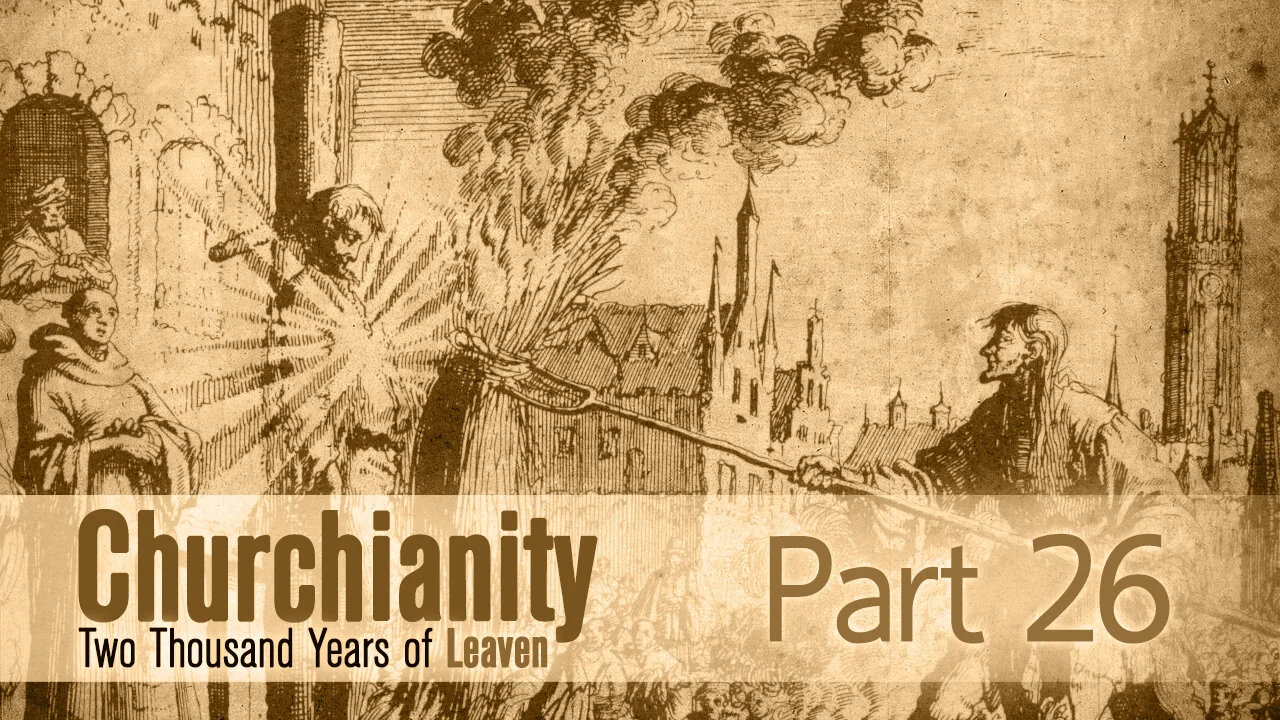
Radical Reformers
Aug 2, 202000:27:11Tap to summarizeDue to his outlaw status, Martin Luther is forced to remain in the shadows of the Reformation while others assume leadership positions in his church, which quickly develops into an institution. Meanwhile, Ulrich Zwingli, a prominent Swiss reformer laboring apart from Luther, spearheads an important reform movement in the Swiss Confederacy that gives rise to radical Protestants who create yet another denomination: the Anabaptists. Radical Reformers Kingdom Prepper Download Show TranscriptShalom, and welcome to our history podcast. This is a production of Kingdom Preppers.org. I’m your host, Kingdom Prepper, and you’re listening to: Churchianity: Two Thousand Years of Leaven. We continue with our history. Last Episode Next Episode All Episodes Part 26: Radical Reformers Martin Luther had led the Reformation movement in Germany for years, but in 1530, there were many prominent Reformers who had risen to leadership positions, filling a space that Luther could no longer occupy. A summit conference held that year in Augsburg was convened without Luther’s presence, because he was still considered an outlaw. The purpose for the conference—which was even attended by Lutheran princes—was to present a clear statement of faith, or confession, for what had come to be known as Lutheranism, and the man at the helm was a young Wittenberg professor named Philip Melanchthon. Like Catholicism the Augsburg Confession proclaimed that the Lutheran church held the power and authority to excommunicate members who rejected any fundamental Lutheran doctrine. While Charles V did all he could to prevent the spread of the movement, which was deemed heresy, it thrived. In defense of the new denomination, Lutheran princes joined forces and fought intermittent battles in what was basically a civil war from 1546 to 1555. Peace was later reached through compromise, and the princes were left to decide the religion of their lands, which they all insisted be Lutheran, to the exclusion of all other Protestant movements that had lately emerged. Former Catholic bishops had to divest themselves of all property received from the church as well. After a time, Lutheranism became the state religion throughout much of the empire, and spread from Germany to Scandinavia. Despite the popularity of this new Protestant belief, however, some felt there was need for a reform within the reform. They were considered radical Protestants. While Luther was spearheading the Reformation in Germany, a Swiss Reformer working apart from him was spearheading a similar movement in Zurich. His name was Ulrich Zwingli. “Luther might have sparked the Protestant Reformation, much to everyone’s surprise, but he was far from alone, and not even the first in his generation to challenge Rome.” Writes Carlos M. N. Eire, in his book Reformations. “The Swiss city of Zurich is 468 miles southwest of Wittenberg. There, in Zurich, before Luther took on Johann Tetzel, another young cleric had been challenging the whole of the Catholic tradition for a few years. In some ways, he was far ahead of Luther when it came to envisioning a thorough reform of the Christian religion. His vision was more systematically consistent and less paradoxical, and focused on a different set of theological issues. Most significantly, his reforming vision involved symbols and rituals at its very center, and linked this concern to a conception of church/state relations very different from Luther’s. This Reformation tends to get second billing, largely because of chronology and of its initial impact. The Reformation led by this Swiss cleric, Ulrich Zwingli, progressed more slowly and cautiously on a smaller stage, almost as if hidden from view by the towering Alps.” Neither did Zwingli’s protestations erupt with the kind of fire that ignited Luther’s. Zwingli never stood before the emperor at an Imperial Diet, nor was he whisked away by prominent nobles to live in disguise while enjoying sanctuary in a castle. The Swiss Reformation never gained the international acclaim that Luther’s did, nor did its writings reach as wide an audience. It also failed to mature as much or survive as long as Luther’s movement did. “But being the first to bolt from the starting gate, or having the larger, splashier stage setting, or the wide readership, or the longer life does not necessarily mean all that much in terms of the eventual unfolding of history.” Writes Carlos M. N. Eire. “The Swiss Reformation proves this to be true, several times over, for when all is said and done, this Reformation would end up affecting a greater array of countries and a larger number of people than Luther’s ever did.” A year before Martin Luther burst onto the scene with his ninety-five theses, Zwingli was already laboring in Switzerland to bring reform in the Catholic church. After 1517 he was often compared to Martin Luther, or mistaken for one of his followers, despite the fact that he preceded Luther, and in fact sharply disagreed on many theological points. So much did the two dislike each other that Luther himself was offended whenever someone suggested that Zwingli was his disciple. The two men were born six weeks and about 330 miles apart, but aside from being ordained Catholic priests who had become disillusioned with their religion and took pains to reform it in their own way, the two had little else in common. Ulrich Zwingli was born to a peasant family in the village of Wildhaus, located in the mountainous county of Toggenburg—part of the Swiss confederacy. Being typical Swiss citizens of the day, the Zwingli family was devoted to their land, and they treasured the independence of their region, for which they were willing to fight. Self-sufficient, military-minded, and defiant against the nobles who lorded over them, the peasants, who had formed Swiss cantons—or administrative communities—won independence from the Holy Roman Empire in the previous century, though that independence had gone unrecognized by t...
Transcribe →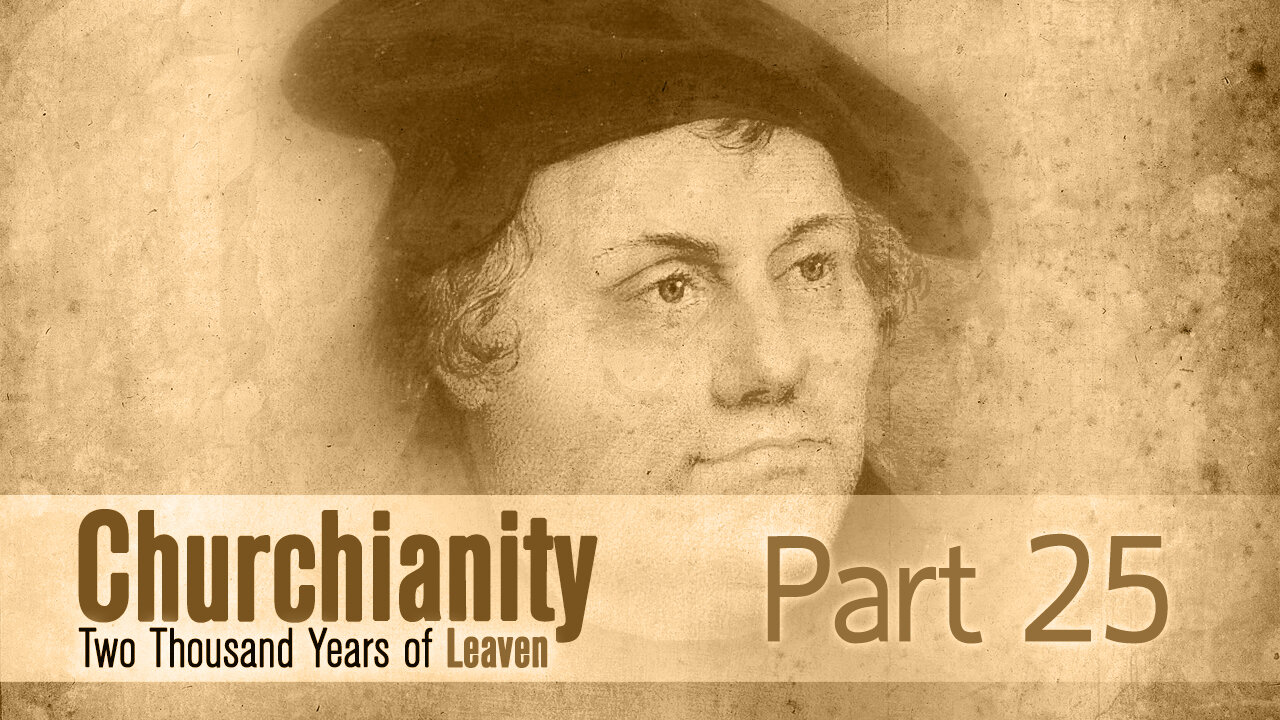
Martin Luther
Jul 19, 202000:27:41Tap to summarizeMartin Luther lived through a series of pivotal historic movements, and he charted a course that saw him leave his own indelible and prophetic mark, that being the Protestant Reformation, which he is considered to have fathered. Abhorred by the selling of indulgences, Martin Luther begins his attack on the church with a series of influential writings, which leads to his excommunication. But the Reformation could not be stopped. Martin Luther Kingdom Prepper Download Show TranscriptShalom, and welcome to our history podcast. This is a production of Kingdom Preppers.org. I’m your host, Kingdom Prepper, and you’re listening to: Churchianity: Two Thousand Years of Leaven. We continue with our history. Last Episode Next Episode All Episodes Part 25: Martin Luther At a time when priests, cardinals, bishops, and other clerics were living in open sin and rebellion against their own Catholic laws, such as that of celibacy—and countless Scriptural precepts besides—certain clerics who aspired to something more pious were aggrieved enough to act upon their strong convictions. One such cleric was Martin Luther, a local preacher and respected university professor of theology, who dared to challenge the corrupt establishment. He lived in a time when Catholic men bought their ecclesiastical office—a practice called simony; when popes flaunted and openly supported illegitimate children; when convents and monasteries were leisure dens, over which monarchs and Catholic noblemen appointed their unqualified sons and daughters as abbots and abbesses. But author James Reston, Jr. in his book, Luther’s Fortress, also states that: “The period of 1483 to 1546, Luther’s lifespan, was an era of giants: Henry VIII in England; Francis I in France; Charles V, the Holy Roman emperor presiding over most of Europe; the Medici popes, Leo X and Clement VIII in Rome; and Suleyman the Magnificent in Constantinople. It was a time of conflict between Charles V and Francis I in Italy, the sack of Rome in 1527 by Protestant forces from Germany, and the siege of Vienna by Suleyman in 1529 and 1532, when the Ottoman sultan threatened to spread the dominion of Islam all the way to the Rhine River. It was the time of Christopher Columbus and the opening of the New World, of Vasco da Gama and the opening to India, and of the Renaissance with its luminaries: Michelangelo, Leonardo da Vinci, Raphael, Albrecht Dürer, and Machiavelli.” It was also the time of Israelite slavery and oppression at the hands of Hamite Africans and Gentile Portuguese and Spanish explorers, who were vested with authority by the Roman papacy. Martin Luther lived through all of these moments, and would himself add a memorable page to the annals of history. Luther was born in Eisleben, Germany in 1483. His father, a Saxon, was himself a man of peasant stock who earned his living as a miner but later owned several foundries, or copper smelters. Luther’s parents were austere in the extreme, a fact he complained of in his later years. He was often punished severely as a child, which left him in states of depression and anxiety. Despite a slow academic start, in that he was caned excessively for not preparing his Latin lessons correctly, Luther later aspired to become a lawyer, at the urging of his father. Those plans changed in 1505, however, when, at nearly twenty-two years of age, he was struck by a bolt of lightning while walking toward a village in a thunderstorm. He had been knocked to the ground, and in terror he cried out to the Catholic patroness of miners and protector from storms, an apocryphal woman known as St. Anne—this was a holdover from Greek mythology and ancient pagan religions that appointed a deity over agriculture, another over the weather, and different deities over various aspects of nature and life in general. Well, St. Anne was supposed to protect miners, mining being the business Martin Luther was born into. This deeply rooted superstition compelled him to beg the supposed saint—believed to be the mother of Mary—to save him from death, a favor he would return by becoming a monk. Seeing he was still alive after two weeks, Luther, to his parents’ regret—and somewhat to his own—kept his word by selling many of his books and walking into an Augustinian monastery at Erfurt to become a monk. By his own admission, Luther was no common monk either. “I kept the rule so strictly,” he said, years after the experience, “that I may say that if ever a monk got to heaven by his sheer monkery, it was I. If I had kept on any longer, I should have killed myself with vigils, prayers, reading, and other work.” A life of austerity, shaped through days of fasting and sleeping in the freezing cold without the protection of a blanket, along with many acts of penance, was an outflow of the misery Luther suffered while he lived as a monk. During one of his confessions, he was told to love the Creator, to which he replied in a burst of emotion, he did not love him. In fact, he hated him. It was not until he came across a Latin Vulgate translation of the bible that Luther began to experience a change of heart. In his day, the Scriptures were not readily available to the masses—not even to monks—as Drs. Paul Maier, Joel Biermann, and Ken Schurb, explain: “He had heard readings from the bible before but never realized they all even came from the same book. Because in those days the bible was regarded as a very dark and obscure document which only the clergy could properly interpret. “Now remember, Luther is born right at the advent of the printing press’ discovery, but it was still in its infancy and books were still rare. If you had a book it meant somebody had to hand copy that book. And so bibles, they were very expensive because you had to copy every single line of every single bible by hand, but in Luther’s time growing up, there were bibles that were very rarely found. “Luther was very much aware, as were all Christians at the time, that the church said, ‘Now, you need our help in order to be able to understand this. You need guidance, expert guidance to interpret this very my...
Transcribe →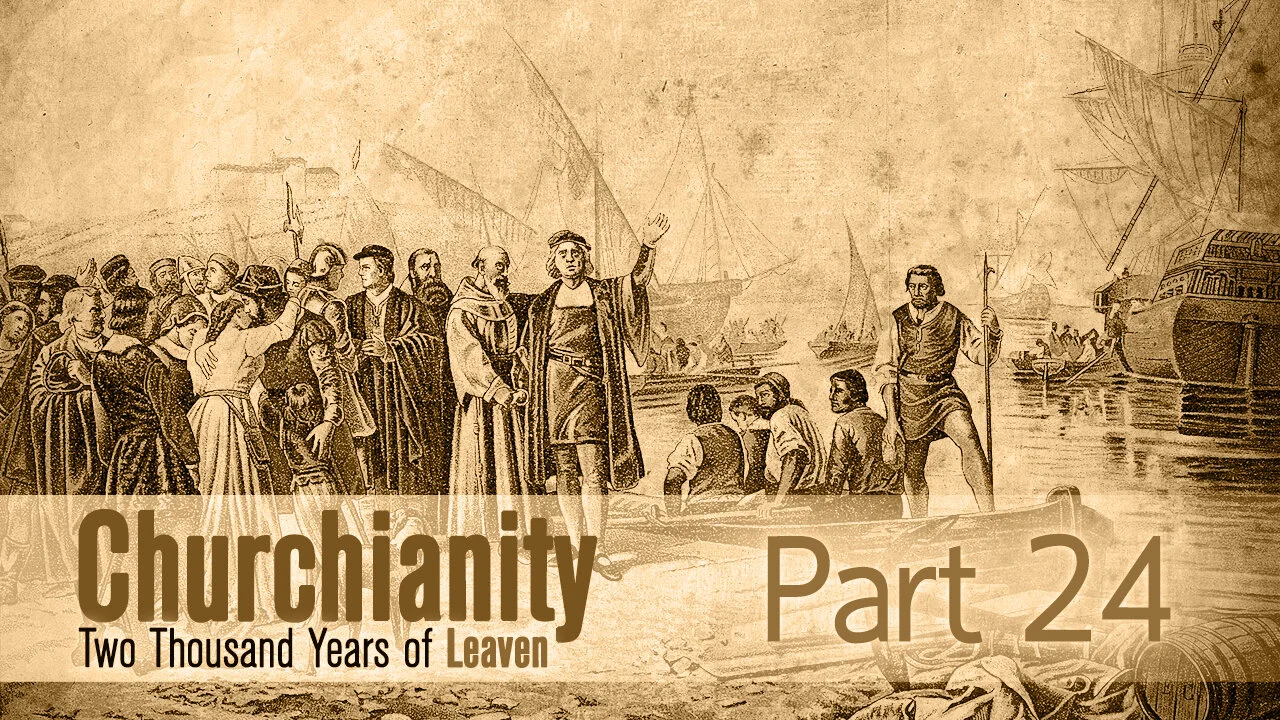
The New World
Jul 5, 202000:28:11Tap to summarizeAfter gaining maritime knowledge, the Portuguese embark on explorations that lead to the discovery of islands that become their new outposts. In search of gold, they reach the west African coast and instead create a new slave market by enslaving and trading descendants of ancient Israelites. Meanwhile, Spain finances Columbus’s first voyage to the New World—mistaken for the East Indies—which touches off the European age of “discovery.” The New World Kingdom Prepper Download Show TranscriptShalom, and welcome to our history podcast. This is a production of Kingdom Preppers.org. I’m your host, Kingdom Prepper, and you’re listening to: Churchianity: Two Thousand Years of Leaven. We continue with our history. Last Episode Next Episode All Episodes Part 24: The New World While the Renaissance was flourishing within Italy, and in fact reaching its height on the peninsula, the Portuguese were expanding their empire into the Atlantic. They looked to establish new trading routes, and thus settled Madeira in 1419, the Azores in 1427, and the Cape Verde Islands in 1450. This allowed for the establishment of important trading posts along the African coast. While their primary pursuit was gold, this was not easy to come by, therefore slaves took precedence since they were easier to acquire. The already booming trans-Saharan slave trade allowed the Portuguese to branch off into a distinct market, but, being Catholics, they first needed the approval of the pope. The justification for that approval came on the basis of war, or to be more precise, a crusade. The people on whom the Portuguese had set their sights were descendants of ancient Israelites, who had established settlements in West Africa and other territories after fleeing Jerusalem and its surroundings during the Roman siege of 70 CE, and the failed Bar Kokhba revolt of 135 CE. In 1452, Pope Nicholas V issued a bull to Alfonso V of Portugal titled Dum Diversas. That bull allowed the king to launch a crusade on Saracens and pagans—namely Israelites—and, in conquering them, submit them to perpetual slavery. “Dum Diversas regarded the enslavement of Africans to be part of the Holy War of Reconquest.” Writes Katharine Gerbner, in her book Christian Slavery: Conversion and Race in the Protestant Atlantic World. “It also granted the Portuguese Crown the authority to act as the head of the Church in Africa and, later, in Brazil, a right known as the padroado real. In 1454, Nicholas V reconfirmed his support for Portuguese expansion in the brief Romanus Pontifex. Later Popes reiterated the grants in 1456, 1481, and 1514.” Those popes were Calixtus III, Sixtus IV, and Leo X—three popes of the Renaissance—and they reiterated the grants of the papal bulls on the cusp of the Protestant Reformation, which would act as a judgment of the church while existing as a fulfillment of prophecy. The Portuguese eventually formed alliances on the African coast and set up colonies there. In 1483, they arrived at the mouth of the Congo River and discovered that the vast land beyond, and all its territories, was ruled by Nzinga a Nkuwu, who held the title mani kongo, meaning “king.” In the hopes of accessing distant Ethiopia by sailing the Congo, the Portuguese maintained good relations with the mani kongo and his subjects. An agreement was soon reached that left four Portuguese in Congo, while four Africans were taken to Lisbon to experience court life. When they returned, reports of the pleasant treatment they received and the splendors of European civilization they witnessed were enough to convince the king to make Portugal his ally. This eventually led to baptisms, and the king and his heir naming themselves after Portuguese kings. Portuguese missionaries were able to labor in the Congo freely and thus a church was formed, complete with a bishop who was the son of the next Congolese king. Relations deteriorated after a few decades, however, and the Portuguese looked to new lands south of the Congo. Now known as Angola, these lands were a rich source for slaves. Unlike the Congo, where the mani kongo controlled the slave trade, the Portuguese were free to use force in Angola and establish another important colony, and also lay claim to vast lands stretching well into the interior, which were another source for slaves. Slavery had been practiced in Africa for centuries prior to the arrival of the Portuguese, and it took on a new life after other European kingdoms crossed the Atlantic. African elites were able to supply the Europeans with slaves from their territories, and many of these slaves were the descendants of the ancient Israelites. The Kingdom of Ghana for instance, once ruled by Israelite kings, eventually collapsed, forcing its Hebrew subjects into other African territories ruled by various tribes. Arab chronicler al-Zuhri wrote of the Barbara and Amīma people, who were frequently captured as slaves. In his book African Dominion: A New History of Empire in Early and Medieval West Africa, Michael A. Gomez writes concerning these peoples: “It is not clear who the Amīma and Barbara were (possibly ‘Bambara,’ also ambiguous), though the latter were regarded as strong, ‘impetuous,’ ‘brave,’ and ‘skilled in war,’ the ‘most noble and aristocratic of men’ to whom ‘the amīr’ of Ghana was related.’ Said to inhabit ‘the middle of the desert,’ they may have been a branch of the Soninke. The Amīma, on the other hand, are identified as impoverished Jews who ‘read the Torah’ and were involved in the import business.” These readers of the Torah, captive Israelites no less, bore a similar skin complexion to native Africans, which is primarily why they were able to assimilate into various tribes and adopt their culture. And many African tribes were comprised of ancient paganized Israelites from the northern kingdom who had fled the Assyrians in the seventh century BCE. As to the Portuguese, they were not satisfied with Africa’s west coast. Their initial aim...
Transcribe →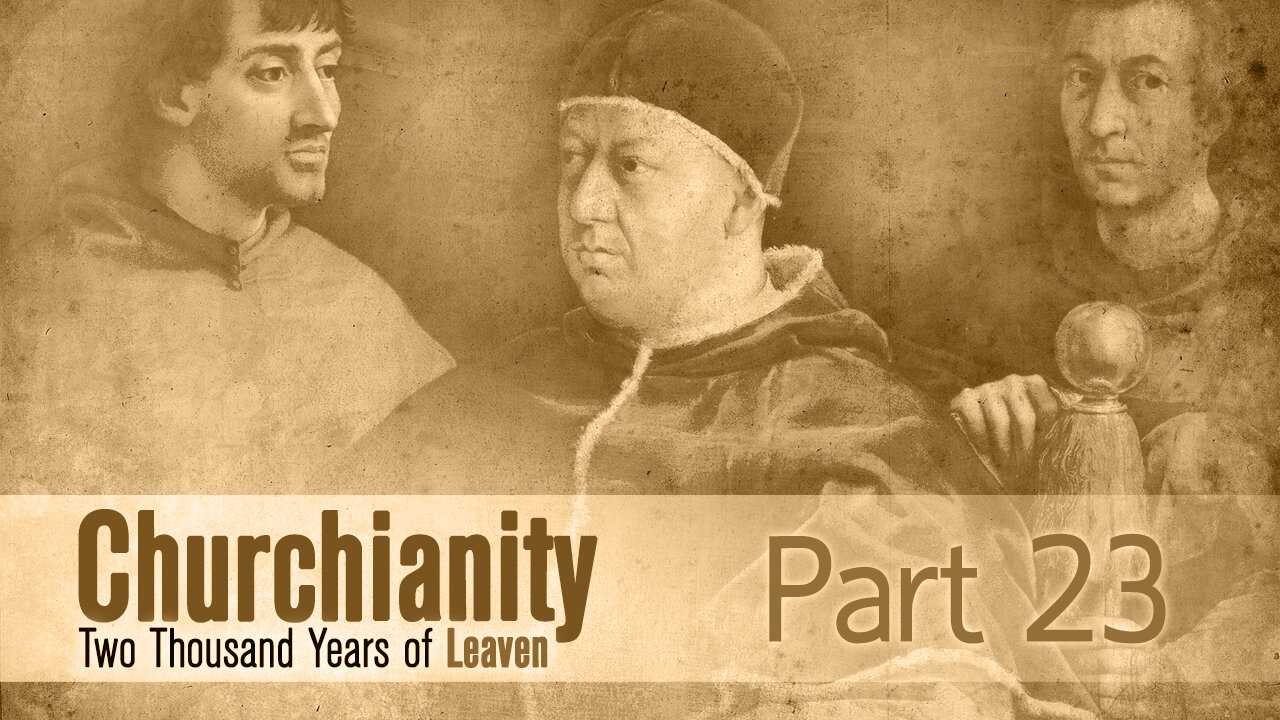
The Renaissance
Jun 21, 202000:28:12Tap to summarizeWhile the Great Schism of the papacy played out following the Avignon period, the glories and excesses of the Renaissance were being realized. Painters, sculptors, artists, and poets—by blending paganism and Christianity—sought to capture the essence of Greek and Roman splendor as expressed through art and literature. Amidst the creative explosion, the popes sought to elevate Rome to new heights and restore her former glory. The Renaissance Kingdom Prepper Download Show TranscriptShalom, and welcome to our history podcast. This is a production of Kingdom Preppers.org. I’m your host, Kingdom Prepper, and you’re listening to: Churchianity: Two Thousand Years of Leaven. We continue with our history. Last Episode Next Episode All Episodes Part 23: The RenaissanceIn the midst of the pre-Reformation movement was the European Renaissance—also called the Italian Renaissance—which covered the fourteenth, fifteenth, and sixteenth centuries, and ushered in the modern era. In this cultural period, politics incorporated the custom of diplomacy, while science relied more on observation and induction, where conclusions were drawn from a part to a whole, or from particulars to generals. This was also a period of education reform, and in the arts, particularly oil painting, natural realism was the new aim, therefore new techniques were developed to achieve it. Accomplished artists such as Leonardo da Vinci and Michelangelo soon emerged and helped define the Renaissance. While the period has its origin in fourteenth-century Florence, it soon spread to other Italian city-states, such as Genoa, Milan, Venice, Bologna, and Rome, among many others. Later, the culture flooded into western Europe. Of course, there was no true nation of Italy at the time, nor an Italian language; those would come centuries later, along with the recognized territorial boundaries featured on modern maps of the peninsula. So, in referring to Italy, I do so merely to frame a historic region and period for the contemporary mind. That said, the Renaissance witnessed the revival of antiquity, wherein Latin manuscripts were copied and circulated. And, after the fall of Constantinople to the Ottoman Turks in 1453, exiles from Byzantium fled to Italy and filled the country with classical Greek literature. This literary awakening eventually spread to Europe as well. Scholars began to focus on humanism, which is what we call the humanities today—otherwise known as liberal arts. The term humanism has been used to encompass a spate of activities and ideas, but during the Renaissance, it had two important, harmonious meanings: “First, there is social (sometimes called civic) humanism, which describes the outlook of the upper middle class in the Italian cities during the Renaissance.” Writes Norman F. Cantor in The Civilization of the Middle Ages. “The upper bourgeoisie, glorying in its new political power, expressed its independence by placing great emphasis on human autonomy and on the value and grandeur of the city-state. The new class imitated the French aristocracy of the thirteenth century, taking up the aristocratic education, style, and courtly life that they considered suitable to their own emancipation and to their equality with the northern aristocrats. Social humanism inspired a passionate civic patriotism, a belief that all urban resources should be applied to the defense and beautification of the republican commune. “The second major aspect of humanism was the intellectual movement, based on Platonic philosophy, which emphasized the primacy of human values and individual creativity over feudal and ecclesiastical traditions and institutions. Humanist philosophers believed that the human mind was capable of deciding for itself without relying on traditional authority. In both its social and intellectual aspects, humanism drew strength and inspiration from the Greek and Roman classics, which taught the value of the city-state and its self-governing urban elite and upheld the critical powers of the individual human mind.” Humanists in Italy focused on the study of Scripture using their newfound philosophy, which they mingled with notions from secular classical literature. Many humanists were dedicated Christians, yet, like the Neoplatonists and Gnostics before them, Christian humanists of the Renaissance sought to infuse their religion with pagan philosophy and mysticism. Despite these leanings, Rome—seat of the mother church—was in fact the spiritual and intellectual center for these humanists. More to the point, several popes were humanists as well, hence their full support of the arts during the Renaissance. Humanism at the time did not merely denote the philosophy and intellectual bent of the Italian nobility, where the sole focus was the humanities as it is today; humanism also emphasized the so-called “genius of man,” and in fact praised the ability of the human mind, which was considered to be “extraordinary.” This kind of man-worship was at the heart of humanism, while its proponents looked back to the literature, language, and values of ancient Rome and Greece, as these were viewed as the twin epitomes of man’s great achievements. What shaped the Italian Renaissance was fourteenth- and fifteenth-century Italian culture itself. The wealth of the Italian elite and the structure of society in the city-states, with their unique political systems, saw to the development of the Renaissance as a full-blown cultural movement, rather than a passing expression of ideas and art from a scant few. Europe would look to Italy as the forerunner of cultural rebirth as it emerged from the feudal despotism of the middle ages. Italy was able to do this via its vast wealth, together with the political structure of its powerful city-states. Unlike the antiquated feudal economy that was tied to land … “By the latter part of the thirteenth century, Italy had a money economy based on trade and finance.” Writes Norman F. Cantor. “The late thirteenth and ear...
Transcribe →