
Podcast
CLEARING A NEW PATH™
Hosted by Explorative conversations on Canadian journalism. · EN
Explorative conversations on Canadian journalism.
Podcast art inspired by the graphic design of Katie Wilhelm.
Music branding by The Hankering Studio.
Subscribe to the Clearing a New Path™ weekly newsletter: https://substack.com/@clearinganewpath
Contact us at: shauna@radarmedia.co
clearinganewpath.substack.com
clearinganewpath.substack.com
10episodes
Episodes
Newest firstAll episodes
Canada's Rural Development Network
Dec 1000:43:25Tap to summarizeThe folks at the Rural Development Network (RDN) have been on the pod previously, but much has changed since that time (January 2023).Nearing the end of 2025, urgent issues have shifted for rural communities, and RDN has shifted to serve those priorities.When new President and CEO Melissa Fougere reached out to me in late October about having some of her team on the podcast, it took us a little bit to find a date and time that worked for all. SummaryIn this episode, I spoke with Sydney Stenekes, Director of Homelessness Initiatives and Mary McGuire, Program Manager from the Rural Development Network about their initiatives aimed at addressing homelessness, supporting aging populations, and fostering inclusive communities in rural Canada. They discuss the importance of community engagement, the challenges faced by rural communities, and the innovative approaches taken to provide support and resources. The conversation highlights the significance of data collection, storytelling, and collaboration in creating effective solutions for social issues in rural, remote and Indigenous communities.Takeaways* Homelessness in rural areas often manifests as hidden homelessness.* Community engagement is crucial for identifying needs and solutions.* Funding opportunities are available for communities to address social issues.* Aging populations face unique challenges in rural settings.* Data collection helps understand housing needs and service gaps.* Veterans experience unique challenges related to housing insecurity.* Storytelling is vital for advocating for community needs and securing funding.00:00 Introduction to the Rural Development Network03:29 Community Engagement and Funding Models08:21 Addressing Urgent Issues in Rural Communities14:08 Connecting with Organizations and Community Needs18:36 Rural Immigration and Community Support22:58 Understanding Homelessness in Rural Areas28:34 Data Collection and Amplifying Voices42:41 Conclusion and Future Directions Get full access to clearing a new path at clearinganewpath.substack.com/subscribe
Transcribe →
Live with Clearing a New Path
Oct 1500:11:28Tap to summarizeThank you to those 3 or 4 folks who tuned into this live video! It was an experiment, and while I could edit it before I post it, I’m not going to. You know why?I have zero s***s and zero f&cks about perfection. This was raw, real, off the cuff and that’s the vibe of this new season.No fluff, no pretend toxic positivity, it’s too late for that.Rural Canadians have to organize, unite, be inspired and connect with one another not just online but in REAL spaces like the grocery store and the dentist, but authentically. When you ask how someone is, you actually wait and listen for the answer and give a genuine reaction. Or when asked how things are, you have the courage to say if you need help or things aren’t ‘perfect’.Hence the rawness of the video.This is the vibe of season four. REAL.Thanks for your patience as I took the time to heal and grow (still in progress by the way) but basically just to exhale, and get ready for the next chapter, ‘cause from all reports, we’re in for a rough ride!See you real soon, before the end of October! Get full access to clearing a new path at clearinganewpath.substack.com/subscribe
Transcribe →
Season 3 Episode 11 - Craig Boddy, Fusion Youth Centre in Ingersoll, Ontario
Jun 25, 202400:31:05Tap to summarizeI was fortunate enough to have a tour of the Fusion Youth Centre in Ingersoll, Ontario last month. Craig Boddy has been with the organization for over a decade and seen many transitions. The building is a former school, purchased by the municipality, when youth crime was a burgeoning issue.The centre was established in 2006 to provide a safe space for kids after school. It offers a wide range of programs and facilities, including a gymnasium, lounge, kitchen, recording studio, and tech centre. The centre has seen changes in its age group, membership fees, and programming to adapt to the evolving needs of youth. Craig shares success stories of youth who have benefited from the centre and emphasizes the importance of community support and partnerships. He also discusses the challenges of keeping up with youth trends and the positive impact of the centre in preventing youth from engaging in negative behaviors.Takeaways* The Fusion Youth Center in Ingersoll, Ontario, provides a safe space for kids after school and offers a wide range of programs and facilities.* The center has evolved over the years, including changes in its age group, membership fees, and programming to meet the changing needs of youth.* Community support and partnerships have played a crucial role in the success of the center, with organizations like United Way Oxford providing funding.* The center has had a positive impact in preventing youth from engaging in negative behaviors and has seen success stories of youth who have benefited from its programs.* Challenges include keeping up with youth trends, such as technology and cyberbullying, and the limitations of being part of a municipality in terms of funding and decision-making.During our conversation, Craig mentions a study and paper that was authored and produced through the University of Guelph. The two authors were Heather Cross and Al C. Lauzon. You can find it online here: Fostering Rural Youth Wellbeing through Afterschool Programs: The Case of Fusion Youth and Technology Centre, Ingersoll, Ontario (2015)Fusion Facebook page Get full access to clearing a new path at clearinganewpath.substack.com/subscribe
Transcribe →
Disrupting Rural Business
May 24, 202400:37:10Tap to summarizeSummaryI met Helen Tremethick, a rurally-based Regenerative Business Designer and Holistic Business Coach, through her workshop for the Canadian Women's Chamber of Commerce and it was her workshop's title, "Sustainability is B******t" that caught my and so many others' interest. In this episode, Helen discusses her approach to disrupting business coaching and the importance of redefining success. She emphasizes the need to consider how our businesses are running for us and the impact they have on our ecosystem. Helen also highlights the challenges and benefits of being a rural resident and business owner. She shares her insights on somatic therapy and its role in decision-making and self-care. Helen concludes with advice for entrepreneurs, encouraging them to connect with their bodies, define their own version of success, and focus on their own journey rather than comparing themselves to others.How to connect with Helen:Website: helentremethick.comMotorcycle Club: helentremethick.com/clubIG: instagram.com/helentremethickFree Gift: bit.ly/beyondsustainableBook A Chat: tidycal.com/helentremethick/cuppaTakeaways* Consider how your business is running for you and the impact it has on your ecosystem.* Connect with your body to make better decisions and prioritize self-care.* Redefine success based on your own values and priorities.* Focus on your own journey and avoid comparing yourself to others.Sound Bites* "How is our business having an impact? And ideally, what we want to do is create an impact that is net positive, has a net gain for everyone involved."* "We need to factor in future care, present care, and the fact that your mortgage broker doesn't take fresh baked bread."* "If you have a community where you can exchange time or energy or attention, then great, then you don't need to have money as part of that equation."Chapters00:00 Introduction and the Concept of Regenerative Business02:59 Redefining Success: Beyond Traditional Measures06:24 The Impact of Our Businesses on the Ecosystem09:22 Somatic Therapy: A Tool for Better Decision-Making25:36 Finding Joy in the Outdoors and Parenting27:25 The Love and Badassery Motorcycle Club32:34 Advice for Entrepreneurs: Redefine Success and Focus on Your Journey Get full access to clearing a new path at clearinganewpath.substack.com/subscribe
Transcribe →
Prof. April Lindgren - Metropolitan University School of Journalism - Mapping Local News
May 14, 202400:33:29Tap to summarizeApril Lindgren, a former journalist and current professor, discusses the state of local journalism in Canada and the challenges it faces. She shares insights from her research on the decline of local news outlets and the emergence of new models. Lindgren emphasizes the importance of local journalism in building communities, holding power accountable, and combating misinformation. She explores the role of digital mapping in understanding the landscape of local media and highlights the need for multiple revenue streams to sustain local news organizations. Lindgren also discusses the potential role of philanthropy in supporting local journalism and the importance of collaboration among newsrooms.TakeawaysLocal journalism plays a crucial role in building communities, holding power accountable, and combating misinformation.The decline of local news outlets in Canada has led to a lack of verified, timely, and independent local journalism.Digital mapping can provide insights into the state of local media and track the opening and closing of news outlets.Sustaining local news organizations requires multiple revenue streams, including advertising, membership models, philanthropic support, and events.Collaboration among newsrooms can lead to more impactful journalism and a diversity of voices in local communities.Chapters00:00 Introduction and Background03:14 The Decline of Local News Outlets05:51 Understanding the Local Media Landscape09:01 Sustaining Local News Organizations14:05 The Role of Philanthropy in Supporting Local Journalism28:59 The Future of Journalism32:55 Conclusion Get full access to clearing a new path at clearinganewpath.substack.com/subscribe
Transcribe →
Andrew Button - MashUp Lab
Jan 13, 202400:53:41Tap to summarizeAndrew Button - MashUp LabI first met Andrew Button from MashUp Lab over the phone. He was inquiring about the national conference the organization I was working with, Community Futures Ontario, was hosting and how he could become a speaker. That was in the throes of the pandemic.Andrew and I caught up again recently to chat about how he’s supporting entrepreneurs in rural Canada (and the US), what is missing for many rural communities and some of the opportunities they have at the start of a New Year.After a 15-year career working in rural communities with various innovation, businesses, and economic development organizations, Andrew founded Mashup Lab in 2014.Mashup Vision: A world where EVERY person in a rural place has the opportunity to unleash their full potential.Identifying a gap in resources and a need for support in his community, Andrew has since launched a community of 3 co-working spaces for freelancers, entrepreneurs and independents in the south shore under the brand WorkEvolved.Andrew is from a small rural community in Newfoundland and married a girl from a small rural community in Nova Scotia that they now call home with their two boysSummaryAndrew Button from Mashup Lab discusses the challenges faced by rural and remote communities in Canada and the US. He highlights the importance of addressing equity and systemic barriers and shares his personal growth journey in understanding and addressing these issues. Andrew also talks about the role of co-working spaces in rural communities and the potential of social innovation and social business models. He emphasizes the need for open-mindedness, collaboration, and taking small steps to create positive change in rural communities. The conversation explores the importance of taking the first step and the potential for surprising ourselves with what we can achieve.TakeawaysAddressing equity and systemic barriers is crucial for supporting entrepreneurship in rural and remote communities.Personal growth and learning are essential for understanding and addressing these challenges.Co-working spaces can play a significant role in fostering entrepreneurship and collaboration in rural communities.Social innovation and social business models offer opportunities for solving social challenges in a sustainable and profitable way.Open-mindedness, collaboration, and taking small steps can lead to positive change in rural communities. Success stories often start with one person taking the first step.Opportunities arise when we take action without expectations.We can achieve more than we think in a short period of time.Chapters00:00 Introduction to Mashup Lab03:01 Challenges Faced by Rural and Remote Communities06:33 Equity and Systemic Barriers10:53 Personal Growth and Learning13:41 Healing Communities through Personal Growth16:25 Barriers and Opportunities in Rural Communities20:21 Co-Working Spaces in Rural Communities27:22 Understanding Social Innovation and Social Business Models33:17 Bartering and Mutual Aid in Entrepreneurship40:18 Progress in Rural and Remote Communities44:25 Goals for 202446:06 Finding Opportunities in Your Community48:28 Taking the First Step49:03 Surprising Ourselves Get full access to clearing a new path at clearinganewpath.substack.com/subscribe
Transcribe →
Elder Cindy Crowe - Sacred Circles
Jan 13, 202400:49:00Tap to summarizeElder Cindy Crowe - Sacred CirclesThis is the third time I have had the pleasure of speaking with Elder Cindy Crowe for a podcast episode, however, I speak with her often as she is my mentor, a dear friend and my chosen family.Cindy is an Anishinaabe Grandmother Elder, a Knowledge Keeper, a Lodgekeeper, a Pipe Carrier and a Drum Keeper.Cindy is from Opwaaganisiniing close to Thunder Bay, Ontario, Canada. She is called to connect Indigenous & non-Indigenous folks, as well as support the relationship between Spirit & our human experience. Through her Anishnaabe lens, Cindy holds space for belonging & interconnectedness through vulnerable storytelling & unconditional acceptance.I have had the benefit of participating in one of Cindy’s Sacred Circles for almost a year. It is a weekly date I rarely miss. And it has literally healed me and changed my life.Cindy is now hosting virtual circles twice a week and we talked about what circles are, what makes them sacred, who can host them and how they can heal communities.SummaryIn this conversation, Cindy Crowe, an Identity and Purpose Coach, discusses the concept of sacred circles and their significance in creating a sense of belonging and connection. She explains that sacred circles provide a space where individuals can feel loved, accepted, and free from judgment. Cindy emphasizes that anyone can host a sacred circle as long as they approach it with an open heart and the belief that everyone is equal. She also explores the roles of knowledge keepers and lodge keepers in facilitating circles and highlights the importance of inclusivity in community healing. Cindy encourages individuals to focus on self-healing and love, as well as to foster a sense of unity and collaboration within their communities.TakeawaysSacred circles provide a space where individuals can feel loved, accepted, and free from judgment.Anyone can host a sacred circle as long as they approach it with an open heart and the belief that everyone is equal.Knowledge keepers and lodge keepers play important roles in facilitating circles and passing down wisdom.Inclusivity is crucial in community healing, and circles should be open to people of all backgrounds.Focusing on self-healing, love, and fostering unity within communities can lead to positive change and a brighter future. Get full access to clearing a new path at clearinganewpath.substack.com/subscribe
Transcribe →
The Coxes: Rural Ontario in Colour
Nov 22, 202300:57:24Tap to summarizeThe Coxes: Rural Ontario in ColourThis episode, I again handed the microphone to folks who share a lens I do not have.This is an intergenerational conversation, from a mom and son, whose experience and perspective is, as people of colour, who once lived in urban settings and now have moved to the country.Mojdeh and her son Darius talk about safety, access to cultural food, infrastructure, climate and agriculture among a number of other topics. The two have recently gone into business together with their consulting agency, Cox & Co, a full scale values-driven firm providing strategic advisory services, training and skills building, and specializing in ethical governance and deep anti-oppression.Mojdeh Cox is an award-winning consultant, convener and facilitator who is nationally recognized for her expertise in anti-oppression and human rights. For over a decade, Mojdeh has coached organizational and community leaders, businesses and not-for-profit organizations across all sectors on re-imagining their work through a heightened equity lens rooted in social justice, from organizing and convening the largest equity-based lobby on Parliament Hill on Indigenous rights and justice for the Canadian Labour Congress, to facilitating consultations leading to the co-creation of the Community Diversity and Inclusion Strategy (CDIS) for the City of London. Most recently, Mojdeh’s thought leadership on Radical Accountability has been nationally recognized in her tenure as President and CEO of Pillar Nonprofit Network. Mojdeh currently lives in the county with her partner, their four children (including Darius) and their not-so-mini Mini Goldendoodle, Leo.Darius Cox was born and mostly raised in London and is currently a King’s University College, Western University student majoring in Political Science and minoring in Sociology. With a passion for learning and leadership, Darius has been a leading delegate in the North Meets South Exchange where youth create a policy framework to draw attention to issues facing Indigenous peoples in Northern Ontario after learning first-hand of the culture and experiences. Darius has also been a delegate at the Smart Start Youth Summit centred around developing leadership and ethics competencies to work on building your future. During highschool he had a leading role in a program called “MANUP”, addressing toxic masculinity and emphasizing respect towards others, especially women. He also sits on the board for the Gender Equality Coalition of Ontario as the youth chair. Get full access to clearing a new path at clearinganewpath.substack.com/subscribe
Transcribe →
Organizing and Activism in Rural Canada
Nov 8, 202300:43:00Tap to summarizeOrganizing and Activism in Rural CanadaAs a response to injustices that happen around the globe, protests and demonstrations have always been a way for people to express their views in a public way.We’ve all seen big protests and demonstrations depicted on television news and increasingly on social media. But many of those displays of solidarity happen in big cities.I believe that there are progressive folks, looking to get involved in social movements in smaller rural and remote communities across Canada too but many don’t know where to start.David Alton is a queer organizer and community facilitator. They co-founded GroundUp Waterloo Region (GroundUPWR) in 2020 to help fill gaps and build bridges in the grassroots world of Waterloo Region. What started as a twitter account has now grown into a network of 100 local organizers. David is an urban planner and community facilitator, who is passionate about humanizing public discourse, overcoming stakeholder conflicts and advancing societal values.Roy Mitchell grew up in Northern Ontario and escaped to be gay, make films and videos and… trouble in Toronto. He is now back in Northern Ontario where he is a community organizer and runs the Hybla Artist Residency. After 10 years, he still can’t believe he is living rurally and loving it!I met Roy through our mutual involvement in the Drag Storytime Guardians and that group’s counter protests at drag storytimes in rural Ontario this summer, but Roy has become a great friend and mentor to me and I am grateful to have benefited from his wisdom.Both he and David share insights into what folks across rural Canada can do to form their own grassroots movements and organizations.Special mention to the Blueprints of Disruption podcast with Jessa McLean, as that’s where I heard about David and GroundUp. It was a suggestion from Roy!You can reach David and the folks at GroundUpWR at groundupwr@gmail.comYou can reach Roy Mitchell at roybruno100@gmail.com. **Roy mentions a video that illustrates the creation of a movement. You can watch that here.*** Get full access to clearing a new path at clearinganewpath.substack.com/subscribe
Transcribe →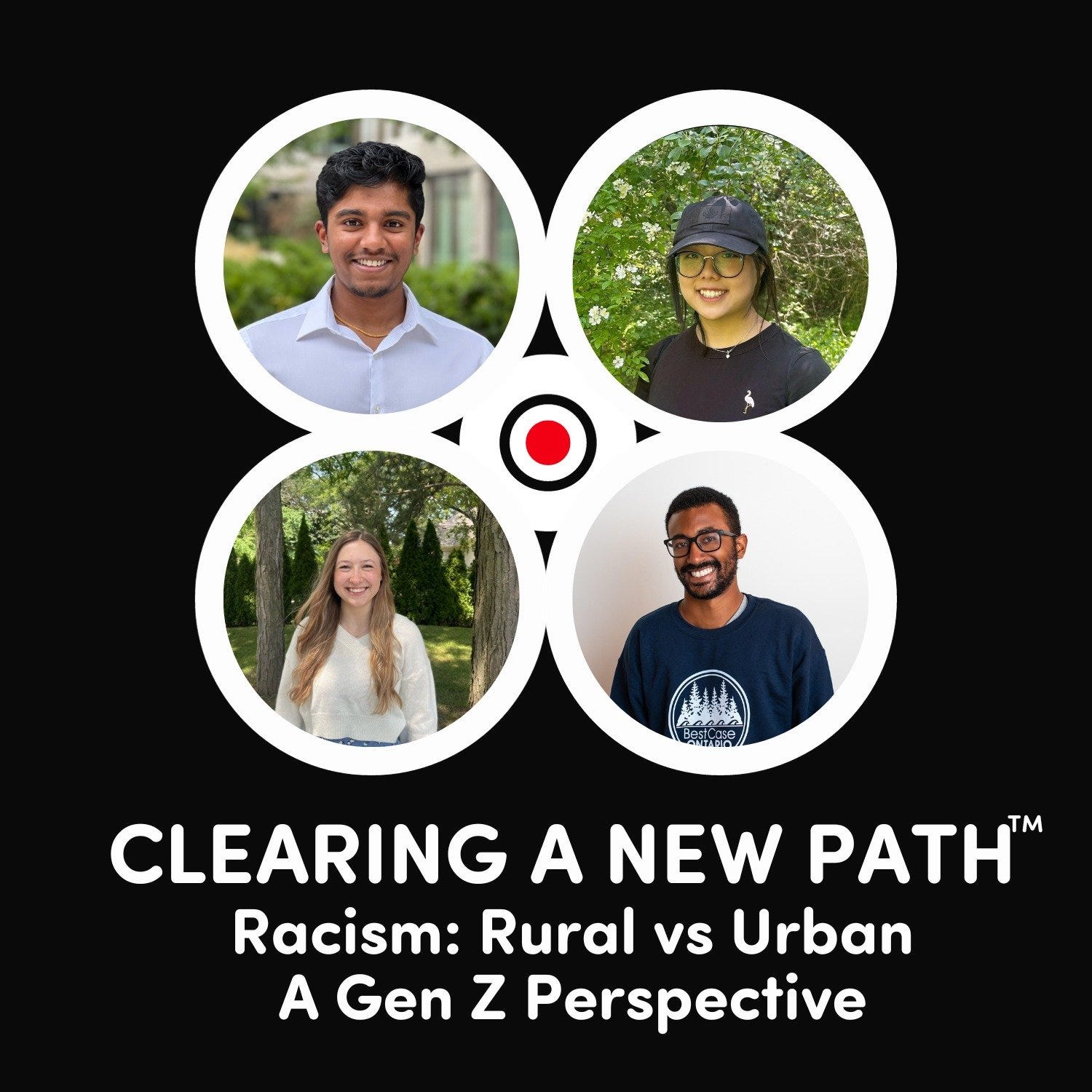
Racism: Rural vs Urban - A Gen Z Perspective
Nov 1, 202300:43:08Tap to summarizeRacism: Rural vs Urban - A Gen Z PerspectiveRacial inequities exist in Canada, and particularly in rural, remote and northern Canada.I have heard the stories. Just one example is a Black woman entrepreneur in rural Alberta, who told me of the racism she experienced at her local Chamber of Commerce.She’s the reason I enlisted the help of post secondary students (from the Venture for Canada Intrapreneurship program) from racialized and marginalized communities to create the report: How Inclusive are Canada’s Chambers of Commerce? A Report Card and the Words 2 Action: DEI Mobilization Map that followed.As a white settler, am I the right person to facilitate a conversation about race?I again enlisted the help of students from the Venture for Canada program.This time, I asked the students to help me rethink the podcast. What more could I be doing to bring attention to contentious and uncomfortable topics in rural Canada, like racism?Yvonne Wang and Uttej Mannava, both Western University students, took on the challenge of planning a podcast episode about racism from a rural vs urban perspective. Yvonne’s studies are currently around health and Uttej is studying data science.They hosted Kirsten Schmidt from the rural perspective. Kirsten is a research assistant with the Rural Development Network and a student at the University of Alberta. She grew up in rural Alberta.From the urban perspective, Cedric Richards, a local travel influencer from London, Ontario added his lens to the conversation.(You can follow his awesome newsletter/blog here!)I listened ‘backstage’ and it was really evident to me, because Yvonne, Uttej and Cedric are all people of colour, there was so much more context, richness and fullness to the conversation.I am so grateful to all of them for taking this on. Get full access to clearing a new path at clearinganewpath.substack.com/subscribe
Transcribe →