Loading summary
Transcript77 lines
- [00:03]
Dina Temple-Rastin
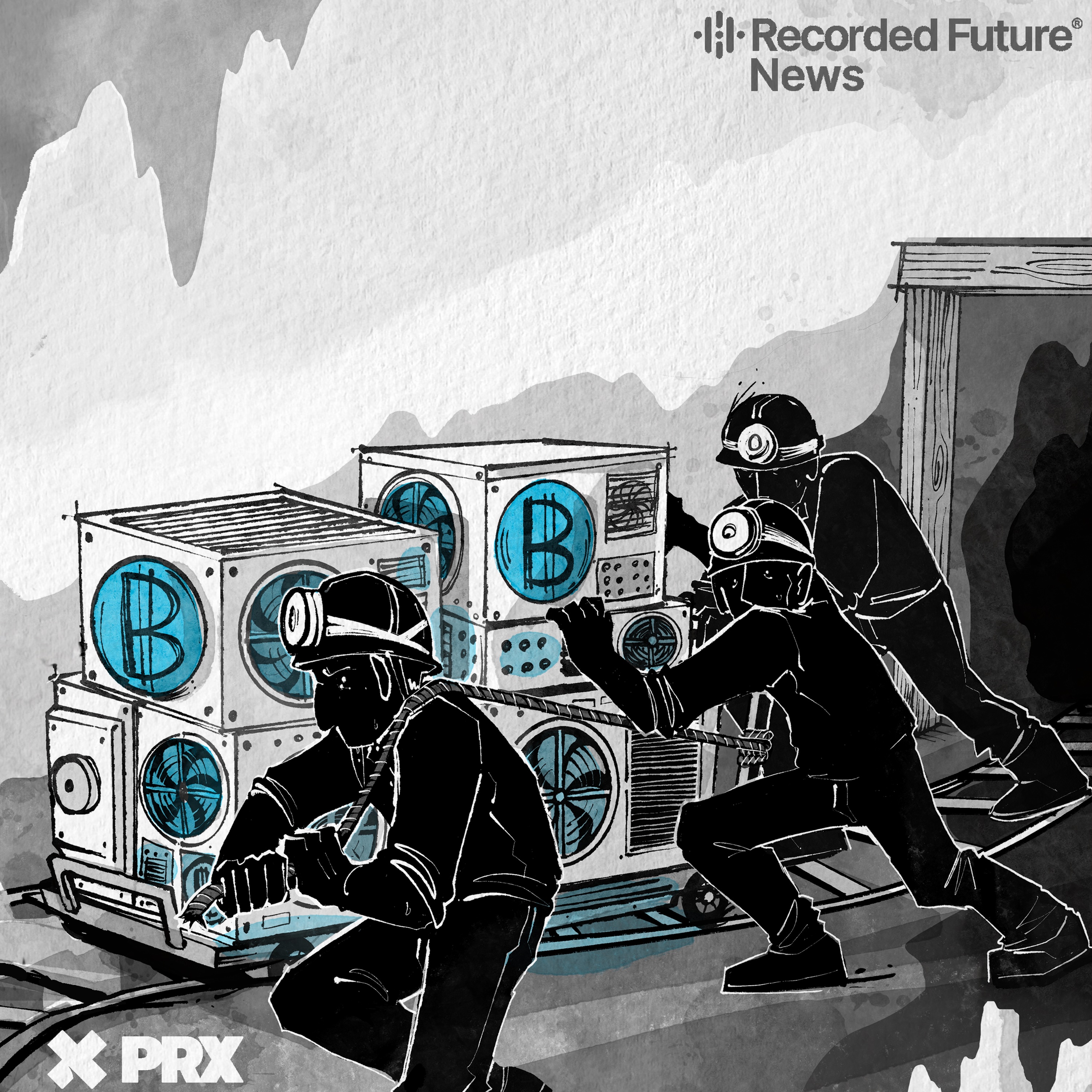
From Recorded Future News and PRX, this is click here. We're about 60 miles east of Lexington, Kentucky, deep in the Red river gorge. It's after dark, and we're walking along this little creek at the bottom of a hollow. Tall hills dense with blue gre green shadows of the trees. It smells like moss. And bats are flying overhead to see. Bat. Yeah, of bats. Out here, the city falls away. There are no street lights, no traffic. Just us and the geese. Then we drive a little way down the road where the quiet begins to fray. So we're walking along Little Bend Road, and there's a big substation here. And then just around the corner, maybe you can start to hear it. There's the bitcoin mining. A bitcoin mining center. It's a hundred yards ahead of us, tucked into the velvety folds of the Kentucky hills. A half circle of shipping containers, eight of them, and they're wrapped in chain link. And there are two guards and pickup trucks outside. This is one of many bitcoin mining centers in the area. They've popped up all over eastern Kentucky in the past few years, drawn here by something unexpected, something buried in the state's past. It turns out this part of the country is ideal for crypto mining because it was once ideal for coal mining. Same infrastructure, same power lines, just a different kind of extraction going on. Not in the hills, but in these centers. But this isn't a story about noise. It's about signals, signals of a new industry, one that claims it's here to save what coal left behind. This is the sound of a region known for mining falling in love with it all over again. Though this time, the pickaxes are algorithms.
- [02:23]
Anna Weitz
People are happy with mining, comfortable with mining. See mining as a savior.
- [02:29]
Dina Temple-Rastin
There's something seductive about that idea. It's like the past didn't die. It just updated its software. I'm Dina Templewresten, and this is Click Here. We tell true stories about the people making and breaking our digital world. Today, a story from the hills of Kentucky, where coal is mostly gone, but the idea of extraction never really left. Four years ago, cryptocurrency mining swept into eastern Kentucky with the swagger of a tech boom. It promised jobs, investment, a reason for young people to stay. We spent four days chasing that promise past shuttered mines, empty storefronts, and towns where the post office doubles as a community center. And we were chasing what sounded like a fairy tale. But what we found felt more like a parable. Stay with us. Click Here is brought to you by Progressive insurance, fiscally responsible financial geniuses, monetary magicians. These are things people say about drivers who switch their car insurance to progressive and save hundreds of. Visit progressive.com to see if you could save Progressive Casualty Insurance Company has affiliates. Potential savings will vary. Not available in all states or situations. For recorded future news, this is Click here. I'm Dina Templerest. The promise of crypto mining lands in a different way in Kentucky than it might somewhere else.
- [04:19]
Anna Weitz
Mining. This is a different kind of mining, but that's a very emotional word for eastern Kentucky because of the generations of coal miners.
- [04:29]
Dina Temple-Rastin
This is Anna Weitz. She's a lawyer in Frankfort, Kentucky. Wow. I hadn't even thought of the emotional resonance of.
- [04:36]
Anna Weitz
Oh, it is. It is so important to people. The tradition is I was a coal miner. I am a coal mining family. Even though this is by a computer, they understand the idea of using resources to make something that helps people for money.
- [04:57]
Dina Temple-Rastin
For generations, Kentucky coal miners worked underground, often in danger, all to keep the lights on for the rest of us. And in the process, they became a kind of American archetype, a symbol of grit, of muscle, of the industrial machine that built America. Appalachian coal was king right up until the 1990s. At its peak, it was one of the biggest industries in America.
- [05:24]
Commodore Long
The roads were lined with trucks, coal trucks, 18 wheelers, 12 what we call triaxles. And it's all the way from here to Hazard. Either coming down or going back to get another load or coming down with a load.
- [05:40]
Dina Temple-Rastin
This is Commodore Long, the 79 year old editor of the Wolf County News.
- [05:45]
Commodore Long
It's a boom time as far as coal was concerned. It was really booming.
- [05:50]
Dina Temple-Rastin
Booming most of all for the coal companies. They seemed to know what Kentucky's hills were worth far better than the people who actually lived on them. And they took advantage of that.
- [06:02]
Commodore Long
All these companies came in, stripped the coal, stripped the hills, tore them up. They buy an acre of ground that was probably would produce I don't know how many tons of coal for a dollar an acre.
- [06:19]
Dina Temple-Rastin
A dollar in exchange for land that would go on to mint millionaires and leave the people who sold it with little more than dust.
- [06:27]
Commodore Long
We trusted people, that's one thing in my view anyway. We usually trust people till they prove it to us otherwise.
- [06:35]
Dina Temple-Rastin
But that trust came at a cost. By the time the coal boom went bust and companies left town, the hills were stripped bare, flattened, gouged and left for dead. Streams ran orange with mine runoff. Some of the trees never came back. The economy unraveled. Most of the jobs the Pensions, the future. Coal promised, gone. Which may explain why when crypto came calling about four years ago promising something new that sounded familiar, people around here listened. And they weren't the only ones to be taken in by this new, new thing. Have you ever heard of bitcoin? It's a digital currency that's gaining popularity.
- [07:30]
Colby Kirk
It exists only online.
- [07:31]
Dina Temple-Rastin
Tell you the truth, celebrities like Matt Damon were pitching it during the Super Bowl.
- [07:36]
Dylan Fine
Fortune favors the brave.
- [07:39]
Dina Temple-Rastin
Ftx. It's a safe and easy way to get into crypto. Working with crypto has never been easier. Come on, Granny. People were getting rich off it.
- [07:49]
Dylan Fine
Dylan Fine is living the dream.
- [07:51]
Dina Temple-Rastin
I turned $350 into 12,000. And then at the height of all this buzz, a totally unexpected thing happened. Countries started banning crypto mining because of the amount of energy it consumed. Even China, which at one point was the source of almost 70% of the cryptocurrency mining in the world, banned it in 2021. So what exactly is bitcoin mining? It's basically a race between thousands of computers competing to solve a kind of math puzzle. They're all trying to guess a secret number, one that unlocks the next block in something called the blockchain, which is bitcoin's immutable digital ledger. The thing about bitcoin mining is that it's pure trial and error. Guess wrong, guess again wrong. And this happens millions of times until the first computer that guesses it right in return wins some bitcoin, and then the whole thing starts over. This process keeps the bitcoin system running, but it uses a ton of electricity, which is why crypto miners are always chasing the cheapest power they can find. And this is where, quite unexpectedly, Kentucky came in. In a million years, did you think that you would get involved with cryptocurrency cases?
- [09:15]
Anna Weitz
I did not. In fact, I'm a skeptic. I did not understand how it worked and how it made. But anything that would provide jobs and training people for careers that they could do, I'm very passionate about that.
- [09:31]
Dina Temple-Rastin
This is Anna Weitz again, and she's become a kind of go to lawyer for crypto in Appalachia. Foreign companies found her by googling on two occasions.
- [09:41]
Anna Weitz
Some, a Chinese company called me and said, we've seen that you do this. We see that you have a translator available in your office. Would you help us talk to the county and negotiate?
- [09:54]
Dina Temple-Rastin
Funny thing about progress, it doesn't always blaze a new trail. Sometimes it follows the old ones, wires and all. Kentucky, it turns out, was practically pre Wired for a crypto boom, thanks to the ghosts of coal. Back in the days of coal, when a company discovered a promising seam, it didn't just dig. It built a town. Houses, stores, schools, all orbiting around a single mine. And because coal requires so much energy, they built power lines, too. Big ones with substations and transformers, which, as fate would have it, crypto miners need, too. By some estimates, to mine a single bitcoin, you can burn through as much energy as an average US household uses in about 47 days. When China banned crypto in 2021, effectively outlawing more than half the global bitcoin market overnight, bitcoin miners had to move fast. They needed land, they needed power. And Kentucky had both. But it also had something else, something hard to quantify, A kind of brand recognition rooted in American mythology. A place where bourbon flows and horses run. Kentucky was part of America that Chinese bitcoin miners thought they understood.
- [11:17]
Anna Weitz
Kentucky is heavy into tourism because of the bourbon, because of the horses. And so I think it was a state that people abroad thought of. When they thought of America, they thought Kentucky, oh, yeah, we've seen a horse or the derby or bourbon. And so it felt more familiar to them.
- [11:36]
Dina Temple-Rastin
That was the X factor. So companies came, some small, some splashy, and at least one with a pitch that sounded more like satire than strategy. What if we burned trash to power the bitcoin mining?
- [11:49]
Anna Weitz
Unfortunately, incinerating the garbage did not produce as much power. Shocking. No one did not produce as much power as they needed.
- [11:59]
Dina Temple-Rastin
And then there was Mohawk. A new company focused on technology repair has opened its doors in Jenkins, Kentucky.
- [12:07]
Nina McCoy
Mohawk Energy is training people to repair everything from iPads to bitcoin mines.
- [12:14]
Dina Temple-Rastin
Everything about it sounded like happily ever after.
- [12:17]
Anna Weitz
The plan with Mohawk was to employ retired coal miners and disabled veterans who were back in eastern Kentucky and couldn't find work and train them.
- [12:28]
Dina Temple-Rastin
Mohawk promised training and technical skills that they could use beyond just crypto pay that exceeded expectations. They built a 42,000 square foot facility. And for a time, it was as good as it all sounded.
- [12:43]
Anna Weitz
28 families did very well for the 18 months it was open.
- [12:47]
Dina Temple-Rastin
And what are they doing now, do you know?
- [12:50]
Anna Weitz
I believe most of them are unemployed again.
- [12:52]
Dina Temple-Rastin
Wow. After a little more than a year, the dream began to crack. Accusations flew. There were electrical problems, unpaid rent, questions about who owned the bitcoin mining machines. Lawsuits followed. There were whispers about false promises, about whether Mohawk could ever do what it said it would do. Other crypto mining facilities followed them out the door, leaving only higher electric bills in Their wake rates driven up by power hungry crypto machines. All that hype and hope finally died down. Until the Kentucky night sounds were all you could hear again.
- [13:35]
Anna Weitz
I think that not just in terms of coal, but in every resource eastern Kentucky has ever had. I think that has happened over and over. Everything that's popular and valuable gets stolen away. That land, those hills have a long, deep history of being abused and pillaged, and I hate that.
- [13:57]
Dina Temple-Rastin
But then in recent months, a familiar tune started to play in Kentucky. Same song, different words. Not coal, not crypto. People started talking about AI.
- [14:09]
Unnamed AI Expert
Bitcoin is a one trick pony. You know, you create it. The only person that gets paid is the owner of the machines. Okay, there's no benefit after that. But AI is in everything that we do. Siri, like chat, GPT, like robotics, like everything you can imagine has to have AI. If you can create a key bunch of data centers in eastern Kentucky, all the AI people in the world will want to relocate their businesses in those areas.
- [14:45]
Dina Temple-Rastin
And boom.
- [14:50]
Unnamed AI Expert
It just creates a euphoria, a perfect deal for everything to start growing.
- [15:01]
Dina Temple-Rastin
Coming up, a new new thing may soon be rolling into town. Stay with.
- [15:13]
Unnamed Media Host
Most of our media are owned by a handful of tech billionaires. But there's one place that still operates like the Internet was never invented. On the new season of the Divided dial from onthemedia, we're exploring shortwave radio, where prayer and propaganda coexist with news and conspiracy theories and where an existential battle for the public airwaves is playing out right now. Listen to on the Media wherever you get your podcasts.
- [15:45]
Dina Temple-Rastin
ChatGPT, AI Machine, Satellite Engine ignition. Click here and lift up. Colby Kirk has been in eastern Kentucky long enough to recognize the sales pitch. He's the president and CEO of One East Kentucky. It's a regional nonprofit focused on economic development.
- [16:10]
Colby Kirk
We serve a nine county area here in the far eastern part of Kentucky, formerly kind of the heart of the coal fields.
- [16:17]
Dina Temple-Rastin
He's watched ideas come and go. Hemp farming, auto parts, solar farms, prisons, and yes, bitcoin. They all promise jobs, stability, a future. And then back in April, at a statewide economic conference, a new promise took center artificial intelligence.
- [16:40]
Colby Kirk
They had some site selection consultants that were on a panel and they were talking about data centers, and they talked about, you know, could our communities prepare for some of these kinds of investments? And the consultant was like, here's kind of what it takes.
- [16:56]
Dina Temple-Rastin
The consultants explained what a data center could mean for towns like Hampton or Ines. If built out properly, they said it could mean tech jobs that pay over $100,000 a year. With the AI boom, data centers are in high demand. So this could mean steady and even growing local investment. And for Colby, it clicked.
- [17:16]
Colby Kirk
You know, maybe a data center or something is a part of the puzzle.
- [17:20]
Dina Temple-Rastin
Kentucky already had the bones of data centers from crypto. So just like coal mining paved the way for crypto, crypto seems to be paving the way for AI. And data centers don't just need software engineers, they need welders, H vac techs, electricians, all of which Kentucky has in spades. While it all sounded so promising, Colby has seen this movie before. So he sat through the pitch and when the Q and A time came, he took the mic and I asked.
- [17:56]
Colby Kirk
You know, what are the long term trends of this? Are these data centers going to keep taking up million square feet, buildings with 30 and 40 foot ceilings, or are we going to be left with an abundance of, you know, warehouse or, you know, industrial scale buildings that we won't be able to keep up? And so he didn't really have a great answer for that question. He was honest with me and said, I don't know, you know, and that's the thing. We don't know what the future is going to hold when it comes to this stuff.
- [18:30]
Dina Temple-Rastin
And that uncertainty is exactly why people like Nina McCoy are skeptical. Nina lives in Ines, and she was Colby's high school biology teacher. She still teaches in a way, though. Now it's about patterns.
- [18:44]
Nina McCoy
This is going to sound awful, but if they're putting it here, then that means it's bad. We've lived here long enough to see that that is how it works. You put those things that you don't want in your neighborhood in a place like this. You put it in a place where the people are poor, desperate, and they just have to live with it.
- [19:18]
Dina Temple-Rastin
To some people here, the boom always seems to belong to someone else.
- [19:24]
Nina McCoy
You know, they call it boom and bust, but it's just a little boom for a few people. We've allowed these people to be called job creators. And I don't care if it's AI or crypto or whatever, we bow down to them, them and let them tell us what they are going to do to our community because they are job creators. They're not job creators, they're profit makers.
- [19:55]
Dina Temple-Rastin
And even the profits come with a cost. AI data centers are power hungry. Goldman Sachs did a study on just how much electricity these large language models use. And AI queries are estimated to require 10 times the electricity of traditional Google ones. And all that consumption has ripple effects. Rural areas with aging infrastructure have seen rate hikes. They could face rolling blackouts. Because when it's AI versus the local gym or bakery for power, the algorithm tends to win. And then there's water to stay cool. The centers draw hundreds of thousands of gallons a day. And what goes back isn't what came out. It's warmer, sometimes chemically altered. So when it leaves the data center and goes back out into the wild, it might change the streams, the fish, the soil. And Nina says the water systems they have now already aren't that great and might not be able to stand the strain.
- [21:02]
Nina McCoy
I am trying to get safe, affordable, reliable water for our community.
- [21:10]
Dina Temple-Rastin
And is there not safe, reliable water in the community?
- [21:14]
Nina McCoy
I'd say reliability and affordability are our biggest problems. There are a lot of breaks in the water system. The system is old. The system was put together very quickly during the time that mining was going on. And a system that was built in 1968 for about 600 homes within this small town, which is the county seat now, has been expanded to cover the entire county with 3,400 homes.
- [21:52]
Dina Temple-Rastin
And while some parts of Kentucky are considering a new AI future, the crypto past isn't really past. It's still working its way through the court system. That big Mohawk crypto project, it went into arbitration in May, and a single.
- [22:09]
Anna Weitz
Arbitrator decides whether they breach the contract. We breach the contract. Nobody breached. Everyone breached. And then which damages go to which side?
- [22:20]
Dina Temple-Rastin
And do you get the sense that. Because when all this sort of went down, I think the value of bitcoin was around 64,000.
- [22:28]
Anna Weitz
Yes.
- [22:28]
Dina Temple-Rastin
And now it's about 80,000. Do you get the sense that they might be more interested in restarting things here?
- [22:34]
Anna Weitz
I am hopeful. I always feel like you have to get to the very eve of trial or hearing before the parties will meaningfully negotiate. I am very hopeful that they sit down and say, mighty nice plant you have there. Let's just go ahead and turn it on and start.
- [22:53]
Dina Temple-Rastin
Since we talked to Anna Weitz, the price of bitcoin has gone up. It's now trading at a little over 100,000. And some people are hopeful that President Trump's crypto obsession might be the extra nudge bitcoin mining companies need. Hope, after all, is what gets sold here over and over again. Just outside Camden, the Artemis power mining operation. Those shipping containers with the computers inside continues to roar. Do you have your phone?
- [23:26]
Dylan Fine
Got it.
- [23:27]
Dina Temple-Rastin
Okay. Yeah. That's producer Zach Hirsch. He downloaded an app so we could measure just how loud the data centers are. We take a measurement 70 a weighted decibel. That's loud like standing next to a taxiing airplane loud. We're about 100 yards away from it and you can still hear it. Imagine what that's like. 24. 7 the Artemis Powertech miners in Campden never stop. Not at night, not on Sundays. And to some, it is the sound of a new digital future. For others, it sounds like history repeating itself. Because for all their efforts to create jobs in these hills, the future keeps arriving in eastern Kentucky. But it never seems to stay. This is Click Here.
- [24:34]
Unnamed Media Host
Looking for more of the cybersecurity and intelligence coverage you get on Click Here. Then check out our sister publication the Record from Recorded Future News. You'll get breaking cyber news from reporters in New York, Washington, London and Kyiv, among others. And you'll see for yourself why it attracts hundreds of thousands of page views every month. Just go to the Record.
- [24:58]
Dina Temple-Rastin
Here is some of the top cyber and intelligence news of the past week. Today, three stories. One about a quiet federal rollback that you might have missed. Another about a money laundering empire hiding in plain sight. And lastly, a crypto company that's decided to turn the tables. It's Tuesday, May 20th.
- [25:23]
Anna Weitz
The White House has scrapped a plan to block data brokers from selling American's most cens.
- [25:30]
Dina Temple-Rastin
Now this story is super boring, but really important. Back in December, the Consumer Financial Protection Bureau, the agency that watches over everything from loans to medical bills, had an idea. What if your most sensitive personal information, like your credit history, your Social Security number, your income couldn't be sold unless you gave permission? The Bureau's director under President Biden Rohit Chopra said this was a matter of national security and that these data sales could, quote, threaten personal safety. What a difference a couple of months makes. Now that plan is gone, the agency's workforce has been gutted. Over 1,000 employees, about 80% of the agency's staff was fired by Elon Musk's so called Department of Government Efficiency. And with their departure, the rule disappeared as well.
- [26:25]
Anna Weitz
Some people are calling it the biggest Darknet marketplace, like ever.
- [26:29]
Dina Temple-Rastin
Ever. And the kicker is, it wasn't tucked away on the Tor network or anything. It was running on Telegram last week. Telegram, the encrypted messaging app, took down thousands of accounts tied to a massive Chinese language dark market. It was called Hawang Guarantee and it sold everything a crypto scammer might need to succeed. Stolen data, fake passports, deep fake software, even GPS enabled collars and electric batons. Used untrafficked workers held captive in scam compounds. Elliptic, a blockchain tracing firm, says the network laundered more than 27 billion in illicit transactions, most of it in stablecoins tied to the US Dollar. Another market Shimvy guarantee, was shuttered as well. It reportedly had done some 8.44 billion in deals since 2022. Telegram's crackdown didn't happen in a vacuum, though. Earlier this month, the US treasury officially blacklisted How Wong as a major money laundering entity and finally, $2 million in unmarked bills, just like you want. But this is as close as you'll ever get to it, because no ransom will ever be paid for my son. Instead, I'm offering the money as a reward on your head. Coinbase, one of the world's biggest crypto exchanges, is doing its best Mel Gibson impression. After a hacking group demanded $20 million in ransom to not leak Coinbase customer data, the company flipped the script. Instead of paying the ransom, they offered the identical amount as a bounty. The breach allegedly began when hackers bribed customer service workers in India to gain access to internal tools that identified customers, bank information, and even some government IDs. The goal was to trick Coinbase users into handing over their crypto. Coinbase says it plans to spend up to $400 million in cleanup costs and promise to reimburse any of their customers duped by the scammer. Foreign.
- [28:44]
Dylan Fine
Was written and produced by Megan Dietrich, Sean Powers, Erica Gaeda, Dina Temple, Rastin and me Zach Hirsch. I was the lead producer. Field reporting by Dina Temple, Rastin and me. The episode was edited by Karen Duffin, Fact Checked by Darren Ankrum and contains original music by Ben Levington with some other music from Bluedot Sessions. Our staff writer is Lucas Riley, and our illustrator is Megan Gough. Martin Peralta and Jesse Niswonger do our sound design and engineering. Click Here is a production of Recorded Future News and prx. Tune in Friday for Mic Drop, which features our favorite interview of the week. We'll see you then.
- [29:41]
Unnamed Media Host
Looking for more of the cybersecurity and intelligence coverage you get on Click Here, then check out our sister publication the Record. From Recorded Future News, you'll get breaking cyber news from reporters in New York, Washington, London and Kyiv, among others. And you'll see for yourself why it attracts hundreds of thousands of page views every month. Just go to the Record Media.