Loading summary
Transcript101 lines
- [00:03]
Dina Temple-Raston
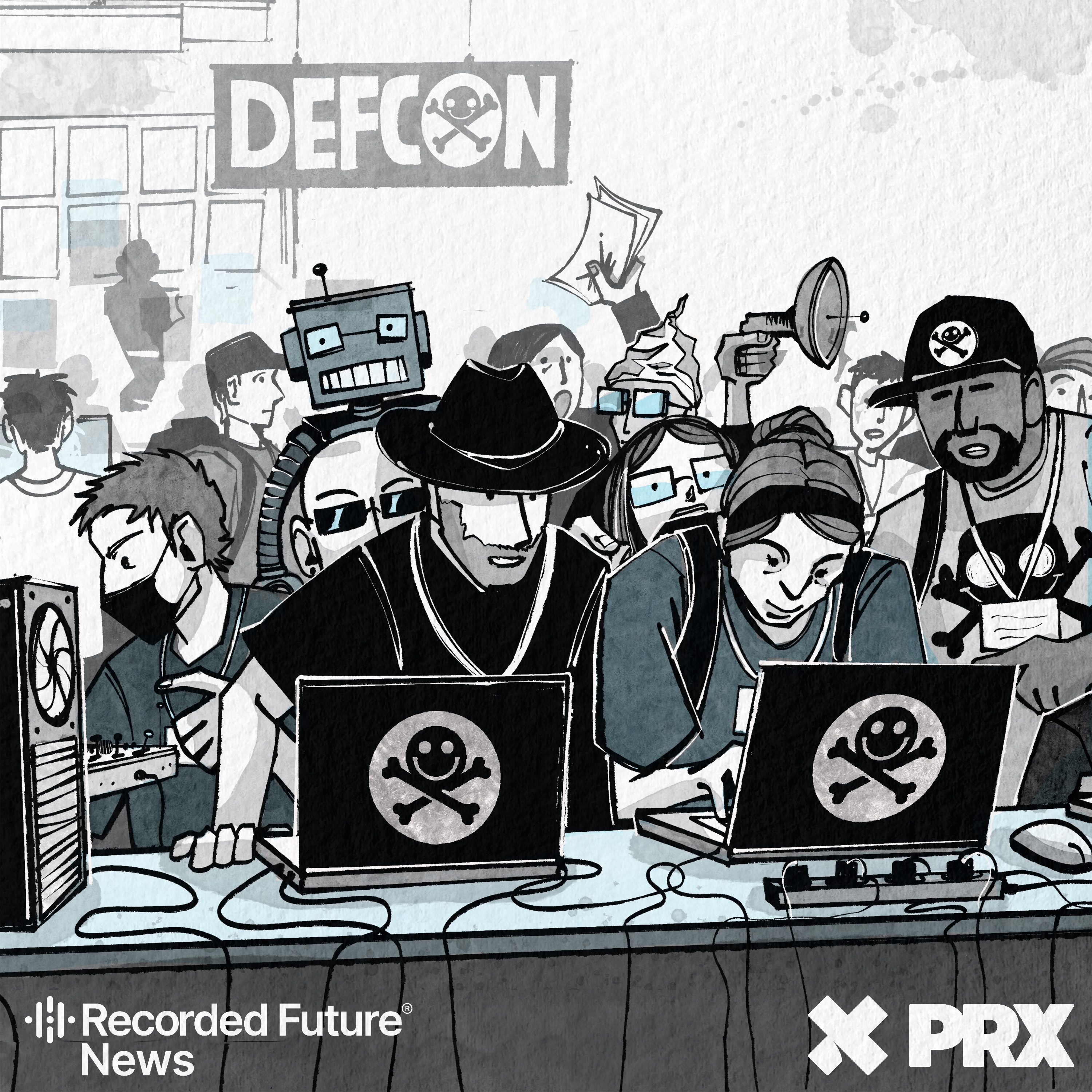
From Recorded Future News and PRX, this is click here. Later this week, 30,000 hackers will descend on Las Vegas. They'll arrive with backpacks full of cables, burner phones, and with a mission. A mission to test the limits, to find vulnerabilities hiding in plain sight and to be seen and sort of not seen in a city of smoke and mirrors. They bring the mirror. And this is defcon.
- [00:44]
Jeff Moss
Welcome to DEF con. Hello, DEF con. I want to talk a little bit about DEF con. And then we're going to introduce.
- [00:51]
Dina Temple-Raston
Not a convention exactly, more like a controlled detonation, a gathering where the underground comes up for air just long enough to show us what's broken before disappearing again. This is a place where the hallway whispers turn into zero days, where you might find yourself sitting next to a teenage hacker, a federal agent, or both.
- [01:13]
Jeff Moss
Welcome to the Karaki Village. As you can see, we've got a semi truck here if you're interested in learning how to hack a semi truck. We're showing people how to hack a microgrid using weather data. And if you come here, you can solve a challenge that will get you a White House bad.
- [01:29]
Dina Temple-Raston
At defcon, it's hard to know what's coming next. But more often than not, this gathering gives us a glimpse, a peek at the digital chaos on the horizon, and sometimes a little deja vu. From Recorded Future News and prx, I'm Dina Templewreston and this is Click Here, a podcast about all things cyber and intelligence. We tell true stories about the people making and breaking our digital world. And this week, Jeff Moss, the man who accidentally threw a party and ended up creating the most legendary hacker convention on earth. Stay with us. Support for Click Here comes from the Electronic Frontier Foundation. For 35 years, the EFF has been fighting to make sure that when you go online, you. Your rights go with you. And they have a podcast. It's called how to Fix the Internet. And it's all about getting things right in our online world. Season 6 kicked off May 7 with an episode exploring the concept of digital autonomy. The fight for digital rights is bigger and more urgent than ever. EFF is at the forefront of that battle. And because it's members supported. The more members they have, the more they can fight for our digital rights in state houses, in courthouses and everywhere. Visit eff.org podcast to listen to how to Fix the Internet and join EFF From Recorded Future News. This is Click here. Before Google, before discord, before the Internet as we know it, there were bulletin boards, not web pages. Exactly. You had to dial in with a modem, one user at a time. You'd leave a message. At the tone, please record your message. Maybe download a file. And if you were Jeff Moss in the late 1980s, you'd spend your whole teenage life there and become anyone you wanted to be. Call yourself anything you wanted to call yourself.
- [03:45]
Jeff Moss
The cool thing with handles is, was that if you really screwed up and you really made a fool of yourself or did something wrong, you could start over. You just pick a new handle and nobody knew.
- [03:58]
Dina Temple-Raston
It felt like magic. And for Jeff, it kind of was.
- [04:03]
Jeff Moss
It was a miracle, because on our block that year, every kid could have got a computer that Christmas.
- [04:09]
Dina Temple-Raston
TRS 80s TI9944S, the Atari 800. Jeff had one, too, but no modem. So he walked down the street to.
- [04:19]
Jeff Moss
Borrow one, and we would go to this house, and he'd be like, nobody knows that we're kids. I can't drink, I can't drive, I can't vote, but I can talk to people on the other side of the planet, right? So super, super exciting for a kid.
- [04:36]
Dina Temple-Raston
He explored everything online, including a technique known as war dialing.
- [04:41]
Jeff Moss
Everybody war dialed.
- [04:43]
Dina Temple-Raston
Explain what war dialing is.
- [04:44]
Jeff Moss
So war dialing. So if you ever saw the movie War Games, right the beginning. Matthew Broderick, he's war dialing. We're in. He's dialing every phone number sequentially, looking for a modem to find a computer. This box just interprets signals from the computer and turns them into sound.
- [05:01]
Matthew Broderick
Shall we play a game?
- [05:04]
Dina Temple-Raston
Jeff was hooked. And soon he wasn't just logging in. He was helping others connect. By the time he was 15, he was the digital switchboard for 11 different bulletin boards.
- [05:17]
Jeff Moss
So I was generally the hub for the United States. And I was pretty strict on moderation. And so I was kind of a dick, I think. You know, like, if people were not being very relevant, I'd just delete them or delete the message. But because of that, people wanted to get on my board because there was a really high signal and very low noise.
- [05:36]
Dina Temple-Raston
It was very well curated, curated.
- [05:38]
Jeff Moss
But I didn't know that's what I was doing at the time. I was just trying to get at the cool information and of people.
- [05:43]
Dina Temple-Raston
And he came up with a handle.
- [05:44]
Jeff Moss
And there was this comic book called D apostrophe arctangent, like the mathematical function. And I lost the comic book. And so I'm coming up with a name, and I misremembered the name of this comic book instead of D Arc Tangent. I remembered it as Dark Tangent.
- [06:01]
Dina Temple-Raston
Dark Tangent, the name stuck. Then someone running PlatinumNet, one of the bulletin boards that he was curating, said they were moving and wanted a going away party. So Jeff for Dark Tangent offered to organize it.
- [06:16]
Jeff Moss
So I picked Vegas because there weren't any.
- [06:18]
Dina Temple-Raston
Sure, why not Vegas? He sent out invites.
- [06:22]
Jeff Moss
I'm sending out faxes to these like any public. Mondo Magazine, Anybody that's like remotely interested in the Internet, or not even the Internet back then. Just, you know, I'm sending faxes. I sent a fax to. Since we knew the feds were going to come to DEF con, I sent a fax to the Secret Service in Las Vegas.
- [06:39]
Dina Temple-Raston
Why did you know they would come?
- [06:41]
Jeff Moss
It was well known that the Feds would go to any hacking conference. I don't know if it's true, but that was the mythology, right? So you may as well let them know you're coming, right? So I sent them this fax saying like, hey, we're going to do this hacking conference and you're invited, Secret Service, you should come and speak. And you know, I don't hear back from them at all.
- [06:58]
Dina Temple-Raston
But the idea behind the invitation was, was pretty simple. Jeff wanted to bring people together, not just to celebrate, but to make sense of a world that was changing fast. Because back then even the basics were murky. What was a computer crime? What crossed the line and who got to decide?
- [07:19]
Jeff Moss
Because I was so tired of all this nonsense. And so I'm like, well, if I'm getting them all together to have a party, what can I do with it? Well, I can try to get the people that know better to dispel the nonsense.
- [07:29]
Dina Temple-Raston
So right from the beginning, DEF CON was more than a party. He was part celebration, part reckoning.
- [07:36]
Jeff Moss
And that's really how it started.
- [07:40]
Dina Temple-Raston
Naming the thing he was creating, that was easy.
- [07:43]
Jeff Moss
Everybody had a con. The name in the early days was based sort of on a like a season. Summer con, Hohokan, pumpcon, right? So it's like, okay, can't be tied to a season. I need something neutral. It's going to be on the West Coast. Not going to be invite only. The slang back then was, man, that's totally deaf, right? And number three on the phone is def. All of a sudden it's like that lines up, war games lines up. The number three on the phone lines up, you know, the jackpot.
- [08:13]
Dina Temple-Raston
About 100 people showed up to the first DEFCON. They came in from California, Utah and the east coast, even England.
- [08:21]
Unknown
Did you guys fly in any Foreign countries, non US Countries, England.
- [08:30]
Dina Temple-Raston
You make it sound like it was really easy to put together. Was it?
- [08:34]
Jeff Moss
Well, in the early days, it kind of was because I just had a tape recorder to record the talks. And it was like a room with chairs. I mean, none of this stuff was thought through. Right. It was basically like the room opens at 2. See you there too. Right. I think I. I don't even know if I had a sign. I had the T shirts.
- [08:49]
Dina Temple-Raston
And it was just strangely, the one person who did not show up, the friend he had arranged all this for, he had just ghosted Jeff.
- [08:57]
Jeff Moss
So now I'm stuck trying to throw this party.
- [08:59]
Dina Temple-Raston
And it didn't take long for the mischief to begin. Hackers started playing with the elevators. RFID hacks, door jams, random Muzak pumped into the speakers. DEF CON was already becoming DEF con.
- [09:17]
Jeff Moss
We stayed up all night, learned that you do not want to stay up all night for three days in a row at your conference.
- [09:23]
Dina Temple-Raston
At what point did it turn into something that you were hacking into things?
- [09:26]
Jeff Moss
Well, I mean, the first year, we definitely were hacking into things.
- [09:32]
Dina Temple-Raston
Thing is, back then, no one really knew what counted as curiosity in the hacker world and what crossed the line into a federal offense. The Computer Fraud and Abuse act, the seminal law that even to this day governs tech issues, had only gone into effect a few years before, in 1986. And while it made access to computers without authorization a crime, it didn't do much to define what that actually meant. So people guessed and asked each other to try to gauge the limits and the boundaries.
- [10:04]
Jeff Moss
There wasn't a Google, there wasn't Amazon, there are no books on this. So it was all about who you knew. And can I convince them to tell me about it?
- [10:11]
Unknown
How many of you have been interviewed? Okay, how many of you have been on? My hand is up. How many of you have been charged? My hand is up. How many of you been busted?
- [10:22]
Dina Temple-Raston
And sometimes that hacking didn't involve any code at all.
- [10:26]
Jeff Moss
Dumpster diving was one of the early ways people would try to learn information so you could find just weird internal nodes, any kind of access information, login, password, dial in information. Especially in the telco age, where at.
- [10:38]
Dina Temple-Raston
DEFCON 1, Jeff and a few others took a field trip to a telecom site. And they came back with bags of documents, big black Glad bags stuffed with secrets.
- [10:49]
Jeff Moss
We grabbed all these printouts and all these docs, and we come back in these Glad bags, like, you know, returning victorious warriors. Dump them on the carpet right there. And everybody starts, you know, going into.
- [10:59]
Dina Temple-Raston
It then one of the conference speakers, a federal prosecutor, happened to walk by.
- [11:04]
Jeff Moss
So was the dumpster inside the chain link fence or outside the chain link fence? We're like, oh, it's outside. Excellent. You know, enjoy yourself.
- [11:14]
Dina Temple-Raston
And that's when Jeff realized the Feds weren't just watching from a distance. They weren't just keeping tabs on defcon from behind a desk in Washington. They were here in the hallways, in the ballrooms, blending in, taking notes. And then there was this moment right after one of the early cons.
- [11:35]
Jeff Moss
Some guy comes up to me, lifts up his shirt, shows me his Secret Service badge, and he's like, hey, this is a great con.
- [11:41]
Dina Temple-Raston
Just like that. No pretense, just a badge and a smile. And things only got stranger. At a later capture the flag competition, a kind of hacking Olympics. Jeff noticed someone who was kind of.
- [11:54]
Jeff Moss
Off, and there's some rando standing behind them, and he's scribbling on these yellow post IT notes as fast as he can. And the Post IT notes are, like, going down his arm, and now they're working up his chest.
- [12:04]
Dina Temple-Raston
And then across the room, another guy.
- [12:07]
Jeff Moss
And I end up standing next to this guy. Oh, hey, what are you. What are you doing here? Where are you from? He's like, oh, I'm from the dia.
- [12:15]
Dina Temple-Raston
The dia? That's the Defense Intelligence Agency. Think CIA, but more spreadsheets than trench coats. They track satellites and foreign militaries and apparently hacker gatherings.
- [12:28]
Jeff Moss
He's like, oh, well, I'm trying to figure out if other people are here trying to recruit hackers. And I'm like, fascinating. How would you do that? He goes, oh, well, no, what you do is you like what we're doing now. You stand at the edge of the room and you watch, and you watch for other people watching.
- [12:48]
Dina Temple-Raston
In a place where everyone's observing, the real trick is spotting the observers. And that's when Jeff realized he hadn't just built a party, he'd built a magnet.
- [12:59]
Jeff Moss
And that was the moment of, like, there's value and things going on here that you don't comprehend and you might not ever comprehend.
- [13:07]
Dina Temple-Raston
And it was about to get even curiouser and way more out of control. That's when we come back.
- [13:20]
Unknown
In cybersecurity, your greatest fear isn't the threats you see. It's the critical signal signals lost in the noise. Every day, security teams sort through millions of potential threats. That's why Recorded Future exists, to give you precision intelligence tuned to your needs. Our advanced AI detects patterns humans might miss, while our Threat intelligence experts, veterans of military and intelligence services provide crucial context with recorded future. You gain the confidence to identify critical threats and the precision to act before they become attacks. Learn why 1900 + customers, including 45 + sovereign governments, trust us to detect threats faster and achieve 350% plus ROI within a year.
- [14:13]
Dina Temple-Raston
ChatGPT AI machine satellite engine ignition. Click here. DEFCON 3 felt different the moment you walked in. Here's Jeff Moss speaking to the crowd there. In 1995, when I started playing this.
- [14:31]
Matthew Broderick
Convention, I never thought it would be get this much attention. It was just meant to be a party and now it's sort of ballooned into whatever. So that's why I like to kind of keep the carnival atmosphere so it doesn't ever get too serious.
- [14:42]
Dina Temple-Raston
But serious or not, DEFCON was changing. What had started as a gathering of friends and phone freaks was suddenly drawing a new crowd. Rowdier, rougher, less interested in the culture and more into the chaos.
- [14:57]
Jeff Moss
A whole nother breed of people started to show up from LA and they were trashing the place and it was no fun. Like they just get the microphone, blah blah blah blah, and throw the microphone on the ground and it's like, that's a $150 microphone I'm going to have to pay for now.
- [15:10]
Dina Temple-Raston
And Moss, this accidental founder, found himself in a new role. Security.
- [15:15]
Jeff Moss
People would come up to me and say like, do you know, somebody's like, you know, doing some chaos in that other room. And I'm like, no, I have no idea what's going on in that room. Could you help me out? And pretty soon people in the community started to help out. They kind of deputized themselves and that problem went away.
- [15:31]
Dina Temple-Raston
And just like that, a community started policing itself. DEF CON had officially outgrown its creator. A one off farewell party had morphed into a full blown movement. Part scene, part pilgrimage, part job recruiting fair. And that last piece, Jobs, is what hit a nerve.
- [15:52]
Jeff Moss
That was the beginning of the Anti Sec movement and you're a sellout if you take a job in this area. But all of a sudden all these banks and places going online needed help. Who understands the technology hacking community? All of a sudden they're all getting ridiculous job offers. It got really crazy.
- [16:10]
Dina Temple-Raston
Antisec, short for anti security, was a line in the sand. Take the job or stay underground, help build the system or keep trying to break it. Some hackers cashed in, others saw it as a betrayal. Proof that the culture had been commodified. But either way, the tide had turned. By DEFCON 6, you didn't just see hacker villages and rogue lock picking demos. You saw booths, logos from Fortune 500 companies. The underground had just gone mainstream.
- [16:48]
Jeff Moss
And with that came a lot of money flooding. The parties went crazy. People are showing off with all the champagne action and the limo cars rented. And then there are the other half who are like, not into that. They just like the technology and the purity of that.
- [17:01]
Dina Temple-Raston
And for Jeff, it started to feel like a fork in the road. So he built a second track, Black Hat. Something more structured, more polished, more corporate. I think most people think of DEFCON as kind of being punk rock.
- [17:15]
Jeff Moss
Yeah.
- [17:16]
Dina Temple-Raston
And Black Hat as being sort of corporate.
- [17:19]
Jeff Moss
Yeah, yeah. One's infosec, one's hacker, you know, one's kind of keep DEF CON weird and the other one is help get me a better job.
- [17:26]
Dina Temple-Raston
But DEF CON never stopped being def convicted. It stayed weird and brilliant and just a little bit dangerous. A place where hackers set their sights on the next green field.
- [17:36]
Jeff Moss
They're always looking for green fields. Oh, it's lock picking, it's access control, it's ATM machines, it's aerospace, it's satellites, it's biomedical, it's, you know, whatever the new thing is, they want to explore it.
- [17:49]
Dina Temple-Raston
DEFCON became a kind of radar. He didn't need to look ahead to see the future. He. You just had to walk the halls.
- [17:56]
Jeff Moss
So it turns out that the community itself has sort of become, you know, the conference was, we were presenting content to the audience, but now the audience itself, some of the members are becoming the content. One day you're an attendee, the next day you're participating, the next day you're presenting.
- [18:11]
Dina Temple-Raston
And that may be the most important thing DEF CON ever taught us. Not just about hacking, but about power. Because DEFCON isn't just a conference. It's a place for people who see systems differently, who know secure is just a word. And everything, every network, every firewall, every institution is more fragile than it looks.
- [18:33]
Jeff Moss
I wish I had a crystal ball. It's always a reflection of the community. More automation, more AI, more politics. Supply chain farming, automation, maritime. There's all these layers going on. I get to see some of these people peeling back these layers in a.
- [18:52]
Dina Temple-Raston
World where we're all being watched, where code decides what happens next. And one hack can change everything. DEF CON is still different. It's still a place where the edges come first, where changes start quietly with a question or curiosity. And sometimes with a little chaos.
- [19:12]
Jeff Moss
I miss the olden days too, but I like the current days, too, each different. And it's a reflection of what's happening. And you can't, like, freeze that lightning in a bottle, right? It's just, it's ongoing, continuous evolution.
- [19:26]
Dina Temple-Raston
And maybe that's the point. DEFCON doesn't stay the same. It adapts. And maybe that's the magic, not in holding on to what it was, but watching what it becomes. This is Click here. Oh, and one last thing. If you're going to Vegas this week, take the stairs. Trust me.
- [19:53]
Unknown
If you're looking for a daily guide to cybersecurity news and policy, sign up for the Cyber Daily from Recorded Future News. It serves up the day's most interesting and important cyber stories from our sister publication the Record, and then aggregates all of the big cyber stories you might have missed from news outlets around the world. Just go to the Record Media and click on Cyber Daily to get all you need to know about the world of cybersecurity right in your inbox.
- [20:22]
Dina Temple-Raston
Here are some of the top cyber and intelligence stories from the past week. It's Tuesday, August 5th. American healthcare is finally getting a digital upgrade.
- [20:34]
Jeff Moss
Thanks to this announcement, healthcare providers across the country will also finally be able.
- [20:40]
Dina Temple-Raston
To kill the clipboard.
- [20:41]
Jeff Moss
It's an expression.
- [20:42]
Dina Temple-Raston
The Trump administration has unveiled a private sector initiative that will let more than 60 companies, including Amazon, Google and CVS, share patient health data in real time. The idea is convenience. Your entire medical record pulled up on your phone with just a tap. No more faxes, no more forms on clipboards. No more waiting. But privacy advocates worry that it'll do away with the walls between your medical life and big tech. Because signing up doesn't just give your doctor access, it gives every participating company access to everything. Mental health assessments, prescriptions, your full medical history. And sure, officially, you'll need to opt in. But data privacy experts are worried because not so long ago this same administration gave Medicare data to ice. So the real question isn't who can see your records, but what they'll do with them once they do. Meanwhile, the cost of a data breach in the US just hit a record high $10 million. That's per incident, according to a new report from IBM. And while the rest of the world is getting better at stopping the bleeding, not so much in the US Why are data breaches getting more expensive? Because fines are going up and security systems are getting more expensive. The healthcare industry is getting hit the hardest. It takes almost 280 days to find and fix a hack, about five weeks longer than the global average. Meanwhile, countries like Germany South Korea and Italy say they've seen the cost of a hack dropped by some 20%. Here in the U.S. we're trending in the other direction. And in Moscow, something weird is happening.
- [22:35]
Jeff Moss
With the WI fi, the Kremlin's most notorious hacking group. Turla, has been using Russian ISPs to plant spyware on the computers of their targets in Moscow, leaving their communication.
- [22:47]
Dina Temple-Raston
A new report from Microsoft reveals that Turlo, a hacking group with ties to Russia's fsb, has been using local Internet providers to spy on diplomats. Here's how it Embassy staff try to connect to the local Internet and they get a pop up, like the kind you see in a hotel lobby asking them to update their security certificates. But that pop up isn't from the embassy. It's actually from the hackers. Click once and spyware is installed. But it doesn't lock your files or demand a ransom. Instead, it just quietly turns off encryption and exposes sensitive conversations and gobbles up credentials, letting Russia essentially listen in without lifting a finger. It's a modern twist on an old Cold War tactic, surveillance disguised as tech support.
- [23:39]
Unknown
Wow.
- [23:40]
Rainbow fruit.
- [23:41]
Dina Temple-Raston
Do you want it? Yes. And finally, the children are outside, sort of. They're farming on Roblox. If you don't know it, Roblox is a gaming platform that allows users to build their own games, millions of them. And one of those games is called Grow a Garden. And it has quietly taken the Internet by storm. No shooting zombies or high speed chases here, just bees buzzing, tomatoes ripening and chickens pecking through pixelated straw. You buy a plot of land, adopt some animals and tend to your digital crops. It was designed by a teen developer and in June it racked up some 21 million players all at once. A Roblox record. And maybe in a bit of a bright spot, the game is pulling in more players than Fortnite. Because in a world built for speed and spectacle, this quiet little farm might be the most radical thing in gaming right now. Sometimes the ultimate rebellion is just touching the grass.
- [24:51]
Unknown
Today's episode was written and produced by Megan Dietre, Zach Hirsch, Erica Gajda, Dina Temple Raston, and me, Sean Powers. I was the lead producer. The episode was edited by Karen Duffin, Fact Checked by Darren Ankrum, and it contains original music by Ben Levingston. We have some other music from Blue Dot Sessions. Our staff writer is Lucas Riley and our illustrator is Megan Gough. Jussie Niswonger is our sound designer and engineer. Click Here is a production of recorded future news and prx. Tune in on Friday for Mic Drop, which features our first favorite interview of the week. We'll see you then.
- [25:34]
This show is supported by Odoo. When you buy business software from lots of vendors, the costs add up and it gets complicated and confusing. Odoo solves this It's a single company that sells a suite of enterprise apps that handles everything from accounting to inventory to sales. Odoo is all connected on a single platform in a simple and affordable way. You can save money without missing out on the features you need. Check out odoo-o o.com that's o d.
- [26:02]
O-O.Com if you're looking for a daily guide to cybersecurity news and policy, sign up for the Cyber Daily from Recorded Future News. It serves up the day's most interesting and important cyber stories from our sister publication the Record, and then aggregates all of the big cyber stories you might have missed from news outlets around the world. Just go to the Record Media and click on Cyber Daily to get all you need to know about the world of cybersecurity right in your inbox.