Loading summary
Transcript74 lines
- [00:03]
Dina Temple Ralston
From Recorded Future News and prx, this is Click here. A few years ago, Ed Liu recorded this video from the International Space Station. He was in the station's bay, floating about 250 miles above the Earth.
- [00:33]
Ed Liu
Good evening and greetings from the International Space station. I'm Expedition 7 flight engineer and NASA science officer Ed Liu.
- [00:40]
Dina Temple Ralston
He lived on board for six months in the early 2000s. Now, there are certain preconceived notions we earthlings have about space travel. Like, it seems like it might get lonely up there, floating endlessly in the cosmos.
- [00:57]
Ed Liu
Lonely is the wrong word. Busy is the right word. We had so much to do. So you're always doing something. You're always, you know, go, go, go, go.
- [01:07]
Dina Temple Ralston
And spacewalks, well, Hollywood would have us think they're incredibly quiet, but that's wrong, too.
- [01:14]
Ed Liu
The worst thing would be if it was quiet, because that means your fan has died in your suit. Yes. You have to blow oxygen and air over. Over your face. There's a whirring sound to the fan. And if you stop hearing that sound, it is a bad thing.
- [01:34]
Dina Temple Ralston
The sound of space is a whirling fan.
- [01:36]
Ed Liu
That's exactly right.
- [01:42]
Dina Temple Ralston
During his NASA career, Ed did spacewalks. And a spacewalk isn't so much a walk as it is a workout. They usually last for hours. So people like Ed check instruments, tighten bolts, and look for problems on the station's exterior. And as he made his way around, moving from one handrail to the next, he fully expected to see some loose bolts and this spectacular view of the Earth. But there was something else he kept spotting, too. Something pretty terrifying. Holes. Lots and lots of holes.
- [02:23]
Ed Liu
I remember seeing a. A sort of hole in one of the handrails. Looked like a bullet hole. And at that time, the space station had only been up for a few years.
- [02:34]
Dina Temple Ralston
These holes were created by what NASA has deemed the number one risk to astronauts in space.
- [02:41]
Ed Liu
NASA does a. Something they call a probabilistic risk assessment, which, where they try and add up what are the risks, what are the largest causes of risk? And quantitatively, as best as you can. And the largest risk for astronauts on the space station is space debris.
- [03:01]
Dina Temple Ralston
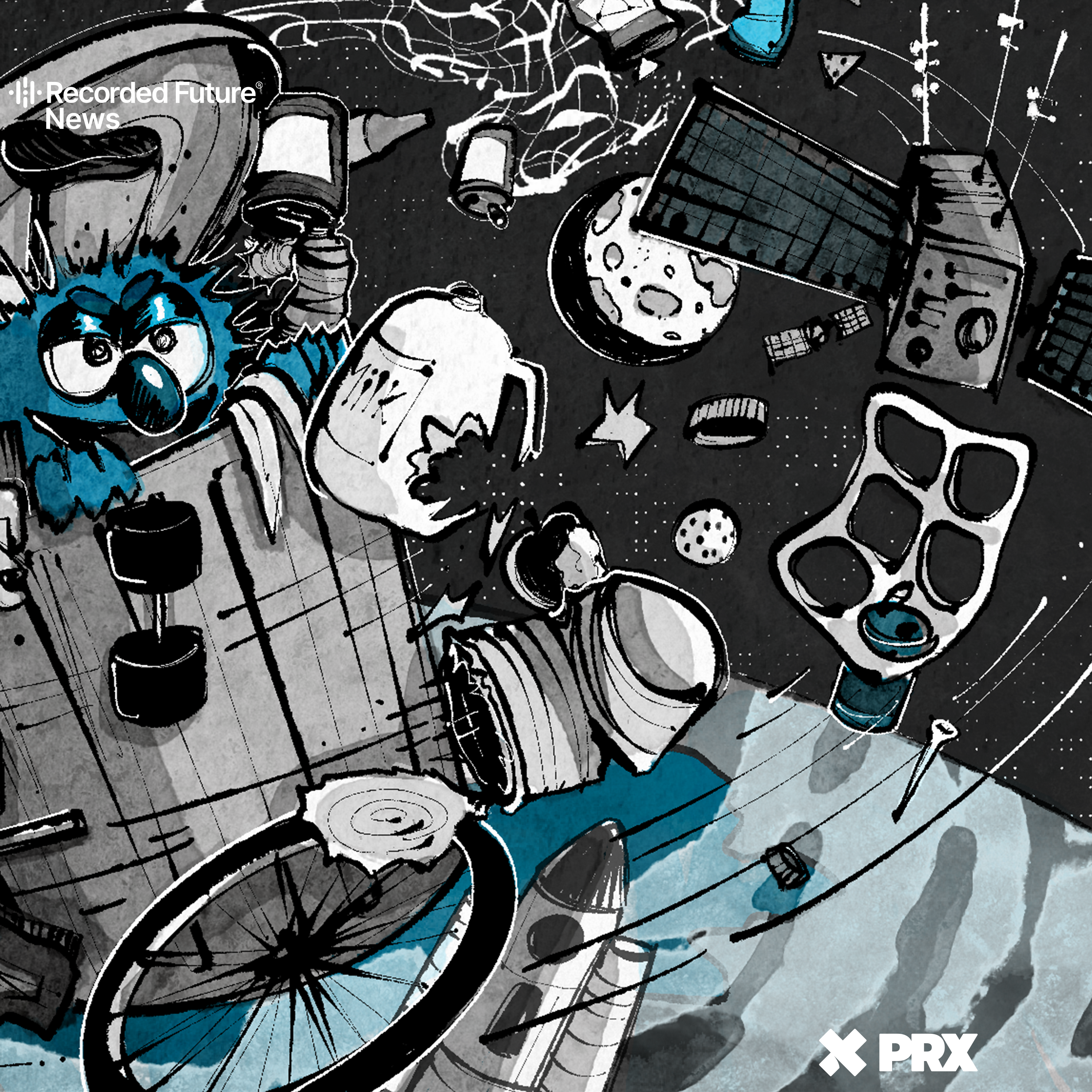
Space debris. There are millions of pieces of it circling the Earth. There are big pieces, everything from dead satellites to spent rocket stages and tiny ones like bolts and paint flecks. And they're all whizzing around at speeds that can be faster than a speeding bullet. It's a huge problem. Think about what a pebble does to your windshield at 80 miles an hour. And this Is much, much worse.
- [03:28]
Ed Liu
It was that way in 2003. It's that way today. Every year you're in, year out, it's number one on the list.
- [03:37]
Dina Temple Ralston
This is exactly the danger that played out in the movie gravity with Sandra Bullock. Explorer's been hit.
- [03:45]
Unknown
Explore.
- [03:46]
Dina Temple Ralston
Do you ring? Sandra Bullock was an astronaut out on a spacewalk when the shuttle was hit by debris and she was catapulted into the void. Astronaut is all structured. Could you hear debris hitting the space station?
- [04:05]
Ed Liu
I have heard that, you know, a very loud ping sound. You'll hear it throughout the space station. You don't know where it's coming from.
- [04:12]
Dina Temple Ralston
And about 10 years ago, when Ed stopped being an astronaut, he decided to try to nail down where all those people, pieces of space junk were coming from. Not just to help future astronauts, but to keep people on earth safe too. I'm Dena Temple Ralston and this is click here. A podcast about all things cyber and intelligence. We tell true stories about the people making and breaking our digital world. And today we look at the vexing problem of space debris. Not just what it is, but now that it's there, how our adversaries might be able to make it a whole lot more dangerous. Stay with us. From recorded future news. This is click here. I'm Dina Templerest. When Ed Lieu retired From NASA in 2007, at first he was focused on what you might call a more organic form of space junk.
- [05:33]
Ed Liu
We've been working on the problem of preventing asteroid impacts on earth.
- [05:37]
Dina Temple Ralston
Ed helped launch a nonprofit called the B612 Foundation. It's a reference from the little prince. It's a tiny asteroid sized world. In the book, Ed and the people at the foundation decided to map and track as many near earth asteroids as possible because, and this is important, if we can find them early enough, we can do something about them.
- [06:00]
Ed Liu
If you know where an asteroid is years ahead of time, that one's going to hit the earth. It's almost relatively easy to deflect an asteroid. All you need to do is give them an absolutely ridiculously tiny nudge to make them miss the earth.
- [06:11]
Dina Temple Ralston
Really? This happened in real life. Just a couple of years ago, NASA used a small spacecraft to slam into the asteroid Dimorphos. NASA is about to intentionally crash a spacecraft into an asteroid. And they're going to do mission known as DART. A Test of Quote Planetary Defense. 3, 2, 1. Oh my gosh. In the name of planetary defense.
- [06:39]
Bob Gourley
It is a first for humanity. NASA successfully changed the path of an.
- [06:43]
Dina Temple Ralston
Asteroid after doing that for Several years. Ed then spotted a trend that was happening so far in the background, or maybe so far up in space, most of us probably didn't give it much thought. 3, 2, 1.
- [07:00]
Bob Gourley
SpaceX lifted off from the launch pad in Southern California minutes later, sending 10 satellites into space.
- [07:11]
Dina Temple Ralston
Thousands and thousands of satellites have been launched into space. And now they're tracking our weather, sending us TikToks and hopefully providing directions so we can get to brunch on time. They've become kind of like the utility poles of space. No wires, but just as vital.
- [07:30]
Ed Liu
All of our modern day life is dependent upon things going on in space. A lot of people don't realize this.
- [07:35]
Dina Temple Ralston
It sounds strange to say it, but as more and more satellites go up, space is getting more and more crowded, or at least the area where satellites typically settle, something called the low Earth orbit, or LEO. It's about 1200 miles above us, so.
- [07:54]
Ed Liu
There'S a lot of activity. And there are satellites that tail other satellites that track other satellites that get close to the maneuver to get close to other satellites. There's all sorts of stuff happening. It's not. It's a very dynamic situation.
- [08:08]
Dina Temple Ralston
He's not exaggerating. There are about 10,000 active satellites in low Earth orbit right now. And there are something like 25,000 or so pieces of space debris that are large enough to be tracked. Things like bits of satellites with another 250,000 pieces of untracked debris like those paint flecks. Low Earth orbit is no longer like a backcountry road. It's getting dangerously close to the Audubon at rush hour. As Ed watched this unfold, he had an epiphany. This cosmic highway needs a traffic cop. So he switched from tracking asteroids to tracking satellites and space junk. And he helped set up a company called LeoLabs. They've set up radars around the world to track all the stuff that's in low Earth orbit.
- [09:01]
Ed Liu
What we do is we help satellite operators prevent collisions with other objects because we tell them where everything is.
- [09:09]
Dina Temple Ralston
They can spot when debris is on a collision course with something and then alert people so they can stop that before it happens. Flight 022, turn right at 180 and maintain at 3000, often well before it happens. LeoLabs can actually predict potential collisions up to seven days in advance. So they can give companies plenty of time to move their satellites out of the way.
- [09:35]
Ed Liu
We've had some very close passes. We have tracked objects that have gone within a few meters of each other. A few tens of meters for sure. At, you know, a relative velocity of 15 or so kilometers per second, that's, you know, 35,000 miles per hour. And to miss by, like, meters is crazy. And we've observed that many times.
- [10:10]
Dina Temple Ralston
If all of this wasn't already making you feel anxious enough, the threat actually isn't just about one satellite hitting another, a kind of interstellar fender bender. The real concern is a pileup, because, of course, when you move to avoid object A, you might be running into object B. And if you hit object B, it might then ricochet off a half dozen other objects. It's kind of like being at a dinner party where someone bumps the table, a glass falls, shatters, and as someone lunges to catch it, they also bump the table, and another glass goes flying and then another. Pretty soon, what was just one spilled glass is now a chain reaction mess. The concern is that a couple of errant satellites can do something similar. But in space. One piece of junk hits, say, the space station, and something flies off and it becomes another piece of junk. And every collision increases the odds of more collisions. And eventually the space around the Earth could get so cluttered that satellites are under constant threat of that or even worse, that launching new satellites becomes almost impossible. A NASA scientist named Donald Kessler read aloud about this back in the 1970s. But he had a sort of evil twist. Not just what if two satellites accidentally run into each other, but what if some villain hacked into a defunct satellite, turned it into a projectile, and then created one of those destructive chain reactions, not by accident, but on purpose. This is now known as the Kessler Syndrome. And should it come to pass, the worst case scenario could be terrifying.
- [12:01]
Gregory Falco
Space is increasingly a contested environment, and it's actually a war fighting domain.
- [12:09]
Dina Temple Ralston
That's when we come back. Stay with us.
- [12:20]
Unknown
You come to the New Yorker Radio Hour for conversations that go deeper with people you really want to hear from, whether it's Bruce Springsteen or Questlove or Olivia Rodrigo, Liz Cheney or the godfather of artificial intelligence, Geoffrey Hinton, or some of my extraordinarily well informed colleagues at the New Yorker. So join us every week on the New Yorker Radio Hour wherever you listen.
- [12:43]
Dina Temple Ralston
To podcasts.
- [12:49]
Gregory Falco
ChatGPT, AI machine, satellite engine ignition.
- [12:53]
Dina Temple Ralston
Click here and lift up. Satellites in space have become central to maintaining stability here on Earth. Their core to military strategy, Internet functionality, economic growth. So Kessler's nightmare scenario that someone might intentionally try to disrupt the satellite system isn't just a theoretical scientific concern, but a very clear and possibly present danger.
- [13:20]
Ed Liu
Because space is so economically important, strategically important, there Is the potential for bad actors to create mayhem. You could cripple company or a country by cutting off certain key services. Right. And that's what countries and companies are worried about.
- [13:40]
Dina Temple Ralston
Turns out that preventing that kind of mayhem in space has a terrestrial equivalent, Something near and dear to our hearts. Cybersecurity.
- [13:49]
Ed Liu
Why is the Internet target? Because that's where the money is, right? Or that's where all the services are. The same can be said of space right now. Just like the cybersecurities are tracking what's going on on the Internet, we're tracking what's going on in space.
- [14:05]
Dina Temple Ralston
And just like cyber threats, Space threats seem to be growing almost faster than we can keep up. Just ask Bob Gourley, the former chief technology officer at the Defense Intelligence Agency, or dia.
- [14:18]
Bob Gourley
I believe we need to treat space junk as a cyber threat.
- [14:23]
Dina Temple Ralston
He came to this conclusion after spending years studying these threats up close.
- [14:28]
Bob Gourley
I was a early consumer of the nation's intelligence capabilities from space.
- [14:33]
Dina Temple Ralston
DLAA is the agency at the defense Department that produces and manages foreign military intelligence. And Bob says it's only a matter of time before space junk is weaponized in the same way. It was only a matter of time before computer code went to the dark side. And this threat could come about in a very unexpected way. So far, we've been talking only about all those new satellites that have been launched recently. But what about this other problem, Satellites that have been in space since the late 1950s.
- [15:07]
Bob Gourley
We have satellites that were launched decades ago that are still up there, that are not as secure.
- [15:14]
Dina Temple Ralston
There are untold numbers of satellites up in space right now running on software that was developed during the Kennedy or n. And it's so old that updating it is nearly impossible. You can see where this is headed. Those kinds of satellites could be incredibly easy to take over, Much easier than you might think.
- [15:37]
Bob Gourley
A hobbyist from their home could put an antenna up on their roof and send a wake up command to a satellite parked in geosynchronous orbit. And next thing you know, that satellite wakes up and then this hobbyist in theory could send it signals like maneuver over here or take a picture or send some data back. If it's some old ancient system that we launched back in the 80s, that's a definite realistic threat.
- [16:07]
Dina Temple Ralston
Satellite's taken over by not just your weird neighbor in his basement, But a nation state with the naxtigrade. They could be used as a kind of cosmic hand grenade, Sent hurtling in the path of satellites that keep the Internet online or military communications Flowing. This isn't just an idle concern. Back in the 1990s, a time when the Internet was a little clunky, but still pretty magical, Bob Gourley was part of a team watching this unexpected thing happening at the Pentagon. Files just started disappearing, classified ones about military plans and NASA.
- [16:45]
Bob Gourley
This is one where I was absolutely instrumental in figuring out who is doing it and what do they want and how do we stop them.
- [16:54]
Dina Temple Ralston
It turns out who was doing it was hackers from the Russian military intelligence service. And what were they taking?
- [17:01]
Bob Gourley
The information they were stealing was about our satellites and other technical systems.
- [17:07]
Dina Temple Ralston
Fast forward a couple of decades, and adversaries are still doing those kinds of things. Three years ago, right after Russia invaded Ukraine, it hacked satellites that the Ukrainian military was using to talk to its troops. And back in 2007, when Ed Lieu was still at NASA, Gregory Falco says that two US government satellites actually got hacked.
- [17:30]
Gregory Falco
The satellites were attacked and taken control over for a matter of tens of seconds, and the operations center lost complete control over these assets.
- [17:44]
Dina Temple Ralston
Gregory is an assistant professor of aerospace engineering at Cornell University. And while the US eventually got them back, the mere fact that someone tried to take them over for any length of time, that was a wake up call. It sent shockwaves through the intelligence community, and it took a while to actually attribute the attack. Officials think the Chinese were behind it. In fact, they even telegraphed their plans to do it.
- [18:11]
Gregory Falco
China had in its space strategy saying we plan to hijack satellites. And then they've demonstrated how they were able to hijack satellites.
- [18:19]
Dina Temple Ralston
Though the intelligence community has been pretty tight lipped about any satellite hacks since then, Gregory says they've happened.
- [18:28]
Gregory Falco
There's been a number of attacks against these systems. Most of them that happen in space, though, are usually not disclosed publicly.
- [18:38]
Dina Temple Ralston
Whether or not people are willing to talk publicly about these celestial hacks, there is a way to spot them by looking at what all these orbiting objects look like when they're just spinning around the Earth and then spotting anomalies. Which is why Ed Liu and others like him are making giant space junk maps. Because if you know exactly what a satellite is supposed to, it's a lot easier to notice when that changes. Ed has already seen it happen.
- [19:08]
Ed Liu
Then suddenly we've noticed, start moving something that just sat not doing anything for years and suddenly start to maneuver.
- [19:15]
Dina Temple Ralston
You know, I think it's really interesting that, you know, if we look at the Internet, when it was created, nobody ever thought about bad people using it, right? There was just a failure of imagination in terms of regulating it in the beginning, and we're rushing to catch up. Do you think that we're making the same mistake when it comes to space, or do you think that we've kind of learned our lesson and we're trying to get ahead of this?
- [19:37]
Ed Liu
I don't think society learns its lessons like that. You know, any new technology has, you know, enormous pluses and minuses, right? Nothing is entirely positive. Nothing is entirely negative. And it's a mistake to think that, you know, suddenly, you know, we were dumb then and now we're smart. We'll never make this mistake again, right? That's, that's not true.
- [20:01]
Dina Temple Ralston
Right?
- [20:01]
Ed Liu
Just like everything else, something will be growing like crazy. But only a small fraction of the society realizes this and, and understands the significance of this great change. Right? I think the majority of the population in, you know, mid-1990s did not realize the significance of the growth of the Internet. What would happen to society? You know, same thing's happening in space right now. Enormous changes are afoot.
- [20:35]
Dina Temple Ralston
This is Click Here. Today is Tuesday, January 14th, and here are some of the top cyber and intelligence stories of the past week. Hey, Siri, can you talk to me? You go first. Tell me your hopes, your dreams, your favorite cuisine. Apple is settling a $95 million lawsuit that claims their voice activated assistant Siri recorded conversations after being unintentionally turned on and then shared that information with third party advertisers. Apple has denied any wrongdoing, but as part of the settlement, they said users can get $20 for each Siri enabled device they own. And Apple has clarified its privacy rules. Apparently, contractors do listen to Siri's audio, but Apple denies that they sold that data to build marketing profiles on Siri's users. Apple says any audio recordings Siri captured aren't saved unless users explicitly opt in to help improve Siri. And it will keep trying to make Siri's privacy protections even stronger. Meta has said that it will stop using third party fact checkers on Facebook, threads and Instagram and will rely instead on users to add notes to posts. CEO Mark Zuckerberg made the surprise announcement.
- [22:08]
Mark Zuckerberg
We've reached a point where it's just too many mistakes and too much censorship. The fact checkers have just been too politically biased and have destroyed more trust than they've created, especially in the US.
- [22:19]
Dina Temple Ralston
Meta's fact checking policy was originally instituted to try to stop the spread of misinformation across its social media apps. Critics say the company is trying to reposition itself to be more in line with the Trump administration, which has been an advocate of unfettered online speech.
- [22:36]
Mark Zuckerberg
It's time to get back to our roots around free expression on Facebook and Instagram.
- [22:41]
Dina Temple Ralston
Zuckerberg conceded that there'd probably be more bad stuff on the platforms as a result of the decision. And finally, the fate of TikTok now rests in the hands of the US Supreme Court. This were an American corporation be an entirely different thing. Exactly, and the reason that was the crux of the argument the US Solicitor general made before the justices last week. They were listening to the company's appeal against a stated nationwide ban of TikTok if it doesn't find a non Chinese buyer by January 19th. The social video app, which is owned by The Chinese firm ByteDance, is used by some 170 million Americans. The appeal has been winding its way through the courts since President Joe Biden signed a law clearing the Wayfarer ban last year. Making TikTok go away, even if the justices decide to uphold the ban, won't be easy. The law doesn't require anyone to uninstall TikTok from their phones. It also doesn't say TikTok would have to stop its services from working in the U.S. instead, the law will just make it harder to use TikTok over time by stopping companies that help make TikTok work. So if it isn't in the App Store or Google's Play Store, you can't get updates and new features. But analysts say TikTok's users can find a way around that too, by finding the app somewhere else. Today's episode was produced by Megan Dietrich, Sean Powers, Erica Gajda, and me, Dina Temple Raston. It was edited by Karen Duffin, Fact Checked by Darren Ancrum, and contains original music by Ben Levingston with some other music by Blue Dot Sessions. Our staff writer is Lucas Riley and our illustrator is Megan Gough. Martin Peralta is our sound designer and engineer. Click Here is a production of Recorded Future News. We'll be back on Friday with a new episode of Mic Drop.
- [24:58]
Unknown
If you're looking for a daily guide to cybersecurity news and policy, sign up for the Cyber Daily from Recorded Future News. It serves up today's most interesting and important cyber stories from our sister publication the Record, and then aggregates all of the big cyber stories you might have missed from news outlets around the world. Just go to the Record Media and click on Cyber Daily to get all you need to know about the world of cybersecurity right in your inbox.