← Clotheshorse with Amanda Lee McCarty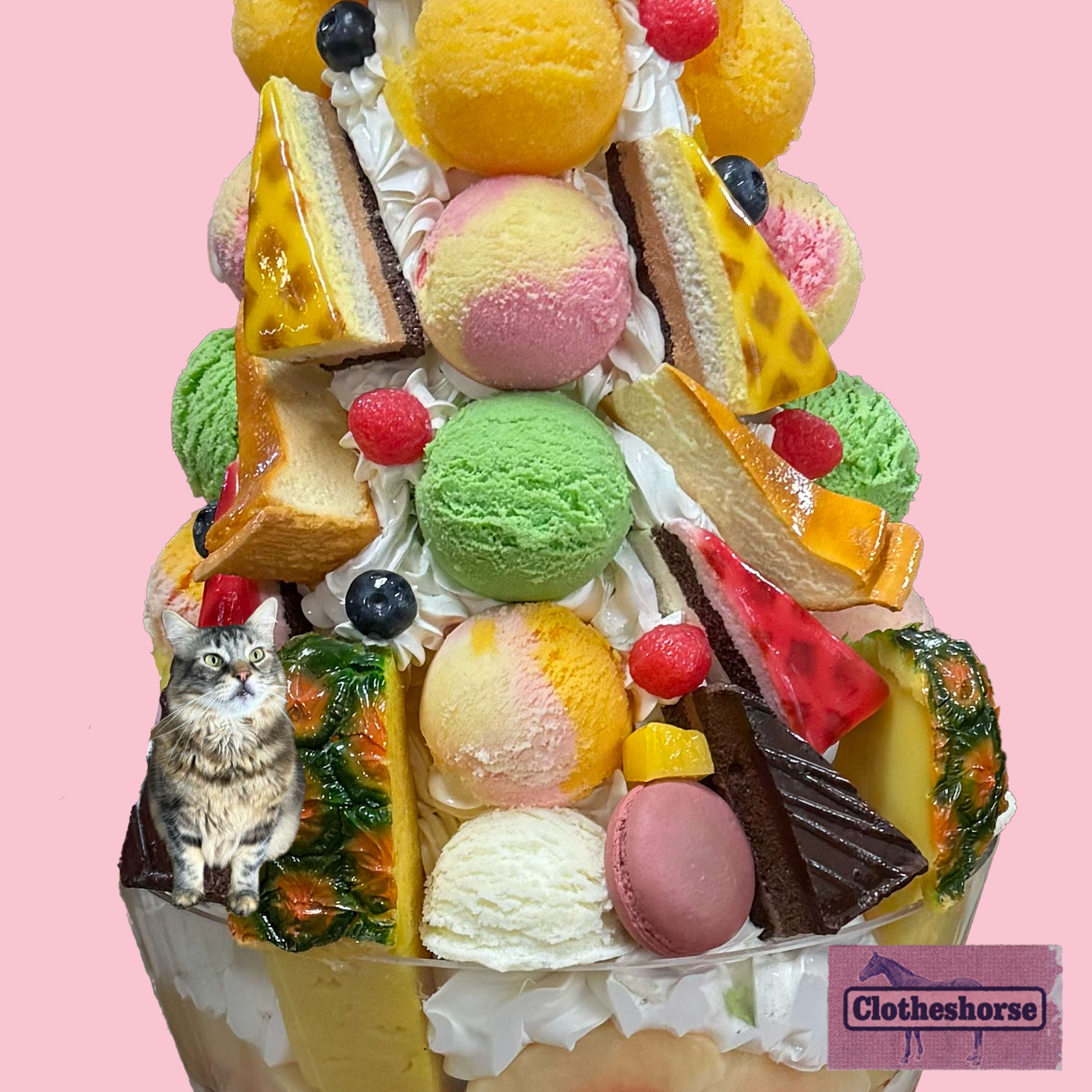
Clotheshorse with Amanda Lee McCarty
Episode 218: Clotheshorse in Japan: Fake Food (Shokuhin Sampuru), Parfaits, and Pudding
01:15:21
Loading summary
Transcript31 lines
- [00:00]
Amanda Lee McCarty
Foreign. Welcome to Clothesforce, the podcast that is.
- [00:21]
Dustin Travis White
Very open about its love of fake fruit.
- [00:26]
Amanda Lee McCarty
I'm your host, Amanda, and This is episode 218, recorded in Nagasaki, Japan. And by the way, can I just tell you how amazing it is to be like, hey, you know, everyone, I love fake fruit, and here's a whole wall made of thrifted fake fruit, and you're all supportive and excited about it. I truly have met my people, and I'm beyond super happy about that. It's incredible. Well, I've been in Japan now for almost three weeks, and I'm flying home in eight days. And, you know, I'm going to miss all of the cool stuff I'm seeing here. I'm going to really miss those convenience egg salad sandwiches. I'm going to miss all the amazing epic parfaits. Have I talked about parfaits yet? We might have to talk about that in the next episode. I love Japanese parfaits. It makes sense when you see pictures of them. Like, of course I would be into that. Despite leaving all those things in another week, I'll also be super excited about seeing Dustin, about seeing the cats. Oh, my God, can you imagine the reunion with Brenda? I'm gonna be so stoked to sleep in my own bed. And wow, let me tell you, not having to live out of a suitcase anymore, that I just keep unpacking and repacking every few days. That'll be pretty grand, too. And just. Just the washing machine being one floor below my bedroom. These are all things that you take for granted until you're away from them for a long time. I'm pretty excited. So what have I done since the last time we talked? Well, for one, I read a really incredible book that I recommend to all of you. It's called Pachinko. It's by Min Jin Lee, and it is all about Koreans who moved to Japan in the colonial period when Japan was colonizing Korea. And it's a whole saga about a family. It extends from, like, the 1920s through the 80s, and it's incredible. There's actually a series, a television series on Apple TV plus, and it's really great. So anyway, if you're looking for a book to read, especially now that the weather's getting cooler and you're gonna be spending more time, hopefully cozy at home. Pachinko. Amazing book. And I'll share that in the show notes. So I read that book. Right now I'm reading a book called the Goldfinch. I'll report back about that later. But what else have I done? Well, I took another three train trip to Takayama, which is a beautiful town in the mountains that I really, really want to visit again with Dustin and at least spend one night there, if not a couple. The purpose of this trip, however, was to visit a pair of Showas slash retro museums that were filled with toys, games and other ephemera of the Showa era, which is a period of Japanese history corresponding to the reign of Emperor Showa. That was Emperor Hirohito from December 25, 1926 until his death on January 7, 1989. It's a long span, right? But if you can imagine a museum filled with toys and ephemera and advertising and gadgets and whatnot from the 1920s through the late 80s, well, you know, there's a lot of cool stuff to look at. And more than ever that era, the Showa era, is experiencing such like a trend here in Japan. I don't, it feels weird to say that, but I think it's just nostalgia. And so there's just a lot of really incredible mid century 70s and 80s design that's sort of being like pushed back into the public eye and products and like characters and such from that period as well. So it was really, really cool to go to that museum. Worth the epic trip. It's actually two museums and they're about, I don't know, a 10 minute walk apart. I filmed so much, so much stuff there. Dustin would be so proud of me because I usually forget to do things like that when I'm somewhere cool, but I really forced myself to and I need to put together a reel so you can all see how cool that was. But by the way, everything that I have done in Japan so far, I try to at least share stories. So you should check out the highlights on my profile to see some of these things. So that was an awesome trip on this trip actually to Japan just as a whole. I'm going further south into Japan than I've ever been before, starting with Beppu. That's how they say at the station, be poo, which is spelled B E P P U. And that's a small resort town on the south Japanese island of Kyushu. It's located between Beppu Bay and volcanic mountains. So it's got its own sort of like moody, interesting environment. The air smelled so good when I got off the train there. And it's home to more than 2,000 onsen, which are the hot springs, you know, with the mineral baths. It's really amazing. It's beautiful. It's moody. It smells really good. And the hotel we stayed in had the best breakfast, including local specialties like bamboo charcoal curry. I'm going to be trying to hack that recipe forever. This incredible chicken and rice dish that was just so simple, but so good. I also had this pumpkin custard, which is savory, not sweet. I'll be thinking about that one for a long time, too. I have a lot of recipes to try to replicate when I get home, which is good because I love a cooking challenge. Okay. The other thing I did while I was in Beppu, I don't believe in bucket lists, but one of the reasons I was in that part of Japan was to visit a place that has been on my. If I were to call it a mental bucket list of things I wanted to do someday. It's been on there for at least a decade. I visited Sanrio Harmonyland, which is an outdoor Sanrio theme park high up in the mountain. Mountains. Some of you might know this if you've been listening for a long time or you've met me irl, but I actually have a hello Kitty tattoo on my arm. It's hello Kitty reading a book, which, you know. Are you really surprised to hear that? So I've always wanted to go to Harmonyland. It's way off the beaten path for most Western tourists going to Japan. It's a lot of trains. There's not a lot of stuff in English there or on the way there, it's a little bit more complicated. Right. And so it's up in the mountains. It's beautiful. There's actually a huge swath of the park that's just for hiking and picnicking. Just incredible. Like, bamboo forests, nature. There's river. It's. It's amazing. And of course, there were some really cute rides. And none of them are scary because, you know, it's a park for children. And it's definitely, like, on the older side, so it's not, like, polished like Disneyland might be, like, it's a little beaten up. There's some weird zones where you're like, wow, this is like a weird dead zone of the park where nothing's really going on except for some trees. Okay, I'll take it. It didn't have that slickness of American theme parks, and I really, really loved it. I've been to Sanrio Puroland outside of Tokyo twice now. It's very tempting to go again on this trip. Not gonna lie. And that feels a little fancier than Harmonyland does. Just a little bit Anyway, it was great. It was really cute. I took a lot of cute photos. I have to share those with you all too. I will tell you. I'm not going to lie. I kind of teared up during one of the performances there. It's called the Parallel Parade, and all the characters are dancing around and, you know, it's really, really adorable. I kind of teared up while we were watching that because it was just like, so exciting to see how well excited everyone around me was. And I don't know, I'm like, very sensitive to moments like that. It's like tears of joy, but it's. It's intensely emotional. And this has happened to me other times. It happened to me at a Fleetwood Mac concert in Portland, Oregon. It has happened to me at the hello Kitty Con Man. That was so like. Was that like 10 years ago now? I think it might have been. It's happened to me at certain shows and things like that. But yes, it also happened at Harmonyland. But tears of joy, once again, just like, so fun and awesome to be there. Back in Beppu, Christina and I went to an American themed restaurant. Meaning? Well, they didn't really sell, like, American food, by the way, did pass an American themed restaurant today that sold, you know, American style food, just as an FYI. But this one was more like, just decorated, like, with a lot of, like, Route 66 wall art and big portraits of Marilyn Monroe and James Dean, like that kind of like Americana sort of thing. And in the bathroom, there was a Beavis and Butthead poster. It was kind of interesting, but we had these massive Japanese style parfaits. And I had. This place had caught my eye basically the moment we got off the train and we're walking to our hotel because they have a huge mural of a very adorable parfait on the side of the building. So in Japan, I guess I'm talking about parfaits now, even though I told you I talk about them in the future. Parfaits are. Well, honestly, they make an ice cream sundae look like amateur hour. Because it's all about layers of very diverse ingredients and textures. Like, for example, corn flakes are gonna be a part of any good parfait. This, like, crunchy layer in there, and there'll be syrup. They'll probably be some ice cream. There'll be fruits or chocolates. There'll be little cookies. Just many different layers of, I don't know, senses, sensual experiences. Okay, that's a terrible way to describe it, but just, I don't know, it's all about the texture and the flavors, and it's really incredible. So I love a parfait because you get to try a lot of things all at once. And to be honest, I think it's why I also love, like, a buffet. Not because I want to go and eat myself sick, but because I just want a little bit of a lot of different things. Like, I always tell Dustin that, like, I love an Indian buffet because then I can just have a little bit of everything and I don't have to commit to one thing. I'm a parfait personality. Okay. I just love a little bit of everything. So, yeah, we had amazing parfaits there, and mine included, like, on top of it, a custard pudding that was cooked, literally cooked over the steam vents from the onsen. It's a whole specialty of Beppu, these custard puddings that are cooked using steam. And it was also made with these special local eggs that have, like, a really orange yolk, which gives the custard a very different sort of color and even a flavor, to be honest. It's. It's, like, much richer, I guess would be the best way to describe it. So that was a five star parfait for sure. And another thing I noticed as we were walking around Beipu is there were a few vending machines that I spotted that were literally just vending machines that sold you little, tiny, like in little tiny glass jars, puddings that had been cooked over the steam vents. And one thing I noticed is that almost every night, they sold out pretty early on, so I didn't get to try them because, you know, or maybe you don't know, I have a soft spot for vending machines. I have a soft spot for miniature things. I have a soft spot for desserts. So of course I wanted a teeny, tiny glass jar of pudding. But another time, this is another place where I would really want to come back. With Dustin, I just. There was so much cool stuff there, and, I don't know, I wanted to see it through his eyes. I've definitely been missing him a lot on this trip and realizing, I mean, I already knew this, but we are two peas in a pod in a lot of ways. I think that's what happens when you wait until you're older and you really know yourself before you, like, partner up with someone. Because by then, you pick someone who complements who you are and shares your interests and connects with you on a deeper level. So I'm glad. I waited a really long time to settle down, and I'M glad. I mean, we haven't really settled down that much, to be honest, but I'm really glad. I waited a long time to commit to someone like Dustin, you know, it was worth it. Sorry, that's super sappy. One last really adorable and cool thing about Beppu. Like, once again, there's, you know, 2000 Onsen Hot Springs in Beppu. And even outside the train station, there's this little structure that you can walk inside and there's a little tiny pool there of onsen water, of hot springs. And it's just for you to wash your hands in and soak them in and get some good vibes and health benefits. And it is so nice. The water is the exact. It's the exact perfect temperature that you want every bath you take to be. But it's all, you know, I mean, maybe I'm just. It's just me, maybe I'm bad at bathing, but it's always too hot or too cold. This was perfect. I could have sat there with my hands in it all day. It was delightful. So I'll tell you, and you may have noticed this already, most outings I take here in Japan seem to involve three trains. Seriously, even if I'm in the middle of the city, I'll pick a museum that requires a walk to one train plus two more transfers. It's just always a three train day. Tomorrow I'm definitely taking three trains. And when I'm venturing out to a small town in the mountains, which I've been doing a lot lately on this trip, it's a real testament to how amazing the train system is here. The further from the city I get, and the steeper the mountain climb will be, the shorter the trains will get. Usually just one or two cars. But the point is that the trains are still there and lots of people are taking them. And so it's very possible to have an incredibly high quality of life here without ever owning a car or even getting in a car. I haven't been in a car since Dustin dropped me off the airport, and I won't be getting in a car again until he picks me up. And that's. It's been a long time since I've gone a full month without contact with a car. It's pretty wild. So last week I took one of those epic journeys into the mountains to Gujo Hachiman, a small river town in Gifu Prefecture. And to be fair, Gujo Hachiman, with a population of about 40,000, is a bustling metropolis compared to the town I grew up in, or at least I would say this is the place we live the longest. When I was a kid, I discovered today that that town, I had to google it. I had to know that town. York Haven, Pennsylvania, where we lived from fourth grade until I was in high school, has a population of 690 people. Like I am legit a small town person. It's pretty wild. That's where I grew up. We had. It was interesting because it's a very small town. We had a public library where I spent all my time. We had at least four churches in the town, if not maybe five. And we had about four or five bars as well. No convenience store, no restaurants. We did have a post office. The elementary school was there. There was a bank. I bet that bank is gone now. There was a bank on the other side of town, which in a town of 690 people is not very far. At the edge of town was a hydroelectric power plant. If you walked a couple more miles, there was a coal burning power plant. I'm sure my lungs are thrilled about that right now. And if you want a couple miles in the other direction, there's a nuclear power plant. So as you can see, I grew up in a very awesome place. No, it's still really beautiful around there though. Yeah. So I can never, I feel like ever call something a small town ever again. Now that I realized I live. I grew up in a town with less than 700 people. So Gujo Hachiman, way bigger than that. It has a population of 40,000 people. It had a really great coffee shop, several restaurants. Still didn't feel like huge though. Unlike York Haven, Gujo Hachiman was founded in the 1600s after the construction of Hachiman Castle. And by the way, I'm just going to tell you, I'm like fully Americanizing my pronunciation in here. Gujo Hachiman is known for several great things. One is it's super high quality drinking water. And I will say, as a person who tried it while I was there, I get the hype. It really is quite refreshing. It's 32 night summer dance festival that began almost 400 years ago. And insert imaginary drum roll here. Or you know what, this might be an air horn moment. Bow Bow wow. It is the source of many of the food replicas made and displayed here in Japan. That's right. In this episode we're going to talk about fake food. A real passion for me. As you know, this was obviously a big day for me when we went up to Gujo Hachiman okay, something I've been dreaming of doing for years. Foreign.
- [18:26]
Dustin Travis White
Let'S take a moment to thank some of the incredible small businesses who keep clotheshorse going via their generous Patreon support. Selena Sanders A social impact brand that specializes in upcycle clothing using only reclaimed, vintage or thrifted materials from tea towels, linens, blankets and quilts. Sustainably crafted in Los Angeles, each piece is designed to last in one's closet for generations to come. Maximum Style Minimal carbon footprint. Shift clothing out of beautiful Astoria, Oregon with a focus on natural fibers, simple hard working designs and putting fat people first. Discover more@shiftwheeler.com late to the party Creating one of a kind statement clothing from vintage salvaged and thrifted textiles. They hope to tap into the dreamy memories we all hold. Floral curtains, a childhood dress, the wallpaper in your best friend's rec room. All while creating modern, sustainable garments that you'll love wearing and have for years to come. Late to the Party is passionate about celebrating and preserving textiles, the memories they hold and the stories they have yet to tell. Check them out on Instagram. Atetothepartypeople Vino Vintage Based just outside of la, we love the hunt of shopping secondhand because you never know what you might find. Catch us at flea markets around Southern Californ by following us on Instagram Vino Vintage so you don't miss our next event. Dylan Paige is an online clothing and lifestyle brand based out of St. Louis, Missouri. Our products are chosen with intention for the conscious community. Everything we carry is animal friendly, ethically made, sustainably sourced and cruelty free. Dylan Paige is for those who never stop questioning where something comes from. We know that personal experience dictates what's sustainable for you and we are here to help, guide and support you to make choices that fit your needs. Check us out@dylanpage.com and find us on Instagram ylanpage life and style Salt Hats Purveyors of truly sustainable hats. Hand blocked, sewn and embellished in Detroit, Michigan. Find us on Instagram Salt Hats Gentle Vibes Vintage we are purveyors of polyester and psychedelic relics. We encourage experimentation and play not only in your wardrobe but in your home too.
- [20:54]
Amanda Lee McCarty
We have thousands of killer vintage pieces.
- [20:57]
Dustin Travis White
Ready for their next adventure. See them all on Instagram. Entlevibesvintage Thumbprint is Detroit's only fair trade marketplace. Located in the historic Eastern market. Our small business specializes in products handmade by empowered women in South Africa making a living wage creating things they love like hand painted candles and ceramics. We also carry a curated assortment of sustainable and natural locally made goods. Thumbprint is a great gift destination for both the special people in your life and for yourself. Browse our online store@thumbprintdetroit.com and find us on Instagram thumbprintdetroit. Vagavan Vintage DTLV is a vintage clothing, accessories and decor reselling business based in.
- [21:47]
Amanda Lee McCarty
Downtown Las Vegas, Nevada.
- [21:50]
Dustin Travis White
Not only do we sell in Las.
- [21:51]
Amanda Lee McCarty
Vegas, but we're also located throughout resale.
- [21:54]
Dustin Travis White
Markets in San Francisco as well as.
- [21:56]
Amanda Lee McCarty
At a curated boutique called Lux and.
- [21:58]
Dustin Travis White
Ivy located in Indianapolis, Indiana.
- [22:01]
Amanda Lee McCarty
Jessica, the founder and owner of Vagabond Vintage DTLV recently opened the first IRL.
- [22:07]
Dustin Travis White
Location located in the Arts District of downtown Las Vegas on August 5th. The shop has a strong emphasis on 60s and 70s garments, single stitch tees and dreamy loungewear. Follow them on Instagram Vagabond Vintage DTLV and keep an eye out for their website coming fall of 2022.
- [22:31]
Amanda Lee McCarty
So food replicas, which are called Shokuhin Sampuru or just Sampuru samples are found at just about every restaurant here in Japan. No matter the price, the type of cuisine or the target audience, it is very normal to walk by a restaurant and see a full window or even a glass case out on the street showing the array of foods available on the menu, often with pricing and names. And in most situations there will be a replica for every single menu item. We're talking entrees, side dishes, even desserts. So as you can imagine, these window displays are huge and I love them. It's not abnormal to even see Samparu in the form of a cup of coffee or tea. Just saw a bunch today. Last week I saw a food replica of iced coffee. And by the way, here in Japan, I am just going to tell you, iced coffee far superior to hot coffee in my opinion. I get a lot of iced coffee in general. I make it every day at home here. I'm obviously buying it out. Actually, that's not true. I've been making a lot of coffee in my hotel room, but there's something about the ice cubes and a lot of the iced coffee here that I just can't resist. I think I might be an ice an ice connoisseur. Anyway, if you go into a coffee shop or cafe or a restaurant and you get an iced coffee, it's usually served in one of those copper mugs, the kind you would get with a Moscow Mule. You know, like it makes the drink extra cold somehow. So I saw a replica Iced coffee in a window in one of those mugs. And I can't even get. I'm still reeling. As a connoisseur of fake food, fake fruit, all the fake things. It had the most hyper realistic ice cubes. It was amazing. We're talking some incredible artistry in the production of fake food. It's not the Fisher Price stuff we had when we were kids. Okay? It is very real. Food replicas are often made of wax and or plastic with an incredible amount of hand painting to add the details. Because with fake food, the devil is in the details. Every piece is made by hand, often specifically to match the exact description of the item on that specific restaurant's menu. Even using the same dishes and glassware that that restaurant uses. The restaurants will send detailed photos of each dish to the replica workshop so that every detail can be exact. Because here's the thing, maybe there are a thousand restaurants serving the same curry dish, but they're all going to be cutting their vegetables slightly differently or garnishing them just a little bit different. And so each of these is made individually for every individual restaurant. So essentially it can't be mass produced because every piece will be different. And furthermore, the artisans making these foods also have to think about how color might be impacted by the light passing through the glass case in or in front of that restaurant. Meaning like what kind of case is it? What kind of glass is it? Where is it? Is on the street? Is it getting sunlight? Is it getting artificial light? What kind of light is it? Where's the light coming from? I mean this, this is an art form. Now as a tourist, the samporu can actually be a lifesaver when your Japanese reading skills are low or non existent. Not to brag, because seriously, this is not a good brag. I can read Japanese on a sixth grade level and that's after eight years of studying. Woof. I mean it's three alphabets. It's very complicated. I still find myself having to open the Google Translate app in a lot of restaurants because there are still a lot of kanji that I don't know yet. And that is when the samparu is so helpful. Like just looking at the food replicas and being like, ah, okay, I get it, it's got gravy. Because I don't know the congee for gravy, but I'm going to make sure I learn it for the next time. Furthermore, it gives you a chance to see the kind of food in the restaurant and get an idea of portion size, etc. Before you even enter. So tourists generally find the food replicas pretty helpful. They're a little disarming at first, and I'm going to tell you they look real, but they also look incredibly fake. And it takes some time to get used to it and be like, okay, this is fake food. I can recognize its fakeness, but there's information that I can gain from this at the same time. And I'm not saying that this is true or false, but all of the fake food companies here, when I went into their websites and dug into their, what they're trying to sell on their story, they all maintain that not only are these food replicas great, you know, for your customers to see so they can order, and they're sort of just a part of doing business now as a restaurant owner here in Japan, but they also swear that creating replicas of special foods, special trends, special products, will actually drive people to buy them because they get excited, excited about the replicas. I don't know if that's true or not, but I will say, even when I go into like the food gift shops, and that's a massive business here, it's pretty standard practice that you give a gift to anyone you're visiting. And so especially here in the train stations, there are huge, really nice stores filled with local food gifts. And there are even replicas of what is inside those boxes, little glass cases on every counter. So this fake food business, it's huge. And everybody kind of has to play the game, whether they own a store, a restaurant, or they're people who just want to go out and order food. The thing is, samporu actually don't exist for tourists. They are part of a tradition here in Japan that has been going on for a really long, long time. The concept of restaurants showing samples of the food at the entrance dates back to the 1800s, when the restaurant owners would put out a display of the actual food for customers to see. Of course, putting out some real ass food, well, it had some pretty obvious drawbacks. The food would spoil. It was generally a waste of food because no one would eat it after it sat out all day. And it would attract insects and animals, which you know, you don't really want at your restaurant. As the day progressed, the sample food would become more and more disgusting, which probably didn't bring in more customers. And to be honest, I have seen this play out in the Starbucks display case my entire adult life with those breakfast sandwiches looking more and more pitiful as the afternoon arrived. Now, I haven't been to a Starbucks in years because, you know, they're union busters, among many other bad things about them. And their coffee sucks. Maybe they have done this now, but I remember after the first time we came to Japan and I was beguiled by the food replicas like you have. The passion I have for food replicas, you have no idea. When we came back, I said to Dustin, we were actually in an airport having the Toronto airport, having a very lackluster Starbucks experience because it was the only food option in that part of the airport. As we were there, I said to Dustin, wow, you would think that Starbucks, you know, they have all these great minds working there, ostensibly, right? Why hasn't anybody ever thought about making fake food replicas of the stuff in their case instead of us having to look at shriveled up breakfast sandwiches? Maybe they've done that by now. I'm not saying we should give them any advice, but, you know, if you know someone there, you might want to mention it. And like I said, they might be doing that now. By the way, speaking of my intense love for fake food and how I was just completely rocked by all the fake food I saw on my first trip here and continue to be rocked, to be honest, for years afterwards, I would say the next time we go to Japan, I'm going to go buy a fake parfait. I would say it every time. And we never did because we were busy or I was worried about how much would cost because I know fake food is expensive. And finally, on a trip that Dustin and I took early last year, I want to say I went to the district in Tokyo that is like the restaurant supply district. It's where you can buy cups and plates and pans and knives and. And there are a few stores that sell artificial food now. There are a few places that sell food replicas. Obviously they're a little bit more basic and not for people who are making it a really innovative menu, but I'm pretty sure there are workshops in the back where you can get your custom stuff made. Anyway, I bought a parfait. It is one of my most beloved possessions. Of course it has Corn flakes in it. And by the way, the detail on those corn flakes is incredible. It has bananas in it. They also look really, really good. And I carried that on the plane in my purse to ensure that it would not be damaged in any way on the flight back. And now it sits practically with a spotlight on it next to my desk back home in Lancaster, Pennsylvania. And sometimes if I'm having a really stressful day. I just pick that thing up and I kind of like rub the whipped cream on it, and it's a really reassuring feeling. So that parfait gets a lot of love, and I'm really grateful for it. All right, I am a freak. I'm sorry that it's time for you all to know that I am a total weirdo. All right, so where were we? Restaurant owners are like, oh, I guess we'll just display real food so that people can see what we have. We can see here that there are numerous drawbacks to that. But for these restaurant owners, it was essential that customers could see the food available for purchase. Why? Well, because even if they had printed menus, and even if that customer could read, which was not a high probability, the menus certainly didn't include photos of the food. And even more certainly, they weren't color photos of food. So how could a customer know what they were getting in order, especially if they couldn't read? These? Actually, real food samparu that they were making were a necessity so customers could know what they could buy and what they were getting. So these restaurant owners, they continued to display real food, and they most likely enjoyed some really fun encounters with rats, with flies, with pigeons. I have no doubt that the massive crows here, called jungle crows, look back at the 1800s as a time of feast and plenty, with all of these real food samples for the taking. I mean, these crows are probably right now sitting in a tree with their crow grandchildren saying, wow, your great, great, great, great grand crow told me about all the sandwiches and noodles one could have at any moment, any day. Just find a restaurant. That's definitely what crows are doing, right? I've always had this really strong feeling that if crows could speak in a human way, that they would probably speak French. And I have no reason why I feel that way. But I would be interested to hear from you. What languages would crows speak if they spoke like a human? I don't know. I love crows. As I said in the last episode, I think about them a lot. Well, any crow will tell you, nothing good lasts forever. And certainly the crows of Japan look back on the 1920s as a time when their lives changed a lot, kind of forever. When they could no longer just grab some noodles from a restaurant display and instead had to shift their focus to trash cans and dishes of cat food left in the alley for outdoor cats. And of course, soft hearted humans. And that's because in the 1920s, making food replicas out of paraffin wax became a thing. Also, I just Want to take a moment here to tell you that probably the coolest thing I've seen in my whole life, and I like to think I've seen some cool stuff. I mean, I went to Sanrio Harmonyland. One of the coolest things I've ever seen was in downtown Portland. It was roughly 2003. I was waiting for the bus, and across Burnside street, where I was a crow was across the street eating one of those Nissen cuppa noodles, literally taking one noodle at a time out of the cup and slurping it down. And I to this day feel that someone either gave him that cup of noodle or he swiped the whole thing from someone and was enjoying it on his own. And he knew. He knew about noodles. Okay? Probably because all the crows have heard from the crows of Japan about how their great, great, great, great grand crows used to get noodles all the time. Anyway, it's the 1920s and crows have to eat out of trash cans now. And that's because fake food is making its arrival on the scene. It's important now for us to meet the hero of our story. But obviously this is only the hero if humans are telling the story, not the crow version of the story, because they probably look at him as the guy who ruined everything for everyone forever. We're talking about Takizo Iwasaki. He was born in Gujo, Hachiman, Japan, on September 12, 1895. It is no doubt that he grew up enjoying the high quality drinking water and the annual summer dance festival. In the 1920s, when he was just a young man, department stores were becoming very popular in Japan, thanks to the ever growing train infrastructure here in Japan. And if you recall from the last episode, I told you that department stores, malls, grocery stores, really just shopping as a whole tend to be clustered around train stations here. And many rail companies just straight up opened their own department stores. I'll tell you here where I am in Nagasaki right now, I'm actually staying in a hotel owned by the railroad because I wanted to be really close to the train station. And so my hotel is essentially atop the train station and it is surrounded by malls and department stores that are connected to the train station. And this is not even. This is like one of the smallest train stations I've been to in like a city here. And yet here we are. There's still tons of shopping here, including a massive Uniqlo. There's a Gap that's doing some sort of Disney collab. I don't know, lots of stores. All the things are Right here on this property. Department stores here are both similar to what we think of as department stores in the west and also much different. I'll just tell you right out of the gate that they're just, they feel better and more vibrant and they're always busy. And in the next episode I'll talk to you more about shopping here in person. Shopping and how it is just such a different vibe. But the department stores are a great example because they're just so vibrant and packed like all day every day. There are people shopping in department stores here and the layout is pretty similar to what we see back home. You know, the first floor you walk in, that's always the cosmetic counters. The air is full of perfume. And each floor up, these department stores are very vertical. Each floor up contains different departments for clothing, home goods, luggage, etc. There are often multiple restaurants and cafes within the department store and brands will even have pop up shops. In fact, some of the department stores kind of feel like a department store mall hybrid with popular brands. Even like say Muji having just a little shop in shop within the department store. There might even be on the top floor. I see this happening a lot. A sort of limited special collab or pop up shop. And these kind of rotate regularly. There might, if it's a really good department store, be an entire department of houseplants and all the accoutrements for growing plants. You really can get just about anything in these department stores. The stationary floor is always a personal favorite for me, where you can get just about any kind of paper good you might want. And based on reading and research and stuff we've talked about here in the past about department stores way back a couple years ago with Jenny of late to the party. The vibe I get is that Japanese department stores resemble what the original department stores were where they are a place where you can get just about anything. And you'll end up spending like a whole day in there if you're really out running a lot of errands because it's all right there and you can stop and eat lunch and grab a coffee and you know, make a day of it. But the real action in these department stores is in the basement. And that's because it's all about food. Pro Japan traveler tip right here. If you don't know what to eat, if you can't bear to go sit down in a restaurant, if you are so burned out on convenience food, go to the closest department store, go down to the basement and there will be all kinds of delicious things to eat. There is usually a section of food gifts all packaged up by these like immaculate employees behind the counters. And the packaging will be so on point, you will be like, how? How did you wrap it with those crisp corners? Please teach me all of your skills, all of your secrets, because I am a terrible gift wrapper. I want to know. So there are the food gifts, there's candies, there's baked goods, there's teas and coffees. There's also a massive section of takeout food, from deli cases overflowing with seafood delicacies and noodles to bento boxes comprised of regional specialties. There's fried chicken, there's fried fish, there's all the foods that you can imagine. And sometimes there will also be some restaurants in there, just some tiny little restaurants, you know, sort of pop up restaurants. So there's so much food. And many department stores also have a straight up grocery store in the basement with fresh produce and standard staple items, frozen foods, fresh meats, fresh seafoods, everything. It's kind of overwhelming actually. There are days where I've been like so exhausted and I've been like, I'll just go to this department store and see what they have to eat because I don't want to like talk to another person today. And then I get down there and I'm like, ah, this is too much. There's too many options. Somebody just tell me what to eat. If you're enjoying this episode, then this.
- [43:09]
Dustin Travis White
Is a great time to remind you that my work here at Close Horse is made possible by the support of listeners like you. Just like NPR and these great small businesses. Please go give them your support. Blank CAS or Blanket Coats by cas, is focused on restoring, renewing and reviving the history held within vintage and heirloom textiles by embodying the love, craft and energy that is original to each vintage textile. As I transfer it into a new garment. I hope we can reteach ourselves to to care for and mend what we have and make it last. Blank Cass lives on Instagram at Blankcas and a website will be Launched soon@blankcas.com Located in Whistler, Canada, Velvet Underground is a velvet jungle full of vintage and secondhand clothing plants, a vegan cafe and lots of rad products from other small sustainable businesses.
- [44:13]
Amanda Lee McCarty
Our mission is to create a brand.
- [44:14]
Dustin Travis White
And community dedicated to promoting self expression as well as educating and inspiring a more sustainable and conscious lifestyle both for the people and the planet. Find us on Instagram, Opvel, VelvetUnderground or online at www.shopvelvetunderground.com St. Evens is a New York City based vintage shop that is dedicated to bringing you those special pieces you'll reach for again and again. More than a store, St. Evens is dedicated to sharing the stories and history behind the garments. 10% of all sales are donated to a different charitable organization each month. New Vintage is released every Thursday@wearsaintevens.com with previews of new pieces and more brought to you on Instagram Where St. Evans that's ware St. Evans Country Feedback is a mom and pop record shop in Tarboro, North Carolina. They specialize in used rock, country and Seoul and offer affordable vintage clothing and housewares.
- [45:20]
Amanda Lee McCarty
Do you have used records you want to sell?
- [45:22]
Dustin Travis White
Country Feedback wants to buy them? Find us on Instagram Country Feedback Vintage and vinyl or head down east and visit our brick and mortar. All are welcome at this inclusive and family friendly record shop in the country. Republica Unicornia Yarns Handmade yarn and notions for the color obsessed. Made with love and some swearing in fabulous Atlanta, Georgia by head yarn wench Kathleen. Get ready for rainbows with a side of giving a damn. Republica Unicornia is all about making your own magic using small batch, responsibly sourced hand dyed yarns and thoughtfully made notions. Slow fashion all the way down and discover the joy of creating your very own beautiful hand knit, crocheted or woven pieces. Find us on Instagram @republicaunicorniarns and at www.republicaunicornia.com. picnic Wear a slow fashion brand ethically made by hand from vintage and dead stock materials, most notably vintage towels. Founder Dani has worked in the industry as a fashion Designer for over 10 years, but started Picnic Wear in response to her dissatisfaction with the industry's shortcomings. Picnic Wear recently moved to rural North Carolina where all their sewing and accessories are now designed and cut, but the majority of their sewing is done by skilled garment workers in New York City. Their customers take comfort in knowing that all their sewists are paid well above New York City minimum wage. Picnic Wear offers minimal waste and maximum authenticity. Future vintage over future garbage. Cute Little Ruin is an online shop dedicated to providing quality vintage and secondhand clothing, vinyl and home items in a wide range of styles and price points.
- [47:15]
Amanda Lee McCarty
If it's ethical and legal, we try.
- [47:17]
Dustin Travis White
To find a home for it. Vintage style with progressive values. Find us on Instagram.
- [47:22]
Amanda Lee McCarty
Utelittleruin Is there a little bit of.
- [47:25]
Dustin Travis White
Italy in your soul? Are you an enthusiast of pre loved decor and accessories? Bring vintage Italian style and history into.
- [47:35]
Amanda Lee McCarty
Your space with the pewter thimble. We source useful and beautiful things and mend them where needed.
- [47:42]
Dustin Travis White
We also find gorgeous illustrations and make.
- [47:45]
Amanda Lee McCarty
Them print worthy tarot cards, tea towels.
- [47:48]
Dustin Travis White
And hand picked treasures available to you.
- [47:51]
Amanda Lee McCarty
From the comfort of your own home.
- [47:53]
Dustin Travis White
Responsibly sourced from across Rome, lovingly renewed by fairly paid artists and artisans with something for every budget. Discover more at theputerthimble.com Deco Denim is.
- [48:05]
Amanda Lee McCarty
A startup based out of San Francisco and it sells clothing and accessories that are sustainable, gender fluid, size inclusive and high quality. Made to last for years to come. Deco Denim is trying to change the way you think about buying clothes. Founder Sarah Mattis wants to empower people to ask important questions like where was this made? Was this garment made ethically? Is this fabric made of plastic? Can this garment be upcycled? And if not, can it be recycled? Sign up@decodenim.com to receive $20 off your first purchase. They promise not to spam you and send out no more than three emails a month with two of them surrounding education or a personal note from the founder. Again, that's decodenim.com so department stores are full of food, right? And that's nothing new. And it goes all the way back to the rise of department stores in the early decades of the 1900s here in Japan. Here were these restaurants, these cafes, even the gift food counters in the basement. They, they faced a problem if they continued to put real food samples of their offerings on display, which, as we discussed, they kind of had to. They were wasting a lot of food and they were inviting pests into the store. And as much as I like to laugh at the idea of a raccoon in a department store or even just a little chuckle at a squirrel being in there, the reality is this was not a good look for these new and exciting shopping meccas that were trying to say, hey, this is the future. It's all inclusive, it's clean, it's kind of luxurious. So what were they going to do? Well, around this time, you know, people, people were realizing that this was a problem. People in the know. And so candle makers and other artisans were beginning to make fake versions of these foods using paraffin wax. But it wasn't a super widespread practice yet. It was super time consuming. The quality wasn't quite there yet. I mean, this was a new art form, right? Legend has it. And by legend, I mean the Iwasaki Company website that Takizo Iwasaki was watching candle wax drip onto the tatami mat in his living room when he had a Light bulb moment, he would try to make fake food out of wax. He got to work trying to make a replica of the rice omelette his wife cooked just about every day. After months and months of perfecting the process and details, he finally got it right. And according to his biography, Flowers of Wax. Should I read this? I don't know. It sounds. It sounds a little cheesy. I might. According to that book, he exclaimed, suzu. That's his wife's name. I did it. And she said when she compared the model of the omelette with rice to the one she just made, she said, oh, I can't tell which one is real. Moreover, both agreed that his replica actually looked better than the real thing. So now that he had nailed creating a food replica that was that good, he developed a production process that would make creating these food replicas a lot more efficient so that the use of Sampuru could be scalable and widely available. It was all about finding the balance between accuracy, because in the world of Sampuru, details really matter, and volume, right? Churning out a lot of these, when you think about it, that's a real challenge because all of these items are handmade and then hand painted, and every one of them is different from the other, right? Iwasaki figured it out, and he now could open a workshop in his hometown of Gujo, Hachiman. His first omelet was displayed at a department store in Osaka in 1932. And if legend is to be believed, an entire industry was born. After World War II, demand for food replicas increased as more restaurants began to introduce dishes that were a combination of Western and Japanese food. In fact, things like hamburgers, French fries, pizza and pasta became hyper trendy in Japan in the middle of the last century. I never cease to be amazed by how many pasta restaurants are here. Pizza restaurants, hamburger restaurants. I've seen frozen pizza at 7:11. There are major hamburger chains like most burger. I mean, there's also like, you know, Wendy's, BURGER King and McDonald's are here. I've seen one. Taco Bell, it's in Shibuya. I have thought about going just, you know, out of my love for Dustin, who really loves Taco Bell. Beyond all this American influenced food, there's also the family restaurant chains that are directly, in one way or another, exported from the United States. Things like Denny's, which I talked about in the last episode, and Royal Host. Well, Post World War II, when these items were just the hot new thing, a replica made it easier to understand what the new Food was. So it's really great that at this point, Takizo Iwasaki already had created this industry and had really dialed in the processes to make more and more fake food. He's considered the grandfather of Sampuru here in Japan because he was the first person to turn it into a large scale industry. But obviously, over the years, other companies emerged and grew to meet the ever increasing demand for food replicas. Even in Iwasaki's hometown, there is another sample company called Sampuru Kobo. And for decades, these companies, you know, grew. They made all of their food out of wax, just as Iwasaki had decades before. But in the 1970s and 80s, more and more of the food replica industry shifted from wax to plastic and resin. Why? Well, when you really think about it, it does make sense. Wax just isn't that sturdy. You know, it melts in the heat, whether that heat is from the sun or the lights inside a glass case. And the colors fade from the combination of light and time. And as that wax softened over time from changes in temperature, it attracted dust that could not be removed. And you know this. If you've had a candle hanging out in your home for a really long time, that dust is there for life until you burn it, right? I'll tell you that every once in a while here in Japan, I have visited a restaurant that is still using old wax, Samporu. I'm specifically picturing a place in Ueno that has delicious tendon, which is like rice with some sauce and tempura vegetables. So good, really cheap. Usually there's a tempura egg in there too. Oh, I'm gonna have to get something like that soon. Anyway, I went to that restaurant and one thing that struck me was like, ew, this fake food is kind of gross. When you look closely, it's because it's just softened up a little bit. It's just faded a little bit. And there's a thick layer of dust permanently adhered to it. I don't love plastic, but I also see how the replica food is a lot less wasteful than using real food. After all, these food replicas are intended to be used for years and years, and they're expensive. So they're an investment for a business. They don't want to buy a new parfait every few years. They want this one to last until they change their menus. Gosh, I just had this moment where I was like, what happens to the food replicas when a restaurant goes out of business or changes the menu? Looking into this, because imagine if there were a store where I could buy second hand fake food. I would pee my pants. And I mean that in a really positive way, not in a terrible way. It would be worth it. Okay. To pee my pants. So, yeah, I think that, you know, these replicas, they're intended to be used for years and years and no one is cooking and then tossing out a plate of food every single day or even multiple times a day. So in that way, it is less wasteful if you're going to have a bunch of food, display it outside your restaurant. I guess it makes sense to use the plastic stuff, the process for making this food. Well, it sounds deceptively simple. Basically, resin or plastic is poured into molds and then individual pieces like garnish are shaped separately. Then each piece is hand painted before being glued together and placed in the serving dish. But it's so much more than that. It's an art form. It requires a lot of training and talent to do it well. It's all about the details, the finesse and an understanding of color. And honestly, you have to be good at painting things. There's a lot of fine detail work here. Furthermore, the artisans making this stuff have to find the balance between realism and the appearance of deliciousness. Because I think we can all agree that sometimes the most delicious meals don't actually look delicious. Right? But you know, you know, like maybe something from Taco Bell, not that photogenic, but does hit the spot. You just know it's gonna be good. But you can't make gross looking food models, even if that's what the food really looks like, because it won't register as delicious for the person looking at it. Right. So the artisans kind of have to solve that problem. If they receive photos of a food that's not quite appealing looking, they have to sort of fictionalize it and make it cuter. Right? I mean, that's. That's what it is. Like, this is some pretty genius work. So I wanted to take a minute to tell you about a time that Dustin and I were definitely tricked, perhaps bamboozled, if you will, by some really appealing food replicas. And that was on our second trip to Japan and we were on this island. It's called Odaiba. It is sort of like a. This sounds perverted, I'm sorry, but it's sort of a pleasure island outside of Tokyo, like in the bay. And there are malls there and museums and arcades and a lot of American chain restaurants, actually, and just other places to hang out. There's a Beautiful, like, rainbow Ferris wheel that I think was. Was really getting a lot of moments on Tumblr for a while there. And so we were over there to go to an art thing, and when we finished, we were starving, and we were like, oh, wow. Like, do we want to go to TGI Fridays in Japan or do we want to go to Chili's in Japan? Or whatever the options were. And we were kind of walking around getting hungrier and hungrier and kind of more desperate and sort of frustrated with one another. And we walked up to this restaurant. The walls were glass because it was in one of those, like, kind of mall things. And we could see everybody inside. And let me tell you, everybody inside was having the time of their lives, okay? There were multiple birthday parties going on in there, people singing happy birthday, having cakes, laughing, looking so jolly, eating this food. And we were like, huh? Like, what is this restaurant? Okay, we go up and it says, it's an international buffet featuring foods from around the world. And when you looked at the massive case of Sampuru, I mean, it was huge. It was like a whole glass wall. Because this is a buffet, so they have a lot of food to show you. Everything looked so good. We were like, oh, my God, are those enchiladas? Is that macaroni and cheese? That pizza? This is gonna be amazing. Okay, we should sign up for this. I mean, even in the glass window of all the Samburu, there was a fake chocolate fountain with marshmallows and fruits dipped into the fake chocolate. It was spectacular. Everything was so delicious. We were so hungry. I was like, I'm gonna die if I don't eat this delicious food asap. So we pay for the buffet, and we are very excited. It includes, as an extra add on which we paid for an all you can drink soda buffet. We needed calories, okay? So the food. The food. To say it was bad, it would almost be an understatement because our expectations were so high, based on all the food replicas we'd seen in that huge glass wall. The Mexican food, which I personally was most excited about because, you know, we eat a lot of Mexican food at home. And there had been, like, a week we hadn't had any Mexican food. Like, I had a craving for it. And there were two dishes in the Mexican section. One was, as far as I could tell, sliced radishes in a sort of tomatoey ketchup y sort of sauce with some melted cheese on it. It was probably. I'm gonna be honest, it's. It. It was worse than you're imagining it was. It was really gross. And I can't remember what the other Mexican, and I mean this in quotes, Mexican dish was, but it was a similar mixture. And I think there was some noodles thrown in there. There was, of course, some pasta. Dustin tried the pizza because we were like, even the worst pizza is usually pretty good. No, the Chinese food was extraordinarily bad. Even the Japanese food was some of the grossest food I've ever had. So I kind of tried everything, and I couldn't eat any of it. And I said, okay, giving up. Still need calories to make it home. Because we had. It was a. You know, it was one of your classic three train days. One of them was a long monorail ride over the bay. I wanted to be in top form for it. So I'm like, you know what? I'm just gonna have a bunch of dessert. I'm gonna hit up that chocolate fountain. I'm gonna get some fruit. There's all these little cakes over there. I have to tell you, every single thing was disgusting, including the chocolate, which was sort of gritty and strange. So there we are. We're sitting at the table. We're pretty despondent. We're both like, wow, this food is, like, inedible. And we just spent probably the most money we've spent on a meal ever in Japan on this buffet food. And we're just sitting there sad, People around us still having the time of their lives. Certainly at every moment, someone was singing Happy birthday. It was so bizarre. And Dustin was like, well, I signed up for that soda buffet, so I need to get my money's worth from it. So he proceeds to go up there and fill all these little cups with every soda that's on the soda bar. And I just sit there while he drinks each one. It was excruciating. Just surrounded by this gross food, that feeling of disappointment and, yeah, just feeling like, wow, I really, really got scammed by the fake food in the window. And, you know, listen, many people, Many people would have hold a grudge against fake food. Maybe they would have, I don't know, question the accuracy of it in the future, you know, maybe. Maybe, I don't know, spoken ill of fake food to someone. And I have to say that despite that being literally one of the worst meals I've ever had, it didn't change. It didn't decrease my love and affection for fake food. So last week, as I started with here, Christine of lady hog vintage and I, we took the three trains necessary trip up to Gujo Hachiman to learn more about making samparu food replicas, we decided to check out Sample Village Iwasaki because obviously we have to go to the original innovator of fast food. And yes, that original or allegedly original fake omelette was on display for all to see, along with a lot of other really cool figures food, including cakes, pasta parfaits, some really incredibly impressive fried chicken sandwiches, Basically all the things. There was one that was great where it was like spilled beef stew. I can't explain it, but it looked so real that you were like, oh, that's going to stain the carpet. You know, that kind of thing. Just incredible work and artistry. For a reasonable fee, visitors can choose to make a wide array of foods in the studio with a lot of help and coaching from the staff. Staff there who are incredibly patient and awesome. It's funny, when you walk in, there's a whole glass case of the options of food you can make. Much like going to a restaurant, right? So I opted for parfait for obvious sentimental reasons. It was also incredibly easy to make. I didn't need it to be that easy, but I just wanted another, like, baby parfait to live with My bigger parfait, Christine chose some sushi. So we got to see, kind of between those two things, all the different ways in which this fake food is crafted. The studio itself is a big but cozy open space, and it's filled with tables that each have a large warm water bath in them. The warm water bath houses containers of different colors of melted wax. And I will tell you, the space itself does have a not really unpleasant smell of like melted birthday cake candles. Like it was very cozy and comforting. Along the edges of the room are stations with hot knives for slicing things, glue guns and bins of little, little artificial garnishes like sprinkles and crushed nuts and tiny pieces of fruit. And seriously, I could have been there all day. I was just looking at all the little fish cakes and whatnot and being like, ah, I just want to like, I don't know, like touch all of these. I don't know what I wanted, but it was just so cool. So making a fake parfait is remarkably easy, but also very gratifying. You start by pouring a splash of fake syrup into the bottom of the glass. I was offered a variety of flavors, but I was told not to taste them. Obviously. I opted for strawberry because my other parfait is chocolate. I was like, why not add a strawberry one to the mix? Next you Add ice cream via a huge caulk gun filled with faux soft serve ice cream. Now, there's a certain finesse to the wrist when you're dealing with this caulk gun to get it to sort of twist and look like soft serve. It's really fun. It's like a very interesting, like, experience. I don't know, it feels. It feels cool to do it. And you can't confuse this huge caulk gun with the smaller caulk gun that is filled with faux whipped cream. I think it's the same ingredient in both of them, but with, like, a different sort of tip on it to get a different texture and detail. And by the way, my heavy use of caulk guns in Fake Food Studio led to a long conversation with Cristine on the train about how much I hate the word caulk. And even having to go to Home Depot or something and ask for caulk is like, gives me trauma. I'm so. It's just such a gross word to me. But here I am working it into this episode in a big way. So once you've added the ice cream and the syrup, you add, of course, a layer of corn flakes, fruit, more syrup, and then you top it with more fake ice cream. Next, you garnish with the tiniest fake fruit. Seriously, there's this little, tiny maraschino cherry. It was so adorable. I put some sprinkles on there, a little wafer cookie, and there it is. Voila. You've got a parfait. Mine's in my suitcase right now. I can't wait to put it on my desk with its larger friend when I get home. So that one was easy. Christmas Justine's sushi was a whole other ball of wax, no pun intended. But then again, it was made of wax. The rice and salmon were super easy. Just pour the wax into the molds and allow them to cool. Okay. Check, check. And the molds were silicone, so it was really easy to get the cooled wax out of the mold. And I was like, wow, that really does look like rice. It's kind of amazing. It just had the right kind of transparency and everything and, like a glistening. So good. When the salmon cooled, Christine hand painted the edges and the center with a darker shade of pink to get the look of real fish. And you know what? It took a while, but it also looked very real. The real challenge of the whole process, however, was the pickled ginger. For that, the instructor showed Christine how to ladle the hot wax into the warm water in the shape of a circle. Next, she had to use her fingers to mold it into the thin slices of ginger. Once again, this took time and a level of finesse. Christine also made a roll, so she had to use the hot knife to heat up the wax rice so she could wrap the fake seaweed around it. It was all kind of amazing to watch and really, really fun. At a nearby table, a family was making fake seaweed tempura shrimp. After pouring the shrimp into the mold, they were busy making the tempura coating by shaping bits of breading colored wax into tiny flakes in the warm water bath. Then they put the shrimp in there and kind of smooshed it all together. It was so cool and it looked so real. If anything, and I'm sure you can tell this by listening to me talking, My visit to Sample Village Iwasaki actually made me want to make more fake food. There is a store in the Tokyo Skytree mall back in Tokyo that is run by another fake food company. I don't know if they're a rival arch arrival, who knows. It's called Ganso Food Sample Company and they sell kits for making just about every fake food you can imagine. And so I'm thinking about actually, actually picking up some kits for Dustin, Dylan and I to work on at Christmas. We don't do a very traditional Christmas. We make either a big feast of gyoza, including mashed potato filled gyoza, or we'll do a huge hot pot with like tons of little vegetables. We'll get really splurgy on all the produce for it. We also do usually have a big midday cheese platter on that day because it just feels super festive. But we spend the day like, you know, hanging out, making crafts, watching movies. It's a really fun time. So maybe this year we might be making fake food. I mean, I'm basically as I'm recording this, I've like talked myself into this. Like, I need to go pick that up because, you know, we gotta get good at this. Maybe this is like my calling is making fake food. If you have a restaurant and you want fake food for your restaurant, talk to me about it. Maybe I can make it. Although I think I have a long learning curve ahead of me. Anyway, that's all I have for this week. I'll be heading back to Pennsylvania next week, but I may release one more episode about Japan when I return. So keep your eyes out for that. There's also a chance that I might get extra ambitious and do one more before I leave. Here, so just keep an eye out. And of course you can see photos of my trip in the saved highlights on my Instagram profile. I'm definitely going to be making some videos of the food samples of the Retro Museum and of maybe even my trip to Harmonyland. I'll be doing that over the next few weeks, so keep your eyes out for those too. But thanks as always for listening to another episode of Clotheshors. Written, researched, edited, Hosted all the things by me, Amanda Lee McCarty as always, if you like what you've heard, please leave a Rating a Review Subscribe Tell your friends all that stuff. If you would like to support my work financially, there are numerous ways you can do that. You can find them in the show notes for this episode. And by the way, there's always information in there. And so if you have a question about something that I talked about in an episode, you should look in the show notes. There's probably a link for it. So yeah, check out the show notes for ways you can support my work. I also just holler let you know I announced this on Instagram. There are new stickers and iron on transfer Designs available@clotheshorsepodcast.com I thought it would be cool to come up with some new stuff in case you wanted to make some cool gifts for your friends and family this holiday. And those will all ship when I get back in like a week and a half. So go check those out. Lastly, but not leastly of course. As always, thank you to Mr. Dustin Travis White for our music and our audio support. Okay, well that's all for now and I will talk to you all soon. Sayonara.