← Collectors Gene Radio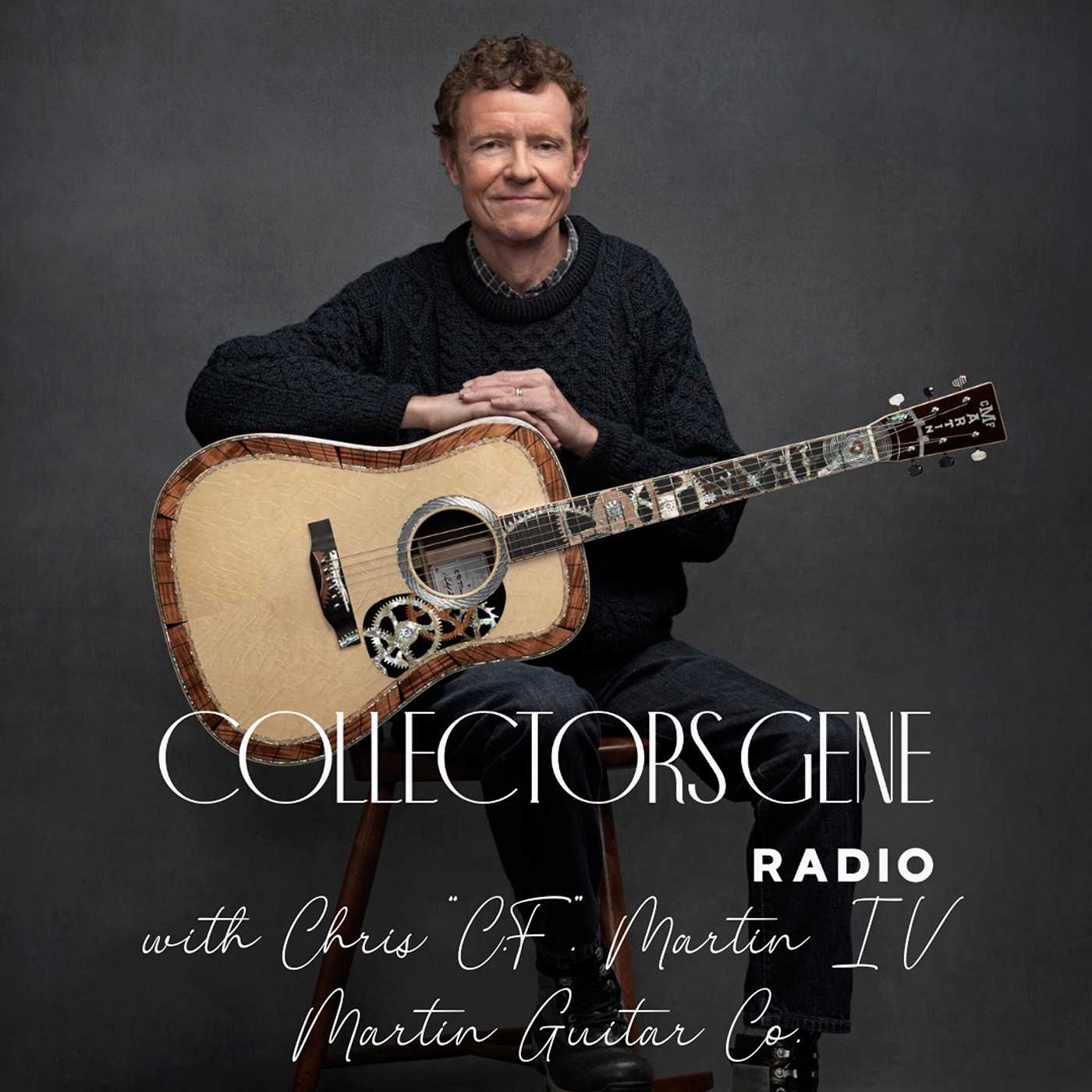
Loading summary
Transcript132 lines
- [00:01]
A
The best sounding guitar. The best sounding acoustic guitar. Not electric guitar. The best sounding acoustic guitar is on the verge of self destruction but never does.
- [00:11]
B
What's going on everybody? And welcome to Collector's Gene Radio. This is all about diving into the nuances of collecting and ultimately finding out whether or not our guests have what we like to call the Collector's Gene. If you have the time, please subscribe and leave a review. It truly helps. Thanks a bunch for listening and please enjoy today's guest Collector's Dream Radio. Today, I have the distinct pleasure of sitting down with Chris Martin, the sixth generation CEO of Martin Guitars. For nearly 190 years, the Martin name has been synonymous with music. And their iconic guitars have graced the hands of some of the world's most legendary musicians. But the question we explore today is what is it that has allowed this storied brand to remain at the pinnacle of excellence for nearly two centuries? The answer lies in Chris Martin IV, who has led the company for over 40 years, all while remaining steadfast to the legacy that has defined Martin from the very beginning. Chris is by nature a collector, and upon joining the family business, it became clear that his passion for preservation would extend to Martin's rich history. He has meticulously gathered some of the brand's most prized instruments from the most renowned collections and has created a museum to house them. A museum that is anything but traditional. Rather than a sterile glass encased gallery, the Martin Museum invites visitors to engage with the guitars, some of which can even be played. Martin Guitars has long been hailed as the gold standard in the industry. And after spending time with the man at the helm, it's easy to see why. So without further ado, I'm honored to present Chris Martin for Collector's G Radio. Chris Martin of Martin Guitars, Martin Company. What an honor to have you on Collector's Dream Radio.
- [01:50]
A
Thanks. Pleasure to be here.
- [01:52]
B
So I really want to kick today's conversation off by reading Danny Milton's opening words from your piece in Hinki Magazine, volume seven. And Milton says guitars are inherently special objects. You know, they're extensions of those who play them. They're keepers of memories and, and the instruments by which we share stories through song. And if you get the right one, you never have to buy another again. Chris Martin, CEO of CF Martin & Co. Makes that kind of guitar, the right guitar. And it's the reason his company has stood the test of time.
- [02:25]
A
I would love to put an addendum to that, that if you get the right one, hopefully it inspires you to look for another. Right. One.
- [02:33]
B
Right, right.
- [02:34]
A
It should.
- [02:35]
B
You shouldn't only have one.
- [02:36]
A
Right.
- [02:38]
B
I think your museum is a testament to that.
- [02:41]
A
You know what? Most, not all. There are some guitars in the collection that were I inherited from my grandfather, and they were small body guitars, many of which he and his brother actually played. They, they went to Princeton. They were in the glee club, and they played the guitar. But most of the guitars in the museum collection we had to buy back because back in the day, they were cash flow. Back in the day, no one said, hey, let's put one of these aside, because someday Chris may open a museum.
- [03:10]
B
Right?
- [03:11]
A
Yeah.
- [03:12]
B
And you got to, you got to go hunt those down. And, you know, hearkening back to 1833, when your great, great, great grandfather started this company, you know, why do you think Martin has stood the test of time?
- [03:27]
A
The instrument evolved and became a contemporary steel string guitar at the right point in time. And cf, you know, I've, I've seen his early work, and it's impeccable. And I, I think he, you know, he, he said to himself, if I'm going to make a guitar, I'm going to make a good one, and I'm going to make a good one every time. And I think that's when, when the, the, the purchaser, the player says, hey, it's a Martin. It's a good guitar.
- [03:55]
B
Do you think, you know, his, his level of craftsmanship has anything to do with growing up around furniture makers? Because, you know, that's a whole nother level of craftsmanship, too.
- [04:07]
A
Yes. And also, you know, being German and having that, you know, meticulous mindset of do it right, do it right the first time. Yes, sure.
- [04:17]
B
Yeah.
- [04:18]
A
And he studied with Staffer in Vienna, and Staffer had a very high aspiration in terms of quality.
- [04:25]
B
Right. They sure did. I mean, and, you know, growing up around also other instrument makers, too, probably got a little bit of a taste of that.
- [04:33]
A
Yes. And early in his career, he pivoted, stopped making Stauffer copies and started making copies of Spanish classic guitars, because that's what people pictured in their head. That's, you know, and at that point in time, the Spanish builders were. Many of them were located in Cadiz, where it's down on the Mediterranean. It was hot and humid, and the guitars didn't travel well. So CF was able to make a reproduction of a Spanish guitar built in America, built in a climate that it, it would live it the rest of its life in. And so the guitars were actually a little more durable than the early Spanish guitars he competed with.
- [05:11]
B
And growing up, you didn't have too much interest in joining the family business. In fact, you don't do much guitar playing at all. But what was the turning point for you to go ahead and start working on the floor of, of Martin and company?
- [05:25]
A
Yeah. My parents were divorced when I was three. It was a nasty divorce. My mom never encouraged me. I would come back and visit as a kid and it was interesting, but I had it, you know, had an interest in marine biology. And I thought, my mom wants me to go to college, I gotta get out of the house. So I'm gonna go, I'm gonna apply to the University of Miami because I assumed that if you studied marine biology at the University of Miami, you got to scuba dive in warm water every day, right? And, but, you know, I, I, I would come back and spend time here and it was, it certainly it was interesting. Friend of my father's came to visit. Fred Wallachi had a store in Los Angeles. And he asked me bluntly, he said, why aren't you going to join the family business? I said, fred, I don't know anything about it. He said, here, I have an idea. Instead of going to Miami, why don't you come to ucla? Get you out of the house, they'll take you, you're a good student, you're going to be full pay because you're not a California citizen and you can work in my music store. And Fred at that time was a very significant Martin guitar dealer in the LA music scene. So I get accepted, I go out, I go to the music store, and he goes, okay, go sell guitars. I said, fred, I don't know what I'm talking about. And it took him about a day to realize, oh, yeah, this kid doesn't know anything. So he goes, all right, go in the back and help John Carruthers repair guitars. John was very nice, and it took him about a day to realize, oh my God, Chris doesn't know how to repair guitars or sell them. He doesn't know anything. So I quit college, I came back, lived with my grandfather, worked in the shop, and began to go to community college at night. So that it really wasn't until my late high school, early college that I said, maybe I should pay attention to this opportunity.
- [07:10]
B
And for 40 plus years, you've been at the helm of the company. And over the years you've amassed easily the greatest collection of Martin guitars in existence, and rightfully so. The necks bear your name on them. You even had the museum built that we mentioned earlier, just to house them all. At what point of working for the.
- [07:29]
A
Company do you start collecting guitars or stuff in general?
- [07:33]
B
Well, I know you were a collector of things in general, but when do you start collecting guitars for the museum?
- [07:39]
A
So the original museum, we had a museum that my dad had put in place and it was a circular room with round plexiglass display cases, but no story. So I would say, you know, if an instrument came up, you know, possibly, maybe sort of. But I was asked to help my trade association, nam, they moved into new headquarters. They moved from Chicago to, to Carlsbad, California, Southern California. And they, in the building that they bought, they created a space. Then they said, we're going to put a NAMM museum in this space. And Chris, would you be on the board, the first board of directors of the NAMM Museum? And I thought, I'm honored. And what was very cool, it was, you know, people, industry people. And the chairman of the board was Henry Steinway. So I was like, oh my gosh. One of my mentors, I get to hang out with Henry Steinway. And they hired a virtual museum company out of Boston. And what they wanted to do was tell the story of the trade association in like 20 year chunks. So we'll start in, I forget it was 1901 and we'll go to 1921 and that'll be the first display. And so it's instruments and sheet music. And this is what a retail music store would have looked like because the origins of the association were it was a retail association before they brought in the manufacturers. And so I become CEO. Business picks up thanks to MTV Unplugged and we're expanding the office. And Keith Lombardi, who was the president, said, you've always talked about expanding the museum while we're doing this office expansion. Why don't we. So the first thing we did is we just got permission to do it. Business got a little better. Hey, we can afford to do this. We hired the same company, the Virtual Museum Company, because one of the principals actually grew up in a music store, Sherry West. Her family had West Music. So it was really helpful to have this museum design company have someone on the staff that knew what a guitar was. And that's when I began to realize we don't have enough guitars in our collection to fill a museum. Now we've gone to the opposite, like many museums where we have more than enough guitars, most of which live their life in storage. But we do rotate them in and out of the museum.
- [10:07]
B
You mentioned earlier that, you know, your. Your family had their own little collection that they had over the years and whatnot. Did the company keep a good archive since inception of, you know, when these guitars were purchased, where they were sent to, or any of that?
- [10:23]
A
Generally, that's the one advantage we have. I was talking to someone who said, you know, Chris, what's different about some of the other legacy guitar companies, like, let's say, Gibson, for example, that Gibson moved. And when they moved, when they moved from Kalamazoo to Nashville, the story is they threw away most of the records.
- [10:47]
B
Oh, goodness.
- [10:48]
A
And, you know, because we only moved once we moved from New York City to Nazareth, we never threw away the records. And the records are, you know, it's handwritten ledger books. You know, this. This is how many of this model we made. This was the price. This was the customer. So I think, yeah, from a. From the standpoint of guitar companies with a history, we probably have better archives than anyone else.
- [11:15]
B
I want to talk about the 1931 D28 that you hunted down. That was from the collection of Richard Gere, because a lot of people say that this is the prototype type in which all other modern guitars have been produced from. Is there a record to see who originally had that guitar before him?
- [11:32]
A
That's a good question. I know we have records. I don't know how far they go back, but the records are. This is the retailer that we sold it to. Those are the only records we have up until the time that we started to. To gather information from warranty returns. But who the retailer sold it to, that generally we do not know that. But, you know, I don't. Again, I don't know how far those records go back, but, yeah, you can go in and they go, there's the card that said so. And so dealer somewhere in the Midwest bought this particular guitar. Yeah.
- [12:07]
B
What's interesting is that, you know, as you mentioned earlier, you've always been a collector. You collected iridescent glass and vintage watches before you were seriously collecting guitars. Is there anything that you learned early on about collecting that paid off when you started collecting guitars?
- [12:23]
A
Well, you know, when I was younger, when I wasn't married, there's still auctions in this part of Pennsylvania, but it was a big deal. So the morning call would come out maybe Thursday or Friday, and there would be a page, an entire page of auctions. This is before the Internet. And so I'd get the paper, and I'd say, all right, so Saturday, I'm gonna. I'm gonna pick one, maybe two, gonna Go to this auction, spend the day there, because I have nothing else to do. And I learned early on it was really clever of the auctioneer. They'd hold something up and I'd look at it because, you know, you're supposed to look at everything. But I didn't. And I'm like, oh, I didn't even see that thing. And he holds it up, you know, and I bid and someone else bids, and I get it. And the runner brings it over to me and I get it and I turn it around to the back and find out that, oh, there's a reason he didn't show the whole thing, because the back is all buggered up on this thing. So I did learn early on that you really have to pay close attention to what you're buying. And you find that with guitars. And I'm not a guitar, I'm not a vintage guitar expert, but I'll say to people, I say, most old guitars have stories, and that's fine as long as they're good stories and they're true. But, you know, people will do things to guitars and then along the way, oh, it's original. Then you take it to someone who knows, they go, no, I'm sorry, it's not original. And I don't know why that person told you it was.
- [13:56]
B
Right. And a lot of times the condition reports don't always advertise all the juicy details.
- [14:04]
A
Right.
- [14:05]
B
And you've been known to go the extra mile in the auction room. I mean, at this point in your collecting, is there an instance where you don't walk away with an item?
- [14:12]
A
Yes. I was just. I just gave a museum tour to some new coworkers and I told the story about. First of all, do you know what Roy Rogers real name is?
- [14:23]
B
I don't.
- [14:24]
A
Okay, so I love to tell the story that here's Roy, handsome, talented singer, songwriter, going to become a singing cowboy, have his own TV show, sits down early in his relationship with his manager. And the manager goes, well, the first recommendation is, we retire Leonard Sly. What do you think about Roy Rogers? The Roy Rogers Museum eventually decided to close, and they had an auction, and they had Roy's original OM45 Deluxe. And even today, particularly when it's an instrument auction, we have a group of us that get together, hey, do we need this? Will it fill in a hole in our collection? And how much should we bid so we don't get caught up in auction fever? But we gave that guitar a good run for its money, but we did not get it. Just because it was like, boy, it's getting pricey.
- [15:26]
B
Sometimes you have to have a limit.
- [15:27]
A
Right, right, right. And I don't even do the bidding anymore because sometimes I can get a little too emotional. So we have someone who goes, no, I know what the limit is, and I'm going to stop bidding when we hit the limit.
- [15:40]
B
Sometimes it's better to stay a little bit removed from that.
- [15:43]
A
You know, what's interesting is sometimes we will overestimate. That's what's really fun, is we're like, okay, what do you think? Because, you know, the gallery will say, well, it's going to go between this and this. And we'll sit down and go, all right, what the heck? We just had one recently. Well, we'll go to 75 grand. And so the next day I come in and someone says, hey, you know, we didn't get the one guitar because it went for more than 75, but the other one that we were going to spend 75 grand on, we got for 50 grand. So that was fun.
- [16:12]
B
So you made your money back. Do guitars ever pop up that you don't know existed?
- [16:19]
A
Once in a while, we just bought so from Carter Vintage Guitars two years ago. Christy Carter calls and says, I've got something you really should have for your museum. So I socialized it with my colleagues and they're like, yeah, it's kind of a quirky little thing, but it turns out we only made one of them. So it's a 545, which was top of the line, but a little guitar, it had a very, very dark top. And I said to one of my colleagues, I said, what's going on? And he said, yeah, I did some research. That was. That was a custom option back then. So that was a. That was a fun, fun one off. You know, if it's only one and you don't buy it, it's like, well, will we ever get another chance to buy it?
- [17:00]
B
Right? And there's probably not that many one off pieces, you know, still in existence.
- [17:05]
A
Well, we'll find out, right? Something will pop up and we'll go in the archives to go, oh, my God, we didn't even.
- [17:12]
B
That's amazing. And of course, your main focus is on Martin guitars, but are there other pieces of musical instrument history that find its way into the museum just because.
- [17:21]
A
They'Re that special or into my collection? Yes, I'll. I'll occasionally buy something. Well, I just recently there was an auction and we bought a Gibson Jumbo because it was made the Gibson J series. Was really Gibson's taking a look at our dreadnought and saying, hey, maybe we need to have something sort of kind of like that. And we also bought what's called a frying pan electric. Because at some point I want to, you know, when we redo the museum displays periodically, I want to talk a little bit more about the Hawaiian music craze and how that period in time, not so much the ukulele, but the steel string guitar really came into its own. And then that steel string guitar went on to become the country in western and folk guitar.
- [18:08]
B
So pretty amazing.
- [18:09]
A
Always looking for something that helps to tell a story these days.
- [18:14]
B
Yeah. And I think it goes back to the idea that, you know, the, the Richard Gere guitar, you know, was what people considered a prototype. And I think it's such an interesting concept that so many guitars and so much of the design of guitars has been based on what Martin has done for acoustic guitars.
- [18:32]
A
Yes.
- [18:32]
B
Yeah, exactly. So when you think of a collection that's housed in a museum, you think of glass showcases, stay six feet away, et cetera. But you actually will let some people play the guitars in the museum, is that right?
- [18:46]
A
Yes. You know, I have to be careful here, but I would say you either have to be a good Martin dealer or a Martin player that people know. But that's a good question. Maybe we should have a museum tour where you give a donation to the Martin Foundation. And when you give that donation, not only do you get a tour of the museum, but you get to play one of the guitarists in the museum. I think about that.
- [19:11]
B
I love it. I will gladly come in town for that.
- [19:16]
A
The other thing, you know, we have some celebrity owned guitarists. And I have to say to people, they'll. They'll be like, that isn't Hank Williams's guitar. I said, hey, Hank Williams owned more than one Martin guitar, right?
- [19:29]
B
Yes.
- [19:29]
A
We don't have the one you're thinking of, but we have one of the ones that Hank Williams owned and played.
- [19:34]
B
Right. All those guys are collectors too.
- [19:37]
A
Right. Or they. They have a guitar, then they'd sell it, then they'd buy another one. People give them. Like Woody Guthrie gave guitars away. Am I thinking of, you know, George Harrison gave ukulele's away to his friends, so.
- [19:52]
B
Right. Have you always viewed the items that you collect as not so precious enough to where they. They can't be used?
- [19:59]
A
All right, so this is, this is a really funny story. I'm in Santa Barbara traveling around with our sales rep. I do presentations in music stores. I Don't play. So I talk, and I bring someone with me. I think it was with Diane Ponzio. And the. The dealer said, I just restored an antique Martin guitar from the late 1800s for the local museum. Can we go down and do a photo op for the local press? I said, of course. This sounds like so much fun. It's an interesting story. It was a fairly aristocratic family in the Santa Barbara area that had large land holdings, so they were quite wealthy. And I don't know if it was an arranged marriage or what, but the son was getting married to a woman from back east and presented her as a wedding gift. I can't remember the model, but it was a fancy Martin guitar, Pearly. I don't know if it was a 45 or a 42, but it was fancy and a little body. And the dealer said, I did extensive restoration work. And the museum director will be there. We're going to have the local press there. So we get there, I meet the director, we go over to the glass case, and the museum director, he says, who's going to wear the gloves? And I looked at him and I said, gloves for what? He says, no one touches any of our artifacts without wearing gloves. And that's when I realized, this guy's not a guitar player.
- [21:33]
B
Yeah, exactly.
- [21:35]
A
So I put on the gloves, but it was like, no, I've never seen anyone. Yeah.
- [21:44]
B
You might give that guy a heart attack if you told him some of the guitars you put in people's hands, but that's.
- [21:49]
A
Yeah, they're. Yes, they're. They're works of art, but they're also guitars. They're meant to be played.
- [21:53]
B
Exactly, Exactly. So in 1970, the business had some turmoil, a bit of a downturn, but here we are today, some 54 years later, and the business is still standing and remains one of the strongest names in the musical instrument industry. What role do you feel having the museum and the collection plays in keeping the brand strong?
- [22:17]
A
Well, because, you know, the museum morphed from those plexiglass tubes with a light, with a guitar with a little description to the museum. We get factory tours, but the factory tour doesn't tell you how we ended up here, how we got here, how the guitar evolved into what it is today. And if you get in the museum and you spend 45 minutes and you start in the beginning to the end, I have to believe you come away. And I've had people say this. Even when I go out on the road and tell the story, they're like, I had no Idea. I had no idea of the rich history and heritage of the Martin guitar and contemporary music.
- [22:59]
B
Well, you know, that is kind of part of the thing. Anybody can read whatever they want online, but to hear it from the horse's mouth, for lack of a better, you know, phrase, and to be able to see the items because you guys are out there collecting them back is, is really special.
- [23:14]
A
So what I'm doing now, and they're. These are collectible. But you know, certainly I tell people, I say, look, don't primarily buy a new guitar as an investment. Buy it because you want it. Buy it because you're going to play it. It's going to depreciate. It's going to depreciate the moment you walk out of the store. But if you hang onto it and you take good care of it, someday it may be more valuable than you ever imagined.
- [23:43]
B
Well, I'm curious to know how you feel the collector market for Martin guitars, what that looks like going forward. Are you making modern day guitars that you think will be collectible one day?
- [23:54]
A
I would hope so. But again, we're not making them for the purpose of investing in a collectible that's going to go up in value. We're making good guitars for someone that wants a good guitar. And, and certainly the ones that we make in limited, limited quantities, the ones that we make that have an artist, you know, affiliation are going to be more collectible than, than just a run of the mill D28. So the other thing I wanted to share with you is I had the foresight early in my career when we would do artist models to say, let's keep one of the prototypes. So we have, we don't have everyone, some, some particularly early on, they, they slipped away. So now when I travel domestically, it's difficult to do overseas. So I just gave a talk last week at the Country Music hall of Fame. So my friend Craig, who plays, we sit down with the list of the prototypes and we think about the geography. We think about, okay, we're going to Nashville. So which model should we take to Nashville that will resonate with the audience that's coming to the Country Music hall of Fame to hear me talk about the history of Martin guitar. So we had, you know, guitars that people go, oh yeah, Johnny Cash, George Jones. Now this last weekend we were in New York City, different vibe. Okay. We want guitars that people can think about. Greenwich Village. So that's a lot of fun. And people, they know we did these artist models. But when they come to an event and they see like 10 of them in one place on display and they're like, wow, that's really special.
- [25:36]
B
Yeah. I mean, obviously the limited quantity models and all that stuff will be collectible one day and, and the artists, you know, specific models will be collectible one day. But I do agree with you, a lot of people don't view things that they buy at a retail shop now as future collectibles. But they have to think about there's a reason that it costs what it costs. And even if it does depreciate a little bit when you take it home, if you take good care of it or you have a good story with it, you'll never do your wallet wrong.
- [26:06]
A
Right. And you know, I joke with people. I said, all right, again, I'm not an investment advisor. I cannot tell you to buy it as an investment. But if you had $3,000 and you bought a good Martin guitar today, and instead of buying the guitar, you put that $3,000 in the bank now. Yes, you know, interest rates are up, so you're going to earn four and a half percent interest on it. And then 30 years from now all you have is more money versus 30 years from now. You have memories of playing a Martin guitar for 30 years.
- [26:35]
B
So Martin guitars, as we all know, have been played by some of the most influential and well known artists in the world. I mean, Elvis Presley, Bob Dylan, John Lennon, John Mayer. It doesn't stop there. The list goes on and on. And people would probably not even believe some of the artists that have played those guitars. I'm curious to get your take on. You know, Martin is such a leader in the industry and category that you play in the same way Remova is with luggage. Right. And it's been given this stamp of approval that anybody who even wants to go buy their first guitar and doesn't know, you know, jack squat about anything, they go right for a Martin. And you, of course have great design, but with a guitar it also has to sound good. And Martin guitars have sounded amazing from inception. What is it about the design of a Martin guitar that not only carries the quality through, but also the beautiful sound?
- [27:32]
A
So the shape of the body definitely influences the sound that you're going to hear. And so we have, you know, shapes that have endured. The O, the double O, the triple O, certainly the dreadnought, the materials. Right. Rare, exotic woods. But I think that the real key is that anyone can over build a guitar and it's a safe place to go in terms of durability. Right. But the More durable you make it, the more I believe you are sacrificing some potential tone. Now, the flip side of that is when you talk to people about the flamenco guitar, they will say, in order to get a big sound out of a flamenco guitar, you have to under build it. And you have to accept the fact that it will crack and that you will have to have it rebuilt periodically during its life. And so I think what my family has done is found that sweet spot in the middle.
- [28:40]
B
Perfect geometry.
- [28:42]
A
They're not overbuilt, they're not underbuilt. And I like to say that, you know, the best sounding guitar, the best sounding acoustic guitar, not electric guitar. The best sounding acoustic guitar is on the verge of self destruction, but never does.
- [28:58]
B
I love that. Before we wrap it up with the collector's gene rundown, I'd love to know what you think your great, great, great grandfather would say about the way that you've built this company the last 40 plus years.
- [29:10]
A
What I would like to do, certainly they would get a kick out of the collection in the museum, but I would like them to come back and see the technology. Because people are like, oh, Chris uses machines and he uses tooling and he uses fixturing. Hey, my family always used machines. We always use tooling. And if you're making more than one of something, you have to tool up. And fortunately, we could make them in quantity. We're not just making one of one shape, we're making hundreds of one shape. But the technology we have today, much of which we've developed in house with very sophisticated partners outside, their heads would spin if they could just see how much we've invested in making Martin guitars better than they've ever been, more efficiently than they've ever been.
- [30:00]
B
Amazing. All right, Chris, let's wrap it up with the collector's gene rundown. You can answer these questions based on any of the things that you collect, whether it was iridescent glass, vintage watches, or guitars. Sound good?
- [30:11]
A
Yep.
- [30:12]
B
What's the one that got away?
- [30:14]
A
Now we have one today. But early in my career, business was real. We were in workout. The company was in workout, which is where you go if you can find a bank that wants to bank you before you file for bankruptcy. And even then, we knew we did not have a D45 in the collection. And just to show you how tough times were, now this is back, you know, 40 years ago that someone said, hey, there's a used pre war D45 for sale. How much is it? It's $7,000 and we didn't have the $7,000 to spend on it. But one came back, we were hand to mouth and we found one years later. But it was much more than seven.
- [30:57]
B
Sure. Well it had to be, right? How about the on deck circle? So what's something that you're hunting after now or maybe something that's coming up on the auction block?
- [31:08]
A
Well, I, you know, Internet auctions are dangerous for me personally, you know, because I've traveled so much during my career. One of sometimes there's like a little arbitrage going on that up until very recently when, when China was booming before the big, you know, housing debacle. I noticed when I would go to Hong Kong and I'd go into a Chinese antique store and I'd see something, I'm like, wow, that's really cool. I could take that home. It'll fit in my carry on. How much is it? And tell me a price. I'm like, holy mackerel. So it turned out that when China was booming, you know, not that many years ago, Asian art in Asia was becoming very, very, very expensive. So with my sort of discerning eye, I continue to look for Asian art in America because it's actually cheaper than it is in Hong Kong.
- [32:05]
B
Right? Amazing. How about the unobtainable? So this is one that's too expensive in a museum, a private collection, just complete unobtainium.
- [32:15]
A
Well, let's go back. I'll tell you a story from my friend George Green Ruin. Because you know, I'm not in the vintage business, but I talked to vintage dealers and I, I said to George, I said george, how do you value old guitars? And he said, well Chris, he has a nasly voice that I won't try and imitate. You know, ideally the in if the instrument was built by a reputable maker like you or Leo Fender or Orville Gibson or their, or their, you know, the following on generations. That certainly helps because that, that lends credibility to the instrument. He said today what players want, they, they'll buy a vintage instrument if they can use it to make music that people want to listen to today. He said, for example, Stauffer style Martin guitars from the 1830s and 1840s are collected, are collected by people that want to round out their collection. They're not collected by people that are going to go out and play the Stauffer guitar to an audience. So he said that. So that's why like pre war Martins with steel strings are much more valuable than Martin guitars from the 1800s and and he, he was going on and on and he said, there's one exception to how I value guitars because I've been in this, you know, my entire adult life. He said, and that's if it can be documented that it was owned by a celebrity. And he said then, particularly if there are two people that worship that celebrity, he said, in terms of value, in terms of price, all bets are off.
- [34:04]
B
Forget it. Yeah, no holds bar.
- [34:06]
A
So we periodically. Well, recently one of the guitars, I told you we got one because obviously people weren't following that celebrity. But the other guitar went for more than we wanted to pay because there were two people out there that said, no, I want to own that guitar because I'm a fan of that particular musician.
- [34:27]
B
Interesting. Well, hopefully it comes back your way soon.
- [34:31]
A
Well, we'll see. And it's like old cars. Different generations collect different generations of old cars. Someone in their 30s might be really interested in buying a Honda that's 25 years old, not necessarily a Buick that's 75 years old.
- [34:52]
B
Right. How about the page one rewrite? So if you could collect anything else and money was no object, what would it be?
- [34:59]
A
So that's a question. My wife Diane, rest in peace, she kind of confronted me with that. And I've been fairly judicious in my collecting in terms of value because I had come home from an auction and she's like, what did you buy today? And it would bother her because I'd come home and the next thing you know, sometimes I would put things on display in the house and just wait to see how long it took for her to notice that it was there.
- [35:24]
B
I've done the same.
- [35:26]
A
There's a local flea market up in Sailorsburg. And she said to me, she said, now, you know, if you predecease me, I'm taking all this stuff up to the Sellersburg flea market and I'm selling it just to get rid of it. So I've been pretty judicious in terms of my budget, but I have a particular appreciation for the New Hope school of American Impressionist art. And I have a particular appreciation for European impressionist art. But the fact that there were artists in New Hope, Pennsylvania. Oh, another one. Let's see, here's an even better one. So we're. Someone commented on it when I just gave the museum tour. My coworkers, we switched from Brazilian to Indian rosewood and they has to rose. The woods have to be cut in a particular way for guitars that be quarter sawn. And there was, there was, there was no One in India had the ability to cut the wood the way we needed it. So we brought the logs in and we had to buy a saw. So we went to Belgium and we bought a saw specifically designed to cut exotic hardwoods with a very thin blade. And their argument was, yes, you could get a saw made in America with a thick blade. It's very durable, but you're going to create a lot of really valuable sawdust. So the thinner the blade, the more useful wood you'll get out of this rosewood log. So the word got out that we had this beautiful Brenta band saw. And we have hired a sawyer from New Hampshire who knew how to run it. And we started cutting wood for George Nakashima, the father of American craft furniture. And I was not in the business, but I come in the summer and I remember I met George, but I don't know if I met him here, but he was very particular in what he wanted, how he wanted to cut. And my big regret now in the museum we have some Nakashima pieces. They were made by George's daughter. So my big regret is that my father and grandfather did not commission any Nakashima furniture from George while we were cutting his wood here in Nazareth.
- [37:27]
B
That would have been a pretty easy exchange.
- [37:29]
A
I know. And you know, one of the things, if you've ever seen it, what people like about George is he'll, along with the piece of furniture he made, you will be the hand drawn. You know, is this what you want? And he'll draw the table and he'll have the dimensions and he'll write the price. And it was sort of like, oh, my God, it's a hand drawn receipt of the table that George made for.
- [37:50]
B
Me, which is oddly, probably equally as special.
- [37:54]
A
Right, right. So that's a big regret that they didn't commission George, just make something.
- [38:01]
B
It could have been anything, could have been a cup. How about the goat? So who do you look up to in the collecting world or who do you think is just a great collector?
- [38:11]
A
So my friend and I have to be careful. I understand people, their concerns about security. Right. That do I want someone to know that I collect these valuable things. So I have a friend, I won't mention his name, who's a very prolific Porsche collector. Other cars too, but primarily Porsches. And every time I get to see him, I got, hey, dude, what's new? He goes, I'll come on over. So the last time I saw him, I said, what's new? He said, well, what's new is I had to Put an addition on the car barn to indulge my, My. My obsession with collecting Porsche sports cars.
- [38:54]
B
Amazing. Can't. Can't be mad at that.
- [38:57]
A
Nope.
- [38:58]
B
How about the hunt or the ownership? Which one do you enjoy more?
- [39:03]
A
I'm gonna say the hunt. Yep. Because it's, you know, you might get it, you might not. It might be what you thought it was. It might not be. All right, so here's a funny one. Internet, right? That and I. I miss live auctions. Like, they just don't have them as much as they use post Covid. I understand. So it was an Indian deity. It's paper mache. I'm looking at it and I must not have opened up the picture on the catalog. You know, the auction catalog on the Internet, it's like, ah, I'm going to buy that. That'd be cool. Put in my collection. I'm thinking, you know, it's like tabletop size because I'm looking at the picture on the, you know, on the Internet. So I get it. And I asked my assistant, Mary, I said, mary, would you contact the auction house? And, you know, see, it was in Philadelphia. You know, can they. Can they ship it to me? Just what's the best way to get it up to Nazareth? She calls when she comes into my office, and she said, they asked me a funny question. I said, what's the question? They asked me how big a truck we have? I said, why would they ask a question like that? She said, I asked them the same thing. And they said, well, because this paper mache Indian deity is 12ft tall.
- [40:23]
B
Oh, my gosh.
- [40:24]
A
And I thought it was 18 inches tall.
- [40:29]
B
So that's pretty special.
- [40:30]
A
Yeah, I actually let that one go. I did not spend enough money on it to even. I just said to the auction company, I said, why don't you just go ahead and resell it? It isn't what I thought it was going to be.
- [40:40]
B
Yeah. It wasn't going to fit my dining room.
- [40:43]
A
Right.
- [40:44]
B
You probably would have paid more in shipping.
- [40:46]
A
That was the thing. Yeah. Like, all right, so now I make sure I open up and look at the dimensions.
- [40:52]
B
Amazing. Curious to know, are vintage watches still something on your radar?
- [40:57]
A
Yes. You know, it's like with anything, I'm wearing the same. So I get anniversary watches. So a friend of mine here at work, in his prior lifetime, he worked in the watch industry. So it was my anniversary and I'm wearing it today. I said, mike, you know a guy, can you get me an Omega Seamaster? And it's such a Good watch. I've just been wearing it every day.
- [41:25]
B
Yeah, it's one of the best. And there's a reason that they've been. It's like a Martin guitar. There's a reason that they've been making it for a long, long time.
- [41:32]
A
Right. It keeps good time. And I like automatic watches. I was in Japan in the spring and I looked closely, I have a very small wrist. I looked closely at. Is it Casio or Seiko? Who makes those? The watches that change time as you travel from time zone to time zone?
- [41:50]
B
Sure, yeah, Seiko. And you know, the GMT watches and all that.
- [41:53]
A
I'm going to get one of those someday. I just, I like the idea that, you know, no matter where I am, I look down and the watch knows what time it is.
- [42:02]
B
That's pretty amazing. Most importantly, do you feel that you were born with the collector's gene?
- [42:08]
A
Yes. And you know why? Because got divorced coming back and particularly my mom's family, they came over from Ireland during the potato famine, but the Martins came over in 1833. And I remember saying to my grandfather, I said, pop, all these generations, why isn't there more old stuff? And he said, you know, because back then it was just old stuff. And he, he told me the story and there's a, there's a video. It was a movie Nazareth commissioned, like a documentary for the hundredth anniversary of Nazareth's 200th anniversary. Nazareth was founded in 1740. So in 1940 they did a movie and they, you know, to celebrate, to kind of archive, hey, 200 years after Nazareth was founded, this is what Nazareth looks like. And they shot some of the footage at our old factory. So it's really cool old black and white footage of Martin guitars being made. And there's a shot in the office of my great grandfather and my grandfather and Maude, Maude was the company's secretary. And in the corner was an oak S, if you can picture that roll top desk. And I remember my grandfather saying as an example, his father paid the junk man to haul the oak desk away because he said my father wanted steel desks because they were modern.
- [43:50]
B
Tough call, tough call.
- [43:52]
A
So that's when I'm like, all right, I'm going to make up for all the stuff my ancestors got rid of.
- [43:58]
B
I love it. Chris Martin, thank you so much for coming on Collector's Gene radio today.
- [44:03]
A
Keep on collecting.
- [44:04]
B
Yep, keep collecting. And everyone go check out the Mart Museum if you're ever find your way in Nazareth.
- [44:09]
A
Great, Good stuff.
- [44:11]
B
Thanks so much. See ya all right, that does it for this episode. Thank you all for listening to Collector's gene radio.