Loading summary
Transcript76 lines
- [00:01]
A
The spaces at El Buco, all the restaurants have, you know, a piece of that original space. I think there's nothing like the Bond street space because it's so. It was so hand wrought, you know, it was never intended to be a restaurant. So it has what Bob Guccione Jr. Said to me once. It's just slightly awkward, Donna, and that's what makes it so wonderful.
- [00:24]
B
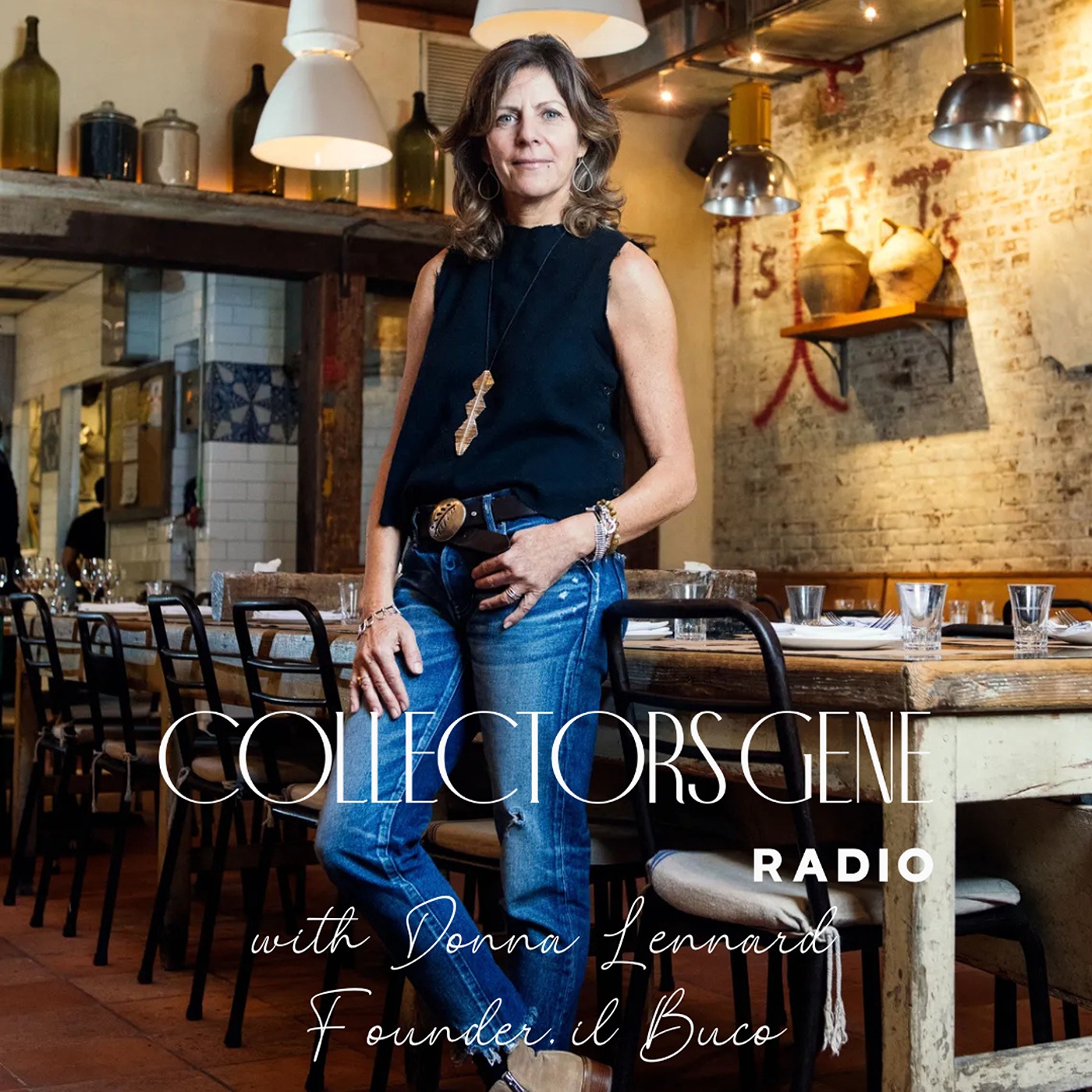
What's going on, everybody? And welcome to Collector's Jane Radio. This is all about diving into the nuances of collecting and ultimately finding out whether or not our guests have what we like to call the Collector's Gene. If you have the time, please subscribe and leave a review. It truly helps. Thanks a bunch for listening and please enjoy today's guest on Collector's Gene Radio. Today, I'm thrilled to welcome Donna Leonard, a trailblazer who has redefined how we experience dining, design and community. Donna is the founder of the iconic Il Buco family of restaurants, destinations renowned for their ingredient driven Italian and Mediterranean cuisine, and Il Bucovita, a lifestyle and tabletop brand rooted in craftsmanship and cultural heritage. What began as a unassuming antique shop on Bond street has over the last three decades, blossomed into a beloved collection of spaces that feel more like homes than restaurants. From her beginnings working in the kitchen to her journey into antiques and culinary artistry, Donna's built a world where every single detail, from the handmade dishes to the plate it's served on, tells a story. Her ability to bridge the worlds of collecting and curating in both food and design creates an atmosphere of warmth, connection, and timeless elegance. Donna shares how it all started, the pivotal moments that shaped El Buco's evolution, and the parallels between curating antiques and crafting unforgettable dining experiences. We'll also explore the balance between consistency and evolution and the importance of community and the future of Ilbuco's ever growing world. So with great honor, this is Donna Leonard for Collector's Gene Radio. Donna, what a pleasure to have you on Collector Stream Radio today.
- [02:09]
A
Thank you so much for having me. I'm totally honored.
- [02:12]
B
It's my pleasure. And I'm grateful to the Dada Goldberg team for reaching out and putting us in touch because I'm such a fan of Il Buco and what you've built. And I think the story is going to be really exciting for the listeners today. And I think my favorite part about your story is that Il Buco actually started out as an antique shop. And unless you've kind of been around since the beginning, it's sort of this if, you know, you know, thing, insider baseball kind of thing. And, you know, it's a big part of your story now, and you have your own line of home goods. But tell me how this all started and why you chose to open an antique shop after you were working in restaurants prior to that.
- [02:51]
A
Yeah, it's a kind of unusual, slightly convoluted story. I came out of a personal disaster, you know, many years ago. Lost my fiance to a brain aneurysm and was working in a restaurant as a bartender at Arcor restaurant on Church street in Tribeca, peddling his screenplay and kind of recovering a year later and met a crazy Italian guy named Alberto Avalle who wanted to either move back to Europe or export Americana to Spain and Italy and had all these ideas about where to collect this Americana. He was absolutely infatuated with all of these things, old radios and old tools and toboggans and tricycles and early American quilts. And I was ready to leave the country. But he dragged me to these antique fairs all along Pennsylvania. We would take our Suzuki samurai down Route 78, and we'd go to all these fairs and the pieces that were too big to keep in our little apartment on Avenue C and 11th Street. We left with this couple that we came to know from these fairs who were up near the Finger Lakes in pa. And we were looking for a space. And I one day drove across the cobblestones of Bond street and saw Spectra Photo Labs opening and pulled over. And then next door was this storefront with these whimsical chandeliers in the window. And I was drawn to it and went inside. It was a studio for these wonderful artists who were making those whimsical chandeliers. And a woman, one of their friends, was down in the basement painting crop circles. And I got to know them, and they were looking to rent out their backspace. They were in dispute with their landlord, and he was raising the rent from 1750amonth to 2000 for this 2000 square foot beautiful space. And it turned out they knew Alberto. And one of the clients at Arqua used to buy Warren's chandeliers. The artist was. Warren Muller was the main artist and a guy named Michael Biello. And we ended up taking the space. They introduced us to the landlord. They had a building they owned in Philadelphia. They decided to move back to Philly. And we took over the space and scraped the paint off the floors with Todd Nicki of Nikki Kehoe and a friend of mine. And we went upstate with this couple from the Finger Lakes. And we spent a week or so with them at auction and in different antique stores. And we filled two 17 foot trucks with antiques, and we opened a store at 47 Bond.
- [05:45]
B
What kind of antiques were you filling the store with back then?
- [05:48]
A
Primitive American country.
- [05:51]
B
So a lot of wood and a.
- [05:53]
A
Lot of beautiful primitive tables, you know, dark woods and pine and cabinets and tons of, like 1940s and 1950s radios and huge collection of quilts. We started building beautiful old tools and copper pots and, you know, you name it. It was like an eclectic. We had a big potbelly stove that we had in the back, and we created all these little vignettes in the space and opened the store. And we would have our little afternoon pranzo or lunch that we would prepare in the back because there was a little, what we called the Susie homemaker. Four burner stove and a refrigerator. And they had the professional stainless steel sink set up for the ceramics. And we had the store going until we were like, okay, we need to make more money here. And it would be great to be able to serve little tapas and a little boutique list of wine and beer. And so we invited our landlords over for lunch one afternoon, and when they saw what we did with the space, they were pretty bowled away and agreed to everything and agreed to let us become a little tapas bar. And after some crazy dispute with the people living above us who didn't want us to have that, it was discovered that it was grandfathered before. There was a couple that used to have a little speakeasy in the basement. So we were able to turn it into a little wine bar. And then it grew in leaps and bounds. First you could buy the furniture, and you could buy your table or your chair or the cupboard in the room. And after a few years of doing that, we said we didn't have time to do the antiquing anymore. And it really became more and more qualified restaurant.
- [07:47]
B
What was Bond street like back then? Was it a big toss up to open a restaurant there, or was the area growing quite a bit?
- [07:53]
A
There was nothing. It was the only thing, the only commercial presence on the block was Bob the furniture guy on the corner of Lafayette and Bond, who had this kiosk on the corner that he would open up in the morning and pull out all these old antiques and put them on the street and us and crack vials all over the street. My parents were like, what the hell are you thinking? Like, this is the coolest neighborhood in New York. You'll See?
- [08:24]
B
Right. Yeah. You'll see a long time from now.
- [08:27]
A
And then it became peppered with antique stores. We had Buying the Farm and Stacy Senlinger's rhubarb home, and across the street, Capsud the French Ladies. It became this little antique mecca. And then Bob Furniture moved across the street to where J. Crew is now, and he had a really legitimate store. And then the fashion came in with Ghost and Cationia Deli, and, you know, it just kind of kept morphing.
- [08:58]
B
Everything really grew around you guys, which is pretty impressive.
- [09:01]
A
Absolutely. And then Modern Link and back to modern furniture. There was another big modern furniture store two doors down. I can't remember the name of it, but it was quite an evolution of the neighborhood. And we just kept really qualifying what we were doing and had immediately a really wonderful following of neighbors and locals that just kind of the word spread by word of mouth, and really a community grew around us.
- [09:32]
B
You know, there's this ceremonious aspect to dining and gathering around a table, the same way there is for a collector to share with others what they find. Did it feel like a natural transition to you to kind of do the tapas and then the wine bar and, you know, and then the whole restaurant? I mean, you guys were becoming cereal collectors, filling the store with stuff. Did you approach opening Il Buco the same way?
- [09:57]
A
I don't think we approached it in any way in the sense that. In the sense that it wasn't. It was so organic. Everything that that happened, it wasn't really thought out like, we're going to do this. But what really we were creating in our minds was a trading post. Like, this is a trading post for objects, for ideas, for culture, for, you know, people to share thoughts around a table or to look at beautiful things and talk about them. So that's. And. And this link between Old World and New World was always threaded in there. And then we morphed. We were kind of antique radios and quilts and tools and that kind of thing. And then we went to Spain, and we collected beautiful cupboards from Spain and beautiful ceramics and things that kind of upped the game and gave the space a little more sophistication over time. So I think that was also changing. The space itself was changing. And we kept a piece from the original from Warren and Michael and Patricia. They had this harlequin design on the top of the front piece of the storefront. Like, the first 10ft of the storefront were like a kind of showroom, and the rest was just dark painted floors and White walls and kilns. But they had this little saying on the top of the wall that said being there was like being in a museum. I was like an object on the shelf with other objects. And we still have that. You know, we have that little piece now. You can't see it as well because of some of the things that have gone on. And then, of course, the chandeliers, you know, are there still. And we continued to buy Warren's chandeliers and fill the place with his chandeliers, and then brought one of his chandeliers to Alimentary when we opened. In fact, my son and I went down to Philadelphia to his space, and we picked out all these objects, and he created this incredible chandelier that hangs in the atrium of Alimentary.
- [12:11]
B
That was probably a full circle moment for you, I'm sure.
- [12:14]
A
Yeah, absolutely.
- [12:16]
B
I think what I find really interesting is that you really started as a collector of antiques, right? You started to learn all about them and what it was like and sourcing. And then you go to Spain and you're sourcing from Europe and all these things, and then you become a curator of restaurants. And I would love to know how you see the parallels between sourcing objects and then sourcing amazing ingredients for Il Buco. Is there. Is there a parallel there?
- [12:43]
A
I think everything I do is very much about quality and really looking for, like, kind of the purity also down to earth ingredients. You know, you want to get the best beet or the best piece of meat grown with love in an open field, you know, like, so, you know, the antiques are, you know, you're looking for something that has, like, the love in it, the artisan craft, something special that speaks to you. It's a slightly different paradigm, but there's a lot of linkage, I think, there as well. You want to really focus on how to find quality and realness. Like unmanufactured.
- [13:33]
B
Yeah, certainly.
- [13:35]
A
So unmanufactured food means no pesticides, no herbicides, the most natural farming methods, and natural fresh.
- [13:44]
B
Yeah, well, part of collecting is also, you know, experiencing just like it is for dining. Right. It's all about the experience. As much as the food is important, the experience is also just as important. And when you dine at the original Il Buco, you can easily feel and see how it's still very much of an antique shop, or what it was once like before you started even serving tapas. How important was it for you to keep that integral part of the ambiance and that charm to really propel Il Buco to what it is today.
- [14:20]
A
It was everything. I mean, that is the foundation of the brand. Creating an environment that's warm and inviting and filled with all the things that you love. Even when you're antiquing, it's like you're not buying the stuff from the guy that you hate. You know, like, if there's a. If there's not a nice story behind it, you kind of move on. You know, you try and buy it if you love it that much. But if it. If there's something that's, you know, discordant, you. You go to the next thing. And I think, you know, you develop relationships with the people that you buy from or you get drawn to the artisan who's making something or to the producer who's growing grain or making olive oil. You know, it's the passion and the. And the dedication that goes into it. So, you know, I think the spaces at El Buco, this. All the restaurants have, you know, a piece of that original space. I think there's nothing like the Bond street space because it's so. It was so hand wrought. You know, it was never intended to be a restaurant. So it has what Bob Guccione Jr. Said to me once. It's just slightly awkward, Donna. And that's what makes it so wonderful. You know, it's not done. You know, it's not symmetrical. Right. So, you know, I think there's a lot to that. And then the other restaurants have, you know, elements of that that came with, you know, bringing in the beautiful antique bottles or the beautiful antique table in the middle of elementary, the glass top ceramic table, or the beautiful cupboards upstairs, or the barrels of vinegar. Just the pieces of history and old beauty. Like, even keeping the old brick walls inside that were part of the lumberyard and using the joists to make the bar, the old joists to hone the furniture. So I think that, you know, combination.
- [16:22]
B
Of old and new, and if people really didn't think that you were a collector to begin with, you end up launching Obuco Vida, your tabletop and lifestyle line. Are these objects and home goods influenced from your years of collecting and traveling?
- [16:38]
A
Of course, yeah. I mean, my partners are two cousins who grew up in the same town as Alberto, my original partner in Foligno in central Italy, Umbria. And, you know, for years before opening, we, you know, we're like, we have to do an artisan home line. We know all the artisans here that the craft is. Are dying. You know, we need to, like, support these people and create that we can create these beautiful things. So we talked about it for probably more than 10 years. And then when we opened elementary, they helped me with all the furnishings there, the antique pieces from Italy, and they started sourcing the Vita line and sent over a container full of artisan goods before I was ready to do anything with them.
- [17:30]
B
Of course they did.
- [17:32]
A
And we did a little pop up at the top of Alimentary and got a lot of interest and ended up taking the space two doors down on Bond street on the second floor and opening a little showroom. And, you know, and Vita was born. And it really was like full circle back to the beginning because we had, you know, it also included beautiful antique, you know, vessels and beautiful old pieces, but also these newly made, beautiful pieces of real art from artisans all over central Italy, whether ceramics or hand blown glass, or one of our artisans, you know, uses all recycled glass from her neighbors and makes these beautiful whimsical pictures and carafes and glassware with wings and breasts. Yeah, all kinds of things. Linens and, you know, marble mortars and pestles and, you know, carved wooden cutting boards out of old wood. So it's all, you know, it all brings back the same, the same feeling.
- [18:37]
B
Our tastes change when it comes to collecting. It's inevitable. One day you're collecting primitive furniture, the next day you're collecting Italian ceramics. And those two couldn't be more opposite. Even though they look great together, they couldn't be more opposite. And when it comes to food, of course, people will be willing to try new things, but they also expect a consistency and an overall palette when it comes to a place like Il Buco. Right. Your customers, no matter which restaurant of yours that they go to, they expect to have this remembrance of the last time they were there and what to expect. Right. How do you manage your collector sensibilities changing while remaining this consistent approach to Il Buco?
- [19:20]
A
I don't think of those two things as being in conflict with one another. Look, there are many restaurateurs who open different restaurants with different names that have very different kinds of food. And in that case, they would be like the collector changing taste. Right. My brand is not that. Each of my restaurants has Il Buco in the name. And even if they may vary slightly in terms of some sort of tonality, there's a connection with the food and the ingredient driven menu and the Italian Mediterranean sensibility. So, yes, that is consistently followed. But even as you know, starting with primitive American, Edelbucco Alimentary has more of a little bit of an industrial feel thrown in with the primitive antiques. Al Mare has also some very modern elements thrown in. So I think all of those things work well. My apartment is a combination of, you know, I have. I'm sitting at a big antique tavern table from Italy with, you know, wishbone chairs around it and a console and a Wegener bench in the corner. So I feel like those tastes really work together. I mean, I feel like we can. We can play with those different tonalities. You know, it doesn't have to be only one line.
- [20:56]
B
Well, I think what's interesting is that all this primitive furniture and the mid century and French antiques in your apartment that you're talking about, there's this cultural heritage around them. There's a story, there's a reason that it's labeled as primitive or that it's labeled as mid century. It's this era and this stamp in time. And what I find also interesting is that the menu at Il Buco also serves as this element of cultural heritage. All the ingredients are so organic and fresh and as perfect as could be. Do you think if you weren't collecting furniture and antiques that had this cultural heritage behind it, that the menu at Il Buca would end up looking different?
- [21:44]
A
That's an interesting question. No, I don't think it would be different. I mean, I think what you're speaking to is kind of a personal taste. Like, you know, cultural taste goes across all of these disciplines, right? Like food and, you know, decor. So I think that resonates with me. Like, what's clear about all the things that I collect or surround myself with is they're made by somebody who has a really strong connection to the handiwork or the design or not just throwing something together. Right. It's very artisan made. Whether it's mid century modern or primitive country, There's a hand in there. There's the artist's hand and the thought and the culture behind creating beauty. And I think with food, it's very similar. It's like you're seeking sometimes the most simple and authentic expression of ingredients in order to create something that's both flavorful, but also healthy and clean and nurturing. And then you can add whatever little je ne sais quoi comes from your very talented chef, that little ingredient that you don't even know that's in there that just kind of brings the dish to life, just the way that a little flourish in a piece of furniture brings that piece to life. So I think those parallels are quite, like, beautiful to think about.
- [23:36]
B
Yeah, and that's actually something I really wanted to ask you about, is, you know, as a collector and for the furniture and antiques that you add to your personal collection, Right. We, as collectors, we have this checklist that we go down. The condition, provenance, you know, like you said, whose hand was on it, whose hand made it. And it's the same thing for a menu item for you. Where is this ingredient coming from? What farm? You know, what. What other, you know, ingredient source is this coming from that makes it so special? Would you say that there's any differences at all between the way that you collect antiques versus, you know, how you add a new menu item? Because to me, it seems like they're kind of two in one of the same.
- [24:19]
A
I think there's a lot of similarity, except that, you know, there's more restriction in the menu items, maybe. Right? Like. Like, for collecting, you can go anywhere. You can. You can go in so many directions, right. If you went in that many directions with your food, it would just get too busy, Right.
- [24:36]
B
A bruise on your furniture versus a bruise on a. On an ingredient's a little different.
- [24:41]
A
Right? So I think the collecting gives you, like, there's a. Such a plethora of directions you can go. And in my food, maybe not as many. Like, a little more. You're a little more limited, but, you know, look, there's some incredible ingredients out there, so you can go after whatever you want and mix things together and find the common ground or the special little substance that adds to your dish. I guess in the same way that you can find a special piece of pottery or a special, you know, little doodad that just hits your eye.
- [25:24]
B
Do you ever look back at your early days of collecting for the original Il Buco antique store and think about how all of these small items or all of these tables and stoves and armoires that you were collecting turned into a collection of restaurants?
- [25:40]
A
That's interesting. I don't think about that. But, yes, I mean, it's very true. They became my restaurants, you know, they became the basis, the beauty, the beautiful touch that draws people in in my restaurants. I think without those pieces, my restaurants would not have the same draw and. And excitement and. And comfort.
- [26:10]
B
Is there an object in your personal collection that has some sort of special significance to you or something that inspired a moment in your journey with Il Buco? Or something that even just reminds you of. Of everything and all the success that you've had?
- [26:26]
A
That's so interesting. When you said that, what came to mind was the table in the middle of the restaurant, the big, long table, nine. It's been there since day one. It's a pine, beautiful, you know, ten foot table. That really was the kind of the. This is kind of the soul of the restaurant. And people wanted to buy it like the entire time that we've had the rest. I mean, until we, we. We stopped selling anything. But it was like, I want that table. Can I have that table? Even when we weren't selling anything, it was like, can we get a tape? Can we. Would you sell that table? And I was like, no way.
- [27:06]
B
Too many stories and too many secrets in that table now.
- [27:09]
A
Yeah, I guess that's just like, you know, one piece that's just super special to me.
- [27:16]
B
With three decades of El Buco's success, what excites you most about the future? Whether it's a new restaurant or a new collection, for Vita, something else entirely.
- [27:27]
A
What excites me most is no more restaurants. We're done. What excites me is the lifestyle that's been created around Ilbuco. And I think building Vita has given me that full circle to come back to what it is that I really love about what I do in restoration. I never considered myself a restaurateur until I opened elementary, which, you know, got its three stars in the New York Times and brought a lot of attention to the brand. And then, you know, Al mare just happened during COVID and, you know, Ibiza happened because my crazy Italian partner Alberto went to Ibiza and found this little project. But what really excites me is the lifestyle piece and how with Vita, we're able to bring that into people's homes. So I think my desire right now is to follow that path. And we have a couple new projects kind of in mind for playing around with that expansion. So in terms of, you know, expanding the Vida collection into other areas, maybe not. Maybe not just Italy. Maybe we'll bring in some beautiful antique Moroccan rugs or beautiful pieces from Spain. You know, I was just in Spain in May and spent a lot of time with a friend whose mom is a big ceramic collector there and went looking around and she's invited me to go on a little tour with her, which I'd love to do sometime soon. So it's expanding into that. Maybe there's a place that has the food element, like our little alimentary out east in the Vita store where you can see the two things live together. All the beautiful products from alimentary in the Vita store, where you can get a coffee or have a Snack or experience food and the beautiful objects together?
- [29:34]
B
Certainly. Yeah. I urge everybody to go online and check out the whole Vida line. It's really special stuff, and it certainly doesn't feel like brand new plates, but in the best way. They feel like they have character to them and they feel like you are transported to a different part of the world, somewhere in Europe, and really, really great stuff. And I can't wait to see what you do next with that.
- [29:59]
A
Thanks so much. Me too. I'm excited.
- [30:02]
B
Let's wrap it up with the collector's dream rundown. You can answer these questions based on the antiques that you collect, based on the restaurant collection, the Vita collection. Whatever you see fit, you answer. So the first one is, what's the one that got away?
- [30:16]
A
Nothing.
- [30:17]
B
I love it.
- [30:18]
A
Yeah, nothing got away. I feel like, you know, there's the thing that maybe you see in the moment and you want and you don't pick it up and you. But then there's the next thing. So I never. I don't have, like, that shopper's remorse.
- [30:31]
B
What about. I'm curious to know, was there ever a location for Il Buco that you really wanted that just didn't work out? Maybe the rent just didn't make sense, or the location wasn't absolutely perfect, but the space was great.
- [30:44]
A
Yeah, we had, you know, look between opening El buco and alimentary, 17 years passed. So during those 17 years, there were various things that came and went and they went because, you know, I was like, if it's not green lights all the way, we're not doing another one. And that happened numerous times until that lumberyard on Great Jones came into my path. And that was a very ambitious and difficult project. But we have a wonderful landlord and we work together to really rebuild that building structurally. So, yeah, everything happens in its time.
- [31:22]
B
I love it. How about the on deck circle? So what's next for you in collecting? Potentially something you're hunting after?
- [31:29]
A
I think I'm looking at these. These Spanish ceramics is my next little spot. But I'm, you know, I'm open to everything. I was just in Japan last year, and there's. There's lots over there that I covet.
- [31:43]
B
So they do a good job of making people want a lot of different. Different things.
- [31:49]
A
Yeah, absolutely.
- [31:50]
B
How about the unobtainable? So this is one that's too expensive in a museum. Private collection, Just complete Unobtainium.
- [31:57]
A
Oh, so many things. I was just in a friend's gallery for Chris Christmas party on 25th street, and he had these incredible Japanese chairs with these, like, leather woven backs and this very worn patina was. They were amazing. So those are one. I'm sure they're thousands and thousands of dollars. I didn't even ask. I love so many things and Gallery. Gallery half in la.
- [32:29]
B
Oh, yeah, sure. Forget it. Forget all of us. All of us.
- [32:34]
A
Beautiful. I was at the Noguchi Museum in Japan and, you know, I could go on and on.
- [32:42]
B
How about the page one rewrite? So if money was no object and you could collect anything else, what would it be?
- [32:49]
A
Probably more art.
- [32:51]
B
Yeah, because if you can collect a lot of really expensive art, you could probably collect a lot of other things too. How about the goat? Who do you look up to in the collecting world or who do you think is another great collector?
- [33:05]
A
Well, the person closest to me that I think about often is my dear friend John Darien. I love what he does and I love his spirit. And he's very dear to me. I don't honestly follow that many collectors. I'm a very kind of quiet in my collecting. There's a guy that comes to mind. I just actually just looked him up again when thinking about this podcast and his name was Marty Jacobs. I just discovered he just passed away on December 11th. So strange that. And he had a place in South Egremont, Massachusetts, called the Splendid Peasant. And it was a. He and his wife bought. I think her name was Kitty. They bought an old mill and they lived in the house and they created this incredible antique gallery in one wing of the house that each piece was set up like as if it was a piece of art and a beautiful collection of American folk art and beautiful primitive furniture, but of an incredible quality. I think he was one of the special collectors that I really admired.
- [34:22]
B
How about the Hunt or the ownership? Which one do you enjoy more?
- [34:26]
A
I like the ownership. I like sitting and looking at everything, but I certainly do enjoy going out and I mean, I love it all. But at the end of the day, you come back and these pieces are usually for keeps around you, and I love that. I love to look back at the things and remember where they came from and the story behind picking them up and moving them around, maybe from my New York house to my Hamptons house and giving them different light or a different atmosphere.
- [35:03]
B
Couldn't agree more. And most importantly, do you feel that you were born with the collector's gene?
- [35:09]
A
I guess I'd say it's kind of a soft, innate gene. In the same way that I never considered myself a restaurateur and didn't necessarily. I don't necessarily think of myself as a collector. And when the data team told me about your podcast and coming on and I said, but am I really a collector? And they were like, what are you talking about?
- [35:32]
B
Well, I think it's safe to say you certainly are. After chatting today, it's no doubt. And I really appreciate you coming on the show today. It was really special for me. And next time I'm in New York, I'm coming. I'm sitting at that massive table in the original space and we're having a coffee.
- [35:47]
A
I love that. Or maybe a glass of wine and.
- [35:49]
B
Some yummy food, I think should do that, too.
- [35:52]
A
Okay, sounds. Thanks so much.
- [35:55]
B
Thanks, Donna. Take care.
- [35:56]
A
Bye.
- [36:00]
B
All right, that does it for this episode. Thank you all for listening to Collector's Gene Radio.