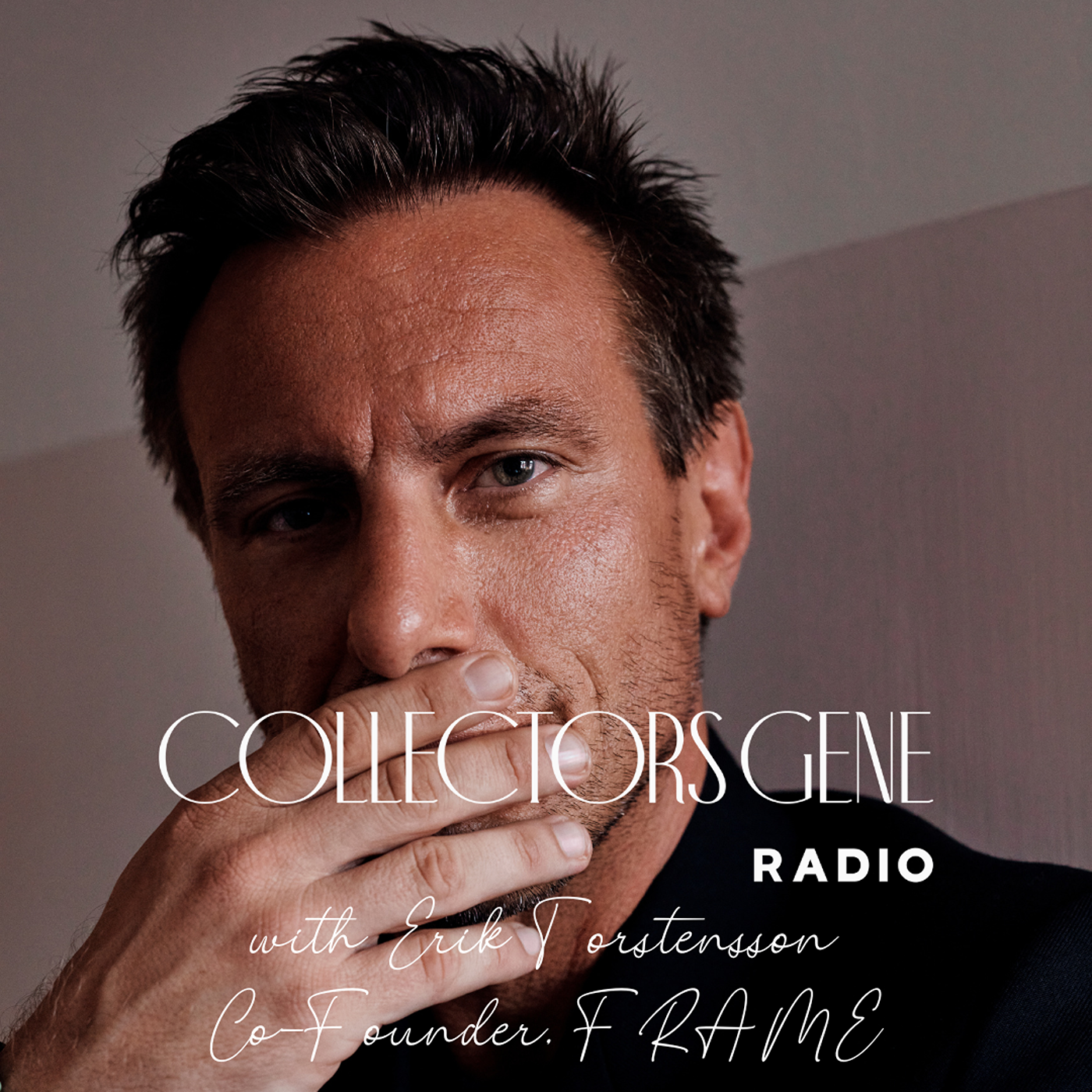
Loading summary
Transcript72 lines
- [00:00]
Erik Torstenson
It was a pivotal moment when I got my hands on an issue of magazine called the Renown plus that was, you know, men's fashion biannual out of London. And I just thought, you know, I'd found my calling.
- [00:12]
Collector's Gene Host
What's going on, everybody? And welcome to Collector's Gene Radio. This is all about diving into the nuances of collecting and ultimately finding out whether or not our guests have what we like to call the Collector's Gene. If you have the time, please subscribe and leave a review. It truly helps. Thanks a bunch for listening and please enjoy today's guest on Collector's Dream Radio. My guest today is Erik Torstenson, the visionary co founder of Frame, one of the most influential fashion brands of our time. A true powerhouse in fashion branding and creative direction, Eric has redefined modern style, building a brand that embodies effortless sophistication and timeless design. But beyond Frame, Eric's a collector at heart, a lover of art, design and objects that tell a story. From childhood curiosities, growing up in Sweden to carefully curated pieces of furniture, ceramics and art, Eric's collections reflect a deeply personal sensibility rooted in heritage durability and sentiment. Whether it's a Paul Chambeau ceramic spanx 10 object, or even the custom furniture he designed for Frame stores, everything he surrounds himself with carries meaning. His passion for collecting extends beyond objects. It's about storytelling, curation, and creating environments that stand the test of time. We'll talk about his fascinations with auctions, his admiration for Swedish design, and how his personal collecting instincts influences work. And of course, we'll discuss one of my favorite Frame collaborations to date, the Ritz Paris collection, and how it captures the essence of timelessness and collectibility. How does someone like Eric, who has spent his life refining his eye and building one of the world's biggest fashion brands, decide what belongs in his atmosphere? Well, that's what I wanted to find. Out. So without further ado, this is Erik Torstensen for Collector's Gene Radio. Erik Torstenson, what an honor to have you on Collector's Dream Radio today.
- [02:04]
Erik Torstenson
The honor is all mine. Thank you for having me.
- [02:06]
Collector's Gene Host
My pleasure. So you've had a fascinating career spanning creative direction and branding, and of course, as the co founder of one of America's greatest fashion brands and stories, Frame. But today we're here to talk about collecting and whether that's creating a collection for Frame, down to the things that you fill your most personal spaces with. I'd love to know what were the things that you were collecting As a kid growing up in Sweden, when I.
- [02:32]
Erik Torstenson
Was growing up on a farm in Sweden, there was not access to so many things. And of course, I decided to be early on most interested in skateboarding, which was not the easiest to have access to. You know, the dreams of Carlsbad in Los Angeles and whatnot. It was very far away. So my first items that I collected was actually skateboarding stickers. It was the beginning, which I was obsessed with. They were, you know, possible to get a hold of, potentially, if you manage to go to Stockholm once a year. And I treasure them. I still have them. And then I upgraded to try to collect skateboarding magazines, which also was a funny process where I managed to get my parents to subscribe to Thrasher magazine to come out to the farm. But back in those days, you know, the issue, they came three months after publishing, but it was still, you know, my most treasured possessions. And I read them back to back, you know, over again and in and out. So, like, this skateboarding was my. My. My first sort of big passion. And I think that really set off what would then become, weirdly, my career as well, because I really was. I really sucked at skateboarding. You know, I tried very hard.
- [03:42]
Collector's Gene Host
That makes two of us.
- [03:44]
Erik Torstenson
Yeah, I think it's a lot of us, but. But I was very passionate about it. And I was very taken by the graphics on the boards and the logos and stuff. So that's kind of my way of interacting with. Start drawing logos and actually taking pictures of the guys that were better, better than me, so I could hang out with the older cool guys. But the stickers and the magazines was a massive part of my life. From maybe 11 years old, was there.
- [04:09]
Collector's Gene Host
A big skateboarding scene in Stockholm and Sweden?
- [04:13]
Erik Torstenson
In Stockholm, it was great. Sadly, I lived an hour and a half away, so I didn't get to experience it much, but when I did, it was amazing. And there was a town like half an hour away where there was at least some kind of mini ramp or something. But, you know, my access to this was very scarce, and therefore there was a lot of dreaming involved. And not so great to skateboard on gravel on the farm. I mean, maybe. Maybe I suck because my access was limiting too, but I think I was also. There was. It was not my talent. I was not born to be a talented skateboarder, but it was. My dream was to be a skateboard pro that failed massively.
- [04:45]
Collector's Gene Host
I love it. And then as time goes on, I mean, you leave Sweden at around age 19 and you move to London. How did Your collections evolve over the years.
- [04:54]
Erik Torstenson
It evolved like from skateboard magazines. Then I found magazines in general. I got obsessed with magazines and the idea of working with magazines and I don't know I've said this before, but it was a pivotal moment when I got my hands on an issue of magazine called the Renown plus that was, you know, men's fashion biannual out of London. And I just thought, you know, I'd found my calling. I remember it had a line on the COVID yellow background with some guy, and I said like the world's greatest magazine or something, I can't remember. But like these, I started reading these and then I started collecting the Face magazine. All the stuff from England, primarily around fashion and graphic design. That was like my obsession. So as I moved to London, back again, back in those days when Internet wasn't as big and as important and there was no Instagram and whatnot and not everything was digitalized. A large part of my job as a then graphic designer and soon to be art director was you kind of were like the bigger. Your collection of references, magazines and books, you know, you had, you were kind of winning because a lot of your work was based on, well, one's learning and seeing and developing your own taste, of course, but also be able to, you know, put together mood boards and describe what you wanted to achieve with the project. So the sort of. The collecting part has really been very, very, very big part of my career. You know, like books and magazines became and still is a large part of what I love and obsessed with. And it set me off in the. On the career path I ended up having. As late as today, I took a delivery of some books. You know, I still love the printed medium so much, even though a lot of people have access to everything now digitally, but everything is not digitalized and these books are still incredible.
- [06:40]
Collector's Gene Host
Beyond fashion, you've spoke about your love for art and design, especially in the article that you did with Financial Times. For you, you're so busy running Frame and you're an investor in a lot of other places. But what role does collecting play for you in your personal life and how do you think it's influenced your perspective as a creative?
- [06:59]
Erik Torstenson
I mean, I love it and I collect in a very. I don't know, it's completely emotionally driven with such as upsides and downsides, which I can explain. But. But my job, you have to be curious, right? So I'm very curious about new things. You know, as you start. In the beginning, I was curious about graphic design and Then I want to know everything and consume everything about that, which I did. And you know, started with, you know, being obsessive with. I mean, I collected typefaces and everything about typefaces and book about typefaces and you learn everything about typefaces. And as my personality is very much like, if I like something, I will go deep and if I don't like something, I'm not there. So now, you know, it's more of a. It's like the fun part of my. It was like, like a hobby or whatever as a way of living in a way. But I ultimately, I think it all goes back to. I love beautiful things and I love beauty, right? And if that is graphic design or if it's a piece of clothing or if it's, you know, people or you know, architecture or sunset, I don't know. But like editing your life to have a lot of beauty in it that is based on my taste is something that I take great pleasure in. And I think nowadays, you know, from skateboard stickers to of course like that you graduate in your life when you learn more and of course maybe you have different financial means and so forth. You live and you learn and you educate yourself. And now my focus is furniture and art for sure. And that's very exciting because, you know, it's a never ending sort of learning process. And if I look at where I started with that, it's very different to where I am now also depending on of course, how you develop your own taste and understanding of what you like and long term like and what you want to sit with or not. So I think the exciting thing with where I'm at nowadays is that it's just you learn new things and you feel, get to feel new emotions and you put things together and you know, you. Ultimately we're editors, right? Like my collecting is one thing. The editing of it is another part which I both enjoy very much.
- [08:57]
Collector's Gene Host
In that same article with ft, you mentioned the scrapbook that your mother made for you. You mentioned the Chuck Taylor's that you've been wearing for 20 years. And you talk about your growing collection of Spanx. Ten pieces, each of those tied to a sentiment or durability and heritage. Would you say those collecting sensibilities are the same things that you try and implement at Frame?
- [09:20]
Erik Torstenson
Yes and no. The problem with not the problem. And why like making fashion by definition is hard to make collectible unless you're one of the maybe one or two brands in the world that can do that. We are not one of Those brands. Because, you know, the word fashion also means that something has to be unfashionable, which is not something I love, but that's the name of the game right now. So, you know, there is that you produce a lot of new things constantly. So I think that's more like, you know, gathering in output. And of course, it's a curation of sort of taste more and also thinking about your customer and what they want and so forth. I think there's another part of frame, though, that is very much collecting and curation. And that comes then down to more things that are around for a longer time, which is the stores and then the furniture in the stores and then the art that we do for the stores and objects for stores, which I think is one of the most exciting parts of this job, for sure. But then it's more about making it yourself. I think there's two different. And this is my maybe personal thing, but I like collecting. But historically also, if I get interested in something, I don't just want to be someone from the outside that is just looking in. I think that's a very typical personality. But I want to get my hands dirty and try to make it just like I've done with, you know, as an art director for pictures for many, many years. And then I'll say, but why can't I take the picture? Or, I was an art director for a magazine, why can't I be the editor? Just like I'm obsessed with furniture. Why can't I make some furniture? And I think those are two sort of mentalities. And a lot of people that just collect don't really create anything. And for me, it's very important to participate and push myself to do things creatively that are not passive, if that makes sense. Collecting, I think, is a very different thing, certainly.
- [11:06]
Collector's Gene Host
And I mean, you've now started designing the furniture that goes into the frame stores, and people can purchase the tables or the chairs or whatever. I would have to assume you're pulling design and inspiration from all the things that you love to collect or wish to collect.
- [11:21]
Erik Torstenson
Yeah, of course. I mean, it's ultimately a taste. You're effectively yourself. You know, you're. I am the mood board of my life. Right. Or my taste. And that. That is what some people call like a gut feeling or creativity, which is based on one part of it. You don't really know where it comes from, but it's, of course, it's informed by everything you ever saw. You know, it's like every exhibition, every book, everything so, and then you have emotional connections to certain. If it's art or design, whatever it might be your materials that then, over time, I think, develops your taste. And I think taste is very interesting because my taste is very specific. Me, I can really respect someone else's taste that is not mine at all. But I'd rather people have, you know, taste, and a good taste is irrelevant. It's just to have an opinion about it. And I think, yes, but again, like, I'm gonna do it for frame, then it needs to fit into the concept of what that is. So it's kind of a certain things I would do for there and that I wouldn't. And, you know, let's say frame, you know, from California. Like, woodwork is important there. Like, we have things by Nakashima in the store because it makes sense. You know, we have these tables that I made there out of a stone that is reminiscent of what you could find in Malibu. You know, so it has to kind of makes sense. My house will not look the same, if that makes sense. So I think it's the balance between maybe like a typical collector. I think I like being a collector, but I very much is a creator as well. And I think that's the balance between the two, and how you can put them together is what I find very exciting.
- [12:53]
Collector's Gene Host
Yeah, it has to have cohesiveness. And many of the things that you collect, like the tapestry that was behind you when we last spoke on camera the other week, and the Paul Shimbo ceramics in your chair collection, they're so cohesive and yet so distinctive. Have you ever found yourself drawn to something that you had to have, but you weren't sure how it was going to fit in your space all the time?
- [13:20]
Erik Torstenson
You have no idea. There's a lot of things that collecting and developing your taste also needs to be full of mistakes or mistakes or whatever. I mean, I have. I have so. So many things that I'm like, what was I thinking? What does this have to do with anything? And. And I think I'm also. Because the way I describe it is like, I'm not a very, you know, strategic nor planned person in anything I do. It's all emotional. Right. So, like, let's say early days, when you dabble in art, you can also be, you know, you have to learn and. And. And you also have to learn how that works and what you can get access to and not. And what is your taste. You know, in the beginning of that, you know, I sit on a lot of stuff that I'm Like, I don't know what I was thinking, honestly. Also, because I'm so emotionally, it can be like someone goes, like, you should get this. And I'm like, this is lovely. Yes. And then when it comes home, you. I'm like, well, I don't understand what's happening here. So now, after, you know, some years of experience, now it's much more about curating and actually pushing myself to stay within my. What I think is my taste and what I love and curate myself, if you will. So I'm trying to. To limit it, but it also depends on where it's going to end up and how you're going to enjoy it. Let's say, just like with interiors, I believe if you do a house and apartment in New York, it's very different to if you do a country house in England. My taste will be, it's the same, but it's like how you adapt it. It's different kind of projects, let's say. And I think that goes for the furniture and whatnot. But I could send you a list of hundreds of things that should never have ended up anywhere.
- [14:51]
Collector's Gene Host
Well, something that I think will put a smile on the listener's face is that you love to watch auctions. Sotheby's, Christie's, Phillips. Is this how you stay informed with the market on the things that you love?
- [15:03]
Erik Torstenson
Yes, I love auctions. I go and see. I mean, it's amazing because I live in New York and we have, you know, the big three are very present here. I go and see everything. I truly enjoy it, to be able to see the pieces in person as well. And then I, you know, happily stream them. I have kind of banned myself from actively participating in auctions because being very adhd, I get very. I've made many mistakes that, you know, so I will only participate with absentee beads that are decided beforehand and cannot be changed, ideally. But I love seeing it and I love. And I highly recommend for people interested in this at any level, ask them to, like, view the results afterwards, to track, you know, what things are and whatnot. Because, you know, of course, this, you know, it feels good if you made a good deal too. You know, I'm not. So I'm not in this to, you know, as I said, I'm not strategic. It's all emotional. I've never, like, purchased anything because I thought this was going to be, you know, like the stock market. But of course, you don't want to overpay. You want to be informed. And as it is, the only unregulated market. There is. It is the wild, wild west, but you have to learn how to be the sheriff.
- [16:05]
Collector's Gene Host
Yeah, well, it's funny, I commend you because my biggest kryptonite is watching the auctions and then forgetting that there's a 26 to 30% buyer's premium and I'd make a bid and then I'm like, oh, shit, I forgot about that.
- [16:20]
Erik Torstenson
Yeah, it happens to me too. And I mean, ideally, I wish they would just show it the total cost at all times so you don't have to think about it. But, I mean, it's smart on their behalf. Of course, the class 25 or 20 is never a great surprise. And then you have shipping and customs and. Yeah, yeah, that's the worst part. Buy locally.
- [16:38]
Collector's Gene Host
Yeah, exactly. I'd love to get your take on Swedish design. It's obviously very personal to you with your upbringing, but I feel like it's having quite the moment right now. But I'm sure this was just kind of the normal stuff that you grew up around.
- [16:51]
Erik Torstenson
I wish. Let me remind you, I grew up on a pig farm. It was IKEA at best. No, but, yeah, some of them are. I mean, annoyingly is having a moment because now everything is, you know, racing, racing ahead. But of course, yeah, you know, Spence 10, I didn't grow up with that. That was something I learned later in life about. And what I liked with that specifically, and I love Spence 10, is that they have. It's only one store, you know, when everything is so globalized and you can get things everywhere. I. I used to really like that. Like, I, you know, got a lot of stuff there for house I have in England because guests came and they did. They were like, this is amazing, but I never seen it. So, you know, I like that. I like things that are not like the typically overexposed, unidentifiable things. And compared to many other things, it's expensive, but it's not like out of this world. Christ, is the sign auction expensive? You know, so I think that's great. And for me, of course, you know, being Swedish is hard to. Having been away Since I was 19, it's nice to have a little bit of a link and now, you know, I always admire this period of, you know, Swedish grace, so the expression Swedish grace from Sweden, which I think is amazing. And. Yeah. And all the pewter and Anna pictures and, you know, the World exhibition in the 1920s and it was. It's so beautiful and elegant and I think different to what people were used to. Seeing from Sweden, that was very practical early days, you know, the design is more modernist. That was popular. And it's nice to see this elegance spreading. But it's also annoying because now, yeah, the prices are skyrocketing and it's harder to get it. But I've been looking at it for some time and I have what I have, and that's great. And I'm glad to see, you know, Sweden having a spotlight on it for. For this beautiful gracefulness that they created and. Or created. I don't know if you're familiar with, like, Axel in a yurt. And there's something. There's all this, like, wood furniture that in Swedish is called sportstuge Mebler, which I. Hard to translate, but, like, it's where you had a new little cabin, whatever, in Sweden, and they were like, very affordable and easy to make. And then suddenly, you know, this is the interesting thing for the market that it gets hyped and someone builds up a case around it, and then suddenly those things go for insane amounts and you kind of. In the beginning, you know, again, early on with that stuff. So it's good, but you kind of like thinking, this is crazy.
- [18:59]
Collector's Gene Host
It's a little hard to understand at some points.
- [19:02]
Erik Torstenson
Yeah. But, you know, it's a certain hype. But, yeah, I mean, I. I love the Swedish connection. I think it's nice to, you know, you know, I have one foot in that and then one foot in, you know, and really enjoying French design, of course, and some Italian and. And the upside of. Of being Swedish is that you can dig deeper into smaller auction houses and really do fines and work with, like, smaller dealers. And, you know, it's harder for me to do that in Italy or for France, I think, certainly. Yeah.
- [19:31]
Collector's Gene Host
And I think the best part about all the Swedish stuff that's kind of coming to light right now is that it does, like you said, work with French antiques and Italian antiques. And if it's done right, it's. It's actually a beautiful mix.
- [19:43]
Erik Torstenson
Yeah, no, I mean, yeah, exactly. And that's the curation, right. And that is what makes it your own, which I think, again, comes back to taste. It's like, you know, I think the worst thing is, like, when you do the, I don't know, whatever they call it, like the rich man starter kit, it's like the typical, like, three paintings and then it's like the typical, I don't know, Royale flower sofa nowadays or whatever it might be. Like, that's. That's just like you're getting like the starter kit, what you've seen other people have and what you're supposed to have, and which to me is like, not taste. Even though there's a bunch of maybe beautiful and great artists involved. Yeah, it's. I think. I think real live friends or collectors that I was like, I don't have the funds to do certain things, and I definitely don't. And I have friends who are, like, extraordinarily wealthy, and it's all very different. But the people I respect are the ones who apply their own taste. And I think also being brave or like, you know, having the opportunity to mix high and low, that is just qualitative. You know, I have things that cost 200 bucks and next to things that cost much more, but it's the mix of it that makes it my taste, if that makes sense.
- [20:44]
Collector's Gene Host
For sure. Let's talk about the other side of collecting, which is what you do for work. And arguably my favorite collection you've done at Frame, and that's the Ritz Paris collection. First off, I'd love to know from you what your favorite pieces are, because I have mine from that collection.
- [21:00]
Erik Torstenson
Well, I mean, it's forever changing. We just dropped the fourth drop. We've done this. And this is what I think the best part of this collaboration with the Ritz is that nowadays brands often do these things as a very sort of hit and run, as a marketing ploy, whatever, or like a stunt, and then they move on. And I think the consumer is kind of tired of that. It often doesn't make sense, but I'm very proud of it. The Ritz collab is that, you know, we're on. We've done it for two years solid now. It really sells. You know, it really. It's amazing. And I always love the idea. It came about because it was also just of, you know, Covid and came out of here. There's a friend of mine who, you know, they own the hotel, asked if we can do something together. And I love the idea of being able to, you know, not everyone again. It's almost like I know the clothes are not cheap in any way, but they're much more affordable than going to Paris and staying at the Ritz. So I like the idea of democratizing the experience of the Ritz in a very luxurious way, so. And not just doing what a lot of other brands do. And so many followed suit, you know, resortel collaborations where, like, you know, you put the logo on the sweatshirt. Like, to me, like, that's not enough. What is good here? Is like, we're doing luxurious products. So, like, if you ask my favorite pieces, this, you know, we take our extremely well crafted cashmere sweaters and actually do in Tarsha logo on it. You know, we try to have fun with it. We have. I love the stuff that we use that we do that. It says, like, don't disturb on the back. That is kind of hotel lingo. But then the other part is, like, in the most recent collection, we've done a specific scarf print that is like a silk scarf that is based on the hotel DNA, you know, and then we use that as a lining in a trench coat. Things that are a little bit more advanced. It's what I prefer. The merch part, of course, is amazing, but what we try to do with that is always make it, like, try a bit harder than what is usually seen as merch. I don't really like the merch idea. What is your favorite pieces?
- [22:52]
Collector's Gene Host
Okay, my. My three picks are. I love the tonal logo crew neck in cotton, and I think all the colors are amazing, but I think there's something about the green and the red that seem pretty special.
- [23:05]
Erik Torstenson
Love it. Yeah.
- [23:07]
Collector's Gene Host
The trucker hat is insane.
- [23:10]
Erik Torstenson
That's the best seller.
- [23:12]
Collector's Gene Host
I love it. And I think the denim shirt is maybe the biggest sleeper of the. Of the bunch, and I love that maybe because I'm. I'm constantly wearing a denim shirt.
- [23:20]
Erik Torstenson
Interesting. What I like. It's funny when people, like, figure out different ways to. To use this. I have. We did the silk pajamas that was meant to be, like, the most luxurious version of pajamas that you have in a hotel. And then I started seeing friends that was, like, women that were wearing it out in New York. And I was like, this is amazing.
- [23:36]
Collector's Gene Host
I love that. The reason I wanted to ask you about that is because, you know, collaborations often have a very collectible quality to them. It offers something unique and something rare, and I love that it's like this ongoing partnership, and everyone is always on the edge of their seat, ready to see what the next collection looks like and get the next piece of the next collection. Would you say it was an easy approach to make it feel this special and collectible? Was that the idea in your mind, or did it just kind of happen that way?
- [24:05]
Erik Torstenson
It's funny, I haven't thought about it, but as you say it, I mean, I remember we have, like, the first, like, varsity jackets we did for the first collection I have seen now, you know, being on Grail and places like that for, you know, $5,000. So they definitely have to be that. But I think what we're fortunate to do here is to collaborate with one of the greatest luxury brands in the world that has so much history and so much emotion attached to it in the Ritz Paris. So I think the combination of us as a brand and how we can execute the clothes with. With their brand and the, you know, the feeling that they bring and the recognition make something that is a little bit more magical, for sure. And, you know, it signals something if you, if you wear these things, for sure. But maybe more so than Frame, because Frame is very much, you know, a no logo brand. We really make clothes, you know, that are supposed to be worn day to day or make everyday chic, which is kind of our. Our job. I think Ritz becomes something else. You know, it's a bit more status. You know, it says something. So I think that often is what ends up being collectible when it comes to fashion. You know, that's why an Hermes Birken bag is, you know, very expensive and, you know, times more when you walk out of the store with it if you're lucky enough to buy it, because it's effectively status. Right? Same with unique or special supreme drops or whatnot. And usually we're not in the business of that at all. But yeah, the Ritz is the closest we get, I think.
- [25:25]
Collector's Gene Host
And what I really loved about, and continue to love about it is that it tells a story. That whole collection tells a story. It could have no copy behind any of the photos or any of the adverts or any of that, and it tells that story. And I think, you know, the Ritz hasn't really changed their MO since Inception. And the same with Frame. You guys are both really about what you've been about from day one. And the story is often such an important thing to collectors when collecting anything. Was that important for you when. When you guys were doing this collab and when you're creating other collections like that for Frame?
- [25:59]
Erik Torstenson
Yes, I think it's a continuous storytelling. Every, I mean, every Ritz Drop we've done, you know, has like, you know, the first one was very centered around the Ritz itself, as it should be. And then we took Ritz to New York for the second one. And then this, the one that just dropped now was very much about sort of. It was like old money Long island, actually, and kind of Jackie Kennedy, you know, that sort of aesthetic. But again, like applying the Ritz to that. So we would take it traveling, you know, next time when I, you know, I really want to take it back to Paris and again. So, like, every. Every time should have a story to keep it sort of together, which I think is important so people understand when and how. So that's definitely considered. We don't do that with all the sort of the frame collections that we drop because it's. They're much wider and it's more sort of. It needs to do much bigger job, if you will. But it's very exciting to do this and we have a. I mean, I have another big collaboration coming, which I cannot speak about here, but will come this year that I think you specifically will enjoy. I'll make sure you get some.
- [26:59]
Collector's Gene Host
Okay. I love it. I'm excited for that.
- [27:01]
Erik Torstenson
It's all about collectibles.
- [27:02]
Collector's Gene Host
Oh, really interesting. That's maybe the first little sneak peek we'll get here for all the listeners. I'm sure everyone's going to be excited to hear that. Does it ever occur to you that your most die hard and loyal customers are effectively collecting the pieces that you've created?
- [27:20]
Erik Torstenson
I don't know if they do. I think they buy the clothes to look good and feel good and sort of maybe be part of a certain esthetic I like. I honestly don't think we're. We're in the business of making clothes that are collectible in that I don't think is anyone that is like, oh, I'm like collecting frame cashmere sweaters or frame jeans and they feel anything about it that way. I think that would be to be too. Thinking too highly of ourselves, I think. I think we make clothes that people wear. I'm very proud of that. That's great, you know, and we need to have. We try to have a appealing and consistent sort of brand DNA that our customer find exciting. And then it's our job on top of that, of course, to re energize the brand with new things and exciting opportunities. It's like the Ritz or other things we've done or are going to do, if you will. But then I think the feeling of, though, being a brand that cares about sort of the lifestyle of our customer and us, that that really comes into play when we do the stores and the curation of like, you know, the furniture and art there, that is that we really take. I think it's a big part of our DNA. And even more so to come before.
- [28:28]
Collector's Gene Host
We wrap it up with the collector's gene rundown. I would love to know for you with someone who is. You're someone who's just so busy and you have so much going on. But you decide to spend your excess mental real estate collecting. And I'd love to know why collecting is just so important to you.
- [28:45]
Erik Torstenson
Well, everyone thinks I'm so busy. I don't know. I think it's. It is. I mean I talk way too much about this, but when you have like my type of personality which is, you know, ADHD driven and very restless and quite fast, I think I really get off on new information, new visuals, whatever it might be. Just like, you know, I'm effectively also collecting images as a digital images that is research. I probably have 100,000 images, you know, that I, you know, saved and it's like an asset. But I truly enjoy it because it's like it's new and learning. So it's not like it, it doesn't take that much time. I'm not, you know, I'm not the one who will research everything. And I mean I. This also makes for many mistakes, but it's like, it's very, very fast. And I think often people ask me about, even with work, like, how do you handle certain things? And I think things that took a long time, many, many years ago, it's faster now. It's like a sport. You become better at your sport because you trained a lot so to do, you know, an idea for a shoot or whatever, you know, it's, it's much faster. And I think the same thing when, when you, when you learn about your interests, when it comes to furniture or art or whatever it might be, who, what you're interested in, you, you must. Faster. I go very quickly through everything. You know, I also like, you know, I will walk, you know, I will walk the sales, whatever Christ is like this, this is a 15 minute thing because I hate to stand and look for too long, you know, so everything, everything is very fast, very, very fast, which also is. Creates many mistakes. But that's just the way I am.
- [30:15]
Collector's Gene Host
So I love it. Eric, let's wrap it up with the collector's gene rundown. You can answer these questions based on any of the things that you collect. So the first question is, what's the one that got away?
- [30:27]
Erik Torstenson
Oof. So many, so many. And I have a funny story. This is also why I stopped actually bidding Light. I had for many, many, many years dreamt of having this pair of Giacometti chairs. It's like my absolute dream. And the sale came up and I was like, I'm going to go for it. I guess I was feeling good and it was on the app and, and these two beautiful Chairs. And I was bidding and bidding, and I was seeking advice from a dear friend of mine who's very, very knowledgeable. And he's like, still a good price. Still good price. Go, go, go. And then I won them. And I was so happy and a little bit sick to my stomach because it was a little bit on the upper end of what I should really fiddle with. But then. Then this is the problem I have. You see, now you will understand what I was talking about earlier. Then I looked at the description, because I hadn't. And it goes the chair. But it's a picture of two chairs. But that chair is what I had bought the one. And then the next lot came up, and it was another chair. So not only had I bought one chair instead of two, for what I thought was the price of two, I obviously couldn't go for the one that came after. And that one definitely got away. So I wish that was in my possession. It would be much nicer with two. But I learned a lesson for sure. Luckily enough, I didn't lose out on it anyway, because those. Those kind of things never, never go down. But it was definitely a lesson learned, and that one definitely got away.
- [31:54]
Collector's Gene Host
I've had many moments like that where I. I win a lot. And then I look at the description, and I'm like, oh, shit, me too.
- [32:01]
Erik Torstenson
I once bought a selection of ceramics. It wasn't expensive. It's very great. And I was like, great. This is perfect. Like, 12 of them. And when it came, they were all like a centimeter and a half or 2cm tall. It was like miniatures. And I was like, great.
- [32:15]
Collector's Gene Host
Yeah, it was for a dollhouse.
- [32:18]
Erik Torstenson
Exactly.
- [32:19]
Collector's Gene Host
How about the on deck circle? So what's next for you in collecting? Maybe something that you're hunting after?
- [32:24]
Erik Torstenson
I think it's, like an ongoing process, and it's more of what. What comes. I mean, there's certain things that I'm trying that I like. If it's furniture designers and an artist that I keep an eye on, of course. And if things come up or become available, I take greater interest. But my focus is only furniture and art. There's nothing else I really care about now, so. And I'm also, like, in the process of finishing a house. So this is. Will be an intense period for it, but I need more of it. But I don't know how to do it.
- [32:55]
Collector's Gene Host
That's always the problem, the unobtainable. So this is one that is just too expensive in a museum. Private collection, just complete unobtainium, all of them.
- [33:06]
Erik Torstenson
I Don't know. Almost everything I like this is the problem when you study and you like the good stuff is that it's all unobtainable. There's an Alexander Null cabinet that is in Black that is 101 that I would love to look at every day. But it's in a private collection owned by Pinot. I think it is that I always, you know, I looked at it for years and years and years and that will never, of course never happen but that endless amounts of things the page one rewrite.
- [33:37]
Collector's Gene Host
So if money was no object and you could collect anything else besides what you currently collect, what would it be?
- [33:44]
Erik Torstenson
All the things that are in museums and private collections. On the previous question, um, I don't know. I think I'm. I found my. What I like which is like the furniture and the art for sure. Uh, if I could. I like sculptures and I like big outdoor sculptures. So if money was no object, I would happily have a sculpture parked full of massive Henry Moore's. This is also not never going to. It's never going to happen either. But that I would truly enjoy for sure and also be able to, you know, it only exists for the public and so forth. But yeah, that wouldn't be so bad.
- [34:18]
Collector's Gene Host
How about the goat? Who do you look up to in the collecting world or who do you think is a great collector?
- [34:23]
Erik Torstenson
Oh, I mean this is again more closer to my test. But I think Peter Brandt, if you know, here in New York, I think is an incredible collector and been for so many years and also, you know, interesting because you know, sometimes that sales you actually get to see. But it is like very active and turning things around. And I think his, his knowledge and having been there, you know, during important times and picked up the right things that were so important for those times. It's very admirable and also being able to have a foundation to share with people, which I think is very important. But I agree a lot with his taste and selections. I very much enjoy, I think what he's doing and it's very impressive in that way. But then on another level, I have someone that I look up to a lot is actually someone I work with called Nicholas Dreyfus, who's the CEO of Frame, who's you know, dear, dear friend and an amazing partner to me. And he's the opposite to me. We have the same taste, but he's like a savant information, you know, cruncher, knows everything about everything and you know, all the history and what is good and what is not. And he has an incredible eye and also an incredible wealth of information. So I often seek advice from him if I'm going to look at something and what he thinks. And I love working with him on even the, you know, the creation and design of our stores and so forth. And I think he's just very, very knowledgeable. And we share, you know, we share a lot of similar tastes. It gives me lots of pleasure, but I think he's incredible.
- [35:48]
Collector's Gene Host
The hunt or the ownership? Which one do you enjoy more?
- [35:54]
Erik Torstenson
The edit, I would say. If I can pick.
- [35:57]
Collector's Gene Host
The refinery.
- [35:58]
Erik Torstenson
Yeah, like, I don't care as much about ownership. Weirdly, like, I don't. I like looking at things and experiencing things and living with things. And of course, as I said, like, I like to curate sort of what I think is beautiful, but it's really not about ownership. It's like it's not about at all about status and stuff like that. For me, I think I like the edit and the hunt and the curation more. You know, the find and then the feeling.
- [36:27]
Collector's Gene Host
I'm with you there. And most importantly, do you feel that you were born with the Collector's gene?
- [36:32]
Erik Torstenson
Oh, I think I was just really bored. I don't know. Maybe. Yes, maybe, maybe. But. Yeah, maybe. But I think I also was bored a lot when I was little and therefore, like, I had to have something to do. But yeah, by now for sure. And I think, again, as I said earlier, I think a large part of what I do in work is collecting information or visuals or experiences and whatnot, and then creating output from that. So it's very innate, you know, it's day to day and it doesn't matter if it's like researching images, it's a part of it, like kind of collecting too, or books or art or furniture. Because I'm very specific, you know, like, I don't care about a lot of people that collect watches or cars or stuff. I'm completely uninterested in this. So it's very specific to different categories.
- [37:19]
Collector's Gene Host
I love it. Erik Torstenson, co founder of Frame. Thank you so much for coming on Collector's Dream Radio today. I can't wait to come to New York and we'll sit down and we'll chat about all things collecting.
- [37:31]
Erik Torstenson
It was great talking about this. Thank you. We can walk to auctions very fast.
- [37:35]
Collector's Gene Host
I'm a fast walker too, so I'm there with you.
- [37:37]
Erik Torstenson
All right. Love it. Thank you so much.
- [37:41]
Collector's Gene Host
All right, that does it for this episode. Thank you all for listening to Collector's Gene Radio.