Loading summary
Transcript108 lines
- [00:01]
A
Growing up, I didn't. I was always about new everything. Like every time I would have my a new room growing up, I would always want everything new. And so I've only learned that collecting is really, is really a choice and it's, it's a lifestyle choice of like having things around you that you love that don't necessarily have purpose. And like, that's okay.
- [00:25]
B
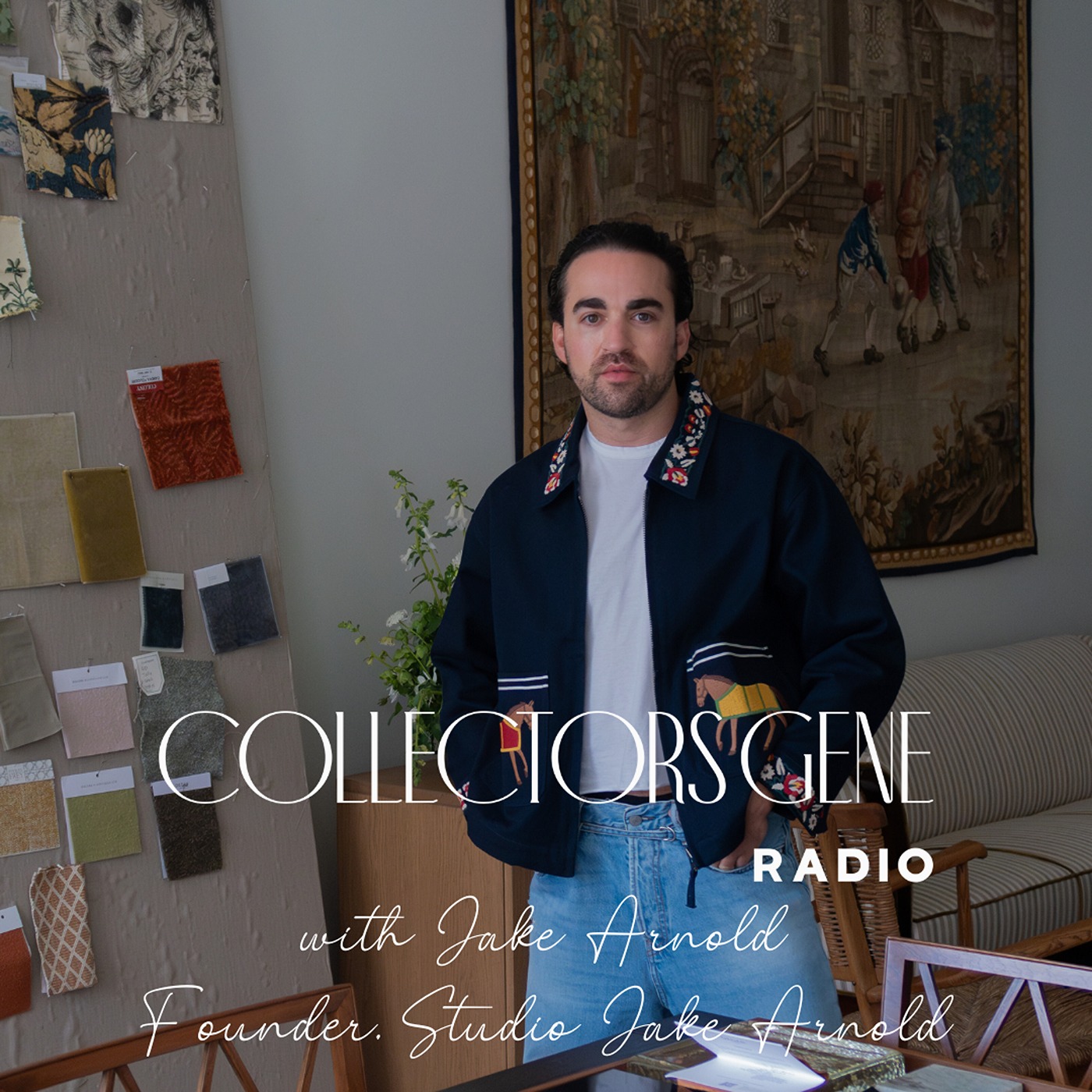
What's going on, everybody? And welcome to Collector's Gene Radio. This is all about diving into the nuances of collecting and ultimately finding out whether or not our guests have what we like to call the Collector's Gene. If you have the time, please subscribe and leave a review. It truly helps. Thanks a bunch for listening and please enjoy today's guest on Collector's Gene Radio. Today I'm thrilled to be joined by none other than Jake Arnold. From his British roots to his current home base in Los Angeles, Jake has taken the interior design world by storm. Earning a coveted spot on the AD100 list and redefining what it means to create spaces that are both luxurious and inviting. Without a formal degree in design, Jake carved his path through instinct and passion and an unparalleled eye for detail, crafting interiors that feel effortlessly timeless. But Jake isn't just transforming spaces. He's transforming the way people access design expertise. As the founder of the Expert, a groundbreaking platform connecting homeowners with top tier designers for virtual consultations, he's making high end design more collaborative and accessible than ever. We dive into Jake's journey from his very first project to the inspirations behind his signature style, his love for collecting furniture and decor, and his career defining collaborations with brands like Crate and Barrel, Lulu and Georgia and Parachute. We'll also chat about his recent coffee table book, Redefining Comfort, and the lessons he's learned designing his own home. It's truly an honor to have him on the show and I hope you all enjoy just the same. So without further ado, please welcome Jake Arnold for Collector's Gene Radio. Jake Arnold, welcome to Collector's Dream Radio.
- [02:07]
A
Hi. Thank you so much for having me.
- [02:10]
B
My pleasure. So you have British roots and now you're based in Los Angeles. So I think it would be great for our listeners to know when you actually came from the UK and made your way to the US Well, I.
- [02:22]
A
Actually last week officially became a citizen, so that's a major change because I came almost 14 years ago.
- [02:34]
B
Wow. Congratulations.
- [02:35]
A
Thank you. So when I came, I did an internship over a summer and then fell in love with it. I'd Never been here before. And then I decided when I went back to London that I was going to live a delusional life and tell everyone that I was moving to la. And eventually I kind of put it out there and it happened. And then I got on a plane, came here and worked for another interior designer and another architect. And it was really difficult and really hard because I had no, I didn't know anyone. It was very hard. And then I eventually worked for just the architect and he had a client who let go, I should say not fired, let go of the designer that she was working with at the time and asked me if she knew anyone who could do the house. And I was ballsy enough and just said, I'll do it. And this was at a time when I literally had no experience or relationships with any vendors or anything here. And I just learned as I went and then I kind of built the design, interior design, part of the architect's business. And we kind of worked together for the next six years until I ended up doing my own. So it was a journey.
- [03:58]
B
And how did that first project go? Was it a success? Was it a little rocky?
- [04:03]
A
Yeah, we actually. Well, in all honesty, there was one moment I'll never forget where I went to the job site to do a check in and when I tell you everything was wrong, like every electrical location, I just was so out of my depth and I just burst into tears and was like having a full meltdown and wanted to go back home because I was just like, I can't do this.
- [04:30]
B
Well, I feel like the interior design world is pretty welcoming to anybody with open arms to answer questions though. So I'm sure you were probably able to use some resources, right?
- [04:39]
A
Yeah, I mean, look, I didn't have chatgpt then, so that was different. But no, it was. And ultimately, like anything worth it is hard and that's just life. And I'm such a self starter and learn on the job job. So I just pushed through and then the house got on the COVID of Better Homes and Gardens and so it went really well and still very close to the client now as a good friend of mine. And it was an incredible success. And I never forget she turned around to me one day in the car and was like, just so you know, I can't tell you how grateful I am that we're doing this together. And I just love working with you. And so it's important to know that even when you're struggling inside or something feels hard, like not everyone can see that. And that's okay. Like, you kind of have to fake it a lot of the time. And so that kept me resilient, and I just kept pushing through, and then it was a huge success. And I learned so much from that experience. And then, honestly, that was at a time where, like, the phone was ringing. Like, people would just call me randomly and say, I saw you did, like, can you do my house? Like, I wasn't speaking to, like, business managers or anyone. I was, like, directly speaking to a lot of these clients, but just call me on the phone. And so I had to build my business around that, like, building the plane while flying. So it was. It was very difficult.
- [06:07]
B
Well, I think you did it with such grace. You know, you've kind of entered into this world, and your success here has been meteoric. I mean, at the minimum. And you've done so many product collaborations and all that stuff that we'll get to. You've launched the expert. You've done all these amazing things. And do you think that growing up in Europe was able to have a significant influence on you? Because I do find that, you know, Europe has something that the US doesn't, and that's this charm, this old world charm. It's history, it's detail. It's all these things that a lot of times we don't get here.
- [06:47]
A
This was something I actually thought about last week when I became a citizen is, like, in my heart and soul, like, I feel like an American in the sense that I'm so open to change and newness and opportunity and, like, really building something from nothing. Like, that's really my. My natural state. And I think from a sentiment of, like, history, from both aesthetic and just, like, respecting the past, I definitely was exposed to that naturally. Like, it wasn't necessarily that I was going to these high cultural experiences, but even just the school that I went to was like, a Georgian and Edwardian, like, mansion that turned into a school. And I was always around architecture and design, but it wasn't necessarily, like. It wasn't necessarily, like, a formal education whatsoever. And so I do think it definitely, sensibility wise, had a huge impact. And so my whole philosophy is, like, bringing the best of both, where you have a European sensibility, but with the relaxed and informalness of the US Which I think that Europe doesn't do that well, where everything feels very serious and not as livable. So I think that I try and marry those two ideas together. And it's kind of like, why one of my biggest, I guess, someone that I look up to is, like, A Ralph Lauren type person who is able to connect all of those dots in a way that feels timeless but also always interesting.
- [08:31]
B
Yeah. And I think what's interesting is that, you know, your style of design isn't traditional English by any means, but I think, you know, from what I see, you know, as a. As an outsider here, is that there's so much inspiration from English design and, you know, the different textiles and using curtains instead of cabinets and things like that that you typically just don't see here.
- [08:54]
A
Totally. Yeah. I mean, when I first started, and especially being in Los Angeles, where everything was light and bright, I was doing darker, moody, like, richer toned words and stones and other materials that you just weren't. People weren't doing that much here. So I definitely think that at the time when I started, like, it was. It was definitely a bolder approach, but it's how I personally like to live and create cozy, comfortable, livable spaces that are impactful by nature and don't just necessarily look good on a picture, but really feel like your house or your home can support your lifestyle. And so that's a huge way in which I kind of draw on when I'm designing. It's really like how I want to feel in a space, not just like, what does it look like? And in England specifically, it's got incredible architecture, craftsmanship, and certain things that we don't have here in the US And I do think that materiality, finish, and again, craftsmanship and artisans is. You don't have the history that you do in the UK specifically. So I definitely draw on a lot of those. Those aspects. And it's funny for me because I've worked on a lot of, like, Tudor style or Georgian revival homes here, so I definitely bring that experience and exposure to the projects. But it's. It's. Again, it's like. It's. It's an American. Americanized version of. But I think there's something great about that, too.
- [10:39]
B
Yeah, absolutely. I think, you know, when you look at homes like that and the history of what they once were, it's nice to see them revived still with a little bit of that touch, because a lot of people will skip out on the outside, the architecture and the facade of a home and just do whatever design style they want on the inside. And there's a time and place for that, but sometimes it needs to have a little bit of an ode. Right?
- [11:02]
A
Yeah, of course. I think anything in design is the difference between something that feels thematic and something that feels inspired by. And I think that's what you have to be so careful with is that I'm a lot of the times working in architectural context where you're adding the soul, the depth, the character through millwork, cabinetry, architectural ornamentation, like whatever that may be. And it's not just like being in Europe where you can juxtapose and put any furniture in any space or go for the boldest color because the architecture really grounds everything. Whereas a lot of the projects I've worked on, especially on the west coast, you don't have that grounded kind of juxtaposed nature of a space. And so creating that first has been always the challenge.
- [11:55]
B
I want to talk to you about the Expert. It's the company that you founded amongst all the other million things that you have going on. You decided to launch this platform that allows people to book consultations with designers to get advice, whether it's you or whether it's somebody else. They can actually book you and pay you to give advice. And you've curated an amazing shop and fantastic editorial. And it's really, in my opinion, such a great platform. And I've watched you start it from the very beginning. I remember when you announced it that it was coming initially and it's been fun to watch it grow. But what I love most about it is that it sheds light on just how collaborative and friendly the industry can be. Right. Because you're an interior designer amongst a million other people that are and you have your own clients and your own design style. But that doesn't mean that you're going to turn your nose up about talking to other designers where I think a lot of other industries people don't collaborate this way.
- [12:56]
A
Totally. I mean, look, on a personal note and professional have really understood the sentiment that there's enough for everyone in this world. And I think it's really important to shine a light that we have to like celebrate other people and show that there is enough space for not only just different designers stylistically, but personality wise and what people bring to the table. Like, there's such a plethora of incredible talent out there. And so when we started the Expert during COVID it was a natural, it was a natural evolution because we were. I was getting a lot of DMS on Instagram asking for advice and to potentially do a zoom call. And my best friend Leo Siegel, who's my co founder of the Expert, was like, wait, why don't you just do one of these sessions? And I was so resistant. Like most designers, like a few years ago, like the idea of E design has such a negative connotation, but I ended up trialing one and realized how much kind of knowledge someone could take in an hour and then realized how many other designers were probably getting the same messages. And so I naturally reached out to a lot of my peers and friends of mine in the industry and came to find out that everyone was having the same idea. And as designers were such people pleasers. And so we want to help people, but we also don't have time. And like, sometimes you want to get compensated. I mean, all the time you want to be compensated in the way that a doctor does. When you ask for an advice, like, you're not just giving a paint color away. You're not just giving construction advice like it's a business. And like, first and foremost, I'm proud of the expert because it supports both the designer as a business owner, but also allows the end user to have the best part of the process, which is to only work on creative discussions. And like, that's the idea, is that it's a platform that works for everyone. And it's not just designer forward, but it's also for everyone and for people to have access to designers that they love around the world without having to geographically be in the same place. So it's. Yeah. To really hopefully answer that question is like, there's enough for everyone. And I believe in democratizing design because it's happened naturally. So I like to lean into what happens naturally versus resist it. And I think in the past, a lot of designers or people that still say to me, they're like, why would you want to share all your tips? Or why would you want to share all this content that's helping other people and people pay you for that. And I think that it's like there's so many different markets. Like a full service client who's building a house from the ground up or doing a renovation is not that customer. They're different customers. And so I think that again, it's like, there's enough for everyone. And I like to celebrate and people have a platform to really showcase their work. And that typically is not. Doesn't happen in many industries. Like, we want to bring people together and have a community.
- [16:18]
B
Yeah. And I think the other great part about it is the shop that you've curated, there's so many great brands on there, whether they're new or vintage. And I think that also is something that's important, is that it sheds light on. People will see photos of, you know, the projects that you've done. Or another designer has done. And they want to know where some of this, you know, object or furniture has come from and they can look right in your shop. And I think that's special.
- [16:40]
A
Yeah, absolutely. I think, I think ultimately that's just like the. Was the natural progression of again, like having communities online, especially on social media, and seeing what people want and giving exposure to these smaller brands that we love and again, giving them a platform like it's a win win for everyone this way. And I think what makes designers kind of special in the sense that they're always evolving. So the idea is that this platform and the store is always expanding, evolving with new designers, new artisans, new brands and companies and really showcasing them and keeping it as up to date as possible as we explore and discover new companies as we go. And it's just really fun to see. And I use it as a resource in my own studio, so it helps my team tremendously when everything's in one place. And the expert has an incredible infrastructure that support everyone on the trade. So we have a trade program where other designers who have same access to the same brands that I do, but they go through the expert because it has the support of navigating that relationship between the vendor and making it as easy as possible for our trade customers as well. So that's been like a fun evolution to see how it's not just the average consumer, but also other design studios who also use the expert platform for efficiency in the studio as well, which has been pretty interesting, certainly.
- [18:25]
B
And a lot of the items that are in the shop are actually a lot of the things that you like to collect. You know, decor and object and furniture and books. Were you a collector growing up or which of these came first as you started to get interested in interior design?
- [18:39]
A
So I have to tell you that I'm one of those people that's all or nothing. So I've gone through most of my life like, I'm not going to buy this until I have that, that house. Or I'm not going to do this until I figured out the whole story of how I want to design this space. And what I've learned in the last few years is the idea of collecting is like you don't need the context. Like if you love something, buy it and you keep it. You make it work. I can use it on a project or I get to have it and use it in different ways and live with things that you love. And so I've started collecting personally in the last few years in a different way than I had in the past, like there used to have to be such a specific purpose. And now I find that every time I've moved and I have things that I collected that they get to take on a whole new personality and experience. And so I think growing up I didn't. I was always about new everything. Like every time I would have my a new growing up, I would always want everything new. And so I've only learned that collecting is really a choice and it's a lifestyle choice of having things around you that you love that don't necessarily have purpose. And that's okay.
- [20:01]
B
Now you have to source all of these things for your projects that you work on as well. What happens when you find something that fits perfect in your collections but could also be perfect for the client or a project?
- [20:12]
A
Yeah, I mean, again, that's always the hardest thing is like I don't like to be too attached to anything because I do feel like big picture being attached to things in general is a dangerous space to be. So I do like to let things go. And if it works for the project, I always tend to put that first because I have the benefit of being able to always be inspired or excited by anything new. And if it really works for the project, then I let the project have it.
- [20:45]
B
I think people would probably be curious to know, you know, when you do one of these projects and you style it the way that you want to style it, with all these antiques or furniture, whatever it may be, is the client always saying we're going to take all of this or do they then once the project is over, kind of pick and choose the things they want to keep.
- [21:01]
A
So I would say it's a mix. In the past, I used to bring everything in on the install only and they would decide what they wanted to keep and what they didn't. Now what I do, especially if it's a long project, like over two years, we start collecting like a year into the project, once we have a kickoff of like kind of the North Star and the narrative of the project and we start sending things like, as we find. And so by the. By the time we do an install, like they are, the clients are a part of that process. It really depends on the client's desire to be involved in that process and if they're able to buy into something that they love without necessarily knowing exactly where it goes. Because some clients need to know exactly what individual object is going on what shelf. And that doesn't work obviously in the prior example. So it's a mix. And It's a combination. But I do find when people see things in in situ, then nine times, nine to ten times more likely to buy it and when they see it in context and styled. Because I do think the styling and the usage and showing clients how things can be displayed is a huge part of that approval process.
- [22:25]
B
Yeah, for sure. Is there a place that you love to travel most to to collect and source? I mean, I've followed along with you when you go to the Paris flea market and you bring back a bunch of amazing, you know, objects and vintage barware and all that sort of stuff. Is that kind of the grail for you?
- [22:41]
A
Yeah, I mean, the reason I've gone to France a lot is I honestly love spending time there in general. So I like to. I've done taken a lot of trips there because I enjoy spending time there regardless of collecting. So it feels like a lesson. It's not necessarily such an intentional trip just to go for that purpose. But now I would say that I'm trying to carve out more time to go to other. Like there's somewhere in Brussels that I really want to go to this next year and a few other places I have on my list for collecting. But when I was in Paris last time we actually went to a local. I would. I didn't. It was almost like a. I don't even know what it was, but what we call it in the US but we used to call it like a car boot sale, where it's just like people sitting with their cars and it's in all their stuff in their trunk. Like it's. It was outside of the city and it was all just. It was all local French people. But going through all of those items and getting like the most amazing deals and just seeing things that are so. Like you would see in the. In the other flea market and there'd be ten times the price. So I think there's also like places outside when you're in Europe. Like someone's selling their old. Their grandma's old stuff is going to be 10 times chica than anything you're going to find here. So I think it's just. It's interesting how design in European families is just an inherent part of their culture. It's not. You don't necessarily have to be into design. It's like weft into the culture. So someone has a beautiful chair or a lamp or an obj. It wasn't necessarily because that person was a design maven. It just is a more common thing that you see.
- [24:31]
B
Yeah. Usually when you see people buying things out of trunks in the US it's usually not antiques.
- [24:37]
A
Yeah, it's not antiques. And again, it's like that's what's so amazing about going outside of the city in major European countries is that design is so. Is such a huge part of history. And I think it's what I really respect about France and I love in a different way to maybe somewhere like Italy that while Italy is also very design focused, like the average person in France has such knowledge on design in a way that is very interesting to see. Like there's this like excellence that they have and uphold so that the rest of the world can break the rules. But they're such rule followers and I find it kind of charming.
- [25:25]
B
Do you feel that being a collector yourself helps you a lot when it comes to doing projects and you know, sourcing different objects and materials and all that sort of stuff? Is it. Does it make it easier?
- [25:37]
A
Definitely. I mean, it's changed my whole perspective from when I first started to things being very rigid that I now have given myself the permission to be a lot more organic because collecting myself, I don't need the full context. Like one minute it could be a Chin Waziri cabinet, the next minute it's a Scandinavian light fixture. Like it doesn't matter what it is, it just. If you love it, then you buy it and you put it together. And it's really not the objects themselves that the magic happens. I think it's how things are used and placed and styled together is what brings something together. It's really how I approach even buying clothing. It's like if you have a closet of an amazing classic pieces and then a few fun pieces and you have that to draw upon. It's the same way of working and collecting beautiful furniture, lighting and obviously because it's. It's always evolving and expanding. And I think that it helps when working on clients houses is my whole goal is that it doesn't look like they've moved into a brand new house that has. Everything has been designed by an interior designer. Like I want it to look like they've collected things themselves over time and that they've brought pieces of furniture in from different houses and created something from what they had. To me, that's the skill that I've tried to expand upon is letting other people who aren't collectors feel like they have been collectors themselves.
- [27:18]
B
Well, I think you've excelled at that. I mean, you do projects all over the world, not just California. I mean, you've done Stuff. In Stadt, you've done stuff. And in California, you know, across. Across the country, is there a place, whether it's in the US or in another country, that you love to work on the homes the most, you know, based on the architecture or the style or the neighborhoods?
- [27:40]
A
I mean, I think. I mean, if I. If I. If I could do anything, I would love to do something in London. Because I haven't worked in London and I have since I was a kid, I always been obsessed with Georgian townhouses. Like, that's my dream palette, like, to work on. And yeah, working in Switzerland was an amazing experience to have a completely different context. But I think it's just more to come, like, more so. Like, what I've done in the past, it's been so different because it's either been a lot of new construction or I will say what I do really enjoy working on specifically in Montecito is like the older, like, Spanish Revival, like, Italian Palladian style houses. Like, I do love working on those because they do have, like, a whimsical nature that when you go to, like, Italy specifically, it's just a different. It's a little more playful. So I do. I do love the context of California projects because you don't have to be as serious, which I like.
- [28:43]
B
Yeah, Montecito is pretty incredible. I mean, the architecture alone there, you really don't feel like you're in California. And I feel like for you, all that you do and all the different design styles that you mix, you know, a Scandinavian or a Swedish lamp here with French sconces, like, those sorts of things lend to those homes, like, perfectly.
- [29:05]
A
Yeah, I mean, but that's what's so amazing about California. And even in la, it's that you can have a street with a Georgian style house, a. A Tudor starhouse, a French Normandy and a contemporary. And it all works like you don't have rules. And so while that can sometimes be difficult when there's bad design, it's amazing if you have the freedom to be creative. And there's this book, it's like a. I think it's called California Romantica. And it's just like an amazing, almost like love letter to how California creates a landscape to imagine so many different lifestyles. And I think that's what drew me to move her in the first place, honestly, is like, I just find there to be such magic in that and the idea of possibility. And I kind of, in my book had written about, like a chapter about charisma. And I do think that Being in a place that allows you to have an open mind with no ceiling has kind of really given my design philosophy a huge boost. Because now if I was working, even when I was working in Staad, it's like, so strict. Everything is so by the book. And being able to maneuver, being around people who are such purists that it's like respecting the context, but also and knowing the rules so that you can break them in a way that still feels respectful and timeless, but, like, gives us something to feel different and interesting.
- [30:54]
B
Why do you think, especially in a place like California, maybe more so Los Angeles specifically, that all the new homes that are being built are just these glass boxes? There's no molding, there's no, you know, architecture and arches. Like, like, even the homes that are in Montecito and Santa Barbara, you just don't see that being built anymore.
- [31:14]
A
Well, I feel. I do feel like in the last couple years, I've seen a shift that people are leaning towards homes with character or at least trying to replicate that. Because I think that in LA specifically, I think especially when people have a view, they're trying to expand on the view and not realize that it's not. It's like, have something to be surprised by. And I think when you see everything at once, it doesn't allow for those moments where in traditional architecture you have beautiful enfilades and interesting openings and viewpoints to create different moments. And the idea of, like, contemporary glass box type houses is almost like there's too much of a good thing. It's like there's too, like, almost like you don't want to wake up. I don't want to wake up in a room that is glass floor to ceiling on three walls where I feel like I'm in a glass house. And I think that it's not considered how people actually live and what feels comfortable and cozy for a human being and not just for a party. So. Yeah, and also it's a question of taste. Like, to some people, they find older homes dark and have low ceilings. Like, you see people tear down the most beautiful houses here to build the ugliest houses. But again, it's all opinion. And that's the best and the worst part about design is that it's so subjective.
- [32:44]
B
Now, I picked a few of my favorite interiors that you've done, and a lot of these are older projects and are what's shown on your website. And I know that you've done a lot since then, but these are the ones that everybody can go out and see, because I know a lot of clients like to remain private and don't necessarily want their pictures everywhere, so I get that. But these are a few from your website. And I picked an item from each project that I just felt was interesting or caught my eye. And, you know, figured I would just see if you could tell me a little bit something whether where you sourced it or why you felt it was special for the space. Does that sound good?
- [33:20]
A
I remember, yeah.
- [33:22]
B
So the first one's in Villa Vendome. And in the living room with the fireplace, you have this Swedish floor lamp with two shades. And the arms are kind of going in asymmetrical directions. And I just love how it's such a delicate looking piece in terms of simplicity. But it packs such a big punch in terms of design.
- [33:42]
A
Yeah, I mean, I would say a lot of light fixtures that I tend to use are more of, like a feminine touch. Because I do think that they soften a space, Especially in that room with, like, the stone fireplace and the darker sofa. Like, it just adds a softness to it. And that's why I really love the sculptural element of it, too. And so I think when using, whether it's drapery, floor lamps, anything that's like your largest vertical in a room is being really cognizant of, like, the silhouettes that it creates. And, like, that's a perfect example of something that has structure, has purpose and beauty. So, like, really combining all of those three is, I would say, subconsciously part of my intention when sourcing that.
- [34:33]
B
Love it. The next one is the Montecito tutor. And you have this French trestle table in the master bedroom that you actually use as a desk or a writing table. And I love this because most people don't think to use tables like these as desks.
- [34:51]
A
Right. Well, the one thing I learned when working in Europe and also just like thinking about growing up, some of the people that I went to this very small school. And a lot of the people lived in these, like, very old, like, amazing houses. I was. I was the poor one in the school, but I used to go to all these amazing houses all the time. And I loved how you would just see beautiful piece of furniture used in the way that they needed it to be used for. So instead of buying something as a desk or a nightstand or a side table, it's like, this is what we have. And, like, this is going to be a desk because that's what we need it to be. And it's perfect. And I don't need to have every single drawer and compartment. And I find a lot of times in the US Everyone wants that look, but they also. They want. I want three drawers, and I want an outlet. And I also need it to have a swivel chair. And it's like, okay, well, now this. Isn't that so, Right. It's. It's retraining that, like, if you want that type of look where things feel collected and the usage is maybe not what it was intended for, like, you have to accept the input. And I think that that is a huge part of the storytelling. When I work with clients, it's like there's an imperfection to everything. Like, you want to buy that console table for the dining room. It's going to maybe be slightly undulated. And like, maybe the plate, when you put it on there, might not sit perfectly flat, but it works. And people have been doing it for hundreds of years in Europe. And you just have to accept that that is a reason why something is amazing, not an imperfection.
- [36:41]
B
Certainly the next one is the Beverly Hills hillside home. And flanking the fireplace, you have these two amazing. I believe they're royere sconces with the multiple arms and shades. And to me, it's such a state in that room and something that you would expect to see in a French country home that's just coming to the market out of having been in a family for 100 years. And I just felt like it was such a smart piece of, you know, lighting to put in that space.
- [37:12]
A
I mean, I think with those specifically, I always like to think of ways that I can introduce color without it being the biggest element in the room. And these were like this deep, almost like a burgundy racist. And it was very intentional that we actually didn't do anything in the center of the fireplace because of these lights. And so they were chosen really for, like, the scale and the idea of bringing in color in an interesting way. And again, like creating interesting silhouettes and shadowing. And I thought what was nice about how we installed them is that we did leave the space around there for them to really be the focal point.
- [37:56]
B
Yeah, I love that because your eyes go directly to them. And I'm assuming they were Roy Ersconces, right?
- [38:02]
A
Yeah, they were old. One of them was like, we had to have refinished, but they were. And all the shades are new, obviously, but. Yes.
- [38:14]
B
So I'm curious about those because obviously royer stuff is very high end now and expensive and fairly rare. Is that something that a client specifies they want? You know, do they Know, like, hey, I want. I want some jamrare pieces. Or is that something that you bring in and kind of surprise them with?
- [38:33]
A
I think it depends. This client specifically had a little more knowledge than most and definitely did throw out a few names. And again, like, I think everything's. A lot of people are talking about like Royere or genre or a Tyrell. Like there's like a combo package of, I think just designers that everyone. It gets so overdone that it becomes like, oh, I want this. Because this is. To a lot of people, it's like wearing a Birkin bag. It's like it's not really based on design for them. It becomes more of a status symbol, I think. And I think at the time when we did this, that was not really the case. But more so I see people throwing out names for the idea of like status and the things that they have.
- [39:28]
B
Owning it or.
- [39:29]
A
Yeah. Versus like actually loving something.
- [39:32]
B
Right. And it's much easier for you to find them than for them to find them.
- [39:36]
A
Yeah, exactly. And again, a lot of times people get a sticker shock on how much these things actually are.
- [39:41]
B
Right, right. Like if you have a 20 foot dining table and you want all genre chairs, you better understand how much it's going to cost.
- [39:48]
A
Exactly. And I think some will value that. And I have some clients who are again, our collectors. They collect art, they value that. And then other people, like, I just like the look of that. And so it's a different. And then at that point it's like you have to look at something completely different because we're not making something like that. Because again, it's like the education of respecting design for people who don't necessarily have that much skin in the game. I think it's just re educating. And I like to always give analogies to clients, especially if they're in entertainment or music or fashion or whatever. It's like explaining to them that it's the same thing of just disregarding like the past. It's like we can all be inspired by things. And I think there's nothing wrong with creating something that maybe has like a similar line or material, whatever. But like again, it all depends on the client and what they're willing to spend and what they value certain things. And the value is what's so personal for people.
- [40:55]
B
The last one I'll ask you about is the Brentwood Spanish Revival home. And in the entryway I believe you have this really rustic triangular table with an opposing toned wood top. And it's such a statement piece Especially as you walk into an already very rustic home.
- [41:15]
A
Yeah, I mean, that space was always very difficult because we didn't have that much space when you entered. But it always felt to me that it needed a specific piece. But any other console table wouldn't have worked and would have been far too large for the space. So I, again, I think it was two weeks before we were doing the install, found that piece in actually in la, and I was like, oh, my God, this is perfect. Like this. Definitely, we have to try this. And we brought it to the house, and there are things like that that I don't necessarily show the client first. And I bring it to the house to try it out, especially if it's local. And that's where the magic happens. I always allow for a certain percent of things to happen on the inside install week, because some things you can't plan for, and sometimes you don't have the perfect piece until you find it. And I think that if the client accepts that and they want to have a beautiful house, like, there's an element of patience that maybe you don't have every single thing done the day that the install is done, because it's just not how I typically now work in the way that I used to, where it was a mad rush to get everything done and then you're stuck with it. So I think it's good to take your time.
- [42:34]
B
For folks that are decorating their own home, what do you suggest they do to think outside of the box?
- [42:41]
A
Right.
- [42:41]
B
For example, I think it was a long time ago, maybe during COVID that you posted a picture. It was possibly Jen Rubio's house that you did in the Hamptons. And you took this hexagonal dining table base from what looked like House of Leon. And instead of using the glass top that they suggest on their website, you put this massive stone, maybe travertine top on it. And it was such a dramatic piece to just put in the middle of a room. And I feel like it's creative thinking like that which really takes homes to the next level.
- [43:11]
A
Definitely. I think. I think, again, it's. How do you take something that really, like, maybe doesn't typically belong in that context and reimagine it? So I always like to think about, not necessarily always reinventing the wheel from scratch, but how do you use a certain material or apply it in a new way, especially when it comes to, like, bathrooms, kitchen spaces that people don't tend to add certain decor or accessories or auberge or, like, reimagine things and so it's almost like, how do you change the top of a console table that maybe is glass but you now put stone on it? Or how do you elevate, like, seating by maybe doing like two different fabrics for the chair or on the cushion and like giving it a whole different personality or whatever it is. Like, I think just thinking about the compass components and how to give it a new point of view. And I think when people are in doubt and they don't know what to do, I always say do less. Like, edit, remove something. Because I think sometimes people get caught up that every surface or every single thing needs to have something, and there's a beauty in the void. And so knowing what that void is and feeling it out, I think elevates the pieces that are remaining and makes things feel more elevated, in my opinion. I think if you're not going full maximalist and you're not someone that loves to be around so many objects, the idea of being minimalist, I think, can be cold sometimes. For it to not feel cold is like the pieces that do remain, like thinking about texture, thinking about scale, and again, playing with scale, like do a tiny, tiny mirror over a sink in a powder room is so much more elevated than just buying any old mirror, I think is just an interesting way to do that. And lighting. Vintage lights are everything. I try to majority only use vintage lighting, especially lamps, for sure. And I think that's an easy way for anyone to kind of introduce soul into their space.
- [45:37]
B
Certainly. Yeah. And I feel like that's kind of what a lot of contemporary or, you know, big box retail or furniture stores do wrong these days is they're showing all this outdoor furniture, tables and all that stuff, and it's like, show how that looks in your home, you know, on the inside, because it is stone. And, you know, this stone table could look really interesting as a dining table or as a console table or. Or as nightstands or whatever it may be. And I think that they've done a great job at creating beautiful products, some of these companies, but they don't do a good job at educating people on design.
- [46:16]
A
Totally. But I think people have got a lot better. These bigger brands have got a lot better in the last couple years of just showcasing, especially with designer collaborations. And that's why they do those collaborations, is to give that educational insight, I think, to a much bigger audience, certainly.
- [46:38]
B
And I want to talk about that because that's the other side of collecting, which is creating collections for brands like Crate and Barrel and Lulu and Georgia and Parachute and You've done such a great job at creating interesting out of the box items that you've really never seen from these brands before. And the way that you've styled them and photographed them, um, you know, it, it's, it's the opposite of what I was just saying. It, it's like, it's like you saw this happening with these big brands and you're like, okay, let me do this right. Let me create these products and let me stage them in, in these photographs to show people how they can feel lived in. And it's not just a white background on, on the product page. And I have a lot of those items in our home. I have the Crawford sofa, I have the Murfield chair, the state console table, simply because I do feel like they are timeless pieces and they are pieces that I will be able to travel with from home to home.
- [47:31]
A
Well, thank you so much. It's so nice of you. Yeah. I mean, that whole process for me was one of the best experiences I've had in my career. Honestly. Like, I loved every second of it and it was just so fun to reimagine certain pieces and again, like think about them as classic pieces, even if they're not vintage or antiques. Is I think every single thing you typically see from big box retailers. Like, I never really see that like nice patina or finish or scale that is done in a way that feels like a more expensive piece. And I've been using these pieces from Creighton Vowel in multimillion dollar homes and projects and you can't really differentiate the difference once they're all mixed in with everything else. And that was the goal. Like I wanted to not just put my name on something, but really be deeply involved in the process of working on all of the materiality and being such a stickler for that on my projects anyway. And just shining a light on how just because it's something that's more affordable doesn't mean it has to sacrifice on quality or detail. So it was, it sucked to me that like combines all the things I enjoy about this industry is the design element, but then sharing it with a bigger audience and so it allows me to fulfill that versus with clients. It's a much higher end, more expensive, time consuming process. So to to be able to have that as a vessel has been so amazing certainly.
- [49:13]
B
And I think for me, the one piece or the two pieces of that crate and barrel collab that you did that speak to everything you just said is the Crawford sofa. Because one, I think you see a Lot of products that these big box retailers put out. And you're like, okay, I get it. It's new fabrics, slightly different, maybe design. But with yours, like the Crawford sofa, you did a bench seat, which not many people do in sofas, and you did this, like, pleated skirt on the bottom of it, which you just don't see anywhere. And the curved back and the arms. And I just. I love that they let you run with the design and they weren't, like, handcuffing you to, you know, their design styles and all that. And they just let you have it and do whatever you wanted and it shows.
- [50:05]
A
Totally. Yeah. I mean, that. That was really the best part about it is I didn't sacrifice one thing. Like, there was lessons on the way in terms of materiality for, like, mass, like a larger consumption. But I will say, like, the design process, they encourage that creativity. And that's why we're. That's why they're doing these collaborations. They want to expand the horizons and a bigger audience, to have more access to well designed, thoughtful pieces that you don't see all the time. Like, and it's a benefit for their existing customer, too. And so that.
- [50:43]
B
That.
- [50:45]
A
That they do exceptionally well. And I have other friends who have done other collaborations. And maybe it's not the same at every company that doesn't have those sort of restrictions, but it's also the capabilities. And with Crate and Barrel specifically, they have such a broad range of capabilities that allow for an exploration of design to happen. And so that's the funnest part, I.
- [51:10]
B
Think, of the process, certainly. What's your typical approach to creating and designing these collections? I mean, is it. Do you come in there with fresh ideas or fresh hearts? Or is it, you know, let's start riffing on some. Some inspiration.
- [51:26]
A
It's a mixed bag. I think it's. Some of it is okay. Like, what do we have such a hard time finding naturally? And what do we typically make custom all the time? And how do we bring that into something that is available and easy and a huge part of it. Like, especially with upholstery pieces, 90% of the time, I'm making custom pieces. And then when it comes to some of the cabinet, cabinetry and credenzas and consoles, it's. Again, it's like, scale is never right. Especially with, like, larger, bigger box companies, everything is always too small or it can be too big, actually, in other cases, I won't mention any names, but. And I do think that that element is so important, like purpose and Functionality is such a at the forefront of my design philosophy that I like to think about what's not available first instead of just more of something just because of the sake of design. Because this is not the audience where it's just about design without purpose. And then another part is I'm always talking about collecting. I collect imagery. Like, I'm a. Am an image collector across the board, and I have folders of just images, like, from old books. I have so many things that I collect, and then I go through them and I see what was inspiring, whether it's an architectural detail, like whether it's materials or construction of furniture or something, and then take that and then come up with something that feels unique and interesting, but also doesn't disarm people. Because I think that there's this idea that it's also for the customer, like, that's currently shopping at the brand that you're working with. And so I like to consider who those people are who may have never heard of me, know the work I do. There's no context. And so it needs to stand on its own and not have to have context for someone to appreciate it.
- [53:35]
B
Certainly before we wrap it up with the collector's dream rundown, I've seen that you're working on your own home, which is so exciting to see the process go through and all the decisions that you're making, and everybody's standing on the sidelines and can't wait to see the finished product. But I would have to assume that this is maybe the most difficult project that you've done thus far, just because your tastes are so broad. And how do you hone it into something for yourself?
- [54:01]
A
It's so hard. I can't tell you. Like, it's. It's so fun because I'm so. I'm like, lit. I was just there this morning, just, like, pointing at walls, knocking things down. Like, there's no plan. Like, normally I'm, like, sitting with a plan for three years, doing an electrical plan, a plumbing plan. Here it's just, like, doing whatever I feel like that day. And so it is so hard because I know what's available, I know what's out there. I also don't want to be so tied down to one direction. And the house specifically might have not been my first choice originally when I was looking at houses, but I've. I've come to love the modern element of the space. And so it's hard because I'm always like, how do I make this feel like me, but also work with the, with the space. And I think the honing in and the editing is really just about the finishes. Because I think that having an element of consistency always ties things together. And no, there's no wrong decision. Is what I'm learning in this is like there's 20,000 ways I could do this house that would all be good and I just have to commit to one.
- [55:15]
B
Well, I'm sure whatever it turns out to be, it's going to be amazing. And we can't wait to see it.
- [55:19]
A
Thank you. Well, hopefully I wish I didn't have to pay for it. That would make it easier.
- [55:24]
B
Yeah. Well, that's. That's the hardest part. Part. Right. Let's wrap it up. The collector's gene rundown. You can answer these questions based on the things that you collect for yourself or whether it's things you're curating for projects or even the collections that you've done with some of the big brands like Crate and Barrel and Parachute Lulu in Georgia. So the first one is. What's the one that got away?
- [55:45]
A
Oh, my God. Well, something just got away recently. This set of chairs that I was obsessed with, they were like, I think they were 1950s, like mahogany dining chairs that almost. They had like a chinoiserie feel to them. But they're incredible. And they just sold and I was desperate to buy them, so I'm sad about it.
- [56:07]
B
Were they at a dealer locally?
- [56:09]
A
They were actually in Missouri, randomly. Like, I don't even know how.
- [56:16]
B
It's like, how did they end up there?
- [56:17]
A
I don't know how they ended up there, which is a whole nother story. But I. I loved these chairs so much and they would have been so perfect for my house.
- [56:26]
B
All right, another set will come around.
- [56:28]
A
Another set. I've just never seen anything like it before.
- [56:32]
B
Now you're going to see a bunch of them. Hopefully the on deck circle. So what's next for you in collecting? Maybe something else that you're hunting after for your house or for a project you're working on.
- [56:42]
A
So right now, oh my God. I'm looking for so many different things. It's like endless. But I, I'm. I'm looking specifically right now for a beautiful, like oversized, humongous cabinet that I can use in a project that has like. I think it's like, there's like 12 foot ceilings in the living room and I want to do this entire wall that's like a ten foot wall just covered in like a humongous cabinet. And I always seem to see them all the time until I need them. Certainly on the hunt for that, for sure. And a less expensive, like, Carlo Bugatti set of chairs, but that's always hunting for those.
- [57:25]
B
The unobtainable. So this is one that's too expensive in a museum, a private collection. Just complete unobtainium.
- [57:31]
A
Oh, my God. That's such a good question. Oh, there was actually this desk that I saw in the Victoria and Albert Museum in London, and I actually can't remember the name of the designer. I'd have to, like, send it to afterwards. And it was completely covered in. It was like, in, like a silver leaf, this desk. And it was the most stunning thing I've ever seen. Like, unbelievable. And then when I looked it up, I think. I think the desk is like, maybe $600,000.
- [58:02]
B
Unbelievable. That's why it's in the museum.
- [58:05]
A
That's why it's in the museum. But it was. It was an amazing piece.
- [58:09]
B
This is the page one rewrite. So if you could collect anything else. Money is no object. What would it be?
- [58:16]
A
If I could collect anything and money was no object? Oh, my God, that's such a hard question. I mean, art, I think, like, is the first thing that I would be collecting. Like, I would be. There's. There's so much art. I actually just installed this project in the Hamptons, and the client has the most incredible art collection, which is something that is so hard to love. Someone else's art collection. Like, I don't think that's as common. And there were some pieces of even artists that aren't necessarily as known, but just incredible pieces that I think in the last three years have become much more well known. And that's what I would buy. It's just the most incredible art collection.
- [59:00]
B
What kind of art are you attracted to? Do you like, you know, more neoclassical and portraiture? Old masters or more contemporary?
- [59:07]
A
Definitely a mix. I love old Masters, but I also do love. Like, there's like a. There's an element of some art that I do find the austere almost a little creepy. I do like, to be honest, like, I like something where you really don't know its origins. And there's a lot of, like, contemporary artists now that I find have so many sentiments of, like, the old mask, like, the depth and the richness of subject and color and. But also doing it in a more contemporary way that feels. I don't know, like, for me, art. I'm such a believer that there are things that you just love and you enjoy them and you enjoy being around them. And I don't look at art in terms of just collecting. To collect from a financial standpoint, sure.
- [59:56]
B
It's got to catch your eye.
- [59:58]
A
Yeah. And I find that that's what I really love about this house I just finished is, like, the pieces, regardless of what the interiors and the furnishings were like. The actual art collection is so solid and strong and has such a unique perspective and different mediums and different origins that I find made the biggest difference compared to projects in the past where I found the art collection is weak and is not necessarily, again, being collected over time. Right.
- [60:31]
B
Or commensurate, maybe with the home. Yeah.
- [60:33]
A
Yeah. I think sometimes people choose art too decoratively, but I understand it's a very expensive investment. But I do think it's the difference between a great space and an incredible space. And that, again, depends on, for me, working with clients. I like someone who has their own collection because it's walking with some boundaries I think is good.
- [60:55]
B
Certainly. How about the goat? Who do you look up to in the collecting world? Or who do you think is just another amazing collector?
- [61:03]
A
I mean, I think Jacques Grange is like an amazing collector because I feel like the way he uses objects and pieces in a way that feels so unique but so grounded in the past in the same way. And I just. I love the mix of how everything is used because for me, the collection, like I said before, is all about its execution and how you're living with the pieces. And I think that Jacques Grange has made pieces in all the work, like, so livable and beautiful to be around and doesn't feel so austere and serious.
- [61:48]
B
The hunt or the ownership? Which one do you enjoy more?
- [61:52]
A
The ownership. Definitely the ownership.
- [61:57]
B
Love it. And most importantly, do you feel that you were born with the collector's gene?
- [62:02]
A
Yes, I do. Yes. I mean, yeah. But I'm also. The thing is, why I say I'm hesitating is I'm also someone that doesn't need anything. Like, I also am happy with, Like, I'm not tied to things. So it's like, while I enjoy it and it's. And it's a passion, I don't seek identity from it, if that makes sense.
- [62:25]
B
Totally makes sense. Jake Arnold, thank you so much for coming on Collector's Dream Radio. Cheers to you and all the collaboration, products and projects and homes that you're doing. And good luck with your own home. And, you know, you. You launched a coffee table book. You have so much going on and you deserve it. So cheers to you and thanks again.
- [62:44]
A
Thank you so much for having me. It's such a pleasure. I love what you do and appreciate it.
- [62:53]
B
All right, that does it for this episode. Thank you all for listening to Collector's Dream Radio.