Loading summary
Transcript60 lines
- [00:00]
A
I said, excuse me, probably in a puberty type voice. I said, can I look at your cards? I literally spent less than a minute looking in one bag and said, what do you want? And he said, $100. I had no negotiation. I told my dad to pay him. My dad reached in his wallet, he had $70 and that's it, 70 in cash. So I took the 70 out of my dad's hand, showed it to the guy and said, will you take $70? And he said yes. We backed my dad's car up. Luckily for me, it was a summer. We loaded it into his car, I brought the cards down to my basement and my parents did not see me for the next four months.
- [00:43]
B
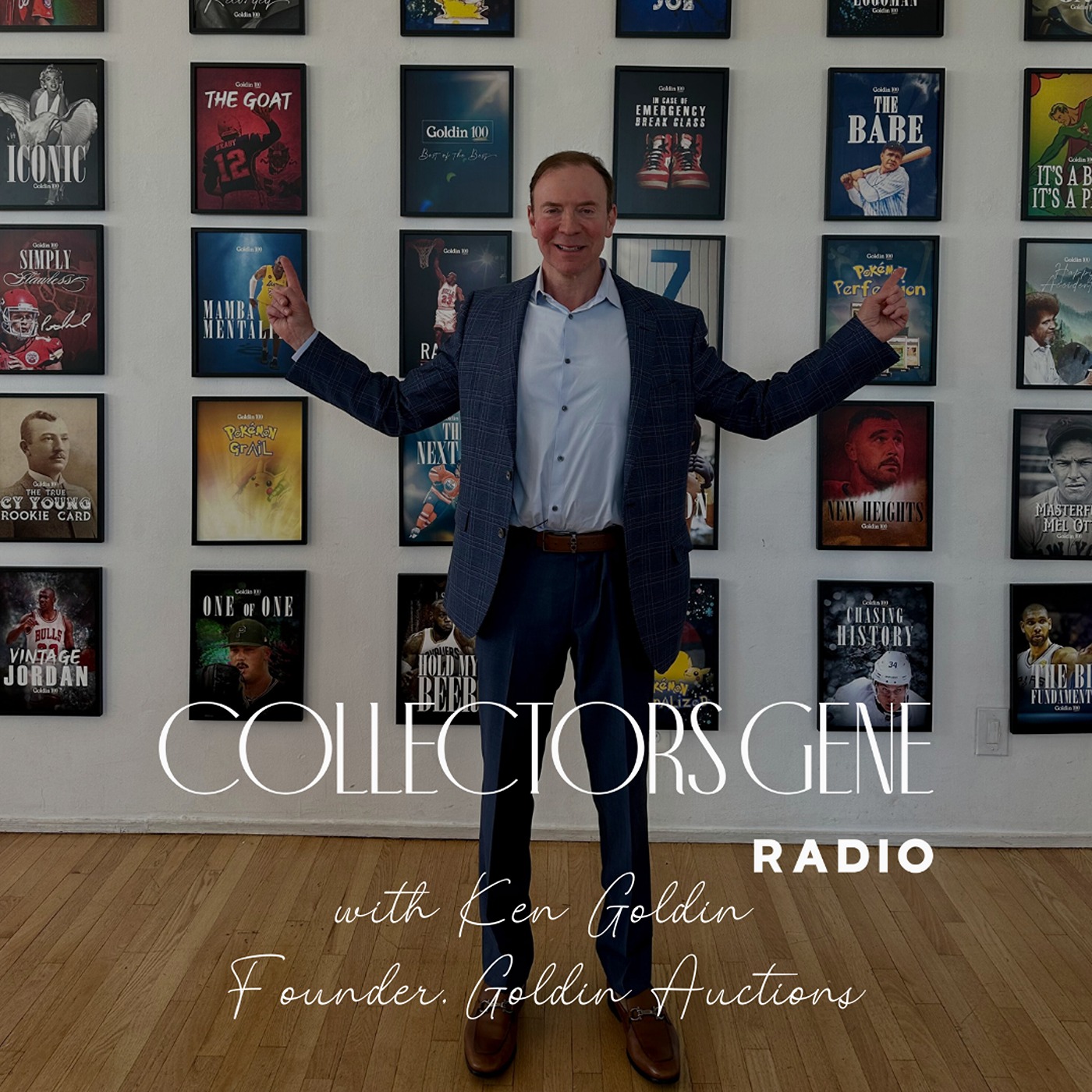
What's going on everybody? And welcome to Collectors Gene Radio. This is all about diving into the nuances of collecting and ultimately finding out whether or not our guests have what we like to call the Collector's Gene. If you have the time, please subscribe and leave a review. It truly helps. Thanks a bunch for listening and please enjoy today's guest on Collector's Dream Radio. Today I'm sitting down with Golden Auctions founder and the king of collectibles, Netflix star Ken Golden. Ken and his company Golden Auctions have been highly regarded for a long time as the go to auction house for sports memorabilia and more recently getting acquainted in other spaces like pop culture and historical artifacts. But Ken and his team have staked their flag as a go to for a reason. See, Ken has the knowledge, enthusiasm and tenacity of a specific trait that all of his biggest clients have and that's being a collector. Ken's been collecting and dealing sports cards since he was a little kid, learning how to make money from the hobby pretty early on. His parents support pushed him to where he is today, both as a collector and founder of one of the largest and fastest growing auction houses around. Golden has sold the rarest of the rare from the original T206 Honus Wagner cards to game use bats from the greats and most recently the highly sought after Shohei Ohtani 5050 ball which has 15 days left on auction and a current bid of $1.5 million. They've done over a billion dollars in deals and were recently acquired by ebay. Ken's been seen with the likes of Drake doing card breaks where he happened to stumble upon three Jordan rookie cards and sitting down with the greats like Ken Kendrick to review arguably the greatest card collection of all time. He's a collector himself with possessions like a game used Babe Ruth bat and other Smithsonian worthy provenance pieces. At the end of the day, he's the guy you want to buy memorabilia from simply because he has the collector's mindset. So, without further ado, this is Ken golden for Collector's Dream Radio. Ken golden, welcome to Collector's Dream Radio.
- [02:47]
A
Thank you for having me.
- [02:49]
B
So there is so much to talk about today, and I really just want to start from the beginning. So take me back to 1978. You're 13 years old, and you start collecting baseball cards. A hobby and decision that would ultimately change the trajectory of your life.
- [03:05]
A
Sure. It's interesting. I actually, I collected cards when I was even younger, probably, you know, seven, eight years old, because I was always a Phillies fan and would go, you know, to local store and, you know, buy packs. You know, that was back in the days where kids actually did chores and would earn money for them.
- [03:25]
B
Right.
- [03:27]
A
Like my family now. But what happened was I was going to a flea market and looking for, you know, looking at the card shops, you know, looking. Excuse me, there was no such thing as a card shop. Looking at the people with tables, selling all type of, you know, older stuff, trying to see who had baseball cards. And I found one guy with baseball cards. And. And I was looking at them, and somebody came up to him, and that individual said, hey, do you buy cards? And the guy said, yes. He goes, can you come look at my car? I've got bags in my car. And the guy said it was a Sunday. And he said, no, it's my busy day. Can you come back on a Tuesday or a Wednesday? And the guy just walked away. And I heard him mutter to himself, like, no, because I'm shipping off tomorrow. So my dad was with me because he always drove me to these places. And I said, dad, follow him. I said, excuse me, like, probably in a, you know, puberty type voice, right? I said, can I look at your cards? So we looked at it, and he took us back to, you know, one of these big 1970s cars with the giant trunks and opened up the trunks, and he had six giant Hefty bags in there, and you stuffed. And I took a peek in a few of them, and they were just filled. Filled with cardboard, all cards. And I literally spent less than a minute looking in one bag and said, what do you want? And he said, $100. I had no negotiation. I told my dad to pay him. And my dad reached in his wallet. He had $70, and that's it, 70 in cash. So I took the 70 out of my dad's hand, showed it to the guy and said, will you take $70? And he said yes. And we backed my dad's car up. Luckily for me, it was a summer. We loaded it into, I brought the cards down to my basement and my parents did not see me for the next four months.
- [05:23]
B
That's amazing. I mean, you've mentioned in the past that your parents were really big supporters of your collecting, which isn't always the case, especially being young. You know, parents always tell you, save your money, do this, but they must have seen something in you and this passion that you had. And I'm curious to know how important their support was in terms of where that got you today.
- [05:43]
A
Oh, look, I wouldn't have started if it wasn't for my dad. I mean, he loaned me the first hundred dollars or seventy dollars to do a real transaction. And when I was done sorting that big collection, I kept what I wanted and started selling the rest by mail. And I would leave out packages for him and he would take them to his office and he would ship them from his mail room for me. And without that, I couldn't have done it. I, you know, advertise in local papers and he would drive me around and he would get excited by the fines and, you know, he would, you know, take the phone calls and things of that nature. So it was very, very important. And I think they saw that I was really good at it, that I was able to earn money that they never had to give me money for, you know, anything really. You know, I was a self supportive business, you know, Although there was a summer when I was 16 years old that my mother told me two things. She said, one is I need to get a real job for the summer. And she also said that you're not going to support yourself the rest of your life selling baseball cards and you need to learn how to take orders from somebody else and work for somebody else. And I reminded her until the day she died that she was wrong on both accounts. I did not need to learn how to work for somebody else, and I was going to be able to make a living selling baseball cards. But no, they were always supportive. And honestly, after that, my mom was my biggest fan. Anytime I would hold my starred golden auctions, anytime I would hold a live auction, she would attend the auction. And if I was doing athlete signings in the 90s, she'd want to show up and meet the athlete. And it was very into it and very proud of her son.
- [07:45]
B
Amazing. And just to stick it to her, in 2012, you launched your company Golden Auctions. I'm curious to know how the collecting market has changed since then. Certainly it's expanded tremendously, but a lot has happened between 2012 and now.
- [08:03]
A
It's tremendous. When I started Golden Auctions, I actually was remarried and got married the 2011, the year before. And I said to my wife, you know, if I can build this company to $10 million a year, I can run a nice comfortable business that will support us until whenever I want to stop. And we did $800,000 in sales in 2012. It grew significantly to 2019 where we did about 28 million. And then suddenly in 2020 we did 102 million. But a lot of the trends have changed and this is really what has happened. Trend number one is in 2012-2014, I would say I think the aggregate sales of all the soccer cards combined by golden would have been under 100,000 in 2020. We sold multiple soccer cards for over $100,000 by themselves and are doing millions and millions and millions a year. In soccer. There was the first six years of Golden. There was almost no women's sports cards, no college cards, no wnba, no soccer, nothing. That market has exploded where we could do over a million dollars a year in female sports cards. What has happened to collectible markets overall is they have really changed from a four sport, US centric, male dominated atmosphere, I'm talking about the sports cards in particular, to a global, all inclusive, you know, whether it's soccer, whether it's tennis, whether it's golf, whether it's ufc, it's just everything that could be printed on a card has become popular and really accepted worldwide. The other aspects have come in in sports is that autographed memorabilia and game used memorabilia has really grown in popularity. And the prices, obviously you can talk about anything and say the prices have gone up a lot, but the prices on game used items have just absolutely exploded. And unlike trading cards, which really peaked for modern cards in 2021 and then dipped after the, what they call the COVID boom, that did not happen to game used because it never really went up irrationally. It was just adopted by more collectors. And the other thing that has happened is when I started this business, they really weren't talking about alternative investment or making an investment or defining it as an asset class. And now I think that collectibles in general and sports cards in specific are really defined as an asset class and are accepted by a lot of people who do wealth management.
- [11:43]
B
Yeah, absolutely. You know, golden is obviously known for ultra rare sports memorabilia and but you actually auction items across all categories. Was that always the plan to get into things like pop culture and, you know, film and all this sort of stuff?
- [12:01]
A
It was, I mean, in my very first catalog, in fact. And when I. My first booth for the national convention, you know, I felt I had an advantage going into the marketplace because what I always figured the strength was is I had previously been a certified baseball player agent, which a lot of people don't know. I also did marketing for the most well known sports agent in the world, Scott Boris, who's represented, you know, represents Bryce Harper, represented Greg Maddox, Alex Rodriguez, Barry Bonds, like virtually everybody. So I had a lot of relationships and I also did a lot of memorabilia deals, signing contracts with a lot of players. So I felt when I entered into the auction business, my compet edge would be to bring items directly from the collections of athletes where the athlete themselves was consigning to golden. And I would be able to provide a level of authenticity that did not exist currently in the marketplace. And in the very first auction of Golden, I said, the one thing we are going to do is everything we sell is going to be guaranteed and anything that is autographed or game used is going to come with a letter of authenticity backing it up. Which is something the other houses did not do in 2012. That said, I made a conscious decision in 2012 to have certain key comic books. For example, Avengers movie was coming out. I had an Avengers number one for sale in my very first auction. I had an Abraham Lincoln document in my very first auction. I was looking at the model of some of the older established auction houses that have been around for hundreds of years. Not just sports collectibles, the sports auction houses that popped up in the 90s and 2000s. And that is who I was modeling the business after. Because I felt that if somebody collects cards, you know, they're likely to be interested in the comic book or maybe a concert used rock album or maybe a, you know, maybe a movie prop or an Abraham Lincoln or George Washington document.
- [14:13]
B
Yeah, absolutely. You know, in, in the auction market, there's themed auctions. And these themed auctions are usually based on a specific person's collection or a specific moment in time. And they're really, really popular and important for the collector market to have these one off themed auctions. I'm curious to know from your experience how these themed auctions perform in comparison to a more general auction.
- [14:43]
A
I think that the themed auctions are terrific for really narrow areas of collectibility. For example, we run our monthly elites Every month we run our weekly auctions and we even run pop culture auctions. But even them, the pop culture auction is a pop culture auction. However, you can get comic books, you can get video games, you can get historical, you can get rock and roll, you can get movie memorabilia. So it's not really narrow when we get a special athlete collection. For example, when we had the Dream Team collection and were able, I mean it was just a 24 lot auction. It was all 12 uniforms and all 12 game use sneakers from the 1992 Olympic Dream Team that every single item we sold set a record. It was just absolutely unbelievable. And to go into a complete opposite spectrum, we partnered with AMC and we did a Walking Dead auction. And some of the stuff you look at. And I'll say this, as somebody who's in the business as an auction owner and a collector, I look at some of the props and I say to myself, this Prop probably cost $250 to make, but it was used in Walking Dead in an iconic scene and it sold for $87,000. So I think that when you can have, and I love the themed auctions, you can't plan for them. We don't know when we're going to get a Walking Dead collection or we're going to get. We recently announced the signing of what is known as the Apex collection. It is a comic book collection called the Apex and it is the largest and highest graded collection of its kind. And they signed an exclusive with golden and we're going to start launching those auctions in December. People are going to go crazy. And there may only be 200 books in an auction, but they're all comic books from the Apex collection. And it really lets you target your audience. And people who really know what they're looking for will gravitate to those auctions and they'll stay up all night to make sure they win. They'll win those auctions and you can't plan for them. We get a big athletes collection. You know, we can do it. We get an amazing comic book collection. We can do it. You know, you get a. Let's say we did a deal with a rock group. You know, let's. I'll take a wish list. Let's say Don Henley said, I've got all my memorabilia from the Eagles and I'd like to sell it. He would do a themed Don Henley and the Eagles auction and it would get amazing publicity. So those are the most enjoyable for me because you're really getting it not only from the source, but you're catering to people you know, are absolutely die hard fans. And they've never seen anything like it and probably never will see anything like it again.
- [17:46]
B
Now, you obviously have an obligation to put as many great items up for auction, but you're a collector yourself, so there's always some items that make their way into your collection as well. Is that a difficult decision to make or are you pretty focused and honed in on what's going to come in and out?
- [18:03]
A
Well, look, I run golden as a business. If we can, you know, if we get something consigned or somebody wants to consign something, it's. It goes into the auction. The only time if I'm dealing with an athlete, you know, somebody I've had a long relationship with, let's say Joe Montana, and he's consigning his entire collection to us. And it's 450 pieces. And there's one item not overly crazy expensive, but, you know, maybe five, ten grand that I just think is really cool. I'll say, joe, what are you hoping to get for that? And I'll say, well, do you want to sell it to me? I may do that once or twice every five years, but other than that, it is a business. And I'll really only hit up a friend of mine before they auction something for that type of thing. But honestly, right now I probably have too much stuff. It's tough to find what I'm looking for.
- [19:03]
B
What does it take for an item to enter your collection? Are you a conditioned guy or is it strictly rarity and provenance?
- [19:11]
A
I collect such a diverse number of things. For example, for trading cards. The only trading cards that I personally collect, not to offend anybody, but as individual cards, is baseball, because that's what I grew up on, you know, and there are only certain sets, like a 1952 top set and a 1909 T206 set, you know, so I'll collect. I'll try and get the set in the highest, highest condition. I do collect sealed boxes and for that I've got some of the best boxes of everything from baseball, football, basketball, even hockey. I own a 1979 hockey box. It's got the Gretzky rookie in it game used. I used to focus solely on 500 Home Run Club, but I've expanded more to, you know, goats greatest of all time items as well. And I started, you know, assembling a really nice comic book collection. And for that I'm trying to get the classics in the highest grade that I can get. That I don't think is, you know, really putting me out of reach at affordability. And finally, the other thing I collect is really anything cool that strikes my eye. I mean, I've picked up a George Washington signed piece lately. I picked up a really nice Alexander Hamilton document when he was treasurer in the United States. Why? Because I think it's cool. I think hanging up my office, it looks cool. And I also look at, hey, you know, I'm in. I'm next to Philadelphia. The 250th anniversary of the Declaration of Independence is coming along soon, and I feel that those items are undervalued and will probably, you know, increase over the coming years.
- [20:58]
B
The thing I find interesting is that, you know, there is a juxtaposition on condition and how and when condition matters, depending on the item. Right. So a PSA 10 Jordan rookie card commands a much bigger price tag than a PSA 9 or 8. But when it comes to a bat, for example, it's almost like the more used, the better because it has the patina, it has the history, it has the story. You could see where a ball was hit, you could see where the gloves were. What's your take on the juxtaposition between condition and how that really matters to people?
- [21:34]
A
I want to get items in the best possible condition, but I also will have my limits. You know, for example, the 86 FLIR Jordan as an example in a PSA 10 could be $200,000 and a PSA 9. I don't know what the going rate is. Maybe 15. And to the naked eye, to a lot of people, those cards look exactly the same with maybe incredibly slight variations. But for people who want the best of the best, they want the absolute highest grade. And I think that the authentication companies have really created an amazing product with their registry collections where people have set registries and they're in competition to beat each other out. And I think that drives a lot of the ultimate high condition pricing, but also in history, in whether it's art, whether it's coins, whether it's, you know, again, an older collectible such as stamps or more modern collectibles like, you know, comic books, sports cards, and game use memorabilia, people have always paid the highest prices for the best item in the best possible condition. And people have always done well by buying the best of the best. There are so many cases I can point to where people think that this person set a record price and they overpaid only to six months later or two years later that exact item in that exact condition you know, then the new auction price shatters it. So I definitely can understand and appreciate people going for the best of the best. And for me, it's kind of what can I afford? And what, you know, not even what can I afford, what does not make me feel uncomfortable in buying. And, you know, to give you an example, if I am going out and I am buying, whether it's 1972, tops, baseball cards or X Men comics, you know, I will want, you know, a 10 or a 9 in all my cards, and I'll want a 9, 6 or 9, 8 or all my comics. However, you can't apply that same math if you're trying to go out and get golden age comics of Superman and Batman or put together a 1952 top set or a T206 set, because those can run in the tens of millions of dollars. If not, you know, you take the 52 man or $100 million if you want to try and get the best set, the best possible grade. So I go for the high, highest condition that I, you know, I will tolerate, you know, as an expense.
- [24:33]
B
Yep, absolutely. And, you know, going back to the bat collecting thing, you obviously have such a wide range of baseball bats that you've collected. You mentioned the 500 Home Run Club. But there's a couple really special ones, and one of them that I wanted to ask you about is the Babe Ruth bat from his 60th home run season, or 60 home run season, rather. And it happens to be the only bat that Claire Ruth kept, is that right?
- [24:57]
A
Correct. And I'll give you the history behind that bat. So the Babe Ruth museum opened up in 1973, and Claire Ruth and the Ruth family donated some items back in the day. And there's an article that I have that she was at the ceremony and she said that Babe only kept one bat. He kept, you know, and I have it. It's a bat from his 1927 season. And he kept it because it was his favorite year, which, of course, the Yankees won the World Series, and he hit 60 home runs. And in, you know, you know, it was given to the museum. And then during the, you know, after, during, I guess, 2008, after the financial crisis and the bank collapse and everything else, you know, to save itself from bankruptcy, the museum did sell a couple items. And one of those items was the Babe Ruth bat, which it sold to Reggie Jackson, as a matter of fact. And Reggie kept it for a number of years, and then he wanted to sell it. And I actually was a sponsor and a donor of the Ruth Museum. And I told the guys, hey, you know, is this bat from the collection? Did you sell it to Reggie Jackson? And they said, yes, we did. And I said, well, I can keep him from selling that bat publicly by buying it myself. And they said, if you could do that, that would be wonderful. So I said, oh, you know, they wrote me a letter regarding the provenance of the bat, and, you know, I bought the bat from Reggie, and it is the only existing bat that traces directly to Claire Ruth, the wife of Babe Ruth. And it was certified by PSA as, of course, PSA 10, their highest possible grade, with the best possible provenance. And that is the most valuable item I own.
- [27:01]
B
And it's pretty amazing because a lot of people would maybe gloss over the fact that Reggie Jackson owned it, but he's another legend in and of himself. And the fact that it was also in his collection at one point adds another. Even if it's a small layer of provenance through the, you know, the history of it, it's pretty amazing.
- [27:19]
A
Yeah, I had Reggie write me a nice long letter about his history, you know, why he bought it at the time, you know, to help them out, and, you know, that he's going to, you know, sell it to his good friend Ken Golden.
- [27:35]
B
Amazing. The other bat I wanted to ask you about is maybe the most novel, quirky bat that you own, and it's the Jim Brideweiser bat, which was used by Mickey Mantle when he was a rookie because he didn't have his own bat yet. And then it subsequently gets signed by Mantle later on. I mean, how did you acquire this? It's such a. The story behind it. And the thought process that Mantle would sign this other guy's bat is just so amazing.
- [28:02]
A
Well, actually, it's interesting. The key with this bat is he actually signed it that year when he was a rookie, because the. And I'll give you the history of the bat. So I was, you know, I just started Golden. You know, I just started golden auctions in 2012, and I decided, I'm going to expand my memorabilia collection. And there was an auction that was taking place, and, you know, it had this bat. And I called John Taube, the authenticator for psa, who had supplied a letter, and I said, is this legit? And I said, yeah. He said, yes. I said, what's the story? He goes, well, Mantle was sent down to the Miners. You know, we started early with the Yankees, and that's when he was number six. And he was sent down and he came back up later in the season. And he did not have his own model bat. So he used a teammate's bat, Jim Brideweiser. And he. And you know, you use this bat in the game and I guess he cracked it because you could see the tape on it. And I don't know who he gave it to. But on the bat is what is what might be the single earliest signature of Mickey Mantle on a game used Yankee item. Because what Mantle did was Mantle used to have a very straight signature where it was like just up and down lines. And then I think when he got to, you know, after, you know, approach the triple crown year, he gave himself however, a more elaborate signature with loops and more broad strokes and very, very identifiable. That really stayed the same from 1956 till the, till the day he died in 1995. And this bat has his rookie signature on it. So it is a Mickey Mantle game use bat, Jim Brideweiser bat, but with a Mantle signature on it. So I own one of the earliest game use Mantle bats along with a rookie signature. And I also, because I own that I had to buy one of his last bats that he used. So I also own one of the last bats he used in his career in 1990.
- [30:22]
B
What a great story. I mean you just don't really get stories like that nowadays with modern stuff and you know, just the quirkiness and all that. It just doesn't happen anymore.
- [30:34]
A
No, it is very collective. Modern collecting right now especially game is very methodical. The teams tag everything. Players use specific issued equipment like that jersey that Joe Montana were in two different Super Bowls that we sold. That would never happen today because the NFL wouldn't allow it.
- [30:53]
B
Yep, totally. Now collecting is obviously still quite niche as much as it's grown. The amount of collectors out there that are really serious that know their stuff, it's still a pretty niche market, has so much room to grow. But it does seem that now more than ever there is such a growing interest and people want to be a part of it and people want to learn and they want to collect and they want to do all these things. And I'm curious to know why you think collectibles and alternative assets have just become such a phenomenon.
- [31:24]
A
I think that part of the reason is certainly the history of the items. Okay, items are cool and it used to be Pinot art, but I think that people my generation and younger, they really didn't grow up with art. You know, they didn't probably didn't grow up with Picasso's and Van Gogh's. However, you Know, they grew up with specifically sports and the great ability, the authentication companies coming in like a psa, you know, you know, like, you know, like a Beckett, like, you know, something like some of the CGC for comics and things of that nature that really gave people confidence that they can buy and sell an item, that they're going to get something authentic, they are going to get something that a third party tells them the condition. So they're not going to get an argument when they go to sell it, you know, because something. Look, in the old days, like I was buying and selling, trust me, every time you go to a card convention and you try to buy a card, the card was mint. You came back to that same guy a week later at the convention to sell it to him. That same card you bought for him that he said it was mint, he's going to say was very good to excellent or he's going to say excellent to mint. Because that was the nature. And it was a difficult process and it was difficult to transact. There was a lot of choppiness in being able to transact the third party grading. And again, for purposes of this, I'll stick on PSA because it's easier, is the fact that they guarantee the authentication and authenticity of the item and they graded enabled you to buy and sell an item without risk and also enabled you to really buy an item without seeing it. And that made it more of a tangible asset that, you know, that asset advisors, you know, could do. It's like, for them, it became like buying and selling gold or buying and selling, you know, platinum or buying and selling oil. And the fact that prices kept going up really created, okay, this is an actual investment. But when you look at this, people have been collecting items for thousands of years. I mean, like literally a thousand years ago, people were collecting art, people were collecting rare coins, people were collecting sculptures. I tell people about, you know, baseball in particular. I said organized professional baseball has been around since the 1860s. They've produced baseball cards since the 1860s. So I really feel that, you know, people have always collected and they've always collected in my mind for, in some degrees, for the hope of future value. It's just the modernization of the ways to transact and trade and have the item verified in a slab with a serial number with online price guides. That just made it easier and gain more acceptance as an alternative investment.
- [34:40]
B
Absolutely. I recently finished the second season of your show on Netflix, King of Collectibles, and you had the chance to sit down and take a look in person. At Ken Kendrick's collection, and it's such a pinnacle. And I would just love to know, you know, you have seen everything. But Ken Kendrick's collection is known in the market to just be some of the best of the best, if not the best of the best. And I would just love to know the feeling that it gave you to see these in person.
- [35:12]
A
Oh, it was tremendous. I mean, look, I. I'm very desensitized to amazing collectibles and amazing cards, but when you can hold something that is so special and so significant and also that you've read about your whole life, it's remarkable. And definitely his collection is my favorite. And the cards in his collection, you know, retreat. And that look, that scene where I said, I gotta take a selfie, and people could say or tell selfie, you gotta take it himself. But, you know, we don't plan this stuff. I have no idea what's gonna go. And I looked at this, I said, listen, this is only gonna be on camera, on motion. I want to get a picture in my phone of me holding his big cards. And it was spontaneous, and I did it.
- [35:56]
B
It's pretty spectacular. I mean, knowing that that collection is down the street from where I live is just. It's my work. Speaking of cards, you know, card breaks and unboxing are more popular than ever. And such a great example of, in my eyes, what makes collecting and the hunt so exhilarating. The anxiety of breaking open a pack and not knowing what's going to be inside there. I mean, is there a card break or unboxing story that comes to mind that sums this up for you? Getting, obviously getting, you know, three Jordan rookie cards with Drake isn't the worst story. But, I mean, is that. Was that the most insane card break.
- [36:32]
A
You'Ve had From a pure financial dollar perspective? That was the most insane. I mean, we opened up probably, you know, a couple hundred thousand dollars worth of the panini cards searching for the LeBron Triple logo, man. And obviously, we opened up a box of 86 FLIR. And with that, we pulled the three Jordans, and we pulled the three Jordan rookies. And of course, just being there with Drake, I mean, that was absolutely amazing to see. And he was so excited when we pulled those Jordans. I mean, he was so incredibly excited to get that and to be part of it. And it was just, you know, for me, spectacular. I've liked opening up cards with my, you know, with my son Paul. I remember a specific time when we had a opening up. We were opening up 96 tops finest. And we were live on Instagram and all of a sudden we had Seth Curry jumped into the live and he just like sold alive and he just jumped in and then we're going through it and all of a sudden we hit the Kobe Bryant refractor and Paul had it and he was showing it and it slipped at it. He was like 8 and he was showing it slipped out of his hand and I caught the card in the air. I ended up getting a PSA 9. But that was probably, you know, with an 8 year old at the time, was probably worth about $25,000, but with an 8 year. But that was, that was a big pull, not only because it was with my son, but it was of course with a bunch of people watching live and Seth Curry's face on my Instagram. And it was great because he was a, was a sixer at the time.
- [38:40]
B
That's right. That's right. Now golden has become such a trustworthy brand and operator. And of course, there are still issues in the industry when it comes to authentication and people feeling comfortable as a leader in collecting. You know, how does golden continue to combat this and move forward and remain a trustworthy brand and operator?
- [39:01]
A
Well, the first thing that we do is, you know, everything we sell is authenticated. So we're using the best authentication companies out there. Whatever it is, whether it's autographs, whether it's game used, whether it's trading cards, whether it's comic books. And even with that, we personally inspect every single thing that we, every single thing that we sell. And people know, and that's part of what they get from golden is people know, hey, if I buy something from golden, it is going to be real, it is going to be authentic. I'm going to receive exactly what I'm looking at. And I feel that that is why people oftentimes pay more for something sold at golden than something sold elsewhere. And the other part of that with an auction, besides the authenticity of the item is do you trust the marketplace? Do you trust the auction house? And we, you know, unlike a lot of competitors, we verify every single bidder. If somebody wants to bid a certain amount, we get their driver's license, we ask for bank statements because we want people to know, hey, if you're bidding for something that's $100,000, you should know that the other people bidding against you are verified bidders who have the ability to pay and that we have checked. So you are not bidding against fictitious bidders, which is extremely, extremely important. So I think that is really what the most important thing is about Golden's business is that people understand we go to every single possible step with game used items. We will try to photo match them to a particular game so they know exactly what they're buying. We'll try whenever possible to get items directly from the athlete or the celebrity. And with cards and autographs, we'll use the best authentication services to verify the authenticity as well as to give them a grade.
- [41:10]
B
I love it. Before we wrap it up with the collector's dream rundown, I wanted to know why you feel collecting is such a great place for people to spend excess mental real estate, whether they ever shell out a dollar or not.
- [41:24]
A
Look, I think that, you know, that's why I think people like to watch King of Collectibles, right? I mean, not only is it exciting, not only is it fast paced, not only are there cool people on it and cool stories, but people like looking at really cool stuff. I think no matter what the collectible is, you know, a great collectible captures a moment in time. Like we were talking earlier about the 1927 Babe Ruth bat. You know, that brings back, I look at the bat and I bring back, brings back memories of Murderers Row, you know, Ruth and Gehrig, the 27 Yankees, the 60 home run season, the Mantle bat, of course, young Mickey Mantle with all the promise in the world before his, you know, before his injury, before he tore up his knee, literally a month after he, after he, a month he signed, he signed that bat. But a great collectible captures a moment in time, captures a piece of history. And even if you don't buy it, I think everybody can respect it. You know, like for example, we recently received for auction the actual 50 home run ball of Shohei Ohtani. Now most people out there would never be able to afford to buy it. Most people out there may not think about it, but everybody out there can marvel at his amazing talent as a two way baseball player, a pitcher and a slugger, and marvel at his power and speed and all the ability and all the love of the game that he brings and can say, wow, that's a really cool item. And that is what makes collecting again. You don't have to, you don't have to buy something. You don't have to buy the most incredible thing in the world. But if it's meaningful to you, then it's a collectible.
- [43:09]
B
Couldn't have said it better, Ken. Let's wrap it up with the collector's Gene rundown. You can answer these questions based on Any of the things that you collect, whether it's sports memorabilia or historical artifacts, whatever it is. Sound good?
- [43:21]
A
Sure.
- [43:22]
B
What's the one that got away?
- [43:25]
A
Ooh, I sold the T206 Honus Wagner uncut strip.
- [43:29]
B
I definitely saw that in the show. How about the on deck circle? What's next for you in collecting? Maybe something you're hunting after the big thing.
- [43:40]
A
You know, we're trying to grow categories, so we're looking, you know, we're going to build into other areas of collectibles. Sneakers, watches, possibly coins. But really, my great project is again, golden became part of the ebay family this year, and I have a big audience and I got a lot of people, millions of people who watch me and watch golden on King Collectibles, the Golden touch on Netflix. But ebay is ridiculous. They got 130 million plus people. So my goal, and ebay's goal as well, is really to be able to bring the golden brand and some of our inventory and some of the cool items and expose it worldwide to the ebay audience, which, shockingly to me, I know it amazes me, and somebody may not have heard of golden auction somewhere in North America or Asia or Europe, but people haven't. But they all know ebay. So we bring the brand power of ebay and the great unique collectibles of gold and able to showcase it. I think it just broadens our horizon tremendously.
- [44:52]
B
No doubt. How about the unobtainable? So this is one that is too expensive in a museum. Private collection. Just complete unobtainium right now.
- [45:02]
A
For the time being, I will not complete my T206 set because I'm not right now going to spend the money on a T206 wagon.
- [45:12]
B
Yeah. I can't say I don't blame you.
- [45:15]
A
But I would like to own. I would like to own one. I should have kept any of the others I've owned prior in my career had I known what was going to happen to the price.
- [45:26]
B
Sure, sure. That's always the case, right? Yep, the page one rewrite. So if money was no object and you could collect anything else in the world, what would it be?
- [45:36]
A
Ooh, if I can collect anything else in the world and money was no object, I would really love to put together a collection of the like. Locally, we saw a Ruth Jersey go for 20 million. Right. I mean, some of the Babe Ruth, Ty Cobb, you know, Lou Gehrig, things like that. That would be amazing.
- [46:05]
B
Yep. The original greats for sure. How about the goat? Who is someone that you look up to in the collecting world that you just feel is a great collector?
- [46:14]
A
Oh, well, I've had, you know, Ken Kendrick certainly is, you know, is amazing, right? Ken Kendrick is incredible. Nat Turner was really before his time with collecting sealed boxes and modern cards. And he also happens to be a friend and, you know, really one of the original pioneers, Marshall Fogel, as well as my good friend Dr. De Paci, who appeared in season two of Netflix. And we saw a small part of his collection. He's built his dream. And that museum is opening, is opening in the next month. So his dream has come to reality and he put his faith in it. And he had been buying stuff to put away for it since the 1990s, and I love him for it. It's great.
- [47:00]
B
Spectacular. The hunt or the ownership? Which one do you enjoy more?
- [47:06]
A
Oh, God. A lot of people are going to say the Hunt, but for me, if I acquire something, I typically display it and I like showing it off, so I don't want to chase it. I'll get it.
- [47:27]
B
I love it. Most importantly, do you feel that you were born with the collector's gene?
- [47:32]
A
Oh, 100%, yeah. I've always, you know, some people may call it, you know, hoarding, you know, when you're younger, but then you can fine tune it and it looks, you know, and it becomes collecting.
- [47:43]
B
Amazing. Ken golden, everybody. Thank you so much for joining me on Collector's Dream Radio today. I hope there's a third season coming out of the show and look forward to all the up and coming auctions that you guys have going on at Golden.
- [47:54]
A
Thank you so much. You know, I appreciate the time and hope everybody enjoys it.
- [48:01]
B
All right, that does it for this episode. Thank you all for listening to Collectors Dream Radio.