Loading summary
Transcript62 lines
- [00:00]
A
I don't think I ever would have been able to create if I hadn't first been a collector and enthusiast that kind of connected with these things deeply. And then curating them for other people widens your sensibilities as to why other people care about things.
- [00:19]
B
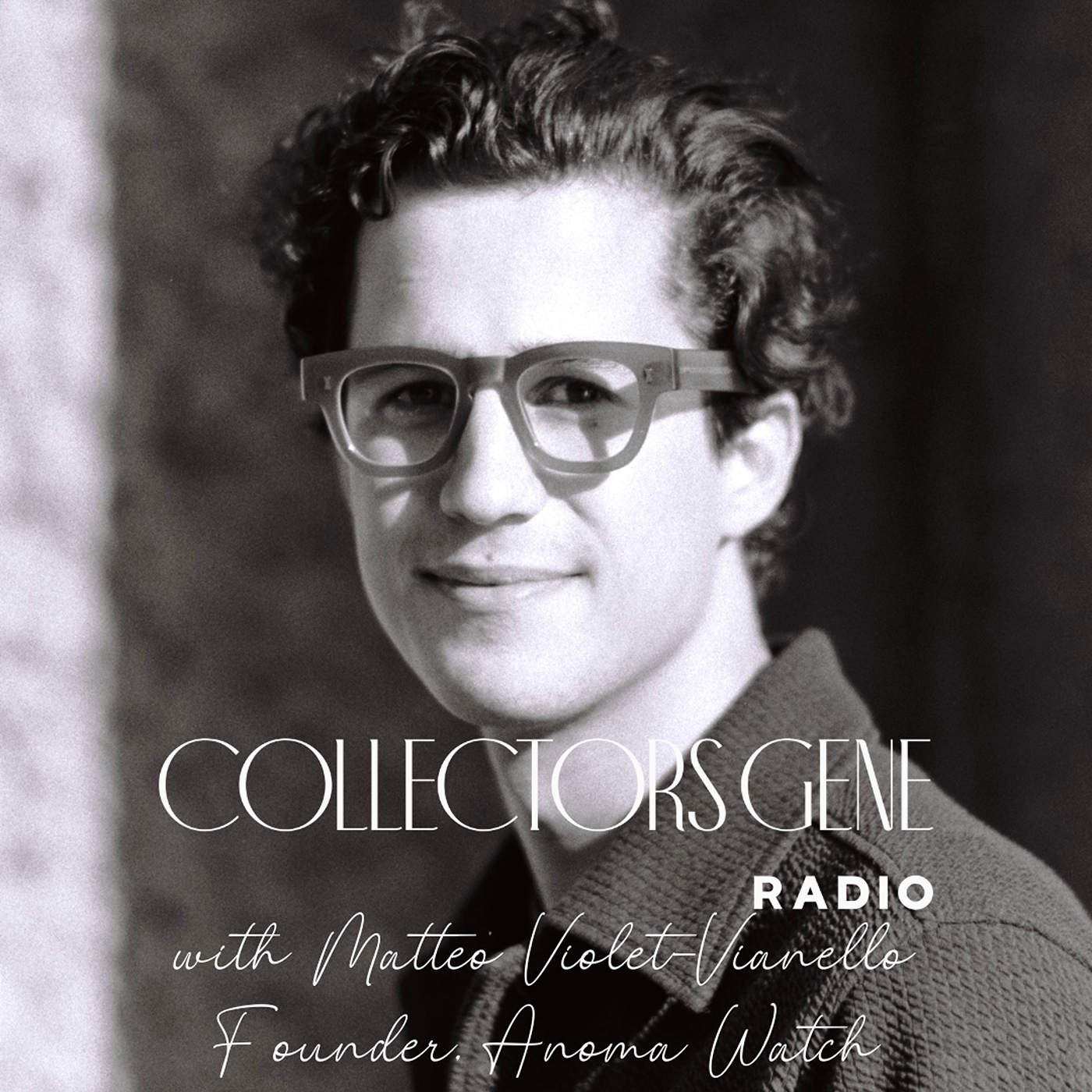
What's going on, everybody? And welcome to Collector's Gene Radio. This is all about diving into the nuances of collecting and ultimately finding out whether or not our guests have what we like to call the Collector's Gene. If you have the time, please subscribe and leave a review. It truly helps. Thanks a bunch for listening and please enjoy Today's guest on Collector's Dream Radio. Today's guest is founder of Anoma Watch, Matteo Violette Vianello. Innoma isn't just a watch brand. It's a daring artistic statement that pushes the boundaries of what a watch can be. With its inaugural creation, the A1, Matteo has seamlessly merged influences as diverse as Charlotte Perignon's freeform tables, Rancoosi's modernist sculptures, and the natural elegance of primitive tools and river stones. Anoma offers a rare intersection of profound design and accessibility, a gateway for collectors to engage with bold creativity typically reserved for galleries and museums. But Matteo's journey to Anoma doesn't come without tenure. From disassembling watches as a child to handling some of the rarest pieces during his time at Sotheby's and a collected man, he has spent the better part of his life not only immersed in the craft and culture of watches, but in the most coveted art, design and architecture. It's these influences that converge into Noma's ethos, where the idea always comes first and reality is bent to bring it to life. We get a sneak peek into what lies ahead for the brand, the thoughtfulness behind Matteo's designs, and the evolving role of watches as both art objects and collectibles. So without further ado, this is Matteo, founder of Anomawatch for Collector's Gene Radio. Matteo, such a pleasure to have you on Collector's Dream Radio today.
- [02:03]
A
Thank you for having me, Cameron.
- [02:05]
B
My pleasure. So many recognize you as the visionary behind Anoma Watch, but your journey with watches, I would say, began much earlier, evolving through probably pretty formative experiences at places like Sotheby's and A Collected Man. But Anoma is, in my opinion, and I'm sure yours too, so much more than just a watch brand. Right? It's this artistic expression with each element of of your initial concept, the A1, that is so deeply inspired by art and design, and you have Actual references that you can point to, which not many brands do these days. So to start, I'd love to understand how your time at the aforementioned company shaped your perspective and led you to approach Anoma with such intentionality.
- [02:52]
A
Good question. I mean, first, I don't know if I'd agree with the line visionary. I think I'm mainly a recycler of great ideas and insights I find in a lot of places, whether it's nature or art or elsewhere. But I appreciate the compliment. I think as far as, you know, my passion for watches, it almost. I'd almost started a little bit earlier than my time at Sotheby's and A Collected man because it hopefully leads to why I ended up working with those places. But I got fairly obsessed with watches, I think, when I was about five or six. So I discovered a set of broken vintage watches in a drawer at home. Nothing special. I think they were Seiko's. So nothing kind of like horologically significant. But I got really fascinated by these kind of tiny mechanical things, as I'm sure a lot of us do when we first come across them and started kind of like disassembling with them, playing around with them, kind of trying to recombine them, and then quickly fell down the rabbit hole of watches for all the reasons that we all do around the craft, the history, the design, the reasons so much of us choose to project meanings on those things and the multiple meanings they can have. And it kind of followed me throughout, you know, childhood, adolescence into adulthood, until I then decided that it's something I wanted to do, you know, professionally and kind of turn. Turn my passion into profession. So I worked for at Sotheby's briefly and then end up spending a fair bit of time, kind of four, four and a half years at A Collected man, as you pointed out. I think that was a really, really formative experience because obviously Collected man focuses on kind of lower volume, very kind of curated selection of watches, whether it's vintage, neo, vintage independence. And I think for me the experience was amazing in my ability to like get hands on with a lot of different watches, but also get a lot of different perspect perspectives of what watchmaking could be, from the kind of like very classic established houses all the way to independence, crafting 10 watches a year. And I think it really helped shape my perspective very intuitively for the objects themselves, handling them, feeling them. A lot of the things you can't really learn or get a sense for unless you get hands on. But it also, I think really broadened my perspective as to what watchmaking could be. And I really fell in love with, like, strong viewpoints about watchmaking. You know, that's what a lot of the independents are about, in a way. You know, their parallels with artists or is often, I think, appropriate because it's people who have something very distinctive to say, aren't able to say it within the structures of society or within the structures of other watch companies, in this case, and decide to sell on their own and say what it is that they want to say. So I think that whole experience was really, really quite formative and. Yeah. And set the seeds, some of the seeds, at least for Anoma.
- [05:57]
B
I love it. I would have to imagine, you know, after the few times that we've chatted and got to know you a little bit, that your upbringing must have shaped your influence, too. I mean, between Paris and Venice, what things do you remember as a kid in terms of design that stuck with you because, one, you don't have a design background. And between Paris and Venice are two extremely special places, but wildly different.
- [06:23]
A
Yeah, I think, to be honest, in a weird way, you know, once you've done something, you kind of look back and discover how everything in your life almost led up to that point, or at least was a contributing influence at that point. And I think I realized this with Anoma, that actually, you know, that upbringing was hugely influential. So, as you mentioned, my mum is originally from Venice, my father from Corsica, but I was kind of raised in Paris between Paris and Venice. And, you know, I think it was really in a context that, you know, growing up, we were constantly surrounded by culture, whether it was kind of music at home, books endlessly dragged to museums on family holidays, which at the time was something that we obviously hated and wanted to escape from, but really left a kind of market impact. But there are also two places that pervade, I think, culture, design, and also the mixing of design. Because I think what's very interesting is if you look at Venice as an example, we think of Venice today as a city that's very representative of a certain period of Italy. And one style, historically, it was a wealthy merchant city for close to a thousand years, influenced from the Ottoman Empire, from Asia, from Mediterranean cultures. And so it was such a melting pot of so many different cultures, which makes the city and the fabric of the city so immensely rich. And so I think it's also. It definitely shaped my, on a basic level, sense of beauty and classical art, but also really started to develop, I guess, this love for the mixture of elements. You know, if you walk around Venice, you actually see, you know, in the architecture influences from the Ottoman Empire, from, you know, cultures further afield in kind of China and that part of the world. And so I think both of them were, you know, on one level, I really got that appreciation more generally for kind of arts and the culture, but also as you kind of live in them and get under the skin, you also get conscious that really interesting things happen in the kind of melding and mixing. And so I think it was hugely influential and a lot of my taste today, whether it's in art, in furniture and architecture, I think was shaped by those early experiences, no doubt.
- [08:48]
B
I think the listeners would be pretty keen to know what watches interested you or what watches you were collecting before you started Anoma. Was it all about odd K shapes for you, the way the A1 is, or is it more about the artistic design, brand, focus, what caught Matteo's attention?
- [09:06]
A
I'd say it was a real. It was a real range. And in a way, what I'd like to say is like, I tried to collect strong points of view regardless of where they sit on the spectrum. So, you know, watches I've owned in the past that sadly I've now had to pass on to other owners. Starting a watch business, being the financial hole that it is, have been, you know, everything from, you know, a classic 33 millimeter Patek Calatrava, which was a 90s reference, but was a RE edition of the original 1906 from the early 20th century. So that was interesting. Yeah, exactly. Yeah, exactly. And that's great because, you know, it obviously has the wearability of a. Of a modern or new vintage watch, but that's a watch that is so reductive and represents like an archetype and in many ways, some would argue is the quintessential time only watch and an homage to the watch that invented, or at least set the standard for what a classic watch would look like. And so I think it went all the way from that to I had an urwerk ur103 for a long time, which was. I have tiny risks, could barely wear it, but I'd take it off the strap, I'd hold it, I'd play around with it. And it was like this tiny spaceship that you can hold in your hands and enjoy. And I think what I like isn't necessarily coherent in terms of a specific taste. It's not that I like classic watches or non classic watches or shapes or not shapes or complications or not complications. I think it's just when you come across something that is like an undiluted point of view, you can't help but be moved by it and be excited by it. And that's the stuff I've always kind of been drawn to. I mean, I even had, you know, a mid sized Royal Oak for a long time. I think it was one of the first, quote unquote, serious watches I bought when I was a collected man. And that's a great watch because if you're trying to be original, is it ultimately the watch you buy? No. But there is an undeniable greatness about that watch and what it's trying to do, that if you see it purely for the object of design that is, then it's incredible. And so I think that's always how I've tried to look at watches or how I feel about watches. It's like ultimately it needs to connect on a very instinctive level. I don't care where it's coming from, as long as it's honest, it's pure and it's a really strong position. And strong doesn't mean it's in your face. It just means that it's undiluted and you can feel that it's honest at heart.
- [11:39]
B
I think the juxtaposition between Patek 3919 and the Urwerk is something that speaks to probably who you are as a person and how you almost maybe landed at the A1 design. Because those two couldn't be more opposite, but they play in this same field in an odd way. And I think that those two are just such special watches. A Royal Oak, of course too, you know, that's undeniable. But I think the juxtaposition between those, those two is really interesting. And I think it's kind of how you describe Anoma, right? You describe a Noma as it's animated by this powerful abstract concept. And While maybe the 3919 Calatrava isn't and the Urwerk is, you can see the similarities there. And I'm curious to know how you see watches functioning as both art objects and something collectible.
- [12:36]
A
Yeah, I mean, I think ultimately like in the modern world, and this is not a new point of view, but I think it's worth reminding ourselves, like the only purpose that watches serve is ultimately to generate emotion. Right at the end of the day, whether that's a connection with the mechanical aspect or the design, they're ultimately there for that sole purpose. And I think it's a great reminder. Two brands and two Collectors a lot of time of that, because I think we can sometimes get caught up in endless pursuit of certain technical goals or defining watches in a certain purpose. But I think the base requirement that they need to meet, and it's arguably the kind of minimum requirement, but also the maximum requirement that we need to remind ourselves is does it spark that level of emotion? And that's where I think the parallel with art is relevant. It's sometimes a tricky parallel to make because they're ultimately functional objects. They're ultimately a lot of them produced industrially. And whether you want to relate that to art is tricky. But I think they come down, when done well, down to that same point, which is, does it have an ability to generate emotion? And for something that is so personal, worn on the wrist every day, connected to something, as, you know, existential is the notion of time. I think there's a real potential when it's done well to kind of transcend from purely functional into that world of art.
- [14:08]
B
Let's talk about the art thing kind of for a second. Because the A1 lends itself to so many influences in the art space, right? And I think it's pretty fascinating how you've found ways to weave that into the A1, like the freeform table from Charlotte, Perrion and Brancusi sculptures, and it ends up creating something that feels so deeply artistic but utterly wearable. Right. At $1,700, it's clear that this level of thoughtfulness isn't just about aesthetics, but also about the accessibility and the realm of fine design, because the aforementioned artists are certainly not in everyone's budget. But an anoma A1 at some point could be in everybody's budget, right? And I think that accessibility is intriguing because it transforms a NOMA into more than just a watch brand, right? It becomes a gateway, in my opinion, to experiencing art and design in a tangible, personal way. Do you see the A1 as an invitation for people to engage with kind of bold creativity that's typically reserved for the Guggenheim and art galleries across the world?
- [15:20]
A
It's funny you mention Charlotte Pin's furniture. So when I first launched and put on my website a reference image of the table that the watch is inspired from, I had Arthur Tuchel from Philips reach out, because the link that I listed was at Philips. And he was like, just came across this, and I'm curious, did you happen to buy the table and you're now basing it off the watch? And I was like, no, I don't happen to have $70,000 to spare on her table at the moment. But it's funny, I think in a way it wasn't the intention. The intention, I think was very much that. I think there's a lot of experimentation in horology, but it's very much within kind of like watchmaking codes. And my thought process was there's so many other interesting things happening outside of watchmaking, whether it's in furniture design with Barion's work, sculpture with Brancusi, or even much more essential things like the beauty of pebbles or river stones or the flowing of water. And I thought creativity in watchmaking is often so self confined to playing on the same themes or pushing the same themes further. And there's nothing wrong with that. But I just felt that there's this real opportunity for a transfusion of some of those ideas, some of those inspirations, some of those forms of almost kind of perfect, perfect harmony or essential beauty you can find elsewhere and to bring those into watchmaking. And I think that was the core desire. But I think you're absolutely right that there is then a second layer, that it then opens up those worlds. Those are the references to people who might not have otherwise considered them. I remember when I first opened pre orders for the A1, someone placed a pre order and then the morning after first thing went to the bookshop and bought a book on Charlotte Perrin because they were curious to learn more about her and her work. And that's the kind of stuff that I think is awesome because it allows you to, if you're creating a product that's trying to draw on a lot of different influences, combine them and say that there's richness in that mixing. I think if it can also enable people to want to delve into those influences and discover about them and go into different fields, whether it's kind of like art or being more attentive to the nature around them or whatever it is. I think that can be a really powerful aspect of something like this that ultimately should expand your universe or your kind of awareness of what is interesting or what intrigues you. So that was a side effect, but definitely a welcome one.
- [18:02]
B
Yeah, I think it's so interesting. I think right now we're seeing more art driven influence watches and brands come on the scene. And I'm curious to know if you think, I mean, is there something happening in the art market that you think is triggering the watch market?
- [18:16]
A
I don't think it's so much the art market that's impacting the watch market. I think it's more dynamics in the watch market that mean that people are open to being more experimental or feel that there's a need to be more experimental? Because I think it's a combination of factors. I think there's been a tipping point with regards to people feeling like they're always getting the same thing from a lot of the big brands. And so I think that fatigue has maybe hit its kind of extreme point in kind of like recent years. I also think over the last three, four, five years, we've seen a real acclaim for independents and independent watchmakers in a way that wasn't before. And ultimately, independent watchmakers represent what we touched upon earlier, which is that kind of pure, undiluted, sometimes more visually extreme form of experimentation. Often, or at least for the kind of earlier generations, very watchmaking tied. Even something like MB and F is very unconventional for a watch, but really grounds itself in watchmaking and the watchmaking skill. And so I think those independents have kind of opened consumers eyes and opened some creators eyes to, okay, people are more open to different point of views than we might have initially thought. And at the same time, consumers are ready for that. And so I think there's been a kind of combination of those factors, such as now people are like, actually maybe there is space to be a little bit more daring, a little bit more bold. I think with the A1, even though it was a labor of passion, I don't know if it would have worked to the same extent five years ago. I think people would probably have been much more closed off to something like this. And then I think maybe there is some impact from the art world as well, because I think art has def, over a longer time frame, has reshaped itself from something that is very specific and just art, and basically has kind of like blended with popular culture. I mean, you look at the way basically art has become democratized, either by virtue of being more accessible to everyone, or kind of like collaborations like the ones that Louis Vuitton do with certain artists, to kind of bring it into the realm of fashion. It feels like the realms of cultural production, whether they're music, fashion, art, are kind of like blending into one another. And I think slowly Watches is also kind of coming into that. And I think you're in the future increasingly going to see, I guess, types of culture and types of material culture increasingly blending into one another and people seeing the richness and that kind of cross dissemination of ideas, of inspirations, of creatives. And so I think that's partially also impacting what's going on here, or at least Starting to. And I think we'll see a lot more of that in the future.
- [21:16]
B
Something I think that is interesting with the A1 and its relation to art is that a lot of art starts with a canvas, and each time someone goes to paint on the canvas, they get a different painting. In the same way, a lot of brands try and release new designs and new models, and they use different canvases. But I think what's really interesting is that the A1 canvas is here to stay, and you're going to iterate on it, but it's going to have a lot of the same design language. And I think it's great that it's a watch that you've designed that lends itself to be so much more than just the initial release. Was that always the goal for you, or did that just kind of happen to fall in place as the design took its way?
- [22:00]
A
It was definitely always the goal, because my goal with the A1 wasn't to create something that's like one, a very impactful watch that kind of only has its impact by virtue, being in that configuration. It was more about, how do I find a form of almost like, essential beauty? By looking elsewhere, by looking outside of watchmaking. And if you look at the A1, visually striking as it might be, it's incredibly reductive and it's incredibly simple. At the end of the day, it's two rounded triangles tilted inside one another and kind of curved all the way around. It's incredibly simple. And if you have the chance to kind of wear one or hold it in your hands, there's something very instinctive about it.
- [22:50]
B
You make it sound simple, but it's not just triangles. It's the way that it's angled so that the light reflects on it in certain ways. And I think it's a lot more thoughtful than I think you're giving yourself credit. But I appreciate the. The underplaying.
- [23:05]
A
I guess what I was trying to get at is maybe it's definitely a lot of effort for it to go in, but the end result, the execution is very complicated, but the end result is deceptively simple, I hope, in a powerful way. And so I think the logic there was, if you're able to find, hopefully, something like that that is very pure, has a timeless quality to it, then it lends itself to two things. One, it lends itself to being reimagined and readapted in many different ways and from many different viewpoints. And it also lends itself to hopefully aging well with time, because I didn't want something that was kind of very impactful now and then in 10 years feels a little bit outdated. But I think that was also the nice thing is trying to get to something where I now see the A1. And I see that as many identities and many sub identities and many different facets of its personality it can lean into. There's a reduced minimalist A1. There's a slightly more maximalist jewelry like A1. There's a closer to its natural rough stone, like nature inspiration A1. There's all these different facets of its personality. And I think the fun thing in the future, in the next few years will be to play with those facets of the personality and try to tease them out and I guess, hopefully show to people. Huh. I hadn't thought about it that way. Or if you change these elements, then a different side of the personality comes out. So that's the goal, hopefully.
- [24:42]
B
I want to talk about the piece unique that you did for the Time for Art Auction. It was an incredible design and dial. And you were inspired by two artists that kind of focus, maybe more on the optical illusion side of things. Bridget Riley and Ferruccio Gard. But you took their designs and you made it into this super masculine, avant garde piece. And I would love to know why these two artists inspired you and maybe what the process was to take it where you did in terms of the design.
- [25:10]
A
Yeah. The focus with that watch was obviously because of the theme of the time for our auction being linked to art. I kind of jumped at the opportunity of taking part because I was like, this is such a great way to show people that this is a part of our identity and to kind of reinforce it even more. And I was really drawn to the idea of the A1 with the first series. There's indices, there's a logo. It lends itself to readability as well. And I was very keen early on in the journey to show, okay, this. This design. And I guess the reason people have liked the design is not an accident. There's many different facets of the personality that we can pull out, as I was saying earlier. And I thought, okay, it'd be great to lean into something, into this kind of world of optical art. It's something I've always loved. I've always found kind of like almost hypnotic. When you look at these kind of patterns that create optical illusions, there's something very childlike. Right. You find yourself in front of them and you don't really need to think about it. It kind of draw you in and that was kind of what I was trying to achieve with the A1. That kind of very instinctive quality. And I was like, that's a great opportunity to combine those two ideas. And ultimately, I wanted to do so from a very simple point of view. So I took essentially loads of concentric triangles where we spaced them just closely enough that you lose the triangles themselves. And we tilted all of them by a certain degree that you start getting these forms of distortion, an abstraction in the dial. So that was the goal of how do we use something that's essentially very simple, the triangular shape, but then slightly tilt it, play on smaller spacing versus larger spacing, to start creating these kind of a slightly wilder distortions that play with the light. And it's not something I'd seen a lot. I think a lot of people do engraving. A lot of people do guilloche dials. But it was in this thought process of how do I use those to create something that is distinctively my own and distinctively linked to those ideas? And I think the good thing with being able to work in watches is, you know, on canvas, as you know, Bridget Riley Farouche guard work, you're ultimately limited by a 2D medium, and that can give you something. But here, because we were able to work with engraving and depth and light and lacquering, and ultimately the fact that you're wearing it on your wrist and playing around with it, I thought was an incredibly exciting opportunity to push those, like, hypnotic ideas even further and basically get to something on the wrist where you kind of, like, stare at it, but you're also constantly playing in the light and having fun with it.
- [27:47]
B
Well, it was absolutely spectacular. And I mean, I think it achieved what, a $12,000 result, which is ridiculously impressive.
- [27:54]
A
Yeah, I was very happy. I got to speak to the owner, actually, afterwards on the phone, and he was super excited about it and very happy. So went to a good home as well, which is always good to know.
- [28:07]
B
Good. Well, hopefully you get visitation rights.
- [28:10]
A
Hope so.
- [28:12]
B
I think the listeners would love to know maybe where you're headed, what you're thinking about, and what speaks your interest lately. So let's talk about the future plans of anoma and the A1, at least what you can share.
- [28:23]
A
Sure. So I think, as I said, the idea with the A1 is for it to really be a canvas for experimentation in the future. So the focus for this year will be putting in place a core collection for the A1, by which I mean essentially three variants of the A1 that are stable Permanently available and not limited series. So we'll probably drop them in batches. But I like the idea of saying These are the three core versions of the A1. We stand by them, they're constantly available, and maybe in kind of three, four years we'll update them. But this is like what we see is like the most classic diluted representation of the design because, yes, it has many different facets, but I like the idea of saying this is our core product, we stand by it and it's here. I think there's a nice continuity to that. And so I think this year we'll look to release those three variants, starting with the first one, which will be in early March. So we'll be calling that the A1 slate, which is just a pretentious way to say black. We've reworked the dial from the first series to be basically a vertically brushed base, contrasting kind of engraved triangles. And then again we're applying layers of lacquer, but this time all in black for a very kind of like, monochromatic, subtle, pure effect. And the goal with that one is to get almost to like, the quintessential archetypal A1 that's, you know, as pure as possible and as subtle as possible. And that one will be the first one in the core collection. And then we'll release a further two, I think, later on in the year, not sure when, but maybe June. That will be the two add ons that will complete the core collection. And those will be much more colorful, so maybe bring out the more playful, jewel like side of the design. So we're playing with a few, but they'll probably be, yet again, for the pretentious terms, blood and moss, which is basically just red and green. But those that I'm kind of testing with and even having those three side by side, even though they're all the same. Finishing with the kind of brushing, the engraving and the lacquer, which I'm excited to share. Soon, even choices of subtlest color bring out the different identities. The black is very stark, very monochromatic, very masculine. The red is super sensual. It's almost kind of like blood wine colored. But then it has these kind of, because of the engraving, these sharp glimpses of red that almost remind you of rubies. And the emerald is much calmer, much more kind of like nature inspired. But it also has these little sharp bursts of color. And so it's fun to look at them and be like, yes, these are very similar, but I see very different sides of the identity in these. And So I think that's the fun thing as you kind of slowly start to build out these things. And so I think that'll be the focus for the first half of the year. And then what I like is you mentioned the term canvas earlier is I almost see the A1 as like a canvas for experimentation. So alongside the core collection that will always be there, I then want to do kind of like much more maximalist, all out creative projects that use the A1 as a canvas. And they're probably made in kind of smaller series, smaller batches by virtue of being all that more experimental. But those are the ones where we embrace our even wackier ideas. All of them, I guess, guided by a strong concept, a strong part of the A1 identity that we want to explore. So I mean, to make it more, I guess, tangible. One that we're playing with is if I look at the A1 in terms of the basic shape, it reminds me a lot of early prehistoric tools. So whether it's arrowheads or hand axes, and what I always found cool about those objects is that the base form is very pure and essential because. Because it's essentially a stone or a pebble. But then there's a hardness in the way it's been broken and shattered by stone. And so something I'm currently working on is I'm working with an engraver in the north of France who is basically hand engraving a case as a first test, but basically shattering the metal to get that kind of hardness, almost as if an object was kind of aggressively by a human broken to make it into a tool. And what I like there is it's definitely something that's not for everyone. I mean, the A1 generally not, but it's even more so. And it's intentionally trying to lean into a different side of the personality, but reanimated by a concept. And I like that there's loads of way to read it. I mean, hopefully the end result will be beautiful and kind of very, very striking. But there's also these interesting parallels between the base shape of this, of the prehistoric tools. There's also the idea that I guess an early prehistoric hand ax is a tool that's now become irrelevant and that now serves purely decorative reasons, which I would argue is also what a watch has become. Right. And so there's interesting parallels there. I think bringing the human hand onto the watch and kind of artisanship is something I'm keen to do and something I care about. And engraving, I was speaking to the engraver about this is by most accounts the Earliest human skill. So even bringing that in to the watch when it's trying to link back to this theme of some of the earliest tools used by man, that's something that incites me. And so I think that's an example of one of the experiments that we're toying with. We're still kind of playing around and experimenting with a case and seeing what works. But those are the kind of things that excite me. Having a cool collection that really speaks to the purity of the product. And then, you know, occasionally, maybe once a year, twice a year, whatever frequency it is, we come out with these slightly wilder concepts that show you, okay, there's many different ways to look at this thing or interpret this thing.
- [34:17]
B
I can't wait to see that. Because that is such a. It's one of those things, like, if anyone could do it and have that idea, it's you. And I think the way you're going to storytell when that comes out is going to be so special. I'm just. I'm at the edge of my seat for that. Really excited.
- [34:32]
A
I'm excited. The engraver was sending me pictures of the tool that he uses to essentially shatter the case. Because he's working directly in steel, he's basically edging a kind of sharp tool and then hitting it with a hammer. But the level of aggression, even just looking at that tool, you can tell it's meant to basically shatter and break. There's something super primal and exciting about that. So even just photographing that, showing his process, getting under the skin of that, will be super fun.
- [35:02]
B
Oh, yeah. I mean, that's. That's going to be some insane content just to show people, like, how this is done. Because a lot of people would think that, you know, you're just putting this through a machine and a mold and it's coming out this way. But I think the handmade element of that is just going to be really special.
- [35:16]
A
For sure. For sure.
- [35:18]
B
How has your journey from collector to curator for others at places like Sotheby's and A Collected man and now as a creator, shaped your understanding of the emotional and narrative connection between people and the objects that they choose to collect?
- [35:37]
A
I mean, I think it's almost the most natural evolution in the sense that I don't think I ever would have been able to create if I hadn't first been a collector and enthusiast that kind of connected with these things deeply. And then curating them for other people widens your sensibilities as to why other people care about things. And so I Think you then get to a stage of creation where you're both finely attuned to your own instinctive reasons as to why you're drawn to things and also receptive to why other people would care or what other people would prioritize. And I think both those things are important. Both those things are valuable because they're ultimately what you need to fall back on when you're creating. It's very hard to assess what you're doing and run it by certain parameters. And at times the only thing that matters is like, do I like this? Does this instinctively speak to me? Is this something I'm like wildly excited about? You know, when I was looking at the first pictures of the. The engraved case, I was like, there's something raw and there's an energy here which is just instinctively me as an enthusiast and a collector making me go like, yes. And usually I find that if you find that and you have that reaction, you will find other people who feel the same way. And then having curated for other people, I think it's also made me fairly attuned to the things that other people can value or the way other people experience objects. So even for things as simple as the design of the A1 at a collector man and I was able to see so many watch owners and so many like, I guess, well attuned people who'd be doing this for a while, watch owners that I got a really good sense of how they'd their relationship with a watch. And so something I was very keen with the A1 is I don't want people to buy it and have it because there's a novelty factor to it. They wear it a few times and then it kind of loses its magic. It's consciously designed to be a watch that always adapts with its environment. You can constantly rediscover has many different facets of its personality because it should be the kind of watch where you slowly better and better understand it with time. So even the use of lacquer on my dials, what I did on the first series that I'm now carrying through to the Core collection is I tend to do a base finishing on the dial brushing and engraving in the case of the Core collection and then I cover it with lacquer. What that allows me to do is I basically subdue everything and I hide everything. Which means that it's what would otherwise be a very easy to understand dial is slightly more interceptible. It evolves. In some lights it's fully glossy and flat. In other, it's Full two turn in three dimensional. And what you're doing there, you're essentially hiding. And that was intentional because I was like, I don't want someone to receive the watch, for the watch to give itself entirely to that person. They entirely understand it and then it doesn't evolve. And so I think the way people live with things, how they experience things, and how they maybe fall in and out of love of things, I think that was like a lesson I learned a lot from, I guess being on the curatorial side and kind of helping people and accompanying them on their journey is, you really think longer term as to how people enjoy these things, whether it's the proportions of the dial, the way it interacts, even the weight of the watch, and when it feels right. So I think I can't imagine myself being a creator without having done those things before. And it was never actually a desire to create. It kind of just ended up almost happening accidentally as a result of those two experiences. But they're very, very valuable and they almost ingrained in me in a way that I can't imagine doing what I do now without having had those amazing.
- [39:20]
B
Matteo, let's wrap it up with the collector's gene rundown. You know the drill. You can answer these questions based on any of the things that you collect, whether it's the watches you previously collected, whether it's new collections for anoma or things that you would like to do. Totally up to you. First question is, what's the one that got away?
- [39:38]
A
So I'm going to go for a non watch answer here, which is a big obsession of mine, is Jean Prouvais, who's an early 20th century furniture maker. And he made these chairs, chairs that you'll be familiar with, the standard chairs. And I think a few years ago, I think four or five years ago, there was a small auction house up in Leeds in the uk which had a pair of unmarked standard chairs in black metal with a kind of mint green, very chipped seat and backrest. Unmarked 50 to 100 pound estimate. But looking at reference books, I could tell they seemed to be something fairly interesting. Of course, as these things go, there's no secret anywhere. So I think they ended up going for upwards of 10,000. But being the idiot that I was, I was like, I'm going to. I'll go up to 400 if I really need to. You know, I'll go all out on these. So I lost out on those. Yeah. Kicking myself a little bit. Obviously couldn't have gone that far. But I just Fooled myself into believing I had a chance.
- [40:48]
B
How about the On Deck circle? So what's next for you in collecting? Maybe something you're hunting after, something you're working on.
- [40:55]
A
So something I'm looking at a lot more actually is jewelry because I think I've. I no longer feel such strong of a desire, instinct to collect watches in the sense that I've seen a lot of them. There's still kind of certain things I covet at, but I love the feeling of discovering a whole new body of work or a whole new area of collecting. And so jewellery has been that for me recently. Some which I wear and would like to wear and some of it which is purely for aesthetic enjoyment, I kind of like to play around with and learn from. And so something I'm currently looking at is a lot of Elza Peretti's work for Tiffany in the 70s. So she's most famous obviously for the bone cuff design of kind of like very organic bracelet that kind of wraps around the bone on the wrist. And I have been toying with. I don't know if I can pull it off, but I have been toying with the idea of buying a vintage one. There's a few floating on ebay, mainly in Japan it seems, for some reason. But buying one really beat up silver one from the 70s, so that, that might be next on, on my list at some point.
- [42:01]
B
I think you go for it. I think I'm here to spend your money.
- [42:07]
A
It's research. It's research. It's a, it's a business expense. Exactly.
- [42:11]
B
Yeah. Maybe I'll write it off too.
- [42:14]
A
Exactly.
- [42:15]
B
How about the unobtainable? So something too expensive in a museum. Private collection, Just complete Unobtainium.
- [42:22]
A
Yeah, I mean I'm going to zag back to watch this here. I think it's probably a watch that's in the Patek Philippe Museum, which is as good as it gets, really. I'm sure a lot of people would love to do a heist at that place. And it is a patek, I think it's 3424. So it's the asymmetric, it's the tank like asymmetric watch designed by Gilbert Albert. But this is the white gold version with baguette diamonds on both sides. And it's just, I think it's the only one and it's indescribably good. When I go in there, it's like, yes, the first series 2499s and the world timers, they're amazing. But this one Just tickles me different. And whenever I'm in Geneva and I get some kind of extra time, which is not often, but whenever I can, I try to pop in to say hello.
- [43:19]
B
I love it. I think if Roni is your heist partner, there's a chance that one of you is not coming out alive.
- [43:25]
A
Yeah, I think he'd. I think he'd hog. Hog the ownership, sadly. Yeah. Yeah, I love it.
- [43:31]
B
How about the page one rewrite? So if money was no object and you could collect anything besides watches, what would it be?
- [43:38]
A
I mean, if we're gonna go, money's no object, I might as well go for the. The most shamelessly expensive thing, which I say is architecture. I mean, it's something that is so wildly unobtainable now. But the dream, it would be incredible is, I think, out of the fields of design, architecture shapes the way we exist with the world and live in the world more than anything else. And I think what's interesting when you visit the work of, say, Le Corbusier or Frank Lloyd Wright or Carlos Gadbau or other architects I admire, you go in and you become so conscious that everything is designed according to a worldview of. This is the way people should interact with their environment. This is how people should live. And you're already kind of blown away by that when you're in them. But I think if you were able to be in one of those homes, live there day in, day out, have that essentially form, the way you are, the way you interact with the environment, I think it probably changed your. I'll give you a whole psyche and life output. I think that would be an incredible, incredible experience. So I think probably, like, if I'd had to pick one, it's probably Villa Savoy by Le Corbusier, where I just. I mean, impossible to buy. I think it belongs to the French state now. But that'd be one where. Yeah, I'd be very happy to take the lack of central heating to live in one of those. Yeah, yeah.
- [45:01]
B
I think if you can afford that, you can afford to figure out the heating problem.
- [45:04]
A
Yeah, I'm sure. Get a small portable one.
- [45:07]
B
Well, if you find your way out on the west coast at any point, I'll take you to some of the Frank Lloyd Wright homes out here. They're pretty incredible.
- [45:14]
A
I love that.
- [45:15]
B
How about the goat? Who do you look up to in the collecting world? Or who do you think is just a great collector?
- [45:20]
A
So it's funny you bring up Frank Lloyd Wright, because I'm going to talk about Someone called Todd Levin, who was a client of mine at a Collected man, who is an art advisor by trade. But the reason I love him is he collects very sporadically different things, but all of them, I guess, with the same approach of it's all about quality. He enjoys and lives with all of the items he collects and he collects with. It's not about the money, it's not about the rarity, it's about the emotional connection to those things. So he lives in a Frank Lloyd Wright home an hour outside of New York. He collects high end independent horology, rare jazz vinyls. But at the same time he's got, I think a wall framed with menus from restaurants where he's had kind of significant meals that have meant something to him. And significant doesn't mean a business achievement or anything like that. It's just meals that have meant something to him. And what I love about his approach is it's across categories, it's super genuine, there's a consistency in approach and it's all about enjoyment of those things, regardless of whether it's a dufour simplicity or a menu from a diner on a highway where he just had a kind of Happy Meal. I just think that's a really cool way to approach where. Where approach it where if you are lucky enough to be able to own these things, you enjoy like the heck out of them and you know, the value becomes secondary. So I think he's, he's in my eyes, always done it really well.
- [47:01]
B
Yeah. And I think the other thing to touch on with Todd, that a lot of people may not know about what he does for work as a, you know, a art curator, dealer, however you want to say it, is that he deals with such a wide range. Right. Because he's at, at the hands of his clients of what they're looking for. So whether it's an old masters painting or something else, the idea that he is so knowledgeable and knows so much and loves all that stuff but then goes home to a Frank Lloyd Wright house that is so opposite of an old master's painting is just the best, you know, the idea that is just amazing.
- [47:35]
A
Yeah, no, I agree and I think it shows that it's about. He can appreciate all the almost things back to what we're saying earlier, but he can appreciate all those things because they are qualitative in their own way. And what was interesting when he entered watch collecting is he went straight to the Indies and had a very sophisticated taste instantly because he was just applying the same mechanisms or the same thought processes that he had in art or in architecture, or with his taste in jazz to the watch space. And I think that's a very interesting thing. Sometimes when you have these kind of cross category collectors, 100%.
- [48:11]
B
The hunt or the ownership, which one do you enjoy more?
- [48:14]
A
I know you meant to say the hunt. I think that's the more kind of refined approach. But I'm all about the ownership. I love owning things. And I think it's not so much that I'm tied to owning it forever. I just think for me, ownership until you own something, you don't fully understand it, or at least there's a layer of it that you don't understand. And so I love living with objects for its own period of time. And I think being able to get under their skin and understand them and then I'm happy for them to then pass on. I'm not tied to, like eternal ownership, but for me, the hunt is interesting and it's part of the process, but where I really get my kick is out of understanding something, living with it. So, yeah, call me Shiloh, but I'm all about the ownership.
- [49:00]
B
I love it. Most importantly, do you feel that you were born with the Collector's gene?
- [49:05]
A
I guess so. I guess so. I was thinking back on this when I was looking at this question. I tried to remember what the first thing that I ever collected is. And I think it might have been Coke cans. Because I remember when I was a kid, in my room, I used to have a stack of Coca Cola cans. So whenever we went to a different country or they released Coca Cola with cherry or something like that, I'd basically collect one, get it from the supermarket, maybe not even drink it, sometimes empty it out, and then just have a wall of Coke cans. Apparently my parents were okay with this, but I think that's probably the first thing I ever collected. And that was pretty, pretty early on. So I guess, yeah, the. The gene was well implanted.
- [49:43]
B
I love it. Mateo, thank you so much for coming on Collector's Dream Radio today. Cheers to you and Anoma and all the stuff that you have going on. Everyone keep an eye out for what Mateo's doing because there's some special things on the way for sure.
- [49:54]
A
Thank you for having me. This was fun.
- [49:59]
B
All right, that does it for this episode. Thank you all for listening to Collector's Gene Radio.