← Collectors Gene Radio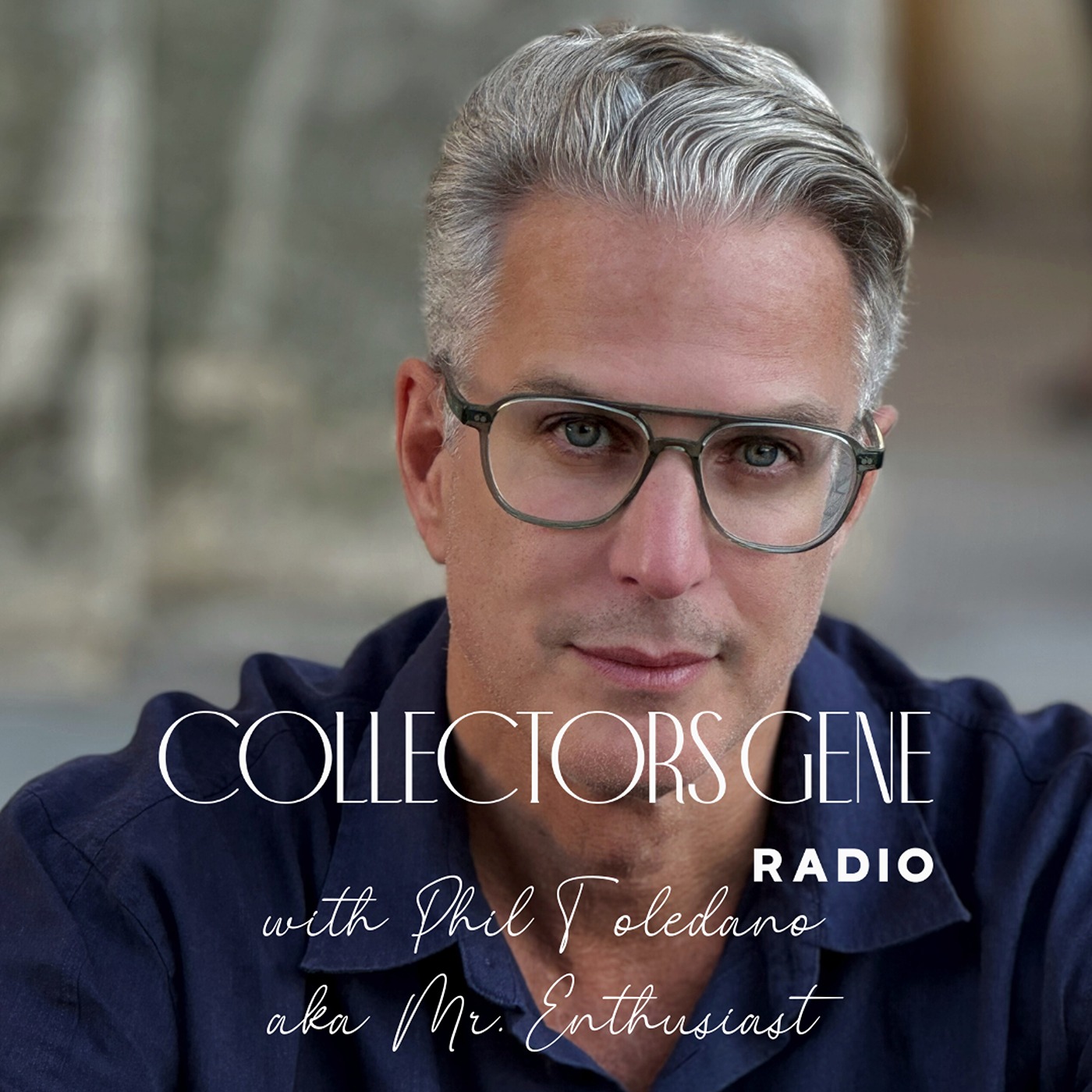
Loading summary
Transcript122 lines
- [00:01]
A
There is so much beauty in the world. There are so many extraordinary things to discover. Like, the greatest shame is to live a life where you're not poking around in the corners. Like, why wouldn't you want to just look at that stuff?
- [00:14]
B
What's going on, everybody? And welcome to Collector's Gene Radio. This is all about diving into the nuances of collecting and ultimately finding out whether or not our guests have what we like to call the Collector's Gene. If you have the time, please subscribe and leave a review. It truly helps. Thanks a bunch for listening and please enjoy today's guest on Collector's Dream Radio. Today, I'm thrilled to welcome Phil Toledano, a man whose name has become synonymous with passion, creativity, and, of course, collecting. Known to many as Mr. Enthusiast, Phil is an artist, photographer, and a collector with a taste for the unconventional. His collection spanning watches and cars in a way that reflects his unique perspective on life and creativity as an artist by trade, Phil has always approached collecting not just as a hobby, but as an extension of his creative expression. Raised between London and Casablanca, his formative years gave him a truly global outlook, which is reflected in the way he curates his eclectic collection of cars and watches. In fact, it was a deeply personal moment the day after his father passed away that marked the beginning of his foray into car collecting. By purchasing a Ferrari Dino in tribute to a man who, like him, had a profound connection to the world of art, Phil's creative journey has been anything but linear. After a career in advertising, he began to take his passion for collecting more seriously, moving from one obsession to the next, always searching for the unique and the unexpected. Phil's approach to collecting is as much about discovery and reinvention as it is about the items themselves. His own watch brand, Toledano Enchant, has garnered significant attention from collectors, affirming his place not just as a curator of fine things, but as a creator who deeply understands the culture of collecting. From the art he creates to the rare pieces he seeks, Phil's approach to life as an enthusiast is truly one of a kind. So, without further ado, Phil Toledano, aka Mr. Enthusiast for Collector's Dream Radio. Phil Toledano, aka Mr.— Enthusiast. So great to finally have you on Collector's Dream Radio.
- [02:12]
A
Thank you so much for having me, man. It's been a while coming, that's for.
- [02:16]
B
Sure, but I'm happy we made it happen. And you know, a lot of folks will know you as Mr. Enthusiasts, and some say it's an alter ego, but it truly is who you are. You are an enthusiast and a collector of many things. Art, watches, cars. You're an artist at trade, photographer by trade. Were you a collector of things when you were a kid, though?
- [02:37]
A
Not really. Like, actually I remember actually thinking, oh, I should collect stuff. And then I tried to have like a stamp collection and I was like, oh, this is miserably boring. But I tell you what I was as a kid, and that's mirrored the way I collect as I was always super curious about like everything. I haven't thought about this in years, actually. I used to go on what I call crazes like that I would get really interested in this thing. I'd really learn about it. I'd want to like, I don't know, get into this world. And then I'd sort of lose interest suddenly and go to the next thing. And that used to happen like so, so often for me as a kid. Like, I'm talking like a 10 year old. I think maybe now it'd be ADD but then I just, I was just interested in shit.
- [03:22]
B
And now there's medicine for that.
- [03:23]
A
Yeah, exactly. Now I'd probably be less interested in things.
- [03:27]
B
I'm curious to know how growing up in London and I believe Casablanca influenced your perspective on becoming an artist and subsequently a collector.
- [03:37]
A
Well, I'm not sure necessarily growing up in those two places influenced me as an artist so much as my father was an artist. So I grew up watching him work. I grew up talking to him about his art, I grew up going to his shows. And this really influenced me as a father. But I grew up watching him take my ideas seriously. Like he would talk to him about things he was working on and I'd have suggestions or ideas. And then maybe a, a couple of days later he'd come back and say, you know, I did this sketch. Is this kind of what you're talking about? And to me as a kid, that meant everything that my dad, you know, took me seriously. And so that's how I've tried to raise my own kid. Like, I take her seriously. But he was also very curious. He was also, he made, you know, he worked with sculpture, oils, charcoal. I mean, so many different mediums. He was always interested. And I guess maybe that's what I kind of absorbed from him. It's just being interested in everything.
- [04:37]
B
Yeah, absolutely. And I can't help but talk about the journal that you did days with my father. I was reading it last night, choking up in bed. My wife's like, why are your eyes watering? What's Wrong with you.
- [04:48]
A
I'm not crying. You're crying.
- [04:50]
B
Yeah. And I wish I had done that with my mother before she passed. And knowing that your father always wanted you to be successful and that he was an artist himself, you know, what do you think he would say about the person that you are today and the success that you've had as being an artist?
- [05:08]
A
I mean, look, one of the things you don't think about, or no one really tells you about, about the death of your parents is all the things you want them to see about your life, the things you want to share with them. Like, you know, I would love for my parents who have met my daughter, but I think. I mean, look, I know that my father would have felt nothing but pride to, you know, see me having a show in France or, like, currently I'm having a show, I'm having shows in France, Turkey, and the Netherlands simultaneously. And so for him, you know, that would have been an incredible source of pride. So, yeah, I mean, the book you were talking about, days with my father, I think that's probably the best thing I ever did after I made that work, actually. It's funny because I. I always. As a kid, I always wanted that. When my dad used to talk to me what I wanted to do in life, I always said, oh, I want to make work that changes people's minds or helps people or affects people and some way shows them something new. And that work did that. And I didn't mean for it to do that, but I guess if I croak tomorrow, I've done one good thing, which is that book.
- [06:13]
B
It is really special. And I think even if someone doesn't know you or understand what you've done in terms of your work and your collecting and all that stuff, just reading that, anybody can't help but feel that it's just a special piece of work.
- [06:29]
A
Thank you.
- [06:30]
B
So the day after your father passed away, you went and bought a special car, and you had a career in advertising. And as humorous and outgoing as you are, people should be able to tell from your previous work. So you're also a very sentimental and thoughtful person. And I'm curious to know what it was that made you buy that Ferrari Dino that day.
- [06:53]
A
Well, I mean, the great sad. One of the great really irritating things about life is that as you get older, you realize that all cliches are true. And it's really annoying because you spend most of your life going, oh, cliches are so stupid. But then you get older, you're like, oh, they're all real. So one of the things about my father dying, you know, I've been looking at this 246dino for ages, and it was so much money. It was. At the time, it was, you know, I mean, it was $90,000, which in retrospect looks like peanuts. But to me, that was the most money I'd ever spent on anything. But when my dad died, I just had that, the cliched reaction. Well, you know, what am I waiting for? Like, I've got the money somehow I'll make it work out. And I kind of. I accidentally bought an incredible car because I didn't know anything. I just knew I loved that car. I love the shape of it. I didn't know there was a European version and a US version. I didn't know there's a GTS version. It was just all the right things. And it turned out to be. I kind of, you know, in a buffoonish way, stumbled onto, like the greatest spec Dino I could possibly imagine, which was a dark blue European GT original design, like the, you know, before they did all this chairs and flares stuff to it. And I bought it. And it was so weird to be doing that the day after my dad died. But in a way, it made perfect sense. Like I was just kind of. I was honoring the lesson that he had inadvertently taught me in his death, which is, you're not going to be around for long if you can, you should live.
- [08:19]
B
Absolutely. And, you know, retail therapy is a real thing.
- [08:25]
A
Yeah. And that was like extreme. Retail therapy. Yeah.
- [08:28]
B
Some people, you know, they go and they buy some flowers or they buy, you know, a pair of pants or something like that. And some people go and buy Ferrari Dinos.
- [08:36]
A
Yeah. I mean, well, look, in retrospect, I turned out to be a genius, but obviously that was not planned. I had no idea I was going to be a genius at the time.
- [08:44]
B
That car in blue is absolutely insane.
- [08:47]
A
Yeah, I mean, it was. It was. And I used to keep it down the street from me in a public garage in New York City and with just a car cover on it, which is kind of crazy. You think back about it now, but I would, you know, go down the road, take the COVID off, and I drive the. If I was feeling miserable, I would just drive the Dino around New York. And it was genius. It was like being Elvis, man. Because people, people in New York are just so grateful to see any car that's not like a beaten to shit taxi. And then to see this thing in New York must have been like, you Know, like, seeing there, like seeing Elvis, like, it was like a. It was like a miracle sighting. And people just come up to me and talk to me, and, you know, it was. It was the most glorious experience.
- [09:29]
B
Now you can't even keep a Prius covered in a public parking garage.
- [09:33]
A
Well, I don't even know what the reaction would be. I mean, every now and then I'd go there and there'd be a little note on the windscreen, like, would you be interested in selling this car? But it was amazing. I'm a real proponent of driving, like, vintage cars in New York City because the experiences I've had have always been so wonderful.
- [09:49]
B
And they handle potholes just perfectly.
- [09:52]
A
I mean, you know, they've got massive fat tires, so they actually handle them better. And then I became really adept at, like, developing this sixth sense of, like, oh, there's a massive, like, Grand Canyon chasm in front of me. I just bob around it.
- [10:07]
B
When you bought that Dino, was that the real start to your car collecting?
- [10:11]
A
No. Well, the first really expensive car I had was a Porsche 964 Porsche C2 that I bought in the mid-90s for 27 grand. I mean, I'm sure that when I tell people the prices of things I paid for, things that people weep because cars were just like, they weren't the things they are now. I guess they were and they weren't, but that was the most expensive car I had. And then the Dino. But then the Dino was like, okay, this is vintage. This is. And, yeah, that was the beginning of, like, realizing, okay, I have some money. I can actually buy, like, amazing things with it.
- [10:49]
B
Yeah, absolutely. So as an artist, it's no surprise that you would collect things with the same fervor, to be different and outgoing. It's evident in all your collections. Were you ever tempted to collect more mainstream blue chip stuff? Or has it always been something less of interest to you and more of an interest to kind of go outside the box a little bit?
- [11:11]
A
Well, I think that that's just who I am. And, I mean, I've mentioned this before, but when I worked in advertising, this old boss of mine called me a pathological contrarian. And when he said that, I suddenly had this revelation. I was like, holy shit, that's true. I had no idea that that's who I was, but it was. So even when I bought the Dino, like, the thing I loved about it was it wasn't even badge as a Ferrari. I mean, when I bought it, it was festival in Ferrari badges. I took them all off to make it the thing it was. And I loved it because I'd go to, you know, cars and coffee things, and people didn't really know what it was or was like, yeah, that's not really a real Ferrari. It's a six cylinder. It's not even, you know, like, people didn't really. They. They didn't really, like, treat it with much respect. And I was. I always just think, are you crazy? Look how beautiful this thing. It doesn't matter what it was badge at. Just look at it. But, yeah, you're right that. I guess that I've always been unconsciously or consciously motivated to not try and do the same thing. Only because I feel like. Well, there's a bunch of reasons. One is it requires more imagination to think about who you are and what you want than if you buy things that everyone else has. And two, more practically speaking is that if you resist the gravitational pull of the norm, often everything is much cheaper. Because, you know, when I was buying a Dino for 90 grand, that was, like, cheap because no one was interested, Right? Do you know what I mean? So, yeah, like, when I was buying and I'm. When I buy pateks from the 70s, I started buying those six or seven years ago or five years ago whenever it was. Because no one cared about the 70s, right?
- [12:45]
B
It's funny that people were, you know, upset that you debadged the car and stuff. It's like sometimes you think people want you to wear the matching Ferrari Puma shoes, and then you wear them and they ask you why you're wearing those.
- [12:56]
A
I would. I mean, yeah, because the Dino never came with Ferrari badging, right? So what happened with Dino's is people would, you know, buy them and put Ferrari badges on them to be like, yeah, hey, look, see, it's a Ferrari, I swear.
- [13:12]
B
So, you know, like your work as a conceptual artist, you know, your tastes and collections have ebbed and flowed. And anybody that follows you knows that, you know, there's constant stuff coming in and out, and that's what keeps, I think, your collection so interesting. But as an artist, you know, it's important to keep an open mind and always be thinking of the next thing and how to create it. How important is it for you to turn over your collections and keep exploring new things?
- [13:40]
A
Well, actually, it's interesting, man, because I never thought about it. There is. Because my job as an artist is to be curious. That's the kind of job description I've always felt is to always be interested in new technologies, new developments, Whatever. Like, everything around you, like, everything is of interest. And that's how I feel about collecting. Everything is of interest. So with watches in particular, I guess that there are some. There are things now I've kind of focused in on two kind of main areas, like this kind of 70s Patek stuff, and then like these 40s pre Daytona chronographs and stuff. But then there's other stuff that I'm interested in, so it's important to be. So I don't shuffle. I mean, I think people think I'm always. I'm always. I am usually always selling something, not because I'm necessarily bored of it, but because there's something else that's caught my eye. And I'm not one of those people who has, like, endless funds to fund everything. Like, I've got to sell stuff to buy the new stuff. So, yeah, I mean, there's always things I'm selling, I guess, but there's always things that will at least stay in the collection for. I mean, the 70s stuff and the Rolex stuff has kind of stayed more or less static. I kind of trim it a little bit here and there, but I like those two directions a lot.
- [14:50]
B
And you've had the chance to do a few of your own watches. First, your collaboration with King Nerd, and most recently, the launch of your new brand, Toledano and Chan. You've received so much great feedback and recognition, and rightfully so.
- [15:03]
A
Thank you. And look, I've said it endlessly, but it's both overwhelming and deeply humbling and flattering and all of those things to think that people are as enthused about that idea as Alfred and I were when we started thinking about it.
- [15:18]
B
Well, and I'm curious to know, you know, as a collector yourself, what's been the most rewarding aspects of launching your own brand for other collectors to be a part of?
- [15:28]
A
Well, I guess what I just said really is that the idea, like, when you make art, you're making it for yourself. And that was the same experience making this watch. When we designed this watch, we would design it for ourselves. And so I guess, have this realization that other people share the lunacy is a joy. Because you don't know, like, when you make something, you have to be kind of delusional. Like, you have to make this. Like, we made this thing and we would. And we were kind of delusional to agree to a certain degree. Because when we. When we made the watch. When we were making the watch, we thought of the watch. The watch landscape was so different, right? Like four or five years ago, it was Rolex, you know, steel sport watches. And the idea of, like, Midas and all that stuff wasn't really on the horizon. So we would kind of just. We were just sort of crazy people thinking, yeah, we'll make this thing that we love, and maybe other people like it too. But there was no, like, real basis for that. That assumption.
- [16:21]
B
Well, and your timing was insane because as you're getting ready to launch this and you start making announcements about it, the world kind of took by storm. All these watches that are kind of in the same realm that. That are vintage. You know, you talk about the Midas and you talk about, you know, all these integrated bracelet, 70s Pateks, and the world just consumed it. And then you launch your watch and it's like, how perfect is that?
- [16:46]
A
I know, it's crazy, man. Then two weeks later, AP launches the reissue of the Master, whatever it was called. And all of a sudden we're like, in conversation with ap, which is ridiculous because we're nobody. And then, you know, people are saying in the airlines, you go, oh, I can't believe AP copied you. Which is, of course also ridiculous because it's not like AP would just churn out a watch in two weeks. But, yeah, the whole thing was amazing, man. Like, if we launched that watch two weeks later after ap, everyone would have said we had copied ap.
- [17:13]
B
Well, I think it's all a testament to you. I mean, you've built this audience and you've built this platform and everybody is so engaged with you. When you had your clothing brand items consistently sold out and now your watches are selling out, what's it been like to create a brand that is so well received by other collectors? You know, you have people that follow you and you have people that are constantly commenting on your stuff, and so, you know, people are interested. But to put something out for people to buy is just, you know, a whole nother ballgame.
- [17:47]
A
Well, yeah, I mean, it could have gone horribly wrong and it would have been publicly, like, I mean, look, Alfred and I talked about that and, you know, like, the possibility for, like, massive public shame was high. I mean, it's funny because we were going to go live at 9am and then at like 5 to 9, it's sort of like. It's like, you know, when you're a kid and you have a. You're going to have a birthday party and you have like all the balloons and the cake and everything, but you don't know if anyone's going to show up really, like you have this like fear, like what if like only three people come? Or at least that was my fear. So, you know, five to nine. I was like, fuck it, we're just going to launch the site, we're going to and I'm just going to see if anyone's at the door like waiting to come into the party.
- [18:31]
B
I love it. And they all did. And plus some.
- [18:35]
A
Yeah, it was amazing, man. Like, yeah. And then I started, you know, I started seeing the sales come in, I called Alfred and we were just like laughing and shouting over the phone. I mean it was an incredible moment for us.
- [18:45]
B
That's amazing. I want to talk about art and photography for a bit because it's such a subjective place to live. You know, people either love your work or they don't. And that's just a general thing. When it comes to art and photography and when it comes to watches and cars, you've been known to be a tastemaker. You have followed your gut and your interests and a lot of people have followed along rightfully. So I mean, you've single handedly put certain watches and styles on the map as well as cars.
- [19:15]
A
Well, I mean that's really. I went. I mean, I have to say, man, I find that like, I know, look, I know that I have, I have like a lovely relationship with people who follow me and occasionally I'll get an email from some guy saying, oh, I bought this geezer watch because, you know, like I saw stuff like this on your feed. It's lovely. But I find it hard to believe that I have the influence you're claiming I have. Which is, if that's true, that's deeply flattering.
- [19:41]
B
Well, I think, you know, it's all relative to an extent. Right. I think people see that you are interested in these things and it gives them the idea of, okay, maybe I could wear that too, or maybe I could be interested in that or maybe I should give that the time of day, you know what I mean? It's less of Phil bought this, so I'm going to buy it. It's more of, I'll give this a.
- [20:01]
A
Chance because, well, look, and that's lovely, man. Because what that means is I've just, I mean, I've always sort of considered myself a bit of an evangelist. Like if I like stuff, I always want everyone I know to like at least look at the thing I like or consider the thing I like. I don't know what it is about me, but I'm always like, you know, it's just a Thing for me. Like, oh, I found this watch. I've got to show it to people. Go, look how cool this is. You've ever seen this kind of thing before? You know, like, I love doing that. It gives me real pleasure to introduce people to stuff that they haven't thought about.
- [20:29]
B
Well, how do you translate that into your work as an artist? Because I feel like they kind of play in the same space a little bit.
- [20:36]
A
I don't know. Actually, man, that's a good question. I'm not sure. Like, in some ways, it's the same. It's the same methodology. Like, when I make work, you know, I'll just. I'll make something that is interesting to me, that I think is really important, and I'll secretly hope that people will also be interested in it. And sometimes, look, I've done projects that I think, wow, this is so fascinating. How can it. This is going to make me famous, and then no one's interested at all. I mean, that happened.
- [21:07]
B
Yeah. I mean, you did a really interesting project with the New York Times, and you worked with prosthetics and all that sort of stuff. What was the impetus behind that?
- [21:17]
A
Well, it ended up being a New York Times documentary, but the genesis of that project is basically this idea that my parents died quite suddenly, and I became really fascinated with this idea of how your life can change so radically. Like a phone call will change your entire life, and you don't even know that those things are right around the corner. And I became really obsessed with this idea of what other kind of sharp turns does life have in store for me? So I thought I'd do a project where I'd envision all the worst possible things that would happen to me in my future, which is crazy. So how do you research the future? Well, you know, I spoke to fortune tellers, tarot card readers, you know, all these kind of people. Numerologists. And then based on their predictions, I worked with prosthetics experts to become all these future versions of myself and act out these terrible possible future scenarios, which is, you know, when you think. When I hear myself explain it, it sounds pretty crazy, which my wife just said. Couldn't you just see a shrink like a normal person for three years, like, living these terrible scenarios and all this stuff? And it became a New York Times documentary film.
- [22:31]
B
It was impressive, I mean, I think, in its lunacy, but that's the best part about it. And I think it's actually a testament to the way that you collect things, right? You. You get these scenarios in your head and you think of all the possibilities. And I think that that's probably what. What's made you such a great collector is having that open mind, you know, that we mentioned earlier, and being able to just go for something and put yourself in it. And if it doesn't work out for you, then you move on to the next thing. But you have this ability to just try things, you know.
- [23:06]
A
That's interesting. Yeah. Well, look, I mean, I feel like curiosity is just the greatest gift because there is, and this is going to sound trite, but there is so much beauty in the world. There is so much. There are so many extraordinary things to discover. Like, the greatest shame is to live a life where you're not poking around in the corners. Like, why wouldn't you want to just look at that stuff? And if you make a mistake and if you're lucky enough to afford to be able to make mistakes as I am, then that's okay. There's so much extraordinary stuff just around, like, that's just been forgotten about.
- [23:39]
B
Yeah.
- [23:40]
A
And also there's this. There's this weird paradox because at the same time, particularly in the context of collecting, say, watches, there is a tremendous gravitational pull. Right. That. And I'm subject to that too, that everyone want, you know, like you. Because you see, like Submariners or Daytonas, they cut that. That gravitational pull sucks you in. And all of a sudden that's what you're looking at, and that's only what you're looking at. And you forget, like, zillion kinds of things that happen in the 20s or the 40s or the 80s or whenever it happened to be because the gravitational pull is so strong, it crushes the light of everything else that you might want to look at.
- [24:14]
B
When it comes to collecting art, do you have the same interest in what you created?
- [24:19]
A
I actually don't collect art at all.
- [24:21]
B
Well, you do have a couple things like that I would consider art, like that moon suit, which is insane, by the way.
- [24:28]
A
The spacesuit.
- [24:30]
B
Yeah, yeah, yeah.
- [24:31]
A
I mean, look, that was a dream of mine from when I was a kid. Like, when I was a kid, I wanted to be an astronaut. And I dream and I. And I was like 11 or 12, I wrote to NASA saying, hey, can you. Could I buy a spacesuit from you? Because I just thought it amazing. And oddly enough, they didn't want to sell me one. But then in the 90s, when I was working in advertising, I see if this is before Google, I would Yahoo. Search spacesuit for sale. And this is. This is kind of Crazy. But this is during the collapse of the Soviet Union. So I came across some guy in Poland who clearly had access to like some. Some space museum in Russia that was selling everything. So I kind of was just. I started talking to this guy, ended up buying this space suit from Russia. A cosmonaut suit.
- [25:14]
B
Amazing.
- [25:15]
A
I mean, it's funny, I guess, when I more than I'm. In some ways, like, I just bought this 16th century chefron, which is a. Which is a armored horse. It's horse armor for the horse face. So to me, that's art. Or like I've been doing this thing where I've been collecting 16th century portraits that are $2,000 or less at auction. So you can make these kind of weird collections of stuff.
- [25:41]
B
Yeah, I mean, it's all art. I mean, you know, I think at the end of the day, cars and watches and, you know, a spacesuit or horse armor or portraits, it's all art in one way or another. And I think you can categorize them generally that way. When it comes to collecting cars and watches, in my opinion, it's easy to kind of collect across multiple different genres. Right. You have dressy Pateks, you have vintage Rolex sport watches, and you can kind of make a collection and make it really cohesive. And you're not necessarily. You don't consider yourself an art collector or photography collector, but how do you think people collect art and photography in relation to the way that people would collect cars? I mean, do people collect in a really narrow, tight knit era and genre, or are people really widespread with the art that they collect?
- [26:34]
A
Well, it's hard for me to talk about other people's collecting habits, man. But I think that a friend of mine collects only group portraits from the 50s like that. I mean, the thing about collecting in any, in any genre or space is that you can become incredibly specific. You know, like only military watches from the 80s or whatever it happens to be. So, yeah, I mean, collecting art is exactly the same as collecting castle watches. It depends if you want to be eclectic or you want to be specific watches. I find it hard to like have a lot of random stuff.
- [27:09]
B
Right.
- [27:10]
A
Like, it makes me happy to sort of look at what I've collected and see this cohesion there.
- [27:15]
B
So you become a recurring character on Mike Nouveau's page and you've gotten to see a lot of watches in person from other characters that he unlocks.
- [27:23]
A
Yeah.
- [27:24]
B
Is there anything that you've seen that you were surprised to become interested in after seeing it in person?
- [27:29]
A
I'll Tell you what's interesting about collecting watches, man, is that I find, and actually in general is that I find there are things that I've rejected for years. Like, for instance, in watches, there are Gerald Gento watches. I just looked at those for years and were like, that's just too much. It's too. Just too crazy. And then suddenly this thing happens and all. And then I look at it one day like last week, it could be too much and terrible. And I look at it, you know, Tuesday, the next, the following Tuesday, I look at it go, oh, this is amazing. How is it that I didn't see this as amazing before? And I'm so curious to know what that. What is the chemical reaction that happens within me to make me think this thing is genius now, whereas before it wasn't. And part of it, I think, is repetition. Like I think with. Often with watches or cars or whatever it is, you look at things and you're not used to that. Your brain has acclimatized itself. It's created the neural pathways to sort of acclimatize itself to this specific kind of design. So if you like, say you've been looking at Rolex subs for 5 years, your brain likes that design, it's used to that design. So when you see a Gerald Gentle, you go, whoa, that's crazy and too much. But if you keep seeing a gender on a regular basis, your brain will begin to mold and adapt and conform to this new idea, this new aesthetic design. And eventually it will begin to see what's genius about that.
- [28:51]
B
That could be an interesting art project for you.
- [28:53]
A
Well, I don't know how that would become an art project, but it is interesting. I'm interested how, like, things I previously thought like, you know, 70s integrated bracelet watches were always just. I just looked them and I was like, ah, they're just kind of cheesy, whatever. And then the more I looked at them, the more I thought, oh, hang on, these things are amazing.
- [29:09]
B
Well, I think you could do it with other people, right? You could put certain things in front of other people and things that are maybe really polarizing that you wouldn't expect people to like and then revisit with them later on and say, how do you feel about this now?
- [29:23]
A
I think that's actually happening now with what we. What I guess is now called geezer watchers. Like, I've been posting them, but because Nouveau in particular has been posting them and he has a far greater, greater reach than me. All of a sudden a lot of people are seeing these Kind of integrated bracelet, blingy watches in the 70s and 80s. And they're. And because they're seeing them more, they're liking them more, right?
- [29:43]
B
Yeah, I guess it's a current study that's happening without us knowing about it. What's your current area of interest in cars? Are we at a 91 Bentley Turbo R yet, or are we still on the Group B stuff?
- [29:56]
A
Actually, it's funny you say that, because I spent all of. Yes. Well, not obviously, but yesterday I was like, rooting around in the depths of YouTube, but like, Bentley onages and, you know, Bentley Continental T, which I've been sort of obsessed with for years. Like, all of a sudden, I guess I've had. The cars I've owned for the last 10 or 15 years have all been like really hardcore Group B homologation rally cars. Like, they just. They just beat you senseless when you drive. And they're super loud, super noisy, super hot. Like, you know, just no ac. Like, they're just. It's just like a. It's a bludgeoning. And as I think, I guess I've just sort of tipped over to Geezerville. And now I just keep thinking, how nice would it be to drive around the car that's entirely silent? You're just kind of drifting around in this luxo barge.
- [30:41]
B
I love those 90s Bentleys. I think they're incredible.
- [30:44]
A
Yeah, they're amazing, man. They're really amazing.
- [30:46]
B
And you can get them in that azure, light blue color over the really cognac interior. It's incredible.
- [30:55]
A
Yeah. And you've got the full, like, drinks cabinet interior with all the mahogany bollocks. I mean, yeah, just. I would like to own one of those cars at some point just to kind of experience what it's like to be in something so luxurious.
- [31:09]
B
Yeah. You mentioned in an article with a collected man that living in Chinatown in Manhattan is important to you for the culture. And in terms of the collector and artist that you are today, do you still feel that way and how important is it for you to travel to places with culture?
- [31:28]
A
Well, I prefer to go to places without culture, if possible. I mean, look, I guess I moved down to Chinatown in the late 90s because I kind of liked the fact that it was a real neighborhood. Like, it wasn't like, I used to live in East Village and everyone kind of looked like me and everyone was sort of doing the same things. When I moved down to Chinatown, it was just sort of families and not like white kids doing cool things. It was. I don't know, like, it just seemed like a real place. So I still. I mean, although now where I live has become like this. It's the. It's the nexus of hipsterism. I mean, it's crazy. Like, I am basically the old geezer of the neighborhood, and everyone else is walking around, like, wearing dresses and eye patches and peg legs and whatever, and I. You know, they must look at me like, just, who is this old guy?
- [32:15]
B
Patches and peg legs.
- [32:17]
A
Yeah. I mean, it's amazing, and I love it. I love that. It's so, like. It's just like everything is. Everything is fine now, which is kind of genius.
- [32:25]
B
Yeah.
- [32:26]
A
But, yeah, traveling is everything, man. Because it just. You get so used to ways of thinking, and you forget that everyone else does things differently, and it's glorious to be reminded that on a regular basis.
- [32:39]
B
Well, it seems like most of the shows that you do for your art and all that stuff are overseas. Is that right?
- [32:45]
A
Yeah. Well, it's safe to say I'm more appreciated in Europe than I'm in the States for my art. I mean, it's interesting. I wonder about that. Like, I don't know if it's the. I don't know if people are more audacious there. I mean, look, I would like to tell myself that to make myself feel better about that fact. I don't know what the reason is for that.
- [33:04]
B
I love it. Well, Phil, let's wrap it up with the collector's gene rundown. You know the drill here. You can answer these questions based on any of the things that you collect, whether it's spacesuits and horse armor or car. Cars and watches sound good. What's the one that got away?
- [33:20]
A
I had bought my Dino, and then someone said to me, do you want to buy a Ferrari 275, long wheelbase, and it's $650. $650,000. And I was like, that is crazy. That's just. That's crazy amounts of money. And then now, of course, they're like 2 million over 3 million, whatever it is. And the same thing happened with a 959. Someone offered me a 959 for 300 grand.
- [33:46]
B
Wow.
- [33:46]
A
And I was like, no, it's. I don't. It's red. Actually, I turned it down because it was red.
- [33:51]
B
Oh, geez.
- [33:52]
A
At the time, I just looked. I just didn't. It was a different time. I didn't have that kind of. I didn't have $675,000, but it just seemed like too much money anyway.
- [34:00]
B
Makes sense. The on deck circle. So what's next for you in collecting? Maybe something you're hunting after?
- [34:07]
A
I honestly don't know, man. I really don't know. I mean, that's what I find actually is the joy. That's kind of the joy and deep rage about watch collecting is that at least in cars, I feel like I kind of know almost everything that's out there. I've either owned it or I've been lucky enough to own it, or I can't afford it, or I just know it exists. And it does interest me. But with watches, there's so much shit that you just like, oh, here's a whole other bloody, like thing of watches, like style watch I never knew existed. Now I've got to start buying these things, right? So I don't know what it is, but I'm sure I'll be, you know, dazzled tomorrow.
- [34:42]
B
How about the unobtainable? So this is one that's too expensive in a museum. Private collection. Just complete. Unobtainium.
- [34:49]
A
If it's going to be a car, it'd be a Ferrari 250LM.
- [34:52]
B
Yeah.
- [34:53]
A
Just because that thing's just amazing. And also it's kind of so quirky in the design. Yeah, maybe one of those.
- [35:00]
B
I love it. The page one rewrite. So if you could collect anything else and money was no object, what would it be?
- [35:09]
A
I guess it would be art. Like, I'd buy like, I don't know, Jeff Koons. Or I'd buy like, I really love 16th century painting. I'd buy that kind of stuff. Like, I just find that really beautiful. There's something about that period of history that's amazing to me.
- [35:26]
B
How about the goat? Who do you look up to in the collecting world or who do you think is just a great collector?
- [35:32]
A
I mean, honestly, the collectors I respect the most are the people with the most imagination. The people who just like, obviously. Look, I'm sure everyone says this, but Ronnie Mahvadi, I think it's how you say his last name. He's obviously got like really interesting taste. And that also weirdly goes for dealers. Like, I think like my friend, I just. Based on it, I just had it. Watch Brothers in London. Prince. Yeah, that guy. I just, I've just completely had a senile moment and forgotten what is. And we just, we talk.
- [36:05]
B
Ben. Right, Ben.
- [36:07]
A
Thank you. Jesus. That is what happens. You have jet lag, you don't sleep. Ben has really remarkable tastes and I respect people like that because I feel like he not only anticipates the market, but he creates it, too by just by showing you things that are amazing.
- [36:21]
B
Yeah. He certainly put Vacheron, you know, perpetual calendars on the map, for sure.
- [36:26]
A
Yeah.
- [36:27]
B
Totally great stuff over there.
- [36:28]
A
Yeah.
- [36:29]
B
The hunt or the ownership? Which one do you enjoy more?
- [36:33]
A
That's a good question, man. Look, the hunt is so exhilarating and so frustrating because, you know, you hunt for ages and you find one and then, oh, look, it's, you know, been re loomed or whatever happens to be. But the hunt's really exciting because the hunt involves two things, curiosity and knowledge. But the owning is. I mean, it's pretty glorious to, like, look in your watch box and go, okay, there's that thing that I really wanted.
- [36:58]
B
Right. Both are fun.
- [37:00]
A
Yeah.
- [37:01]
B
Most importantly, do you feel that you were born with the collector's gene?
- [37:07]
A
Well, I guess I am now, but it didn't manifest itself, I think. Okay. I say yes because to me, collecting is curiosity. And so I've always been curious. So, yes, I love it.
- [37:19]
B
Phil, thank you so much for coming on Collector's Dream Radio today. Always great to catch up with you, and I am so looking forward to seeing what you do at Toledano and Chan and the next cars that come in and all sorts of great stuff that you have going on.
- [37:32]
A
Thank you so much for having me, man. It's been a real pleasure.
- [37:34]
B
Anytime. Cheers. All right, that does it for this episode. Thank you all for listening to Collectors Gene Radio.