Podcast
Commonwealth Club of California Podcast
Hosted by Commonwealth Club of California · EN
The Commonwealth Club of California is the nation's largest public affairs forum. The nonpartisan and nonprofit Club produces and distributes programs featuring diverse viewpoints from thought leaders on important topics. The Club's weekly radio broadcast — the oldest in the U.S., since 1924 — is carried on hundreds of stations. Our website features audio and video of our programs. This podcast feed is usually updated multiple times each week.
110episodes
Episodes
Newest firstAll episodes

Pria Anand: A Neurologist on the Strangeness and Wonders of Our Brain
Yesterday01:08:19Tap to summarizeJoin us for a talk with a neurologist as she reckons with the stories we tell about our brains—and the stories our brains tell us. Such as: A girl believes she has been struck blind for stealing a kiss. A mother watches helplessly as each of her children is replaced by a changeling. A woman is haunted each month by the same four chords of a single song. Anand explores these topics in her new book The Mind Electric: A Neurologist on the Strangeness and Wonder of Our Brains, using case study, history, fable, and memoir—sources she says the medical establishment has overlooked—to explore the complexity and wonder of brains in health and in extremis, and the vast gray area between sanity and insanity, doctor and patient, and illness and wellness, each separated from the next by the thin veneer of a different story. Learn more about your ad choices. Visit megaphone.fm/adchoices
Transcribe →
Rashad Robinson: From Presence to Power
3d ago01:15:39Tap to summarizeWhy do some struggles for justice succeed while others stall? What is needed to make effective social change, especially in today’s world? According to Rashad Robinson, it comes down to understanding the difference between presence and power. Failing to do so is one reason things got this way, but understanding how power really works is a big part of how we get out of it. Robinson would know. As a social change strategist, he’s spent more than 20 years at the highest levels of leadership in two of the most significant social movements of our time: the fight for LGBTQ rights and the fight for racial justice. He’s taken on tech giants and the criminal justice system, politicians in Washington and corporate executives in Hollywood. He’s been on the front lines of protest and in the back rooms of negotiation. He argues that achieving presence—the visibility of marches, media fads, and making issues popular—is not the same as gaining the leverage required to change the rules for how society works or change the decisions that politicians, corporate executives, and other people in authority make. It’s a topic he explores in his new book From Presence to Power, offering a set of essential lessons about power for people who want to understand it, gain it, and use it to make positive change. Robinson provides tools to help everyday people build real leverage in systems designed to prevent them from doing so. As someone who helped shape the resistance after the 2016 election, and who continues to help leaders at every level find innovative ways to fight back and win progress today, Robinson offers a hopeful, practical guide to achieving positive impact in the most challenging times. Find out how. Learn more about your ad choices. Visit megaphone.fm/adchoices
Transcribe →
CLIMATE ONE: Hollywood, Baseball, Cage Fights, and… Climate
4d ago01:02:33Tap to summarizeWhen it comes to climate, we have the facts, but we aren’t moving fast enough. So we need to get climate education and solutions into the places where people already spend their time. Pop culture offers endless opportunities to influence audiences – your favorite movie or TV character can feel like a friend whose views on climate might affect your own. In this episode, we connect moments like this to the broader media environment shaping how we understand the world. Can you be masculine and care about the climate? Can watching a character take charge of the future onscreen actually change what people believe they can do in real life? And can the stories we consume ultimately shape public attitudes and even policy outcomes? Guests: Allison Begalman, Co-founder & Chief Strategy Officer, Context Collaborative; Co-founder, Hollywood Climate Summit Michael P. Haselhuhn, Associate Professor of Management, University of California, Riverside Brent Suter, Baseball player, Los Angeles Angels; EcoAthletes Climate Champion Highlights: 00:00 – Introduction 5:00 – Allison Begalman on why it’s important for climate to show up in popular culture 8:45 – Unpacking a climate-themed scene from the show “Hacks” 13:00 – Unpacking a climate-themed scene from “The Morning Show” 16:30 – Bringing new people in at the Hollywood Climate Summit 23:15 – Michael P. Haselhuhn on how men’s views on masculinity and climate change are linked 33:25 – Masculinity is multifaceted 34:30 – Kousha goes to an MMA cage fight to ask guys about their views on masculinity 40:15 – Brent Suter on where he got his nickname, “The Raptor” 42:00 – His reaction to seeing “An Inconvenient Truth” as a young person 44:00 – Speaking out against fossil fuel endorsements for pro sports 49:20 – Suter on how his faith drives his climate activism 54:30 – How Suter talks to his teammates about climate and the environment 57:40 – Climate One More Thing For show notes and related links, visit our episode page at ClimateOne.org *** Join Climate One for an electric conversation on September 1 at 6 p.m. between PG&E CEO Patti Poppe and California State Senator Scott Wiener about energy affordability, outages, and whether cities like San Francisco are ready to break up with the investor owned utility model. Tickets available at climateone.org/events *** Support Climate One by going ad-free! By subscribing to Climate One on Patreon, you’ll receive exclusive access to all future episodes free of ads, opportunities to connect with fellow Climate One listeners, and access to the Climate One Discord. Sign up today. *** Ad sales by Multitude. Contact them for ad inquiries at multitude.productions/ads Learn more about your ad choices. Visit megaphone.fm/adchoices
Transcribe →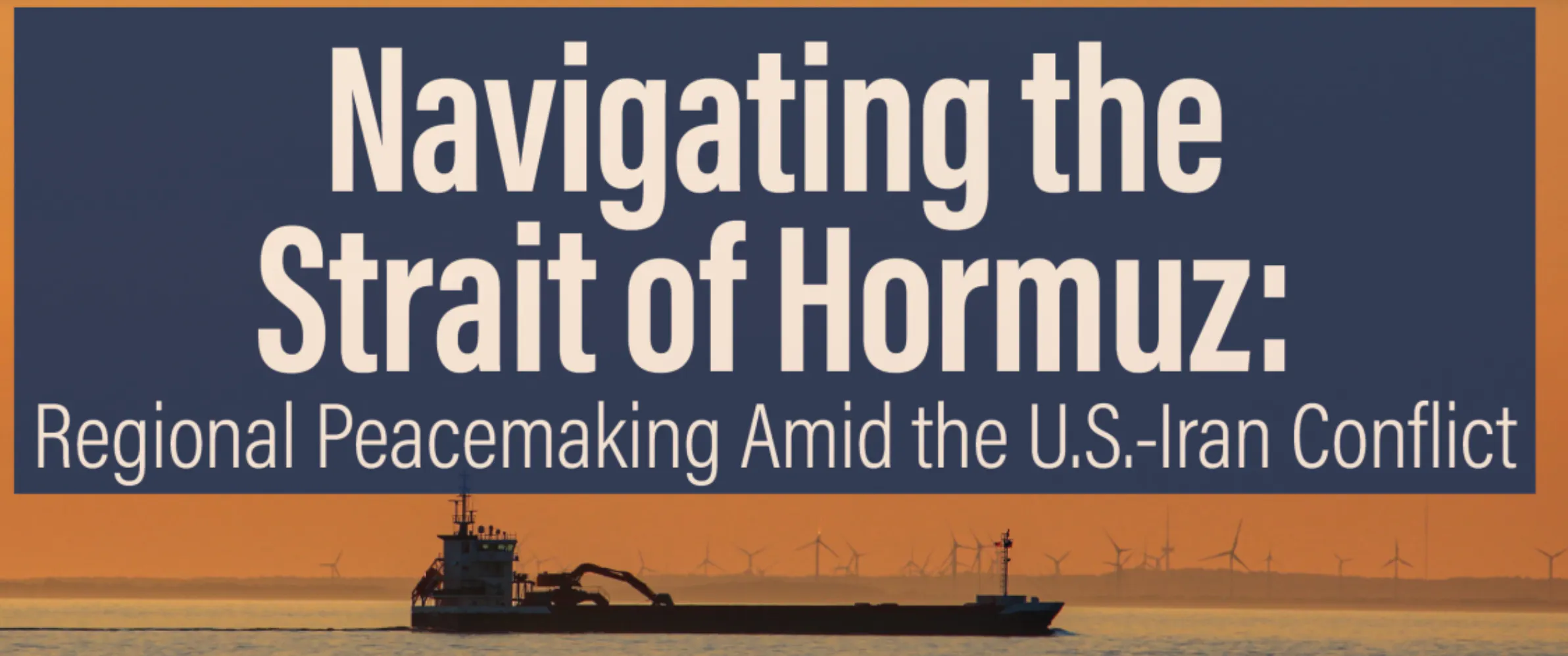
Navigating the Strait of Hormuz: Regional Peacemaking Amid the US-Iran Conflict
1w ago00:55:38Tap to summarizeWith one-fifth of global oil supplies and the movement of critical LNG stuck in the crosshairs of a military standoff, the need for diplomatic off-ramps has never been more urgent. This panel brings together top diplomats and geopolitical experts to unpack the overlapping mediation efforts of key regional powers. From Pakistan’s frontline ceasefire negotiations to Qatar’s high-stakes maneuvering over nuclear frameworks and frozen assets, and Oman’s delicate balancing act of historical neutrality. Join us as we explore how these three nations are acting as vital firewalls against catastrophe, attempting to bridge the gap between Washington and Tehran and how the two capitals respond. ORGANIZER: Banafsheh Keynoush Learn more about your ad choices. Visit megaphone.fm/adchoices
Transcribe →
DJ DiDonna: The Transformative Power of Sabbaticals
1w ago01:00:57Tap to summarizeThe professional world usually prioritizes urgency, but the most important moments of our lives rarely happen at the desk. In his new book Big Time Off, Sabbatical Project founder DJ DiDonna offers up a simple but radical idea: sabbaticals help us avoid sleepwalking through life by giving us time to be present in moments of celebration, difficulty, and transition. Integrating original research and compelling stories of sabbatical-takers from all walks of life—from teachers and nonprofit leaders to startup founders and Fortune 500 employees—DiDonna explores why extended time away from work has such a profound effect on people’s identity, relationships, creativity, and direction. DiDonna covers when to take a sabbatical—and how to avoid waiting for a crisis to take off; why sabbaticals—unlike vacations—help you forge a new career path, feel human again, and live a more authentic life; how to navigate your sabbatical using archetypes—the explorer, the seeker, and the achiever—and avoid common pitfalls; and best practices for individuals—no matter the circumstances—and organizations of all sizes to make extended leave possible and sustainable. Whether you dream of making a big change, exploring the world, or simply carving out space to heal, think, and recalibrate, join us to hear DiDonna discuss his guide to creating a richer, more intentional life. About the Speakers DJ DiDonna is a senior lecturer at Harvard Business School, where he teaches entrepreneurship. In 2019, he founded The Sabbatical Project to define, explore, and research sabbaticals. DiDonna has advised over a dozen organizations on the creation of sabbatical policies, including Zappos, Google, and DaVita, and from nonprofits to Fortune 500 companies, both in the United States and around the world. He has appeared on ABC, NPR, CNBC and attended Harvard Business School, later cofounding an international credit-scoring company, EFL Global (the Entrepreneurial Finance Lab), based in Lima, Peru. Aarti Shahani took a sabbatical from college to lead a campaign against her father’s deportation. After almost a decade, her advocacy was successful. Her family remained together in the United States. She went on to become a prominent voice for the country as an award-winning NPR correspondent, where millions of listeners have turned to her to explain the significant stories of our time. Her bestselling memoir Here We Are details the history of I.C.E. through her family’s experience. She regularly hosts conversations with leaders in business, politics and arts on her podcast “Art of Power” as well as shows like NPR’s "Fresh Air" and KQED’s "Forum." Learn more about your ad choices. Visit megaphone.fm/adchoices
Transcribe →
Humanities West presents the 250th Anniversary of the Declaration of Independence
1w ago02:24:03Tap to summarizeIt has been 250 years since upstart young leaders of the American colonies declared independence from King George III and imagined founding a republic, based on a democracy of sorts, which has, over 25 decades of difficult growth and adjustment, arrived at our current version of a government “of the people, by the people, for the people,” as President Lincoln put it. How far has our democracy come in a quarter of a millennium? And do we even believe yet in the idea at its core: that our civilization should change as the majority sees fit, with constitutional guardrails to protect us from their worst follies? Or are we almost all born authoritarians, bristling whenever the majority disagrees with our own visions of what America should be? Caroline Winterer will explain why the appeal to classical antiquity was so central to the American Revolution, and how even today it continues to shape our sense of America’s destiny. The United States is covered with classical architecture, and has a Senate, named for the ancient Roman senate. Even 250 years after the American Revolution, we continue to ask, “Are we Rome?” Is the American experiment in government by “we the people” doomed to fail, just as Rome did long ago? How can the United States avoid Rome’s destiny? Is the appeal to Ancient Rome an opportunity—or a trap? Ed Larson will explain why, in response to the words and deeds in the American fight for liberty, 1776 marked such a dramatic and decisive shift in patriot thinking. In a matter of months, the great bulk of American patriots went from seeking their rights as British subjects under royal rule to demanding their liberty under representative governments of their own making. With this came the corollary and similarly revolutionary embrace of the principle of the rule of law and the ideal of human political equality. Join us to celebrate the improbable American experiment that has partially succeeded in achieving its goals for so long. A Humanities Member-led Forum program. Forums at the Club are organized and run by volunteer programmers who are members of The Commonwealth Club, and they cover a diverse range of topics. Learn more about our Forums. In association with Humanities West. Organizer: George Hammond Learn more about your ad choices. Visit megaphone.fm/adchoices
Transcribe →
San Francisco Culture: Lost, Found or Reimagined?
2w ago01:00:06Tap to summarizeSan Francisco has long been a city of dreamers, artists, innovators and cultural pioneers—a global epicenter of creativity, innovation and social change. From its modern origins during the Gold Rush to the Beat Generation, the Summer of Love, Silicon Valley and the AI revolution, each generation has shaped its own version of the city while wondering whether the San Francisco they love is disappearing. As San Francisco experiences a new wave of growth and renewed optimism, it also faces rising costs, changing neighborhoods and mounting financial pressures on arts and cultural institutions. Many are asking: What defines San Francisco culture today, and who gets to shape its future? Through personal stories, spirited debate, and audience engagement, we’ll explore what has endured, what has changed, and how artists, community organizers, small businesses, and social media creators are documenting, preserving and reinventing the city. Is San Francisco culture lost, found or reimagined? The answer may depend on who you ask. Learn more about your ad choices. Visit megaphone.fm/adchoices
Transcribe →
CLIMATE ONE: How Do I Say This…
2w ago00:53:52Tap to summarizeIt’s becoming increasingly clear that how we talk about climate change matters as much as the science or policy itself. The words we use carry weight, and climate communicator Susan Joy Hassol says specific word choices, like “heat-trapping pollution” rather than “greenhouse gases,” can cut through polarization and help messages resonate with a wider range of people. Equally important is listening to what people and communities need to better handle the impacts from climate disruption. And different audiences need different approaches. For example: adults can help children process climate fear and grief without overwhelming them by offering age-appropriate honesty paired with validation of their emotions. Good communication can be one of the most effective forms of climate action. Guests: Robin Cooper, Co-Founder and President, Climate Psychiatry Alliance Elizabeth Yeampierre, Attorney; Executive Director, UPROSE Susan Joy Hassol, Director, Climate Communication Highlights: 00:00 Introduction 2:14 Robin Cooper on climate related mental health issues young people have 5:16 Robin Cooper on how adults can help young people in their lives 12:22 Robin Cooper on having multiple conversations with young people about climate 15:57 Robin Cooper on next steps after identifying climate anxieties in young people 19:46 Elizabeth Yeampierre on what it took to get Sunset Park Solar going 29:33 Elizabeth Yeampierre on building community trust and listening 31:40 Elizabeth Yeampierre on working with other communities 36:11 Susan Joy Hassol on not using the phrase “climate change” 39:52 Susan Joy Hassol on the phrase “natural disasters” 46:11 Susan Joy Hassol on dealing with hostility when discussing climate For show notes, related links, and episode transcript, visit our episode page at climateone.org *** Join Climate One for an electric conversation on September 1 at 6 p.m. between PG&E CEO Patti Poppe and California State Senator Scott Wiener about energy affordability, outages, and whether cities like San Francisco are ready to break up with the investor owned utility model. Tickets available at climateone.org/events *** Support Climate One by going ad-free! By subscribing to Climate One on Patreon, you’ll receive exclusive access to all future episodes free of ads, opportunities to connect with fellow Climate One listeners, and access to the Climate One Discord. Sign up today. *** Ad sales by Multitude. Contact them for ad inquiries at multitude.productions/ads Learn more about your ad choices. Visit megaphone.fm/adchoices
Transcribe →
Melissa Murray: Understanding the US Constitution
2w ago01:09:15Tap to summarizeThe U.S. Constitution is often at the center of debates about rights and wrongs and public policies in this country, but how many people have actually read it? How many have thought about it? How many understand it? Join us as bestselling author and popular law professor Melissa Murray shares with us her look at the country’s founding legal document—a document that still guides our judges, lawyers, lawmakers and executives nearly a quarter millennium later. Murray has spent a lot of time demystifying laws for people, something she does as a contributor to MSNOW, on her podcast “Strict Scrutiny,” and in articles and books, including her most recent, The U.S. Constitution: A Comprehensive and Annotated Guide for the Modern Reader. With the Supreme Court and its interpretations central to the continuation of the republic, come see Murray act as an expert guide for reading and understanding the U.S. Constitution. Learn more about your ad choices. Visit megaphone.fm/adchoices
Transcribe →
Dusty Baker: A Memoir in Baseball and Life
2w ago01:08:17Tap to summarizeJoin us in-person or online as legendary baseball player and manager Dusty Baker explores his extraordinary career, one filled with invaluable lessons on perseverance, leadership, and how to live life meaningfully on the field and off.Dusty Baker walked with baseball legends and became one himself. After he signed with the Braves in 1968 at the age of 19 (against his father’s wishes), no less than the great Hank Aaron promised to take Baker under his wing. Mentored by Aaron, Orlando Cepeda and Willie Mays, Baker became a premier hitter, helping take the Dodgers to a World Series victory in 1981. Along the way he spent 10 seasons as the manager of the San Francisco Giants from 1993-2002. He would later lead the Houston Astros to a championship in 2002.Baker has been respected by generations, and has come to embody the spirit of the sport. He explores this in his new book Crossroads, which delves into the mind of one of baseball’s mavericks: a curious, inquisitive thinker whose deep interest in the worlds of music, wine and the simpler joys of life charts a journey of success, struggle, faith and perseverance. Don’t miss this chance to hear from a true American original, who counts among his friends presidents and dignitaries, bluesmen and artists. Learn more about your ad choices. Visit megaphone.fm/adchoices
Transcribe →