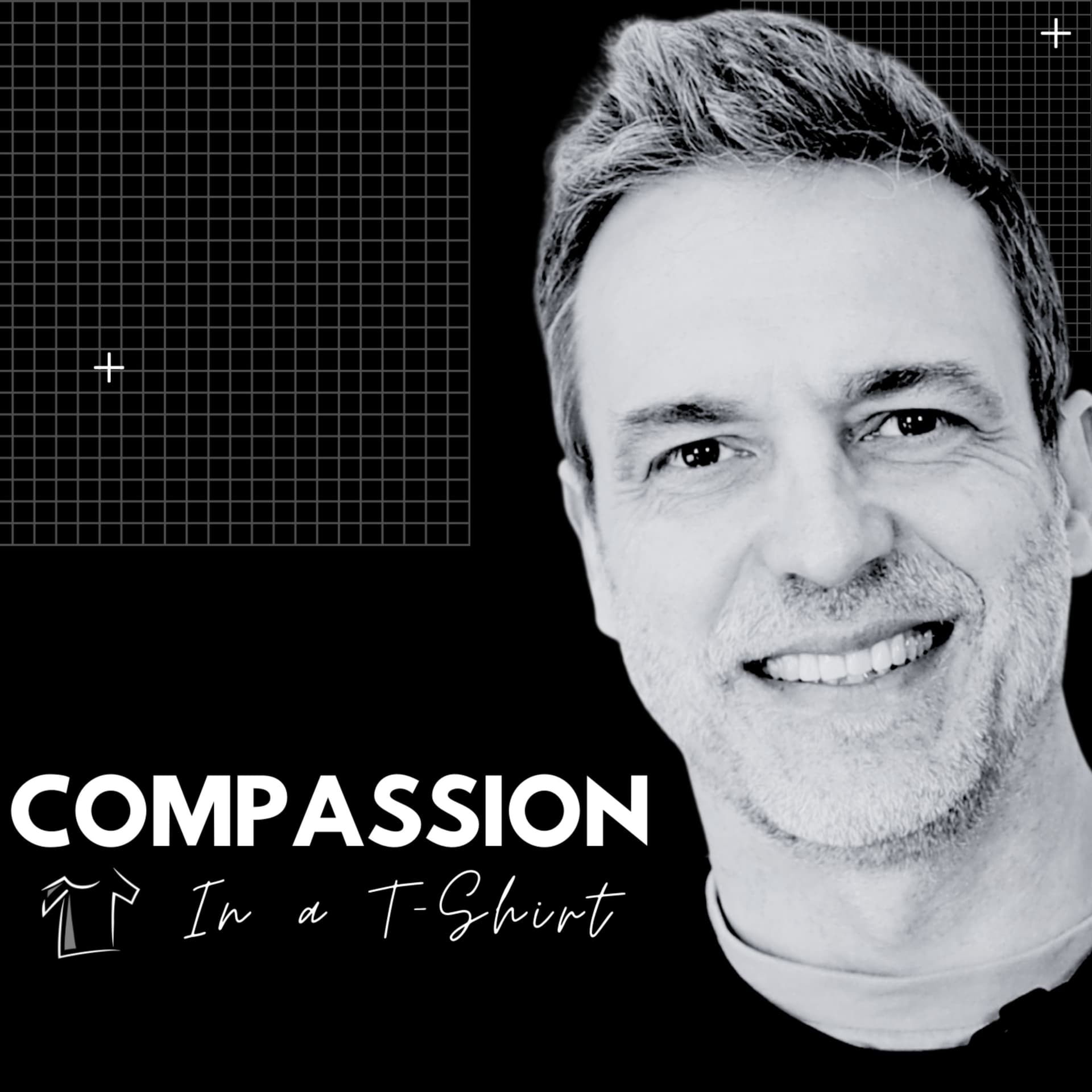
Podcast Summary: Compassion in a T-Shirt
Episode: How to Have Compassionate Conversations That Heal with Stephen Andrew
Host: Dr. Stan Steindl
Date: October 3, 2025
Overview of the Episode
This episode of Compassion in a T-Shirt features therapist, trainer, and storyteller Stephen Andrew, renowned for his dedication to compassion, particularly in his work with addiction, trauma, and recovery groups. The discussion dives into the art and science of truly compassionate conversations—what they look like, the inner skills required, and the healing power they hold. Stephen shares practical guidance, personal philosophy, and robust frameworks drawn from decades of helping others, all with humility and warmth.
Key Discussion Points & Insights
What Makes a Conversation Compassionate?
- Empathetic Understanding as Foundation:
- Compassionate conversation is rooted in the ability to regularly and skillfully offer deep empathetic understanding.
“If you're skillful at the ability to drop down into your heart and have a felt sense of what it must be like to be this person or this group... you offer that and they start to feel their nerve endings softening.” —Stephen Andrew [01:32]
- Compassionate conversation is rooted in the ability to regularly and skillfully offer deep empathetic understanding.
- Connection Over Prescription:
- Healing happens through relationship and connection, often more than through medication or advice.
- Compassion releases people from isolation by providing a safe, attuned relational experience.
The "Tai Chi of Empathy": Internal Process and Steps
- Five Steps for Compassionate Conversation:
- See the other—notice body language and non-verbal cues.
- Hear what they say—listen deeply, taking in both words and tone.
- Drop to the Heart—move the experience 12 inches from the ears to the heart (not up to the ego).
- Avoid reflexive statements ("I know exactly what you mean") and instead cultivate a felt sense.
- Offer a Gentle Guess—tentatively share what you sense about their thoughts or feelings.
“Empathy is a guess. If I was you, I would be thinking, that's a guess. If I was you, I would be feeling, that's a guess.” —Stephen Andrew [12:28]
- Watch for the Response—observe how your offering lands; adjust accordingly.
- This cycle repeats, making compassion a living, dynamic process.
“You see, you hear it, you drop it to the heart, get a felt sense. You offer that, and then you watch it, how it lands. And then you take in that, and then you go through it again...” —Stephen Andrew [07:12]
Radical Humility and "Disappearing"
- Practitioners must disentangle their own history, agenda, and ego from the interaction.
- The job is not to matter in that moment:
“I want to listen to you, experience you from a place of disappearance, that I don't matter. It's not a partnership. It's a place of radical humility.” —Stephen Andrew [06:05]
- Mistakes and misattunements are inevitable and essential; radical humility means being willing to be “wrong” at least 20% of the time.
The Role and Power of Presence
- Thomas Merton's notion: The greatest gift is your presence.
- Mindfulness and presence allow the helper to resonate with and acknowledge what is behind the words—e.g., the “tears behind the eyes.”
- The practice is continual; “some days I walk away going, that was not my best... but after 25 years of practicing, I’m so much better.” [16:22]
Compassion as "Sitting with Suffering"
- True compassion isn't rushing to alleviate pain—it’s the capacity to sit with it, respect its ownership, and not be exhausted by taking it on personally.
“The ability to sit with suffering—not to alleviate it, not to change it, just to be able to sit with it all the way to life and death.” —Stephen Andrew [18:52]
- The guiding principle:
“Be responsible for the intervention, not the outcome.” [20:11]
Trauma, Worth, and Healing
- Trauma often whispers “I don’t matter,” “I’m not lovable,” “The world is not to be trusted.”
- The antidote is relational:
“Wouldn't empathy, authenticity really change that?... If someone comes along, gently, genuinely says you matter, wouldn't that have to slow down?” [29:38]
- The ultimate goal is not just quieting pain, but to “dream out loud” again, restoring meaning and hope.
The Relational Dance of "I" and "You"
- Artful use of “I” statements (as a vehicle for resonance, not ego) deepens attunement and authenticity.
- “A genuine, gentle guess” (GGG) combines authenticity, gentle tone, and the humility of guessing, creating a powerful bridge.
Building Safety and Security
- Creating a gradual sense of security (as opposed to instant “safeness”) is at the helper’s initiative, through consistent, rhythmic compassion.
- Attachment Theory: Individuals with insecure attachment need a secure haven/base, which can be cultivated through compassionate, empathic community.
- Group settings amplify these benefits, spreading compassion “like wildfire.” [40:13]
Compassion Across Differences and Conflict
- Dealing with Disagreement:
- Clinging to “the right position” at the expense of relationship is destructive.
“If you hold the right position, you will destroy the relationship.” —Stephen Andrew [42:20]
- Instead:
- Lead with Empathy—seek to understand, especially amidst disagreement.
- Set Compassionate Boundaries—assert one's values or needs kindly.
- Offer Heartfelt Apologies—own and repair missteps without shame or blame.
- Silence and pausing are spiritual tools—allow internal whispers and hopes to surface; facilitate returning to empathy.
“Can I trust breath? ... And then a whisper starts to emerge.” [48:14] “Meet people where they dream, not just where they're at.” [51:40]
- Clinging to “the right position” at the expense of relationship is destructive.
Everyday Practice and Starting Points
- Frameworks and Rituals:
- Develop/choose a framework for empathy (books, listening, practices).
- Practice consciously, with the understanding that your “first thought is wrong,” dictated by history/ego—pause and let the heart speak.
- Mentorship and Group Practice:
- Find support groups or communities to practice compassion (as modeled in Stephen’s men’s groups).
- “Tai Chi of Empathy” as a Takeaway Process:
- See
- Hear
- Drop to Heart
- Offer
- Watch
- Repeat as needed for deepening attunement.
Notable Quotes & Memorable Moments
- On Empathy as Guessing:
“Empathy is merging into another person’s soul, then differentiating. Just like our breath: we breathe in and we exhale.” —Stephen Andrew [12:44]
- On Practice:
“Some days I walk away going... that was not my best. But after 25 years of practicing... people know it.” [17:33]
- On Relational Antidotes to Trauma:
“You matter, you are lovable, and the world can be trusted, at least between the two of us... Wouldn’t that cause a cognitive dissonance?” [29:48]
- On Disagreement:
“When I totally disagree... this will not change unless I can offer him empathy... If I can set compassionate boundaries and also do empathy, then I can meet any human being with any dilemma.” [43:07]
- On Silence:
“Can I trust breath?... A whisper starts to emerge. And that whisper will send me in a direction... back to empathy.” [48:14]
- On Practice for Beginners:
“Find your mentors who you trust... Get a framework, practice, find a place to practice, find a support group... I'm doing with 110 people. Practice, practice, practice.” [58:08]
- On the Essential Task:
“The purpose isn’t to quiet down the nerve endings. The purpose is to dream out loud.” —Stephen Andrew [30:51]
Timestamps for Key Segments
- [01:32] What makes a conversation compassionate?
- [04:06] The internal steps: The Tai Chi of empathy
- [10:24] Practice: Dropping from cognition to the heart
- [12:28] Humility, being willing to be “wrong”
- [18:52] Definition of compassion: Sitting with suffering
- [26:04] Deep reflection and attunement: the power of “I feel so alone”
- [29:38] The whipsers of trauma: “I don’t matter”, “I’m not lovable”, “The world is not to be trusted”
- [34:04] Building gradual security and group compassion
- [42:01] Compassion and disagreement; leading with empathy, boundaries, apology
- [48:03] Silence as a spiritual tool
- [56:31] Practical advice for starting: frameworks, rituals, practice
Conclusion
Stephen Andrew and Dr. Stan Steindl together model and demystify the practical steps for cultivating compassionate conversations that truly heal. Through humility, presence, authentic guessing, boundaries, and communal practice, anyone can begin to create secure, healing relationships—even amidst conflict and suffering. The “Tai Chi of empathy” offers both guideline and invitation for everyday action: see, hear, drop to heart, offer, and watch. In a world fraught with division and isolation, these invitations are more vital than ever.
