
Podcast
Connecting to Admired Leadership
Hosted by Admired Leadership · EN
Twice a month, we take 30 minutes to connect leaders to Admired Leadership® content and our Admired Leadership® coaches.
These sessions are specifically tailored for leaders who are craving universal, simple and actionable leadership content. Participants will leave the session with an understanding of Admired Leadership’s behavioral approach as well as valuable insights to implement immediately.
30episodes
Episodes
Newest firstAll episodes
The 5-3-1 Rule and Social Fitness
3w ago00:33:30Tap to summarizeRegister for future sessions here. Key Highlights Social fitness is a discipline, not a personality: Being good at relationships isn't something you're born with — it's something you practice. Treating it like physical fitness, with intention and consistency, is what separates leaders who build lasting influence from those who don't. The 5-3-1 rule: Five meaningful connections a week for breadth, three close relationships nurtured daily for depth, and one hour of quality conversation a day. The hardest — and most important — is the one. With prickly people, lead with curiosity: When warmth isn't being reciprocated, shift to genuine curiosity. Learn about the people, places, passions, and defining moments that shaped who they are. That's how connection starts. Influence breaks down in three places: The message, the style, or the relationship. When influence is off, one of those three is usually the culprit — and a transactional relationship is often the one leaders overlook. In efficiency-driven cultures, your discipline matters more: When the organization isn't reinforcing relationships, the accountability falls on you. Treat relational touchpoints as non-negotiables on your calendar — because canceling them sends a message too. Notable Quotes "The relationship is the conversation, and the conversation is the relationship." "If the relationship is hard, that means you're probably doing it right." "We have a strategy for pretty much everything else in business. Why not for relationships?" "It's not the system that undermines authenticity — it's the execution." "Your own personal discipline matters more in environments that don't support it — because the accountability is on you." Featured Speakers Mallory Stacey is a Managing Director in the Leadership Practice at CRA | Admired Leadership. Known for her rare ability to make people feel genuinely connected, Mallory brings both warmth and rigor to her coaching — and is a living example of what intentional relationship-building looks like in practice. Wes Bender serves as a facilitator and thought leadership coordinator at CRA | Admired Leadership, helping leaders connect great coaching conversations to the everyday moments that define their leadership. Resources Mentioned Field Note: The 5-3-1 Rule and Social Fitness
Transcribe →
The Difference Between Motivation and Inspiration and Why It Matters
4w ago00:30:22Tap to summarizeRegister for future sessions here. Key Highlights Motivation pushes, inspiration pulls: Motivation is an external driver — material reward, urgency, even fear. Inspiration is internal. It elevates people toward something they didn't think they could achieve and sustains performance long after external incentives run out. Inspiration is not a personality — it's a behavior: The most inspirational leaders have no common personality profile. What they share is intentionality. Everything that matters in leadership has to be deliberate. Trust is the foundation of every relationship: The degree of trust you have with someone is a function of your credibility, reliability, and relational depth — divided by your self-orientation. The more it's about you, the less trust you build. The best teams are player-led: The most dominant teams in sports history weren't led by the GOAT — they were led by someone in the jersey who held people accountable, inspired from within, and made the leader's role smaller over time. A leader's job is to make themselves obsolete: The goal is a team that moves toward the objective without waiting for permission. You get there by building people's capacity to decide and act — one conversation at a time. Notable Quotes "There are three buttons you should never push as a leader: snooze, panic, and easy." "The way to do hard things is actually pretty simple — just start doing hard things." "The only time you swim in somebody else's lane is when you're not swimming in the same direction." "Inspiration is not a personality. Everything you do as a leader that really matters has to be intentional." "The way we know we've succeeded as leaders — and as fathers — is when they say 'see ya' and they're gone and they don't need us." Featured Speakers Eric Springer is an Executive Coach at CRA | Admired Leadership with five years at the firm and 28 years of prior military service, retiring as a Colonel from the Air Force. A former Division I athlete, Eric brings a rare combination of operational discipline and genuine warmth to his coaching — and has a gift for making leadership principles land in both professional and personal life. Wes Bender serves as a facilitator and thought leadership coordinator at CRA | Admired Leadership, helping leaders connect great coaching conversations to the everyday moments that define their leadership. Resources Mentioned Field Note: The Difference Between Motivation and Inspiration and Why It Matters
Transcribe →
At the Intersection of AI, Leadership & Communication
Jun 2601:01:23Tap to summarizeRegister for future sessions hereKey Highlights Good coaching is advisory, not just reflective: The most effective coaching doesn't just ask questions and hold up a mirror — it tells you what to do. Specific, behavioral recommendations are what actually move people forward. ALEX knows things other AI tools don't: Built on 2 million words of proprietary CRA | Admired Leadership content, ALEX surfaces specialized knowledge on topics like communicating change, conflict management, message design, board dynamics, and motivation — knowledge that generic AI simply doesn't have. Deployment strategy determines adoption: Organizations that hand ALEX to everyone at once see the same low uptake as any unsolicited software rollout. The ones seeing 80% engagement start with their most enthusiastic users and let adoption spread laterally from there. AI is creating a skills erosion problem nobody is talking about: When AI handles the hard work, people stop developing the judgment and pattern recognition that comes from doing it themselves. Leaders need to be deliberate about which skills require ongoing reps — and protect those. The future of talent development is apprenticeship: As AI takes on more of the work, on-the-job learning through doing is no longer enough. Leaders will need to think of themselves as mentors to apprentices — and most organizations aren't built for that yet. Notable Quotes "AI won't replace you. The person using AI better than you will replace you." "Alex doesn't have true conviction. It does not truly care about you. It may act like it cares about you — but it is not laying awake at night thinking about you." "Engage Alex on your hardest problems. It will quickly tell you when it's out of its depth." "If AI is making the decisions you otherwise would make, those are decisions you have never made — and it slows down how much you develop expertise." "You can't scale me to 7,000 people. That's where there's power in a solution like this." Featured Speakers Alan Nelson is Co-Managing Partner at CRA | Admired Leadership, with over 30 years advising some of the most consequential leaders and organizations in the world — from Fortune 500 companies to multilateral institutions like the World Bank and IMF. A key architect of ALEX and a licensed pilot, Alan brings the same precision to leadership development that he brings to everything else: specific, behavioral, and grounded in 40 years of what actually works. Wes Bender serves as a facilitator and thought leadership coordinator at CRA | Admired Leadership, helping leaders connect great coaching conversations to the everyday moments that define their leadership.
Transcribe →
Delivering a Tough Message in the First Two Sentences
Jun 1600:30:55Tap to summarizeRegister for future sessions here Key Highlights Not all tough messages are the same: Performance conversations, unwanted decisions, and feedback delivered upward each carry different dynamics and require different preparation — knowing which type you're in shapes how you approach it Avoidance is a leadership problem first: When leaders delay or soften tough messages, they're not protecting the relationship — they're eroding it, and everyone around them notices The breadcrumb drop: The best leaders prime the conversation before it happens — a simple heads-up that you want to discuss something gives the other person time to prepare emotionally, so they don't feel blindsided or ambushed Don't bury the lead: Loading a tough message with context and excuses before delivering it actually undermines the feedback — by the time it lands, the other person has already been handed a justification for their behavior Reframe confrontation as care: The leaders who are best at this have stopped thinking of feedback as something they do to someone and started thinking of it as something they do for someone — clarity is an act of respect Notable Quotes "Clarity is really an act of care — being able to deliver a message cleanly, directly, with genuine compassion is more respectful to the other person." "People can smell intent from a mile away — if I'm smelling intent that's like, this person just wants me to feel bad, I'm gonna show up in that conversation differently." "The first time they give the feedback is the first time they've heard it out loud themselves." "You're hurting their feelings if you're not giving them feedback." "The only way you get better at this sort of thing is by actually doing it — it may not always feel good, but that's how you become a master at it." Featured Speakers Katie Angstadt is a Partner at CRA | Admired Leadership, specializing in executive coaching and strategic communications. With 18 years at the firm, she brings deep experience advising senior leaders across industries on some of their most consequential conversations — including the ones they've been putting off. Katie used Alex to prepare for this very session, pressure-testing her thinking and making sure she wasn't leaving anything on the table. Wes Bender serves as a facilitator and thought leadership coordinator at CRA | Admired Leadership, helping leaders connect the dots between great coaching conversations and the everyday moments that define their leadership. Resources Mentioned Field Note: "Deliver a Tough Message in the First Two Sentences"
Transcribe →
False Harmony in Teams
May 1900:31:15Tap to summarizeRegister for future sessions here Key Highlights The truth-harmony spectrum: Teams and cultures exist on a spectrum from "truth over harmony" (direct, sometimes blunt) to "harmony over truth" (smooth on the surface, but real concerns get pushed underground and into back channels) - the goal is neither extreme, but leaders need to know where their team sits False harmony is a leadership problem first: Passive aggressiveness and false harmony exist because people have calculated that the cost of honest challenge is too high - leaders who react hard to pushback are often the ones creating the conditions for silence The parking lot test: After a meeting, watch how many side conversations start in the hallway or parking lot - those conversations are the real meeting, and they're a reliable barometer of how much false harmony exists in the room Relationships die in the silence: False harmony at its extreme is polite nodding followed by silence - and that silence is where trust erodes, because there's nothing being worked on together, committed to, or followed through on Depersonalize conflict to make honesty safer: Structured exercises like risk assessments and "fast forward to failure" reframes give people permission to raise concerns without it feeling like a personal attack on the leader or the idea Notable Quotes "Passive aggressiveness happens when people say the cost of a direct challenge is too high. So it just leaks in these very unproductive ways." "Relationships die in the silence. False harmony at its extreme is a lot of polite yes, and then silence - and that's where trust and relationship die off." "False harmony is short-term easy, but long-term headache. Someone nods, agrees, fine - but inevitably that always bites us afterwards." "I think about the first thing I want to say, and I don't say it. I think about the second thing, and I don't say it. I think about the third thing - and maybe I say that." (comedian's secret to a 50-year marriage) "Weak leaders prefer the silence." - Admired Leadership Field Note Featured Speakers Diana Hong is a Partner at CRA | Admired Leadership, specializing in strategic communications and leadership advisory. With over 20 years of experience advising senior leaders through major organizational changes, she brings equal parts warmth, humor, and sharp analytical thinking to every engagement. Known for her ability to turn a room from tense to laughing and back again, she uses Alex daily to pressure-test her coaching by asking it to play her worst critic, her toughest team member, or an outside observer with no context. Wes Bender serves as a facilitator and thought leadership coordinator at CRA | Admired Leadership, joining from the road between his nephew's graduation in Chattanooga and an on-location event in Miami - navigating graduation season with five family graduates across high school, college, and a master's degree. Resources Mentioned Field Note: "False Harmony in Teams"
Transcribe →
The Three Signals Every Message Sends
May 800:31:15Tap to summarizeRegister for future sessions here Key Highlights The three signals framework: Every message - every email, meeting, hallway conversation - is simultaneously advancing a task, projecting an identity (how do I want to be seen?), and signaling something about the relationship (how do I see this person?) whether you intend it to or not Three types of communicators: Expressive communicators react and say what they feel (authentic but full of accidental signals); conventional communicators follow scripts and norms; strategic communicators design - they ask "what am I actually trying to accomplish here?" and think about all three signals The 2008 auto CEO bailout: A masterclass in what happens when leaders nail the task signal but ignore identity and relationship - flying private jets to ask for a government bailout sent signals of disconnection and entitlement that nearly derailed the entire effort, regardless of intent Channel matters as much as message: Different channels suppress different signals - email is efficient for task but strips out relationship entirely, leaving people to fill in tone with the worst possible interpretation; strategic communicators ask which medium will actually carry the signals they intend The accidental vs. intentional leader: The accidental leader asks "what do I need them to do?" The intentional leader also asks "how do I want to be seen?" and "what do I want this message to say about how I see this person?" - going beyond task to design identity and relationship signals deliberately Notable Quotes "Communication is never just information transfer. Every message is doing three things at once - advancing a task, projecting an identity, and signaling something about the relationship - whether you're aware of it or not." "A strategic communicator can turn a birthday party into a funeral, and a funeral into a birthday party - because they're aware of the situation and know how to use communication to drive outcomes." "The intention is beside the point. The signals landed anyway, and it nearly derailed the entire effort." (on the auto CEO bailout) "Email strips out the relationship signal entirely. Because they can't see your tone, they're often filling it with the worst possible interpretation of what you truly mean." "The other two signals aren't disappearing - they're just going unmanaged. That's what we want leaders to focus on: how are you being intentional about all three?" Featured Speakers Jordyn Kreshover is a Managing Director at CRA | Admired Leadership, specializing in strategic communication, organizational change, and leadership visibility. With nearly a decade advising senior leaders at some of the world's most recognizable companies, she helps leaders use communication as a lever to drive outcomes - whether launching a new strategy, leading through change, or building deeper connection with their teams. Wes Bender serves as a facilitator and thought leadership coordinator at CRA | Admired Leadership, helping to connect practical leadership insights with real-world application through webinars and educational content. Resources Mentioned Field Note: "How Others Are Interpreting What You Say and Do"
Transcribe →
Allocate Time in Each Day for Both Strategic & Tactical Work
Apr 2400:30:41Tap to summarizeRegister here for future sessions Key Highlights Tactical vs. strategic defined simply: Tactical is "do and delegate" - executing and getting things done; strategic is "design and discern" - designing how the organization works and looking farther down the field to determine how to win Why tactical wins every time: Tactical work is urgent, visible, and on fire - inboxes, texts, and project management systems are "fancy ways for people to put things on your to-do list without your permission," creating a constant magnetic pull away from strategic thinking Four disciplines for protecting strategic time: Use forcing mechanisms (like Reclaim.ai), build strategic thinking into recurring meetings as a consistent agenda item, leverage relationships and ongoing conversations to keep strategy alive, and find your personal best environment for strategic thinking Delegation as a strategic tool: Assign strategic thinking work to team members as a development opportunity - it creates a forcing mechanism for you while growing their capability, and prevents the stagnation that happens when leaders hold onto everything The compounding effect: Just as financial discipline of saving first pays off exponentially, 30 minutes of daily strategic thinking compounds dramatically - the leaders who do this consistently are the ones who orient to shore while others swim hard in the wrong direction Notable Quotes "Management is doing things right. Leadership is doing the right things." - Peter Drucker (quoted in Field Note) "Inboxes, texts, chats, project management systems are fancy ways for people to put things on your to-do list without your permission." "What got you here won't get you there as a leader. You have to recognize a massive context shift from mainly tactical work to the design and discerning work of strategy." "If you're excellent at something but it drains the living daylights out of you, delegate it - so you can focus on the things you're excellent at that actually energize you. That's where you have real impact." "Think about a swimmer out at sea. Every now and then you've got to pick yourself up and orient to shore - am I heading the right direction? If you don't do that, you may have the greatest tactical work in the world and be miles off course." Featured Speakers John Schoew (pronounced "Shay") is a Managing Director and Senior Executive Coach at CRA | Admired Leadership, bringing a unique combination of corporate strategy expertise and executive coaching to his work with leaders. A former partner at Accenture with experience spanning Fortune 500 companies, government, and the Middle East, he specializes in helping leaders make the critical shift from tactical excellence to strategic leadership. A self-described ADHD thinker who does his best strategic work while driving, he uses Alex daily as a thought partner and voice-records insights to process later with AI. Wes Bender serves as a facilitator and thought leadership coordinator at CRA | Admired Leadership, helping to connect practical leadership insights with real-world application through webinars and educational content. Resources Mentioned Field Note: "Strategic vs. Tactical Thinking" (featuring Peter Drucker quote)
Transcribe →
The Humility Myth
Apr 700:28:11Tap to summarizeRegister for future sessions here Key Highlights The humility myth debunked: Humility is not about retreating, withdrawing, or diminishing yourself - it's an active behavior of putting others higher, not putting yourself lower Selfless self-promotion: You can still be proud and confident while expressing humility - shift from singular to inclusive pronouns, frame success around organizational impact, and highlight what you learned in the process Extend credit in the widest sphere possible: Don't just credit the most visible contributors - look for ways to shine a light on those with first, second, and tertiary connections to the work The compounding effect: What feels like a short-term cost of humility becomes a long-term reputation as someone who scales impact and cultivates excellence in others - it bounces back and reflects on you AI amplifies the need for humility: As AI democratizes capability and knowledge, what differentiates leaders will increasingly be uniquely human qualities - those who acknowledge AI's capabilities while shining a light on others' unique human contributions will stand out Notable Quotes "Humility is not thinking less of yourself - it's thinking of yourself less." - Rick Warren "Being humble means recognizing that we are not on earth to see how important we can become, but to see how much difference we can make in the lives of others." - Theologian quoted in Field Note "You don't have to put yourself back in order to push someone forward. Both of those things can be true at the same time." "If I only extend credit in those instances where I'm expecting a really high return, that feels transactional. In order for humility to be credible, it needs to be demonstrated consistently." "We can drive way more impact when we're moving others and amplifying others to be their most successful - we only get a one-to-one return when we do that on ourselves." Featured Speakers Ben Stringfellow is an Executive Coach and Partner at CRA | Admired Leadership, known for his ability to turn either-or conversations into both-and conversations and his talent for making complex leadership concepts immediately actionable. A passionate advocate for the behavioral view of leadership development, he uses Alex daily as an "intentional contrarian" - asking it to prove him wrong and push his thinking in new directions. His coaching approach is grounded in the belief that leadership is simply making people and situations better. Wes Bender serves as a facilitator and thought leadership coordinator at CRA | Admired Leadership, helping to connect practical leadership insights with real-world application through webinars and educational content. Resources Mentioned Field Note: "The Humility Myth"
Transcribe →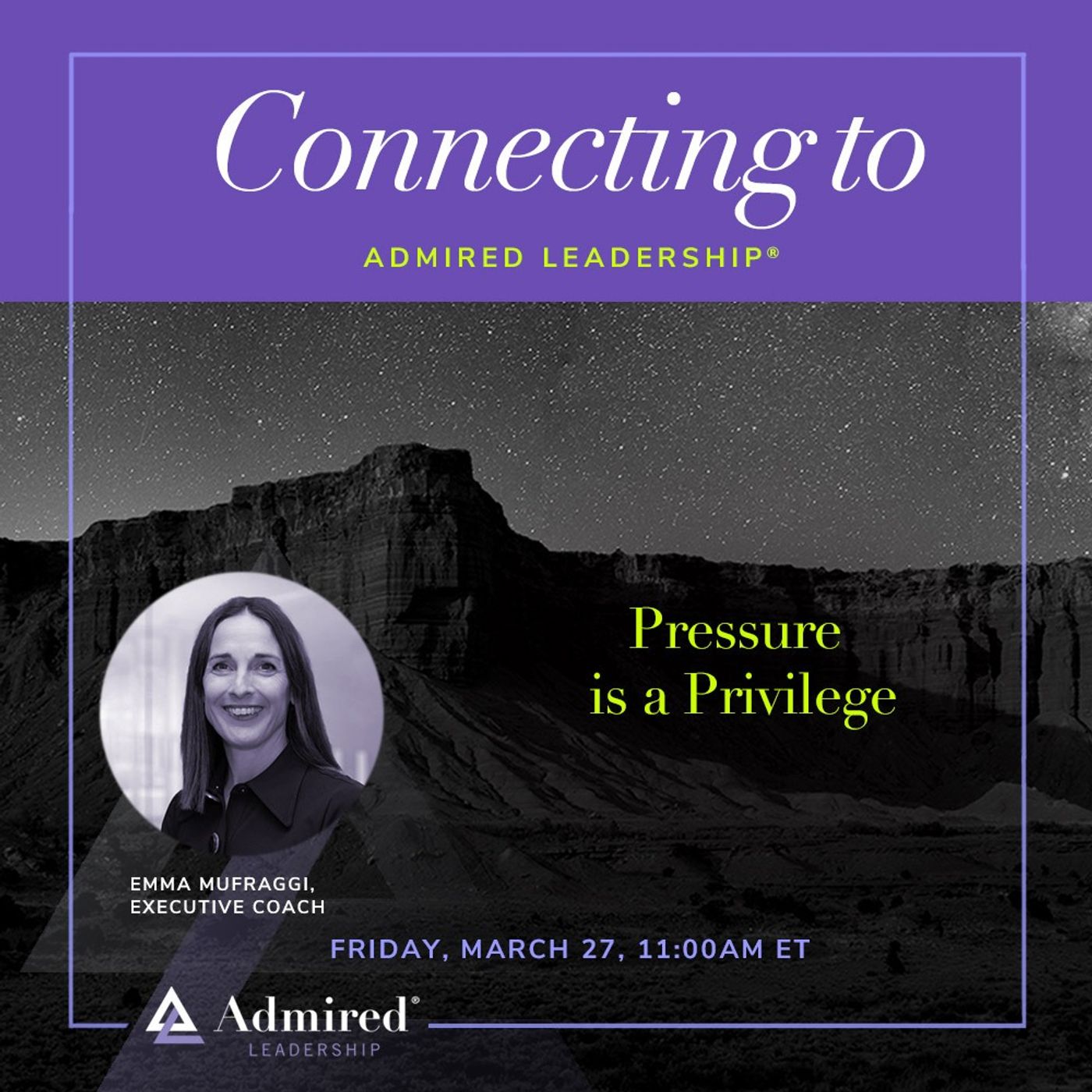
Pressure is a Privilege
Mar 2700:32:13Tap to summarizeRegister for future sessions here Key Highlights The origin of "pressure is a privilege": Billie Jean King coined the phrase spontaneously in 2000 when Lindsay Davenport was "freaking out" before facing a nemesis - but the full quote is critical: "Pressure is a privilege, and champions adjust" Your body isn't betraying you: Clammy hands, racing heart, breathlessness - these physiological signals mean your body is preparing you for high performance, not warning you to retreat The 30-second pre-routine: Recognize your personal pressure signal, label it ("I feel this because it matters and I'm ready"), then control your pace of breath, voice, and movement to project composure Specificity over intensity: When communicating pressure to teams, don't rise with rousing speeches - be very specific: "We need to focus on these 3 things for the next 3 weeks" moves people to action rather than panic Protect your bandwidth: Build a "to don't do" list before high-pressure days - pre-decide what to wear, eat, and your one non-negotiable outcome to preserve cognitive capacity for consequential decisions Notable Quotes "Pressure is a privilege, and champions adjust." - Billie Jean King, 2000 Fed Cup locker room "The physiological response is actually a signal. Our body is not betraying us - it's preparing us for high performance, preparing us to meet the moment we're uniquely equipped for." "Great leaders don't feel pressure less. They just meet it slightly differently, from a place of resourcefulness because they're uniquely equipped to tackle that moment." "When pressure hits, label it: I'm feeling this because it matters, because I care, and I'm ready. That creates distance from the idea of a threat to considering it as a challenge." "I'm here because my experience, my relationships, the hard moments I've passed have equipped me to meet this moment. That's the piece that allows you to meet pressure as a privilege." Featured Speakers Emma Mufraggi is an Executive Coach at CRA | Admired Leadership who has led executives across Europe, Latin America, and North America through their most challenging moments. Joining from France, she brings deep expertise in sports psychology, high-performance coaching, and the practical disciplines that separate leaders who thrive under pressure from those who are overwhelmed by it. A practitioner of everything she teaches, she bookends every day with time outside as her non-negotiable recovery routine - a habit born during COVID that has become a cornerstone of her own high performance. Wes Bender serves as a facilitator and thought leadership coordinator at CRA | Admired Leadership, helping to connect practical leadership insights with real-world application through webinars and educational content. A father of an 18-year-old heading to college who experienced his first genuine "pressure as privilege" moment the morning of this very webinar - his 50th - thanks to coaching from Emma the day before. Resources Mentioned Field Note: "Pressure is a Privilege"
Transcribe →
Learn to Speak in Headlines
Mar 1700:29:32Tap to summarizeRegister for future sessions here Key Highlights Excellence vs. expertise: Leaders don't struggle with what to say, they struggle with how to say it concisely - leading with all your expertise actually works against you by muddying the water The three-question framework: Every headline should answer - What is this really about? Why does it matter? What do I need from you? - in just a few sentences without data or slides Headlines as frames, not reveals: Don't save your recommendation for the end of a presentation - start with the headline to frame what's inside the box you want to discuss, then invite questions Brief, brilliant, be gone: When 30 minutes gets squashed to 5, leaders who start with headlines can adapt instantly while those who planned to build to a reveal get flustered and lose credibility Daily practice builds the muscle: Watch a show and summarize the headline, read articles and improve their headlines, or prepare morning coffee headlines about your work - ritual repetition makes headline thinking automatic Notable Quotes "People follow leaders who create clarity, and headlines create that clarity. We're going to help you tell people what matters, why it matters to them, and how they should understand the conversation." "If you can't get to the headline within just a few sentences, then you probably aren't prepared as you need to be." "The ability to be concise and clear and focused is really a credibility marker and allows us to be heard more effectively, particularly with senior audiences." "We want to make sure that when we're talking to people, we're really crystallizing what those headlines are. The interesting information will muddy the water for us." "Communication is about an interaction, not just a one-way message. Message sent is not message received." Featured Speakers Kristen Fenty is a Managing Director at CRA | Admired Leadership, specializing in coaching and advising leaders on strategic communication, particularly during high-stakes organizational change including new strategies, technologies, mergers, acquisitions, and layoffs. With extensive global experience recently spanning Mexico and India, she helps leaders cut through complexity to create clarity in moments of maximum anxiety and ambiguity. Wes Bender serves as a facilitator and thought leadership coordinator at CRA | Admired Leadership, helping to connect practical leadership insights with real-world application through webinars and educational content.
Transcribe →